


The Code of Falling Apples
Can a man who has spent his whole career measuring the world in violations learn to love a woman who plants hope in every empty lot? That is the question this story answers, one adopted apple tree at a time.
Chapter One: The Citation
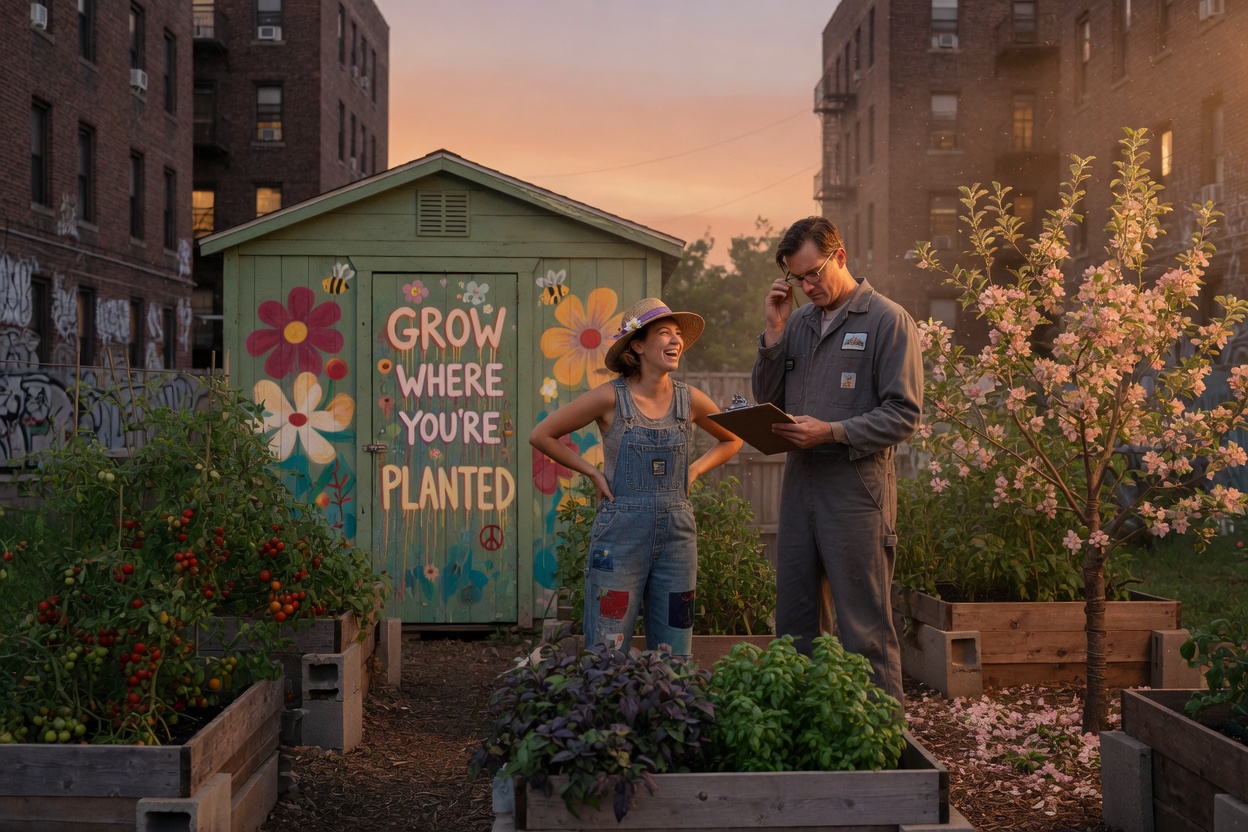
Tobias Wren had written four hundred and eleven citations in his career as a municipal code inspector, and he had never once enjoyed any of them. He did not expect to enjoy number four hundred and twelve, which concerned an unpermitted structure at the corner of Delancey and Seventh, a wooden shed of disputed vintage, and what his Preliminary Observation Form described, in his dry pencil hand, as agricultural clutter in a commercial-adjacent zone.
What he had not put on the form, because there was no checkbox for it, was the smell. Warm tomatoes. Wet basil. The green, sweet, slightly chaotic smell of a place that did not know it was losing.
He had a procedure for sites like this. Arrive early. Photograph everything before anyone could arrange anything. Make no eye contact until the paperwork was fully in hand. Tobias had learned the hard way that sympathy was a liability, that kindness on a job site was a door people would walk through and never leave, and that the safest way to exist inside a city of eight million people was to be efficient, correct, and slightly boring. He had the personality for it. People told him so. Often. Sometimes to his face.
He was crouched at the base of the offending shed, measuring its eave with a folding ruler, when a voice above him said, You know, most people at least say hello to a tomato before they commit it to paper.
He looked up. A woman stood between the raised beds holding a watering can, wearing mud-flecked canvas shoes, denim overalls rolled at the ankle, and a hat that had once, in some earlier decade, belonged to a much more confident straw hat. She was perhaps thirty, brown-eyed, sun-warmed, and smiling at him the way people smile at weather they have decided to enjoy anyway.
Im not here for the tomatoes, Tobias said.
Thats a shame. Theyre wonderful listeners. Im Poppy Alvarez. I run this place. Which apparently makes me the criminal element.
Youre not criminal. Yet. Tobias stood, brushed off his knee, and held up the citation with the efficient, joyless flick of a man dealing cards at a very serious casino. This is a preliminary notice of violation. The shed does not conform to zoning. Neither does the fence, the signage, or the compost arrangement, which I am legally obligated to describe as a nuisance odor vector.
The compost smells like victory, Poppy said, taking the paper. She read it fast, front and back, and her smile dimmed by one careful degree, which told Tobias she understood exactly what she was reading, which was rare, and which made his chest do a small unwelcome thing. Thirty days to remediate, she said. Or demolish.
Or, Tobias said, file an appeal.
Is that a real door or a painted-on door?
Its real. He was already packing his ruler. Its also hard, slow, and the success rate last year was eleven percent.
So what youre saying, she said, falling into step beside him as he headed for the gate, is that you came here on a beautiful Tuesday morning to kill an apple tree.
The tree is a separate issue. Unregistered plantings on public right of way.
Her whole face did something he could not citation. That tree is registered, she said. And its a birthday gift. And its name is Dorothy.
Tobias got into his city-issued hatchback and sat with his hands on the wheel for a full ninety seconds before driving, which for him constituted a crisis.
Chapter Two: A Man of Reasonable Approximations
Tobias lived alone in a one-bedroom apartment where the books were alphabetized, the mugs faced the same direction, and the only living thing was a serrated herb plant he had reluctantly agreed to water for a neighbor who then, inconveniently, moved to Phoenix and stopped answering texts. Tobias kept watering it anyway. He told himself it was about follow-through, not attachment.
There were reasons he was the way he was, and he kept them in the well-organized part of his brain that also stored his grandmothers phone number, disconnected now for six years, and the memory of standing in a hearing room at thirty-one years old while a developer he had trusted explained, very reasonably, that the project Tobias had signed off on included some cost-saving measures Tobias had not approved. Tobias had lost the job, nearly lost the license, and entirely lost the belief that his judgment about people was worth anything. He had rebuilt the first two. He had learned to live without the third.
Rules were better than people. Rules did not have cost-saving measures. Rules never smiled at you over a watering can and made you want to go back to a garden you were legally obligated to be hostile toward.
On Thursday, under the section of the checklist labeled verification of prior correspondence, Tobias found a letter in the file that changed his week. The garden had an appeal history. Three years ago, a nearly identical citation had been filed, appealed, and dismissed, on the basis of a documented legacy-use exemption, signed by a hearing officer named Okonkwo, who Tobias knew had retired two years ago, taking his memory of that ruling with him into an ocean of retirement and an address Tobias could not access.
Someone at the garden had known this. Someone had assembled a binder. Someone had, with a三条-ring binder of older, yellowing manila taste, done the work.
He drove back to Delancey and Seventh on his lunch hour, which was not a thing Tobias did, and found Poppy kneeling in the dirt introducing a group of second graders to a worm bin. She waved him over without standing up. Inspector Wren! Kids, this is the man who wants to demolish our shed. Say a polite hello anyway. Thats the deal with inspector people.
Hello, Inspector, said nine children in the flat chorus of the professionally uninspired.
Hello, Tobias said gravely, and one little girl looked up at him with sudden, devastating interest. Do you have a cufflink of authority?
I have a folding ruler.
Can I see it.
He handed it over. The girl measured a carrot. Tobias watched Poppy negotiate a turn-sharing system with the seriousness of a treaty, and something in his ribcage loosened by a screw.
The binder, he said, once the children were herded off. The legacy-use appeal. Who compiled it?
Me. And before you ask, yes, Okonkwo signed it, no, I did not forge anything, and no, I do not have his home address because I asked and he said he was retired, not dead, and moved onto a houseboat with a woman named Carla. He was extremely smug about it.
Legacy-use exemptions lapse if the underlying use is discontinued for more than one consecutive year, Tobias said. Was the garden ever dormant?
Poppy stopped smiling. It was, he would later reflect, like watching a lamp turn off, and he understood immediately that he had asked the one wrong question on purpose and there was a story underneath it with sharp edges.
Six weeks in the winter of my mothers last year, she said, evenly. We shut it down while I sat in a hospital. If you count those six weeks, the exemption dies. I know exactly what the regulation says. I have it highlighted. I have thought about it every night for three years.
Tobias stood in a garden he was there to destroy and did something he never did, which was to speak before checking. Then we count in my favor to make sure nobody ever counts it against you, he said.
Poppy stared at him. Was that. She narrowed her eyes. Was that an act of solidarity from a municipal employee?
No, Tobias said, recovering immediately. It was an observation about documentation strategy. Do not quote me.
Too late. Im building a shrine. Its going next to the worm bin. Youve met the worm bin, you know how beloved youll be there.
Chapter Three: The Hearing Calendar
The appeal was scheduled for a Tuesday in November, which meant Tobias had six weeks of pre-hearing processing to administer, and six weeks of Tuesdays on which Poppy Alvarez texted him photographs.
It started innocently, by which he meant it started with her having his number because it was printed on the citation. The first photo was of Dorothy the apple tree, captioned: she fruited late this year, four apples, we are so proud. Tobias responded with a single thumbs-up reaction and then, after internal debate lasting eleven minutes, a follow-up text reading: apples on ornamental rootstock are usually good for two or three seasons only. That tree looks like standard stock. It could fruit for forty years.
Poppy replied in nine seconds: did you just give my tree a good prognosis??
I gave the tree a prognosis, Tobias typed. I cannot speak to your sentimental application of it.
You absolutely can. Doctors do it all the time. Its called beside manner and you are developing one like a baby tooth.
The photos continued. The worm bin after a rain. A mural of garden members painted on the shed by a local artist, each face recognizable, including, in the corner with an unflattering amount of straw hat, Poppy herself. A photo of the fourth apple, alone on a plate, labeled Tobiass apple, which is legally yours now, you inspected it, its citizen number four hundred and twelve.
Tobias did not reply to that one. He printed it, which was worse, and put it in a folder on his desk which he labeled, with great care, evidence, and which contained nothing else for six weeks.
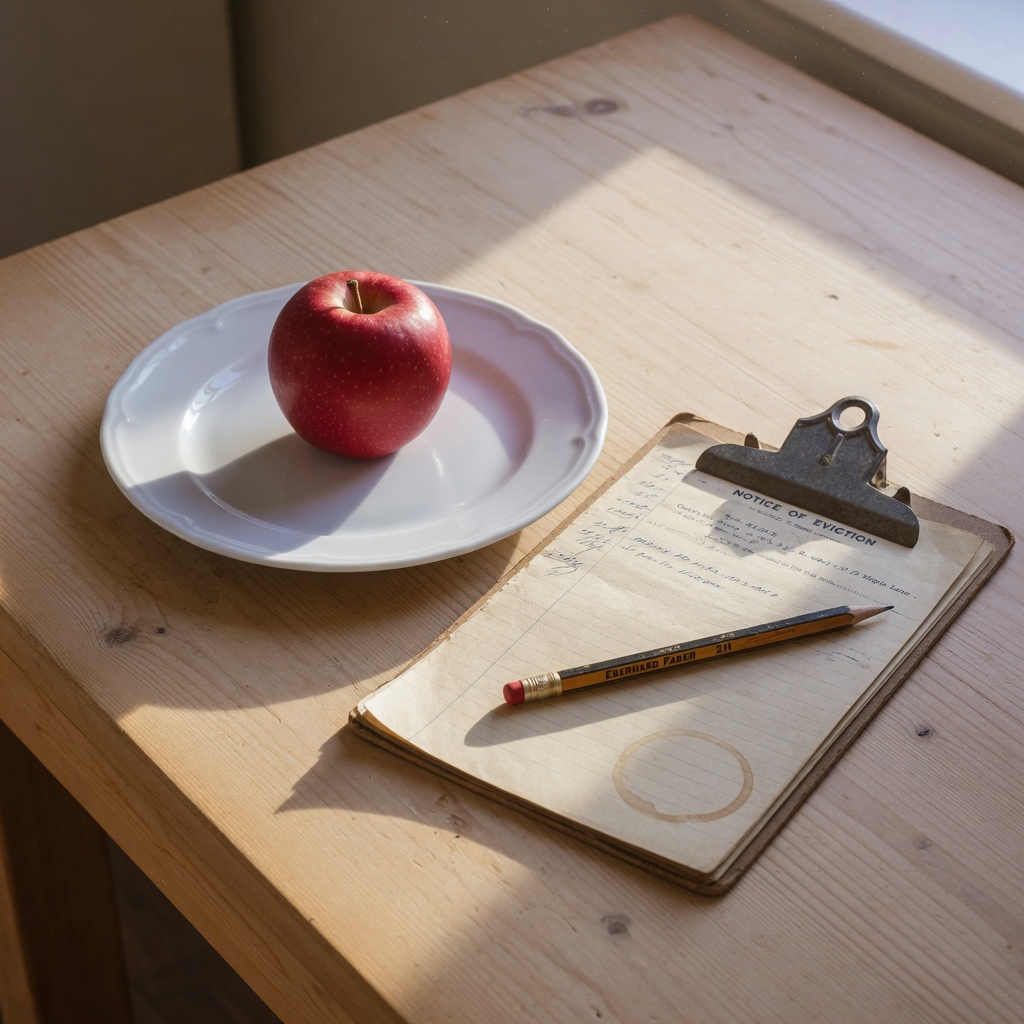
Meanwhile he worked. Tobias knew how hearings worked, and he knew the particular subculture of the zoning board, and he knew that eleven percent became much higher when the paperwork was not merely correct but armored. He spent two weekends, which surprised him more than it surprised anyone, drafting the gardens appeal filing the way he would have drafted his own. Exhibit A, the legacy-use ruling. Exhibit B, the continuity plan, which he made Poppy reconstruct from the shut-down weeks, proving use had never been abandoned because Poppy had driven past every day and a neighbor had kept the water main key. Exhibit C, which was his masterstroke and the thing he would not say out loud for another month: a stormwater retention analysis showing that the gardens unpaved soil absorbed, per year, roughly nine thousand gallons of runoff that would otherwise hit the city drains, a public benefit worth more than the shed.
Where did you learn to do that, Poppy asked, when he handed her the draft at the garden, late afternoon, the light going gold.
Civil engineering degree, one semester short, before I. He stopped. Before things. I worked in land development for six years after. You learn what arguments win.
You were almost an engineer and now you measure sheds with a folding ruler.
The sheds deserve precision too, he said, and Poppy laughed, and Tobias noted with clinical detachment that he had made her laugh and that the sound had entered his nervous system and was not leaving.
Im sorry, she said, quieter. About the stopped sentence. You dont have to finish it.
Someone I trusted used my signature on things I didnt sign. Tobias kept his eyes on the shed, which was a good structure, joinery above average. I reported it. It cost me eighteen months of my life and most of my belief in reading people. Now I read regulations. Regulations stay where I put them.
Poppy was quiet for a moment. My mother started this garden, she said. She got sick the same year the city started circling. I promised her I would keep it alive, and then I spent a year discovering that a promise is not a plan, and plans cost money, and grief does not come with a grant application. So I ran this place on volunteer shifts and stubbornness, and every time someone from the city showed up I smiled at them until they left, because I learned that people will fight a smile the way they fight weather. And it worked. Except you keep coming back.
Thats called pre-hearing compliance monitoring, Tobias said.
Thats called Tuesdays, she said.
Chapter Four: The Spine
The week before the hearing, a developer named Harlan Cotter came to the garden. Tobias learned about it because Poppy called him, not at work, which she never did, but to the number Tobias had, at some point without noticing, given her, the personal one, scrawled on the back of the apple photograph like a teenager.
Cotter Development made an offer, she said. Her voice was doing something strange, bright and brittle at once. One point nine million for the lot. Relocation assistance. A naming plaque in the new building lobby. The Wren Alvarez Community Terrace. Im assuming he got your first name off the filing, which means, Tobias, that the man looked up your whole life to flatter my whole life, and I hate it, and also I have to tell you because you are on that filing.
You said no, Tobias said. Not asked. Said.
Of course I said no, she said, and then, smaller: I said no slowly, though. He left the folder. Tobias, the plaque would have my mothers name on a wall that isnt being torn up and dumped on. The money is real. The garden could be reborn somewhere else, somewhere with parking and an irrigation system and a tap that doesnt freeze in January. For about four minutes I wanted it. I want you to know that. I am not a cartoon. I stood in my own garden holding a bribe and I wanted it for four minutes.
How long have the four minutes been, Tobias asked.
Three days, she said, and started laughing in a way that had tears right behind it.
Then the four minutes are over, he said. Come to the hearing Tuesday. Cotter will attend. Developers always attend dismissals in person when the property matters. He will do a thing where he thanks the board for their service. Count his blinks.
Count his blinks?
Nervous liars blink, Tobias said. I cannot legally testify to character. You can. Bring the truth and a feeling.
On Tuesday, Poppy Alvarez wore her mothers straw hat into a government hearing room and did not take it off when a clerk frowned at her. She spoke for six minutes without notes. She talked about soil that three hundred neighbors had built with their own compost, about a rain barrel that had failed and been fixed by a fourteen-year-old who now studied hydrology at City College, about a tree named Dorothy planted the week her mother finished chemotherapy the first time, because her mother had said, plant something that outlives the news. She did not cry. She did raise her chin one degree when she got to the six hospital weeks and say, with a flatness Tobias recognized from his own mirror, you may count those six weeks against me if you need a technicality. I counted them against myself every day. I have earned the right to say the garden was never abandoned. I was. For six weeks. And I came back.
Harlan Cotter thanked the board for their service. Tobias counted eleven blinks per minute, double baseline.
The board dismissed the violation and confirmed the exemption, four to one, and the one dissenter was overruled before his coffee cooled. In the hallway afterward, Poppy grabbed Tobias by the sleeve of his gray jacket, the first time she had ever touched him with intent, and said, I need you to know that was the hardest thing I have done since the hospital, and I could not have done it without Exhibit C, which is the most unsexy sentence I have ever said to a man I am possibly falling in love with, and I would like to retract nothing except maybe the word possibly.
Tobias stood very still. The hallway of the municipal building smelled like floor wax and had four hundred and twelve ceiling tiles, he knew, he had counted them once during a bad year. Let me revise one thing, he said. It was not Exhibit C.
It was absolutely Exhibit C.
It was you, Tobias said, with thedifficulty of a man pronouncing a foreign language he had been studying in secret for six weeks. It was always going to be you. Exhibit C just gave the room permission to notice.
Then they stood there, in the floor-wax hallway, smiling at each other like two people at a bus stop whose bus is never coming because they no longer need it.
Chapter Five: The Soft Reveal
Tobias came to the garden the following Saturday not as an inspector, having formally recused himself, a document he was low-key proud of, but as a person holding two coffees and a phrase he had rehearsed: I have a skill you might want.
The skill was this. Tobias had spent six years in land development, which meant he had spent six years watching architects and contractors and, on slow Fridays, teaching himself the actual craft. He could draft. He could design. He could look at a rotten shed wall and tell you which stud was carrying the load and which had quit in 2019. He had drawn, in his apartment over three evenings, on real drafting paper with a real mechanical pencil, a renovation plan for the shed and the whole garden: raised the roofline two feet for the tall volunteers, added a curb-cut rain garden that solved the flooding he knew Poppy complained about, relocated the compost to a sun pocket that would triple its speed, and preserved the mural wall untouched, with a protective canopy.
He unrolled it on the potting table with the careful hands of a man showing someone his diary. Poppy looked at it for a long time. Her thumb hovered over the drawn canopy.
You drew the mural wall like its a protected heritage site, she said.
It is one, Tobias said. I did the research. Forty years from now someone will file a citation about it and I want them to lose.
Poppy looked up at him, and whatever was on his face made her set down her coffee. Tobias. This is beautiful. This is genuinely, professionally beautiful. Why are you folding rulers in a hatchback?
Because, Tobias said, and then found, to his mild surprise, that he could finish the old sentence. Because after the scandal I decided I was the kind of man who gets used, so I picked a job where I couldnt be trusted with anything except correctness. It felt safe. It has been very safe. It has also been four hundred and twelve citations of not building anything.
Poppy picked up his mechanical pencil from the potting table, examined it like a jewel, and put it back in his hand, closing his fingers around it. Then build, she said. Right here. I have a volunteer force of retired carpenters, three teenagers with unmatched enthusiasm, and a man named Gus who owns a nail gun and no fear. Tell us what to do, Chief Wren.
Do not call me Chief.
Chief it is.
The rebuild took five weekends, and Tobias discovered that he loved it with the specific, shocking joy of a man who has been starving in a room full of food he believed wasnt for him. He taught Gus load paths. He let the teenager with unmatched enthusiasm operate the saw under supervision and only had to lie down once. He found, in the shed, an old wooden bench with initials carved in it, A.M. among them, and when he showed Poppy, she pressed her hand flat over the letters and said, my mother, and Tobias, who did not know what to do with crying people because he had been one for a solid eighteen months once and nobody had known either, simply stood next to her with his shoulder against hers until it was over, which turned out to be the entire correct answer.
On the fifth Saturday, the shed stood taller, the rain garden had been dug and planted with rushes, and the mural wall had its canopy. Gus declared it done, ceremonially grilled a death-defying amount of sausage, and the whole neighborhood showed up. Somebody put the fourth apple, Tobiass apple, citizen number four hundred and twelve, on the new bench as a centerpiece, and Poppy cut it into slices and made everyone eat a piece like a weird secular communion, and Tobias ate his, and it was, he was appalled to discover, the best apple of his life, and he said so out loud, to general delight, and Poppy kissed his cheek in front of Gus, the nail gun, and approximately sixty witnesses.
Tobias, who had a reputation to consider, did not kiss her back in front of the witnesses. He waited until the lights were off and the tools were locked and they were the last two people at the gate, and then he did, with the thoroughness he brought to all professional matters, kiss her properly against the new shed wall, underneath the mural, below her painted self with the bad straw hat, and asked against her mouth, quietly, is this yes, and she said, it has been yes since the folding ruler, obviously, keep going, Chief.
Chapter Six: The Apples Keep Falling
Dating Poppy Alvarez, Tobias learned, was like being adopted by a small, relentless town. She had him at a Hanukkah dinner at Guss. She had him judging a tomato contest, an experience he described in his complaint log as I was the only contestant and I won and I am adding it to my file of ethical concerns. She had him watering the serrated Phoenix herb together on Sunday nights, a ritual that had migrated from his apartment calendar to a shared one, because Poppy had looked at the plant, looked at him, and said, this is the saddest hostas situation I have ever seen and I am in love with you, and Tobias had said, it is a friendship plant with a deeply problematic level of codependency, and they had both understood they were talking about themselves and not the plant.
He also learned the shape of her. That her sunshine was real but not free, that it was a discipline her mother had taught her as a survival skill in hospital corridors: find the person who needs good news and be its delivery system. That some nights the discipline failed and Poppy sat in the dark of the garden and let the grief have its six weeks all over again, and Tobias, who was not a fixer and had stopped trying to be, learned to just sit in the dark with her, shoulder to shoulder, and hand her his jacket, and say nothing, which she told him later was the most romantic thing a person had ever done, specifically because he did not turn on a light, give advice, or suggest a solution with a taxpayer-funded acronym.
And she learned the shape of him. That the dryness was not the opposite of warmth but its shell, that under it was a man who had loved his grandmother fiercely and lost his belief in his own judgment and had chosen, with the terrible logic of the wounded, a life so correct it could never be betrayed. That he loved regulations the way other people loved lullabies. That he kept the apple photo in the evidence folder still, and she found the folder one evening in his apartment and held it to her chest and refused to give it back, and he told her that was destruction of evidence, and she told him to cite it, and he said he would draft the complaint tonight, and she said, in a voice that ended the conversation for a while, do you have a pen.
In the spring, the hearing officer shortage meant the zoning board was looking for members with land-use expertise, and Poppy shoved the application across the potting table before Tobias had finished his coffee. You know exactly how the system fails people, she said. You have spent years inside its failure modes. And you now know what a garden is worth. You would be unbearable and correct and it would be perfect.
Conflict of interest concerns, Tobias said.
You recused yourself from one garden. You can recuse from one address. The rest of the city is fair game, and Tobias, nobody else is going to fight for the unglamorous lots. Nobody else knows what nine thousand gallons of stormwater means to a street. Be the inspector who builds.
He applied. The interview panel asked him, inevitably, why he wanted the position, and Tobias Wren, four hundred and twelve citations into a life of efficient boredom, said, because I used to think my job was to measure what was wrong with things, and I have since learned that my actual skill is seeing what a thing is trying to become, and the panel did not laugh, they wrote it down, and he got the seat.

Chapter Seven: One Year Later, Approximately
The following autumn, Dorothy fruited for real, eleven apples, and the garden held its second annual apple ceremony, which was now, by unshakeable neighborhood precedent, a thing. Poppy stood on the new bench and gave a speech in which she thanked the board, the volunteers, the worm bin, and one inspector whose apparent sexual orientation was paperwork, and Tobias stood in the crowd refusing to smile and smiling so hard that Gus elbowed him and said, you know were all watching you fail, right.
Afterward, when the lights went off and the tools got locked, Tobias knelt in the dark at the base of the tree, next to the bench with the carved initials, and held up a ring he had designed himself, drafted three times, engineered to carry the load. Poppy made a sound like the entire garden exhaling.
Before you cite me for unauthorized structure on public right of way, Tobias said, I want it noted that I did the research. A tree named Dorothy was planted the week your mother finished chemo, by a woman who said plant something that outlives the news. I would like to be something that outlives the news. With you. Correctly permitted, obviously. I have already checked with myself, who has agreed to approve it.
Poppy Alvarez looked down at him, lit by string lights and the sheer unbearable momentum of her own heart, and delivered her ruling.
Approved, she said, four to one.
Whos the one, Tobias asked.
The worm bin. Hes a tough grader. Come up here and kiss me, Chief.
He climbed up onto the bench beside her, under the branches, where the first of the eleven apples chose that exact moment to let go and fall, with a soft municipal thud, into his open hand, which Poppy took as the gardens official signature on the whole arrangement, and honestly, said Tobias, pocketing the apple, the paperwork had never been cleaner.

Lila Monroe
Lila writes contemporary and small-town romance with banter-forward leads and soft landings. She believes the best love stories sound like two specific people, not a trope checklist.
Leave a comment
Comments