



The Doctor Returns to Cedar Hollow
One: The Funeral
The train to Cedar Hollow arrived at half past two on a Thursday afternoon, carrying forty passengers and one coffin, and Ada Marchetti knew before she stepped down onto the platform that she was seven years too late for everything except this.
She came down the iron stair in her good wool coat, the dark gray one with the high collar, and the mountain air hit her like a hand pressed flat against her chest. Cold. Pine scented. The same air she had breathed for twenty two years before she left, and it still knew her. Below the platform, men in canvas coats unloaded crates of flour and canned peaches, and a boy with a handcart called out that the hotel had fresh bread, and none of it had changed. Cedar Hollow never changed. That was the whole trouble with it.
They carried Dr. Elias Wren's coffin out of the baggage car on two shoulders and four ropes, and Ada walked behind it because no one else would. The town's other physician, Dr. Pell, had offered a few clipped words at the depot and then pleaded the weather. The mayor had sent his deputy. Elias Wren had spent thirty one years in this valley stitching miners back together and delivering babies in kitchens, and at the end, when the cancer had eaten him hollow, the only colleague who came to see him across four hundred miles of mountain was her. So she walked behind the coffin through streets rutted with March mud, past the assay office and the general store and the saloon with its newly painted sign, and the town came out onto its porches to watch her do it, and she let them look.
Let them see that she had come back. Let them decide what it meant.
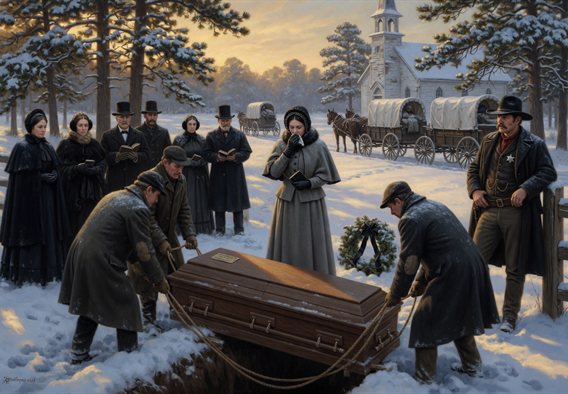
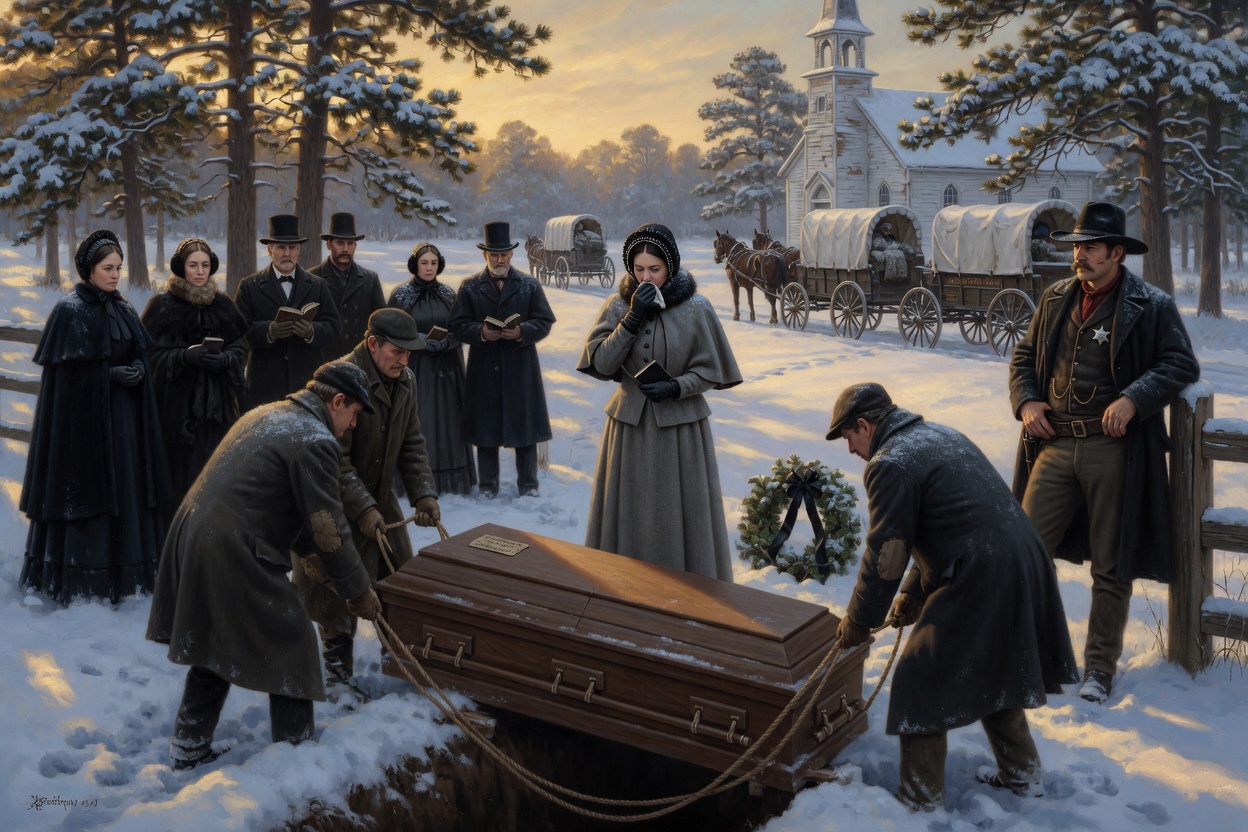
The graveyard sat on the bench above town where the pines thinned out, and the gravediggers had done their work in the frozen ground with picks and steam, and the mourners who gathered were mostly Elias's old patients, ranchers and miners and their wives, women Ada remembered from the year she had spent as Elias's apprentice before everything went wrong. They nodded to her. A few of them said her name in low voices, with the careful tone people use when they are not sure whether a name is welcome. Mrs. Okafor, who ran the boarding house, pressed her mittened hand and said, quietly, that Ada had done right by him, coming back.
Ada did not feel that she had done right by anyone. She felt like a woman walking on the crust of a frozen river, listening for the crack underneath.
And then, through the black wool of her peripheral vision, she saw him standing at the edge of the gathered crowd, hat in his hands, and the crack came.
Nate Whitlock had been twenty six when she left and he was thirty three now, and the years had put weight on his shoulders and silver at his temples and a watchfulness in his face that had not been there when he was a young deputy who laughed too easily. He wore the sheriff's star and a coat that fit him well, and he stood the way he had always stood, square and still, as if stillness were a kind of courage. His eyes found hers across the grave and he did not look away and neither did she, because looking away would have been a confession, and she had made enough confessions in her life to fill a cathedral.
The minister read the words. The wind moved the dry grass. Elias Wren went into the ground he had spent his life serving, and Ada stood with her gloved hands folded and thought, with a clarity that felt almost like cruelty, that the last time she had stood in this graveyard she had been burying her mother, and Nate had held her arm, and three weeks later she had been gone.
When the service ended, the crowd thinned toward the wagons. Nate did not move. He waited, with a patience that had always been his most dangerous quality, until the two of them were nearly alone among the frost heaved stones.
"Doc," he said.
Her name for Elias. Given to her now, deliberately, like a key pressed into her palm.
"Sheriff," she said.
"You look well."
"I look frozen." She surprised herself with the answer. It came out in the old rhythm between them, the teasing they had built across a dozen town dances and a hundred deliveries of mended fence wire. Seven years should have worn that rhythm smooth. Instead it was simply there, like a path through snow that the body remembers even when the mind has sworn not to.
"There's coffee at the office," he said. "If you're staying."
"I'm staying through the reading of the will. Elias named me executor. Then I take the Tuesday train east."
Something crossed his face. It was gone too fast to name. "The office is on Delancy Street. Third door past the assay office. It was his, you know. He left it to the county, but the county hasn't decided what to do with it."
"I know," she said. "I did my apprenticeship there."
"I know you did." He put his hat back on, and the brim shadowed his eyes, and she was absurdly grateful for it. "Tuesday, then."
"Tuesday," she agreed, and he touched the brim of his hat, and he walked down the hill through the pines, and she stood among the graves of the people she had once expected to grow old beside, and let herself feel, for exactly one minute, the full weight of what she had thrown away. Then she counted to sixty, as Elias had taught her to do when her hands shook before a procedure, and she went down the hill after him.
Two: The Wound, Seven Years Old
Here is what the town remembered, because towns keep books no one signs.
In the winter of 1890, typhoid had come down the river into Cedar Hollow with the ice, and it had taken eleven people in six weeks, and the eleventh had been Bridget Marchetti, Ada's mother, the woman who ran the boarding house kitchen and fed half the town and sang Irish songs off key while she kneaded bread. Ada had been twenty two and Elias's apprentice for a year, and she had held her own mother's hand through the fever, and her mother had died on a Tuesday in February with Ada's fingers on her pulse, feeling the moment the drumbeat scattered.
Nate had been there. Nate had come every evening after his shift and sat in the kitchen and brought wood in without being asked and done the small work of keeping a house alive while the woman in the bed was dying. He had been courting her for eight months by then. Everyone knew. He had asked Elias for advice about a ring, which Elias had reported to Ada with undisguised delight, and she had been so happy in that ignorant, pre fever way that she could not now look back on it without flinching.
Three weeks after the funeral, she was gone. She had left a letter on the table of his mother's house, because he was out on a two day ride to the Campton ranch after horse thieves, and she had not been able to wait for him, and the letter had said, in her own careful hand, that she could not marry him, that she had applied to the Woman's Medical College in Philadelphia and been accepted, that she was sorry, that he deserved better than a wife whose heart was not whole enough to hold him, that she wished him every happiness, and that she would not be coming back.
What the letter had not said was the truth, which was this: she had watched her mother die in a house with no running water and a stove that smoked, and she had watched Elias fight the fever with carbolic and quinine and prayer, and she had known, in her marrow, that she could not stay in Cedar Hollow and watch the next fever take the next person while she had only her hands and her grief. She had wanted, with a ferocity that frightened her, to become a physician. A real one. And there was no road to that want that ran through Nate Whitlock's kitchen, because a wife in 1890 did not go to medical school, and a doctor's wife did not practice medicine, and she had loved him enough to know that staying would have poisoned the love, and she had been twenty two and stupid with grief, and so she had written a letter instead of the truth, because the truth would have asked him to wait, and she had not believed she had the right to ask anyone to wait for her.
What the town remembered was simpler. The Marchetti girl got her mother's house and the boarding house money, and she lit out for Philadelphia like a thief in the night, and she broke Nate Whitlock's heart with a piece of paper, and he took to the bottle for a season, and then he took to the badge, and the town had watched him climb out of it one hard year at a time, and it had drawn its conclusions.
Ada had drawn the same conclusions about herself. She had simply had the advantage of distance in drawing them.
Three: Coffee on Delancy Street
She did not go to his office on Thursday. She went Friday, because Elias's lawyer, a dry man named Coombes, needed a full day to lay out papers, and because Ada needed a full day to rehearse four sentences in front of a hotel mirror and then discard all of them.
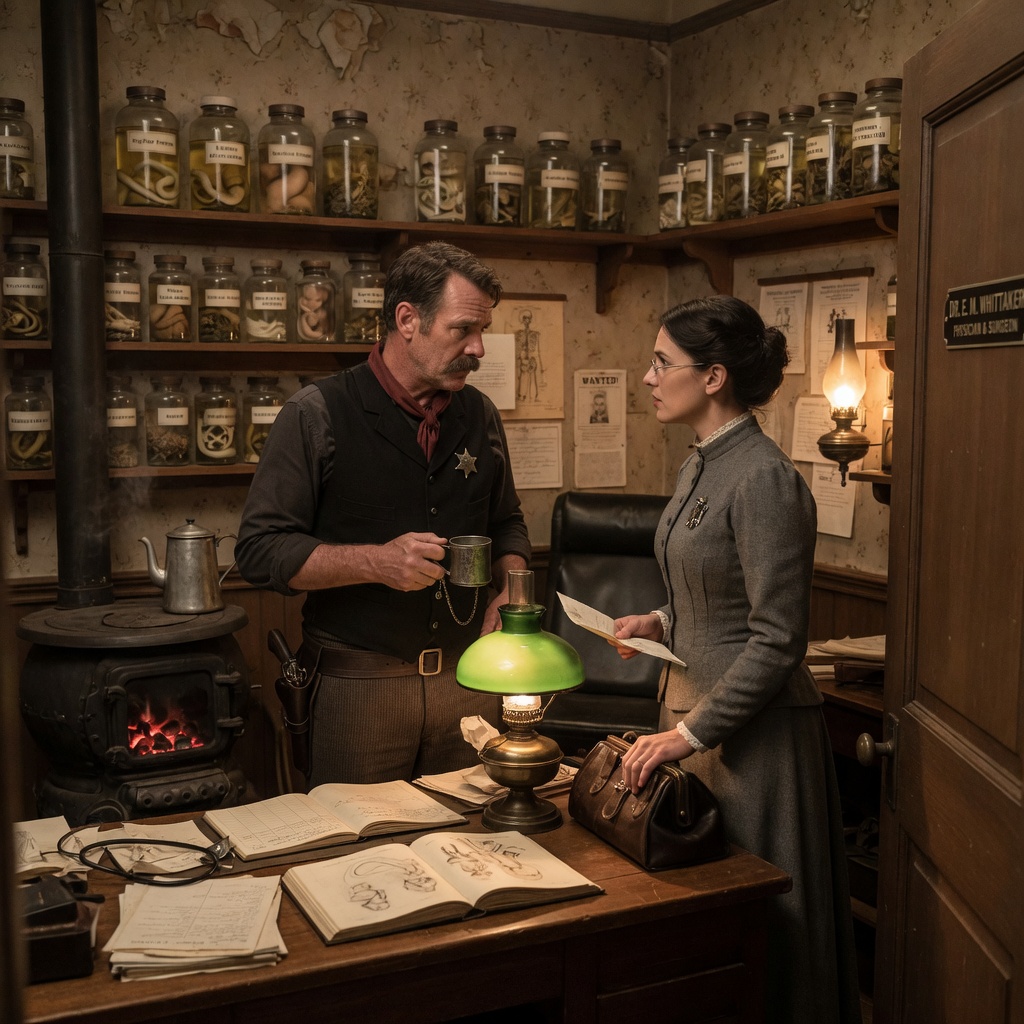
The office on Delancy Street was Elias's old practice, just as he had said. The same brass nameplate on the door, polished by thirty years of hands. The same shelf of jars, the same examining table, the same steel cabinet with its squealing drawer. Someone had kept it up. The stove was lit. The lamp was trimmed. Elias had died in the back room of this office in January with his housekeeper holding his hand, and Ada understood, walking in, that the person who had kept the stove lit was standing at the window with his back to her, and she should have guessed.
"The county wants to sell it," Nate said, without turning. "There's talk of a doctor wanted in Campton, forty miles east. Bigger town. They'd move the whole practice there for the resale."
"Campton has a doctor."
"Campton's doctor is sixty and drinks. Everyone here knows it and still rides forty miles when they can afford to." He turned around then. He had a tin cup in his hand and steam rising off it, and he held it out to her like an offering he did not want to make. "Coffee's not Elias's. It's mine. He drank tea at the end. Said it was for his stomach, but it was because his mother was English and he got sentimental."
Ada took the cup. Their fingers did not touch and she was grateful and sorry in equal measure. "You kept his office."
"The county keeps it. I keep the stove lit so the pipes don't burst. Those are different things."
"Are they."
"Ada." He said her name the way he had said it in the last month of her mother's life, when she had stopped sleeping and started doing arithmetic with her own grief. Flat. Careful. A man handling something that could go off. "Say what you came to say."
"I came to look at his ledgers. The will requires an inventory of the practice before probate."
"The will." He laughed, one syllable, no humor in it. "Fine. The ledgers are in the cabinet. Second drawer. I'll be at the jail."
"Nate."
He stopped at the door. He did not turn around. "You've had seven years to say whatever comes after Nate, and you spent them in Philadelphia, so I'll save you the trouble. It was a good thing you did, going. Elias was proud of you. The whole county knew what you'd become. I read about it in the Denver paper, that piece they ran when you passed your boards. First woman physician in the territory with a full license, or close enough to it." His voice was even. That was the worst of it, how even it was. "I was glad for you. I want that on the record, because the town will tell you I wasn't, and the town keeps the wrong books."
"The town and I have books to settle too," she said. "Nate, I owe you an apology and I intend to give it, but not standing in a doorway while you walk out of it."
He stood there a moment. The stove ticked. Somewhere down the street a smith's hammer rang out the hour the way it had rung every hour of her childhood.
"Saturday," he said. "After the reading. I'll bring the coffee."
And he was gone.
Four: What Elias Left Behind
The reading of the will took place Saturday morning in Coombes's office above the bank, and it was a cold clear day, the kind of day the mountains produce in March to remind everyone why they forgive the winters. Ada sat with her hands folded on her knees and listened to Elias Wren spend his death as carefully as he had spent his life.
He left four hundred dollars to his housekeeper, Mrs. Ruiz, and his books to the school. He left a letter to be read aloud, and Coombes read it, and Ada's throat closed halfway through.
To the people of Cedar Hollow, Elias had written, in the looped, declining hand of his last autumn. I came here in 1866 with a diploma, a bag of instruments, and a horse I did not trust, and I stayed because I found out that medicine is not done in cities to patients, it is done in towns among neighbors, and a man who understands that has found the whole of the profession. I have watched this valley bury its dead and deliver its children for thirty one years and I regret exactly nothing, except the years I was too proud to take an apprentice. Ada Marchetti was the best student I ever had and I say that having had exactly one, and I say also that she left this town because this town left her no other way to become what she was meant to be. That was our failure and I count it among mine. If the county is wise it will not sell my practice down the river. It will ask Dr. Marchetti what she wants to do with it. She is the only person alive who knows what is in every drawer.
Then, the rest: the practice, the building, the instruments, and the ledgers, to Ada Marchetti, in trust, with the single condition that she use it or dispose of it as she saw fit, and with an added line that made Coombes pause and look over his spectacles at her.
And to my friend Nathan Whitlock, who kept my stove lit and my affairs ordered for the last two years of my life and asked nothing for it, I leave my collection of medical oddities, which he never once wanted, so that he will have a reason to visit whoever ends up in this office, and so that the two of you cannot avoid each other forever, which would be the only tragedy I have left unfinished.
There was a silence in the room after that. Coombes coughed. Mrs. Ruiz, who had come in from the back and knew everything about everyone, looked at her hands and smiled very slightly, the way women smile at other people's storms.
Ada found that she could not speak. Elias had known. Of course he had known, he had known everything, he had known in his last months exactly what he was doing, and she had flown four hundred miles to execute the estate of a man who had spent his dying time matchmaking from beyond the grave, and if she had not loved him so much she would have been furious.
"There's one more item," Coombes said. "A sealed letter, to be delivered to Dr. Marchetti privately. And a second, to Sheriff Whitlock. Both marked to be opened only if, in the executor's judgment, the moment is right." He set two envelopes on the desk. "The old man was specific about that word. Right. Not convenient. Not safe. Right."
Ada took her envelope. It was heavy paper, sealed with wax, and it weighed nothing and everything in her hand.
Nate was not in the room. She had not noticed him leave, which meant he had been gone since before the letter was read, and she thought, with a sinking feeling, that she had just been handed a letter by a dead man about a living one who could not stand to hear her praised in his presence, and the shape of the next week came into focus like a coming storm.
Five: The Apology
She found him at the jail that evening, and she did not bring coffee. She brought the ledgers, because Elias's accounts needed reconciling and because the work gave her a reason to sit across a desk from a man who did not want to be sat across from, and because she had decided, somewhere between the funeral and the will, that she would do the hard thing first this time. That was the whole of her reformation, in a sentence. Last time she had done the safe thing and called it kindness. This time she would do the hard thing and let it cost what it cost.
The jail was one room with two cells, a stove, and a desk scarred with thirty years of boots and elbows. He was writing a report. He looked up when she came in, and the lamplight caught the silver at his temple, and she set the ledgers down between them.
"I owe you an apology," she said. "I'm going to give it now, all of it, and you don't have to forgive me, but I'm asking you to hear the whole thing before you decide."
He put down his pen. "Go ahead."
"The letter I left you was a lie," she said. "Not in its facts. In its reasoning. I wrote that I couldn't marry you because my heart wasn't whole. That was cowardice dressed up as mercy. The truth is that I could have married you, and I wanted to, and I would have been a good wife to you and a slowly dying woman, because this town had no place for what I wanted to become, and I chose the want over the marriage, and then, because I couldn't bear to watch you argue me out of it, I chose the letter over the conversation. I stole your chance to fight for it. I decided for both of us and I told myself it was for your sake. It wasn't. It was because I couldn't stand to watch your face while you asked me to stay."
The stove ticked. He did not move.
"I told myself you deserved better," she went on, and her voice held, mostly, because she had rehearsed it, and rehearsal is a kind of courage too. "What I meant was that I deserved better and couldn't say so out loud without sounding like a monster, so I dressed it in your clothes. You were not the obstacle, Nate. You were never the obstacle. The times were, and the town was, and my own cowardice was, and I put your name on a document I signed alone, and that was wrong, and I am sorry. I have been sorry for seven years and I have never once said it plainly, so there it is, plainly. I'm sorry."
She stopped. Her hands were flat on the ledgers. The lamp hissed faintly.
Nate looked at her for a long time. Then he stood, and walked to the window, and stood with his back to her, which was what he did when he was working on something, and she had learned that much about him and never unlearned it.
"I drank for a year," he said. "You probably know. The town will have told you, it's the kind of thing they keep in the front of the book." His voice was low. "My mother died that year too, and I told myself it was grief, and it was, some of it. The rest was that I had a letter where I should have had a conversation, and I couldn't drink the letter into being a conversation, so I just drank. Deputy Carver pulled me out of it. Gave me a choice between the badge and the bottle, and I picked the badge, and I've been dry eleven years."
"I didn't know about your mother," Ada said. "Nate, I didn't know."
"I know you didn't. That's part of what it cost, cutting a person off. You don't get to know what happens to them after." He turned around. His face was not soft. It was the face of a man arriving somewhere he had been traveling toward for a long time. "And here's my apology, since we're doing it plain. When your letter came, I let the town tell me a story where I was the wronged party, and I wore that story for years like it was armor, and it let me be angry instead of honest. Because honest was this: I never once asked you what you wanted. Not in eight months of courting. I asked Elias about a ring. I asked my mother's blessing. I asked everyone alive except the one person whose answer was the only answer. I had it in my head that a man provides and a woman accepts, and you'd been delivering babies beside Elias for a year and reading his anatomy texts after hours, and I saw it, Ada. I saw you light up over a case the way other women lit up over a piano, and I told myself you'd give it up, or it would pass, or a baby would settle you. I built a whole future on the assumption that you would become smaller, and then I acted wounded when you refused to."
"Nate."
"Let me finish. I've had eleven years dry and seven years angry and I'd like to spend the last of it honest." He came back to the desk and sat down across from her, forearms on the scarred wood, close enough that she could see the fine lines at his eyes that had not been there at twenty six. "So. I'm sorry. Not for being hurt, that was mine and it was real. I'm sorry for the assumption underneath the hurt, that your life was a thing to be arranged around mine. You were right to go. You were wrong to go by letter, and I was wrong to let a whole town narrate my grievance for me, and neither of us was a villain, and it took Elias dying to get us both to say that out loud, and I think he'd find that funny if he could see it."
Ada laughed. It came out cracked and wet and surprised, a real laugh, the first one this town had heard from her in seven years. "He'd be insufferable about it."
"He'd be unbearable," Nate agreed, and something eased in the room, some old pressure that had been living in the walls since 1890, and neither of them named it, because naming it too early would have been a kind of lie, and they had both, at last, stopped lying.
Six: The Fever Comes Down the River
Providence, which has a cruel sense of structure, sent the fever on Monday.
It began with the Ferro boy, six years old, who came to Elias's old office with his grandmother because his throat was sore and he had a smell on his breath that Ada recognized before she saw his face. She made him open his mouth, and looked with her throat lamp, and the gray white membrane sat across his tonsils like frost on a window, and her stomach dropped through the floor of the world.
Diphtheria. She had seen it once in Philadelphia, in the infectious ward at the hospital, where they had the antitoxin and the intubation tubes and a mortality the attending had recited like a litany. In Cedar Hollow there was a stove, a shelf of instruments, and forty miles of bad road to the railhead, and the nearest supply of antitoxin was in Denver, on a train, in a cold box, if it existed at all in the quantity she would need.
She did not stop to feel fear. Elias had trained the feeling out of her at nineteen, in this very room, telling her that fear is fuel, burn it, don't drown in it. She quarantined the Ferro house with the grandmother's frightened cooperation, sent a telegram from the depot to the Denver depot medical supply and to the state board of health, and then she went to find the sheriff, because in a town of nine hundred people with a contagious disease and a frightened population, the law and the medicine had to move together or both would fail.
He was already at her door. She saw it in his face before she saw the telegram slip in his hand.
"The telegraph operator is my wife's cousin," he said. "Which is to say, half this town will know by supper. Tell me what you need and I'll get it, and then tell me what you need me to be, and I'll be that."
What she needed, it turned out, was everything at once. She needed the school closed and the two saloons closed, and she needed it done without panic, and she needed every household with a child under ten to be visited and throats examined, and she needed a nurse, and she needed the antitoxin on the first train that could carry it, and she needed, above all, for the town to trust her, and the town had a seven year old story about her that did not feature trust prominently.
"Pell won't help," she said. "He'll be at the Campton poker table by Thursday if he hears the word quarantine."
"Pell will do what I tell him," Nate said, and put on his hat. "The county pays his license fee. He'll examine every throat I put in front of him or I'll ride to Campton and explain it to him in person." Then he stopped, halfway to the door, and turned, and looked at her with an expression she had never seen on him, a kind of fierce steadiness. "Ada. You've been back five days and this town is about to ask you to save its children. Whatever it decides about you afterward, I want you to know that I know what you are. I've always known. Go do it."
She went and did it.
Seven: What the Town Decides
By Wednesday there were nine cases. By Friday, fourteen, and the antitoxin telegram came back from Denver with a promise of shipment on the Saturday morning train, twelve vials, which would not be enough, and a note from the state board advising the immediate engagement of a physician with experience in intubation, of which the territory had perhaps four.
Ada intubated the Ferro boy in his grandmother's kitchen at midnight on Wednesday, with his terrified mother holding the lamp and Nate holding Ada's coat, because he had appointed himself to that post and would not be talked out of it, and because his hands on her shoulders steadied hers, and she let him, and that was its own kind of confession.
The town's story about her began to change on Thursday, when Mrs. Ruiz went door to door with Ada's list and Ada's instructions, and the boarding house kitchen, her mother's old kitchen, became a soup station for the quarantined families. It changed again on Friday when Ada walked into the saloon on Front Street in her blood spattered apron, before she had slept in two days, and told the owner, a man named Duffy who had once been her mother's best customer, that he would close or she would have the sheriff close him, and Duffy looked at her, this girl whose mother had sung in his establishment off key on Saturday nights, and closed.
It nearly changed back on Saturday, when the school board met in emergency session and one member, a farmer named Harlan Boyd whose cousin had lost a child to a different fever a decade back, stood up in front of forty assembled citizens and said what everyone was afraid to say. That Marchetti girl. That she had run out on them once already. That a woman with a fancy eastern license was not the same as a doctor, whatever paper said. That they ought to wire Campton for Pell's colleague before they let her near their children.
Ada heard about it within the hour, because Cedar Hollow's telegraph lines ran in every direction, and she was standing in Elias's office with a vial of antitoxin in one hand and a list of sixteen sick children in the other when Nate came through the door with his hat in his hands and fury coming off him like heat off a stove.
"Boyd's calling a vote," he said. "Tonight. He wants the county to supersede you. He's got signatures."
"Then he'll get his vote." She set the vial down. Her hand was steady. She noticed that it was steady and marveled at it. "Nate, listen to me. You cannot fix this one. You cannot arrest a man for wanting his neighbors' children safe, and if you try, you make it about you, and then it's two outsiders against the town, and the children lose either way."
"He's calling you a fraud in front of forty people."
"He's calling me a risk," she said. "And he's not wrong. I am a risk. I'm a risk every time I put a tube down a child's throat, and the only thing that makes me something other than a risk is whether this town decides to trust me, and no badge on earth can cast that vote for them. Boyd gets his meeting. I'll be there."
"Ada."
"But I'll tell you what I need," she said, and she was so tired that her voice had gone soft and honest in a way she could not have managed on a full night's sleep. "I need you in that room. Not speaking for me. Just present. Because when I stand up there alone, they'll see the girl who left. When you stand there, they'll see the man who stayed, and they'll have to ask themselves why the man who stayed is standing with her."
He looked at her for a long moment. The lamp hissed. Down the street, the smith's hammer rang.
"I'll be there," he said.
Eight: The Meeting at the Schoolhouse
The meeting was held at seven in the schoolhouse, and Ada arrived at six forty five, having slept four hours in two days, in the same back room where Elias had died, under the same gray blanket, and she had washed her face and braided her hair and put on the dark gray coat, because armor, in 1897, was wool and posture.
The room was full. Ranchers and shopkeepers and miners' wives, the mayor, the school board, Coombes with his ledgers, and Boyd at the front with a paper in his hand and righteousness in his jaw. Nate sat in the third row, hat on his knee, and did not look at her, which she understood to be the whole point. He was not her defender. He was her witness.
Boyd spoke for ten minutes. It was not a cruel speech. It was worse, it was a loving one, all about the children, all about the terrible responsibility, all about the strange girl who had vanished in the night seven years ago and could not be relied upon to stay. He was careful never to say the words coward or abandonment. He said history instead, and what we know of a person, and the room nodded along, because he was a good man being wrong in the way good men are most often wrong, which is thoroughly.
Then the mayor called for the vote, and Ada stood up, and the room went quiet the way rooms go quiet for someone they have already decided about.
"I'm not going to argue," she said. "Mr. Boyd is right that I have a history here, so let me tell you the true history, because the town keeps the wrong books and it's time somebody read the right ones." She told them. Not the elegant version. The plain one. That she had loved this town and a man in it and had watched her mother die in a house without a decent stove, and had understood that she could not stay and remain only a pair of hands, and that she had wanted so badly to be a doctor that it had felt like a fire in her chest, and that instead of saying that out loud she had written a letter and run, and she had been twenty two and grieving and wrong, and she was sorry, and she had spent seven years becoming the thing this valley needed and had been too proud, until this week, to say so.
"Mr. Boyd thinks I left you once and will leave you again," she said. "He's half right. I left you once. I was wrong to do it that way, and I'll answer for that for the rest of my life. But I want you to look at the record of the last seven days instead of the last seven years. Fourteen children sick. One dead so far, the Alvarez baby, and I could not save her, and I will carry that until I die, and I am telling you so now instead of pretending doctors don't lose patients. Twelve others, alive, because of what I did with my hands this week. The antitoxin arrives tomorrow morning. It will not be enough, and I will make it enough by diluting it further than the textbooks like, and I will stand in your kitchens and do it, and some of your children will live and God help me, some may not, and there is no other physician within forty miles who knows how to do the thing that keeps a child breathing through the night."
She stopped. The room had gone very still.
"You can vote to supersede me," she said. "I'll walk out this door and telegraph Campton and do everything I can from the sidelines, because I will not let a child die over a grown person's grievance. But if you vote me out, you are not voting out the girl who left. You are voting out the doctor who has been in your kitchens every day this week, and you will have to live with the difference, and so will I."
She sat down. The silence held. And then Nate Whitlock stood up, and every head turned, because everyone in that room knew exactly whose third row seat that was and what it had historically meant.
"I have one thing to add," he said, "and then I'll sit down and you can vote." His voice carried in the way quiet voices carry when the room is afraid. "Seven years ago I was the man that letter was written to, and if anybody here has a right to stand up and say Marchetti can't be trusted, it's me, and I'm standing up to tell you the opposite. She left wrong, and she came back right, and I have watched her work for five days and I have watched men twice her age in this county face this same fever with half her nerve. Dr. Wren trained her. Dr. Wren, who pulled half this room's children into the world, left her his practice in writing, with his name on it, and if his judgment was good enough for thirty one years it is good enough for tonight. Vote how you like. I'm going back to the Ferro house to hold a lamp."
He sat down. The vote, when it came, was not a landslide. It was twenty nine to eleven, and the eleven stung, and the twenty nine held, and Boyd shook her hand at the door afterward with a stiffness that was its own kind of concession, and said, grudgingly, that his wife would be sending soup to the boarding house in the morning, and Ada thanked him, and meant it, because amends run in both directions or they run nowhere.
Nine: The Long Night
The antitoxin came in on the Saturday morning train, twelve vials packed in sawdust, and Ada spent the next seventy two hours in a blur of kitchens and lamplight and the small terrible arithmetic of dilution, and Nate was there for all of it. He drove her between houses in his own rig. He held lamps and basins and frightened mothers' hands. He learned, in those three days, more about what she did than most men learn in a lifetime, and she watched him learn it, and something in her chest that had been clenched since 1890 began, very slowly, to unclench.
It was two in the morning on the third night, in the Ferro kitchen, after the boy's fever finally broke, that the letter came up.
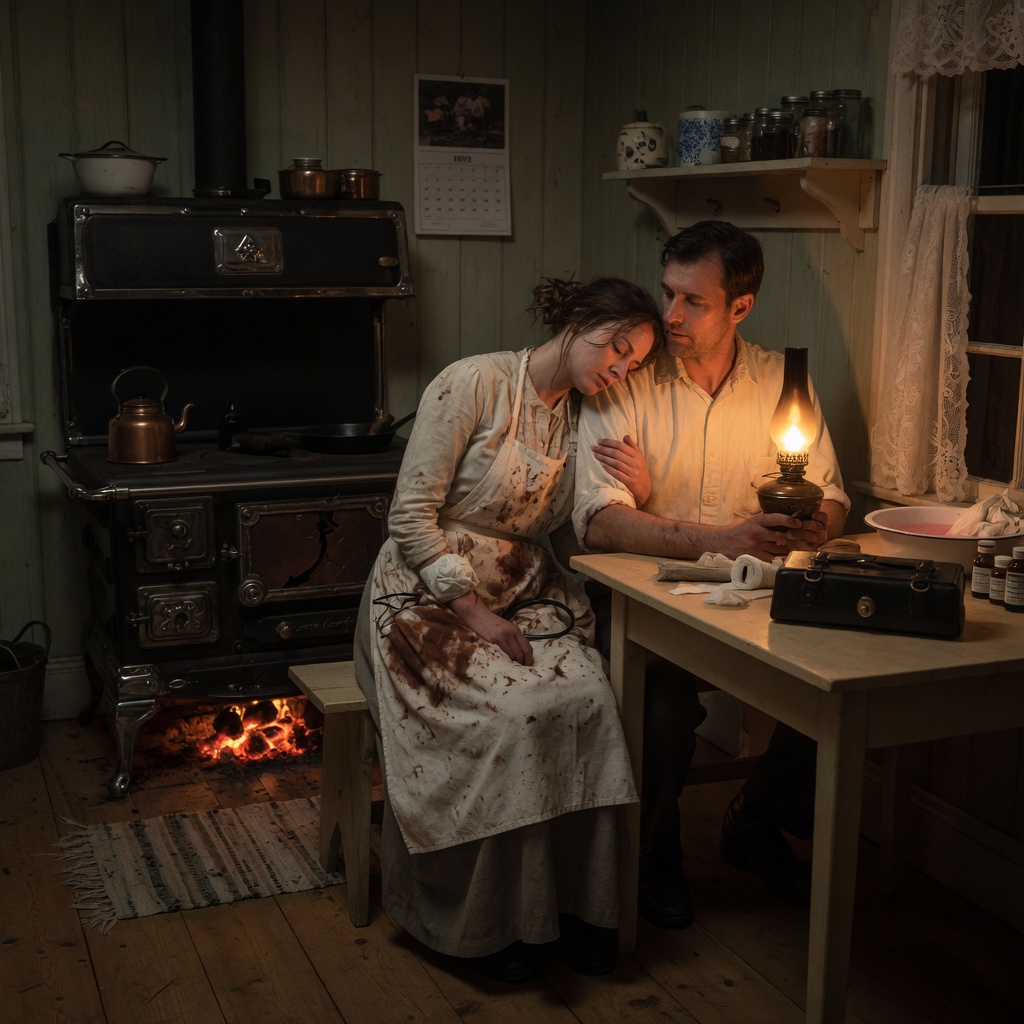
They were sitting on the bench by the stove because sitting down had become unavoidable, and the house was quiet, truly quiet, the kind of quiet that follows a child's fever breaking, and Nate said, without preamble, "Elias left me a letter too. The lawyer's been after me for a week. I haven't opened it."
"Mine's in my bag," Ada said. "Sealed. He wrote instructions that we could only open them when the moment was right."
"And is this the moment?"
She thought about it. The stove ticked. Somewhere in the next room the boy slept with the easy breath of a child on the far side of danger.
"I think," she said, "that Elias spent his last two years watching you light his stove and writing letters, and I think we owe it to him to read them before we decide anything else about each other. But I don't want to read mine alone in a hotel room. So either we open them here, together, tonight, or we put them back in our pockets and I get on the Tuesday train and we spend another seven years being polite."
"There's no Tuesday train," Nate said quietly. "The quarantine. Line's been freight only since Wednesday."
She stared at him. "You knew that."
"I've known it since Wednesday."
"And you didn't tell me."
"No." He looked at the stove, and then at her, and there was no apology in his face, only honesty, which was newer and harder. "Because on Thursday, after we talked in the jail, I had a whole speech built about asking you to stay. And then the fever came, and I watched you walk into that first kitchen, and I thought, if I ask her and she stays out of pity or out of debt, I'll have done the same thing I apologized for. Made her smaller to fit my life. So I kept it. And then Boyd's meeting happened, and you stood up in front of forty people and told the truth with your hands shaking, and I thought, she's not the girl who left. She's the woman who came back. And I want the woman who came back, if she'll have me, on whatever terms she names, and not because of a train schedule."
Ada's eyes were burning. She had not cried in front of him since her mother's funeral and she was not going to start now, or she was, and it hardly mattered which.
"Open your letter," she said.
He broke the wax with his thumb. Elias's handwriting, looped and declining, filled the single page, and Nate read it aloud, slowly, in the kitchen of a house where a child was sleeping, because some things need a witness.
Nathan, it began. I am dying and I find I am spending my last letters on the same subject, which is you and Ada, and I make no apology, because a dying man's business is unfinished things, and you two are the unfinished thing I have watched longest. I have known you since you were a deputy sleeping in my waiting room through the night shifts, and I have known her since she was nineteen and read anatomy at my table while her mother sang downstairs, and I watched the fever of 1890 take her mother and take her courage along with it, and I watched you both make the mistake that grief makes, which is to mistake the shape of the wound for the shape of the person. She left you because she could not see past her own fear. You let her go because you could not see past your own pride. I could have told you both this at the time. I did not, because I was fifty eight and tired and I thought love that cannot survive one wrong decision is not love worth defending. I no longer think that. Age has made me a meddling sentimentalist and I have decided to enjoy it. So here is my last prescription, doctor to sheriff: the moment will come when one of you is standing in a room with the other and the safe thing is to say nothing. Take the unsafe thing. It is the only medicine I ever found that works on this disease. Yours always, Elias.
Nate finished reading and folded the page with great care, as if it were a document that might be needed in court someday, which, in the sense that mattered, it was.
"Unsafe," he said. "All right." He looked up. "Here's the unsafe thing, then. I love you. I have loved you since before the fever and through the fever and I love the woman who came back more than I loved the girl who left, and if you get on a train east I will put you on it with my blessing and a full coffee can, and if you stay I will spend the rest of my life being a man who asks, before he assumes, and I would like very much to start practicing that asking right now. So. Dr. Marchetti. What do you want? Not what's practical. Not what's owed. What do you want."
The stove ticked. A log settled. In the next room, a six year old boy breathed the slow deep breaths of the saved.
"I want the practice," Ada said. "Not the building. The work. I want to be this valley's doctor, and I want it to be my choice, made in daylight, with my eyes open, not a thing that happened to me because of grief or debt or a train schedule. And I want you. Not instead of the work. Alongside it, which is harder and better, and I want us to be the kind of people who fight about it out loud instead of writing letters." She took a breath. "And I want to open mine before I answer you, because I have a suspicion, and if I'm right, I want you to hear it from Elias and not from me."
She broke the wax. The handwriting was the same, the looped declining hand of a man running out of time and choosing his words like a surgeon choosing instruments.
Ada, it read. You will have read the will by now and you are probably angry with me, and I hope you are, anger is a living thing and grief is not. Seven years ago you sat at my table and told me, at the end of the worst month of your life, that you could not stay in Cedar Hollow and become a doctor, and I agreed with you, and I have regretted my agreement ever since, because I was wrong. I told you the town would never have you. I should have told you the town does not know its own mind, and neither did I, and neither, that week, did you. I watched you choose Philadelphia and I watched you flourish there and I have never been prouder of a student, and my one instruction to you is this: do not let the girl who wrote that letter decide what the woman who reads this one does. She was twenty two and her mother was three weeks dead. You are not her. And if Nathan Whitlock is standing anywhere in your vicinity when you read this, which I have arranged, because I am a meddling sentimentalist and I have decided to enjoy it, then for heaven's sake, child, say the true thing out loud. It is the only prescription I have left you. Yours, E.W.
Ada folded the letter and set it on the bench between them, and for a moment neither of them spoke, and the silence was not empty. It was the silence of two people standing in the same place at last, after a very long journey taken in opposite directions.
"He arranged it," she said at last, and laughed, and the laugh broke in the middle. "The coffin on my train. The will. The oddities left to you so you'd have a reason to visit. He spent his dying year building a trap out of love and we walked straight into it."
"Good doctor," Nate said. "Terrible at keeping his mouth shut. Best in the territory." He reached across the bench and took her hand, and his hand was warm from the stove and rough from rope and rein, and she did not pull away, and that was the answer to everything Elias had ever asked of either of them.
"The true thing out loud," she said. "You asked what I want. I want to marry you, Nate Whitlock. In the spring, after the fever's done with us, in the church with the crooked steeple, with Mrs. Okafor's whole boarding house in the pews and Boyd grumbling in the back row and Mrs. Ruiz crying in the front. I want a wedding where my mother's recipe is served and Elias's collection of medical oddities sits on the side table because he'll have insisted, somehow, from wherever he is. And I want us to be the kind of marriage where on the hard nights I say what I need and you ask before you assume and neither of us ever writes the other a letter that a conversation should have been."
"Those are my terms," she said. "Do you accept them?"
"I accept them," Nate said, and his voice was not even at all anymore, and that was the best thing she had heard from him in seven years. "All of them. Starting now. Ada. What do you need, right now, tonight?"
She considered. The stove. The sleeping child. The twelve remaining cases that would need her at dawn, and the man beside her who had learned, in one hard week, to ask instead of assume.
"Ten minutes of sitting on this bench with your arm around me," she said. "And then coffee. And then the Ruiz house by eight."
"Done," he said, and put his arm around her, and she leaned into him, into the smell of woodsmoke and horse and the man she had left and found again, and the ten minutes stretched to twenty, and neither of them counted.
Ten: The Tuesday Train That Nobody Took
The fever released the town in the first week of April. Eleven of the sixteen children lived, and Cedar Hollow buried five, and Ada stood at five small graves and did the arithmetic of survival the way doctors always do, the arithmetic that never comes out to zero and never comes out to whole. The town, which keeps the wrong books, began quietly keeping a new one. It recorded that Dr. Marchetti had diluted antitoxin past the textbook limits and the children had lived anyway. It recorded that she had not slept for three days. It recorded, with the grain of truth that makes a story stick, that she had taken the fever personally, as if each child were her own, and that when the Alvarez baby died she had cried in the kitchen with the family instead of in private like a proper professional, and that somehow this made her more a doctor, not less.
Dr. Pell resigned in April, pleading his health, and the county, in a fit of economy that everyone understood to be something else, formally transferred Elias Wren's practice to Dr. Ada Marchetti, physician and surgeon, licensed in the territory of Colorado. Coombes framed the transfer paper and hung it in the office on Delancy Street himself, on a nail he hammered in slightly crooked, and refused for years afterward to straighten it.
They were married on the last Saturday of May, in the church with the crooked steeple, on a day so clear that the mountains looked cut from paper. Mrs. Okafor's boarding house provided the feast, including Bridget Marchetti's soda bread, which Mrs. Okafor had written down years ago and never once shared the recipe until now. Boyd came and grumbled in the back row and was heard to say, over the cake, that the woman had saved his hired man's boy, and that was the end of the matter as far as he was concerned. Mrs. Ruiz cried in the front row, as ordered. And on the side table, in a case of polished walnut, sat Elias Wren's collection of medical oddities, including a two headed calf preserved in a jar of spirits that had been the talk of the county since 1874, because Ada had decided that the dead should attend their own celebrations, and the town, which had learned some things that spring, agreed.
Nate wore his best coat and no star, having ruled that a man could be a husband for one afternoon. Ada wore ivory, and carried no flowers, and instead carried a single folded letter, the old one, the lie dressed in mercy, and at the moment when the minister asked if anyone knew a reason, she had stood at the altar rail and read the first line of it aloud and then set a match to it over the church's iron candle dish, and the congregation, which had been braced for scandal, instead watched seven years of wrong book go up in a small clean flame, and Mrs. Ruiz cried harder, and the minister, who was a practical man, waited it out and finished the ceremony.
The honeymoon was a week in Denver, on the Tuesday train, taken by choice this time, first class, with a return ticket in her bag that she never once looked at with dread. On the platform at Cedar Hollow on their return, the whole town turned out, and the smith's hammer rang the hour, and the mountains stood where they had always stood, and Ada Marchetti Whitlock stepped down onto the platform of the town she had left and the town she had chosen, and understood that they had never actually been two different places. She had only ever been two different women, and the second one had finally come home.
They had thirty one years, the two of them, most of them good, some of them hard, all of them conducted out loud. The office on Delancy Street kept a second nameplate after a while, brass, with two names on it, and the stove was lit by whoever arrived first, which was usually the sheriff, who never quite gave up the habit of keeping pipes from bursting. And in the back room, under the same gray blanket, in a drawer that squealed, there survived two letters in the same declining hand, read once each and kept always, and every few years, on a bad night, one of them would take a letter down and read a line from it and put it back, and go find the other, and say the true thing out loud.
It was, the county agreed, the only medicine that ever worked.
The End

Ivy Chen
Ivy writes historical and second-chance romance with period texture and modern emotional clarity. Courtship stakes, letters, and choices that cost.
Leave a comment
Comments