

Snowbound at the Hollow Light
What happens when a snowstorm strands you with the one person you never stopped thinking about, in a town you swore you were only passing through? Maren Kowalski found out the hard way, somewhere between the last stop sign in Cedar Hollow and the top of Hollow Ridge, with the sky turning the color of dishwater and her grandmother's old truck complaining in second gear.
She had a plan. Sell the Bluebird Diner, sign the papers, drive back to Chicago before the first real snowfall of the season. The storm had other ideas, and so, as it turned out, did Brandt Voss.
One: The Truck That Refused to Quit
The wind came off the lake like something with an agenda. By the time Maren turned onto Hollow Ridge Road, the flakes were no longer falling so much as firing sideways, and the windshield wipers were losing a fight they had no business starting. She gripped the wheel of the 1987 Ford her grandmother had named Muffin, for reasons nobody in the family had ever successfully explained, and told herself the weather report had said flurries. Flurries. The man on the radio had actually used the word flurries.
"You and me, Muffin," she muttered. "Twelve more miles and we never have to do this again."
That was the deal she'd made with herself in September, when the letter came from Hollis and Pye, Attorneys at Law, informing her that Opal Kowalski had left her granddaughter the Bluebird Diner and its considerable debts. Maren hadn't been back to Cedar Hollow in nine years. She had a lease in Logan Square, a job managing a restaurant group that had her name stitched on a jacket, and a life so scheduled it practically came in a three-ring binder. The plan was simple. Come home, list the diner, sell it to the developer from Milwaukee who had already sent a very confident email with the subject line OPPORTUNITY KNOCKS, and leave before anyone could ask why she'd stayed away so long.
The truck disagreed at mile marker nine.
It started as a shudder in the steering column, then a sound like a spoon caught in a garbage disposal, and then Muffin simply sighed, in the dignified way of old machines, and coasted to a stop on the shoulder with the hazard lights blinking uselessly against the white.
Maren sat there for a moment, both hands still on the wheel, as though the truck might reconsider. Snow piled in the wiper arcs. Her phone showed one bar, then a searching spinner, then nothing at all. She got out to look at the engine, which was a gesture she had learned from her grandmother and which accomplished nothing, because Opal Kowalski could fix anything with a wrench and patience and Maren could not fix anything at all, and the snow was already filling her footprints behind her.
Headlights bloomed out of the white. A plow truck, amber beacon spinning, and when it slowed and the passenger window cranked down, a voice she would have recognized underwater called out, "You planning to dig for oil, or is that truck dead?"
Brandt Voss. Of course it was Brandt Voss. Somewhere the universe was keeping a ledger of ironic outcomes, and she was clearly winning.
"It's dead," she called back. "I'm fine. I'll just wait for a tow."
"There's no tow coming tonight, Maren. County shut the roads twenty minutes ago. Plows are pulling in." He leaned out farther, and even at a distance of fifteen feet and thirty feet of horizontal snow, she could see that same crooked patience in his face. "Get in. You shouldn't sit here in this."
"I shouldn't get in a truck with you, either."
"Fair," he said. "But I'm the fire chief, and you're frozen through, and I promise the truck has nothing but thermal underwear and bad coffee in it." He paused. "Your grandmother's truck is in better shape than mine and she's not even here to gloat about it."
Something about that, hearing someone say her grandmother's name out loud in the voice of a boy who used to eat free fries at the Bluebird, cracked something in her chest. She locked Muffin, gathered her bag, and got in.
Two: Rules of the Cab
The cab of Brandt's plow smelled like diesel and peppermint, and the heater worked like a small angry god. Maren peeled off her gloves and held her hands in front of the vent and did not look at him, which was difficult, because he was the same and also not the same. Broader in the shoulders. A short beard now, dark with a little rust in it. The same scar through one eyebrow from the Fourth of July when they were nineteen and a bottle rocket had made a decision nobody approved of.
"Cabin's five minutes up the ridge," he said. "Roads are closed but a plow counts as an emergency vehicle, and I'm declaring you an emergency."
"I don't need rescuing, Brandt."
"Nobody said you did. I said you're an emergency. There's a difference. One's about need. One's about priorities."
She glanced at him then. "Still keeping lists."
"I keep lists of everything. It's why I'm alive." He downshifted as the grade steepened. "Rules of the cab. Rule one, I do the driving. Rule two, you tell me why your grandmother's truck smells like cilantro."
Against her will, she laughed. "I hauled a cooler of stuff from the diner. Her salsa recipe. There's a jar in the bed somewhere that lost the argument."
"Opal's salsa." He said it the way other men said hall of fame. "I've thought about that salsa at odd hours for nine years. That's not a joke, Maren. That's a confession."
"It's a jar of tomatoes, Brandt."
"It is a certified religious experience, and you know it."
The cabin appeared out of the white like a memory: logs gone silver with weather, a metal roof holding a foot of snow, a woodpile under an overhang stacked with geometric paranoia. He parked the plow nose-down toward the wind, and they ran for the door through a gauntlet of flying ice, and then suddenly they were inside, in a wall of warmth, and the storm became a sound instead of a thing.
"Welcome to the Hollow Light," he said, shaking snow off like a dog. "Fire station annex, grief cabin, occasional bed-and-breakfast for stranded fools. Name pending."
It was one big room plus a sleeping loft, a stone fireplace, shelves of canned things with handwritten labels, two rocking chairs angled toward the fire like old friends. A hand-painted sign over the stove read EAT WHAT YOU FIX, which Maren suspected was her grandmother's influence and not the fire department's.
"You built this?" she asked.
"The town built it. After the Tillman barn fire in the spring. We decided the ridge needed a station closer than the flats, and then winter came faster than the paperwork." He knelt at the woodstove, already working, sleeves rolled. "Point is, you're stuck with me. County says the road won't open till the wind drops, maybe tomorrow, maybe the day after. Phone's down up here. There's a radio."
"So it's a sleepover."
"It's a Tactical Discomfort Situation," he said solemnly. "There's a cot. There's a loft with a spare quilt. You pick. I'll take whichever you don't." He looked up at her through the fire-glow, and for a second his face did something unguarded and young. "It's good to see you, Maren. Even like this. Especially like this."
She didn't have an answer for that, so she put another log in his carefully built fire, which was the Kowalski family version of an answer.
Three: Pantry Archaeology
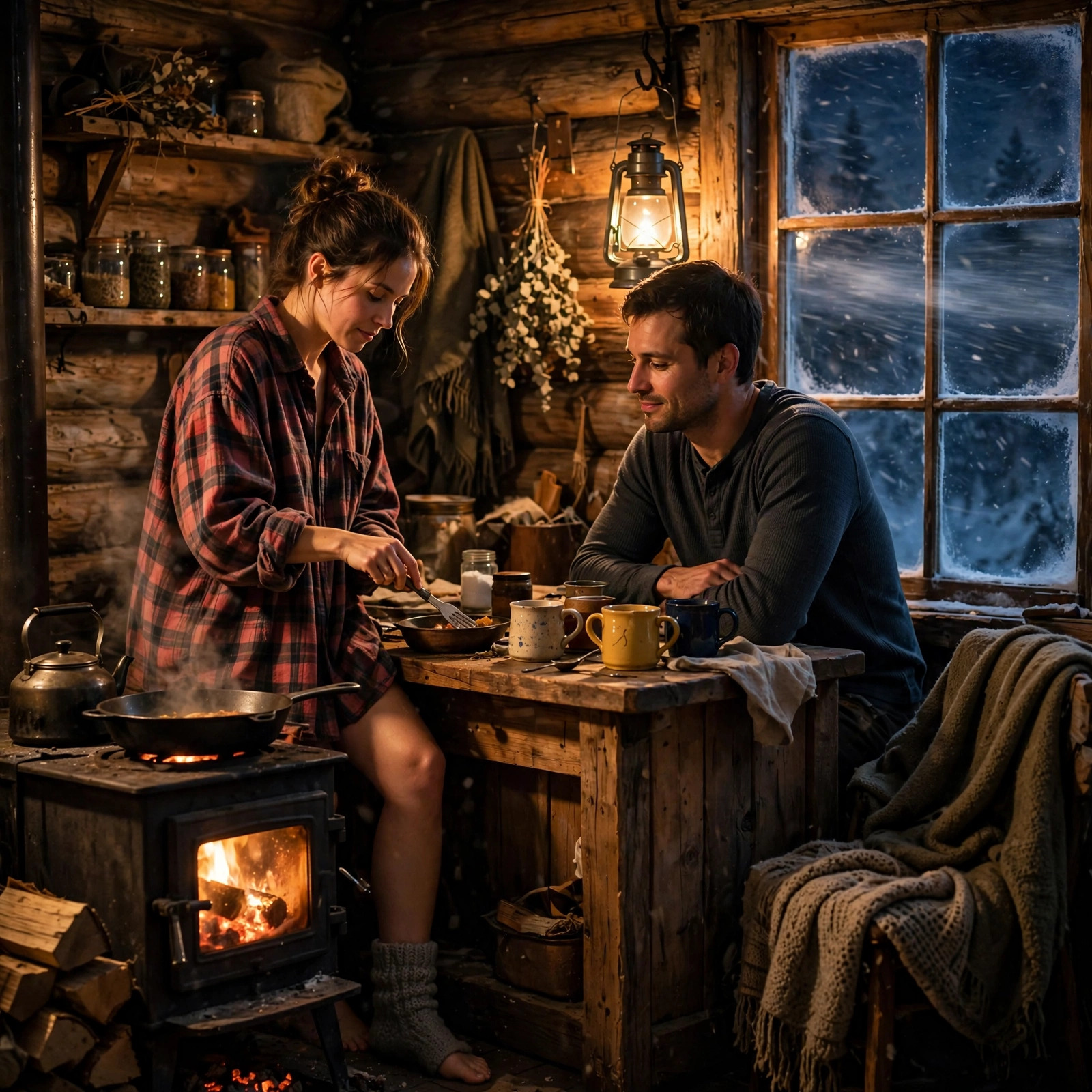
The pantry of the Hollow Light was a museum of the town's borderline obsessive generosity. Jars of Opal's peach preserves with her unmistakable handwriting, which Maren had not been prepared for and which made her sit down on a stool rather abruptly. Corn from the Dressler farm. Venison salami from somebody named Rudy, labeled in marker: GIVE TO VOSS, HE FORGETS TO EAT.
"Do you forget to eat?" she asked, holding up the salami.
"Rudy exaggerates."
"Rudy wrote you a label."
"Rudy is a busybody with a smokehouse." Brandt pulled a cast iron pan down from a rack. "There's beans. There's cornmeal. There's, miracle of miracles, a block of cheddar that Dodie at the蕁 general store vacuum sealed like it's going to war."
"There's a what at the general store?"
"I said Dodie. Dodie Knapp. You'd remember her. Used to work the counter at the Bluebird? Little, loud, gives unsolicited opinions about your love life whether or not you have one?" He cracked eggs she hadn't seen him retrieve into the pan, and the smell filled the cabin so fast it felt like an ambush. "Everyone asks about you, by the way. Since you came back. The whole town pretends it's casual."
"The whole town needs a hobby."
"The whole town's hobby is the Bluebird. Have you been down Main Street lately?"
"I drove through it."
"That's not the same as looking at it." He slid the eggs around the pan with a sureness that surprised her, and she reminded herself that of course he cooked, everyone here cooked, survival was a group project in Cedar Hollow. "Half the storefronts are empty. The hardware store is hanging on. The bank left two years ago. The Bluebird is the last place on Main where people actually sit down together, and the developer you've been emailing wants to put in one of those Glass Sel毗a places."
"Sel赵a," she corrected absently, then heard herself. "I mean. I don't owe you my business plan."
"No," he agreed easily, and put a plate in front of her. "You don't owe me anything. Eat your eggs."
The eggs were perfect. This annoyed her deeply. She ate every bite.
Later, washing the pan in a basin of water heated on the stove, shoulder to shoulder in a kitchen built for one and a half people, the storm rummaged around the eaves. She could feel his warmth like a radiator with a conscience.
"Why'd you really come back?" he asked quietly. "Not the lawyer letter. Why'd you answer it yourself instead of sending a power of attorney?"
She dried the pan slowly. "Because she wrote me a letter too. It came with the papers. She said, sell it or save it, but decide it with your own hands, standing in the room. She didn't want me deciding from far away." Maren swallowed. "She knew I'd sell it. She knew, and she made me come look at it anyway."
"Opal always did believe in making people look," Brandt said. "Then she'd stand next to you while you looked."
"She's not standing next to me now."
"No," he said, taking the towel from her hands and folding it with absurd care. "But I am."
Four: The Borrowed Flannel
By full dark the temperature outside had fallen off a cliff, and the cabin's old furnace ducts, never finished, announced that bedrooms would be a matter of inches from the stove or inches from regret. Brandt dug through a cedar chest and produced flannel shirts, thick wool socks, a quilt that smelled faintly of cedar and woodsmoke.
"Loft's yours," he said. "It holds heat best. I'll take the cot by the fire, I've slept in worse. I've slept at the station during the ice storm of 2019 with eight other guys and a one-eyed cat."
Maren changed in the small washroom, and when she came out in his borrowed flannel with the sleeves rolled four times and the quilt over her shoulders, Brandt was crouched at the fire with a notepad, and he stopped writing. Just stopped. Pen in the air. The look on his face was the kind of thing people usually have the good manners to hide.
"What?" she asked.
"Nothing. That shirt belonged to my dad. It looks better on you than it ever looked on either of us." He cleared his throat and went back to the notepad like a man fleeing the scene. "Storm log. Every hour I check the chimney draft, the CO detector, and the road below the switchback. If the wind drops under a certain sound, we might get out in the morning."
"A certain sound?"
"You learn it. When it's bad out there, the pines scream. When it's turning, they just grumble." He patted the cot, which was exactly as heroic as it sounded. "Sit. Grumble-hour is the best hour. Tea is mandatory."
They drank tea from mismatched mugs, one of which said WORLD'S OKAYEST SISTER, a relic from Dee Voss, Brandt's younger sister, who Maren remembered as a feral twelve-year-old now apparently running a daycare in town. The fire settled into its long overnight voice. Outside, the pines did not so much scream as shout. The storm was committed.
"Tell me about Chicago," Brandt said, in the careful tone of a man asking a question he'd rehearsed for nine years and promised himself he wouldn't ask.
"It's loud. It's fast. I'm good at my job." She looked into her tea. "I date people who are also good at their jobs. We have dinner at eight and split the check and nobody remembers anybody's birthday."
"Sounds restful."
"It's efficient."
"That's what I meant," he said, and she laughed even though it hurt a little, and he grinned at her over the rim of his mug, and for a while they just let the fire talk.
"You never left," she said finally. "You could have. You had scholarship letters. Roseville State wanted you for their crew team. The whole school knew."
"The whole school knew because Dee read my mail out loud." His grin faded into something more complicated. "Dad had his first heart episode that spring. Then the tree farm went under, then he passed, then it was Mom, then it wasn't anybody, it was just me and a fire pager. Somebody has to be the person who stays, Maren. Every town needs a few. We can't all be the person who goes, or who exactly is there to come back to?"
The question sat between them with its elbows on the table. She felt it touch a bruise she didn't know she had.
"That's not fair," she said quietly.
"No," he said at once. "It's not. I've had nine years to perfect it, and I want you to know it landed exactly as unfair as it sounded." He rubbed his jaw. "Sorry. That's the midnight teapot talking. It says things."
"Your midnight teapot has a point, though."
"It has half a point. Never trust a teapot with a whole point."
She laughed again, wetly this time, and reached over and squeezed his wrist once, and did not let go for longer than a squeeze requires, and he let her, and the pines shouted, and the fire kept its word.
Five: The Sound of Something Wrong
She woke at some black hour to the loft rocking, or thinking it was rocking, and the sound of the wind had changed from shouting to something lower and more personal. The fire below had burned to a sullen orange. Brandt's cot was empty, and his boots were gone.
"Brandt?"
"Here," came his voice from the door, muffled, wind-battered as he shouldered in with a blast of cold and snow-dust. "Chimney check. Draft's fouling, we might be getting a downdraft. Going to check the cap in the morning if it eases." He was white around the lips. His eyebrows had ice in them. He saw her up on the loft edge with the quilt around her and visibly softened. "Go back to sleep. All's well, mostly well, forty percent well."
"Brandt, your beard is frozen."
"It's a look."
She was nearly asleep again when the smoke alarm went off.
Not the shriek of fire, but three fat chirps, repeating, the sound she would learn in the following sixty seconds meant carbon monoxide, low-level, detecting. Brandt was on his feet before she finished understanding the noise. He killed the stove damper open, threw the door, then shut it immediately against the storm, opened a window crack instead, got her down off the loft and out of the smoke smell with a hand at her back.
"Downdraft pushed smoke gases down the flue," he said, level, too level. "Cold-corning chimney. Happens. Detector did its job. It's a detector, it detects, that's what it does, everything's fine." His hands were not entirely fine. She could see that. "We'll ride it out with the window cracked and the fire banked low. And the backup heater. And, Maren. Hey. Look at me. It's fine. But I need you to stay where I can see you tonight."
And that was when the chimney made a sound like a giant clearing its throat, and a section of snow-loaded creosote crust, loosened by the downdraft, gave somewhere in the flue, and part of the stovepipe connection let go, and a thread of actual smoke curled into the room, and Brandt grabbed the fire extinguisher and said, very calmly, "Maren, radio, grab the radio, channel six, call Dee, tell her Hollow Light, chimney, no fire, need a hand."
Her hands shook so hard the first attempt came out as static. The second attempt found a voice, and the voice was Dee's, sharp and awake at two in the morning, and eight minutes later, which Maren would later swear felt like eight years, the roar of the station's rescue pickup filled the dooryard, and Dodie Knapp of all people came through the door with a tarp and a thermos and an opinion, and between the four of them and a section of stovepipe from the plow truck's parts box, the chimney got isolated, the room got vented, and nobody burned, and nobody breathed anything worse than terror and woodsmoke and one another's relief.
Afterward, when it was handled, when the alarm chirped its last and the makeshift stovepipe connection held and Dee had bullied everyone with cocoa, Maren stepped out onto the porch with Brandt into the raw smoke-and-snow smell of the night, and her legs decided they were done, and she sat down hard on the cold boards.
"Hey, hey." He crouched in front of her. "Breathe. It's done. It's handled."
"For a second," she said, and her voice came apart, "for a second I thought I was going to watch something happen to you. The pipe let go two feet from your head, Brandt. Two feet. And you just walked into it. You just walk into things. You've always just walked into things."
"That's the job."
"I know it's the job!" The words tore loose before she could catch them. "That's why I left! Don't you understand that? Nine years ago, when my dad's shop failed and everything in this town felt like it was held together with prayers and volunteer hours, you were eighteen hours into a barn fire and you came out of it coughing and laughing, you were laughing, and I was sitting in the truck with a college acceptance letter and I realized I would spend my whole life in a truck outside a fire, holding my breath. I couldn't breathe in this town, Brandt. I loved you at nineteen and I couldn't breathe, so I left."
The storm went very quiet around her confession, the way storms do, the way the world does when the truth finally gets said at the wrong decibel in the right place.
Brandt sat down on the porch beside her. He didn't touch her. He looked out at the white.
"I knew that," he said finally. "I've known it for nine years and I pretended I didn't, because knowing it meant you leaving was about me, and that was unbearable, so I made it about the town instead. About staying versus going." His breath fogged. "I was the safest boy in the world to love, Maren, and the most dangerous one. Both at once. I'm sorry you did your grieving at nineteen alone in a truck."
"I didn't grieve," she whispered. "I archaeologied. I put it in a box and labeled it and put it in a basement in Chicago and every winter, around the first snow, I would open it for one evening and close it again." She looked at him. "You were in the box."
"Every winter," he said. "First snow."
"Every single one."
"Mine too," said Brandt Voss, fire chief, list keeper, man who forgets to eat, and took her cold hand off her knee and held it against his flannel chest over his heart, where it could feel the etch-thump-etch of a person she had been orphaned from for nine years, and they sat like that on the frozen porch while two women and a dog and a rescued stovepipe kept watch behind them, and neither of them said the word love yet, because some words need daylight.
Six: Morning Grumble of the Pines
Daylight came blue and enormous. The wind had dropped overnight from a scream to a mutter, and when Brandt went out at dawn and stood listening at the tree line, he came back in wearing the specific face of a man fighting hope.
"Pines are grumbling," he said. "That's the word. County radio says Route 9 opens at ten if the drifts behave. Dee's coming back up at nine with the station truck to relay you down. If you want."
If you want. Two words carrying an entire cliff edge.
Maren made breakfast. It was the first time in nine years she had cooked Opal's salsa into eggs, right there in a cabin kitchen in a borrowed flannel, and Brandt sat down at the little table and took one bite and put his fork down and pressed the heels of his hands briefly against his eyes.
"It's just a jar of tomatoes," she said softly.
"It's my entire childhood," he said. "Second bite helps."
They ate like people who had slept badly and meant well. Then, because the storm log demanded it and because hanging on to procedure was the only chord he knew, Brandt updated the board by the door: Chimney, isolated. Roads, 10 a.m. maybe. Guests: one, since 6:12 p.m. yesterday. Mood: complicated.
"Delete the last one," Maren said.
"The log is a public record."
"Brandt."
"Complicated," he read aloud, like a man savoring a buffet, and she threw a dish towel at him, and he caught it, and the morning cracked open into something that had room in it for laughter, which had not been true yesterday and might never be true again, so they used it.
At five of nine he said, quietly, standing by the door in his gear, "Before Dee gets here. I don't want you to leave with anything unsaid that we'd both pretend was said."
"Okay," she said. Her heart was doing something with no training.
"I'm not asking you to stay," he said. "I need you to hear that first, because I know what it sounds like when a man asks, and I've had nine years to think about the difference. I'm telling you what's true. The Bluebird matters to this town, but Maren, you're the only thing in this whole story I actually need. Not the diner. You. If you save it, I'll carry chairs at your reopening. If you sell it, I'll help you carry boxes. If you go back to Chicago, I'll freeze a jar of that salsa and mail it every first snow until one of us dies, and Dee will mock us both, and I will consider it a full life." He took a breath. "Whatever you choose, choose it standing in the room. Your grandma's rule. But know that in every version, I'm on your side."
Maren put down her mug very carefully, because her hands had opinions about what came next, and walked across the small warm room and put both arms around him, and felt him go still with the shock of a man receiving a miracle he'd stopped budgeting for.
"For the record," she said into his shoulder, "I'm not deciding anything in a doorway."
"Understood, ma'am."
"And you have salsa on your collar."
"Best collar I've ever had."
Headlights swept the dooryard. Dee's horn did something festive and unprofessional. Brandt stepped back, held her face for one heartbeat with both cold-reddened hands, a question asked and answered in glances, and went out into the blue morning to help her down the mountain with everything he had, which had always been the whole point of him.
Seven: Standing in the Room
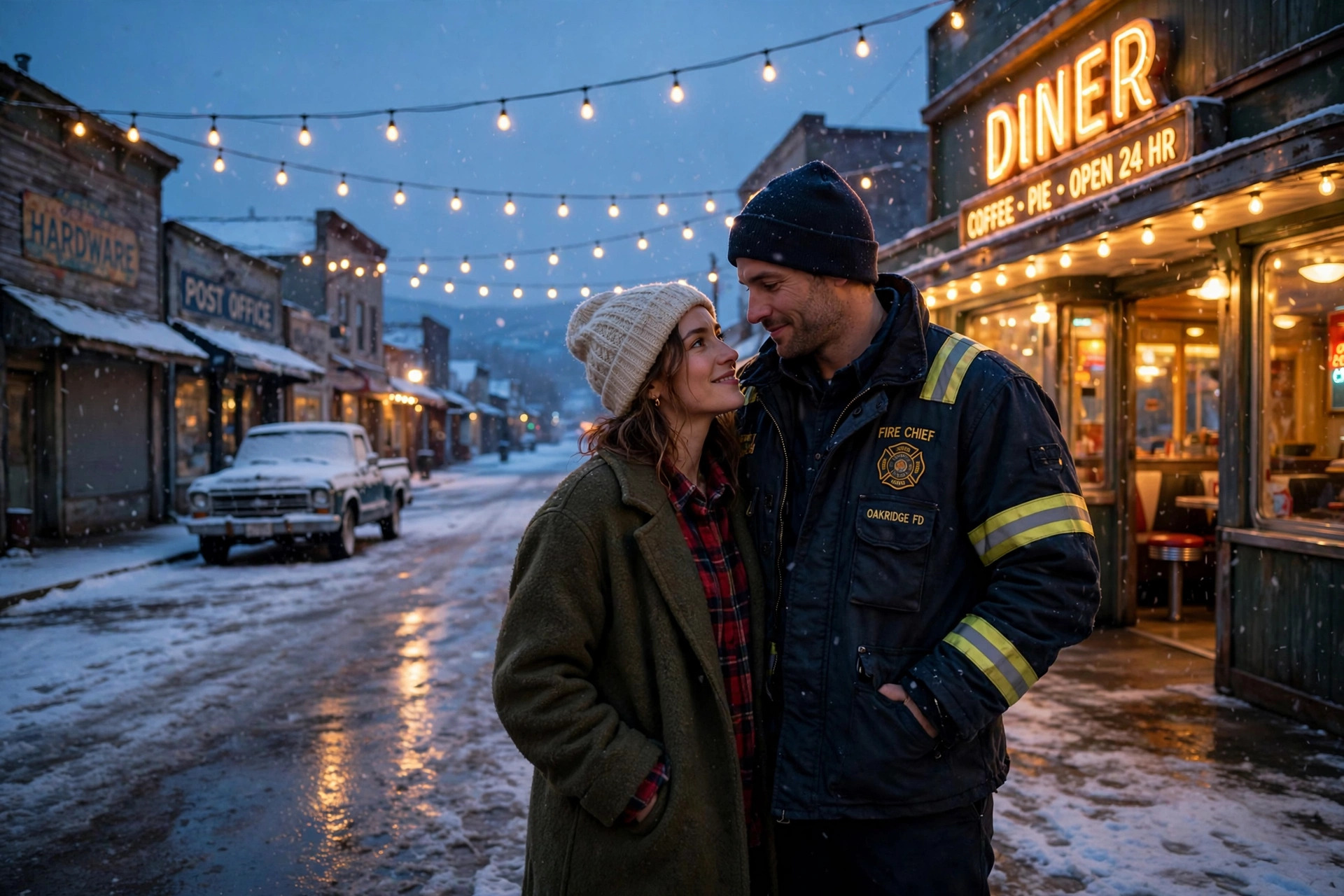
Route 9 opened at 10:40, forty minutes late and thoroughly annoying, and Maren rode down out of the hills in Dee's truck with a thermos of cocoa on her knees and a jar of salsa in her lap like contraband. The town came up out of the white a piece at a time: the stop sign, the feed store, the hardware store with its OPEN sign having the good day, and then Main Street itself, quiet and crusted and, if she was honest with herself, beautiful in a way the lakefront had never once been.
The Bluebird sat where it had always sat, between the pharmacy and a vacant lot where a bowling alley used to be. Snow crowned the awning. Inside the dark windows, the counter and the stools waited like an audience that had agreed to be patient.
Dee left her at the door with a look that promised surveillance. "I'll be back with sandwiches. Do not sell the diner while I'm gone. Do not have feelings without witnesses. This town has rules."
The key was under the horse outside, because it had always been under the horse, and Opal had probably left it there on purpose. Inside smelled like nine years of nothing, plus one evening of everything. Maren stood in the middle of the room the way her grandmother's letter had told her to. She stood in the room. She looked.
She saw the booth where Dee and Brandt had argued about Norse gods. The counter where she'd said goodbye to half the town at her going-away pie brunch, which nobody had ever let her forget was named PIE-brated Farewell. The kitchen where her grandmother's recipe cards lived in a breadbox she now opened with both hands, finding, at the very back, an envelope with her name on it in Opal's round hand.
The letter said, in full: Sweetheart. If you're reading this standing in my kitchen, then you came back and you looked, and I won either way. Whatever you decide, do it at full volume. If a man who knows your salsa exists, consult him about everything except your heart. Love, Grandma, who is wherever the first snow falls, on purpose.
Maren Kowalski sat down on the floor of the Bluebird Diner and laughed and cried at the same time, which the diner, having seen decades of it, absorbed professionally.
Then she got up, wiped her face on a sleeve of Brandt's flannel, and called the developer from Milwaukee from the diner's ancient wall phone, because the signal had returned and the universe enjoys finishing a joke. She thanked him for his interest. She told him the Bluebird was not for sale. She hung up the phone, and it felt like setting down a truck she had been pushing for nine years.
When Dee returned with sandwiches and a de facto committee of six citizens who "just happened" to be walking past, Maren was standing on a chair pinning a paper to the corkboard: BLUEBIRD REOPENS SPRING. WINTER POP-UPS IN DECEMBER, SEE BELOW. HELP WANTED, ALL HANDS, NO EXPERIENCE REQUIRED, FREE PIE.
Main Street had not heard that much noise since the float contest of 2011.
Eight: First Night Back on Main
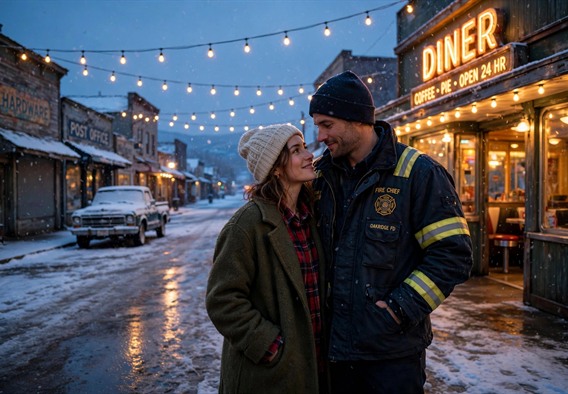
The Winter Pop-Up ran on a Saturday two weeks later, lit by borrowed string lights and heat from three space heaters and one argument. Snow came down gently all evening, the decoration kind, and the whole town came out in boots and envy. Dee ran the register. Dodie hawked salsa at the door like a barker at a fair. Rudy, of the smokehouse, guarded his brisket special with his life. The register sang so continuously that somebody put a hat over the bell.
Brandt arrived at closing hour still half in gear, smelling of winter and cold trucks, and stood at the end of the counter the way he had at nineteen, and Maren slid him a plate without being asked: eggs, toast, a scandalous quantity of salsa, a piece of cherry pie on the house.
"House rule," she said. "Eat what you fix."
"I fixed this," he said. "I fixed the chimney, I plowed the ridge, I mourned you correctly for almost a decade."
"Then it's all yours." She leaned her elbows on the counter across from him, close enough that the string lights haloed them both. "Brandt. Last thing unsaid. Say it with witnesses or without, your call."
He looked around the diner: Dee pretending to count straws, Dodie pretending to dust salt, the whole town conspicuously not eavesdropping at a volume audible from the street. He picked up her hand in front of everyone and laced their fingers together on the counter, and his voice didn't waver at all.
"I love you," he said. "Loved you at nineteen, loved you Tuesday in the storm, loved you in the empty booth in July when you weren't even here, which shows poor judgment and deep commitment. I'll love you at whatever volume you pick. Stay or go, that's yours. But I'm staying. Right here. At this counter. Asking you every day if you need anything else, and hoping you say pie."
"I say pie," Maren said, and the diner cheered, because of course it had all been listening, and someone started the jukebox, and outside the snow kept falling on Main Street like a town wrapping its arms around itself.
They reopened officially in the spring with a banner and a fire truck parked out front by official request, meaning unofficial hijacking, meaning Brandt. The loft above the Bluebird became an apartment in April, and by June the two rocking chairs from the Hollow Light sat on its little balcony facing Main, angled toward each other like old friends. Dee claimed guest rights. Dodie claimed dibs on Sunday pie. The town claimed everything, the way towns do, with both hands and no apologies.
On the first snow of the following winter, Maren found a jar of salsa in the cupboard with a bow on it and a card in Brandt's blocky hand. It said: For the box we don't keep anymore. No need to open it. Everything's out.
She put the jar on the counter, turned the OPEN sign around, and went to tell him that dinner was ready, standing in the room, at full volume, forever.
Sell it or save it, but decide it with your own hands, standing in the room.
Cedar Hollow is a fictional town, invented for this story. The salsa, regrettably, remains fictional as well, though readers report dreaming about it anyway.

Lila Monroe
Lila writes contemporary and small-town romance with banter-forward leads and soft landings. She believes the best love stories sound like two specific people, not a trope checklist.
Leave a comment
Comments