

The Orchard That Kept Burning
One: The Investigator
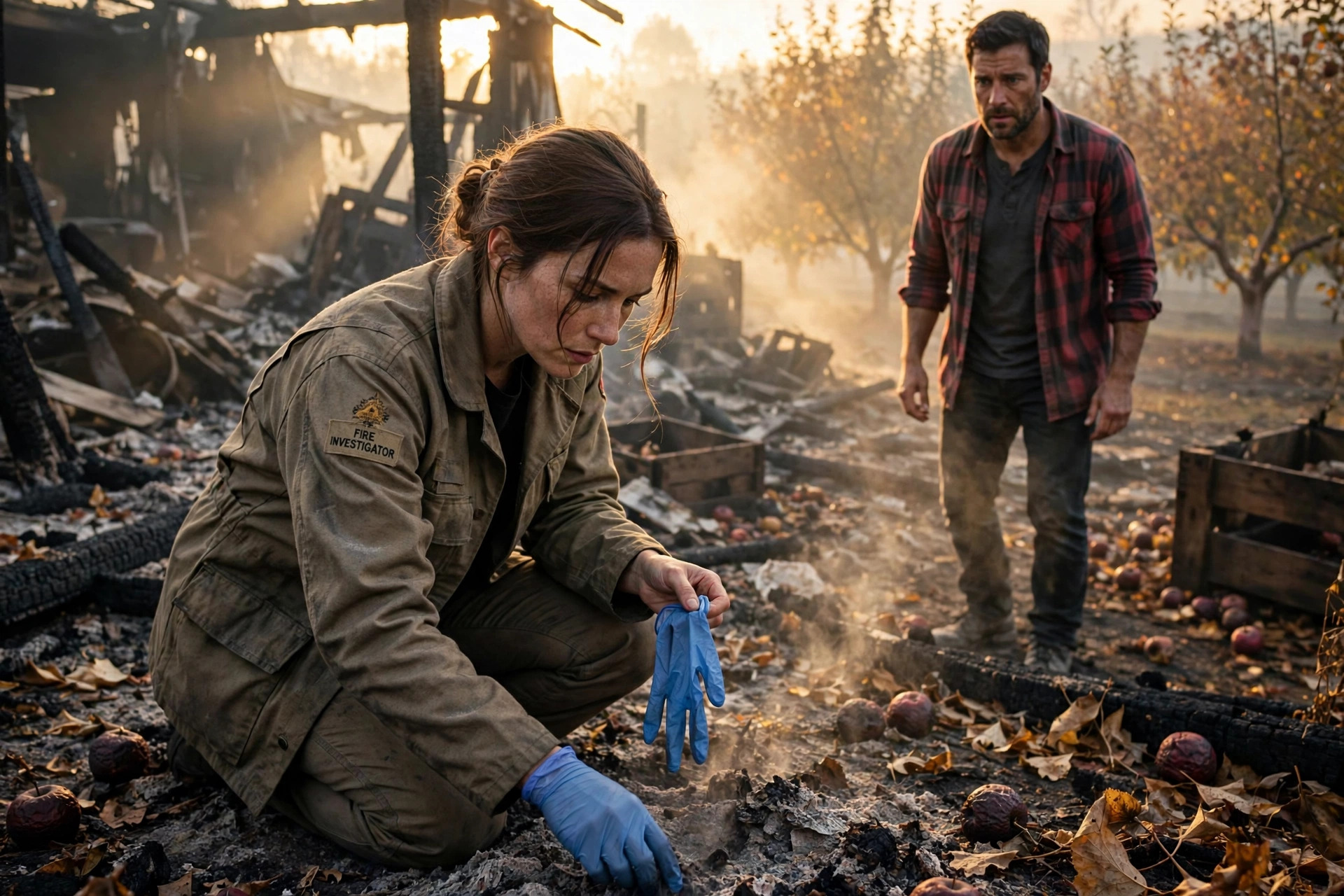
Mara Quist had a rule about crime scenes: nothing in the burned place belonged to her, not the grief, not the blame, not the ache that came from standing in ash and trying to imagine what someone had wanted badly enough to light a match for it. She repeated the rule to herself as she stepped out of her car at the edge of Hollis Orchard, because this fire had cost a family their packing house, and Mara was here to decide whether the family had lit it themselves.
Three fires in six weeks, all in the Alder Creek valley. All apple orchards. All small growers, the kind insurance companies paid grudgingly and called statistics behind closed doors.
The fire had burned the packing house down to its concrete pad, and the smell was the familiar cocktail of charred wood, melted plastic, and scorched fruit that never fully left her jacket. She pulled on her nitrile gloves and started the long slow walk of looking, the walk that most people assumed was boring and that she had come to love like a prayer.
"You're the investigator." The voice came from behind her, low and unhurried, with the particular flatness of a man trying very hard to sound calm. "They sent one person?"
Mara turned. He was tall, sun weathered, maybe mid thirties, with dark hair going silver at the temples early and forearms that suggested he did more in a day than most people did in a week. His eyes were the problem. They were a pale, clear green, and they were looking at her like she was either salvation or the last bad news of his life, and he hadn't decided which.
"I'm Mara Quist. Pacific Mutual Insurance." She held up her credential. "And one person is what a fire investigation gets, usually. You must be Mr. Hollis. Wes Hollis."
"Wes." He did not offer his hand. His gaze flicked to the ruins, then back to her, and something in his jaw worked. "You'll want to see where it started. The fire service thinks they know. They're wrong."
"The fire service is usually not wrong."
"This time they are." He turned and walked toward the pad without waiting to see if she followed, which meant she followed, because men who were sure and wrong were her specialty, and men who were sure and right were her rare delight, and she needed to know quickly which one she was dealing with.
He stopped at the northern edge of the slab, where the loading dock had been, and pointed at the blackened scar. "They're saying it started here, at the dock. Electrical, maybe, because of the compressor." He looked down at her. "But I moved that compressor out in June. Sold it. There's been nothing drawing power on that circuit since summer."
Mara crouched. She could see what he meant. The burn pattern did have that telltale low, hot start, and the wiring in question was, in fact, gone, sold off. Her stomach did the small drop it always did when the picture stopped matching the paperwork. "How do you know about fire behavior, Mr. Hollis?"
"Volunteer crew, eight years. structure fires, wildland, the whole north valley." He said it flatly, like it wasn't the answer that made him either the best witness she'd ever had or the best suspect. "You should also know I'm probably your prime suspect. Everyone in this valley has probably told you by now that I've been fighting with the growers' cooperative for two years, that I've got debt, that my ex wife moved to Sacramento and left me with a mortgage." His mouth curved, without much humor. "I'd rather you hear the list from me. Then you can go build the real one."
Mara stood slowly. Somewhere behind the ruined packing house, a single crow complained about the smoke. She thought about the rule, the one about not belonging to the burned place, and understood that this man was going to test it.
"Give me the day," she said. "I'll tell you what I find. Whether you like it or not."
"Fair enough," Wes Hollis said. "I'll make coffee. You look like a woman who's been up since four."
"I've been up since three."
"Then you look even worse than I thought," he said, and something that was almost, dangerously, a smile passed over his face before he turned away.
Two: The Grower
Wes made coffee the way his father had taught him, in a dented percolator that still lived in the truck barn because the packing house had always belonged to Ella, and Ella was gone now, gone to Sacramento with her trademarks and her clean slate and the good coffee maker. He carried two cups out to the slab, where the investigator was on her knees in the debris with a loupe and an expression of total absorption.
He should have been watching her for clues to what she was about to write in her report. Instead he was watching the way the early light caught the iron gray streak in her dark hair, the way she tucked it behind her ear with the back of her gloved wrist so as not to contaminate anything. She was maybe his age, compact and sturdy, a woman built like she could carry a hundred foot hose line and would, and there was a scar running through her left eyebrow that she hadn't bothered to explain.
Focus, he told himself. The woman was deciding whether to make his life significantly worse.
"Coffee," he said, holding out the cup.
"Not at a scene," she said, without looking up. Then she glanced at the cup, and at him, and something human moved behind the professionalism. "But you can leave it on the tailgate and I'll drink all of it when I'm done. That's a bribe I'll accept."
"What kind of bribe am I buying with bad percolator coffee?"
"The kind where you tell me about the cooperative fight while I work. Start two years ago and don't skip anything, even if it makes you look bad. Especially if it makes you look bad."
So he talked. He told her about the co-op's new contract, the one that cut the small growers' percentage and locked them into a processor nobody trusted. About the meeting where he'd stood up with the spreadsheet and said, out loud, in front of forty neighbors, that the math only worked if the co-op was skimming the small growers to cover someone's private losses. About the letters after that, the anonymous ones, YOU'RE SINKING THE SHIP, HOLLIS, about the nights someone let the air out of his tractor tires, about how the whole valley had picked sides the way valleys do, completely and forever.
She asked questions in a voice that never rose and never fell, and twice she asked him to repeat something, and he realized partway through the second hour that she wasn't testing his story. She was writing a different story underneath it. The one about who wanted the small growers gone.
"There were three fires," she said at last, sitting back on her heels. "Kestrel Farm, the Beam place, and now yours. What did they have in common, besides apples?"
"Small acreage. All of us refused the new co-op contract." He felt the cold move through him as he said it, the same cold he'd felt the night he stood in his barn and understood that the fire hadn't been random. "We're the holdouts. There are only four left. Me, the Danvers at Kestrel, old Mrs. Beam, and the Ashcrofts, up by the ridge."
"And the Ashcrofts burned?"
"There was a barn fire up there in September. Nobody connected it. It was called accidental, a heat lamp for the lambs." His voice came out lower than he intended. "Except the Ashcrofts don't have lambs. They haven't for years."
Mara rose, took off her gloves, and looked at the black slab of his packing house with the particular stillness of a person reorganizing the world. "Mr. Hollis," she said. "I came here with a one fire file. I'm leaving with something else. You should sit down for this part."
"I've been sitting down for this part for two years," Wes said, and handed her the coffee before she could refuse it twice.
Three: The Rules of Proximity
By noon they had a map spread on the tailgate of Wes's truck, the valley drawn in Mara's careful print, four small red circles where the fires had been, a constellation of grudges around them. Two of the fires were flagged with question marks, the September barn and a dumpster blaze behind the co-op's tasting room that the county had logged as juvenile mischief.
"Arsonists escalate," Mara said. "They start small and get confident. But this pattern isn't escalation, it's selection. Whoever set these knew which growers to skip. The Ashcroft barn, Kestrel, Beam, and you. In that order, roughly, oldest holdout to newest." She tapped the map. "Except one thing is backwards."
"What?"
"You're the loudest, the most visible, the guy who stood up at the meeting. If I were building this fire spree, you'd go first." Her eyes came up and held his, and Wes felt the look somewhere under his ribs. "You didn't go first. So either the fire setter isn't thinking like an arsonist, or they're not thinking about you the way the valley thinks about you."
"Which means what?"
"Which means I need to know who hated the co-op loudly enough to be obvious, and who wanted the holdouts gone quietly enough to be invisible." She folded the map with precise creases. "Also, I need to say something you won't like. I can't treat you as a witness until I've treated you as a suspect. Properly. Days of your life, and I'm sorry for that."
"I figured." He was quiet for a moment, looking out at the rows of trees that had been his grandfather's and his father's and were now, technically, the bank's. "My ex wife's brother works for the co-op," he said. "Grayson Pell. I'm telling you because you'll find it, and I'd rather you hear it from me."
Mara wrote the name down without ceremony. "Thank you."
"Don't thank me," Wes said. "It makes me feel like a man informing on his own family, which is approximately what it is."
Something crossed her face then, quick and gone, something that looked like recognition. "I know what that's like," she said, and then, visibly, deliberately, put it away. "The county fire marshal will want a joint scene on this. I'll request one. Meanwhile, the Ashcroft barn is still standing, partially. If the heat lamp story is wrong, there may be evidence left. If you take me up there, I'll want it noted that you did it willingly."
"I'll take you now." He shut the tailgate. "And Quist? Whatever you write in your file, when this is over, tell me the truth. Not the insurance version. The truth."
She considered him for a long second, the wind lifting that iron streak across her brow. "People who ask me for the truth usually regret it," she said. "But yes. Fine. The truth."
It was the first thing she'd said all day that sounded like it cost her something, and Wes found, uncomfortably, that he wanted more of those things from her. He wanted very much more of them, and he was going to have to be careful about that, because she was the person deciding whether he had a future at all.
Four: The Ashcroft Barn
They took the long dirt road up the ridge in Wes's truck, and Mara learned three things about Wes Hollis in forty minutes, none of which he intended to teach her. He knew every tree by its history, not its variety. He drove like a man who had nowhere better to be, which was sadder than driving fast. And when she asked him about his ex wife, he answered honestly and briefly, and then changed the subject to her scar with a boldness that startled her.
"Fire or ice," he said. "That's a burn scar, but it goes up, not down. Flare out of a firebox?"
"Wildland," she said. "Backdraft took a door off its hinges. Twin Rivers, four years ago. We lost two that day." She kept her eyes on the passing trees. "I left the fire service after. Investigating felt like a way to keep helping without being inside the fire."
"Does it work?"
"Some days."
"Today?"
"Today I'm standing in your barn looking at a heat lamp that was never plugged in," she said, "so let's call it a draw."
The barn was a black honeycomb, half collapsed, smelling of September's fire though the air had long since washed through it. Mara moved through it slowly, and Wes watched her the way he had watched his father read weather, the total attention, the stillness. Near the old lambing pen, she went down on her knees in the ash and came up holding something in her tweezers, delicate as a bone fragment.
"Bristle brush," she said. "The kind you finish barrels with. And this." She tilted the tweezers. A scrap of blue plastic, fused but readable. "Co-op chemical drum tag. Fertilizer shipment inventory. These went out on the February delivery to every member." Her voice was very controlled. "This barn burned from a fire that was carried here. Accelerant poured, or a device placed. Not a heat lamp."
Wes looked at the black beams overhead, at the loft where Ashcroft grandchildren had swung on ropes at harvest dinners he remembered attending, and felt the shape of the thing they were standing inside. "Someone is burning us out," he said. "One farm at a time. And the county called it a heat lamp."
"Someone with access to co-op materials, or the ability to scavenge them," Mara said. "Which is most of the valley, so don't build a case on the tag. But this changes my file, and it means the Ashcrofts, the Beams, Kestrel, and you are one list, and there are two names still on it that haven't burned."
She looked up at him then, and Wes watched her understand it in the same second he did. Her whole body changed, the investigator receding and something older, something that had run into fires, coming forward.
"Who's left," she said. "Name them."
"The Danvers are Kestrel. They already burned." He counted on his fingers, his heart going strangely. "Mrs. Beam, burned. Us, burned. That leaves the Ashcrofts and..." He stopped. "The Ashcrofts. And us again. There's no one left but the Ashcrofts and us."
"Then whoever is doing this isn't finished," Mara said quietly, "and we just found the proof that makes them nervous. Take a photo of me holding this, with the barn behind me. Then we're leaving, and you're not staying on this property alone tonight. And Hollis." Her eyes came up, fierce and level. "Neither am I staying anywhere alone. From now on, you and I are going to be very boring and very visible together, because the safest place for both of us right now is in each other's sight lines."
Wes heard the sentence twice, once as tactics and once as something with a completely different weight, and he was troubled by how much he liked the second hearing.
"Boring and visible," he said. "Ma'am, you just described my entire dating history."
The corner of her mouth moved. It was not quite a smile. It was the promise of one, and it undid him more than a smile would have.
Five: The Room With Two Beds
The only motel in Alder Creek had eight rooms, and the county marshal took two for the joint investigation, which left Mara and the problem of Wes Hollis standing in a room with a queen and a rollaway, because the clerk had opinions about economy and none about propriety.
"I'll take the rollaway," Wes said immediately.
"You're six two. You'll fold in half."
"I've slept in a brush truck folded in half."
"I've slept in a command vehicle folded in half," Mara said. "Fine. Rollaway for me. You stay on your side of the queen and I'll hear all about it if you don't, because I'm a light sleeper and I own a stun gun."
"Noted," Wes said gravely, and she realized they were both trying not to laugh, and that the laughter, if it got loose, would be the most dangerous thing in the room.
They ate takeout from the one place still open,Containers of noodles and a carton of rice between them on the motel desk, the case file spread around the food like a second meal. It was, Mara reflected, the strangest and best working dinner of her career. Wes read scene photos with a scientist's patience and a fireman's grief. When they got to the photo of the Ashcroft loft, he went quiet for a long time.
"I was up there once," he said. "Threshing party, years ago. Hal Ashcroft's daughter was on the rope swing, and everyone was hollering at her to jump farther." He pushed the rice around. "The Ashcrofts are in their seventies now. If the barn burns with them in it..."
"It won't," Mara said. "Because we're not going to let it. And because arsonists who escalate to people usually change their pattern, and I'll be watching for the change." She set down her fork. "Wes. Look at me. I have done this job eleven years and nobody has died on my watch, and I intend to keep that record, including the part where nobody dies is you."
He looked at her, and the room got small in a very specific way. "Say the part again," he said. "The watch part."
"Nobody dies on my watch," Mara said, "especially not you."
"That was almost tender," Wes said softly. "You want to be careful with a man who hasn't been looked after in a while. It goes to his head."
"Then I'll be careful," she said, and meant it in ways she declined to examine, and reached past him for the noodles, and their hands crossed over the carton and stayed there one second too long before she pulled hers back.
That night she lay on the rollaway with the lamp off, listening to him breathe on the far side of the queen, twenty inches of mattress and motel air conditioning between them, and she thought about the rule, the one about not belonging to the burned place. Wes Hollis did not belong to her, and she did not belong to this valley, and if she repeated it enough it might stay true.
"Quist," he said into the dark, so quietly she almost missed it. "In the barn, when you said people who ask you for the truth regret it. Who was it?"
"My brother," she said, because the dark makes honest people of everyone. "State fire marshal's office. He sat on a findings report for me once. Made me chase it for a year while a man who shouldn't have been cleared walked around free." A pause. "We don't talk."
"I'm sorry," Wes said. "For the file question. I didn't know."
"You didn't need to know. It wasn't relevant."
"It was relevant to me," he said, and rolled over, and said nothing else, and Mara lay in the dark for another hour pretending the sentence had not settled into her chest like a coal that refused to go out.
Six: The Co-op Dinner
The annual growers' dinner fell on the third night of the investigation, and the county marshal wanted them there, visible, taking notes. Mara put on the one clean blouse she traveled with and discovered Wes waiting for her in the truck in a collar she suspected Ella had bought him, looking rumpled and handsome in a way that made her furious at the universe's sense of timing.
"Rules," she said, buckling in. "Tonight we are friendly professionals. We don't interview anyone without the marshal present. We don't argue with anyone. And if Grayson Pell talks to you, you smile and say nothing, because he'd love a reaction."
"Understood." Wes pulled out of the lot. "You should also know you look nice, since professional honesty is apparently our thing."
"That is not professional honesty, that is a violation of the spirit of the rules."
"The rules you made," he pointed out. "The spirit is your department."
The co-op hall smelled of pot roast and politics. Forty growers, the board at the head table with their fourth year of fat annual reports, and Mara cataloguing the room by sightlines and exits out of habit. Wes was greeted by half the room with warmth and the other half with the careful blankness of people who have chosen a side, and she watched him carry both with the same straight spine, and wanted, inconveniently, to stand next to him the entire night.
Grayson Pell came to their table during dessert, all teeth and cufflinks. "Wes. Heard your insurance has you running around with an investigator. That's one way to stretch a payout." He turned the smile on Mara. "Ma'am. Hope they're paying you enough to dig through one man's bankruptcy for a paycheck."
"Pacific Mutual sends me where the fire patterns send me," Mara said pleasantly. "Though I confess the pattern has been interesting. Tell me, Mr. Pell, did the co-op's chemical inventory reconcile after the February shipment? There's a question on my form about missing drum tags."
She watched it land. Not a flinch, exactly. A recalculation. Pell's smile stayed but his eyes did the arithmetic, and somewhere behind them a door closed.
"I'd have to ask the office," he said. "You enjoy the pot roast." And he moved off through the crowd a shade too fast, and Wes leaned toward her under the pretense of refilling her water.
"He didn't ask what drum tag," Wes murmured. "He already knows there's a missing one."
"I noticed," Mara murmured back, and their heads were close, and his shoulder was warm against hers, and for three seconds the entire dinner existed somewhere else, and then the lights flickered.
Once. Twice. Then the whole hall went dark, and Mara was moving before conscious thought caught up, hand on Wes's arm, guiding him out the side door into the parking lot where the night air was cold and the valley spread out below them like a spilled jewelry box.
"Transformer," someone said inside. "Squirrel, probably."
But Mara was looking north along the ridge road, where the dark had a wrongness to it, where the Ashcroft farm sat unlit, and her skin was doing the thing it had learned to do in years of fire, the thing that knew before she did.
"Wes," she said. "Call the Ashcrofts. Now. Tell them to get out of the house, calmly, and drive to the co-op. Don't say why."
"Why not say why?" He was already dialing.
"Because if it's who I think it is," Mara said, watching the ridge, "the fire won't start until they know we know. We need them moving before panic does our work for us."
Hal Ashcroft answered on the second ring, confused, agreeable, slow. Wes talked him through it in a voice calm as lake water, and eight minutes later a pair of headlights crawled down the ridge road, and two minutes after that, Mara's phone lit with the county marshal's number, and a red glow began to bloom behind the Ashcroft orchard where the barn had already burned once and should have had nothing left worth burning.
"They're burning the old cidery," Wes said, standing beside her in the parking lot, his hand white on the truck door. "The original building. Hal's grandfather built it."
"Then we've got a pattern break," Mara said. "Which means we rattled them, and rattled means close. Get the marshal on the line and give him the drum tag, the date, and Pell's name, and then, Hollis, get in the truck, because if the person who set that fire sees us leaving together, we've just confirmed exactly which two names are left on their list."
"Good," Wes said, opening her door for her with a courtesy that was entirely at odds with the look in his eyes. "I'd rather they think about us than about Hal."
Seven: Almost
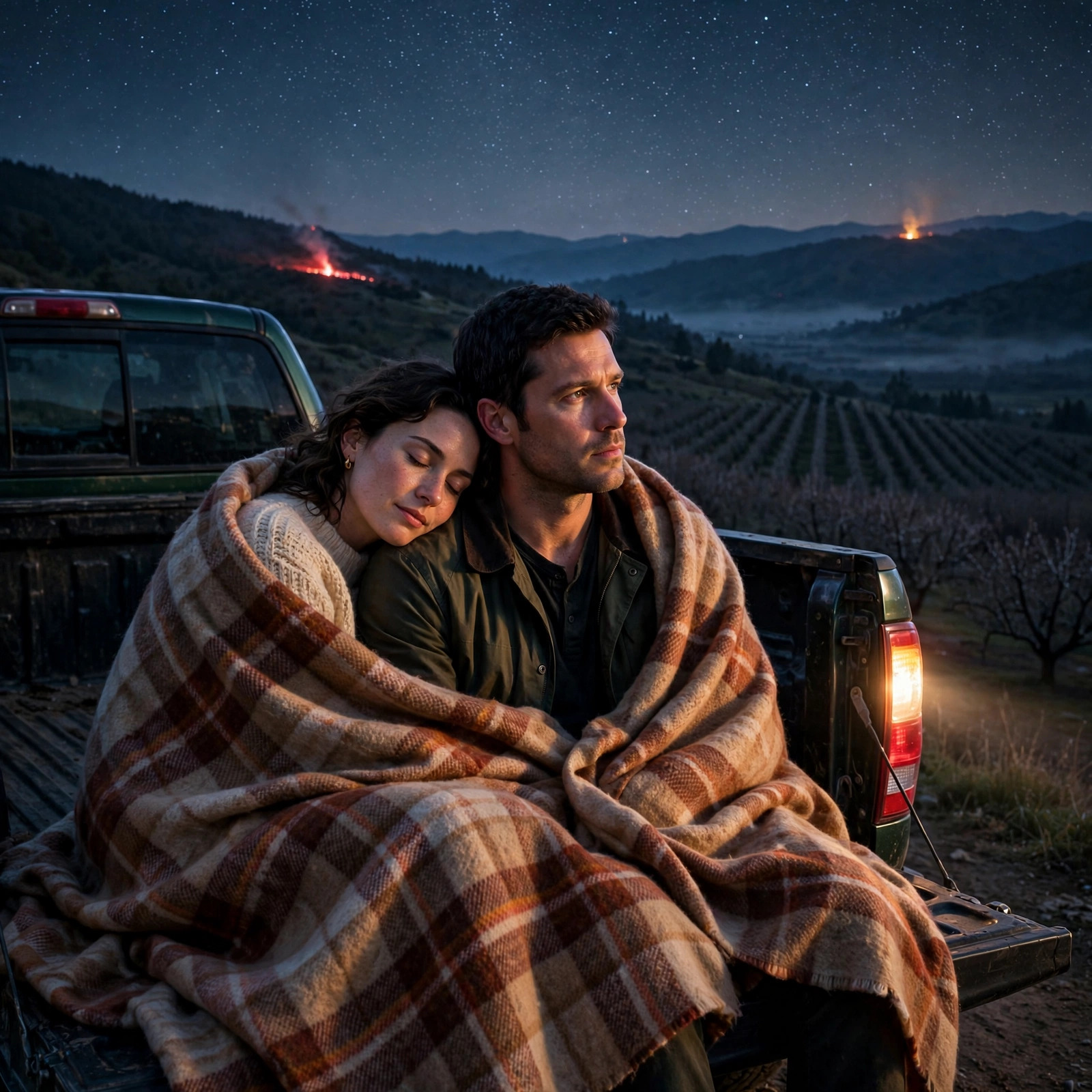
The cidery fire turned out to be small and professional, a burn barrel job against a stone wall that would singe and scare and not kill, which told Mara more than a big fire would have. The Ashcrofts were safe at the co-op hall drinking coffee under the marshal's care. The valley was awake and frightened. And Mara and Wes spent the night on the shoulder of the ridge road waiting for the county's fire crew, sharing a blanket from his truck because the wind had teeth.
Somewhere around two in the morning, with the fire out and the crew packing up, they sat in the open tailgate of the truck with the stars doing their enormous indifferent work overhead, and Wes said, without looking at her, "Ask me the question you've been not asking since the barn."
Mara wrapped the blanket tighter. "Why did the fire service like you so much, and the valley turned so hard? What happened two years ago, before the co-op contract? The real beginning."
He was quiet long enough that she thought he wouldn't answer. Then: "There was a fire at Kestrel. Six years ago now. The Danvers' original barn. A kid from the valley got in with fireworks, panicked, and bolted when it caught. Everyone assumed it was one of the Hollis hands. My hands. The Danvers said so at a public meeting, that the Hollis crew had been drinking up there, which wasn't true, and it stuck. I spent two years trying to disprove a story that felt better than the truth, and by the time the kid confessed, the valley had already made up its mind about us." He turned the truck keys over in his hand. "The co-op fight came after. It just gave everyone a socially acceptable reason to keep believing the worst."
"And your ex wife?"
"Ella couldn't live in a town that had decided what we were. I don't blame her. She asked me to sell and leave with her, and I said the orchard would outlive this." He looked at the dark rows below the road. "The orchard was right. She was faster."
Mara looked at him in the starlight and felt the carefully maintained professionalism of eleven years strain at its seams. "Wes."
"Yeah."
"If I tell you what I'm thinking right now, it would be a problem."
He turned his head. In the dark his eyes were all pupil and patience. "Tell me anyway."
"I'm thinking that in eleven years I have never once wanted to be wrong in a report," she said slowly, "and right now I want you to be innocent so badly that it's compromising my judgment, and I can't, I don't operate that way, and this valley is one wrong move from burning someone, and I have to be the coldest person in it for a few more days, and I'm standing on the edge of something with you that I..."
"Mara."
"I shouldn't have said any of that." She was already moving to slide off the tailgate, retreating into procedure the way she retreated into procedure, and his hand closed gently around her wrist, not pulling, just there, warm through the glove she wasn't wearing because it was two in the morning and she had stopped being careful.
"You didn't finish," he said.
"I can't finish it." Her pulse was beating against his fingers and she knew he could feel it, and hated that he could feel it, and didn't move. "If I finish it and then your file doesn't come back clean, I'll have used you badly, and you deserve better than being wanted while under suspicion by the person holding your whole future." That was the heart of it, the thing she had never said aloud to anyone. "Do you understand? Anything that happens between us before the truth does is me taking something from you."
For a long moment Wes Hollis looked at her, and then he let go of her wrist, slowly, and Mara felt the loss like cold water.
"You heard the list," he said quietly. "The debt, the ex wife, the co-op fight. You heard me tell you I'm your prime suspect. So here's mine, and it's the whole list. I want to kiss you and I'm not going to, because you're right, and I hate that you're right, and I respect the hell out of a woman who holds a line when it costs her something." He closed the tailgate. "But I want you to hear one thing, Quist. When the file comes back clean, and it will, because I didn't do this, I'm going to finish that sentence for you. So don't go find another fire in another county before I get the chance."
"Wes..."
"Goodnight, Mara," he said, and got in the truck, and drove them both back to the motel in a silence that was the loudest thing either of them had ever heard.
Eight: The Financial Ghost
The marshal's office came through in forty eight hours the way Mara's careful phone calls had asked it to, and the picture assembled itself the way the worst pictures do, out of ordinary paperwork. Grayson Pell had private losses,追踪 the co-op's off book investments, four years of quiet borrowing against the co-op's credit line to cover trades that kept losing. The new grower contract had been written to service that debt. The small holdouts were the only growers whose payments the co-op actually needed to make its own loan covenants work, and if the holdouts sold out or burned out, the co-op could buy their cheap land, consolidate, and refinance the debt before the audit everyone knew was coming.
"He wasn't punishing you," Mara said to Wes, in the marshal's borrowed office, with the folder open between them. "He was harvesting you. The fires were cost of goods."
Wes looked at the statements for a long time. "My ex wife's brother," he said finally. "Family dinners. I taught him to drive a tractor."
"He'll be charged. The tag evidence from the barn, the utility records on your compressor circuit, a boil over of financial forensics, and two witnesses who saw Pell's truck on the ridge road the night of the Ashcroft fire." She closed the folder. "It's contained, Hollis. The threat is real and it's handled."
"The file," Wes said. "My file. What does it say?"
Mara had rehearsed this moment in the truck that morning, sitting alone in the co-op parking lot, and every version had been professional. She looked at the man across the desk, the man who had made her coffee she'd forbidden herself to drink on scene, who had told the truth about the worst things in his life without being asked twice, and the professional version dissolved.
"It says one hundred percent accidental is off the table and arson by the insured is ruled out," she said. "It says Wes Hollis was the victim of a conspiracy, not a suspect in one. It says I'm recommending the claim pay in full and fast." She set the folder on the desk and slid it toward him. "And it has nothing, nothing, to do with the other thing I came here to say."
"Which is?" His voice had gone very quiet.
"Which is that I finished the sentence." Her hands were not entirely steady and she let them be, because honest meant honest. "In the tailgate, on the ridge road, I was going to say that I was standing on the edge of something with you that I have never once in my adult life let myself stand on, and that I walked away from the edge because I was protecting your file instead of you. The file is done. There's nothing left in it to protect. So." She took a breath that shook on the way out. "Ask me again. Or don't, and I'll say the rest of it myself, but one of us is finishing that sentence today."
Wes stood up. He came around the desk slowly, the way you approach a fire you've decided to go into, and stopped close enough that she could see the silver in his temple and the exact geography of the smile that had been threatening her for two weeks.
"Mara Quist," he said. "I'm going to kiss you now, and if any part of you wants to invoke a rule, this is your last chance."
"Rules," Mara said, "were a two week emergency measure."
When he kissed her, it was careful and then it was not, one hand at her jaw and the other finding her waist with the certainty of a man who had been thinking about exactly this through two burned farms and a blanket on a tailgate and a hundred inches of motel mattress. Mara's fingers curled into his collar, the one Ella had bought him, and thought that she was going to buy him a better one, and that thought made her laugh against his mouth.
"What," Wes murmured.
"Nothing," she said. "Nothing at all. Come here."
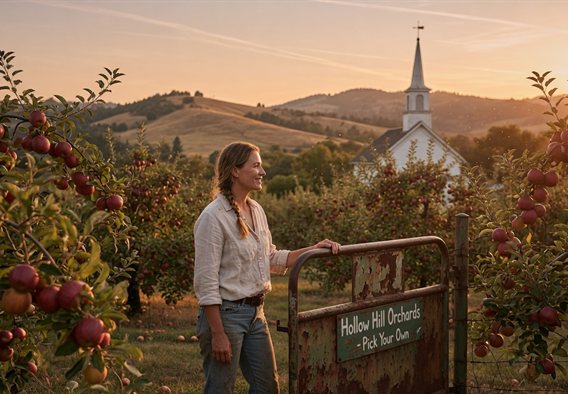
Out the borrowed office window, the valley lay in full October color, the Ashcroft trees heavy with fruit, the Kestrel rows already replanned, and somewhere on the ridge the orchard that had kept burning was finally, after everything, allowed to be just an orchard.
Nine: Cider Season
They gave it three weeks, both of them, out of respect for the town's need for something other than romance to talk about. Pell was arraigned on a Tuesday. The co-op board dissolved itself by Friday. And on the first genuinely cold morning of the year, Wes drove Mara up the ridge road to the Ashcroft farm, where Hal and his wife had insisted on pressing the first cider of the season with their own hands, in the old stone cidery that had survived everything, singed but standing.
"You know what I keep thinking about," Wes said, taking her hand as they walked the rows, the late apples hanging gold in the cold. "The tailgate. Not the almost. The after. The way you looked when you finally said the true thing out loud, like you'd set down something heavy you'd been carrying so long your arms had forgotten its weight."
"I keep thinking about your coffee," Mara said. "It's terrible. I've decided I love it. I've decided I love it in a way that concerns me."
"Move here," Wes said. It came out plainly, no ornament, because he had learned by now that she took things plain. "The county needs a fire investigator with your instincts. The valley needs someone who refuses to believe convenient stories. And I," he stopped between the rows, under the last of the leaves, "have a queen bed and no rules left and a very limited number of mornings I'm willing to do without you."
Mara looked up at him, at the orchard, at the small bright town below the ridge where people were, slowly, doing the work of un-deciding what they had decided about the Hollises. She thought about the rule she had carried for eleven years, the one about not belonging to the burned place, and understood that she had never actually been protecting herself with it. She had been afraid of belonging anywhere at all.
"I'll need a filing cabinet," she said. "And a Sunday, eventually, to drive down and see my brother. We're not done talking, he and I. But we're starting."
"Deal," Wes said. "Filing cabinet. Sunday. Anything else, negotiator?"
"One thing." She pulled him down by the collar and kissed him in the cold gold light of the row, unhurried, with the whole valley below and nobody's file to wait for, and when she finally pulled back she was smiling the smile he had been promised on a tailgate at two in the morning, arrived at last, in full, with interest.
"I'll want the truth from you," Mara said, "forever. Even when it costs something. Especially then."
"Quist," Wes said, laughing, tucking her against his side as the first wind of winter came down off the ridge and shook loose a few last leaves, gold spiraling down around them onto ground that would sleep all winter and wake as blossom. "You just described the entire terms sheet. Where do I sign?"
"Everywhere," she said. "Sign everywhere."
And he did, in the way that mattered, for years, in a valley that kept its orchards, beside a woman who kept her word.
The End
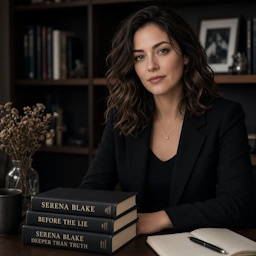
Serena Blake
Serena writes romantic suspense and dark romance for readers who want pulse and payoff. Her stories chase trust as hard as they chase danger.
Leave a comment
Comments