



The Protection Detail
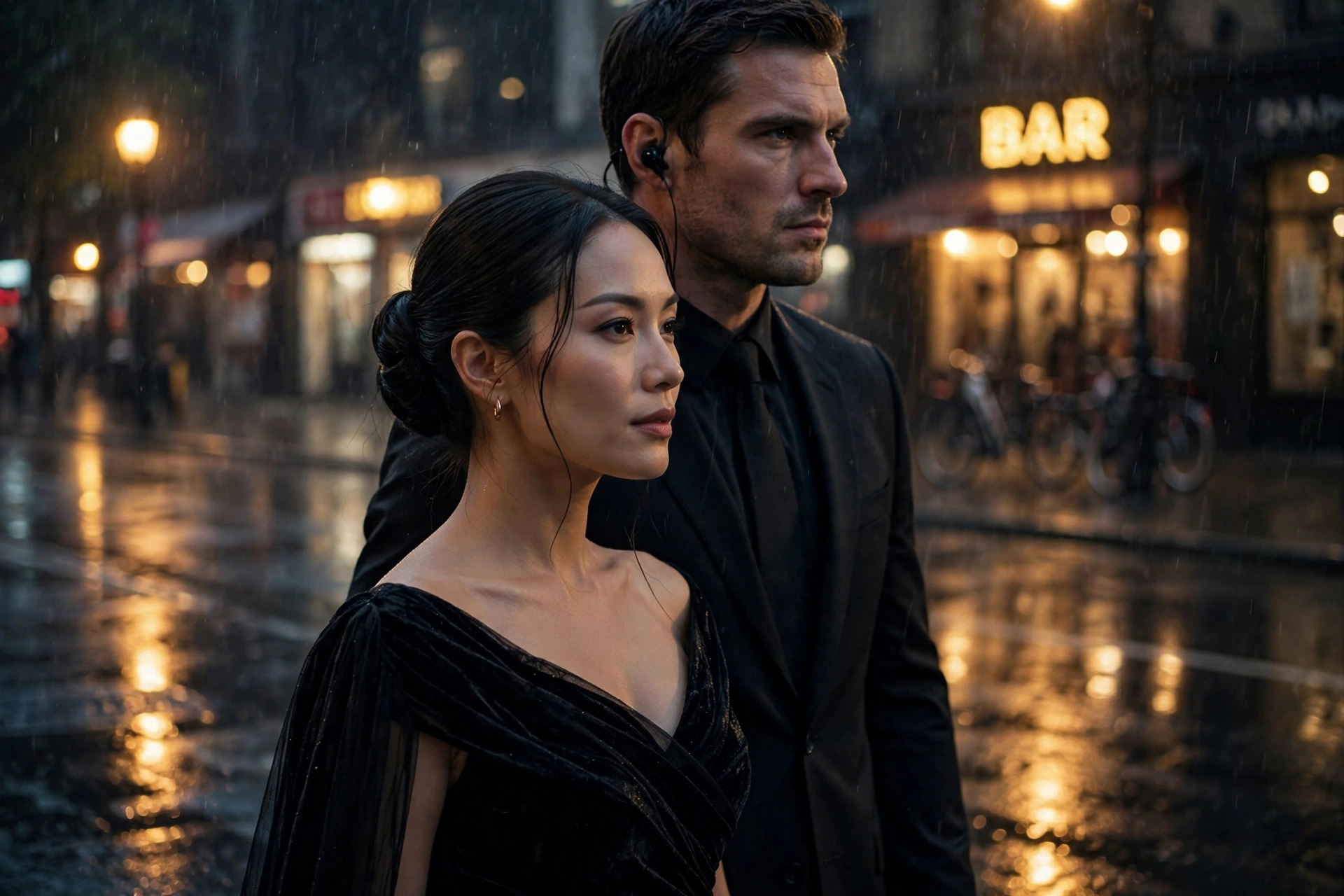
What happens when the one person you are paid to protect is the one person you are forbidden to touch, and the one person you cannot stop wanting?
The file arrived at nine in the morning, and Dario Voss knew before he opened it that it would ruin him a second time.
He had been out of the protection business for fourteen months. Fourteen months of watching other men walk clients through lobbies he used to own, of teaching defensive driving to teenagers whose fathers paid in cash, of drinking bad coffee in a rented office above a dry cleaner in Queens. Fourteen months of replaying the night in Prague, frame by frame, the way you pick at a wound because you deserve the pain.
The email was from Blackline Security, the firm that had fired him. The subject line read: REINSTATEMENT CONSIDERATION, ONE CONDITION.
Inside the file was a photograph of Elena Marchetti, thirty-one years old, sole heir to the Marchetti import empire and, as of six weeks ago, the woman whose sworn testimony had ended his career.
Dario sat very still in his cheap chair and read the file twice. Then he read the condition.
Client has specifically requested D. Voss. Client is aware of the conflict of interest. Client has signed a waiver acknowledging the personal history between principal and agent. Strict professional boundary protocol applies. Any breach is immediate termination, no arbitration.
She had requested him. The woman who had stood up in a federal hearing and said his name in the same sentence as the word compromised wanted him within arm's reach.
He should have said no. Every survival instinct he owned, honed across eleven years of close protection work in places where people died for being in the wrong doorway, told him this was an ambush wearing a silk dress.
He signed the contract at 9:47 in the morning and was standing outside her building by noon.
The Woman Who Ended Him
He had seen Elena Marchetti maybe a dozen times before Prague, always at a distance, always through the professional lens. Daughter of Aldo Marchetti, the shipping magnate whose empire Blackline had been quietly protecting for a decade. She ran the charitable foundation, the galleries, the part of the business that existed to make the other part look respectable. She was famous for her composure. Photographers complained that she never gave them anything.
Then Prague had happened, and Dario had learned exactly what she was capable of giving when she chose to.
The Marchettis and the Sandoval family had been at war for years, a cold war of lawsuits and sabotage and one unfortunate incident involving brake lines that nobody had ever proven. Dario had been sent to Prague to escort a courier carrying documents that would have ended the Sandovals forever. Elena had been in Prague on foundation business, a coincidence, everyone said, though Dario had never believed in coincidences in that family.
What happened in Prague was this: the courier was compromised. The documents were stolen. Dario Voss, decorated, incorruptible Dario Voss, was found the next morning in a hotel bar with a woman he did not remember leaving with, and a photograph of the two of them was in the hands of every interested party by evening. The story wrote itself. The agent had been played. The agent had been drunk. The agent had, possibly, been bought.
Blackline suspended him. The Marchettis demanded a scapegoat. And Elena Marchetti, in a federal hearing about the leaked documents, was asked whether she trusted her family's security apparatus, and she had said, in a voice like a blade wrapped in velvet, that she trusted nothing that could be compromised, and then she had looked directly at the record and made sure everyone understood she meant him.
He had never spoken to her. Not once. Eleven years protecting her family's world, and he had never earned a single word.
And now he was her shadow.
The Rules of the Cage
The boundary protocol was four pages long and Dario had read every clause with the attention of a man memorizing the shape of his own execution.
No physical contact outside emergency intervention. No private conversations beyond operational necessity. No meetings without a third party present or recorded. No sharing of personal information. No gifts. No alcohol consumed in the client's presence. Weekly compliance check-ins with a designated compliance officer, a gray woman named Patricia Oh who looked at Dario the way a coroner looks at a body that keeps sitting up.
The rules existed for good reasons, and he knew them better than the people who wrote them. Protection work ran on proximity. Proximity produced intimacy. Intimacy produced leverage, and leverage was the currency of every enemy his clients had. A bodyguard who loved his principal was a bodyguard who could be turned, blackmailed, or blinded. He had watched it happen to other men. He had been convicted of it in absentia, in a hearing room full of strangers, without ever having committed the crime.
That was the cruelty of it. The rule that would destroy him this time was a rule he had never broken the first time.
He recited the clauses to himself in the elevator up to her penthouse, and then the doors opened, and Elena Marchetti was standing in the middle of a room the size of his entire apartment, and every clause evaporated like breath on glass.
She was not beautiful in the way the magazines meant it. She was beautiful the way a verdict is beautiful, if you were the kind of person who found certainty beautiful. Dark hair cut sharp at the jaw. A charcoal suit with no jewelry except a watch worth more than his severance. She was standing very straight, the way people stand when they have been standing alone for a long time and have made peace with it.
"Mr. Voss," she said. "Thank you for coming."
"You didn't leave me much choice," he said, and immediately hated himself, because the protocol said no private conversations, and this was already a private conversation, and they were forty seconds in.
Something moved at the corner of her mouth. Not a smile. The ghost of one, filed for later. "There's a recorder on the console," she said. "Everything in this meeting is documented. Patricia Oh has the file. I read the rules, Mr. Voss. I wrote half of them." She turned and walked toward the windows, and he followed at the regulation distance, close enough to die for her, far enough to be legally invisible. "I want to tell you why I asked for you, and I want it on the record, so that when you hate me, you'll at least hate me accurately."
What She Wanted On the Record
"Three weeks ago," Elena said, "someone put a dead songbird on the hood of my car. Wrapped in a page from my father's old shipping ledger. The Sandovals are signaling that the war isn't over, and my father wants me invisible until the board meeting in December. Standard detail. Except."
She stopped at the glass. Sixty stories down, the city was doing its gray morning business.
"Except every member of my current detail has been with the family five years or more. Every one of them answers to my father first and me second. And in Prague, Mr. Voss, when my life was in genuine danger, when the courier was taken and the shooters came to the hotel, it was your voice on the radio moving me out through the kitchen. You had never spoken to me. You did not know my face beyond a briefing photo. And you spent forty minutes walking me through a burning service corridor like I was the only thing in the world worth saving."
"That was the job," Dario said.
"That was the job," she agreed. "And then you were fired for it, and I helped fire you, and I have spent fourteen months knowing that what I did in that hearing was not justice. It was survival. My father needed the story to be about a compromised agent and not about a compromised courier, and the compromised courier was a man my father had personally vetted, and if that came out, the board would have eaten him alive. So I gave them you."
She turned around. Her face was perfectly composed. Her hands were not; they were folded so tightly the knuckles had gone pale.
"I am not asking you to forgive me. I am asking you to keep me alive until December, and I am asking you to do it because you are the only person in my father's orbit whose loyalty was never for sale, which I know because I destroyed his name proving it. Is that accurate enough for your hatred, Mr. Voss?"
The recorder's small red light glowed on the console between them like a third person in the room.
"You could have apologized," he said. "Off the record. Like a human being."
"Off the record, you wouldn't believe me. On the record, you can't afford not to." She unfolded her hands. "I've been told I'm cold, Mr. Voss. It's the family disease. But I am not stupid, and I am not cruel without a reason. Everything I do has a reason. You'll learn that, if you stay."
He stayed. God help him, he stayed.
Proximity Is a Slow Poison
The first month was a masterclass in discipline.
He learned her rhythms the way he had learned a hundred principals before her. She woke at five and ran the stairs of her building, forty floors, alone, which violated his every instinct and which he solved by running them twenty steps behind her in the stairwell, close enough to hear her breathing go ragged at floor thirty and even out again by thirty-five. She drank black coffee and read three newspapers and annotated them in a shorthand he eventually cracked, a habit from a childhood spent reading her father's mail upside down at the dinner table because it was the only way anyone in that house paid attention to her.
She was funnier than her reputation. Her humor was dry as bone and arrived without warning, aimed at the powerful and the pompous, and she never aimed it at him, which he noticed, and which he resented himself for noticing.
And she watched him. Constantly. Professionally at first, the way a chess player watches a board. But by the second week, he caught the other thing in it. Hunger, maybe. Or grief. The look of a woman studying the one person in her gilded world who had every reason to despise her and stayed anyway.
The threat pattern escalated on schedule. A car that lingered. A photographer with a telephoto lens who was not a photographer. A server at a gala who touched her wrist and left a bruise like a fingerprint. Dario intervened on that one, and the contact was authorized, emergency intervention, his hand closing around the man's wrist and removing him from her orbit with a violence that surprised them both.
Afterward, in the town car, she looked at the red marks on her own wrist and said, "Thank you," and the recorder in the dash caught it, and it was the most intimate thing anyone had said to him in fourteen months.

"You're staring," she said one night, week six, as the city slid past the windows.
"That's the job."
"Everything is the job with you." She was looking out at the river. "Do you know what I did the week after the hearing? I bought every transcript. I read my own testimony forty times. And I wrote you a letter I never sent, explaining it, and then I realized the letter was not an apology, it was a confession, and I burned it in the sink of my kitchen like a teenager, and the smoke alarm went off, and I stood there under it thinking, this is the most honest thing that has happened in this apartment all year."
"Ms. Marchetti," he said carefully, "this is a private conversation."
"I know." She finally turned to him. In the dark of the car her eyes were nearly black. "The recorder is on. Let it record. I want there to be a record of the exact moment I stopped pretending."
He should have reported the conversation. The protocol required it. He sat in his apartment that night with the compliance form open on his laptop, and he typed client engaged in non-operational discussion, and then he deleted it, and then he sat with his hands flat on the desk for a long time, understanding with total clarity that he had just made a choice, and that the choice had a shape, and the shape was a woman.
The First Breach
The breach, when it came, was not what either of them expected. It was not a hotel room or a drunken night. It was a hospital.
In November, the dead songbird became a live threat. A Sandoval crew hit one of the Marchetti warehouses with the family inside it, and Aldo Marchetti took a bullet through the shoulder, and the whole rotten machine went into the streets with its teeth out, and Dario's entire job became keeping Elena out of the crossfire while she ran her father's empire from a surgical waiting room.
Seventy-two hours without sleep. He had done it before. But not for her, and not while she came apart in front of him, the composure cracking seam by seam until, on the third night, in a corridor that smelled of antiseptic and old rain, she leaned against the wall and slid down it an inch, just an inch, and he caught her.
Contact. Unauthorized. His hands on her shoulders, her forehead against his sternum, her breathing wrecked and ragged while he said the things bodyguards say, you're safe, I have you, breathe, and none of it was protocol and all of it was true.
"I'm sorry," she whispered into his shirt. "I'm so sorry, Dario. Not for the hearing. For Prague. I knew the courier was a setup. I knew before you landed. I had a chance to warn you and I used it instead. I let them take the documents because my father needed the Sandovals exposed and I needed you alive and those two things were only both possible if you walked into it blind and walked out a scapegoat. I did that math with your life and I have to live with it and I wanted you to hear it from me before anyone else dies."
He held her in a hospital corridor at three in the morning, the woman who had burned his career to save his life, and he understood that he would never be free of her, and that he did not want to be.
"You could have told me," he said. "Afterward. Any time in fourteen months."
"And give you the power to destroy my father? You'd have earned it. You'd have been right to." Her laugh was a broken thing. "I couldn't hand you that weapon, Dario. It was the only thing keeping my family standing. So I hired you instead. The one man I couldn't buy, standing between me and the consequences of what I did. It's the cruelest thing I've ever done to anyone and I'd do it again."
"Elena." Her first name. The first breach of the night, the one that mattered. "You don't get to decide what I can survive. That's mine to decide."
She pulled back far enough to look at him, and her eyes were wet and furious and alive. "Yes," she said. "Yes. All right. Then decide."
"Decide what?"
"Decide what you want from me. Because I know what I want from you and I have known since the stairwell, and I am not going to spend December pretending otherwise. But I want it said out loud, by both of us, awake and sober and recorded in neither of our memories as anything but a choice."
There, in the corridor, with his hands still on her shoulders and a war starting outside the glass doors, Dario Voss said, "I want you. Not the principal. Not the job. You. And I have wanted it since the stairwell too, and it terrifies me, because wanting you is how they get me, and you know it, and you're asking anyway."
"I'm asking anyway," she said. "That's what makes it a choice and not a weakness. I'm not falling into this. I'm walking in with my eyes open and I'm asking you to do the same, and if you say no, I will never mention it again, and I will keep you on the detail until December and thank you every day."
He said yes. Of course he said yes. The question had only ever been how much it would cost.
The Price of the Choice
They were not careless. That was the thing the tabloids would never have understood if it had ever come out. Two people who had already lost everything to a single photograph do not stumble into another one.
They built their own protocol, the two of them, in the same language of clauses and check-ins, because structure was the only intimacy either of them trusted. Consent, explicit and ongoing. Hours carved out where the detail ended and the people began, documented in their own private ledger, a shared note on an air-gapped tablet that said things like Tuesday, 9 p.m. to midnight, off record, both willing, both sober, both certain. Either of them could end any of it with one word and the other would step back without argument. They practiced saying the word once, in her kitchen, like a fire drill, and it was somehow the most erotic and the most reassuring thing Dario had ever done.
He learned her. Not the magazine version. The version who read her father's mail at nine years old because love in that house was a ledger. The version who had funded three women's shelters anonymously because her grandmother had never been able to leave her grandfather. The version who touched him like she was asking permission every single time, and melted when he gave it, and gave it back doubled.
And she learned him. The version who kept a list of every client he had ever lost, written on the inside of a notebook he had carried since he was twenty-two. The version whose hands shook after violence, never during. The version who, on the fourth night, told her about Prague from his side, the drink he had not finished, the woman whose face he still could not describe because he genuinely did not remember it, and the way the whole world had decided the simplest story about him and never once asked if it was true.
"You asked," he said, stunned, the night she believed him without needing evidence. "You're the first person who ever asked."
"Evidence is for court," she said against his shoulder. "I'm not a court. I'm the woman who owes you her life twice over. I'll believe you on credit."
The cost arrived in December, on schedule, the way costs do.
What the Rule Was For
Patricia Oh called him in on the eleventh. Not a compliance check. A termination hearing.
"Someone leaked the stairwell," she said. "Not the hospital. Not the town car. The stairwell, from week two. There's a photograph, Mr. Voss, of you running twenty steps behind Elena Marchetti, and a voice memo from the building's security contractor in which you can be heard saying her name in a tone that is not operational." She slid the printout across the table. "The Marchetti family legal team is demanding your removal. Aldo Marchetti is demanding your arrest. And your client is currently in a board meeting defending you, which she cannot win, because the boundary protocol was written to prevent exactly this, and you broke it, and she broke it, and the firm is exposed."
"The stairwell was operational," Dario said. "I was running protection."
"You were running infatuation with a radio earpiece, and we both know it." Patricia folded her hands. "Here is what I have learned in twenty years of this work, Mr. Voss. The rule is not there to stop love. The rule is there because love is leverage, and leverage kills people. Your client has enemies who have already demonstrated they will kill. If they learn what you are to each other, they stop attacking the family and start attacking the seam. They attack you to get to her, or her to get to you, and a principal in love makes catastrophic decisions. That is why the rule exists. Not prudishness. Physics."
"I know," Dario said. "I've buried two agents who forgot it."
"Then you understand that I have no choice."
"I understand." He stood. "But before you file it, you should know that the leak didn't come from the Sandovals. It came from inside the Marchetti legal team. Someone on Aldo's side has been feeding the family lawyer ammunition against Elena for months, because Aldo is dying and the board seat is vacant and Elena is the only thing standing between four vice presidents and the keys. Check the metadata. I did, three weeks ago. I just couldn't prove it without burning my access, which I was saving."
Patricia looked at the printout for a long moment. "You're telling me you knew about the leak and said nothing."
"I'm telling you I'm telling you now, when it can save her, because I love her, and love is leverage, and I am choosing to spend mine on her instead of keeping it for myself. That's the whole argument, Patricia. The rule assumes love makes you blind. Sometimes it's the only thing that makes you look."
The Board Meeting
He was not in the room. He heard about it afterward, the way the world hears about things, through the clean bureaucratic machinery of email and legal copy, and then through Elena's own voice, at eleven that night, in his apartment, because she had fired her entire detail at the door of his building and climbed the stairs to the office above the dry cleaner herself.
The metadata had done what he promised. The leak traced back to the general counsel, a Marchetti loyalist of thirty years who had decided the heir was too independent, too soft on the Sandoval peace process, too much her own person. The general counsel had also, it turned out, been the one who engineered the original courier compromise in Prague, playing both families toward a merger only he would control. Elena had walked into that board meeting carrying Dario's metadata analysis and her own sworn statement, and she had done the thing her family never did.
She had told the whole truth. Prague, the hearing, the scapegoat, the general counsel, all of it, on the record, with her father watching from a hospital bed on a video feed.
"I told them the first honest sentence anyone in that family has said out loud in forty years," she told him, standing in his terrible office with rain on her coat. "That I destroyed an innocent man's career to protect a guilty one, and that I'm done doing business that way, and that if the board wants my name on the door, they take the whole woman, the sins included, or they take nothing." Her voice cracked on the last word, the composure finally, gloriously failing. "They took the whole woman, Dario. And the first thing I did with the power was call Blackline and rewrite the conflict protocol."
"Rewrite it how?"
"The rule stays," she said. "I'm not pretending the danger isn't real. Love is leverage. But the rule changes from prohibition to disclosure. Agents and principals who choose each other get transferred off the detail, or the agent gets reassigned to a different principal, or, in cases where the principal has already been the agent's principal for four months and the agent has already saved her life six times and the agent's name is Dario Voss, the firm hires them both back as a matched team, principal and protective lead, disclosed, documented, insured against exactly the seam Patricia is afraid of." She wiped her face with the heel of her hand, furious at her own tears, and laughed. "I bought your job back with board votes, Voss. It's the least romantic thing I've ever done and I did it at nine in the morning in front of eight lawyers."
"And the romantic thing?" he asked.
"The romantic thing is that I climbed six flights of stairs in the rain to say this in person, because I have spent my whole life doing the important things through intermediaries and I am finished. I am standing in your office, and I am asking, plainly, out loud, one more time, with the war over and the rule changed and nothing left between us but the two of us." She crossed the room until she was close enough that he could see the rain in her hair. "Do you want me, Dario? Not the detail. Not the debt. Me?"
"I have wanted you since the stairwell," he said. "I'll want you when the debt is paid and the war is a story we tell at dinner. Yes. Always yes, and never because you asked, and always because you."
"Good," said Elena Marchetti, heir to an empire, author of her own confession, and she closed the last inch between them like a woman signing something she meant.
One Year Later
The wedding was small, which is to say there were only two hundred guests, which for the Marchettis was practically an elopement. It was held at one of the shelters she funded, in a Brooklyn courtyard in October, and Dario wore a suit he had bought at retail like a normal person, and Patricia Oh was there as a guest, and she cried, which shocked everyone who had ever been through a compliance hearing with her.
Aldo Marchetti walked his daughter down the aisle on the arm of his new physiotherapist, moving slowly, and stopped Dario at the front with a grip that still had shipping docks in it.
"I fired you once," the old man said. "It's the only decision of my career my daughter has never forgiven me for. She made me read your file. All of it. Eleven years, and not one blemish until we put it there." He looked at Elena, then back. "Keep the rule in your head, boy. Love is leverage. But keep this in your heart too. Some debts are only ever paid by staying."
They kept the ledger, of course. The air-gapped tablet, updated weekly, half joke and half sacrament. Thursday, off record, both willing, both certain. Their friends thought it was eccentric. Their security team thought it was brilliant. It was both. It was the architecture of two people who had learned the hard way that trust is not a feeling, it is a practice, renewed like a vow, documented like a promise, chosen again every morning with eyes open.
On their first anniversary, Elena found the letter. He had rebuilt it from her description, the one she had burned in the sink, and written it in his own hand, and put it in a fireproof box with a single line on the front: In case you ever need to burn it again.
She read it standing at the kitchen sink, under the smoke alarm, laughing and crying at once, and then she did not burn it. She framed it. It hangs in the hallway of a brownstone in Carroll Gardens, in a house with a security system designed by the man who lives there, and a rule on the refrigerator written in two hands:
Love is leverage. Spend it on each other anyway.
The End.

Serena Blake
Serena writes romantic suspense and dark romance for readers who want pulse and payoff. Her stories chase trust as hard as they chase danger.
Leave a comment
Comments