


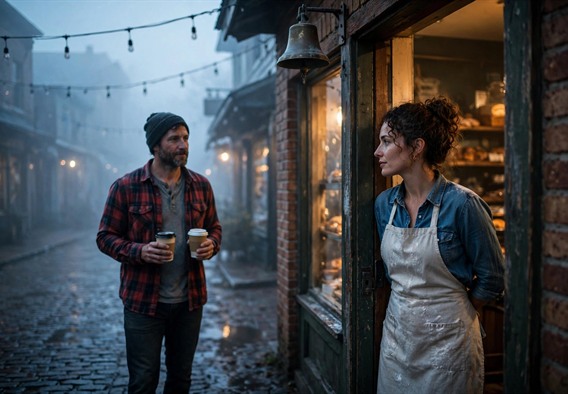


Three Nights at Kestrel Point
Can two strangers who have every reason not to trust each other survive three nights locked in a storm-battered lighthouse, and discover that the only thing more dangerous than the person outside is the truth neither of them wants to say out loud?
One: The Crossing
The ferry captain told Nadia Marchetti that no sane person sailed to Kestrel Point in October, and she had smiled at him and bought the ticket anyway. Sane was a word she had stopped aspiring to somewhere around the moment she had quit a comfortable job at the Boston Museum of Fine Arts to chase a dead man's paperwork across three states.
The crossing took forty minutes and cost her her breakfast. By the time the boat bumped against the island's single stone quay, the sky had gone the color of wet slate and the wind had a teeth to it, a low animal hum in the rigging. She climbed the worn steps with her duffel on one shoulder and a document case strapped across her chest like a holstered weapon, which, in a sense, it was.
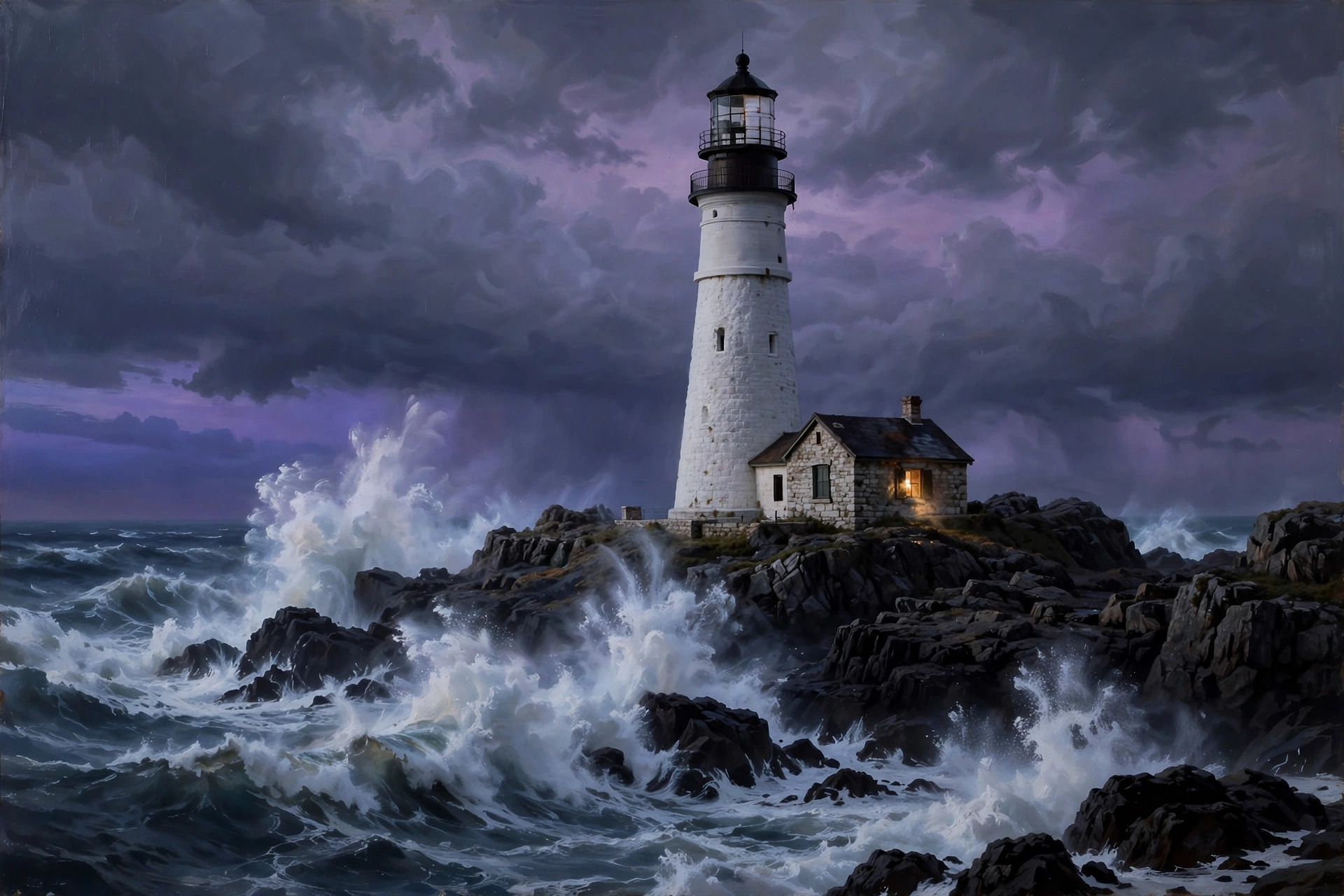
The lighthouse rose ahead of her, white tower, black lantern gallery, a keeper's cottage attached at the hip like an old married couple. It had been decommissioned for thirty years and reborn last spring as a satellite conservation studio for the Alderby Collection, a private archive of maritime charts, letters, and forged-and-genuine sea logs that had made three different men rich and one man, her mentor Elias Ward, very dead.
Elias had died eleven weeks ago. Heart attack, said the coroner. Overwork, said the family. Nadia had believed both, right up until the envelope arrived, postmarked two days before his death, containing a single photocopied page from the Alderby acquisition ledger and four words in his cramped handwriting: Check the 1898 log.
She had checked it. The 1898 log of the brig Cormorant, the collection's crown jewel, was a forgery. A good one. Good enough that Elias, who had authenticated it himself a decade earlier, had apparently discovered his own error too late to undo it quietly, and someone had decided he needed to stop discovering things altogether.
That was her theory, anyway. She had no proof. She had a photocopied page, a dead mentor, and a three-week residency on this island to examine the ledger in person under controlled conditions before the collection went to auction and every document in it became somebody's private property forever.
The plan had one flaw, and the flaw had a name she would learn soon enough.
The studio door was already unlocked when she reached it. That was the first wrong thing. The second was the man standing in the lantern room above her, silhouetted against the storm glass, moving with the unhurried economy of someone who belonged there.
Nadia did what any reasonable person would do. She set down her duffel, took the fire extinguisher off the wall, and climbed the spiral stairs to introduce herself.
Two: The Man in the Lantern Room
He turned at the sound of her boots on the iron treads, and she took an immediate and unwelcome inventory of him. Tall. Mid-thirties. Dark hair going silver early at the temples, a face that had been handsome once and had since decided to become interesting instead. A canvas jacket, salt-stiff at the shoulders. He was holding a clipboard, of all things, and he did not look guilty. He looked tired.
"You're early," he said.
"You're trespassing."
"I'm the caretaker." He held up the clipboard. "Theo Brandt. Facilities and security, Alderby Trust. You'd be Dr. Marchetti."
She lowered the extinguisher by degrees, though not all the way. "Nobody told me the island had a caretaker."
"Nobody tells anybody anything about this island. That's rather the point of it." He came down two steps so they were level, and she noticed his hands, rope-scarred and steady, and the way his eyes went to the document case strapped across her chest and stayed there a beat too long. "Elias Ward's people. He was supposed to come himself in the spring, before he died. You were on the list as a maybe."
"I didn't know there was a list."
"There's always a list." He said it without bitterness, like a man reciting weather. "Kitchen's stocked. Generator's in the shed behind the cottage, and it's temperamental, so you kick it, left side, above the drain plug. Radio works on the hour. The boat comes back for you on the twenty-eighth."
"And you?"
"I winterize the place the first week of November. We'll overlap a few days." He glanced past her at the porthole, where the horizon had gone from slate to charcoal. "Though at the rate that front is moving, maybe more than a few."
She did not like the way he said it. She liked even less the way the barometer in the entry hall, an antique brass thing Elias had donated himself, had begun to fall like a stone. By four in the afternoon the wind was screaming around the lantern gallery and the first rain came sideways, hard as gravel, and the ferry captain's radio crackled through the studio receiver with the news she had already guessed: last crossing of the season, cancelled, front stalling over the channel, forty-eight hours minimum, possibly seventy-two.
Nadia stood at the window and watched the sea erase the mainland. Theo stood beside her, close enough that she could smell cold air and engine oil on his jacket, and said nothing at all, which was somehow worse than any prediction.
"You could have mentioned this at the door," she said.
"I didn't know at the door."
"You suspected."
"I hoped I was wrong." He turned to look at her, and up close his eyes were a grey-green that reminded her unfairly of the sea before a squall. "For what it's worth, Dr. Marchetti, I have spent the last two months on this rock hoping I was wrong about a great many things."
She would think about that sentence later, many times, and how much of the truth it had held while sounding like nothing.
Three: The Rules of Small Rooms
The keeper's cottage had two bedrooms, one kitchen, one stove, and a strict opinion about how two strangers should share it, which was badly. They established territory the way nations do, with treaties and small violations. Nadia claimed the desk by the north window and laid out her tools: raking light, a loupe, ultraviolet pen torch, magnification hood, the leather ledger itself, which she handled with cotton gloves and something close to reverence.
Theo claimed the kitchen, and to her surprise, was good in it. On the first night he made chowder from the stores, real chowder, with salt pork and thyme, and set a bowl in front of her without ceremony.
"Caretakers cook?" she asked.
"Caretakers get bored. Boredom is the enemy on an island. Boredom is how you miss things."
"And what do you miss, when you're not bored?"
He smiled for the first time, and it changed his whole face, and she resented it. "Things like which of us you're really here for, and which of us Elias really trusted."
The question landed between them like a dropped glass. She made herself finish the chowder. It was excellent, and she hated him a little for that too.
The rituals assembled themselves over the next day the way rituals do in small rooms, out of necessity and repetition. He lit the stove at six; she was awake by then anyway, listening to the storm reorganize itself against the glass. He made coffee strong enough to strip varnish; she drank two cups and complained about a third that she secretly wanted. At eight they checked the barometer together, a small ceremony neither of them named. At nine she worked, and he vanished into the tower to run his checks, and at noon they ate, and argued, and the arguing had developed, by the second night, a rhythm she recognized from relationships she had sworn off: the kind where the argument is not about the subject.
The subject, when they weren't pretending otherwise, was the ledger.
"The Cormorant log is worth four million at auction," Theo said on the second evening, drying dishes while she dried nothing, since he had confiscated her towel on day one for slowness. "If it's fake, the collection's valuation collapses. The trust's creditors, the auction house, the family, everyone holding paper on Alderby. That's a lot of people with a lot of reasons to hope you find nothing."
"Or a lot of reasons to hope I find something and bury it."
"Which is it?"
She looked up at him. "You tell me. You've been here two months. You know more about this island than I do, and you knew about Elias's spring visit, and you looked at my document case like it was a bomb."
"It is a bomb," he said mildly. "That's why I looked."
"Then you know what's in it."
"I know what Elias told me was in it," Theo said, and set down the dish he was holding, and for a long moment the only sound was the storm. "He called me in August. Three weeks before he died. He said he'd made a mistake years ago and somebody was using it, and he needed a place where nobody could reach the ledger but him, and he asked me to keep Kestrel Point locked down until he came. Then he didn't come. Then his sister called me instead."
Nadia sat down slowly. "He never mentioned a caretaker with security clearance."
"He never mentioned an assistant who'd burn her career to chase his ghost across three states either, but here you are." Theo's voice was quiet. "We were both his people, Dr. Marchetti. He just didn't tell either of us about the other. That was Elias. He compartmentalized the way other men breathe."
It was the first honest thing either of them had said, and it changed the temperature of the room. She felt it, the small tectonic shift, the wall between them developing its first crack. She did not yet trust it. She had learned, with Elias, that charm and competence could be costumes.
"Prove it," she said. "Show me the August call records. The trust emails. Whatever you have."
"Prove it first that you're not the one who told someone where the ledger would be," he answered, not unkindly. "Because someone knew, Nadia. Someone knew enough to try the studio door the night before you arrived."
"The door was unlocked when I got here."
"It was unlocked because I left it that way on purpose, with the interior chain on, to see who would try it." He held her gaze. "Someone tried it at two in the morning. By boat. I watched the wake from the lantern room."
The storm howled. Somewhere below, the sea drove itself against the rocks like something with a grudge. Nadia realized two things at once: that she believed him, completely and inconveniently, and that for the first time since Elias died she was not alone with the fear, and how much she had wanted not to be alone with it.
Four: What the Ledger Said
She showed him the photocopied page that night. It felt like undressing in front of a stranger, laying the folder on the kitchen table between the bread board and the lamp, and she watched his face as he read Elias's four words and understood them.
"The 1898 log," he said. "That's the jewel."
"That's the lie," she said. "I examined high-resolution scans in September. The iron gall ink is period correct. The paper is period correct. But the ruling lines on two pages were drawn with a machine that didn't exist until 1911. Someone took a genuine blank logbook from the right era and wrote the Cormorant story into it. It's brilliant. It's beautiful. It's fake."
"And Elias authenticated it ten years ago."
"Elias authenticated it ten years ago," she agreed, "which means either he missed the ruling lines, which is impossible, or he authenticated it before the pages were swapped, or he authenticated it knowing, and someone has been holding that over him ever since."
Theo was quiet for a long time. Then he said, "There's a strongroom under the tower. Original Victorian construction, steel door, added a modern electronic lock two years ago. Elias kept the acquisition ledger in there, the real one, the master. If the master ledger shows the Cormorant log entering the collection through a particular dealer in 2014, we have a thread to pull."
"Then let's pull it."
"The lock has a six-digit code," he said. "Elias set it himself. He never told me. He told me he'd tell me in person in the spring." Theo's jaw tightened. "He died with it in his head."
Nadia looked at the photocopied page. At Elias's handwriting, cramped and urgent, the handwriting of a man who had taught her everything she knew about paper and ink and the million small ways human beings lie with both.
"No," she said slowly. "He died with it in his head, but he didn't trust his head. He trusted paper. He trusted redundancy. He taught me that. Check everything twice, Nadia, because the second copy is the one that saves you." She was already pulling the copy toward the lamp, tilting it under the raking light. "Look at the margins. Look at the watermark on the photocopy paper. He photocopied this on the studio machine here, on the island, in March. The studio stock has a private watermark, a kestrel in flight, right corner, faint. Now look at what else got caught at the edge of the glass."
Theo leaned in. Under her pointing finger, ghosted in the corner of the photocopy, was a column of tiny penciled figures, half cut off by the page edge. Six digits. A date notation beside them, in Elias's hand: her birthday, he'll never guess.
"Her," Theo repeated.
"Elias had exactly one 'her' in the last decade of his life," Nadia said, and felt the old grief move through her like weather. "His sister Rose. He adored her. He missed her birthday every single year and sent apologies that got more elaborate annually. It was a family joke." She looked up. "Rose's birthday is June ninth. Zero six zero nine. What's the rest of the notation?"
Theo read it, and went pale in the lamplight. "Nineteen fifty-eight," he said. "Zero six zero nine five eight."
They went down the tower stairs together, through the cold stone throat of the lighthouse, to a steel door that had waited eleven weeks for exactly this. The lock blinked green at 06:09:58, and Nadia felt Theo exhale beside her, and realized how close he was standing, and did not step away.
Five: The Silence Between Sentences
The strongroom held the master ledger, and the master ledger held the thread, and the thread held a name. Nadia found it at two in the morning on the second night, in an acquisition note she had read four times before the meaning assembled itself: the Cormorant log had been purchased in 2014 from a dealer named Verrone, and attached to the note was a condition report in a hand that was not Elias's, and that hand had initialed the pages that had been ruled with a 1911 machine.
"Marcus Vane," Theo said, reading over her shoulder, too close, his breath warm at her ear, and she was too tired and too wired to move away from it. "The trust's own consulting authenticator. He sits on the auction committee. He stood up at Elias's memorial and gave a speech about integrity."
"And he tried the door two nights ago," Nadia said. "Or sent someone."
"Or sent someone," Theo agreed. "Vane doesn't get salt water on his shoes."
It was after that, with the ledger photographed in full and the copies hidden in three separate places, two of which Theo refused to disclose, that the silence happened.
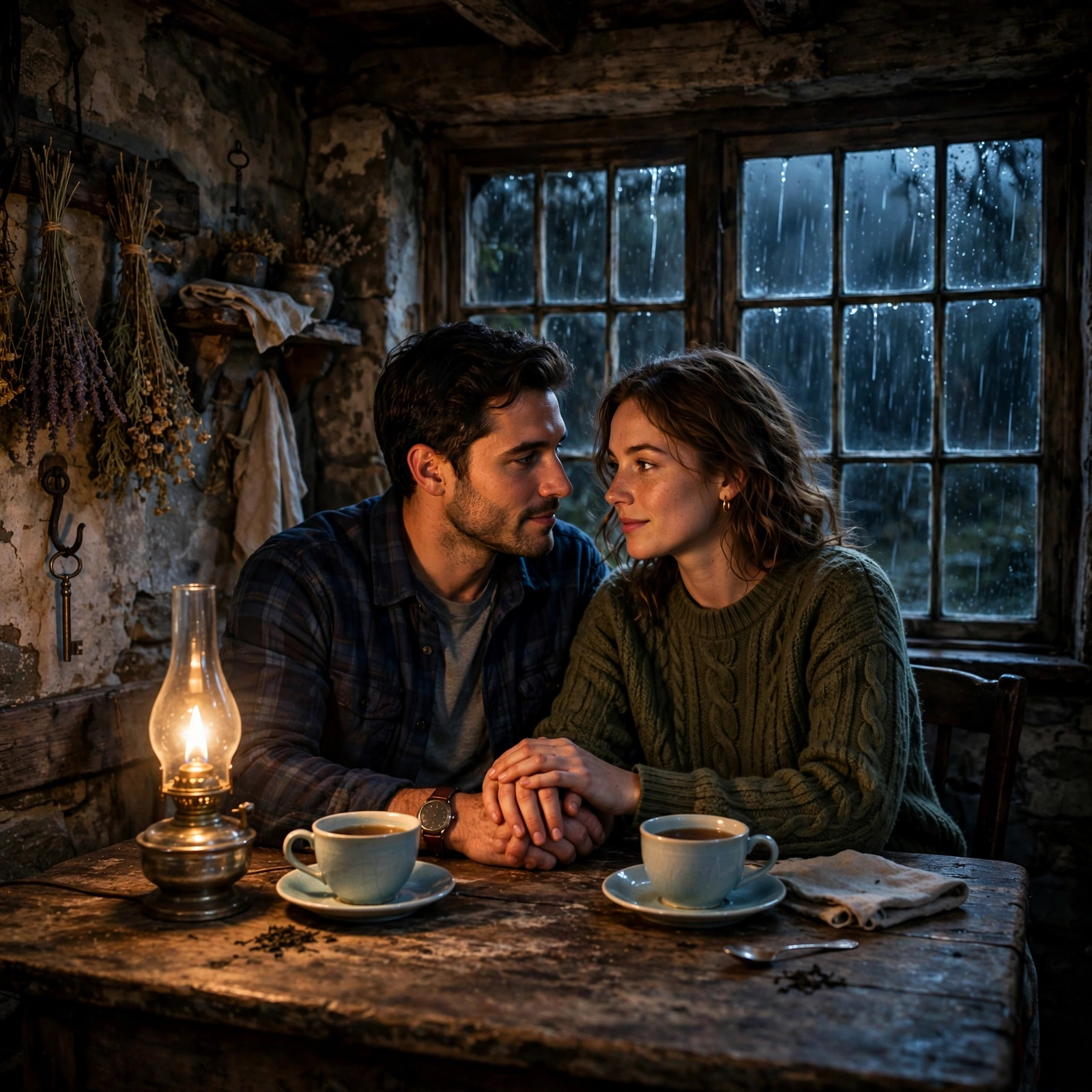
They had climbed back up to the kitchen, soaked from the tunnel drafts, and made tea neither drank, and the storm had entered one of its strange eyewall calms, a stillness so complete that the absence of noise rang in her ears like a struck bell. They sat on either side of the kitchen table with the lamp between them, and neither of them spoke.
It should have been awkward. It was the opposite. Nadia had spent her adult life in archives, in rooms where silence was the working medium, and she knew the difference between an empty silence and a full one. This one was full to the rafters. It held the ledger and the dead man and the name on the note and the fact that Theo had made her coffee at six in the morning for two days without being asked and the fact that she had noticed. It held the two inches of table between his hand and hers, which were somehow the loudest thing in the room.
She looked at the lamp. She looked at the rain beginning again against the black windows, fine and slow now, almost gentle. She looked at his hand.
"You're thinking very loudly," he said at last, without looking up.
"I'm deciding something."
"About the ledger?"
"About whether I can afford to trust you."
He turned his hand over on the table, palm up, an offering and a question, and said nothing, and the silence took the question and held it for her, patient, while the storm breathed outside, and she put her hand in his, and the wall came down with less noise than a ruling line drawn across old paper.
"Elias would be unbearable about this," she said, and her voice cracked in the middle, and Theo got up and came around the table and held her while she grieved her mentor for the first time since the funeral, properly, catastrophically, into the shoulder of a stranger who was no longer one.
Six: The Cut Line
He told her his story while the wind rebuilt itself outside, piece by piece, the way he told everything, economical and unadorned. Eleven years in naval security, then a civilian consultancy, then the Alderby contract, which had looked like a quiet retirement taper and had turned into Elias's paranoia made manifest. A divorce in the file, mentioned once, in passing, in the tone of a man who had inventoryed his own failures and kept the receipt. A daughter in Rotterdam, twenty-two, who wrote him postcards of bridges.
"You could have gone to the police," she said. "In August. When Elias called."
"With what? A feeling and a locked door?" He shook his head. "Elias made me promise. He said the moment anyone official touched it, Vane's lawyers would turn it into a custody dispute over paper and it would be sealed for a decade. He wanted it airtight first. He wanted the master ledger and the condition report and the dealer's invoice, all three, in one room, in front of one lawyer he trusted." Theo's mouth twisted. "He wanted it perfect. That was the other thing about Elias."
"He was a great man and an impossible one."
"Both. Simultaneously. Like the tide."
At dawn on the third morning, the storm ended the way storms do at sea, without transition, and the light came up hard and clean over a channel full of whitecaps, and Theo went out to check the mooring and came back with a face that closed every door in the room.
"The skiff's cut loose," he said. "Not dragged off. Cut. Clean, at the cleat, with the line taken away. And the studio's been entered, sometime in the night, through the seaward window. Nothing taken that I can see. Nothing wrecked. Just opened."
Nadia's stomach dropped through the floor. "The ledger."
"Still in the strongroom." He met her eyes. "Which they can't open. Which means they came to see what you'd found, or to leave something, or to make sure you couldn't leave to tell anyone. Nadia. Someone is going to come back. The ferry's running again by tomorrow afternoon at the outside, and until then we're the only two people on this rock, and one of them knows it."
She should have been afraid. She was, in the honest chamber of herself where she kept such things. But fear, she discovered, was a solvent, and it dissolved the last of her hesitation about the man standing in the doorway with salt spray in his hair, because there was no version of the last three days in which Theo Brandt had been working against her. There was only the version where he had been waiting, for three years of quiet winters and two months of locked doors, for one ally.
"Then we get ahead of it," she said. "The photographs. The condition report. The invoice, if we can find it. Vane's whole position depends on the forgery never being officially examined. So we examine it. Officially. From this island, on the radio, on the record, the moment the hourly check-in comes around."
Theo smiled, and this time she let herself smile back. "Elias would be unbearable."
"Elias," said Nadia, "would be insufferable, and he'd take credit, and he'd deserve it. Get the radio."
Seven: The Hourly Check-In
The trap, when it sprang, sprang on schedule, which was almost a relief.
The nine o'clock check-in went out on the hour, Theo's steady voice reading the situation report Nadia had drafted: suspected forgery in the Alderby collection, documentary evidence secured, request for immediate collection by trust counsel and state antiquities investigators on next crossing. The mainland operator acknowledged, promised relay, and signed off, and for eleven minutes they stood in the lantern room and watched the channel and let themselves believe it was that simple.
Then the boat came.
It came fast, a rigid inflatable running the swell with the arrogance of a vessel that knew the water, and it did not go to the quay. It came around the tower to the lee landing below, and two men got out, and one of them was not Vane. He was younger, heavier, and he moved like a man who had done physical work for money, and the other was a woman in a wet-weather coat with a clipboard, and Nadia felt Theo go very still beside her.
"Trust counsel," he said flatly. "That's Diana Rooke. She's legitimate. She's the lawyer Elias trusted." Then, slower: "The other one I don't know."
"The one who cuts lines," Nadia said.
They went down. It was, in retrospect, the only move available, and Theo made it first, unlocking the lee door and standing in it with his whole body reading reasonable, while Nadia came down the stairs behind him with the master ledger in its case and her heart going like the fog bell.
Rooke climbed the ladder, rain-blown and apologetic, and produced a court order and a phone and a great deal of legitimate-looking paperwork, and explained, over the wind, that the trust's board had received an anonymous tip two days ago that documents at Kestrel Point were at risk of destruction, and that she had been dispatched with an independent examiner to secure them before the auction.
"An anonymous tip," Nadia repeated.
"Anonymous," Rooke agreed, with the weary precision of a lawyer who had not liked the tip and had come anyway, because court orders did not care whose fingers were on the scale.
And that was when the other man moved. Not at the ledger. At the case's strap, at Nadia's shoulder, a fast professional grab, and the whole choreography of the morning snapped into focus: Rooke was the legitimate face, the examiner was the hand, and the tip had been designed to put both evidence and thief in the same boat with legal cover.
Except Theo had read the same choreography three seconds earlier. He was not fast the way the other man was fast; he was fast the way weather is fast, inevitable, positioned. He had stepped into the grab line before it closed, and the two of them went down onto the wet stone of the landing together, and it was ugly and brief and non-lethal, a knee, an elbow, the man's wrist bent back against a cleat until he stopped wanting anything that was in his other hand. Theo put a knee in the small of his back and zip-tied his wrists to the mooring ring with the unhurried competence of a man who had, in another life, done considerably worse to considerably more deserving people.
"Diana," Theo said pleasantly to the lawyer, who stood frozen on the ladder with her clipboard held to her chest. "Check your phone. Check whether the tip that sent you here came through the trust's official channels or through Marcus Vane's personal number, which I would be happy to provide."
Rooke looked at the man zip-tied to the mooring ring. She looked at the ledger case. Nadia watched a career flash before the lawyer's eyes, and watched her make the choice Nadia had made on the ferry, the choice to be sane about the wrong thing or brave about the right one.
"The tip came to my private line," Rooke said quietly. "I have the number. I kept it." She met Nadia's eyes. "Ms. Marchetti. I think you and I need to talk about what's in that case before anyone else on this island says another word."
Eight: The Crossing Home
It took four more days to make it airtight, because Nadia was Elias's student and Theo was Elias's gatekeeper and Rooke, it turned out, had been waiting eleven weeks for someone to hand her a weapon. The examiner they had brought turned out to be genuine, an retired forensic document examiner named Okonkwo who took one look at the ruling lines under raking light and said, with scholarly delight, "Oh, this is lovely work. This is going to be a pleasure to destroy."
Vane was arrested on the mainland on a Wednesday, mid-lunch, at a restaurant where he was entertaining the auction house's acquisition committee. The dealer's invoice surfaced in a safe-deposit box whose location was written, in Elias's hand, on the last page of the master ledger, where he had always said the second copy was the one that saved you. It had. The Cormorant log was withdrawn from auction pending criminal proceedings, and the trust's board, chastened and litigious, established the Elias Ward Fellowship in Documentary Conservation with the settlement, and offered its first fellowship to a conservator who did not immediately accept, because she had an island to close up first.
The winterizing took them a week. They shuttered the studio together, drained the pipes, wrapped the instruments, kicked the generator's left side above the drain plug one last time out of superstition. On the last evening the sky cleared entirely, and the cold came down blue and enormous, and they walked the island's one path end to end and back, and at the top of the tower, in the lantern room with the great dead lens throwing moonlight in fragments across the floor, Theo said, "The boat comes at nine."
"I know."
"It goes to the mainland. The mainland has apartments in it, and museums, and a fellowship with your name pre-printed on the office door."
"I noticed the pre-printing," Nadia said. "It seemed presumptuous."
"Is it?"
She looked at him. Three nights in a small room had taught her the architecture of this man the way she knew the architecture of paper: where he was strong, where the watermarks of old damage ran, what he looked like lit from behind by a lamp he had lit for her without being asked. She had spent her life authenticating things. She was very good at knowing what was real.
"Come to Boston," she said. "Not presumptuously. Practically. I have a second copy of everything and a spare key and a terrible track record with men who can't cook, and you cook magnificently, and I would like very much to find out what we are when there isn't a storm and a felony involved."
Theo crossed the lantern room, and the moonlight broke and reassembled around him, and he took her face in his rope-scarred hands like something he had been keeping safe for three years and had finally been given permission to open.
"Practically," he agreed, and kissed her, and the kiss tasted like salt and cold air and the end of waiting, and above them the dead lens turned slowly in the wind, throwing its fragments of light out over a sea that had, at last, nothing to hide.
They caught the nine o'clock boat together. The mainland, when it came, looked like a beginning.

Reader note: Kestrel Point, the Alderby Collection, and every soul in this story are inventions. Any resemblance to real lighthouses, ledgers, or lawyers is the storm's doing, not ours.
Get notified when new stories drop

Serena Blake
Serena writes romantic suspense and dark romance for readers who want pulse and payoff. Her stories chase trust as hard as they chase danger.
Leave a comment
Comments