

The Threshold Law

The second Mara Voss heard the elevator sigh open at half past midnight, she knew the intruder by his footsteps alone, because no one else in the city walked like they owned the floor and apologized to it at the same time.
"Ashe." She did not look up from the ledger. "The Archive closed at eleven. The sign is very large. I can have it enlarged if your eyesight has degraded since the Hoover administration."
"Nineteen-oh-eight," Julian Ashe said pleasantly, hanging his coat on a hook he had never been given permission to use. "And your sign is legible. I simply chose not to be governed by it."
"That's the whole problem with you in one sentence." She finally raised her head. He was standing at the end of her long oak table in a charcoal suit with no wrinkle on it, silver at his temples that had not been there a decade ago, because vampires aged the way glaciers did, in increments designed to be noticed only by people who were paying attention. She hated that she was paying attention. "You think rules are suggestions with good posture."
"I think rules are tools," he said, "and you think they are scripture. Between us we might make one reasonable adult."
"Between us we make a crime scene."
He smiled at that, and she hated the smile too, hated that it was a good smile, unhurried and a little crooked, the smile of a man who had survived a century and a half by being charming exactly when charm was least deserved. On the table between them sat the reason he had come: a small iron box, sealed with wax the color of dried blood, stamped with a sigil that predated both of their institutions.
The Vesper Relic. Recovered from a demolished house on Catbird Lane three days ago, catalogued by her, claimed by nobody, wanted by everybody.
"You've opened it," Ashe said. It was not a question, and the fact that it was not a question annoyed her more than the question would have.
"I'm the Warden of the Veiled Archive. Opening things is my entire vocation."
"And?"
"And it's a heart." She watched his stillness sharpen. "A vampire's heart, removed sometime in the 1600s, preserved in a binding jar with salt and grave iron. Whoever that vampire was, someone hated him enough to do surgery and loved him enough to keep the evidence."
For a moment the room's candleflames leaned, all eleven of them, in the same direction, as if the air itself had flinched. Ashe put one hand flat on the table, very deliberately, the way he did when he was keeping his hands from doing something his mouth would regret.
"That's mine," he said.
Mara laughed, and it came out harsher than she intended. "Of course it is. Every catastrophe in my ledger is yours. The Meridian fire, yours. The Ashgrave debt, yours. The cursed harmonica I had to bury in three feet of consecrated soil, and I want to stress that I now own a harmonica grave, yours."
"I don't remember a harmonica."
"You wouldn't."
"Mara." His voice dropped into a register she had only heard twice in six years of shared jurisdiction and mutual loathing, once at a funeral neither of them had wanted to attend, once when a fledgling had gone feral in the subway tunnels and they had hunted it side by side, back to back, for nine hours, and she had made the mistake of noticing how well they fit there. "I am not being rhetorical. I was born in 1874. I was made in 1908. In 1911, someone took my heart out of my chest and I have spent a hundred and fourteen years not dying of it. If that jar is on your table, then it has surfaced for a reason, and the reason is going to be terrible."
She wanted to dismiss him. She had a practiced dismissal, an entire gesture, one hand and one raised eyebrow, deployed at board meetings and tribunal hearings and the annual Interfaith Equinox Potluck, which she attended out of spite. But she had read the ledger entry three times before he arrived, and she had run the provenance, and the seller's name on the demolition manifest had been an anagram she did not like. Her own name, rearranged. Someone had wanted the Vesper Relic to come to her.
"If it's yours," she said slowly, "then the person who cut it out knew what they were doing. Removing a heart doesn't kill your kind. It unmakes you. Slower. You keep walking around, eating, charming people, being a menace in a good suit, but the binding jar keeps the rest of you anchored to the world by a thread. And whoever holds the jar holds the thread."
"Yes," Ashe said quietly.
"And you've known that for a century. And you never told the Covenant. Never told my order. You let us write you up in threat assessments as a wild card with unknown vulnerabilities, when the whole time your vulnerability was sitting in somebody's cellar with a wax seal on it."
"I told no one," he agreed, "because the moment it is known, it is leverage. You of all people understand that. Your order's entire existence is leverage. You just call it stewardship."
"I call it the difference between a lock and a hostage."
"The difference," he said, "is usually just who's holding the key."
She stood then, because sitting across from him while he was being devastatingly reasonable was a tactical error, and she came around the table until the iron box was between them and she could put her palm on its cold lid, claiming it, and he watched her do it and did not stop her, which was its own kind of message.
"Here is what happens now," she said. "The relic goes into the deep vault. Under covenant seal. Under my seal. It will not be leveraged, sold, stolen, or used, by you, by me, or by anyone. You get to know it is safe, and in exchange you get to leave, and we never speak of your heart again."
"You'll vault it," he repeated.
"It's what I do."
"And when your tribunal decides, as tribunals do, that a vampire's heart in a jar is too valuable to sit in the dark? When some cousin of yours with a budget shortfall decides the Covenant's survival is worth one immortal's suffering? You'll tell me no, Mara Voss, while your colleagues weigh my life like an asset?"
"Then I'll stand in their way."
"You've never stood in anyone's way," he said. "You stand at podiums. It's not the same thing."
The insult landed exactly where he aimed it, which was the worst part. She had spent nine years as Warden being precisely the kind of person who stood at podiums, correct and contained and very, very alone, and the fact that he could see that, the fact that he had apparently been seeing it this whole time, made her want to throw the iron box at his beautiful head.
"Get out, Ashe."
"I can't," he said simply. "Not while my heart is in your building."
The Law That Everyone Knows
There were, Mara had learned, exactly three laws of the night that no covenant, court, or council had ever needed to write down, because the world enforced them itself. Silver burned. Names had weight. And a vampire could not cross a threshold uninvited.
The third law was the oldest and the strangest, because it did not behave like physics. It behaved like courtesy that had calcified into chemistry. Scholars had argued for centuries about why. Mara's own order, the Wardens of the Quiet Door, taught that the boundary of a home was a living vow, renewed every night by the people inside it, and that vampires, being made of borrowed time, could not pass through another person's vow. They could stand on the doormat forever. They could knock. They could be charming through the letter slot. But the door would only open from within, and only by choice.
Her order taught one more thing about the threshold law, and this was the part they taught last, quietly, in the last hour of the last year of training, the way you teach children about the stove.
An invitation is not a word. An invitation is a bond. When a Warden knowingly invites the undead across her own threshold, her lifeline ties to his. Whatever runs in his veins begins to run, faintly, in hers. Whatever shortens his nights begins to shorten her days. And the bond does not come out. There is no counter-word, no ritual, no salt circle clever enough. The order had one recorded case, in 1893, and the Warden in that case had spent forty years growing old beside the vampire she had let in, dying at seventy while he stayed twenty-nine, and her final recorded words in the Archive were filed under R, for Regret, and Mara had read them at twenty-three and built her entire life on the other side of them.
Which was why, when Julian Ashe did not leave, she did not merely get angry. She got afraid, and she had long ago arranged her life so that fear came out of her as frost.
"You cannot stay here," she said. "This building is my charge. It is, in every way that matters, my home, and the law about homes applies, and I have not invited you, and I never will."
"I know the law," he said. "I've watched it work for a hundred and fourteen years. I've stood on more thresholds than you've read about, and I have never once crossed one without permission, because the world simply does not permit it." He looked around her archive, at the candle stands and the iron shelving and the sleeping ledgers, and something in his face went younger, briefly, before the charm closed over it. "But you misunderstand what I'm saying. My heart is in this room. I am not here to take it. I'm asking you to understand that a vampire whose heart is outside his body does not get to be elsewhere. The thread pulls. Right now, at this moment, standing in your doorway arguing with you is the closest thing to rest I have felt since 1911."
"That is the most manipulative thing anyone has ever said to me."
"Yes," he agreed. "I'm good at it. It doesn't make it untrue."
She looked at him for a long time. The candles burned. Somewhere above them, in the ordinary city, a truck changed gears, and the ordinary world went on being ordinary, and she envied it.
"There's a chair," she said finally, "in the anteroom. The anteroom is not the Archive. The anteroom is a lobby, legally, and I am not inviting you into the anteroom either, because I am not an idiot, but the door of the anteroom faces the street, and the street is public, and if a man chooses to sit in a public lobby all night where any passing constable can see him, that is his own stupid business."
"Generous," he said, collecting his coat.
"It's not generosity, it's zoning."
"Mara." He paused at the arch, and she braced for charm, and instead he said, in a voice with no performance in it at all, "Thank you for not putting me out. You could have. There are words for it. I've been put out before, by better wardens than you, and it feels like drowning in a doorway."
"I know what it feels like," she said, before she could stop herself, and then hated that she had said it, because it was true, because in her second year a senior Warden had tested her by making her bar a door against a begging ghost, and she still dreamed about the sound it made.
Ashe looked at her as if she had handed him a document he intended to have translated.
"Go sit in your lobby," she said.
He went. And she stood alone in her archive with her palm still on the cold iron box, feeling, for the first time in six years of knowing him, the thread she had just been told about, thin as a hair, running from the box under her hand out through the dark to the man in her lobby, and she thought, with real fury: I am going to be so careful. And then she thought, quieter, in the voice she used only for the ledger and the truth: you are already not being careful.
Julian: The Arithmetic of Wanting
Julian Ashe had made a study, over a hundred and fourteen years, of the difference between wanting a thing and being able to have it, and the difference, he had concluded, was the entire content of a human or inhuman life.
He wanted her. He had wanted her since the harmonica incident, which was the moment he had understood that Mara Voss's contempt had a texture, and the texture was attention. She did not dismiss people she did not care about. She buried them in specificity. She had, during the harmonica hearing, cited the exact page of his 1974 violation, from memory, and when he had complimented her memory she had called it a symptom, and he had walked out of that tribunal aware that he was in trouble of the permanent kind.
He had managed it the way he managed everything, with distance and discipline and a private filing system, and for six years it had worked, more or less, the way a dam works.
Now his heart was in an iron box under her hand, and the dam had developed opinions.
He sat in her anteroom all night, in a chair meant for visitors to the tax office that had previously occupied the building, and he thought about 1911.
He had been thirty-seven, newly made, still learning which hungers were his, when the man named Corvus had come for him. Corvus had been old the way bad fruit is old, sweet-looking and rotten to the center, and he had believed, correctly, that a young vampire's heart, taken clean and bound in salt, made a leash of him. Julian had spent the next ninety years on that leash, doing errands, carrying messages, standing in rooms while terrible things were decided, because the alternative was the jar being unsealed, and an unsealed jar unmakes a vampire in a way that even the patient universe does not undo.
Corvus had died in 2001, of ordinary causes, which was the only funny part of the whole century, and the jar had vanished into the estates and cellar sales of the supernatural underworld, and Julian had spent twenty-four years buying, bribing, and tracking his way toward it, one step behind, until three days ago, when a demolition crew on Catbird Lane had opened a wall and found it, and sold it, through a licensed broker, to the Veiled Archive.
To her.
Of course to her. He had checked the manifest twice for his own name and found hers instead, and had sat in his car outside the Archive and laughed until it turned into something else, because the universe had a sense of humor and it was personal.
At dawn he left the anteroom, because the anteroom's tall east-facing windows were not warded and he had no intention of demonstrating the sun's opinion of him, and he went home to a house he had owned for sixty years, and he slept badly for a vampire, which is to say he dreamed.
He dreamed of the night his heart was taken. He always did, when he slept at all. But this time the dream changed at the edges. In the old dream he was on the table alone. In this one there was a woman with dark hair and a frost-colored glare standing at the foot of the table with a ledger, refusing to write down what was happening, saying, in Mara's precise voice, I don't file atrocities, I prevent them, and he woke at dusk with the taste of salt in his mouth and the understanding, arriving with the slow certainty of a tide, that he was not going to be able to keep doing this at arm's length.
Not because of the thread. The thread was real; he could feel it now, a faint continuous tug, like a hooked fish somewhere below the floor of the world. But the thread had been tugging for a century. What was new was the woman.
He had watched her, over six years, defend her archive from a coven that wanted to burn it. He had watched her take a knife wound for a stranger's child during the Equinox Riot and then file a forty-page complaint about the riot's organizational failures. He had heard her, once, through a door he should not have been standing near, talking to the ghost of a Warden dead two hundred years, telling it, gently, with no frost at all, that it was allowed to rest. He had stood in the doorway of that memory for a long time.
He wanted her, and he was not able to have her, and the wanting had stopped being his secret. That was the danger. A want that everyone can see is a lever, and Corvus was dead, but levers outlive men.
The Stolen Week
The anagram on the manifest resolved, on Thursday, into a name: Sovram. Mara read it in her office with the blinds down and felt it like weather coming in. The Sovram family had been Corvus's executors. They had inherited, among other things, a documented interest in unsealed jars.
She had two options. File with the Covenant and wait three weeks for a tribunal that would debate jurisdiction while a family of professional monsters moved, or move herself, tonight, with the one ally she had who could walk into Sovram society without an invitation of any kind, because nobody invited vampires to anything, they just failed to notice them.
She hated the second option with her whole professional soul.
She found him at dusk on the Archive steps, exactly where the thread presumably told him to be, reading a broadsheet from 1946.
"I need your face," she said, without preamble.
"You have it. You've always had it. It's the rest of me you file complaints about."
"The Sovrams have the manifest. Which means they have my name, your anagram, and a map of every legal vulnerability this Archive has. Which means in about a week they come for the box, and the box is your heart, and the moment it leaves my custody it becomes currency." She held out a folder. "There's a Sovram salon on Saturday. Letters of provenance, rare objects, that crowd. I have an invitation for me and no plausible way to bring a warden's security, because bringing security says the Archive is afraid, and I need them to believe I'm not afraid."
"And a vampire," Ashe said, taking the folder, "reads as atmosphere. Nobody counts atmosphere as security."
"I was going to say nobody suspects atmosphere, but sure."
"You want me to be your decorative escort." His mouth curved. "Mara Voss, this is the best night of my life."
"This is professional. You will stand near the champagne. You will listen. You will not do the smile at anyone."
"Which smile?"
"The one you're doing right now."
He put the smile away, all except the part of it that was real, which he could not put away, and looked at her with the salon lights of Saturday already reflected in his eyes, and said, "For the record, I would have done this for free. For the further record, I would have done it if you'd fired me from it."
"For the record," she said, "I know. That's the part I hate."
The Sovram salon was held in a house on a hill that had been built to look older than it was, all imported stone and rehearsed gloom, and Mara arrived in a dark green dress she had owned for a decade and never had occasion to wear, and Ashe in a suit the color of midnight doing an impression of an atmosphere. The salon's guests were collectors, brokers, two mummies' agents, a woman who traded in memories, and the host, Emil Sovram, who had the moist charm of a man who had never once been surprised by consequences.
"Warden Voss," Emil said, kissing the air near her hand. "And your companion is...?"
"Julian Ashe," Ashe said, and watched, with clinical interest, as Emil's face performed a small landslip. Old money remembered old leashes.
"The Julian Ashe."
"There's only one," Ashe said. "It's a design flaw."
They circulated. Mara played the archivist, coolly appraising fakes, correcting a broker's attribution of a forged grimoire with three citations and a raised eyebrow, and Ashe played the background, drifting, listening, and at half past ten he drifted back to her at the window with his voice pitched under the quartet.
"West gallery, second door. They're showing items for private bids. One of them is a jar."
"Empty?"
"No. Salted. Sealed. And the wax is the same as yours, which means same maker, same century, and there is a second heart in this house."
Mara kept her face civil for the quartet's benefit and her voice down in the cellar. "Whose?"
"That," he said, "is what we're going to find out, and I want you to hear how I said we, because six years ago I'd have said I, and gone in alone, and come out alone, and told nobody."
"Six years ago I'd have filed you for trespassing."
"You would have." He offered his arm, formally, absurdly, the gesture of an escort from a century when he had been alive. "West gallery, Warden. Try to look like you're being dragged."
"I never have to try."
But she took his arm, and the arm was solid and cool and offered like a vow, and something in her chest, in the region she kept locked and inventoried, turned over like a page.
The west gallery was hung with portraits of Sovrams looking pleased with themselves across four centuries, and the second door opened onto a small room with a table, and on the table, under glass, among a samovar and a saint's finger and a letter signed by a dead queen, sat a jar. Salted. Sealed. Containing, floating in its preservative dark, a heart that was not quite a heart anymore, more a knot of shadow holding its own shape, the way drowned things hold the shape of their last reaching.
"That's not a vampire's heart," Ashe said quietly. "That's a witch's."
"How can you tell?"
"Because vampire hearts stop being meat after a decade. That thing is still working. Look at the sigil on the wax. Same hand as yours. Same maker." His voice had gone very flat, the flatness she had heard on the subway night. "Corvus didn't just leash me, Mara. He was a collector. And the wax is the same because the same witch made both jars, and I think I know which witch, because I employed her, in 1911, and she vanished that winter, and I spent forty years believing I had gotten her killed."
"Her name."
"Odile. Odile Ferrant."
Mara went still, because the name was in her order's records, in the 1893 file, in the footnote everyone skimmed. The Warden who had invited the undead across her threshold and bound her life to his. The Warden filed under R for Regret.
"Julian," she said. "The 1893 case. The Warden who tied her life to a vampire and died old while he stayed young. Her name was Odile Ferrant."
She watched it land. She watched a hundred and fourteen years of composure come apart at one seam, quietly, like ice going out from under a man.
"She didn't betray me," he said. "She cut out my heart to make a jar Corvus couldn't break, because a jar with a willing witch's heart in it holds anything. She saved me and she leashed me with the same act, and then she went and found a vampire of her own to tie herself to, and she died for it, and I mourned her for a debt I didn't know she'd paid." He put his hand on the glass case, and his hand was shaking, and he did not pretend otherwise. "The salt in this jar is holding her. If it's opened wrong, she goes out like a candle. If it's not opened at all, she's in there forever. And the man who'd know the ritual is a hundred and fourteen years out of practice and standing in a Sovram gallery with his own heart in a rival's vault."
"Your heart," Mara said, "is in my vault."
"Under your seal."
"Under my seal," she corrected, "which means under my protection, which means, and I am choosing these words with a jeweler's loupe, that whatever we do about Odile, we do it with the box. Because whoever made that wax made both jars, and I would bet my order's whole library that the rituals are entangled. Open hers without yours present and yours frays. It's how binding pairs work."
"You're saying we," he said again, and his voice did something on the word that he would deny to his grave.
"I'm saying," Mara said, "that I came here tonight to protect an asset, and instead I found a colleague. And I hate it. And it's happening anyway."
The Night of the Bad Idea
They stole the jar at eleven forty.
It was, both of them later agreed, the worst planned theft either had ever participated in, which was fitting, because it was also the first thing they had ever done together as partners rather than opponents, and partnership, like theft, improves with rehearsal.
Ashe killed the gallery's lights with a favor owed by a woman who traded in memories. Mara opened the case with a hairpin, a whispered word, and a professional contempt for Sovram locks. They walked out through the ballroom with the jar in her clutch purse, which was too small, and the jar held against her spine under her shawl, which was worse, and the whole way to the door Emil Sovram stood talking to a broker with his back to them, and the universe, for once, looked the other way.
In the car, Mara exhaled for the first time in forty minutes and said, "I am never doing crime again."
"You were magnificent at crime."
"I was adequate at crime and I hated every second, and also," she admitted, to the windshield, "my heart rate is up and it isn't the theft."
He did not say anything to that. He was very careful not to say anything to that, and she was grateful and furious about it in equal measure.
They took the jar to the Archive at two in the morning, and here the night got complicated, because the Archive was her threshold, and the jar could cross, but he could not, and the ritual, if her reading of the paired bindings was right, needed the vampire whose heart anchored one end of the wax's chain.
She stood on her own front step with the jar under her arm and the iron box waiting inside, and looked at him on the doormat, and the whole architecture of her life stood up around her like a wall.
"There's a workroom," she said slowly, "off the loading dock. Technically it's a separate parcel. There's an old deed subdivision from 1921, the dock and workroom are on the public way's easement, they were never legally part of the Archive proper." She was talking fast, the way she talked when she was outmaneuvering a tribunal. "I checked the deed three years ago during a zoning dispute, out of spite. It's the only room in this building that is not, in the eyes of the law and therefore in the eyes of whatever enforces the threshold, mine."
"You found a loophole in your own home," he said.
"I find loopholes everywhere. It's my other vocation. Get in before I reconsider."
He stepped over the workroom threshold like a man stepping off a ledge into water, testing, and it held, and he was inside, in the one room in her kingdom she did not own, and they stood there in the workroom's dusty light, three feet apart, both of them breathing in a room where only one of them needed to.
"Odile first," he said. "Or me first. The order matters and I don't know it."
"We research before we cut anything," Mara said. "I do not perform heart surgery on a first date."
The silence after that had a shape. She heard what she'd said approximately one second after saying it, and he heard it at the same time, and neither of them laughed, because it was not funny, because it was the truest sentence either of them had spoken all night.
"Mara," he said.
"Don't."
"I'm going to say it anyway, because I've been not saying it for six years and the not-saying has gotten heavy." He stayed where he was, three feet, giving her the distance like a held door. "I have wanted you since the harmonica. I have wanted you in the stupid way and the serious way, and I have managed it, because I manage everything, and then my heart ended up in your vault and I discovered that I don't want to manage it anymore. I don't want anything from you. I want you to know, before the ritual, before whatever these jars do to us, that the wanting came first and the jars are only weather."
"The jars," she said, and her voice was not level and she let it not be level, "tie my life to yours if I ever invite you across my true threshold. That's the law, and you know what it costs. I'd grow old and you wouldn't. I'd die and you'd keep the tie. My order files it under regret. I have read the file. I built my entire career on the far side of that file." She looked at him, and the frost went out of her eyes and left them just eyes, tired and young and honest. "And I stood in that gallery tonight and watched your composure crack for a woman who's been dead a century, and I thought: that's what it looks like when someone matters. And I have never once let anyone matter, because mattering is the first step of the file. And I don't know how to do this, Julian. I know how to be right. I don't know how to be this."
"Then don't decide," he said. "Deciding is for tribunals. Just let the week happen. Research with me. Fight with me. You fight beautifully, I've always thought so, even when you were fighting me." He smiled, and for once none of it was charm. "And when the jars are settled, if you never invite me, I will stand on your step every night for as long as you live and be glad about it, and I will never once ask. That's not a bargain, Mara. That's just what I want."
"You're describing courtship," she said, "as practiced by stray dogs."
"I'm describing patience," he said. "I've had a hundred and fourteen years of practice. It turns out it was all for you, which is either romantic or a massive waste, and I've decided not to care which."
What the Ledgers Said
The research took nine days, and it was, unexpectedly, the best nine days of her life, which she resented the entire time.
They worked in the loophole workroom by day, or rather she worked and he kept her company in the way he kept everyone company, which was to say completely, attending to her the way other people attended to fires. He read the old accounts of the 1893 binding. She pulled every text her order had on paired jars, on willing-heart wax, on Odile Ferrant, and found, in a sealed appendix she was one of three living people authorized to open, the thing that changed the shape of everything.
Odile had left a letter. It was addressed not to her order but to whoever came after, and it was written in a hand that started steady and ended ragged, and it said:
To the Warden who finds this: the bond is real, and it is not a curse, and I am so tired of my order calling it one. I chose it. I chose him with my eyes open, the way you choose to love anyone, which is to say knowing the cost and paying it anyway. My heart is in a jar because a jar was the only way to save his, and my life is tied to his because I invited him in on a Tuesday in March and it was the single best decision of my long stupid careful life. If you are reading this, you are me. You have the ledgers and the locks and the far side of the file, and there is someone on your step, and you are deciding. Decide faster than I did. I wasted a year. The year is the only part I regret.
Mara read it three times. Then she put it face down on the table and looked at the ceiling of the workroom for a while, and Ashe, who had been reading across from her, said nothing, and poured her tea, and waited, which was its own kind of confession.
"The ritual," she said finally, voice scraped flat. "Her letter doesn't cover it. But the appendix does. The wax can be unmade. Both jars, same night, same hour, both hearts returned, and the binding ends cleanly. Odile never did it because her vampire's jar was already broken by then, Corvus destroyed it after her death to keep the leash on Julian's line. But yours is intact. Both of yours are intact. We can end this. Both of them. You get your heart back. She gets released to rest. And nobody has to be tied to anybody."
"Yes," Ashe said.
"That's the outcome. That's the good outcome. That's the one my order would celebrate."
"Yes," he said again, and then, because he was not a coward, he said the rest. "And you noticed that the good outcome is the one where you never have to decide about the threshold. And you noticed that you noticed. And you hate that."
"I hate," she said precisely, "that the universe has constructed a scenario in which safety and loneliness are the same option."
He reached across the table then, the first time in six years he had touched her on purpose, and took her hand, and his hand was cool and careful, and he said, "The ritual needs three nights of preparation. On the third night we open both jars. And on the third night, whatever you choose or don't choose, I will be your colleague and your friend and the man on your step, and none of that is conditional, and none of it is leverage, and if you never invite me in I will still be, at the end, the richest man I know."
"Because of the jars."
"Because of you," he said. "The jars are just weather."
The Third Night
They did not get to open the jars in peace, because the Sovrams came on the third night, an hour before moonrise, with a warrant bought from a compromised magistrate and four hired hands with iron gloves, and Mara stood in her archive doorway and watched Emil Sovram present the paper and thought, with a clarity that felt almost calm: of course. Of course the world makes you prove the choice under pressure. That is the whole design.
"The relic," Emil said, "is covenant contraband. Recovered materials of this classification must be lodged with the regional repository, not a private archive. You've had nine days, Warden. Produce the item."
"My seal is on it," Mara said. "My seal outranks your paper."
"Your seal," Emil said, smiling, "covers the Archive's holdings. My men are standing in your loading dock workroom, which, as my surveyor discovered this afternoon, is on the public easement, and there is a jar on a table there which is not under your seal at all."
Her blood went cold. She had vaulted the iron box behind triple wards. She had left Odile's jar in the workroom because the ritual needed it there, prepared, warded with her own circles, and none of her circles were thresholds, and the workroom was the one room that was not hers.
She got to the loading dock as the first hired hand reached the table, and Ashe was already there, between them and the jar, and the scene froze for a moment like a painting: four men with iron gloves, one vampire in shirtsleeves, one witch in the doorway with frost forming visibly on the air around her, and Emil in the background doing sums.
"Mr. Ashe," Emil said. "You have no standing here. This isn't your property, and you're not on any register for this parcel."
"I have no standing anywhere," Ashe agreed pleasantly. "It's the burden of my condition. And yet here I am, between you and the jar, and we can do arithmetic about how that ends."
"It ends," Emil said, "when my men take the jar, and then take the box, and then, Warden, we discuss what your tribunal pays for a vampire's heart, because there are parties who would pay very well to hold Ashe's leash, and parties who would pay better to see it melted."
The first man reached past Ashe for the jar, and Ashe moved, and it was fast, the way old things are fast, and the man went into the shelving, and the second and third came together, and Mara hit the dock floor with a circle of frost that locked two pairs of boots in place, and it was going badly and then it was going very badly, because the fourth man had not gone for the jar at all. He had gone for the iron box's transport case, which Emil had apparently had copied from a manifest drawing, and he was running for the gate, and the box inside was not the true box, the true box was in the vault, but the case held the decoy, and the decoy held enough of the wax's resonance to hurt, and Ashe felt it leave the building the way you feel a tooth leave your mouth.
He made a sound Mara had never heard from him, and turned toward the gate, and the sun was down but the moon was up, and the gate was forty meters of open ground, and the hired men were between him and it, and Emil said, conversationally, "Kill the vampire. Keep the case."
What happened next, Mara would file later, under a seal of her own, in the appendix where Wardens keep the nights that reorganize them.
Ashe fought three men and lost the arithmetic, because iron gloves on vampire skin is a slow acid, and one of them pinned him against the dock's iron post and Emil walked up to him through the frost and the chaos and said, "A century of running, Mr. Ashe, and it ends in a loading dock," and Mara was thirty meters away behind a ward line holding two men, and the moon was rising, and she understood, with a terrible clean simplicity, that she had perhaps forty seconds to decide something she had spent nine years not deciding.
Because the gate was public ground. The street was public ground. But the dock was the loophole, and the loophole was the workroom, and the workroom's threshold was ten feet from where Ashe was pinned, and the threshold law did not care about warrants or arithmetic or her order's file under R. The law cared about invitation. And if she called him to her, called him by name across her own threshold, into the Archive itself, the true threshold, the home threshold, the bond would tie, tonight, in front of witnesses, and it could not come out, and she would grow old and he would not, and Odile's letter would stop being a warning and become a prophecy, and every ledger she had ever kept would close.
"Mara," Ashe said, through blood, not asking, never asking, just saying her name like a report of his own condition, and she broke the ward line with a word and walked through her own fight like weather and stood on the threshold of her own Archive with the wind of the law pushing back at her like a hand on her sternum, and she said, loudly, in the voice she used for tribunals, the voice that carried:
"Julian Ashe. You are wanted. You are welcome. Come home."
The world rang like a struck bell.
She felt the tie go through her, not painful, worse than painful, intimate, a thread of heat from her sternum to his, a permanent stitching, and she heard her own lifeline change pitch, and across the dock Ashe came off the post with the strength of the invitation in him, because the law that holds a vampire out also, she learned in that instant, pulls one in, when he is wanted, when he is called home, the threshold stops being a wall and becomes a hand.
He crossed the dock like something out of the oldest stories. He took the decoy case from the fourth man's arms without appearing to slow down. He put Emil Sovram against the gate with one hand and said, in a voice with 1908 in it, "You are going to leave, and sell your warrant to a magistrate who will lose it, and spend the rest of a short life knowing that the last family that leashed me died of ordinary causes, and I am patient, Emil. Ask anyone."
They left. The frost melted. The moon came all the way up.
Ashe stood in her doorway, inside, for the first time in six years, inside her true threshold, tied to her, bleeding iron and breathing her air, and said, "You know what that cost."
"I know exactly what it cost," Mara said. "I have read the file. I am the file."
"Why."
"Because I wasted a year," she said, "and I refuse to waste one night. Because safety and loneliness are the same option and I am done ordering off that menu. Because you stood on my step for nine days and never once asked, and I have wanted to invite you since the workroom, and I am the Warden of the Quiet Door and my door has been quiet long enough." Her voice cracked on the last of it, and she let it. "Come inside. I'll grow old. You'll watch. I've decided it's the good outcome."
He came inside. He crossed the rest of the distance and stopped a breath away, giving her the last inch, always the last inch, and she took it.
Both Jars, Same Hour
They opened the jars at moonrise, an hour late, both of them bleeding a little, both of them laughing at nothing, in the workroom that was no longer a loophole but just a room in a home with two people in it.
The ritual was older than her order and simpler than she had feared. Salt poured in a line. The wax broken by both hands together. Odile's heart first, released with a word of rest, and the jar exhaled something that was not wind, and the candleflames all leaned toward the door as if someone had finally gotten up from a long chair by a window, and the knot of shadow in the salt water loosened, and unraveled, and was gone, and Mara felt, absurdly, certain, that somewhere a woman who had wasted a year was not wasting anything anymore.
Then Julian's jar. His hands on the wax, her hands over his, the word spoken together, and the heart came out of the preservative dark and into his cupped palms, and it beat once, a hundred and fourteen years late, and he made a sound like a man surfacing, and sat down hard on the workroom floor with his heart in his hands, alive in a way he had not been since 1911.
"It's loud," he said, wondering. "I'd forgotten hearts are loud."
"Yours especially," Mara said, kneeling beside him. "It's been making noise about me for six years."
The tie did not break. They had both read the appendix, and they had both known it would not. The ritual ended the jars; the invitation was its own law, its own permanence. She felt his heartbeat now, faintly, always, a second pulse under her own, and he felt hers, and they sat on the workroom floor at three in the morning and were quiet about it, together, which was the whole point of everything.
"Odile's letter," he said eventually. "Decide faster than I did."
"I did," Mara said. "Nine days faster. I'd call that efficient."
"I'd call it," he said, taking her hand, "the best decision anyone has ever made in a loading dock."
"Don't ruin it with praise."
"I'll ruin it with praise constantly. I have a hundred and fourteen years of withheld praise in inventory. You have no idea what's coming."
The Door That Isn't Quiet
The tribunal was, of course, a disaster, and Mara enjoyed it more than any hearing of her career.
She stood at no podium. She stood in the middle of the floor, and when the senior Warden asked her to account for an intentional, witnessed, unrevoked invitation to the undead, she said, "I account for it the way Odile Ferrant asked to be accounted for, with my eyes open. The bond is real. I chose it. File me where you like." And then she sat down next to Julian Ashe in the visitors' row, in front of everyone, and took his hand, and the frost came off the room by degrees.
The censure was formal and the sanction was symbolic and the precedent, the archivists noted with great excitement, was now doubled. Two Wardens in the order's whole history, both filed under R, both, if anyone actually read the letters, filed under the wrong letter entirely.
Mara petitioned to have the file recatalogued under C, for Choice. It took eleven months. It was approved on a Tuesday in March, because the universe had a sense of humor and she had decided to find it funny.

They kept the Archive. They kept the workroom, rezoned, formally, into the Archive, with a new deed Mara drafted herself and Julian notarized through a lawyer who asked no questions at any price. They kept the iron box, empty now, on the shelf in the main hall, labeled in her precise hand: Vesper Relic, contents returned, case closed. Visitors assumed it was a metaphor. The archivists knew better and said nothing.
She grew older. It was slow, at first, a silver thread in her dark hair at forty that he found one morning and looked at for a long time and then kissed, and she said, "Don't make it a thing," and he said, "It's the best thing," and she let it be a thing, which took her another three years and was, both of them agreed, the real romance.
He stayed twenty-nine in the ways that mattered and grew younger in the ways that counted, learning to be warm, learning to sleep like a man instead of a monument, learning her tea, her ledgers, her frost and the thaw underneath it. She learned his silences, the 1908 ones and the 1911 ones and the new ones, the ones that were only him thinking about her, and she learned that being known was not the same as being held, and being held was not the same as being kept, and she had never been kept, and it turned out she had wanted it her whole precise careful life.
They fought, of course. They fought about cataloguing standards and about whether the harmonica deserved a second grave and about the correct way to threaten a magistrate, and the fights were excellent, because neither of them had ever fought anyone they respected this much, and respect, it turned out, was what the frost had been made of all along.
On a Tuesday in March, on the Archive steps, at dusk, he asked her, formally, absurdly, the gesture of an escort from a century when he had been alive, whether she would marry a man whose heart she had personally rescued, vaulted, and returned, and she said, "You're describing a proposal as practiced by stray dogs," and he said, "I'm describing patience," and she said yes before he finished the sentence, because she had decided, and deciding fast was the whole of her legacy now.
The wedding was small and the guest list was strange and the ghost of a Warden dead two hundred years attended from the doorway, uninvited and unnoticed and welcomed anyway by the general weather of the room. Odile's file, recatalogued, was read aloud at the reception by the youngest archivist, who cried, and Mara did not cry, and Julian did, a little, and she handed him a handkerchief with frost on the corners and no apology at all.
"For the record," she said, under the noise of it, her second pulse keeping time with his under her ribs.
"For the record," he said.
"I still think your posture is a crime scene."
"I still think you're magnificent at crime."
And the door of the Quiet Door stood open behind them all evening, and nobody closed it, and it was, at last, not quiet at all.
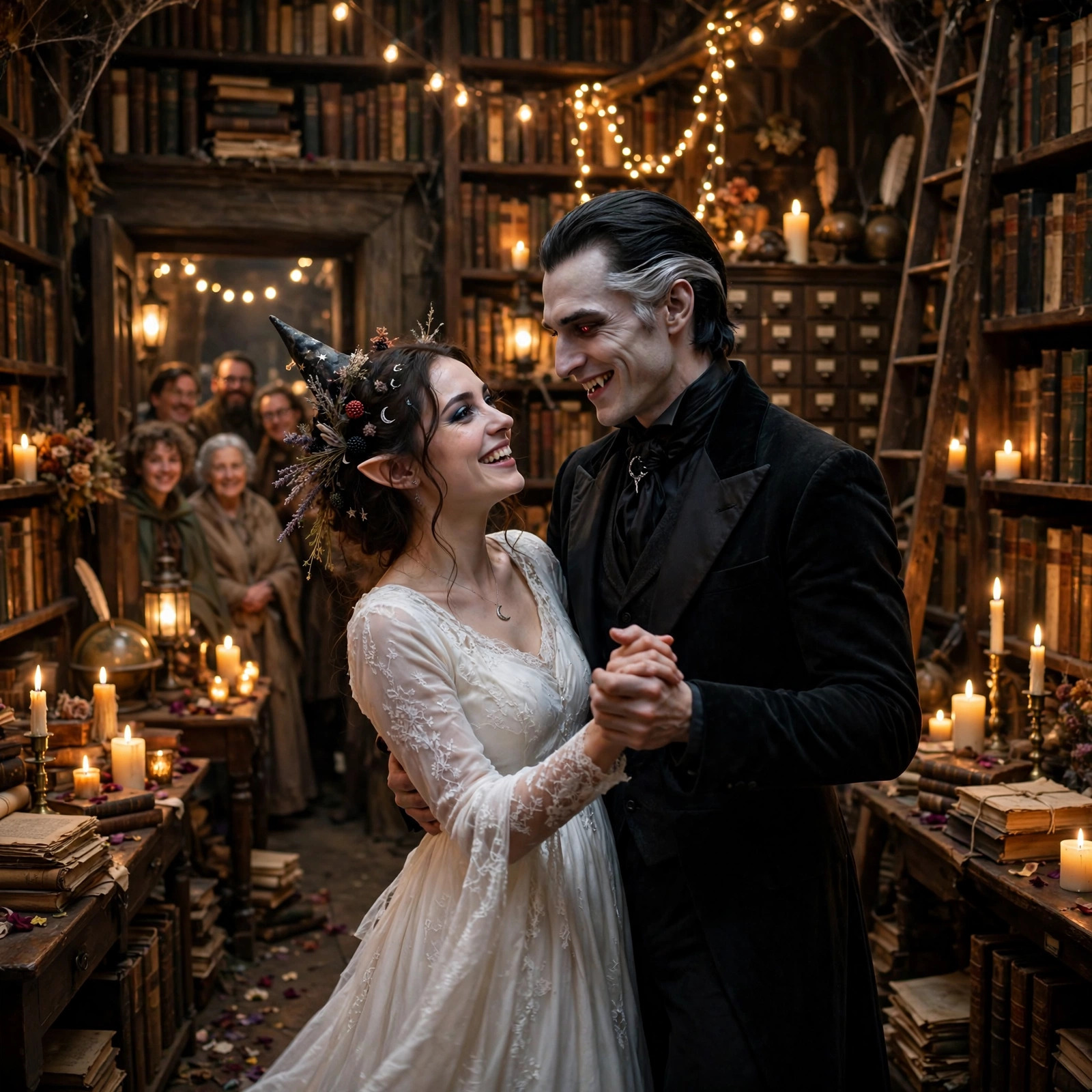
Author's note: the threshold law, as ever, was never about keeping anyone out. It was always about who inside the door was brave enough to call someone home.

Cade Ellison
Cade specializes in romantasy and paranormal romance: magic systems with rules, courts with knives, and longing that rearranges destinies.
Leave a comment
Comments