


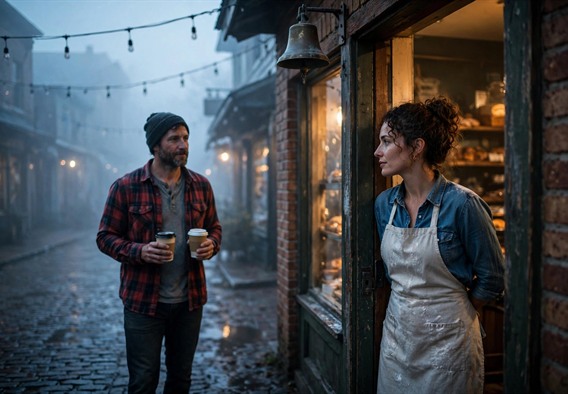


The Ordinary Miracle of Morning Coffee
Can a woman who spends her nights saving strangers learn to let one person save her right back? Thea Okonkwo had never once asked herself that question, mostly because she already knew her answer, and the answer was no. She was very good at no. She had built a whole life out of it, the way other people built lives out of mortgages and Sunday dinners, and it had held up beautifully for thirty-six years.
Then a man with a bright yellow coffee cart parked it directly in front of the Alder Bay Emergency Communications Center, and no started sounding a lot like a word she no longer knew how to use.
One Dead Machine and a Yellow Umbrella
The espresso machine in the break room died on a Tuesday in October, at 4:52 in the morning, with a sound like a small animal giving up. Thea stood over it in her fleece jacket, holding her empty mug, and considered her options. Option one: drink the vending machine coffee, which tasted like a pencil soaked in regret. Option two: drive four blocks to the all-night diner and lose eleven minutes of a break she could not spare. Option three, which she had not yet invented, was about to walk into her life under a yellow umbrella.
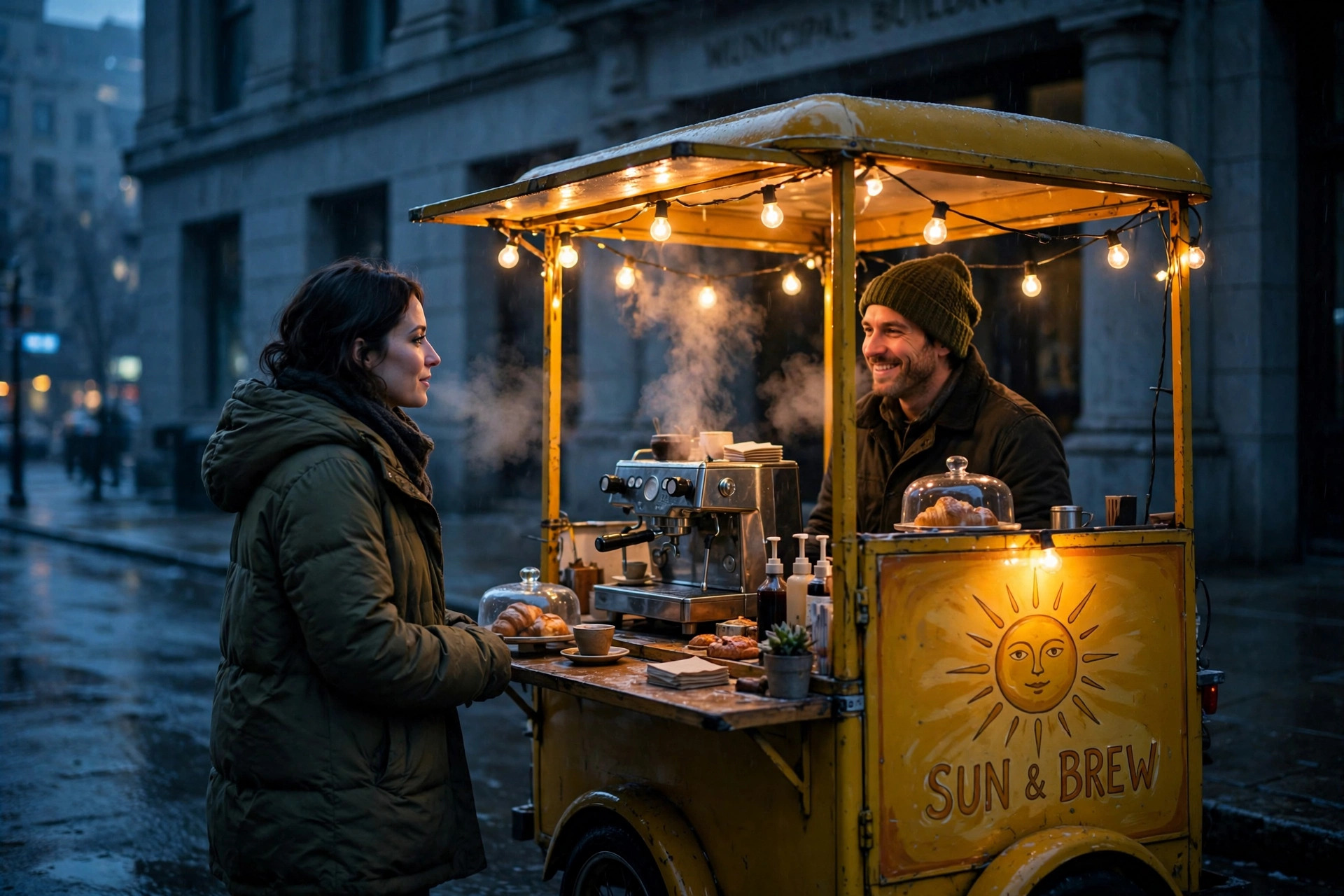
She pushed through the side door into the cold and saw it: a coffee cart parked at the curb like it had grown there overnight, strung with little lights that were still lit, manned by a man in a wool cap who was already looking at her like she was the most interesting thing to happen to him all week. Given that it was not yet five in the morning and his only other company was a parking meter, this said more about him than about her.
"You look," he said, "like a woman whose machine just died."
"I look like a woman with four minutes left of break," Thea said. "What's fast?"
"Everything I make is fast. Nothing I make is rushed. There's a difference and it matters." He was already moving, hands quick and sure on the grinder, steam ghosting up between them. "Drip's ready now. Espresso takes ninety seconds. You strike me as an espresso person."
"You strike me as a man who guesses wrong for a living."
He laughed, and it was an unfairly good laugh, warm and unguarded, the kind of sound that had no business existing at five in the morning in forty-degree weather. "Felix Marsh," he said, offering a hand around the cart's edge. "The Bright Side. That's the cart, not a philosophy. Well. Also a philosophy."
She shook his hand because refusing would have cost more seconds than it saved. His grip was warm and his knuckles were scarred and his palm had the calluses of a man who hauled his own equipment. "Thea Okonkwo. Emergency dispatch. If you park there, you will get a ticket."
"I got three last month. I've decided to think of them as rent." He slid a double shot across the counter in a paper cup with a hand-drawn sun on the side. "On the house. First cup at a new post is on the house, that's the rule."
"I don't accept free things from strangers."
"Then it's not free. It's a sample. You'll owe me an opinion." He leaned one elbow on the counter, entirely at ease, and she registered, with distant irritation, that he was handsome in a way that seemed unaware of itself, dark curly hair escaping the cap, a face built for smiling and currently doing so. "Was I right? Are you an espresso person?"
Thea drank. It was, infuriatingly, the best espresso she had tasted in eleven years in this city, dark and clean and pulled with actual care. "You were right," she said, with the tone of a woman reading a verdict she resented. "It's good. Your cart is a traffic hazard. Move it twelve feet north."
"Yes, ma'am," said Felix Marsh, and moved it twelve feet north, and was there every morning thereafter.
The Grammar of Regular Customers
It took Felix nine days to learn that Thea Okonkwo took her espresso double, no sugar, in a cup she would inspect for drips before accepting, and that she arrived at 4:52 like a train, and that she left at 5:03 like the same train in reverse. It took him eleven days to learn that she did not do small talk, and that this was not rudeness, it was economy, the way some people folded maps. It took him fourteen days to learn that she was funny, in a dry, subterranean way, humor surfacing like a trout and vanishing before you could prove you'd seen it.
"You talk to everyone," she observed one morning, watching him charm an elderly crossing guard and a rookie cop in the same breath. "Is it tiring? Being like that."
"Being like what?"
"On."
Felix considered it honestly, which was one of the things she had not expected from a man who led with sunshine. He wiped the counter in slow circles and said, "Sometimes. But it's like your job, sort of. Somebody has to be the voice that doesn't shake."
She looked at him then, really looked, longer than her usual two-second allocation. "That's either the smartest or the saddest thing anyone's said to me at five in the morning."
"I contain multitudes," he said. "Also, banana bread. Your break room looked like a crime scene on Tuesday, and I refuse to be part of a neighborhood where the emergency people run on vending machine coffee. Take the banana bread. It's not a kindness, it's inventory management, I made too much."
"Your inventory management," said Thea, taking the bread, "is a lie. But it's good banana bread."
"Everything about me is good banana bread."
What she did not tell him, what she did not tell anyone, was that the 4:52 arrival was not a train schedule. It was a flinch. At 4:41 on a night three years ago, a call had come in from a lakeside cottage, a boy's voice, eleven years old, steady and terrified, reading his grandfather's address off a pill bottle because his grandmother had collapsed and no adult was conscious. Thea had stayed on that line for six minutes and eleven seconds. She had done everything right. Every protocol, every instruction, every calm word. The paramedics had done everything right too. Some nights, everything right is not the currency the universe accepts, and that was one of those nights, and the boy had been on the line, still talking to her, when it ended.
Afterward there had been counselors and mandatory leave and a plaque she never looked at, and what Thea had kept from the whole experience was one fact, hard as a river stone: she could not do that again. Could not let another voice live in her ear at that frequency. So she had moved to nights, to training and scheduling and the quiet supervision of the floor, and she had built her no, and she had been safe inside it for three years.
Until the coffee cart, and the man who remembered that she took a double with no sugar, which meant he had been paying attention, which meant he was paying attention, which was a problem, because Thea Okonkwo had learned the hard way what happened to people who paid attention to her.
The Storm on Delancey
The storm came in on a Thursday, the kind of autumn gale that peeled shingles and turned trash cans into migrating wildlife. The power at the communications center flickered twice and died at 9:40 p.m., and the generators caught, and the floor went into the hushed, focused mode Thea knew better than her own heartbeat. Calls stacked up. Trees down on Harrow Road, wires arcing on Delancey, a woman in labor on the third floor of a building whose elevator had chosen this moment to retire. Thea moved through the room like weather of her own, steady, clipped, exact, reassigning seats, feeding information, keeping six operators breathing in rhythm.
At 11:15, she stepped into the stairwell for ninety seconds, because her trainer had taught her that the floor leader who never breaks is the floor leader who breaks badly, and she leaned her forehead against the cold cinder block and breathed.
That was when she saw, through the stairwell's little window, the yellow cart.
He was there. In a gale. At eleven at night. The little lights were off, the umbrella was lashed down, and Felix Marsh was hauling a battered portable generator out of the cart's underbelly, wrestling it behind the building, out of the wind. She should have gone back inside. She went downstairs instead.
"Are you insane?" she shouted over the wind. "There's a storm warning!"
"There's a building full of emergency dispatchers running on generators and vending machines!" he shouted back, hair plastered to his skull, grinning like the storm was a party he'd been invited to. "I brought the good coffee. And soup. Don't ask how much soup, the answer is too much soup."
The generator coughed, sputtered, and died. Felix swore, a word he clearly rationed, and knelt to look at it, and Thea saw his shoulders change, saw the grin flicker, and understood in one flash that the machine mattered more than he was letting on. If the cart died tonight, on the worst night this city had had in months, with everyone watching, then the Bright Side was just a pretty toy.
"Move," she said.
"Excuse me?"
"Move over. You've flooded it or you've fried the exciter winding, and you're guessing, and guessing is loud." She knelt beside him, jacket off, sleeves shoved up, and held out her hand. "Flashlight."
He gave her the flashlight. He also gave her a look she would think about later, the look of a man discovering something. Thea checked the fuel line, found the flood, cleared it, then pulled the housing panel and went quiet. Her father had been an electrician, a quiet, patient, exacting man who had taught his daughter to solder before she could ride a bike, on the theory that a girl who could make a circuit behave would never be entirely at the mercy of the world. She had not touched a soldering iron in nine years. Her hands remembered anyway.
"Corroded connection on the field coil lead," she said. "It's arcing. Give me your multitool, the one in the left pocket, I saw it when you handed me the flashlight."
"You saw my pockets?"
"I see everything. It's the job." She stripped the wire, cleaned the contact, re-seated it, and used a matchbook cover, of all things, as a temporary insulator, a trick from her father's kit that she had thought she'd forgotten. "Try it."
The generator caught on the second pull and settled into a low, steady purr. Felix stared at it, then at her, rain running off his chin. "Thea Okonkwo," he said, "who are you?"
"Someone whose father didn't believe in being helpless." She stood, pulled her jacket back on, and discovered that her hands were shaking, not from cold. It had been nine years since she'd done anything with them that mattered in quite that way, and the feeling of it was enormous and disorienting, like a window opening in a wall she'd bricked over. "Bring the coffee up. Second floor, ask for Reyes. And Felix. Thank you for the soup."
She was gone before he could answer, which was, she would later admit, entirely on purpose.
What the Cart Knew
After the storm, the cart became something neither of them had planned. The night-shift crews adopted it as a landmark. Off-duty paramedics drifted by at strange hours. The crossing guard, whose name was Mrs. Adeyemi, began leaving a thermos of ginger tea for Felix on the coldest nights. A little ecosystem formed around the Bright Side, warm and improbable, and Thea stood at its edge every morning with her double, no sugar, watching Felix hold the whole shifting crowd in easy orbit.
"You know everyone's name," she said one morning. "The rookie cop. The paramedic with the bad knee. Mrs. Adeyemi's granddaughter."
"Names are the cheapest gift there is," Felix said, wiping the steamer wand. "Everything else about people is expensive. Names you can just give away."
"That's a strange way to live."
"It's the only way I know how to live." He said it lightly, but not lightly enough, and Thea heard the seam in the lightness, the place where the sunshine was load-bearing. She was a professional listener who had retired from listening, and even she caught it. "You know what your problem is?" he went on, before she could decide whether to press. "You think noticing people is dangerous. You've got it backwards. Not noticing is the dangerous part. That's how you end up forty and surprised."
"I'm thirty-six and not surprised by anything."
"Bet you were surprised by the generator."
She hated him a little for that, in the specific way that meant he was right. She had been surprised by the generator. Surprised by the sudden reminder that under the scheduling grids and the careful distance there was still a woman who could make a dead machine sing, because her father had insisted on it, before the cancer took him the year she turned twenty-seven, before she had learned that everything you love can be scheduled away from you.
"My father taught me," she said. The words came out before she authorized them. "The wiring. He was an electrician. He believed you should always be able to fix at least one thing with your hands."
Felix didn't pounce on it. He didn't make it a moment. He just nodded, and handed her the cup, and said, "He'd have liked the matchbook trick. That's old-school." And then he told her about the time he'd tried to rewire a toaster and set off the alarm in his building, and the fire department had come, and he'd made them all coffee while they wrote up the citation, and two of them still came by on Thursdays. It was a good story, self-deprecating and warm, and it took the pressure off the thing she'd said without making it meaningless, and Thea recognized, with something close to awe, that this was a skill. That the sunshine was not naivety. It was craft.
The Fire Escape
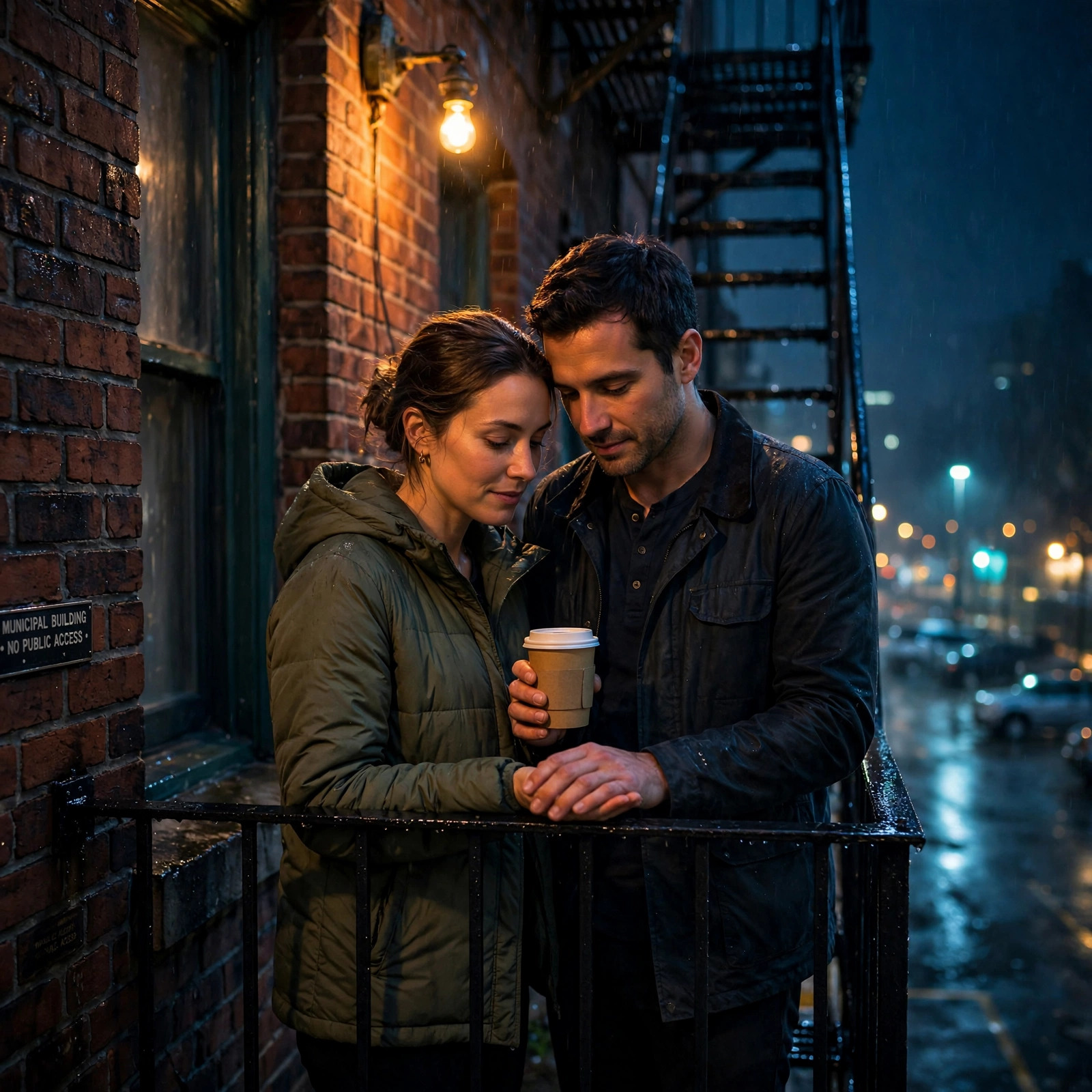
The vulnerability, when it finally came, came at 3 a.m. on a fire escape, because that was the kind of city they lived in, where the roof access door on municipal buildings had been broken for a decade and everyone used it anyway. There had been a bad shift. A multi-vehicle accident on the interstate, four operators deep in it, and Thea had stood in the middle of the floor holding the whole net taut for three hours, and one of the cars had held a family, and the family had come through, everyone alive, everyone alive, and it should have been a win, it was a win, and she had walked out of the building shaking anyway, because the adrenaline didn't know the difference.
Felix was closing the cart, late, because the night crews had run him ragged. He saw her come out the side door and stand in the cold with her hands in her pockets and her face closed like a door with the deadbolt thrown, and instead of waving, he climbed down and stood beside her and said nothing. That was the first miracle. He knew how to be quiet. The sunniest man in Alder Bay knew how to be quiet.
"There was a call," she said, three minutes into the silence. "Three years ago. A boy. He was eleven, and he did everything I told him to do, and he was so brave on the line, Felix, he read the address off a pill bottle like I asked, and he stayed with her, and it didn't matter." Her voice did not shake, because she had built it not to, but it went somewhere flat and far away. "He was on the line when it ended. I heard the whole thing. And after, everyone kept telling me I did everything right, and I wanted to ask them, then what is all this? What is right for, if it doesn't hold?"
Felix turned to face her. In the light from the cart's little bulb his expression was not pitying, which would have made her leave, and not wounded, which would have made her apologize. It was steady. It was the face of a man who had decided to pay full attention.
"Can I tell you something true?" he said. "And you can decide afterward whether to be mad?"
"That's an ominous contract."
"I know. I'm asking anyway." He waited until she nodded. "You didn't fail that boy. But I think you've been treating yourself like a machine that malfunctioned, and machines get pulled off the floor. You're not a machine, Thea. You're the person everyone in that building follows when the room goes bad. I've watched you through the window for months. You're the reason that family came through tonight. And I think you retired from your own life three years ago and forgot to tell anyone."
The wind moved through the parking lot. Somewhere a block over, a siren rose and faded, the city's old familiar sentence.
"You weren't supposed to be watching," she said finally.
"I know. I'm sorry. I'm not very good at not watching you." He said it simply, without performance, and it landed in her chest like a stone dropped in still water. "I don't want to fix you. For the record. I think you're the least broken person I've ever met. I just think you're parked somewhere you outgrew."
Thea looked at the cart, with its hand-drawn sun and its little lights, and at this man who had built a whole warm harbor out of a folding counter and a machine, and she felt the no she had built shifting under her feet like pack ice.
"Come upstairs sometime," she said, which was not what she meant, and she heard it land wrong, and corrected. "Not. I mean, come inside sometime. When it's quiet. I'll show you the floor. I want to show somebody the floor. I haven't wanted that in three years."
"I'd like that," Felix said. "I'd like that a lot."
The Ledger
He came inside the following week, during her day off rotation, and she walked him through the floor: the banks of consoles, the status boards, the quiet choreography of a room where every second had a weight. And because she was Thea, she showed him her ledgers. Ten years of them. Response times, staffing curves, the night the bridge iced, the patterns only she had ever bothered to write down, in her small, exact, unlovely handwriting.
"Why do you keep all this?" Felix asked, turning a page.
"Because numbers don't flinch," she said. "And because somebody should know what this room actually costs and actually saves, even if nobody asks."
Felix went still over the ledgers in a way she had never seen him go still. Then he said, "Can I photograph some of these pages?" and she said, "Why?" and he said, "Because I think we're going to need them," and he was right.
The news broke on a Monday: the city, staring down a budget gap, had scheduled a consolidation review. Alder Bay Emergency Communications would be folded into the county regional hub, forty minutes out, staffed by people who had never driven a street in the city they'd be dispatching. The review was in six weeks. The building, conveniently, sat on a parcel the development office had been eyeing for years, and the parking lot where a certain yellow cart held its ground was, technically, part of the parcel.
Thea read the memo twice and felt the old reflex rise, the one that said build the wall higher, the one that said nothing you love is safe so love nothing that can be taken by a committee. She had watched a building's worth of good people start polishing résumés. She had watched Mrs. Adeyemi's granddaughter cry at the cart. She had felt, with terrible clarity, the exact shape of the flinch, because she knew it from the inside.
Felix, meanwhile, was doing what Felix did. He was organizing. Coffee for the union meeting, signatures on the petition, a Facebook page with a pun in the title. He was good at it, effortless at it, and it made Thea uneasy in a way she couldn't name until she could: everyone expected the cheerful one to carry it, and he was carrying it, smiling, and his eyes had gone somewhere flat and far away that she recognized, because it was her own address.
"You're doing the thing," she told him one morning, two weeks before the council session. "The voice that doesn't shake."
"Somebody has to."
"Not if it's costing you." She set her cup down. "Felix. What happens when you're the one who needs the voice?"
He opened his mouth to deflect, she watched the deflection assemble itself, charming and quick, and then, visibly, he decided not to use it. It was like watching a man put down a heavy bag.
"When I was fourteen," he said, "I was the kid in the foster home who made everyone laugh, because the funny one gets kept. You learn the weather of a new house fast when you're the new one. You learn which smile works on which grown-up. And you learn that the system that's supposed to notice you notices the quiet ones, the loud ones, everyone but the one who seems fine." He wiped the counter, though it was clean. "So I got very good at seeming fine. And then Mara found me at twenty-five and I did not have to seem fine anymore, and then she got sick, and I was fine for her, all the way through, and when she died everyone at the funeral said, he's so strong, look how well he's doing, and I stood there in my good suit being fine one more time and I thought, this is it. This is the trap I built. Nobody checks on the lighthouse."
Thea's hand was on the counter between them. She looked at it, and then, deliberately, turned it palm up. It was the bravest thing she had done in three years, and she watched Felix understand exactly what it cost, because his own hand went over hers and neither of them said anything for a while, and the parking lot held its two idiots and its cold morning light and its yellow cart with the hand-drawn sun.
"Okay," she said at last. "New plan. You stop being fine in public, and I start being public. Deal?"
"That's the worst deal I've ever heard," Felix said, and his voice cracked on the last word, and he laughed at himself, wetly, and held her hand tighter. "Deal."
The Session
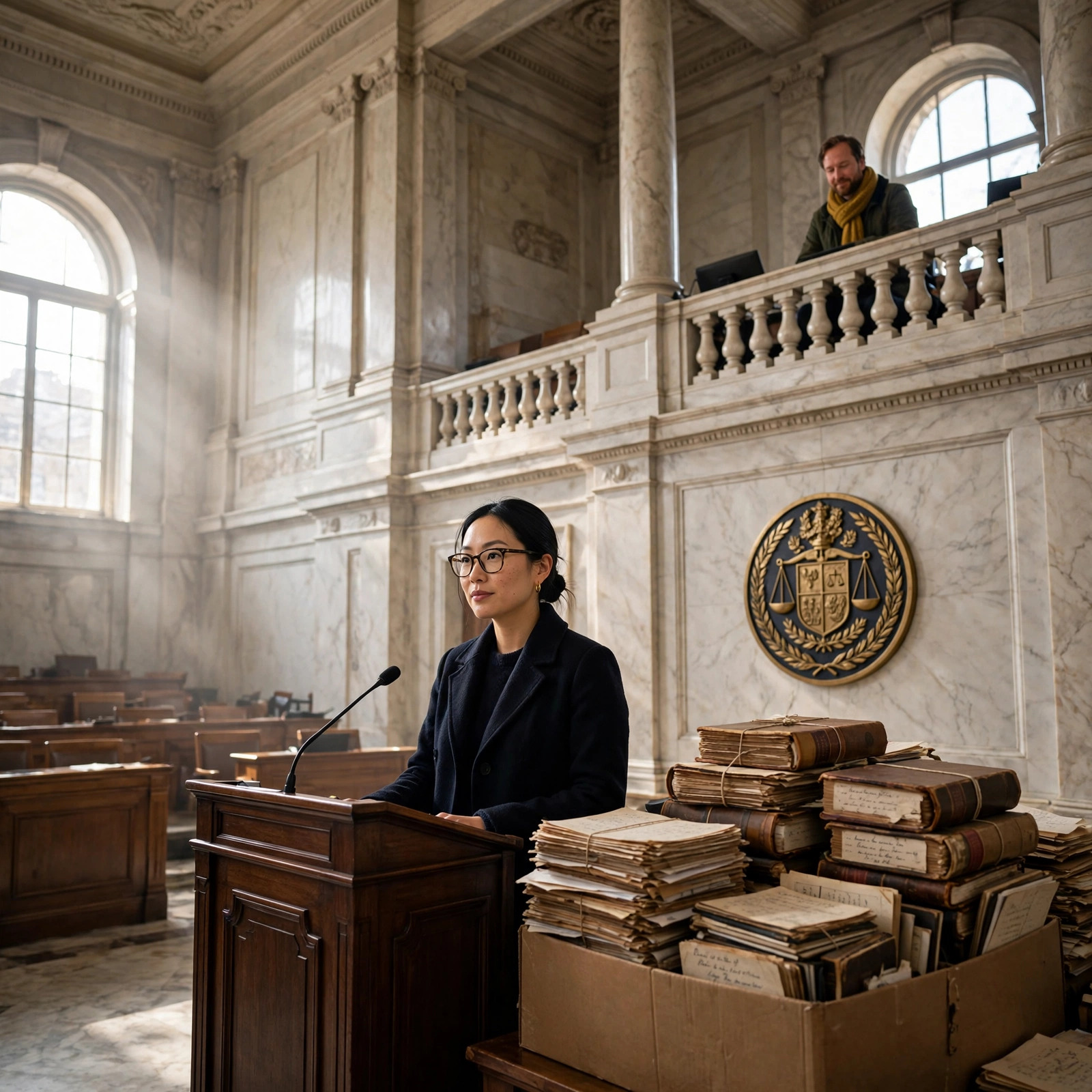
The council session was held in a room with bad acoustics and worse intentions, and the fix was in, everyone knew it, the consolidation had been pre-written and the public comment period was theater. Thea sat in the third row with her ledgers in a box, forty pounds of exact handwriting. Felix signed in to speak eighth. She watched him walk up there with his usual warmth intact and she knew, because she had studied this man the way she studied weather patterns, that the warmth was a costume tonight.
He took off the costume at the podium.
"My name is Felix Marsh, and I run a coffee cart," he began, and let the room's small, dismissive chuckle happen and die. "I've been funny in this room before. I'm not going to be funny tonight, because funny is how this city talks itself out of things." He set down his notes, which was a signal, Thea realized, aimed directly at her. "Forty minutes. That's the county hub's average dispatch-to-scene under the proposed plan, on their own projection sheets, page fourteen, table six. I know that number because a dispatcher I know keeps records nobody asked her to keep. Ten years of them. Her numbers say what your own consultants' numbers say, except hers have faces attached. So before anyone in this room votes to move my city's 911 calls forty minutes out, I want you to sit with one number of mine."
He paused. The room, which had come for theater, got silence instead, and silence, it turned out, was heavier.
"Two years ago a woman on Delancey had a stroke, and her neighbor called it in, and a dispatcher here recognized the address because she'd sent an ambulance there before, and she knew the code on the gate, and she talked the neighbor through getting in. Total time to door, eleven minutes. Under consolidation, with a hub crew that doesn't know that gate, the model says thirty-one. There's a name on that woman's recovery, and it's the name of a room in this city, and you are about to auction that room." His voice didn't rise. That was the unnerving part. It came down, level and clear. "I've spent my whole life being the one who makes hard rooms comfortable. I'm asking you not to be comfortable. I'm asking you to be the room that holds."
He stepped back. There was a beat of nothing, and then Thea stood, carried the box to the front, opened it, and said, in the flat, exact voice that forty years of municipal rooms know means business: "Thea Okonkwo, supervisor, nights. I have ten years of response data. Cross-examine me."
They cross-examined her for forty minutes. She did not flinch once. When it was over, the council president, a tired woman named Hobbes who had clearly been told which way to vote, looked down at the stack of ledgers for a long moment and said only, "These will be entered into the record."
In the hallway after, Felix found Thea standing against the wall with her back to everyone, doing the breathing, and he didn't touch her, he just stood where she could see him, and said, "You were magnificent," and she said, "I threw up in my mouth twice," and he said, "Magnificently," and she laughed, and it surprised them both.
The Choice
The vote, when it came three weeks later, was five to two to keep the center open, with funding for a staffing plan built on Thea's own numbers. It was not a fairy tale. It came with a pay freeze and a hiring delay and a hundred small miseries. But the room stayed. The room stayed because a woman who had stopped believing in rooms had filled a box with proof, and a man who had never once asked a room to stop smiling had asked it to hold.
Two days after the vote, the other shoe dropped, because shoes do that. A regional coffee franchise, sniffing around the same development office that had eyed the parcel, offered Felix a deal: a branded kiosk program, his recipes, his cart design, his little hand-drawn sun licensed, six locations in the suburbs, a salary with a zero more in it than he'd ever seen. His supplier was already raising prices. His lot was still, technically, condemned. Everyone he showed the contract to said take it, are you crazy, take it.
He came to Thea's fire escape with the contract folded in his pocket and told her all of it, honestly, including the part where taking it would mean leaving, and including the part where he had spent two nights not sleeping, doing the arithmetic of his own life.
"Take it if it's what you want," Thea said. "I mean it. I'm not going to be the reason a man shrinks his life. I've seen what happens to people who get talked out of their own futures."
"You're not the reason," Felix said. "You're the opposite of the reason. Here's the thing I figured out at four in the morning, which is apparently when I do all my figuring now. That contract isn't an offer. It's a purchase. They want to buy the thing people actually come for, and the thing people actually come for is that somebody knows their name. I can't do that six places at once. I can do it here. And here is where the dispatchers work nights, and Mrs. Adeyemi crosses her kids, and a woman with ten ledgers takes her espresso at 4:52, double, no sugar." He looked at the contract, and then he tore it, once, cleanly, down the middle, and put both halves in his pocket for recycling, because he was Felix. "Turns out the lighthouse gets to choose where it stands."
"That was a legally binding document," Thea said.
"It was a paper cutout of a life." He took her hand. "Thea. I'm not asking you to promise me anything tonight. I'm asking if I can keep showing up. Every morning. Even the bad ones. Especially the bad ones."
"I work most mornings."
"I know," said Felix Marsh, and smiled, and for once it was a smile with nothing on top of it, just a man looking at a woman. "I counted."
"You counted," Thea said, and her voice did something it had not done in years, went rough and warm at the same time, "of course you counted. Felix. I'm going to be difficult. I'm going to have nights I can't talk, and anniversaries I don't explain, and I'm going to inventory your pockets."
"I'm counting on it. I'm going to be too much. I'm going to learn your whole building's names and feed your whole floor and be relentlessly, structurally optimistic at hours you consider uncivilized."
"Good," said Thea Okonkwo, who had spent three years being safe and one autumn being alive, and pulled him in by the collar of his coat and kissed him on the broken roof-access stairwell of the Alder Bay Emergency Communications Center, which, if you had asked her a year earlier, would have ranked somewhere below the vending machine on the list of places she expected to be happy.
Epilogue: First Light
Spring came to Alder Bay the way it always did, all at once, like a decision finally made. The parcel got rezoned for mixed use, and through a small bureaucratic miracle that Thea suspected involved Mrs. Adeyemi's granddaughter, now a law student, the cart got a permanent concrete pad in the courtyard behind the communications center, with a water line and an outlet and its own little awning, painted the exact yellow of a held breath let out. The first morning it opened on the pad, half the night shift crowded around it, and Reyes brought a cake that said THE BRIGHT SIDE, EST. FOREVER, and Felix cried a little and pretended it was steam.
Inside, on the floor, things were different in ways that would not make a plaque. Thea ran trainings now. New hires learned the room's rhythm from her ledgers, and she taught the module on the call you can't save, the one nobody had taught her, and she taught it well, because she was exact and honest and she did not pretend the hard thing was easy. On her desk, where the plaque had never hung, there was a paper cup with a hand-drawn sun on it, refilled every morning at 4:52, double, no sugar.
At 5:03 the train left the station, every day, right on time. But these days it went both directions. Some mornings, at 5:04, a man in a wool cap came through the side door with two cups and a pastry he called inventory management, and Thea Okonkwo, supervisor, nights, the most exact woman in the building, let herself be looked forward to. It turned out that was a thing you could practice. It turned out that was a thing you could get good at.
"Big night?" Felix asked, setting her cup down.
"Quiet," she said. "Everyone came home."
"Best kind." He settled onto the stool that had quietly become his stool, in the corner of the break room that had quietly become his corner, and the morning came up gray and then gold over the parking lot, and the city moved through its ordinary miracles, sirens and buses and crossed guards and coffee, held, the whole loud fragile thing of it, by people who had decided to keep showing up.
"Hey, Felix," Thea said, into the steam.
"Yeah?"
"Thanks for parking twelve feet north."
"Best decision I ever made," he said, "and I once talked a fire captain into a free croissant."
And because she was still Thea, she checked the cup for drips before she drank. And because she was still Thea, only more so, she smiled while she did it.
"Names are the cheapest gift there is. Everything else about people is expensive. Names you can just give away."
The End. Thank you for reading. If Thea and Felix found their way into your morning, pass the cup along to someone who needs a Bright Side today.
Get notified when new stories drop

Marcus Hale
Marcus writes slow-burn and marriage-of-convenience stories where logistics become intimacy and competence is a love language.
Leave a comment
Comments