



The Salvage Clause
Can two people who despise each other on sight, who have spent years building their lives around that hatred, still choose each other when the hate runs out of fuel? This dark enemies-to-lovers story is one answer to that question.
There were exactly two things Ada Kestrel knew for certain about Julian Ferrow. He had put her father's firm out of business with a lawsuit so procedural, so surgically dull, that no one had even been able to hate it properly. And he had once told a room full of developers that preservationists were "grief tourists with drafting pencils."
She had heard the recording of that quote forty-one times. She had a folder for it. The folder was titled, with restraint she considered heroic, Litigation Support.
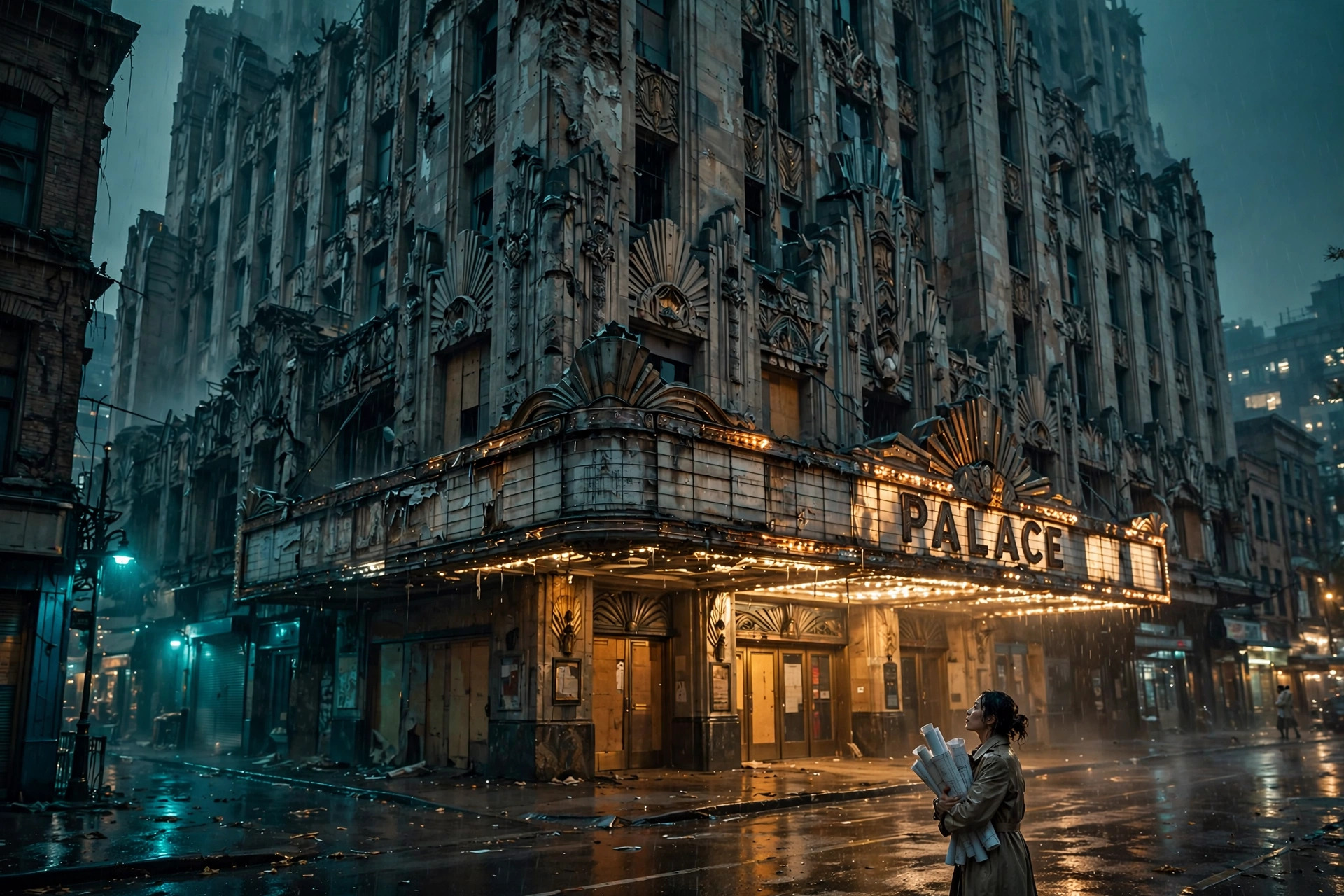
Now here he was, at eight in the morning, standing in the rain-slick lobby of the Aldwych Grand, holding the last thing she loved in the world by the throat.
"You're trespassing," she said from the doorway. She did not raise her voice. She had learned that rising voices gave men like him permission to relax, to become the reasonable one by default. "Notice of entry requires seventy-two hours. Filed with the landmarks office, copied to the preservation trust."
"Filed last Thursday." He didn't turn around at first. He was looking up at the lobby's cracked fresco, at the painted ceiling where seventy musicians had been rendered as golden letters and birds, and Ada had a full second in which she let herself imagine that maybe he was looking at it the way she looked at it. Then he turned, and his expression was exactly the level, faintly amused she was expecting, and she hated herself for that wasted second. "Kestrel. They said you'd be here at some ungodly hour. I didn't believe them."
"Why would you believe anything? Believing costs men like you money."
"Men like me," he repeated, tasting it. He was taller than television footage suggested, broader through the shoulders, dressed in a charcoal overcoat that had probably cost more than her annual materials budget. His black hair was damp at the temples from the rain, and there was a single white streak above his left ear that she had never seen in a photograph. "You have a whole category for us. That's efficient."
"It's structural analysis," she said. "Everything eventually resolves into load-bearing and decorative. You're decorative."
That, at least, wiped the amusement off his face. Good, she thought. Files itself under Litigation Support.
He crossed the lobby at an unhurried pace, stepping around a fallen piece of plaster with a strange, automatic care, and stopped too close, close enough that she could smell rain and cold wool and, under it, sawdust. Which was wrong. Ferrow Development did not do sawdust. They did hearings, buyouts, and孫 insurance settlements.
"Here's what happens now," he said quietly. "You walk back to whatever car your trust gave you. I walk up to the mezzanine with my surveyors. Demolition of the annex starts Monday. The protected facade stays standing, per the settlement, and the inside comes out."
"The inside is the building."
"The inside is two thousand tones of liability."
"The inside," Ada said, and her voice did crack then, which she would be furious about for a week, "is the last surviving proscenium arch by Iris Marlowe. There are two others in the world. One burned in 1988 and the one in Prague is behind iron Curtain restoration they won't finish in your lifetime. This one is here. This one is mine to save."
"Yours," Ferrow said. Not mocking. That was the worst part. He said it like a man checking a receipt for an error. "Where were yours when the roof failed in March? Where were yours during the asbestos abatement bids, the winter burst pipe, the eleven years of hearings your own trust documented and then abandoned? You talk about the building like it's a person you've been guarding. It's a person you've been visiting."
The lobby was very quiet. Rain drummed somewhere above them, through holes in a ceiling she had drawn from memory in her third year of school, and Ada stood with her hand still on the door handle because if she let go she was going to do something she could not undo, and Julian Ferrow looked at her hand on that handle, and said, in a tone she had never heard him use, "I'm sorry."
"Don't."
"I'm not apologizing for the demolition." His jaw moved. "I'm apologizing for the sentence structure. It was accurate and it was cruel, and I don't actually get to hold your grief against you."
"You put my father's company under."
"I know."
"Then you don't get to be human. It's against policy. My policy. I'll have you issued in writing."
For one strange, luminous moment, something crossed his face that was almost a smile, a real one, ugly and crooked, gone instantly. "Get your lawyer to draft it," he said. "I read everything. It's my one virtue." Then he turned and walked toward the mezzanine stairs, and Ada stayed in the lobby with her hand on the handle and her heart doing something stupid and necessary, and understood, with total clarity, that she was in more trouble than the building was.
Two
From Julian's office on the thirty-first floor, the Aldwych Grand looked like a gap in a row of teeth.
He kept the photograph of his grandfather on the shelf behind the door, where clients could see it but not study it. In it, a young man in work boots stood on the theater's stage, 1961, arms up, lit like a saint. His grandfather had laid the concrete for the annex Julian was now legally obligated to remove, had come home every night for a year with lime dust in the creases of his knuckles, and had died, in the end, in a city-subsidized care facility because his own grandchild had let the family contracts go to a rival and their estate to a creditor. Julian had been twenty-three. He had made his peace with what he'd done to survive, the way you make peace with weather.
He had not made peace with Ada Kestrel's face when he'd told her the truth about her own neglect.
Because it had been true, and truth was supposed to be armor, and instead it had gone through him like a round.
"There's a problem with Monday," said his project manager, Daisy Opal, who had survived four acquisitions and one attempted arson and was therefore unstartled by anything. She laid a document on his desk. "The Marlowe arch. Your settlement exempts 'architecturally designated interior elements' from removal pending relocation approval. Which the landmarks office has just, and I quote the email, 'gladly, enthusiastically, with prejudice' granted."
"Meaning?"
"Meaning the city has assigned a conservation engineer to oversee disassembly, and the engineer they assigned is Kestrel. On site. Daily. All week."
Julian looked at the photograph of his grandfather. His grandfather, who had once told him over dominoes that a man who never lost an argument had never wanted anything enough to risk it.
"Fine," he said.
Daisy's eyebrows went up exactly a millimeter, which for Daisy was a standing ovation.
"Fine?"
"Fine. She's competent, she's legally in the right, and fighting her wastes a week I don't have. Give her full badge access. Do not assign Kestrel the temp badges we use, the ones with the time-limit flags. Full access."
"You know she's going to use that access to slow us down."
"I know," Julian said, signing the form, "that I am going to learn more about this building from her in four days than my surveyors learned in four weeks. And I know that I already dislike how I feel about that. Get her the badge."
Three
Ada arrived at six the next morning to find that someone had unlocked the annex stairwell for her and left, on a folding table, coffee in an actual ceramic mug and a printed copy of the Marlowe arch's original 1927 fabrication drawings, pulled from the Ferrow archives, annotated in an old man's handwriting.
His grandfather's handwriting, she realized. J. Ferrow Sr., head plate.
She drank the coffee on principle and decided it changed nothing.
By nine, she and Julian were on the annex scaffolding together because disassembly of the connection wall required sign-off from both of them, and the argument over how to brace the arch was going into its third hour.
"You don't support a frescoed arch from the crown," Ada said, tapping the drawing. "Crown bracing cracks the key. You take it from the haunches, transfer through a temp frame, and you fly it out whole."
"Fly a forty-foot unreinforced arch," Julian said, "through a building with no intact rigging beams, on a site I'm liable for, with a lift record I'm liable for, with you on it."
"Yes."
"Absolutely not."
"It's the only way it survives."
"It's the way it survives if you're wrong, it kills you and my rigger."
"Then don't rig it," she snapped. "Rig it better. You have a hundred million dollars and a thousand people on payroll, Ferrow. What you don't have is an excuse."
He stood on the scaffolding plank in the cold shaft of light coming down through the annex roof, and she watched something happen in his face, the career accountant expression dissolving, and what came up from underneath was rage, real rage, and then, harder to look at, fear.
"My grandfather fell off a rig like that," he said. "Not a legend. Not a story I decorate the office with. He fell off a rig in 1979 and lived the rest of his life in a chair, and I was his kid's kid, and the job that comes with keeping sites like this alive is the job of calling him up in my head and saying sorry, no, this one's too dangerous, we cut it out in sections and throw it away. Every day."
The wind moved through the open roof. Ada held the drawings and did not answer, because the next thing anyone said was going to change which of them was standing at the top of this in a year.
"Design it to fail safe," Julian said at last. "If you can. If it can't be made to fail safe, then it comes down in sections and we pick up whatever survives, and you will hear me say, on the record, that a preservation standard was knowingly not met, and you will get to hate me about it forever, cleanly."
"You'd do that," Ada said. "Write your own failure into the record."
"Once," he said. "For this. Don't make it a habit."
Four
They spent nine days inside the arch.
Not together, not to start. Her by day, him at the edges, at doorways, on the mezzanine, always with paperwork he was visibly using as camouflage. But a theater in scaffolding is an intimacy machine. You shout across it and hear yourself. You walk a plank your counterpart walked an hour before and learn their gait from the dust.
She learned he counted steps under his breath. She learned he was terrified of heights, and had not told a soul, and climbed anyway, every day, because the survey reports had to be checked in person or he would not sign them. She learned he was left-handed and that he hid it, tucking his hand back on angles, and she started logging bracing points right-handed so no one would flag it for him.
He noticed. Of course he noticed.
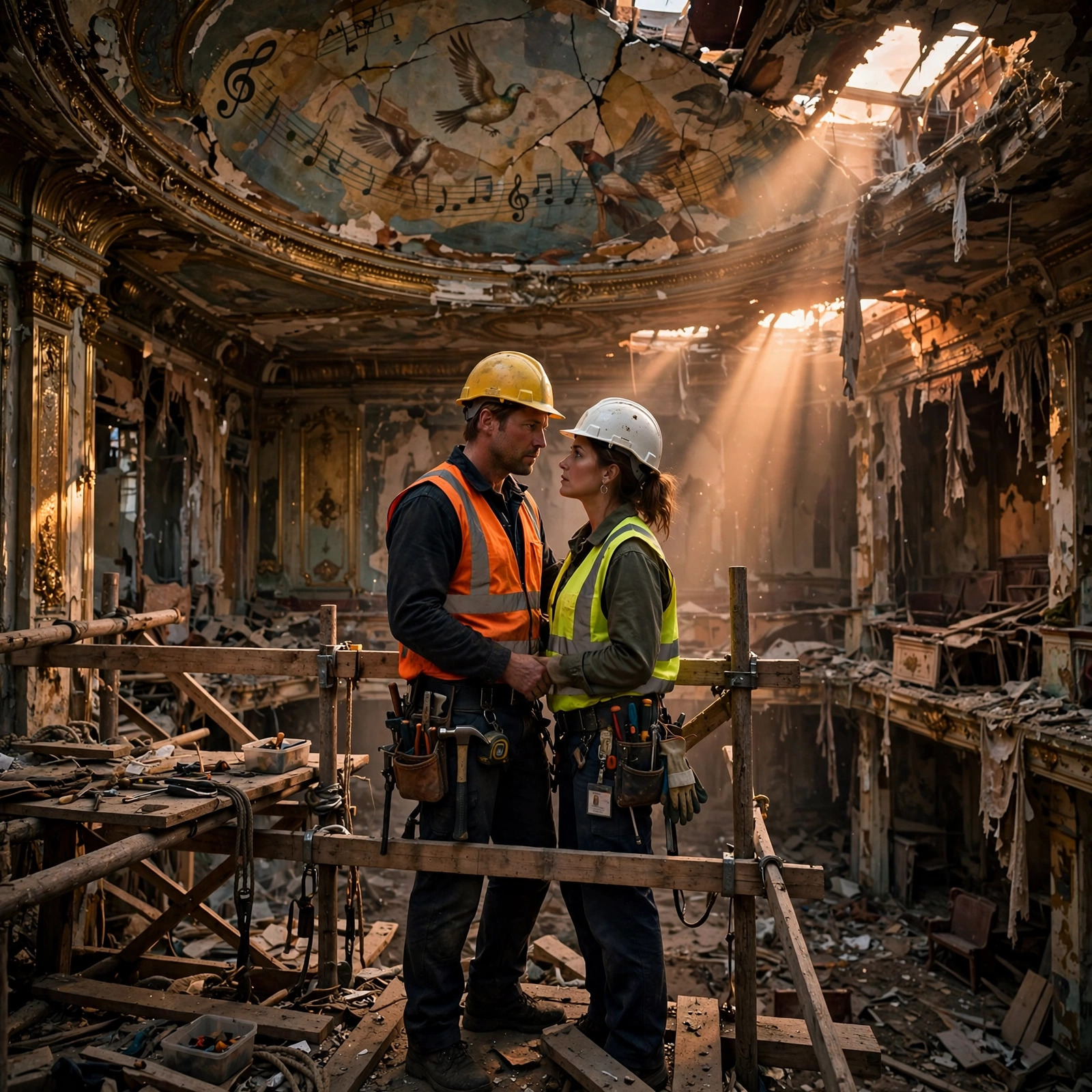
"You moved the tie points," he said on day five, on the platform above the arch crown, thirty feet up, both of them clipped in, dusk coming down copper through the roof holes.
"I optimized them."
"You mirrored them."
"I optimized them for a left-dominant engineer, in case," she said, not looking at him, "your other surveyors happen to be left-handed."
The silence up there was enormous. Below them, the proscenium arch held its painted sky, Iris Marlowe's birds and golden notes, and the whole broken gorgeous ruin of the place took a breath of wind through the missing roof, and Ada felt it make a sound she had never heard a building make before, a note almost too low for hearing.
"She's singing," Julian said. "I've heard that before, with a foundation under repair. Structural resonance. There's an engineering term for it that isn't singing."
"There is," Ada agreed. "It's a bad one."
"When my grandfather was dying," Julian said, all at once, like pulling a splinter, "he asked me to buy this building. Not develop it. Buy it. Keep it. I said yes and then I didn't, because by then I'd lost his money twice and a third loss would have ended the family name in the papers, not just in my head. So I watched it starve for twenty years from across the street, basically. And now my whole legal position, my whole settled position, is that the interior was always a write-down."
"Your position was also," Ada said carefully, "that I'm a grief tourist."
"I know what I said." He was looking at the arch, at the painted birds. "The recording exists because I let a journalist follow me for a week and say whatever crossed my mind, which is how I say some things, to burn the nice version out of myself. It's the meanest quote I've ever given on purpose. And the truest thing I've ever watched a person do in a building, other than lay the concrete for one, is you, this week, at the tie points, with the drawings your dead colleagues' dead colleague drew."
"Don't," Ada said, though her voice had gone somewhere else entirely. "Don't do this up here. We can't do it up here. I'll fall off."
"We're clipped in," he said, and there was the crooked real smile, the one that had almost ruined her on day one. "Structurally. Failsafe. Remember. That was your standard."
She climbed down early that night. She was, she would reflect later, not running. She was simply, temporarily, relocating her whole center of gravity.
Five
Day eight, the crane failed.
It was not dramatic. Nothing fell. The lift line frayed at the sheave, the whole operation froze at six in the morning, and the weather window Ada had sworn to the landmarks office was closing in fifty hours. If the arch did not fly out whole within that window, it did not fly out whole at all.
Julian stood at the annex door in the cold, on his phone, arranging, in order: a second crane, a crew from a rival firm he had personally feuded with since before Ada could legally buy a drink, and a favor from a person whose name he said like a password.
"This is going to cost you," Ada said, next to him, arms crossed against the wind.
"Money costs. Bearings cost. Reputation for weeks of delay costs." He hung up. "This costs other things, and I'll pay those too, quietly, and I'd appreciate you not watching me pay them."
"What things?"
"Ada." He said her name, first time, just the name, no prefix. "There is a way I've structured my whole adult life. It is solvent, it is defensible, and it has cost exactly one building and one grandfather, and I've made my accounting. This week, twice, you have made me stand in a thing I built and feel it from the other side. That's not blame. I don't accept it as blame. It's just the load shifting."
"And now?" she asked. "The load is shifted. What do you do with that?"
He looked at the theater. Its birds. Its sky. Its terrible, fixed, beautiful lack of choice in the matter of its own survival.
"Tonight," he said, "I review the rigging design for a reason that has nothing to do with rigging, and tomorrow we try. That's the entire plan and I'm not adding to it while a crane is broken."
Six
The arch flew.
It rose through the annex roof at eleven the next morning, whole, on a second crane whose operator Ada had hand-picked out of a list Julian had burned a professional blood-feud to obtain, and the whole broken site stopped to watch, riggers and surveyors and Julian's own crew, everyone silent as a cathedral, and the arch went up into the grey sky painted with its 1927 birds, and Ada stood on the scaffolding with Julian Ferrow's hand one clip-link from hers and felt something in her chest break and rehang itself on new points.
"Do not," he said quietly, not looking away from the load, "cry on my site. Liability."
"Do not," she said, "be funny while I'm having a feeling."
"Noted and filed."
The arch cleared the roofline. The wind took it, just the smallest sway, and the crane operator, a grey-haired woman named Petra, talked it home over the radio in the calmest voice Ada had ever heard, and it set down on the flatbed like a coffin made for a god.
Julian took his hard hat off. Under it his hair was plastered flat, white streak and all, and he looked, for the first time since the lobby, like his own grandfather's photograph. Like a man on a stage with his arms up.
"Take the rest of the day," he said to the site, loudly, and when the crew cheered he looked confused, as though cheering were a language he recognized but had never been raised speaking.
"Walk with me," Ada said. "There's one more thing up there. It's not arch, it's not load-bearing, and I found it Tuesday and haven't told anyone, including you."
They climbed to the little scene shop above the gallery, a room Julian had surely never entered, and Ada pulled the dust cloth she had left over it, and the sound the cover made sliding off was like a held breath let go.
A chandelier. Cast plaster and leaded glass, wings out, a swan of a thing, dusty as a held secret. Under it, painted onto the pedestal, a signature, small, looped: Iris Marlowe did the arch, the program said, "and one other thing."
"I haven't catalogued it," Ada said. "Can't. I keep looking at it and my eyes go."
"It's coming with you," Julian said. His voice did something she had never heard it do. "Wherever it ends up. Trust, museum, your living room. It does not come with my truck."
"It's yours. You paid for the site."
"It was a gift from a man who laid concrete here," he said. "It's not currency."
Seven
It was dark by the time the flatbed pulled out with police escort, and the site crew dispersed, and Julian walked Ada to the lot where the trust's old car sat under a broken streetlight.
"Come to the gallery on Thursday," she said, standing by her door, refusing to let herself feel brave because brave was cheap and she needed something solid. "The Marlowe's being hung for condition documentation before it ships. It's not a press event. It's me and a ladder and there will be Thai food and I would like you there for reasons I intend to state out loud only if you come."
"Reasons," Julian said, and his face had gone very still, in the way she had learned was not restraint but terror.
"Reasons with a first name that I'll say through a stud finder, if need be."
"Come Thursday," he said. "Bring the guy from the program. Bring anything. I'll bring what I've been carrying, and it's heavy and I'd rather it was seen."
"That's the most romantic threat I've ever received."
"I practice," he said, and got into his car, and sat there until she had pulled out of the lot, because the man was incapable of leaving a scene first, and Ada drove home into the rain grinning like a broken site.
Eight
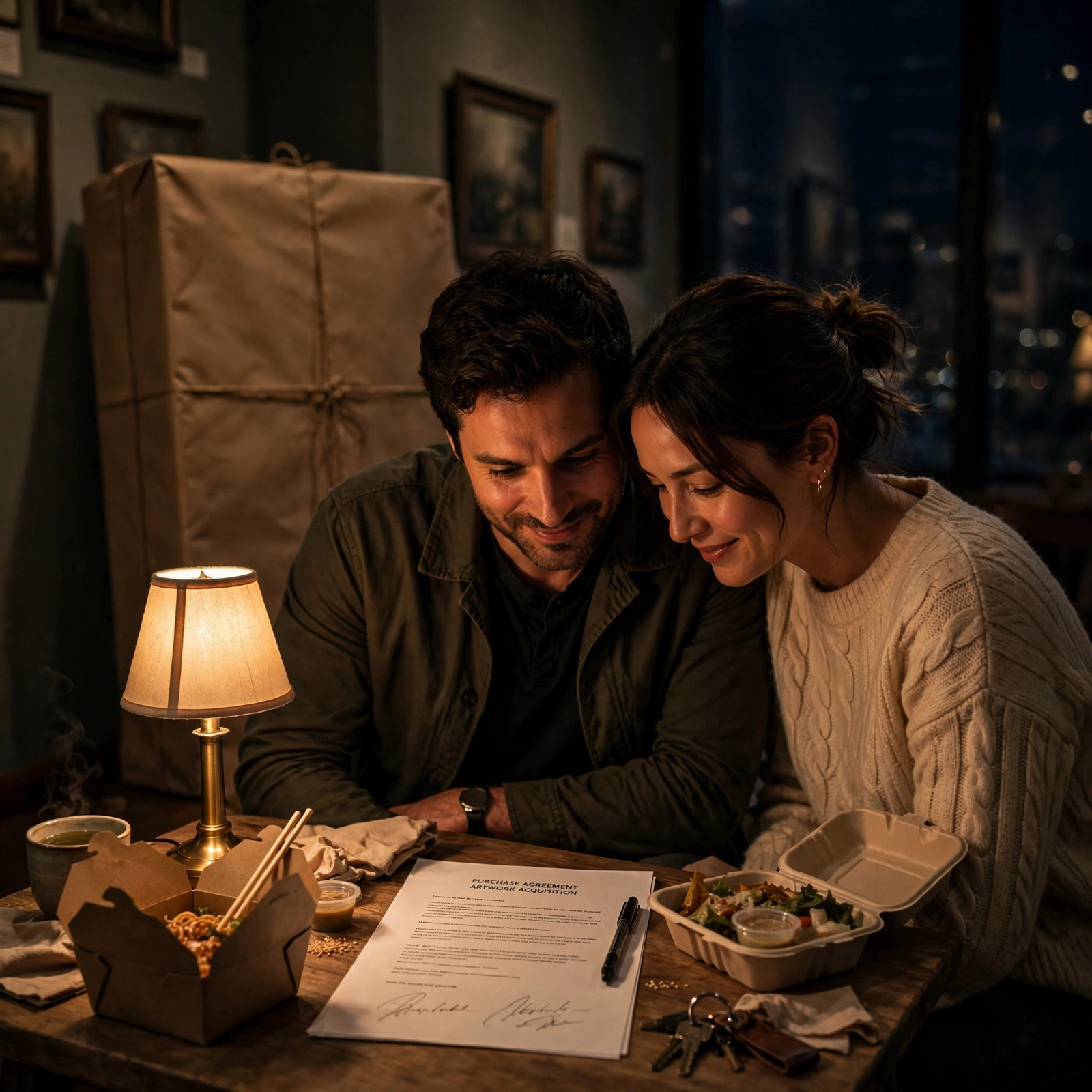
Thursday, the gallery was cold, echoing, half-lit. The Marlowe hung in its travel frame, still dressed in protective wrap, and Ada had indeed brought Thai food, and Julian had brought a folder.
"What's the folder," she said, instead of hello.
"History," he said. "Mine." He set it on the table between the curry and the ladder. "Full disclosure. Before anything, so you can walk out with the spring rolls if you want."
She sat down. She did not walk out.
Inside: the 2003 lawsuit that killed Kestrel & Kestrel, her father's firm, with a margin note in her father's handwriting she had never seen: I lost this one on the law and won it in spirit. Do not let that kid's clever girl know what she's really up against. There are two kindsof Ferrows.
Inside: the deed to a care facility bed, paid by J. Ferrow Sr.'s grandson under an alias, every month for nineteen years.
Inside: a one-page letter, and Ada's hands shook holding it, in an old man's block capitals: Julian. If the Aldwych goes while you own it, you'll get to say it was market forces, and that will be true, and it will be a lie with your fingerprints on it. Buy the site. Keep the bones. Find whoever's fighting for the arch and get out of their way. Grandpa.
"You were never getting out of his way," Julian said, sitting across from her with his hands flat on his knees like a boy at a principal's desk. "I just made you climb over me for nine days first, so I could understand what I was getting out of the way of."
"And now?" Ada said. "The whole load shifted?."
"No. It's still bearing. I'm still a man who does terrible math to keep a name alive, and I still don't know how to be at a table without calculating the exits. That doesn't cure. But this part I can hold up." He slid a second document across, one page, signed. "A first-reservation purchase agreement on the Aldwych interior, contingent to your trust's relocation program, at the price you set, and one clause. The Salvage Clause. Everything in that building that can be saved, gets offered to you first, at whatever the market will bear, for as long as the market bears it. Forever. In writing. My grandfather's handwriting gets a tag at the archive. I get to visit it."
Ada looked at the paper. Her eyes were stinging and she let them.
"This is you giving me the theater," she said.
"This is me," Julian said, "taking my grandfather's advice, which took me twenty-two years and a crane failure to be able to afford. It's not a grand gesture. It's a debt with teeth in it, held by a dead man I loved."
"It's a grand gesture and you know it."
"You want it to be."
"You want me to want it to be," she said, and he had the grace to laugh, a real one, aimed at himself.
"Look," he said. "You're building the story of this every day. I'm just the guy who writes the site checks. And Ada, the rest of it, the first-name-through-a-stud-finder part, I don't presume that, not from a documentary. We fight like weather fronts. I know the difference between gratitude and you. I'm going to be very careful to keep knowing the difference. Even on the days I don't want to."
"Julian."
"Yeah."
"I said Thursday I'd state the reason out loud," Ada said. "Here's the stated reason. On day one you were a category and I had a folder. On day five I was up a rig with a man who counts his steps and his grandfather's letters and doesn't know how to be saved, and I did not hate you once in nine days, and there is not a version of the next thirty years, any thirty years, that doesn't include arguing with you about bracing points." She stood, walked around the little table, and put her hand flat on his chest, over the scary paper, over the scar of the lawsuit, over the heart under both. "I'd like to have the arguments standing next to you, not across from you. That's my stated reason. Sign it."
He put his hand over hers. Under his palm, her pulse was going like the site crew's day.
"You should know," he said, into her hair, at last, the whole man, no portfolio in sight, "that if you ever try to have this argument as a negotiating tactic again, the counter is that I've read everything."
"Noted," she said. "It's in my folder."
He laughed into her hair. "Your folder has a great future in litigation."
"Your building," she said, "has a great future standing."
The Marlowe arch, in its wrap, looked like a sky waiting for its weather to pass. In the corner of the little gallery, under the protective wrap, two adult people leaned into each other over cold Thai food and signed one page of many, and neither of them pulled back first.
The chandelier still hangs in Ada's studio, unwrapped. The Aldwych Grand reopens in three years. The recordings survive. Both of them think that's fine. Neither keeps folders anymore.
Get notified when new stories drop

Serena Blake
Serena writes romantic suspense and dark romance for readers who want pulse and payoff. Her stories chase trust as hard as they chase danger.
Leave a comment
Comments