



The Marigold Theater Reckoning

Can a person come home to a small town and actually stay, or does the leaving change you too much to ever fit again? Delia Hartman had driven eleven hours to find out, and the first thing Copperveil, Montana did was hit her truck with a runaway ladder.
It was not, technically, her truck. It was a rental she had named Gerald, and it was carrying everything she owned that had survived the sale of her Seattle condo, which meant four boxes of books, one sad ficus, and a rolling case of architectural drawings for a building she had never actually been hired to save.
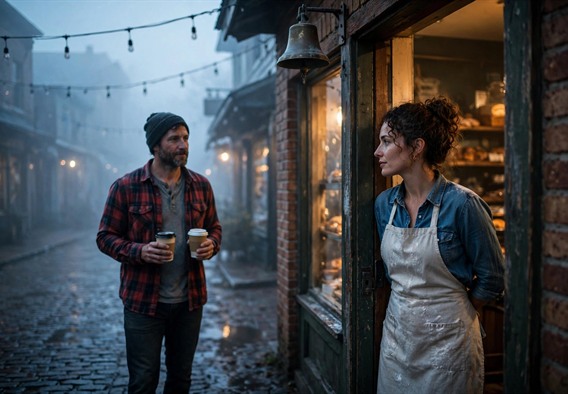
The ladder came off the back of a truck parked crooked in front of Hartwell Hardware, the kind of old-fashioned store with a wooden porch and a cat asleep in the window, and it swung down the sloped main street of Copperveil with the leisurely menace of a thing that had escaped before. Delia saw it in her mirror, heard the shriek of Ruthie Clemens, who ran the bakery and was mid-wave from her doorway, and threw Gerald into reverse. Too late. The ladder kissed the fender with a sound like a piano falling down stairs.
The man who came sprinting after it was tall, sawdust-dusted, and furious in a way that suggested the ladder had done this to him personally many times. He caught the runaway by the rails, wrestled it still, and turned to the truck with an expression that was already composing an apology until he got a good look at the license plate.
"Out of state," he said, as if that were a crime. "You parked on a grade."
"You left a ladder unsecured on main street," Delia said, climbing out. She was tired, road-worn, and wearing the only clean blazer she had, which had been chosen in Seattle for a life that no longer existed. "I've been driving since dawn. I have a ficus in there that has survived three states and I would like to keep that streak."
"The ficus will be fine," the man said. "The fender is another matter. That's a rental?"
"Yes."
"Then you'll want my insurance information, and I'll want yours, and we're going to have to do paperwork in my store because Ruthie is watching and she will turn this into a three-act drama if we do it on the sidewalk." He held out a hand. "Nate Hartwell."
Delia shook it. His grip was warm and calloused and entirely too steady, and something about that steadiness annoyed her immediately, the way a lit window annoys someone standing out in the cold. "Delia Hartman."
"Hartman." He went very still, the way people do when a name lands somewhere old. "Any relation to the Hartman that used to own the Marigold?"
"She was my grandmother. Eleanor Hartman. I'm here about the theater."
Nate Hartwell looked past her, up the street, to where the Marigold Theater stood at the corner of Maple and Main, its marquee dark, its plaster peeling, its doors chained since Delia was twenty-two years old. Nine years of emptiness had given it a kind of dignity, like an old man in a good coat. When Nate looked at it, something crossed his face that Delia would later learn to read as grief held very carefully in one hand.
"Then," he said quietly, "we have a lot to talk about. And I have a feeling most of it is going to be an argument."
Chapter One: The Building Everyone Grieved
Delia had not set foot in Copperveil since her grandmother's funeral, and she had left that funeral early, from a car, having never gone inside, because grief and guilt had made her into a coward at twenty-two and she had never fully forgiven herself for it. Nine years of city work had followed: restoration firms, historic commissions, a reputation for rescuing buildings other people had written off. She was good at saving structures. She had, until this week, been notably less good at saving anything about herself.
Then the letter had come. Not an email, a letter, on paper, in handwriting she recognized from a hundred childhood birthday cards: her grandmother's, posted eleven months after her death, held by the county probate office until the estate's final condition was met. The Marigold is yours now, Della-bell. Save it or sell it, but decide with your eyes open. Come see it first. Some things you have to stand inside of to understand.
So here she was, standing inside of it, three days later, with a flashlight and a hard hat and a heart doing something complicated.

The auditorium was a ruin and a revelation at once. Six hundred seats, most of them salvageable velvet over broken springs. A proscenium arch painted with climbing roses, flaking gold. A water-stained ceiling where one corner had opened to the sky like a wound. And everywhere, the smell: old cedar, old dust, old popcorn, the fossil record of forty years of Friday nights.
"Roof's the killer," Nate said from behind her. He had appointed himself her tour guide with the reluctance of a man who had been volunteered by the entire town, or possibly by his own conscience. "That northeast corner went in a hailstorm three years back. Every winter since, the freeze-thaw has been eating the plaster. You've got maybe two more seasons before the rot gets structural."
"You've been inside."
"I check on it." He said it flatly, as if daring her to make something of it. "Somebody has to. The town keeps voting on whether to tear it down and keeps not quite doing it, and while they dither, I keep the pigeons from taking the whole east wall."
"Why?"
Nate shone his light along a row of seats, and his jaw did something complicated. "My mother had her first date with my father in seat F12. My sister learned to tap dance on that stage. I ran the projector summers, when I was in college. This building is half the memory of this town and I don't vote on demolition committees, I just maintain things. It's what Hartwells do."
Delia wrote that down, not on her clipboard, somewhere less organized. "Well. The good news is the bones are honest. Bad plaster, but the load-bearing structure is sound. The foundation's dry. Whoever built this in 1931 built it to outlive us all." She ran her hand along the rose-painted arch and came away with gold flakes on her fingertips. "I can save it. If the town lets me."
"The town," Nate said, "is going to want to know why you left it to rot for nine years and then showed up with a flashlight and a hard hat."
The question landed exactly where he must have known it would, right in the bruise. Delia kept her voice level. "Because I was twenty-two, gutted by grief, and running. And because I'm here now, with a restoration plan, a line on grant funding, and eleven years of professional experience. The past is the past. I'm asking about the future."
"Then ask," Nate said. "But you should know that in Copperveil, the past isn't the past. It's just the future, wearing an older coat."
Chapter Two: The Town That Talks
Copperveil had one main street, four blocks of it, and by Friday morning everyone on all four blocks knew three things: that Delia Hartman was Eleanor Hartman's granddaughter, that she had inherited the Marigold, and that she and Nate Hartwell had already had a fight about a ladder, which Ruthie Clemens had witnessed and embellished to include raised voices and, in one telling, a torn blouse.
"There was no torn blouse," Delia said, sitting at the counter of Clemens' Bakery with a coffee and a marionberry scone that had rearranged her entire opinion of Montana.
"There will be eventually," Ruthie said comfortably. She was seventy, flour to the elbows, and had known Delia's grandmother for forty years. "That's how it goes with you Hartmans and them Hartwells. Your grandmother and Nate's mother used to feud over the flower boxes on Main Street for a decade and then cry in each other's kitchens every Christmas. Feuding is just caring with poor manners."
"I'm not feuding with Nate Hartwell. I'm professionally evaluating his opinions."
"Uh huh." Ruthie leaned in. "And how's the evaluation going?"
Delia bit the scone rather than answer, which Ruthie correctly interpreted as confusingly well.
The problem, Delia was learning, was that Copperveil had stakes she hadn't counted. The town was struggling; the lumber mill had cut shifts two years ago, three storefronts on Main stood empty, and the county was dangling a redevelopment grant that would pay for either the Marigold's restoration or a new municipal parking structure, not both. The town council would decide in six weeks. Delia's plan, her funding applications, her entire return, all of it threaded through one vote by a room of people who remembered her grandmother and remembered, too, the granddaughter who left and never came back.
"You'll win them over," said Tom Alvarez, who ran the hardware-adjacent diner and had opinions on everything. "Eleanor's blood counts for something here."
"Eleanor's blood," Delia said, "skipped her own granddaughter's funeral. I count for exactly what I've earned, which is nothing yet."
"Then earn it," Tom said, with the blunt kindness of a man who had been slinging hash for thirty years. "Show up. That's all anybody here ever wanted from anybody. Show up."
Chapter Three: Working Saturdays
The ladder incident had generated an insurance claim, which generated coffee, which generated, improbably, a working relationship. Nate Hartwell was the best carpenter in three counties and the only person in Copperveil who understood a building envelope, and Delia needed him, a fact she admitted with all the grace of a cat taking a pill.
"I'll consult," he said in the hardware store, surrounded by the smell of cedar shavings. "I won't join your committee. I don't do committees."
"Fine."
"And I'm not doing it for you. I'm doing it for the building."
"Obviously."
"And the cat comes with us on Saturdays. Pigeons fear Mabel."
"Deal," Delia said, and Nate Hartwell almost smiled, which was a dangerous thing for her equilibrium, so she looked at a stud finder display until it passed.
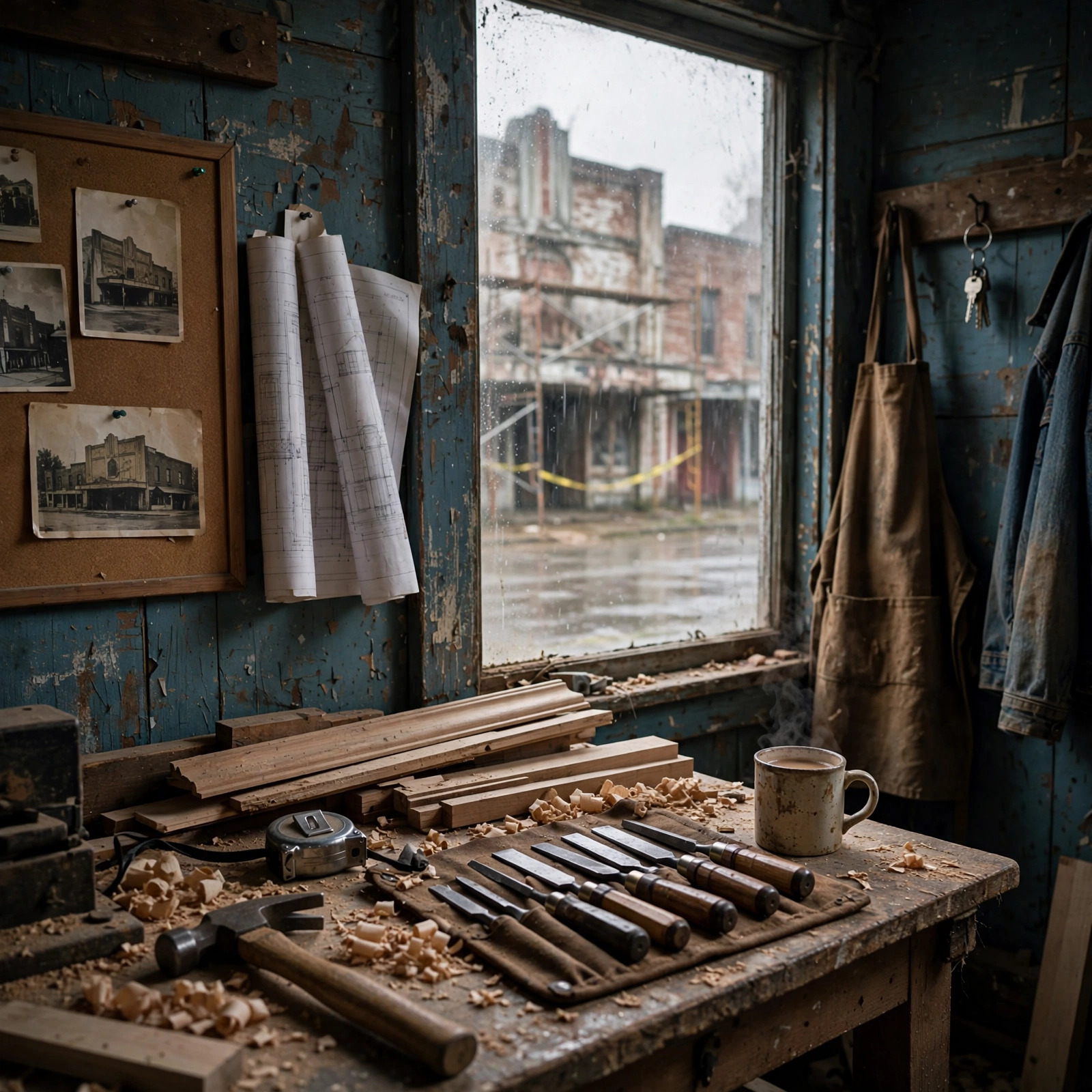
The Saturdays that followed became the architecture of everything. They'd meet at the theater at seven, before the town woke, and work until the light went long and gold through the broken roof corner. He taught her what the local timber could do and she taught him why the 1931 plasterers had scored their keys the way they had. They argued about paint colors with genuine passion. He brought thermoses of terrible coffee; she brought pastries from Ruthie and let him think she'd baked them, then confessed under pressure, then endured his laugh, which was unfair, low and startled, like it surprised even him.
They talked, in the way people talk when their hands are busy and their guards are down. She learned his father had died when Nate was nineteen, and he'd turned down an apprenticeship in Portland to stay and run the store for his mother, and had never once, in twenty years, regretted it out loud, which was its own kind of telling. He learned her parents had moved to Singapore when she was sixteen and she'd finished high school at a boarding school where she learned to make herself useful to buildings because buildings couldn't leave. She learned he kept a drawer of his father's tools he couldn't bring himself to sharpen. He learned she had a fiancé once, a decade ago, a good man who'd asked her to move to London with him and had taken her hesitation as an answer, and had been right to.
"You didn't love him enough," Nate said one evening, not unkindly, from atop a ladder re-securing a cornice bracket.
"I loved him fine."
"Then you'd have gone."
"Or," Delia said, handing him the wrench he'd reached for without looking, "I'd learned by then that I'm the kind of person who leaves, and it seemed unfair to make him a promise shaped like that."
Nate came down the ladder slowly. "You're not the kind of person who leaves."
"I literally left."
"You were twenty-two and your grandmother had just died and you were alone in a town where everyone knew your grief better than you did." He set the wrench down. "That's not leaving, Delia. That's bleeding out. There's a difference, and this town should have known it."
She had no answer for that, so she looked up through the hole in the roof, where the first stars were coming out over Copperveil, and felt something in her chest unlock by one stubborn degree.
Chapter Four: The Committee and the Countdown
The town council meeting was held in the volunteer fire hall, and it was standing room only, because in Copperveil a land-use vote was a social event with consequences. Delia presented her plan: phased restoration, grant funding she had already half-secured, a nonprofit operating model with the theater hosting the school's drama program, Ruthie's farmers market overflow, and a small film series she'd already named Saturday at the Marigold. The numbers were honest. The vision was vivid. The room was warm to her, mostly because her grandmother's name opened doors her own reputation hadn't earned yet.
Then Councilman Bud Prewitt stood up, and Delia learned what the other half of the room was thinking.
"Appreciate the slideshow," Bud said. "But I'd like to hear from the lady herself about her track record. Word is, Ms. Hartman left her last firm in Seattle under a cloud. Word is, a project she led went sideways and she walked away from it mid-restoration."
The room's warmth dropped ten degrees. Delia's stomach did the same. Because the word was true, in the way that the cruelest words always are: the Belltown Rowhouses, her flagship project, had collapsed when the developer went bankrupt mid-construction, and Delia, three months post-burnout and grieving a mentor who'd died that same winter, had resigned rather than preside over the demolition phase. She had walked away. Again. The pattern she'd driven eleven hours to outrun had followed her in her own file.
"That's not the whole story," she said, "but yes. I left that project. I own that."
"Owning it's fine," Bud said. "But we got one shot at that grant, and I'd like to know you'll still be here in year two. Or is Copperveil just another stop on the way to somewhere bigger?"
Nobody spoke. Delia stood in the fire hall with six weeks of work in her hands and her oldest fear standing on a dais asking its name, and she heard herself say, "I don't know how to prove that to you tonight, Councilman. I only know what I'm asking for, and why." And then the meeting adjourned into a buzz of noise she moved through like weather.
Nate found her outside, under the marquee, where the dark was kindest.
"Bud's not wrong to ask," she said, before he could. "That's the worst part. He's asking the right question and I don't have an answer I'd believe."
"Want my answer?"
"You don't do committees."
"I don't," Nate agreed. "But I do answers." He looked up at the dark marquee. "Here's mine. Stay through the vote. Stay through the first phase. Prove it the boring way, in day logs and invoices and Saturdays. Nobody upends a lifetime pattern with a speech. You upend it with Tuesdays."
Delia laughed, wetly. "You make it sound achievable."
"Everything's achievable," Nate said. "It's just not all achievable fast." And then, because the evening was soft and the marquee was dark and they were standing in the exact center of everything either of them was afraid of, he added, carefully, "For the record. I'd be sorry to see you go. Professionally evaluating that opinion, as I understand you like to do."
"Evaluation ongoing," Delia managed, and walked to Gerald on legs that did not entirely feel like hers.
Chapter Five: The Festival
Copperveil's Harvest Lighting fell on the first Saturday of October, and it was, Delia had to concede, exactly the kind of thing city people paid forty dollars to simulate: paper lanterns down all four blocks of Main, the whole town in one place, cider in every hand, and Ruthie Clemens presiding over a pie table with the authority of a small nation.
Delia had planned to leave early. Instead she found herself judging a pie contest under Ruthie's tyrannical instruction, losing to Tom Alvarez's wife in the first round, and then finding Nate at the edge of the crowd with two cups of cider and an expression she was beginning to recognize as his version of courage.
"Dance with me," he said. "There's a band. It's terrible. Those are the best ones."
"Nate Hartwell, are you asking me to publicly slow-dance in front of the entire gossip infrastructure of Copperveil County?"
"Yes."
"That seems like a bad idea."
"It does," he agreed. "Ruthie already has a theme picked out for the wedding newsletter item, so the damage is done either way. You might as well have the dance."
So they danced, under the lanterns, to a band that was indeed terrible, and Delia Hartman, who had spent eleven years being a woman who did not stay, noticed that she was not checking the time, not scanning the exits, not planning her exit. She was just there, in his arms, in her grandmother's town, and it did not feel like a trap. It felt like arriving.
"Can I tell you something," she said against his shoulder.
"You're going to regardless."
"I'm glad the ladder hit my truck."
Nate pulled back enough to look at her, and the lantern light caught him, and whatever was on his face made her pulse do something unprofessional. "Delia," he said, "I've been trying to work up to telling you that for three Saturdays."
They kissed by the marquee at midnight, with the whole town's lanterns glowing down Main Street, and it was unhurried and certain and tasted like cider, and when they broke apart, Ruthie Clemens was not even pretending not to watch, and Delia found she didn't mind. That was the thing about Copperveil, she was learning. You were never invisible. Which meant that if you stayed, you were never, ever alone.
Chapter Six: The Dark Night
It should have been smooth after that. It was not, because Delia had one more thing to learn about herself, and it was the hard one.
The grant decision came down in November, and the Marigold won. The room applauded. Bud Prewitt shook her hand and said, "Prove me right," which was its own strange grace. And that night, flush with victory, Delia opened her laptop and found an email from her old firm in Seattle. A partner she admired was launching a preservation practice. He wanted her as principal. Salary that made her wince, projects that made her mouth water, a city that had never once asked her to prove she belonged. Start date flexible. Answer by December fifteenth.
She told no one. She told herself that was prudence. It was actually the oldest habit she had: when a door opened, she evaluated it alone, decided alone, and informed people after, so that no one could ask her to stay and no one could be hurt by watching her go. She had been protecting people from her leaving her whole life, and calling it kindness.
Nate found out by accident, two weeks later, because Ruthie's nephew worked at the firm and mentioned to his aunt that Delia Hartman was coming back to Seattle, and Ruthie mentioned it to everyone, and by the time Delia got to the theater that Saturday, Nate was already there, sitting alone in the half-restored auditorium with Mabel the cat, in the cold, in the dark.
"You didn't ask me," he said. No anger in it. That was the devastating part. Just the flat calm of a man who had done this math before.
"There was nothing to decide yet."
"There was something to say," Nate said. "That's what I asked you for, that night under the marquee. Not a promise. A conversation." He stood. "But that's not your pattern, is it? You decide alone so nobody gets a vote, and you call it sparing them. Your fiancé. Your funeral. This."
"That's not fair."
"No," he agreed. "It probably isn't. But here's what's true, Delia. I have spent twenty years being the person who stays, watching people I love leave, and I built a whole life out of not asking anyone to stay because it's easier to be left than to beg. And then you showed up with a ladder-shaped catastrophe and I started, for the first time, wanting to ask. And you were going to let me find out from Ruthie Clemens' newsletter."
"Nate."
"I'll finish the cornice brackets myself," he said, picking up his coat. "They were your grandmother's design. You should have the drawings either way." And he walked out of the theater his family had kept alive for twenty years, and the door's echo took a long, long time to die.
Delia sat in seat F12 for a very long time after that.
Chapter Seven: What Delia Knew by Morning
She did not sleep. She sat in her rented room above the pharmacy and she faced the thing, which was this: the Seattle offer was not actually about Seattle. It was about a person who had never once in her adult life trusted anyone enough to let them watch her choose. Deciding alone felt like safety. It was actually just loneliness with good posture.
Her grandmother's letter was still in her bag. Some things you have to stand inside of to understand. Delia had thought she meant the theater. She was beginning to suspect she meant everything. Grief. Staying. Love. You had to stand inside them, in the draft and the dust, and let them be bigger than your escape plans.
At seven in the morning she was on the theater stage with the lights rigged and the town's best-kept secret assembled: Ruthie, Tom, Bud Prewitt, the school drama teacher, forty volunteers who had shown up because Delia had spent a month asking them, one by one, what the Marigold had meant to them, and writing every answer into the restoration plan. She had not come to make a speech.
"I'm not leaving," she said. "I was offered a job in Seattle and I was going to decide about it alone and tell you after, because that's who I've been. And I want to apologize to this town, and to one person in it, for the fifteen years it took me to learn that deciding alone isn't strength. It's just fear wearing a hard hat." She looked at Nate, who stood at the back with his arms crossed and his face giving away nothing. "I turned the offer down yesterday. Before I knew whether you'd even speak to me again. Not because of the theater. Because of a dance under some lanterns and a man who taught me that you upend a pattern with Tuesdays. So here's my Tuesday. The Marigold reopens in the spring, the first show is the school's spring production, and seat F12 is reserved in perpetuity for the Hartwell family, because this building kept your people and I intend to let it keep mine."
The room made a sound like a wave. Nate crossed the auditorium slowly, past six hundred seats he had saved one bolt at a time, and stopped at the edge of the stage.
"You turned it down before you knew," he said.
"That's the whole point of a choice," Delia said. "You make it before the answer arrives."
"I have waited twenty years," Nate Hartwell said, "to hear somebody in this town say something that brave," and then he came up over the edge of the stage and kissed her in the dust and the stage light while forty volunteers and one smug cat looked on, and Ruthie Clemens wept openly into her apron and began drafting the newsletter item she had been preparing since October.
Chapter Eight: Epilogue, One Year Later
The Marigold reopened on a Friday in May, and all four blocks of Main Street closed for it, which the county permitted because the county had learned which fights not to pick. The marquee glowed for the first time in a decade: MARIGOLD THEATER, GRAND REOPENING, TONIGHT ONLY, EVERYONE WELCOME. Under it, the newly gilded climbing roses caught the dusk exactly the way they had in 1931.
Inside, six hundred seats held six hundred neighbors. The school's spring production ran ninety minutes and nobody minded the flubbed lines. Ruthie catered. Tom Alvarez's granddaughter sold tickets. Bud Prewitt, in the third row, stood to applaud longest. And in the lobby, under a framed photograph of Eleanor Hartman, a small brass plaque read: Restored by D. Hartman and N. Hartwell, who learned that a town is just a building that decided to keep its people.
"You know they're going to put our whole history in the newsletter," Nate said afterward, on the empty stage, the two of them sitting where the orchestra used to sit, sharing one last cider out of a thermos. "The ladder. The dance. Ruthie has receipts."
"Let her," Delia said. "I'm done deciding things alone." She leaned into him, looking out at the dark house, the gilded arch, the hole in the roof now patched with local timber and a skylight they'd fought about for a month. Outside, the lanterns of Main Street were still lit, the whole town still up, still talking, still theirs.
"Stay," Nate said. Not a question anymore. Just a word he could finally afford.
"Already did," said Delia Hartman, and the Marigold's lights came up warm and gold, and kept burning.
Set in the fictional town of Copperveil, Montana. All characters are adults and invented; any resemblance to actual small towns is a compliment to small towns.
Get notified when new stories drop

Lila Monroe
Lila writes contemporary and small-town romance with banter-forward leads and soft landings. She believes the best love stories sound like two specific people, not a trope checklist.
Leave a comment
Comments