


The Cipher in the Stacks
The Woman Who Mended Broken Books
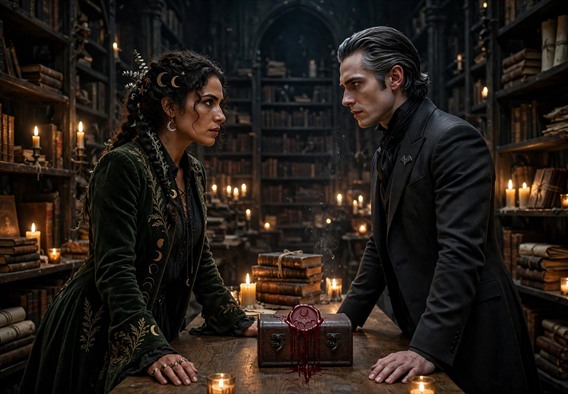
What do you do when the safest place you know starts trying to kill you, and the one man you swore not to trust is the only person who believes you?
The first thing Delia Marchetti noticed about the man in her reading room was that he held a four-hundred-year-old folio as if it had personally insulted him. He gripped the spine with two fingers, tilted it toward the window light like a man checking a wallet for counterfeits, and set it down on her foam cradle with a thud that made her eye twitch.
"Careful," she said, not looking up from the vellum fragment she was mending under magnification. "That book survived a shipwreck, two wars, and a damp century in a Boston basement. It would be a shame to lose it to a man with dry hands."
"Insurance investigator," he said. "Nathaniel Roe. Nathan." He set a laminated badge on the edge of her worktable, next to the brushes and the rice paper and the tiny scissors that had cost her a week's salary. "Whitlock Mutual. I'm here about the fire claim on the Aldous House."
Delia put down her scalpel. "You mean the fire claim on the library that pays my rent." She had signed a two-year contract nine months ago to restore and catalogue the private collection at Aldous House, a gray stone mansion on the coast of Penobscot Bay that its last owner, Edith Aldous, had willed to the town on the condition that the books be preserved and the rooms opened to readers. "Whitlock already sent someone in March."
"I sent myself in March. Now I'm here again." Nathan Roe pulled out a chair uninvited and sat down the way men do when they have decided a conversation is going to be a long one. He was forty, maybe, with a farmer's forearms and a librarian's eyes behind wire-rimmed glasses, and the combination should have been nonsense on him. It was not nonsense on him. "The claim is for smoke and water damage from a generator fire in the east wing. But somebody filed a second, informal report a week later. A citizen's report. Anonymous."
"I know. I filed it."
For the first time since he'd walked in, he stopped moving. "You?"
"I filed it because the fire was in the map room, Mr. Roe, and the generator was in the carriage house, two hundred yards away, on the other side of a gravel drive. The fire marshal called it an ember migration. I called it what it was." She lifted the vellum fragment, turned it so the afternoon light caught the scorch ghost along its edge. "Somebody used accelerant, and the somebody knew the smoke suppression in the east wing had been disconnected for renovation. Whoever it was gave themselves a half hour window to destroy one specific shelf and walk out clean."
"That's an accusation."
"That's a conservation report," Delia said. "I don't do accusations. I do evidence. The burn pattern on the shelving radiates from a single origin point at chest height, the char penetration on the leather spines is directional, and I documented all of it with photographs and a scale ruler, which I sent to your office in April." She met his eyes. "Your office sent me back a form letter."
Something shifted behind his glasses, a recalculation. "My office," he said slowly, "sent me a two-line memo saying the claim was clean."
"Then either someone in your office didn't read my report," she said, "or someone did."
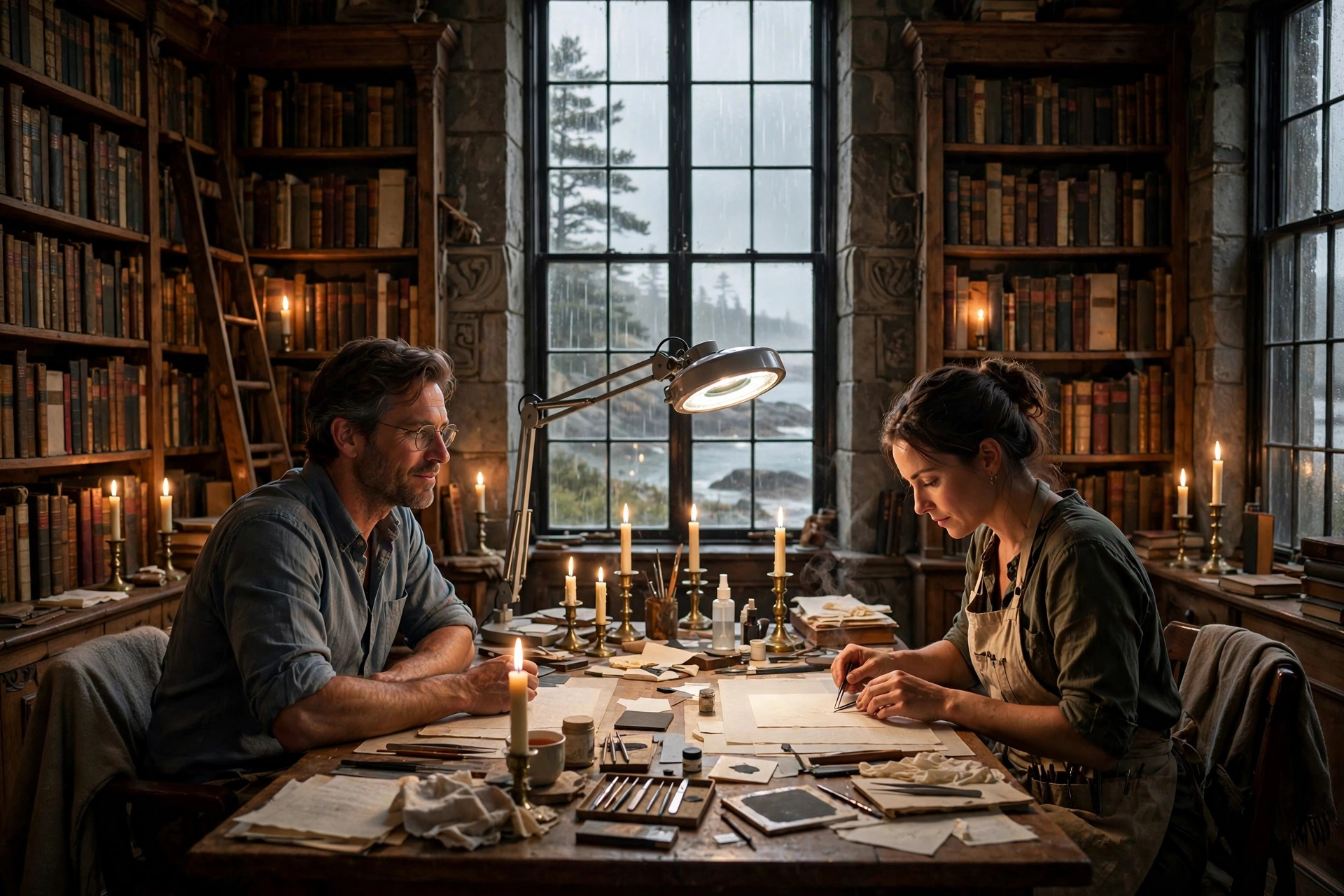
The reading room was quiet except for the ticking of the ship's clock Edith Aldous had left on the mantel and, far off, the sound of the tide working at the rocks below the lawn. Nathan Roe picked up his badge, pocketed it, and did not stand up. "Show me the photographs," he said. "All of them. Take all night if you need to."
Delia should have said no. She had a rule, built brick by brick over eleven years in the profession, about men who arrived with credentials and charm and a way of sitting down like they lived there. She broke the rule for the second time in her life at 4:12 in the afternoon on a Tuesday in June, and spent the rest of the summer learning exactly what that second exception was going to cost her.
What Burned and What Didn't
The shelf that burned had held the papers of Ambrose Aldous, Edith's grandfather, a shipping magnate who had died in 1949 leaving behind eleven ledgers, forty-one crates of correspondence, and one locked journal that the family had never opened. The fire had been surgical. Seven feet of shelving, nothing more. Delia had spent April pulling charred fragments out of buffered trays, flattening them, and fitting them together like the world's most depressing jigsaw puzzle.
"Here's what I have," she said, spreading the trays across three tables while rain started against the tall windows. "Surviving fragments of a ledger dated 1948. Account entries in Aldous's hand. But look at the verso." She turned a flattened scrap under the lamp. Faint pencil lines crossed the paper in a grid of paired numerals. "This grid appears on twelve separate fragments. It's not shipping notation. It's a cipher key, or part of one, and it was on the back of pages in a ledger that someone thought was worth burning a listed historic structure to destroy."
Nathan leaned over her shoulder, and she was professionally irritated to notice he smelled like cedar and rain, which was an unfair cologne for an insurance man from out of town. "Was anything taken?"
"Nothing valuable. The safe was untouched, the silver was untouched, the paintings were untouched." She hesitated. "But the journal I mentioned, the one Edith never opened, the fire was three weeks after the estate inventory listed it, and by the time I got to the vault, the journal wasn't there. The locksmith said the lock hadn't been forced. Whoever took it had a key."
"Keys," Nathan said, "can be copied."
"Keys can also be inherited. Or stolen. Or held by a trustee who changed the story when it suited him." She said it flatly, and watched it land, because that was the part of the file she had never said out loud. Gerald Pike, the estate's trustee, ran the only bank in Bearneck Harbor, sat on the historical commission, and had personally signed off on calling the fire an accident. "I want to be careful," she added. "Gerald was kind to me when I got here. Lent me his truck when mine died. I don't want to be a woman who ruins a man's life over a hunch."
"That," Nathan said, "is the most dangerous sentence in this whole file." He straightened up, took off his glasses, and looked at her without them, and it felt abruptly like being seen by someone not wearing a costume. "I'm going to tell you something I haven't told anyone at the office, and then you get to decide if I'm part of your problem or the other thing." He pulled a folded paper from his inside pocket. "I was the adjuster on a claim in Blue Hill last November. Bookshop fire. Same signature. Surgical burn, suppression conveniently down, one specific safe destroyed. The shop's owner had recently told a state archive committee she'd found correspondence suggesting wartime art transfers through Maine ports." He laid the paper down. "Her name was Marion Quist. She died in the fire. The marshal ruled it accidental. My report flagged the burn pattern. My supervisor reassigned the case and then reassigned me to a parking garage in Portland."
Delia looked at the flag report, at his neat, furious handwriting in the margin: Recommend criminal referral. Denied by regional office. "And you kept the copy."
"I keep copies of everything," Nathan said. "It's the only superpower I've got."
Outside, the rain thickened. Inside, the clock ticked, and Delia Marchetti, who had come to a small town to hide from the wreckage of her own last great mistake, heard the ground under her carefully rebuilt life begin, very quietly, to shift.
The Rules of the House
They made an agreement that first night, sitting on the reading room floor among her trays because there was no table left, eating chowder from the diner that Nathan had run out into the rain to fetch.
"Rules," Delia said, tearing her roll in half and giving him the bigger piece without thinking about it, then noticing that she'd done it and being annoyed at herself. "One. Nothing on paper. Your office burned one flag report out of existence, mine could disappear the same way. We write in the books."
"In the books," Nathan repeated, eyebrows up.
"This is a conservation library, Mr. Roe. I have four thousand volumes of Aldous papers and ninety years of accession records. Nobody audits a shelf of 1930s agricultural almanacs." She'd already begun it. Her grandmother had hidden letters from the fascists in a psalter during the war in Trieste; hiding things in books was arguably the family business. "Two. We tell each other the truth, even when it's ugly, especially about our own mistakes. Three." She paused. "Three is that this is about the books. I'm not looking for a friend. I burned that bridge already and I'm not rebuilding it in the middle of a fire investigation."
Nathan took the roll, thanked her for the bigger half with a look that meant he'd noticed, and said, "Understood. Four, then. When I say leave something alone, leave it alone. Not because I think you can't handle it. Because in Blue Hill, the woman who died was the one who insisted on handling it."
" Marion Quist insisted on handling it," Delia said, "because nobody would listen to her. I've read your flag report three times. Every conclusion is hers. You just wrote it down."
He was quiet a long moment. "That's true," he said finally. "She found everything. I just had the credential to say it out loud." He looked at the shelf of agricultural almanacs with new respect. "Alright. Rule five. Whatever's in those almanacs, I learn to read it too. If something happens to you, it can't die with you."
She hadn't expected that. Most people, she had learned, planned for the story where they were the hero, not the story where they were the one who survived to carry it on. She passed him the first almanac and a page of her cipher notes and watched him frown at it like a man learning a new language in real time.
"It's a running key," she said. "The cipher text is paired numbers, and the key is the Aldous shipping ledger itself. The page number is the first number, the line is the second, the word position is the third." She watched him get it, watched his whole face change. "It's elegant. Ambrose Aldous hid his secrets inside his own bookkeeping. You need the ledger to read the key and the key to know which part of the ledger to read."
"And someone burned half the ledger," Nathan said.
"Half." She smiled, and it surprised her, that her face still remembered how. "I'm a conservator, Mr. Roe. Burned is a condition, not a verdict."
Bearneck Harbor Watches
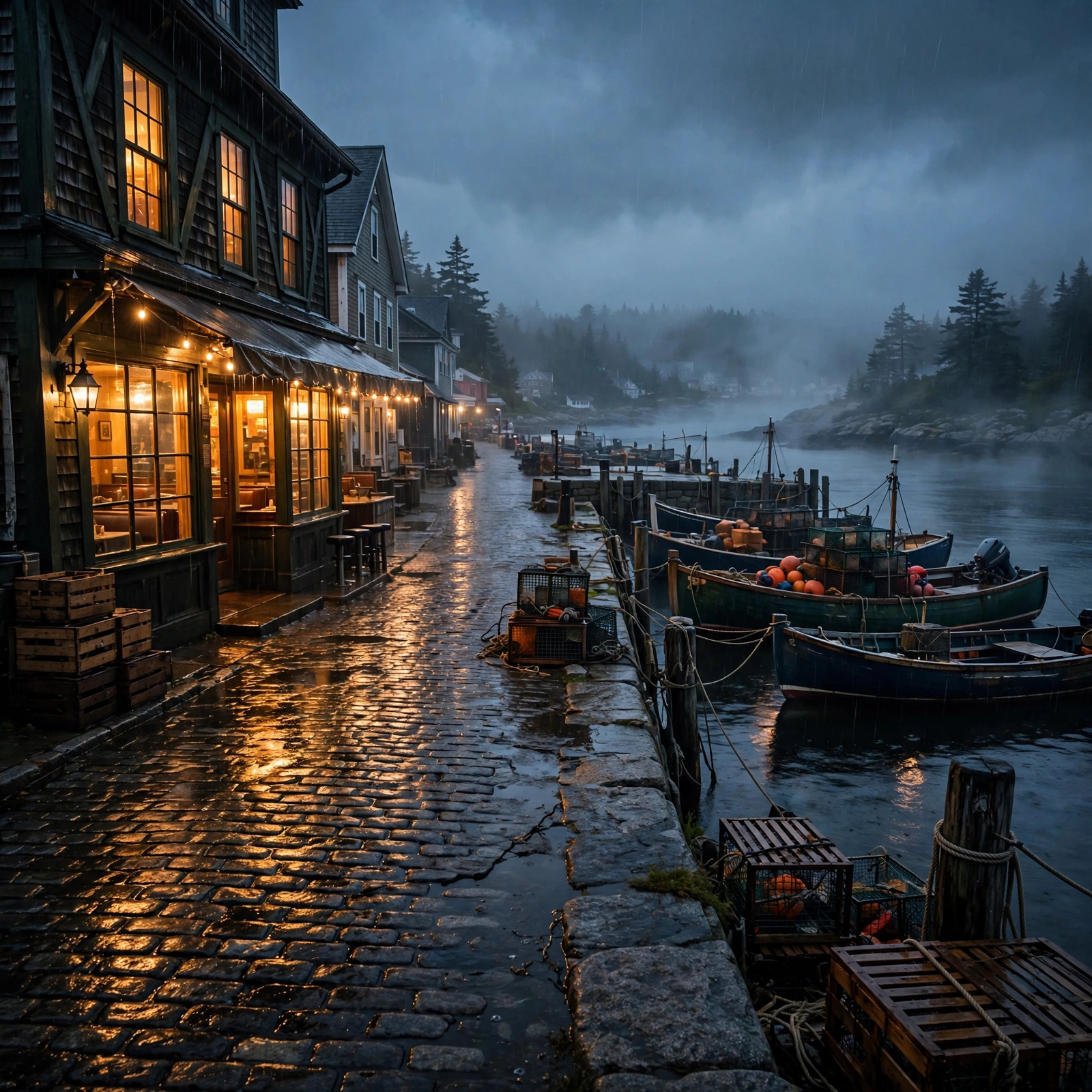
The town noticed them by the end of the first week. Bearneck Harbor had eleven hundred year-round residents, a lobster fleet, two churches, one bank, and a grapevine with the transmission speed of broadband. Nathan had rented the yellow cottage on Harbor Road and taken his coffee at the diner at seven-forty every morning, and by Friday the whole peninsula knew that the insurance man and the book woman were having long conversations in the reading room with the doors closed.
"They're saying you're an insurance man," said Dot Fernald, the diner's owner, refilling his cup on day nine with the frankness of a woman who had buried two husbands and outlived every secret worth keeping in the county. "They're also saying you're a fed. They're also saying the Marchetti woman finally let somebody into the east wing, which frankly they find the most shocking part."
"Which rumor is doing best?" Nathan asked.
"The fed one," Dot said. "It's got narrative drive."
The warnings arrived gently at first. Someone left a note under Delia's door: Better books than fingers. Gerald Pike caught her at the co-op and told her, with real warmth, that she was letting a stranger drag her into something that wasn't her business, and that Edith Aldous had trusted him with the estate's reputation for forty years, and that small towns forget small slights but not big ones. He lent her his truck again, because that was who Gerald Pike was, and Delia got in the passenger seat of his kindness and rode around town with him and felt, the whole time, like she was sitting next to the burned scrap of a man whose verses she couldn't yet read.
The truth she told Nathan on rule two, in the reading room, on the floor among the trays, was not about Gerald. "In 2019 I authenticated a manuscript for an auction house," she said. "Twentieth century, important letters, a famous woman writer's archive. I authenticated it. It sold for four million dollars. Six months later a conservator at the buyer's foundation proved two of the letters were forgeries and that the forger had learned the technique from a workshop I ran." She stared at the ceiling beams. "I had run a public workshop. I had put my technique online. Someone had built a forgery in my own method and sold it through me. The auction house settled quietly. My name didn't hit the papers, but everybody in the field knew. And the worst part, Nathan, the part I don't tell people, is that for two weeks I couldn't prove to myself that I hadn't done it on purpose. I kept thinking, what if some part of me knew? What if my eye saw it and I looked away?"
"And did you?"
"No." It was the first time she'd said it in three years and meant it. "I didn't. I got played, the same way someone is playing Gerald Pike right now, or using him. But I didn't know that for certain for two years, and in those two years I stopped trusting my own judgment, and then I stopped trusting anyone's." She looked at him. "That's my flaw, laid out on the reading room floor where you can walk around it. I would rather be alone and safe than wrong in company."
Nathan was quiet. Then he said, "My sister was a claims adjuster in a flooding zone. She kept flagging fraud on a contractor. Nobody listened, claims paid out anyway, and when the pattern finally blew up she took the fall for it. She got fired and blacklisted and moved to her ex's couch in Tucson. She calls me every Christmas." He turned his cup slowly on his knee. "I became the man who keeps copies of everything because once, I was the man who trusted the office. I would rather be alone and right than wrong in company." They looked at each other across the wreckage of two very symmetrical scars, and Delia laughed first, a short unguarded sound that frightened them both a little.
"We're the same idiot," she said.
"With complementary archives," Nathan agreed.
The Second Fire
They cracked the cipher on a Thursday. By Friday they understood what Ambrose Aldous had died protecting, and by Saturday night the second fire made it urgent.
The decoded fragments told a story the coast had half-forgotten: in 1948, Aldous Shipping had run a quiet ferry operation out of the cove below the house, moving crates under bills of lading for art consigned to neutral buyers. Some of it was legitimate wartime salvage and displacement paperwork. Some of it was not. The ledgers showed three crates of paintings from a Munich collection moved through Bearneck Harbor in November 1948 and never invoiced to any buyer, sold instead through a local intermediary whose initials appeared in the cipher as G.P., with a standing instruction in Aldous's hand that the sale documents were to be kept where the harbor could never dig them up: sewn into the binding of the 1682 atlas in the east wing collection, the atlas that Delia herself had conserved and rebacked nine months earlier, working in the very wing that had burned.
"The provenance documentation," Delia whispered, when the last fragment gave up its words under the lamp. "He hid the proof of where the paintings came from. Whoever inherited the paintings has spent seventy-five years making sure the proof stays buried, because the moment it surfaces, the paintings become stolen property and the collection can be clawed back by the German government and every museum that bought them quietly." She sat back. "Someone still has them, Nathan. Someone in this county has been quietly collecting for seventy-five years, and the collection is worth eight figures."
"And last year, Edith Aldous died," Nathan said slowly, "and left everything to the town, which meant the east wing library, with the atlas, was about to become a matter of public record. A conservator was cataloguing every volume." He looked at her. "Someone couldn't burn one shelf and be sure. They needed to know how close you were."
That was when the smoke alarm went off.
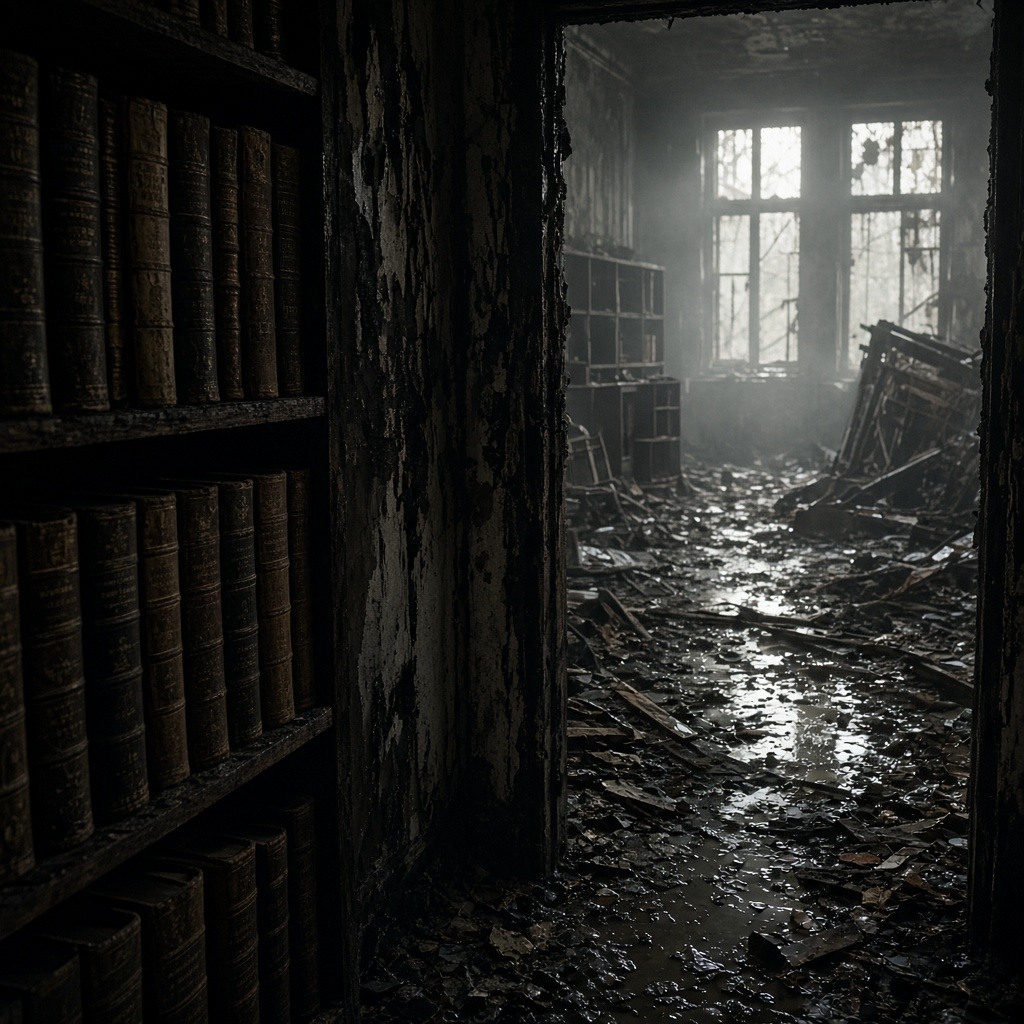
It came from the west wing, the new fire suppression wing, the unburnable wing, and it did not matter, because the alarm was a bell and the bell was a message and the message said: we know you know, and we are done being patient. Delia and Nathan came out of the reading room into a corridor of thin gray haze and moved through the house the way she had drilled with the volunteer department in her first month, checking doors, pulling extinguishers. The fire had been set in the custodian's linen closet with a slow fuse of the same accelerant; by the time the Bearneck volunteers rolled in, it was a scorched closet, not a ruined house. It was arson as punctuation.
In the parking lot, amid the trucks and the flashing lights, Delia's hands were steady and her knees were not, and Nathan put his jacket around her shoulders without asking, which was either the most condescending or the most comprehensible thing anyone had done for her in three years. "Tell me what you need," he said.
"The atlas," she said. "And to not sleep tonight."
They took the atlas down from its shelf at 2 a.m. with the volunteer department gone and the house breathing its smoke smell out through every window. Delia laid it on the cradle under the good lamp and opened the rebacked spine she herself had built, her own stitching, her own linen, her own hands, and there, inside the hollow she had unknowingly closed up nine months ago, lay a waxed oilcloth packet, flat as a love letter and old as sin.
"I rebacked this book," she said, half laughing, half close to tears. "I made it beautiful and airtight and I sewed a man's crimes inside."
"He chose well," Nathan said. "That's the safest vault on the coast. But Delia." His voice changed. "The packet's here. Which means for seventy-five years, everyone who knew about it believed it was already somewhere else." He looked at the burned fragment notes, at the initials G.P., at the estate file with Gerald Pike's tidy signature as trustee. "Or someone with access found the packet years ago, left a decoy in place, and has been sitting on real papers and a fireproof collection ever since. That person burned the ledger shelf thinking the atlas proof was the only other copy in the house." He paused. "And they think we have it now. Which they do."
"So the danger isn't that the papers are lost," Delia said. "The danger is that I opened a book I shouldn't have opened." She looked down at the oilcloth, and then at him. "Then we should give it to someone they can't burn. The Maine Historical Commission has an intact-records protocol, there's a notary in Rockland, there's a U.S. attorney's office that owes Nathan's sister a phone call. We take it public tonight, before whoever it is realizes we've already done it."
Nathan reached into the cradle for the packet, and Delia caught his wrist. "Rule four," she said quietly. "You said leave something alone when you say so. So tell me. Am I leaving it alone?"
"No," he said. "Because they already burned a woman in Blue Hill for knowing too little. We're not going to die for knowing too much."
Dark Night of the Soul
The call to the commission went out at 3 a.m. and by 9 a.m. the story was out of Delia's hands and into the world, and by noon it had come back to her deformed.
The state took the packet. The U.S. attorney's office took an interest, then a keen interest, then requested that the conservator who had reported the original fire be interviewed again, this time with the specific question of how she had gained access to the east wing during the renovation window, and whether her badge logs, compared against the fire's timing, were consistent. And then Nathan came to the reading room with his face gray and put a printout on her table: an internal Whitlock review note, dated March, flagging his investigation for conflict of interest and noting an undisclosed prior relationship between investigator N. Roe and conservator D. Marchetti, both formerly connected to the 2019 forged archive sale through the auction house where his sister's husband had been a junior specialist.
"It's not true," Delia said. The words came out like something smashed. "I never. We didn't."
"No," Nathan said. "We met in June. But Delia, listen to me. My office has opened a disciplinary file. Somebody with reach put it there, someone with a copy of my personnel history and a talent for building a narrative out of true things placed wrong, the exact same technique as the forger, and I can't prove the forger didn't do this any more than you could prove you didn't." He stopped, hearing himself say it, and the silence between them filled with the clock's ticking and everything they had built and everything now being unbuilt in public.
"So your credibility's gone," she said. "And mine goes with it. That's why they built the file this way, isn't it. One tainted investigator, one tainted conservator, two witnesses who cancel each other out. The packet goes into state custody, and the state has a trustee, and the trustee has a bank, and the town closes around it." Her voice was flat, the flat of a woman whose worst forecast had come true. "And here is the part I can't get past, Nathan. When they hand you a deal, or a transfer, or a nice quiet reason to walk away from the case and the woman attached to it, are you going to take it? Because everyone in my life who had an option took the option."
"That's not fair."
"It's not fair," she agreed. "It's a flaw. You know where I keep it."
He stayed through the afternoon, doing what he could, which was copies. Then his phone rang with a Portland number, then again, then a text that made his shoulders drop, and he stood to go, and at the door of the reading room he did something she did not expect. He took the third rule, the one about not looking for a friend, and set it gently down on the table between the trays.
"I'm going to go fight the file," he said. "And I want you to hear this with your conservator's ear, Delia, because it's the only language we both speak. When a forgery is exposed, what is the first thing you check?"
"The paper," she said. "The substrate. Forgeries can fake ink, fake age, fake hands. They can't fake the paper history. Provenance of the sheet."
"Right." He held her eyes. "So when all of this is ink, don't judge it by the ink. Check what it's written on. Check what paper I'm made of. I'll give you time." And then he was gone down the gravel drive, and Delia stood alone in the reading room of a house full of other people's secrets, holding a third rule and hating how much she wanted a fourth.
She did not call him for six days. She told herself it was strategy: he had said he'd fight the file, he'd asked for time, intruding would only taint him further. She told herself it was discipline. It took her five of the six days to admit it was neither. It was fear with a filing system.
On the sixth day, Gerald Pike came to the library.
What Gerald Pike Kept
Gerald Pike sat down across from Delia in the reading room at 4:30 on a Sunday, wearing his Sunday coat, and put an old brass key on the table between them, and Delia understood before he spoke that whatever he had come to say, he had already lost the argument with himself on the drive over.
"My grandfather," Gerald said, "was the intermediary. The G.P. Your cipher solved it right, or solved it wrong, but solved it." His hands were an old man's hands, laced and unlaced. "He was also the one who decided in 1971, after the statutes loosened and everyone got nervous, that the paintings should stay where they were because returning them would beggar half the families on this coast who'd been quietly enriched. He wrote the family a confession and hid it, and my father found it, and I found it. It's been in my safe for thirty years." He looked out the tall windows at the bay. "Edith Aldous knew everything, of course. She was the only person in this town who never pretended not to. She left the house to the town because she wanted it aired, in her own slow way, after she was dead and couldn't be argued with."
"Then the fire," Delia said.
"Wasn't mine," Gerald said, and his voice broke on it. "Delia, I have covered a great many things up in my life and I am ashamed of most of them, but I did not set those fires and I did not kill that woman in Blue Hill, and I know who did, because he came to me in April with my grandfather's old key and told me the ledger would be handled and asked me, as trustee, to keep the estate quiet for six more months. He told me because he needed my key to the east wing before the renovation changed the locks. And I gave it to him." He finally looked at her. "I have been carrying that fact like a stone all summer, telling myself it wasn't mine to tell. Your Nathan's file, the one smearing the two of you together. That was drawn out of my bank's records through a law firm in Camden. I have seen the invoices. The client is the Harrow Fund. And the man who walks in and out of that fund's offices, and through my bank, and out to Blue Hill last November, is named Simon Garrow, and he is the grandson of a man who stood in this same room in 1949 and bought three paintings with blood money and never once lost sleep."
The clock ticked. Delia thought of Nathan saying: check what paper I'm made of. She thought of the psalter her grandmother had sewed secrets into and the fact that people were not books, but could be rebound.
"Gerald," she said. "You gave me your truck when mine died."
He blinked. "It's a truck."
"It's also the only act of uncalculated kindness anyone in this town did for me in my first month, and I'm going to hold onto that even now, because I've decided my flaw has been a cage and I'm getting out of it. Here's what I need from you. Your safe, your confession, the invoices, and a statement to the state police with your name on it, this week. The papers you've protected your whole life are worth exactly what it costs the people they've been burning down to be believed. Which is everything." She slid the brass key back across the table to him, and he stared at it like a man being handed back his own soul.
"And Delia," he said at the door, worn out and straighter than he'd come in. "The woman and the insurance man, in the rumors. That part, at least, is nobody's business, and if you want to be together in front of this whole gossiping town, I'll be the first to shake his hand. If he comes back."
"He'll come back," Delia said, surprising herself with how much she believed it. "He keeps copies of everything. Including, apparently, me."
The Quiet Gesture
Nathan came back on the twelfth day, having refused the transfer, surrendered his badge voluntarily to a federal auditor instead of quietly, and put his flag reports, both of them, plus Blue Hill's real forensic file, into the hands of an arson task force investigator named Okafor who did not work for Whitlock and did not care who did. Simon Garrow was detained within the month; the paintings, provenance complete, began their long careful road home; Gerald Pike resigned from the bank and the commission, and drove to Blue Hill in person to sit with Marion Quist's sister, which the whole town heard about and nobody ever once called an error in judgment again.
The Aldous House reopened on the last Saturday of September. Delia had spent the week finishing the conservation she had begun before the fires, including, as her final act before the public opening, repairing the burned remnants of Ambrose's ledger and binding them, with an explanatory guard sheet, into a new spine so that the evidence of what had happened would live beside the evidence of what had been, exactly as a conservator's creed required.
Nathan came in during the last hour, when the townsfolk had thinned and the light was going amber, carrying nothing but a slim, flat object wrapped in acid-free tissue.
"I heard a rumor," he said, "from a diner with narrative drive, that the conservator in this house has a standing request list at the county records office."
"Dot," Delia said. "She talks more than the tide."
"I got the county to deaccession a copy of something," he said, and unwrapped it. It was a photograph, archival quality, of a newspaper clipping from 1921: a tiny marriage notice from a fishing village in Liguria, a bride named for a psalm and a groom with ink-stained fingers, a shoemaker's son who had taught his granddaughter to mend anything with thread and patience. It was Delia's grandmother's wedding notice, which had been lost in Trieste since the war. Nathan had found it through a cousin-of-a-cousin church archive and spent six days of a fire investigation's aftermath requesting, waiting, and paying out of his own pocket to have it copied properly, because he had listened when she'd told him the truest thing about herself was that she mended broken books, and he had gone and found a broken piece of her and mended it first.
Delia held it a long time. "This," she said finally, when her voice worked, "is the most romantic thing anyone has ever done for me, and it is a photocopy."
"It's an archival copy," Nathan said with dignity. "There's a difference."
"I'm going to conserve it," she said. "Deacidify, house it in the front of my own finding aid. And Nathan." She set the photograph down and took his hand, on the reading room table where they had built everything else, and told him the thing she should have said twelve days earlier with smoke still in her hair. "I checked the paper. Your substrate. Your provenance is clean, your hands are clean, and I was wrong to make you prove it twice. I don't want a fourth rule. I want dinner. I want dinner tomorrow, and next week, and I want to be the kind of wrong in company that we're both going to keep choosing anyway."
"Deal," Nathan Roe said, and kissed her in the middle of the room where a shipwreck folio was cradled, a mended ledger lay shut and at peace, and the whole gray house, aired at last, smelled of nothing but sea air and beeswax and clean paper.
Epilogue: The Finding Aid
One year later, the east wing of Aldous House reopened as a regional conservation studio with two desks. The commission plaque named the Quist Reading Room and included, on a small card by the door, a quote from Marion Quist's last letter to her sister: Somebody has to write it down or it didn't happen. Delia's name was on the studio's letterhead. Nathan taught the security and provenance module once a month and kept, everyone agreed, a suspicious number of copies of everything.
On the anniversary of the night they cracked the cipher, they ate chowder on the reading room floor from Dot's cartons, among the trays and the good lamps, because tradition was tradition. Delia had just finished a manuscript for a professional journal titled: On Fire as Editorial Gesture: Preservation Ethics in Contested Collections. Nathan had just framed his reinstatement letter.
"You know what I figured out," he said, handing her the bigger half of the roll, which he had finally learned to do without being taught. "The thing I'd tell the man I was last June."
"What?"
"That keeping copies of everything is no substitute for keeping one person close." He nodded at the frame, at the little 1921 wedding notice hung behind glass between the two desks, ink-stained groom and psalm-named bride, a marriage that had outlasted two wars and a continent and was apparently hereditary. "Rule six," he said. "We keep each other. Everything else is commentary."
Delia Marchetti, who had come to a gray house on a cold coast to be safe and alone, tore her roll and gave him the bigger half, and somewhere below the lawn the tide kept its old appointment with the rocks, taking secrets out, bringing the ordinary miracle of another ordinary morning in.
This story is original fiction. Names, characters, and institutions are inventions of the author. Happy ending guaranteed.
Get notified when new stories drop

Serena Blake
Serena writes romantic suspense and dark romance for readers who want pulse and payoff. Her stories chase trust as hard as they chase danger.
Leave a comment
Comments