



The Engagement Clause
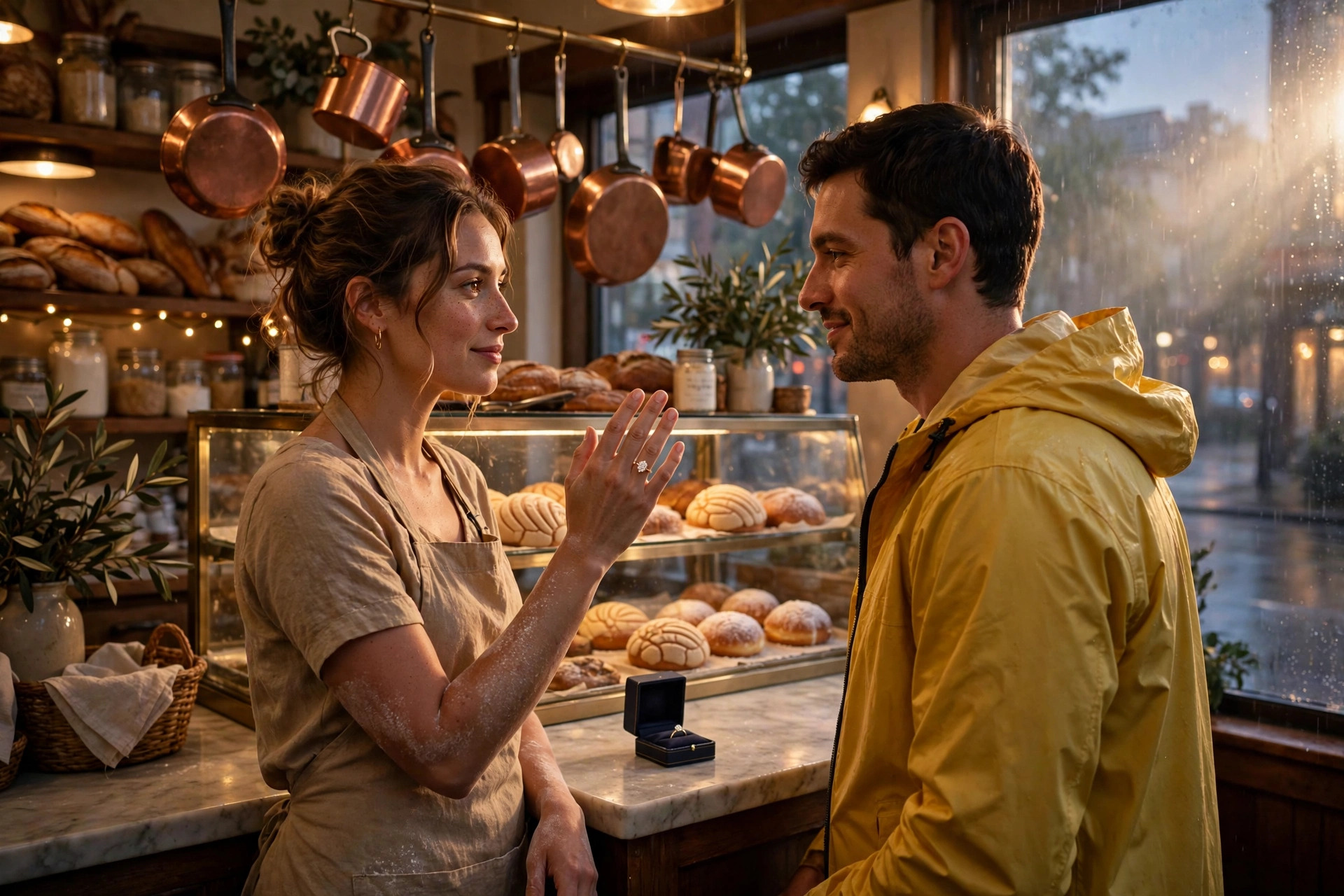
How do you fall out of love with a lie that started as a joke? Chloe Sandoval asked herself that question every morning for three weeks, usually at four a.m., usually covered in flour, usually while the other half of the lie slept on her futon because his apartment had flooded and because, technically, engaged people were supposed to know what the other one's face looked like at four a.m. It was a question with a history, and the history started, as most disasters in her life did, with her grandmother's will and a cake.
One: The Clause
Every family has one document that can start a war, and in the Sandoval family it was two pages of plain legal prose held together by a paper clip and forty years of resentment.
The bakery had been in the family since 1979, when Chloe's grandmother Elena crossed a border and a continent with a bread recipe and a suitcase that had one working latch. Pan Dulce Rosa had survived two recessions, one arson scare involving an ex-husband, and the sourdough trend of 2015. When Elena died in March, she left the shop, the building, and the blue enamel cross above the register in a trust, and the terms of the trust were this: her granddaughter Chloe would receive the deed in full on her thirty-fourth birthday, provided she could show the family one ring and one fiancé who had, in Elena's exact phrasing as relayed by the lawyer, "stayed through at least one Christmas, one birthday, and one jam season."
Chloe's birthday fell in October. The family party, which was less a party and more a tribunal with tamale trays, had been scheduled for the second Saturday of October in her aunt Yolanda's backyard, which had hosted three Sandoval funerals and one quinceañera and had always smelled like rosemary and rain.
"You could just not take the inheritance," said Marcus, her cousin, on the phone, with the bright false sympathy of a man who hoped she would not take the inheritance. Marcus managed a bakery-adjacent cafe for a developer who wanted the block. He said "development opportunity" the way other people said "trust me."
"I could," Chloe said. "Or I could not lose the only thing my grandmother loved more than me and my mother, and I could find a fiancé in five months, which is harder than learning French but easier than grieving properly."
The lawyer, a soft-spoken woman named Brand who had seemed slightly embarrassed by the whole document, had explained that Elena's clause was unenforceable in any real sense. The trust could not compel her granddaughter to marry. What it could do was gift the deed to the bakery and the building outright on one date or to one alternate beneficiary on another. The alternate beneficiary was the Sandoval Extended Family Trust, otherwise known as Aunt Yolanda, who believed sourdough had lost its way and that the shop should convert to a juice bar.
"So it's a test," Chloe had said.
"It's a woman who was ninety-one telling you who she hoped you'd become," Brand said. "Same thing, most days."
Chloe wanted the bakery. She wanted it the way you want a limb. She was thirty-three and she had spent the last eight years waking at four to proof dough and staying till ten to invent a new thing nobody ordered. She had gone on eleven first dates in the previous year. Nine of them had asked what she did and then told her about their software. Two had gone ghost after she showed up with flour on her collarbone. One, a promising string bass player named Duncan, had lasted three months and then said, gently, sincerely, kindly, that he was not interested in a life where the center of it was dough.
The pastries liked her better than the men did. The pastries could at least be relied upon to rise.
Which left her, in April, standing on the loading dock behind her own bakery, three months after the funeral, holding a recycled prom flyer she had made herself, that said HUSBAND NEEDED, MUST SURVIVE TWO HOLIDAYS, CASHIER HUMOR A PLUS, at the exact moment a tugboat captain named Theo walked around the corner and read it upside down.
Two: The Loading Dock Interview
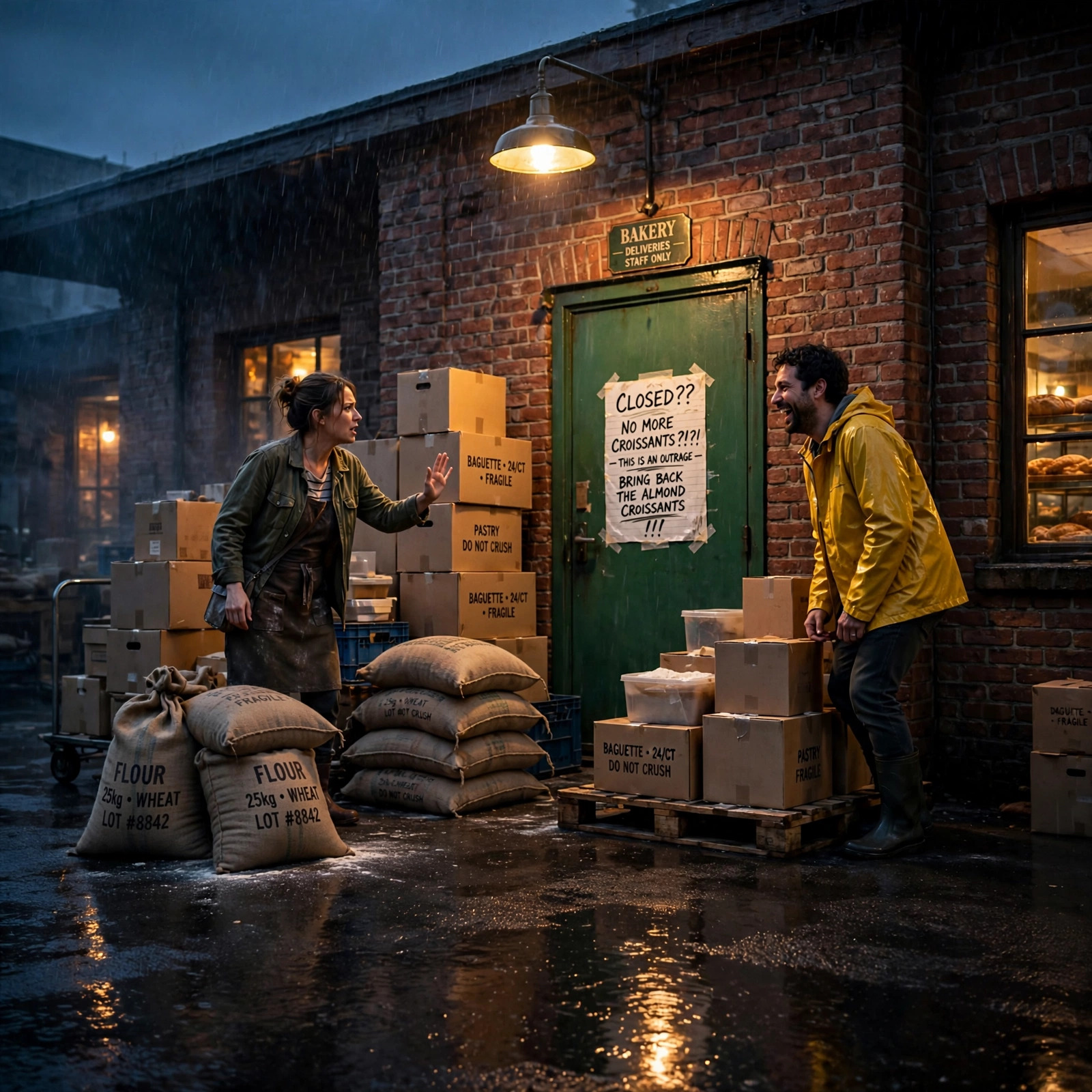
"Is this an artistic statement," Theo asked, "or are you hiring?"
Chloe considered, briefly, dying. She was thirty-three, flour on her wrists, fifteen hundred pounds of chocolate due in an hour, and a man in a yellow rain jacket was reading her desperation out loud. "It's for a piece I'm curating," she said. "At the museum."
"There's no museum." He looked down the street, empty in both directions except for a delivery bike parked badly. "I live across the hall from the museum. There's a laundromat where the museum would be."
He was her neighbor, sort of. The bakery sat at street level on Alberta Street with an old upstairs apartment above it that Elena had rented for thirty years to the same Boeing retiree who had died in January, which was how Theo had come to live above a bakery without knowing the terms of the bake. He was thirty-seven, broad in the shoulders the way working boats make their people broad, and he had a habit of putting his hands in his jacket pockets like a man keeping his own secrets warm.
"Fine," Chloe said. "I need a fiancé by October. And in exchange I will trade you anything within reason."
"Why would you need a fiancé?"
"My grandmother's will is a hostage note with better grammar."
She had planned to lie. Then he laughed, a real laugh that started in his stomach, and she had told him the whole thing instead, the trust, the jam season clause, the aunt with juice bar ambitions, and he had listened while the rain got serious and the chocolate truck sat half a block off, unable to get down the alley until they moved a pallet. He helped move the pallet. She liked that more than she wanted to.
"Okay," he said, when the truck finally growled off. "Mutual terms. Because I need a partner too."
"You need a fake partner?"
"His ex-wife's wedding," Theo admitted, "is in June. On a boat. I told my ex-wife's family, at a Christmas party I did not attend, that I was seeing a pastry chef, which was not a lie, because I had eaten eleven things from your case by December and I did not want to say I was single again at the age of thirty-seven. There will be two hundred guests. One of them is my father, who has a theory about my failures, and one is my ex-wife, who is lovely, and one is her new husband, who is a gastroenterologist, and everyone at my table of that wedding will be a doctor."
"So you need someone to be."
"I need someone who can hold a conversation about sourdough starter with a gastroenterologist," Theo said. "I hear you're qualified."
They shook on it right there on the loading dock, which Chloe would remember later as both the least and most binding contract of her life.
Three: The Rules, Of Which There Were Nine
They formalized things over pączki and two glasses of milk at the corner table that regulars called Chloe's kitchen table, even though legally it was the bakery's.
Rule one: neither of them lied to anyone who mattered, which is to say that the performance was limited to family gatherings and public encounters and no one got set up to hope for anything.
Rule two: physical affection by consent only, rehearsed in advance, scaled one to five. "Level one is hand on shoulder," Theo said. "Level two is hand. Level three I keep meaning to ask about and forgetting."
"Level three is casual arm around waist," Chloe said. "Level four is slow-dance level. Level five has never happened on site and never will."
Rule three: money changed hands at market rates because debt breeds resentment, so she paid him forty an hour for event hours and he fixed her blender for free and they agreed this evened out.
Rule four: his ex's wedding in June, her family tribunal in October, and any obligation in between they would weigh fairly and could refuse.
Rule five, added by Chloe: at no point would either of them fall for the other.
"That's not a rule," Theo said. "Rules have to be possible."
"Then it's an intention."
"Then it's an intention," he agreed, and ordered a third pączki with the confidence of a man who intended many things.
Rule six: they learned each other's real things. Not trivia. Real things. His mother had died when he was twenty-six and he still wrote her birthday in every calendar app he installed. Her father had left in 1998 and she had baked the day he left and decided baking equaled staying. They said these things over pastry once and then never weaponized them, which was its own kind of tenderness.
Rule seven: anyone they actually wanted to date outside the arrangement, at any time, could call it, no fault, full refund of all hours traded.
Rule eight: Lydia, Theo's younger sister who cleaned the deck of his tugboat and refused gossip, got told the truth in full because "lying to my sister is a level nine."
Rule nine, added by Theo, in ballpoint on a napkin: if it stops being fun, we stop. He slid the napkin across the table. Chloe read it twice and had, for no reason she could defend, a feeling like the timer going off at the wrong time.
Four: The Boat Wedding of the Ex
June came in on the river in gold light. The wedding was on a chartered paddle-wheeler on the Willamette and it was, infuriatingly, beautiful. Two hundred people, a string quartet, her ex's family asking Theo if she was the pastry chef he'd mentioned at Christmas.
She was in a green dress and he was in a navy suit and level two became level three somewhere between the ceremony and the shrimp, which is to say his hand found her waist like it had been meaning to for years and forgot where it was supposed to end and when. He did the joke version of introducing her. "Chloe Sandoval. She makes the thing I can't have because it's always sold out."
"He reviews my failed croissants," Chloe told the gastroenterologist. "He has opinions about lamination that no man should be permitted."
"Is that right?" the doctor said, delighted.
"I have surgical standards," Theo said, "applied to baked goods. There's no one more merciless."
The ex-wife, Dana, found them at the rail at sunset. She had a long stem of wine and forty years of Theo's history in her face. "You look happy," she said, and it was not a trap; it sounded almost like a gift. "She's prettier than you described, and you described her a lot."
"I described her accurately," Theo said.
"That's what worries you," Dana said softly, and went to find her new gastroenterologist husband, and left Chloe with a hand still resting on her waist like an exhibit that had outlasted the tour.
The dance, level four, happened at nine, because the bandleader played something in 6/8 and Theo, without discussing it, extended his hand, and Chloe, without discussing it, took it. On the dance floor of a wedding neither of them were guests of in any honest sense, holding each other with two hundred witnesses, Theo said, "I have to tell you something against rule five."
"Theo."
"It's not a confession. It's a weather report. There's weather. Nothing has to be done about the weather."
"Good," she said. "Because so do I."
They danced the whole song and the one after, and neither of them did anything about the weather, and it was the most honest conversation they'd had.
Five: The Summer of Being Practical
Here is what nobody tells you about fake relationships: they create real logistics, and real logistics are intimacy wearing a trench coat.
By July, Theo knew that Chloe went quiet when inventory math went wrong, and she knew he made his bed to inspection standards because a boot camp scholarship had taught him that the bed was the one thing you could win every day. He knew she hummed Portuguese fado when frosting. She knew he had not smoked in nine years and that he counted silently when he was anxious, which she could see in the movement of his jaw.
They ate dinner twice a week, cost-free, as "rehearsal." He fixed the ancient upstairs plumbing for the absurd fee of one box of conchas per month. She went with him to look at the flood damage that had gotten worse. The landlord of the whole brick building had been slow with insurance and Theo, who by trade inspected vessels for a living, had to document everything with the patient stamina of a man used to writing reports nobody wanted.
"There's mold in the back bedroom," he said in August, up on the roof of her bakery, the neighborhood humming below, the evening gold going pink. "I'm going to fight them. It may take months. I may lose my place."
"You'll stay here," she said, before thinking. "Upstairs. The old apartment. It's empty. It's mine now, if the clause holds."
He looked at her a long moment. "That's your inheritance by October."
"The clause only checks that he stayed," Chloe said. "It doesn't check where he slept."
"Chloe."
"It's a service," she said. "Like the pączki for plumbing. Don't make it a thing."
But it was a thing. Everyone could see it was a thing. The regulars began leaving wedding magazine subscriptions in the bakery mailbox addressed to "The Captain." Aunt Yolanda sent a card to the shop saying she had "heard rumors" and that she looked forward to "validating them." Lydia, who knew the truth, had started bringing Chloe rolls she didn't need, the way people feed their co-conspirators.
And in September, the real trouble began, because Marcus made his move.
Six: The Offer
Marcus came to the shop on a Tuesday with a tablet and a latte and the confidence of a man who had been told no in smaller rooms before.
"The building has a strange ownership situation," he said. "A trust that sunsets. Conditional. Aunt Yolanda controls the alternate, and I've explained to her that there's risk in holding out for you to produce a fiancé. Meanwhile the developer wants to make an offer for the block. I got them to eight-fifty for the bakery plus three-ten for the upstairs. That's over a million, Chloe. Split with the family trust, everyone walks away comfortable."
"We," Chloe said, "as in you, would walk away comfortable. I'd walk away from the only thing my grandmother built."
"Or," Marcus said, leaning in, "you try to stage-manage this engagement with the tugboat guy, it collapses, everyone can see the seams, and the family decides you're not ready. That's the other outcome. Everyone's watching in October, Chloe. One wrong answer and Yolanda calls the whole thing a farce and takes the vote. And, hey, we both know you can't validate that clause. Grandma wrote it for a granddaughter she wished existed."
The cruelty of it was that he was half right. The clause was absurd. It measured love by attendance, like a doctor taking your temperature, and it asked her to manufacture proof of the one thing she had never once managed on schedule.
"Thank you for the numbers," she said. "Now take your tablet and go quietly, like a businessman."
He left. She stood in her own kitchen, in her own shop, holding dough she couldn't remember mixing, and Theo found her there twenty minutes later because he had learned her silences.
"What did he offer," Theo said.
"Enough to make him dangerous. And enough to make the idea real, if I didn't have October."
"So we make October undeniable." He said it simply, like a man volunteering for night watch. "We don't play it cute anymore. We play it convincing. Public, loud, family-facing. We go get you your bakery."
"And rule nine?"
"Rule nine has a notation," he said, and didn't show her the napkin, and the weather report from June had become a storm front, and she knew it, and did nothing about the weather, and that was the year's first real mistake.
Seven: The Tribunal at the Rosemary House
The family party in October was held in Aunt Yolanda's backyard under strings of bulbs, with forty-one Sandovals and three tamales tables and a folding chair arrangement that encoded the family's actual politics better than any charter. Chloe came as the fiancée, with Theo in his one good navy suit, and the ring, a thin gold band with a rose-cut stone that had been Elena's, worn backward on her right hand all day and transferred to the left hand at the gate like an actress making her entrance.
It went well. That was the terrible part. It went beautifully.
Theo told the story of the loading dock flyer, edited for comedy, and Yolanda laughed her first laugh of the decade. He held jam-season conversation with three aunts simultaneously. He asked about everyone's knee surgery in a way that made people feel memorable. When Duncan the bass player arrived as somebody's date and looked faintly stricken, Theo put level three on Chloe's waist and said something gracious about musicians, and the evening's tide did not so much as wobble.
At ten, Yolanda raised her glass for the verdict, and Chloe stood beside her fake fiancé and lied with her whole family watching, and watched the lie work, and the working of it broke something in her.
"To Chloe," Yolanda said, "and her good man, and the shop. Deed's in motion. Brand sent me the paperwork an hour ago." A cheer. Someone rang the wind chimes Elena had hung there in 1984, which meant celebration, which Chloe had not heard in two years.
It should have been the best night of her life. It was the moment she realized she had gotten exactly what she asked for and had no intention she could respect. Because the applause was for a fiction, and the fiction was built on a real man who had quietly spent the summer being the truest person she knew, and she was about to take her inheritance, cash a lie, and never have to see him again except across a hall she'd offered as a courtesy.
"Congratulate us," her mother said, hugging her, oblivious. "When's the wedding?"
And Chloe, with the applause still going, felt the whole performance go over like a cart of pans, and looked at Theo across the yard, and Theo, who could read her silences from thirty feet, had already stopped smiling.
Eight: The Unmasking

She told him on the back patio, away from the bulbs, while the first October rain came down in the yard like an audience being dismissed.
"I got it," she said. "The deed. Brand called. It's done. I have the building."
"I know," Theo said. "I heard the cheering."
"So the arrangement ends. That's rule nine territory. It stopped being fun in July and we both kept going, so, technically we broke our own laws, but the point of the original transaction is complete, and you never have to attend another Sandoval event in your life, and I'll pay you the October invoice at double, and I have this whole speech I did not write."
"Say the real one," Theo said.
"I don't have a real one."
"Then I'll go."
"Theo, wait." Her voice did something she didn't authorize. "The pastries didn't like you better. Duncan said that. The pastry thing. Men keep telling me what my life is and you never did, not once all summer, you just showed up with a torque wrench and an opinion about my croissants and you let me work, and I don't know how to do this part, the part where something is real, I only know how to prove things to committees."
The rain got heavier. Both of them stood in it for a second like idiots.
"Rule five," Theo said quietly. "You're the one who wrote rule five."
"Rule five says no one falls. It didn't work. I fell. In August, around the time you were counting silently over the mold paperwork. Possibly June. Possibly April, on the loading dock, when you read my flyer and laughed and helped move a pallet."
The patio door slid open behind them, Yolanda's voice calling about cake. They both looked at the door. They both looked at each other.
"I need to say my version," Theo said, "before someone brings cake." He took the napkin, rule nine's original, creased now, out of his jacket. "If it stops being fun, we stop. You signed. I signed. It stopped being fun for me in June on the boat when your hand shook while we danced, because I understood then that I was not pretending about anything anymore and you were, and that meant you were braver than me by a lot. I came to October because you'd get your bakery and I'd get to keep the dream, the pretending part, for as long as it ran. Because engaged men get to sit next to you at dinner. That's my confession. It's not a weather report."
Chloe took the napkin. She smoothed it on the railing and, with the pen from her apron pocket, because of course she had a pen, she crossed out the words if it stops being fun, we stop and wrote underneath: if it stops being fake, we start.
"Revised term sheet," she said. "I'd like to renegotiate rule two, levels one through five. I'm proposing an expanded scale."
"Propose," said Theo, and the rain fell on them and they kissed in it, level five achieved on site after all, the family applause leaking through the glass door like the score of a movie that had finally stopped pretending it was about a will.
Nine: The Real Interview
They did it properly. That is to say, they did it honestly, the way they had failed to all along.
He told Lydia the engagement was real the following morning over bad coffee on the deck, and she said "obviously" in a tone that suggested the boat crew had a betting pool with a long history. Chloe called Brand, told her the whole truth including the flyer and the rules, and Brand was quiet for a moment and then laughed in a way Chloe had not heard from her.
"Your grandmother had a name for people who audition," Brand said. "She'd have adored your flyer. Also, I should tell you, there was an addendum in the trust file, one paragraph, never filed because the condition wasn't met. It was addressed to you."
Chloe came in and read it at the table. In Elena's looping hand, dictated near the end:
"Mija, if you are reading this, you found someone to stand in the chair at Christmas. Maybe you love him already. Maybe you lied to my lawyer, you did not get that from nowhere. Either way, keep the bakery, keep the recipes, and fire whoever you had to invent along the way. Love is not a clause. It is the only thing that arrives without being written down."
"She knew," Chloe said, half laughing, half crying, holding the page. "She wrote a clause and then admitted it was nonsense."
"She gave you the deadline," Theo said, taking her hand, level five forever now, no schedule, "so you'd know I'd stay through one of everything. That's not a trick. That's just how long it takes a slow man to say so."
Ten: What the Family Got in the End
Marcus's developer got its block eventually, just not that block, and there is a version of this story where Marcus comes to the reopened Sandoval-laundromat fund-raiser, sheepish, employed, having come around, and there is a version where he doesn't. He did. Yolanda still runs a mail-order juice club out of her garage, which Chloe sells pastries to at wholesale, and it is understood on both sides that this arrangement will end in tears and always has.
Theo kept his real job. He kept the tugboat. He kept the apartment upstairs, but not as a tenant: the lease they never had became real ownership papers because Chloe's first act with the deed was adding his name to the residential title, contingent on exactly one clause, in her own hand, at the bottom of her own notebook page: must stay through at least one Christmas, one birthday, and one jam season, renewal automatic and eternal.
They married in September the next year, at the loading dock, rain jackets optional, Yolanda hosting. The gastroenterologist came with Dana, and they danced with a level-four consent rate of one hundred percent. The string bass player sent a card that said "finally" and it was kind of them all.
On the morning of their anniversary, at four, Theo found Chloe in the kitchen at the pączki vat, flour on her wrists, humming fado, and he stood in the doorway a while without counting anything at all.
"Question," he said.
"Working."
"If you'd never written the flyer."
"Then you'd have read the sign by the register," Chloe said, not looking up, rolling the dough for the next morning, "the one Grandma hung in 1984, the one I walk under every single day."
"What does it say?"
"It says the same thing it always said." She took a bite of raw dough, made a face at the salt, and kissed him, unarranged, unperformed, unpaid. "It says open."
The End.
Get notified when new stories drop

Lila Monroe
Lila writes contemporary and small-town romance with banter-forward leads and soft landings. She believes the best love stories sound like two specific people, not a trope checklist.
Leave a comment
Comments