



Printed in Defiance

What happens when the woman you were hired to ruin is the only person in New York you cannot bear to lose? That is the question Nathan Price must answer, and this story is his answer, told in full.
The trouble began, as most trouble in New York did in the spring of 1894, with a newspaper and a lie about who wrote it.
Evangeline Callahan had been awake since five, which was the hour her father's composing room woke, and she liked to be in it before the men arrived, before the smell of fresh ink had time to go stale. The Morning Ledger occupied four floors of a soot-darkened building on Printing House Square, and Evie had grown up in its corridors the way other girls grew up in gardens. She knew which stair tread creaked. She knew which pressman whistled flat. She knew, better than anyone alive except perhaps the Almighty, exactly where the Ledger's typesetters hid their tobacco and their grievances.
She was twenty-six years old, her father's only child, and by every polite measure of the city she was a great catch with a fatal flaw: she had opinions, and she published them.
Not under her own name, of course. Under her own name she was merely Miss Callahan, heiress, ornament, the daughter Marcus Callahan paraded to benefactors and bankers. But three mornings a week, on the editorial page of the very paper her father owned, there appeared a column signed only The City Woman, and the City Woman had spent the winter making a particular newspaperman's life a series of small public humiliations.
That newspaperman was Silas Whitcombe, editor of the Herald Union, and he had declared war on Marcus Callahan eighteen months ago over a crooked gas-lighting contract and had never learned how to stop. Whitcombe wanted the mayor's office. Callahan's editorial page wanted Whitcombe nowhere near it. The City Woman, meanwhile, wanted Whitcombe embarrassed, and she was very, very good at wanting things.
"Papa," Evie said, letting herself into his office with the proof sheets she'd marked before breakfast, "your paragraph about the alderman's paving kickback has a comma where a period ought to be, and it changes the meaning from accusation to slander."
Marcus Callahan looked up from a desk drowning in clippings. He was sixty, broad, silver-bearded, with reading glasses pushed up into what remained of his hair. "Which is it?"
"Accusation. If we're going to say a man steals, Papa, we say it cleanly. Sloppy punctuation is how libel suits are won."
"God preserve me from daughters who edit." He said it with unmistakable pride. Evie kissed the top of his head, took the stairs two at a time, and went out into a city that smelled of horse, coal, river, and money.
The Last Case of Brevier
That afternoon she had an errand that was not an errand. Hessian and Voss, type founders, kept a shop on Duane Street where they sold type to the trade and, more usefully, kept a glass case of antique and exotic faces for anyone who appreciated letterforms the way other people appreciated paintings. Evie had been reading the case for years the way some people read tea leaves. The column's signature line, the little ornamental border that ran beneath THE CITY WOMAN, had come from that case, and she had come to choose a new one, because a signature, like a woman, ought to change its style before anyone grows suspicious of its face.
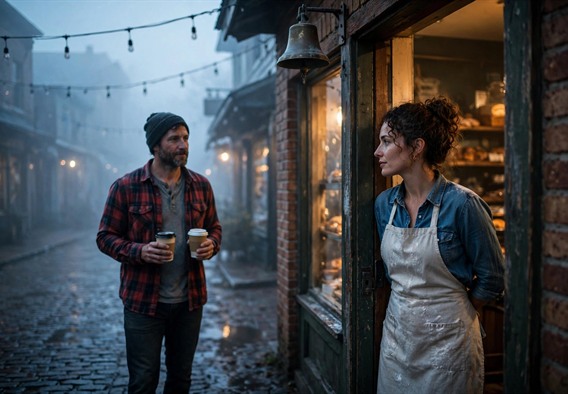
The bell above the door jangled. A man came in behind her, and she registered him the way one registers weather: tall, perhaps thirty, dark-haired, sleeves rolled with the efficiency of a man who worked with his hands and his head at once, ink in the creases of his knuckles that no pumice stone ever fully surrendered. He went straight to the case. So did she. They arrived at the same drawer.
"Excuse me," he said, in a voice like a good press run, even and warm. "But I believe I was here first."
"You were behind me," Evie said, without looking up. "And I have seniority. I've been coming here since I was old enough to be told not to touch."
"Seniority in what trade, may I ask?"
"In appreciation. You're a compositor, by your hands. I'm a collector, by my gloves." She held up her left hand, which did wear a glove, and her right, which did not, because a lady who intended to handle type took the glove off herself.
He looked at her hands, then at her face, and something in his expression suggested he had just revised a first impression downward in politeness and upward in interest. "The drawer you want," he said, "holds the last case of Brevier Ornaments in the city. I know because I telephoned this morning to confirm it. I need it for a job. The job pays. You'll forgive a working man for being unromantic about pay."
"And what is the job?"
"A playbill. A benefit." He hesitated, and she saw the hesitation, filed it, and reached into the case anyway. Their fingers met on the edge of the drawer. Neither pulled. It should have been nothing. It was not nothing. The type case smelled of lead and lacquer and old varnish, and under all of that, faintly, of him, and Evie thought, with the precision she brought to proofs: oh, that is a problem.
"Compromise," she said, recovering. "You take half the ornaments. I take half. Neither of us has to write an angry letter."
"A woman who proposes splitting type down the middle," he said, "is either a saint or a compositor's daughter."
"Worse. A compositor's daughter who edits."
He laughed then, a real laugh, surprised out of him, and Evie understood she was in a quantity of trouble that had nothing to do with type. They divided the case at the counter like diplomats partitioning a small country, arguing amiably over an ampersand, and when he paid he gave the name Price. When she paid she gave the name Callahan, and watched, carefully, to see whether it landed.
It landed. She saw it land. The warmth in his face went still, the way a pressroom goes still when something jams. He tipped his hat, wished her good afternoon in a voice with all the warmth removed, and was gone before her change arrived.
So he knew. Everyone on the Square knew Callahan, the way everyone knew Whitcombe. Evie walked home with half a case of ornaments and the unwelcome discovery that being recognized could feel like being closed.
The Printers' Benefit
Two weeks later, the trade threw its annual benefit for the widows and orphans of fallen pressmen, which in practice meant every newspaper family in Manhattan crowded into a hall on Fourteenth Street to drink champagne, eat chicken in aspic, and pretend the city's papers were not at one another's throats. Evie went for her father. She stayed, though she would not have admitted it under oath, because she had learned that a certain Mr. Price would be there.
She found him at the edge of the dance floor, holding two cups of champagne and looking like a man doing arithmetic he disliked. Nathan Price, she had by then learned from the gossip that moved faster than any telegraph, was the Herald Union's best young reporter, thirty-two, raised in a Brooklyn tenement, supporting a widowed mother and a sister at the Normal College on a reporter's wage, and known in the trade for getting stories other men could not. He was also, the gossip said, Silas Whitcombe's favorite instrument. That was the part she held against him.
"Miss Callahan." He offered one cup with a bow that was exactly correct and exactly mocking. "I looked for you at the type foundry to apologize. I was told ladies of your station do not receive apologies by messenger."
"We receive them in person, if the apology is good."
"Then here is the good one: I was rude, because I was frightened, and I would rather be rude than admit to a stranger that a newspaper name can frighten me."
It was so honest that Evie, who had been preparing to be charming, was disarmed instead. "And what can a Callahan possibly do to frighten a Herald Union man?"
"End his career with an editorial," he said. "Your father has ended three men I know of. Whitcombe reminds us of it weekly." He said Whitcombe's name the way a man names a debt collector.
"And do you admire Whitcombe?"
"I admire my salary," Nathan said. "Admiration is for people who can afford it."
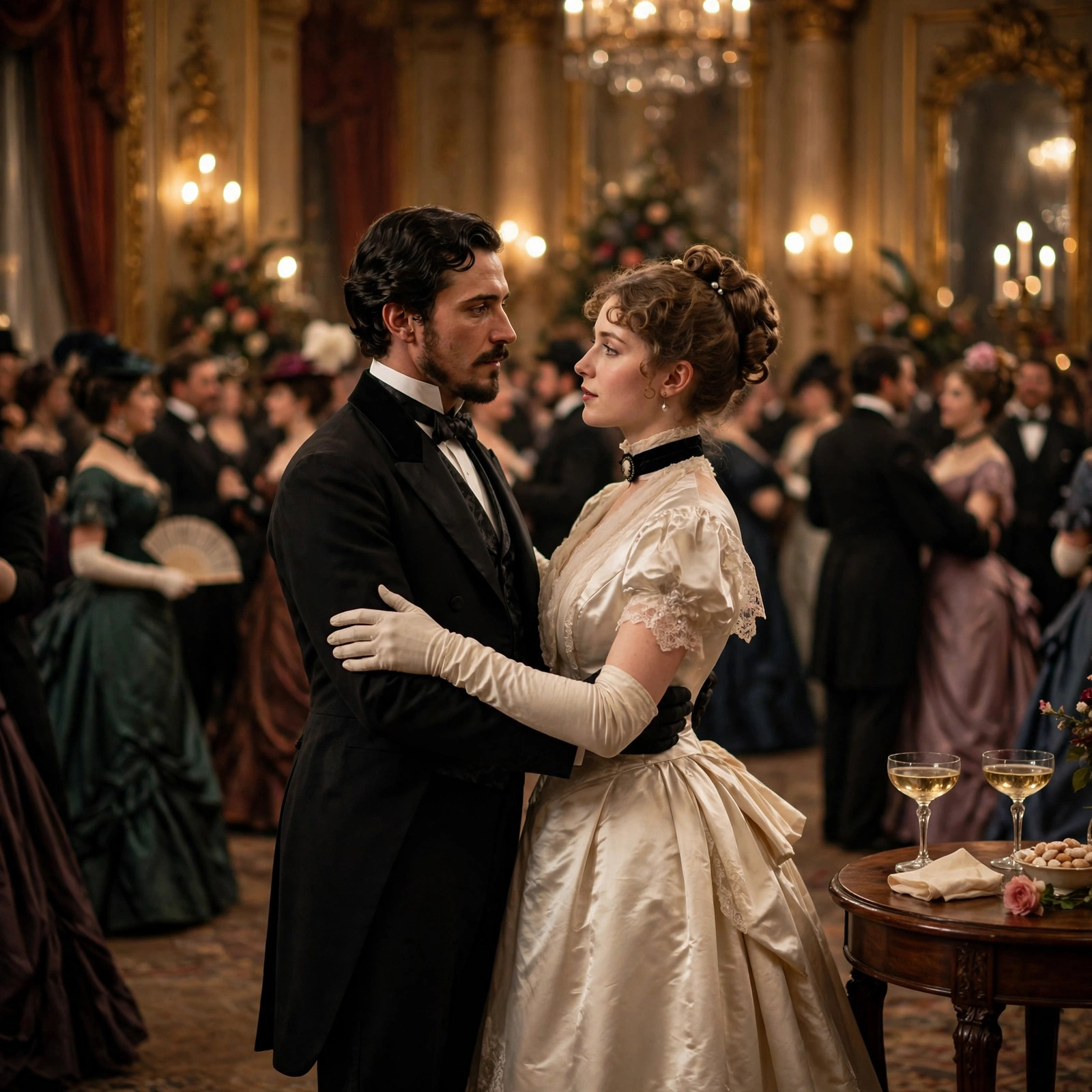
The orchestra began a waltz. Evie looked at the dance floor, at the hundred enemies in evening dress circling one another, and made a decision she would later recognize as the hinge of her life. "Mr. Price. You are the only person in this hall whose hands have type dust on them and whose opinions I haven't already read. Dance with me, and we will say nothing about newspapers for the length of one waltz, on penalty of forfeiting the next."
"And if I want the next waltz?"
"Then you'll find it very easy to obey the rule."
He took her hand. They danced. He was a better dancer than a man who claimed to have learned at church suppers had any right to be, and they talked about everything that was not newspapers: the exhibit of electrical wonders at the fair in Chicago, whether oysters felt fear, the scandalous price of gloves, her sister-at-law's habit of losing umbrellas, which he corrected to my sister and then stopped, hearing what he had said, and she let him hear it without mercy. When the waltz ended he did not let go immediately, and neither did she, and the forfeit was claimed without a word being spoken.
By the third waltz they had broken the no-newspapers rule twice, each time catching themselves like people caught stealing, laughing, guilty, and neither repentant. By the end of the evening, half of Printing House Square had noticed the Ledger's daughter waltzing with Whitcombe's reporter, and by morning, Evie knew, both editors would know it too. She found she did not care, which frightened her more than any editorial ever had.
Letters and the Library
What followed was a correspondence conducted in the only two places in New York where their names did not precede them: the Astor Library's reading room, and the mail.
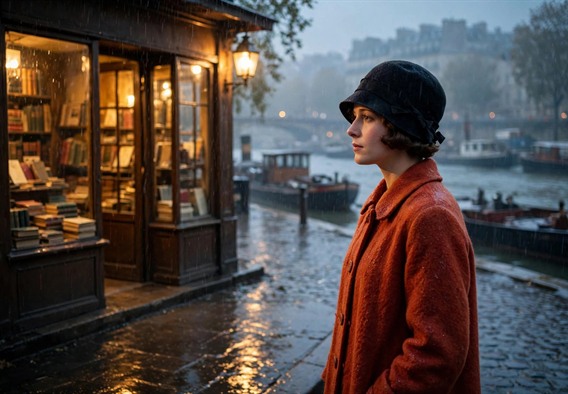
The library came first. Nathan sent a note to the Ledger, addressed not to Miss Callahan but to the lady of the type case, proposing a meeting of the Hessian and Voss Ornament Appreciation Society, membership two, dues one apology, already paid. Evie answered in a hand she disguised, agreeing to Wednesday at three. They met in the reading room among the busts of dead authors, at a table where the rules were silence, and discovered that silence with the right person is a conversation.
He brought her books. She brought him corrections. He had a habit, she learned, of writing with tremendous force and no discipline, and she returned his pages bleeding with blue pencil, and he read her marks like a man reading a love letter, which was a problem she declined to think about. She had a habit, he told her, of being right in ways that made a man want to argue just to keep her talking. They argued about Browning. They argued about whether Brooklyn was a real place or a state of mind. He told her about his mother, who took in sewing until her eyes failed, and about his sister Ruth, who was going to be a teacher and did not yet know how much a teacher's salary would matter to a family like theirs, and Evie understood, sitting very still in the hush of the reading room, that Nathan Price's whole life was a bridge he was holding up with his two hands, and that there was no version of him that could afford to drop it.
"Why does Whitcombe keep you?" she asked, once, quietly. "You're too good for him. He must know it."
"Because I'm useful," Nathan said, "and because a man like me is only ever useful or gone. Miss Callahan, may I say something that isn't in the rules of this society?"
"The society has no rules. That's its chief defect."
"Then here is a rule I'd like to propose." He looked at his hands, ink-stained, work-worn, a compositor's son's hands. "Whatever happens with the papers, whatever our names do to each other, I would like to keep this. The books. The arguments. You. If it must be secret, let it be secret. I know what secrecy costs a woman. I'm not asking you to pay it cheaply. I'm telling you what I'm willing to pay."
Evie looked at the bust of some Roman who had probably also had opinions about editors, and answered the only way that was honest. "Then we keep it. And Nathan, if the day comes when the secrecy costs more than the keeping, we say so to each other first. Before the papers. Before anyone. That is my rule, and I have never once broken a rule of punctuation, so do not imagine I'll break this one."
He smiled, and for a moment, in that great hushed room, the whole feud between Callahan and Whitcombe, the whole city with its coal smoke and its crooked contracts, seemed a rumor about a place they had once visited.
The Assignment
In May, Silas Whitcombe summoned Nathan Price to his office, a room of mahogany and framed front pages, and set before him a folder like a man laying down a winning hand.
"The City Woman," Whitcombe said. "Look at the clipping. Look at the border under the signature. My jeweler's wife pointed it out at dinner: that ornament was sold at Hessian and Voss this winter, one case, divided between two buyers. One buyer was traced. A compositor at the Commercial Advertiser, harmless. The other was a lady, veiled, who paid cash and argued about an ampersand." He smiled with all the warmth of a subpoena. "A lady who argues about an ampersand, Price. Now. Who do we know who has recently been seen dancing with a lady who argues?"
Nathan felt the floor of his life tilt. "Sir, a dance at a public benefit proves nothing."
"It proves where a man's attention went," Whitcombe said. "And I am told his attention went there three waltzes deep. Here is what I want, and here is what it is worth. You will establish, by evidence I can print, that the City Woman is Evangeline Callahan. When you do, we print it with the story behind it: the Ledger's owner has been hiding behind his daughter's skirts, letting a girl write the filth he's too much of a gentleman to sign. It will shame Callahan into silence or into denying his own child, either of which kills him. And you, Price, will be the man who did it. There will be a raise. There will be a byline on the front page. There will, in time, be a desk with a door on it, which your mother's sewing table will appreciate."
Nathan stood very still. He had known, in some cellar of himself, that this was coming. He had known it the night he gave his name at the type foundry and watched his own warmth die of fright. A man's whole family on one salary. A sister at the Normal College. A mother's failing eyes. A desk with a door.
"I'll need time," he said. "Evidence, as you say. I won't bring you a guess about a woman's reputation. If we print this and it's wrong, she sues us into next Christmas and your jeweler's wife dines alone."
"Two weeks," Whitcombe said. "Price, this is the door I told you about. Some men wait their whole lives for a door."
Nathan walked back across the Square to the Union's offices and sat at his desk and did not write a single word for two hours. Then he wrote Evie a note in the disguised hand he had learned from her, in reverse, the way one learns a partner's steps: The society meets Wednesday. Urgent business. Bring the ampersand.
He spent Tuesday walking the city from the Battery to Harlem, telling himself that there might be evidence proving the City Woman was someone else entirely, and knowing there was not, and hating himself for the shape of the thought, which was not is she the woman but what will I do when she is.
The Confession
She knew before he spoke. That was the thing he could never have predicted, and the thing that undid him: when he sat down across from her in the reading room with the folder untouched on his knee, Evie looked at his face and said, "He gave it to you. The assignment. Tell me exactly what he said, and do not soften it, because I edit and I will know."
So Nathan told her. All of it. The ornament, the traced sale, the raise, the byline, the desk with a door. He told her the way he would write it, plainly, without mercy for himself, and when he finished the reading room's clock had moved through a quarter hour of silence.
"You did not take it," she said at last.
"I asked for time."
"That is not the same as refusing."
"No," he said. "It is not." And then, because she had made him promise honesty before papers and before anyone: "Evie, I want to refuse it. I also want to feed my mother and finish Ruth's schooling, and those wants are sitting in the same chest as the first want, and I cannot pretend they weigh nothing. If I throw this assignment back in Whitcombe's face, I am gone from the Union by Friday, and a man blacklisted by Whitcombe is a man blacklisted on the Square, and I want you to look at me while I say that I am going to do it anyway, because I want you to see me choose, not have it chosen for me by affection. You told me once that if we're going to say a man steals, we say it cleanly. I am not going to steal you. Not for a desk with a door. Not for anything."
Evie's eyes were bright and her voice, when it came, was level as a galleys line. "I have a confession that outranks yours. Sit down, because you are about to learn what the society's dues really are." She drew from her bag a folded galley proof, an advance proof of Thursday's Ledger editorial page, which she had, by a lifetime of charm expended on a pressroom foreman, the habit of reading early. She turned it toward him and pointed to the City Woman's column, and to the little ornament beneath the signature, and to the sentence above it.
"Thursday's column," she said, "is about Silas Whitcombe's gas-lighting contract, and it names, for the first time, the exact sums, which I have had for two months from a man in the comptroller's office who owes my father a grudge about a pension. Nathan. If Whitcombe prints that I am the City Woman the day after that column appears, no one in this city will believe he unmasked me. They will believe he is retaliating for being exposed, and the sums will stand in print, and his mayoral candidacy dies on Thursday and my unmasking arrives on Friday as a footnote to his ruin." She paused. "I did not plan it as armor for you. I planned it as armor for me. But it is yours if you want it. Take it to Whitcombe and show him what printing my name would cost him."
Nathan looked at the galley, at the neat devastating figures, at the woman who had, in the space of one conversation, handed him both a weapon and a way out, and he found that the thing he wanted was neither. "Evie," he said carefully, "if I show Whitcombe that column, I am still trading on your work to save my place. That is a smaller theft, but it is the same shape."
"What will you do, then?"
"Resign," he said. "Cleanly. In writing. Tonight. And then I am going to ask you the question I came here to ask before Whitcombe ever handed me that folder, and I would like the reading room's silence to be on my side when I ask it."

The Resignation
He resigned that evening in a letter of four sentences, the cleanest thing he had ever written, and Whitcombe read it standing up and then sat down and then laughed, which was worse than shouting.
"The girl got to you," Whitcombe said. "Price, you are a fool with a future, and I am the last man in New York who will ever say so to your face. Go, then. But hear the terms. Any paper on this Square that hires you will hear from me. Any editor who prints your byline will read my column about his debts the next morning. You are done in daily journalism, and you did it for a Callahan. Your mother will be proud, I'm sure, when the rent is late."
Nathan stood in the doorway and discovered that the fear he had carried all his life, the fear of being useful or gone, had somehow, in the last hour, changed its address. "Mr. Whitcombe," he said, "for what it is worth, the sums in Thursday's Ledger are accurate. I have seen the comptroller's man's figures myself. You may wish to spend tonight with your lawyer rather than your column." And he left, and the door, the one with the desk behind it, closed on someone else's name.
Evie was waiting, at the library, of all places, because the society had never fixed an hour for emergencies and the reading room was the only address they shared. He told her everything. She listened without interrupting, which for Evie Callahan was a sacrament.
"You could have used my column," she said. "I gave it to you."
"It was yours to give and mine to refuse," he said. "I think that is what the vow means, whatever the minister's version of it is." He had not meant to say the word vow and they both heard it, and did not retreat from it. "Evie. I have no position, no prospects, and a blacklist with my name on it. I have a mother, a sister, a set of type cases, and the world's most inconvenient education. I am going to ask you anyway. Marry me. Not because it will be easy. Because I have read every sentence you have ever published under that signature, I have watched you handle an ampersand like a duelist, and I know with the certainty I know a clean proof when I see one that the rest of my life will be poorer without you in it than with you in it, however it has to be arranged."
"Yes," Evie said, before he had entirely finished, and then, because she was her father's daughter: "But we are going to have to survive my father first, and Nathan, I need you to understand that I am not going to let him buy you off, or buy me off, or settle this the way he settles everything, with money and silence. I am twenty-six years old. I have been the City Woman for three years. I have never once asked his permission to have a mind, and I am not going to start by asking his permission to have a heart."
"What do you need from me?"
"The truth, in the room, with him, with me beside you. That is all. He has never once been lied to by someone standing up."
Callahan's Answer
Marcus Callahan heard the whole of it on a Sunday evening in his office, with the composing room quiet below and Evie standing beside Nathan Price with her hand on the man's sleeve like a woman anchoring a claim. Nathan told him everything: the foundry, the waltzes, the assignment, the refusal, the resignation, the blacklist, the proposal. He did not soften it. He had learned that from her.
Callahan listened with his reading glasses pushed up into his hair and his face giving away nothing, which his daughter knew, and his visitor did not, was the face he wore when he was working hardest.
"You refused Whitcombe," Callahan said at last. "You had a raise and a byline and a desk with a door, and you refused him."
"Yes, sir."
"And now you're blacklisted at thirty-two, in love with my only child, and asking me for what, exactly? My blessing? My money? My silence?"
"None of those," Nathan said. "Your daughter has already said yes to me, and she does not require my permission or yours, and I would not insult either of you by pretending otherwise. What I am asking for is a job. Not in your paper. I won't be the Ledger's man; I've had enough of being any man's instrument. I'm asking for the use of your basement and your credit with the type founders, and I'm asking it as a business proposition, because the only thing I know how to do is set type and get stories, and I intend to do both for myself. And I am asking, sir, if you will permit your daughter to work beside me, because she will anyway, and I would rather she did it with your knowledge and her mother's ring on her hand."
There was a silence in which Evie could hear the building breathe, the great sleeping presses below them, the ledger of her whole life turning a page.
"Three years," Callahan said finally, to his daughter. "Three years you've written that column under my roof and let me play the fool who didn't know."
"You knew," Evie said. "Papa. You have always known. You let me, because you could not give me a byline and I would not have accepted one given as a favor. Do not make me say it was a kindness. Say it was cowardice on both our parts and let us stop being cowards on the same evening."
Callahan took off his glasses, polished them on his sleeve, and put them back on, and looked at the two of them for a long moment, the blacklisted reporter and the column that had been wounding his enemy under his own roof, and then he laughed, a great rolling laugh that Evie had not heard since her mother was alive.
"The basement," he said. "On rent, at market terms, because I will not have my son-in-law owing me anything but his presence at Christmas. And Evie, if you are going to be the City Woman in someone's basement, you will sign it with your own name by Christmas, or I will disown you for cowardice instead." He stood, and put out his hand to Nathan. "My late wife, God rest her, told me on our wedding day that she was marrying a newspaper and I ought to learn to share. I never learned. You two appear to have managed it. Don't make a mess of it. The trade will watch, and so will I."
It was not a blessing in church language. It was better. It was a blessing in newspaper language, which is to say it came with terms, a deadline, and the implied threat of a follow-up story, and Evie and Nathan shook her father's hand and walked out into the Sunday-quiet Square holding hands for the first time in front of anyone, and the building below them, as if it approved, ticked and settled like a cooling press.
The Price and Callahan Press
They married in October, at Grace Church, with the widows and orphans of the printers' benefit in the pews because Nathan insisted, and the entire composing staff of the Morning Ledger in the back because Evie's charm with foremen had never once lapsed. Whitcombe did not attend. Whitcombe did, however, print three hundred words of sneer about the match, which ran directly opposite an advertisement for the Price and Callahan Job Printing Office, Basement Level, 14 Beekman Street, and the sneer, people agreed, was the best advertising the firm ever bought.
The basement was cold the first winter and warm every winter after, because two people who have chosen each other against the arithmetic of the world keep a different kind of fire. Nathan got the stories: his first great piece for his own little weekly, The Composing Stick, exposed the blacklist itself, named every editor who had taken Whitcombe's calls, and ran under a headline Evie set herself, letter by letter, in the last case of Brevier Ornaments in the city. Two editors called the next week asking to reprint. One offered him a desk with a door. He sent them, all three, a polite note in a disguised hand, and framed the rejections above the case.
And in the spring, on the anniversary of the waltz on Fourteenth Street, the City Woman's column appeared in the Ledger for the last time, and beneath it, in the same type, ran a notice: The City Woman has retired. Her name was Evangeline Callahan. She will now be writing under it, at the paper she and her husband publish, where opinions are signed, because a city this size deserves to know exactly who is arguing with it. The first signed column under her own name, in their own paper, was about Whitcombe's gas-lighting contract, and it was set cleanly, every comma and period in its right place, because as its author had taught a certain reporter long ago, sloppy punctuation is how libel suits are won, and she had never once lost.
On winter evenings, when the presses below Printing House Square had gone quiet and the gas lamps made small golden worlds of the windows, the Price and Callahan office glowed in its basement like a lamp under a stair. Inside, a man with ink in the creases of his knuckles read proofs aloud in the voice of a good press run, and a woman with her gloves off argued with him about the placement of a comma, and neither of them, by any honest accounting, had ever once regretted the cost of the choice they made, because they had made it together, in type, in ink, and in defiance, which was, as any compositor could tell you, the only truly permanent form of love.
"If we're going to say a man steals, we say it cleanly. Sloppy punctuation is how libel suits are won."
Set in New York, 1894. All characters are fictional adults. The Price and Callahan press, like the best love stories, ran a little ahead of schedule and exactly on time.
Get notified when new stories drop

Marcus Hale
Marcus writes slow-burn and marriage-of-convenience stories where logistics become intimacy and competence is a love language.
Leave a comment
Comments