



The eddy we left behind
There is a question Mari Voss has been dodging for four years, and her mother finally asks it out loud the morning of the Founders' Regatta, while they are stapling sponsor banners to a plywood booth that smells like sawdust and sunscreen. The question is simple. Can a person go home to the same river where her whole life split into before and after, and come out the other side whole? Mari does not have an answer yet. She only knows the river has been waiting, and so has the man she used to trust with her life.
The banner with his name on it
Mari saw the name before she saw the man. That was how the past always ambushed her: text first, then the whole body of it.
She was on a ladder at seven in the morning, one knee braced against the Regatta Committee's wobbliest folding table, stapling the last corner of a vinyl banner to the booth frame when the sun came over the ridge and lit the row of sponsor names in gold. Slezak Outfitters. The Narrows Diner. The Bank of Wirt County. And then, third from the end, in bold red letters that had not been on any banner four years ago: HALE.
She staple-gunned her own thumb. She did not swear, exactly. She made a sound like a kettle deciding whether to boil, and her mother, Doreen, who ran the regatta with the tyrannical calm of a woman who had organized four decades of small-town chaos, looked up from her clipboard.
'That'd be the boy,' Doreen said.
'Do not,' Mari said, shaking out her thumb, 'call him the boy. He's twenty-nine.'
'He's coming back, then. nationals qualifier, right here on the Wolfe. Head of the committee confirmed it Tuesday.' Doreen clicked her pen twice, a punctuation habit Mari had inherited like an elbow. 'You knew that, I assume.'
Mari had known it since Tuesday, actually. She had read the press release standing in the parking lot of the river-safety school where she worked, one hand pressed flat against her sternum like she was taking an oath. DEACON HALE RETURNS TO WOLFE NARROWS FOR HOMETOWN QUALIFIER FOLLOWING RECOVERY. The photograph attached to it showed him crouched on the upstream bank of the put-in, helmet under one arm, shoulders wider than she remembered, looking at the water the way he always had: like it owed him money and he intended to collect.
'I knew,' she said now, climbing down the ladder. Her boots hit the gravel. 'I just hoped the banner would be smaller.'
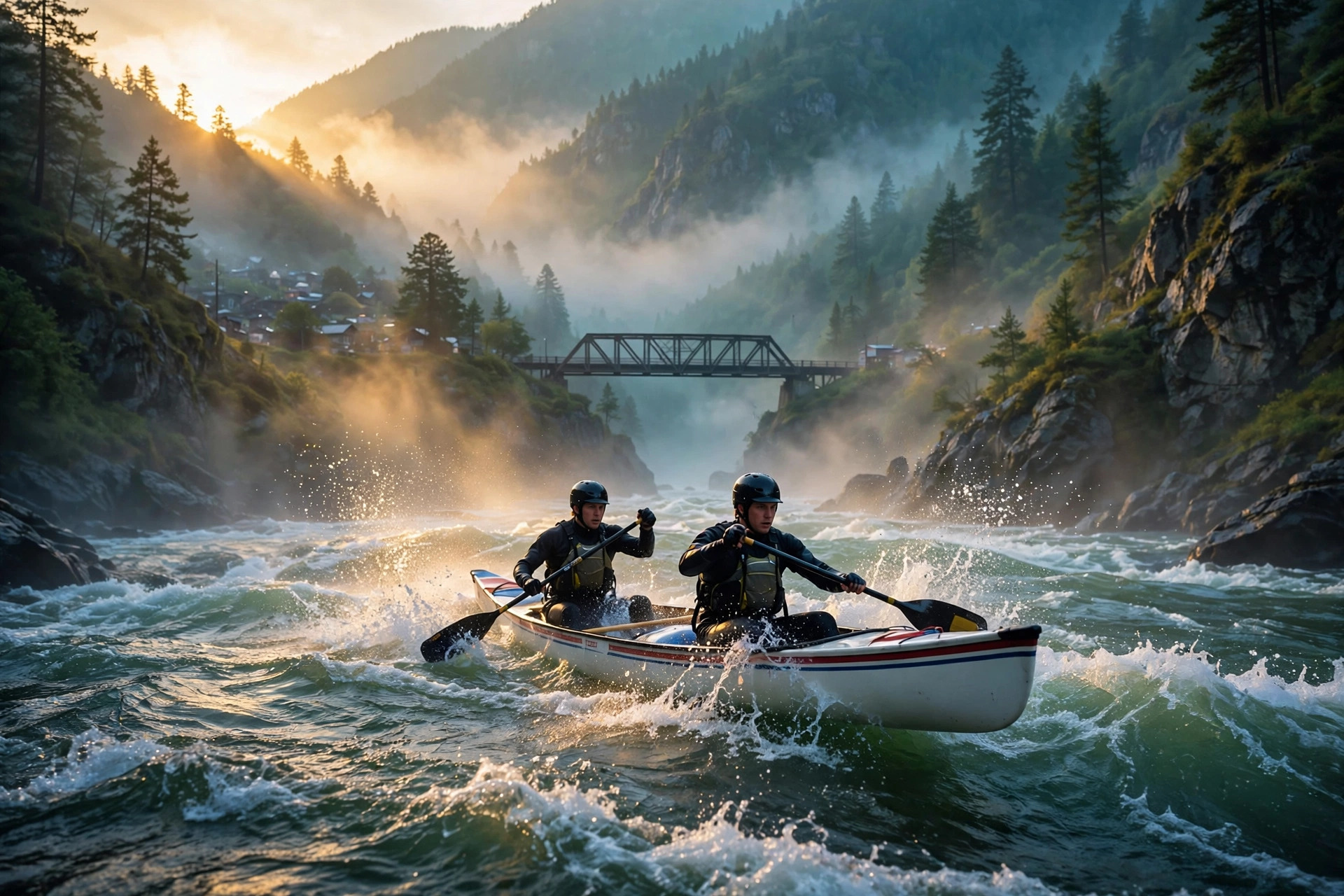
The Wolfe Narrows Regatta had been running since before either of their grandfathers could walk, a two-day August festival of slalom and wildwater races on a river that braided through the gorge like a dropped ribbon. The town lived by three calendars: school, church, and water. Mari had grown up two streets from the put-in, in a house where the sound of rapids was as constant as her father's snoring, and she had been in a kayak before she could ride a bike without training wheels.
She had also, at twenty-three and twenty-four, been half of the most talked-about C2 slalom pair in the eastern region. C2, double canoe, two paddlers in one boat trading strokes like a heartbeat: front paddler calling the line, back paddler driving. Her in the front. Deacon Hale in the back, his jaw set, his reactions fast as a struck match. They had won everything there was to win below the national level, and then at the trials in Ridge Run Gorge, one decision, four seconds, and one undercut rock had ended all of it. Her career as a competitor, his season, his knee, and whatever the two of them had been building in the dark between boats.
'He won't expect you to come,' Doreen said, which was her way of saying he had asked.
'He hasn't called me in four years.'
'No,' Doreen agreed, unfair and unbothered. 'But he sponsors the kid boat fleet now, whole youth program, bought them twelve new boats out of his own pocket. Persons says the man shows up to practices even when nobody's filming him. Whatever that boy did to end things, he's been doing penance up and down this county for it.'
Mari picked up the dropped staple gun. 'Mom. I have to go open the safety school. Two hundred kids in the learn-to-paddle week, and one of them will definitely try to stand up in a moving current.'
'Go save some children from the water,' her mother said serenely. 'Save yourself while you're at it.'
What the water remembers
Wolfe Run, the company Mari had built out of the wreckage of her twenties, sat a quarter mile downriver from the regatta grounds, a converted feed store with a rope course in the side yard and a wall of helmets, sprayskirts, and throw lines that smelled like neoprene and ambition. She taught rescue. She certified guides. She taught eight-year-olds that rivers are generous and absolute, that they will carry you for a mile and also end you in four inches of water over a ledge. She was very good at it, and she had built the whole thing with the specific furious energy of a person proving a point to an invisible audience.
Her assistant, Theo, was nineteen and had a policeman's instinct for bad moments. He was lacing a retired raft at the take-out when she came in, took one look at her face, and said, 'He's here already, isn't he.'
'Who,' said Mari.
'The guy on the poster. There's a guy on the poster in the kiosk, and you've been not-talking-about him since Tuesday, so statistically he's already here and probably at the put-in, and statistically you're going to pretend to inventory the drysuits for forty-five minutes.'
'I inventory the drysuits every August.'
'You count them out loud, Mari. It's a whole thing.'
She was, in fact, halfway through counting the drysuits when the screen door creaked and every particle of air in the shop changed temperature.
She made herself finish: 'Thirty-one, thirty-two, thirty-three.' Then she turned around, and there he was, filling her doorway, and the four years between them were suddenly as thin as the painted sheet metal of the old feed store.
Deacon had gotten solid. That was the first fact her body reported, treacherously, before her mind could censor it. He had been lean as a snapped green branch at twenty-four, all lats and nerves. Now he was built like the timber. A shoulder harness strapped over a gray t-shirt, a surgical scar curling out of the collar of his sleeve like a signature, hair sun-bleached at the temples. He stood the way recovering athletes stand: with tremendous care, as if his body were a borrowed boat he was afraid of scratching.
'Hey, Voss,' he said. Voss. Not Mari. She checked whether that stung and decided it did, in a small precise way, like a sliver.
'Hale.' She held up the clipboard as a shield. 'Shop's technically open. Two-minute waiver and you can rent a kayak, assuming the waiver lawyer and your surgical clearance agree on the terms.'
'I'm not here to rent.' He came in two steps, stopped when the floorboard creaked, seemed to reconsider the whole enterprise, and came in the rest of the way anyway. 'I'm here because the entry list for the qualifier posted, and my back-up paddler tore his rotator cuff in Austria, and persons, that's my coach now, if you can believe it, persons. Persons is telling me I need a C2 entry or I lose my seeding, and I told him there was exactly one person on this earth who knows my stroke.'
The drysuits were suddenly fascinating. She had never noticed how fascinating they were.
'No,' Mari said.
'You didn't let me ask the question.'
'I've been answering it for four years, Deacon. In my sleep. On the water. Every time I paddle past the rock in run three, I answer it.'
He was quiet for a moment. She heard Theo slide, with enormous tact, out the back door.
'It was a good call,' Deacon said. 'At the trials. The gate line you called on the middle drop. It was the right call. I know that now, and I want to say it to your face, which is why I came in person instead of the email I've drafted four hundred times.'
She finally looked up. 'The call didn't fail. You overrode the call.'
'Yeah.' He said it flat, like a man reading his own sentencing. 'I did. And then I watched you get dragged toward the undercut with my boat stuck under you, and I spent eleven months learning to walk again, and I have never once, not for a second, blamed you for any of it. I blamed me, which was accurate, and then I was too proud and too wrecked and too sorry in the useless way, sorry like a wrecker instead of like a repairman, and by the time I could string three sentences together you had moved to Charleston and quit racing, and I let you go because chasing you felt like asking for a favor I hadn't earned.'
Four years of rehearsed fury in her chest met this and found nothing to push against. It was like punching water.
'You want to know what it was like?' she said. 'Afterwards? I got twenty minutes of consciousness on a riverbank, and the first thing I heard was a corner reporter saying the Voss call went wrong at the middle drop. My name, wrong, out loud, to the whole region, because you gave a interview on a stretcher where you took the blame. Noble. Headline-ready. And it erased me. It erased the actual call I made, the right call, and it erased that you shut me out of the boat when it mattered, and then it erased me entirely, because if the great Deacon Hale is guilty then nobody has to figure out what actually happened. Including you.'
His jaw worked. He looked at the rack of paddles on her wall, each one labeled in her handwriting with the kid's name it was strung for, and when he spoke his voice had dropped a register.
'You're right. All of it. I took the fall because it was simpler than the truth, and the truth was that I overrode the best line-caller I ever raced with because I was twenty-four and trying to be the hero of a race I should have been sharing with you. And it broke your knee-adjacent dreams and your faith in me and it nearly broke you on that rock. I'm not here to undo any of it, Mari. I'm here to say it to you sober, in daylight, in the town where we grew up, because you deserved to hear it four years ago and you deserved to not hear it from a stretcher-cam clip either.' He stopped, steadied. 'That's the apology. There's no request attached to it. You never have to get in a boat with me again. I'll race doubles with the physio's cousin and finish eighth and lose my seeding and limp into a desk job, if that's what keeps you whole. But I was taught you don't hand a person an amends and an invoice in the same envelope, so: amends, no invoice.'
Mari discovered her eyes were wet and despised them for it.
'You should go,' she said, not cruelly. 'I have a kid who can't roll yet coming at ten, and I need twenty minutes to be someone who didn't just feel all that.'
'Yeah.' He moved to the door, then stopped with his hand on the frame, and something old flickered across his face, the ghost of a grin she used to follow off drops blind. 'The rapid misses you. That's all. River doesn't hold grudges, Mari. People do the grcudge-holding on its behalf. It misses you, and so do I, and I'd have said that four years ago too, if I'd been brave instead of clever.'
The door sighed shut. Mari stood in her shop among thirty-three drysuits and did not count anything for a long time.
Ten o'clock, and one kid who can't roll
She got through the morning on muscle memory. Ten o'clock brought Tam Okafor, age eleven, defiant in a PFD two sizes too large, who had failed her roll practice three sessions running and met each failure with the full dramatic despair of a middle schooler.
'I'm quitting,' Tam announced, upside down in the pool anchor, paddling a reliable reverse Sweep. 'My arms are noodles. This is a noodle-based sport and I have been deceived.'
'Roll again,' Mari said. 'Number eight, Tuesday. You got seven last week.'
'Because Julian distracted me.'
'Because you panic at the hip snap and rush the sweep. Breathe at the hip snap. Slow is smooth, smooth is fast, say it with me.'
'Slow is smooth,' Tam muttered, upside down, bubbles rising. She came up on eight, sputtering, furious, victorious, and for a second her face held the exact joy that had made Mari fall in love with this sport at eight years old, in this same water, with a boy in the back of her boat who believed in her more loudly than he believed in anything.
After Tam left, Mari sat on the shop's loading dock with her feet over the water, which shivered in the August light. Theo appeared with two illicit sodas and a THEORY he had been harboring.
'So he came in person. That's like, a courtship behavior. That's a documentary thing.
'It's an apology behavior,' Mari said. 'Different genre.'
'Same shelf,' Theo said, with the confidence of someone who had read exactly one book about human behavior, which happened to be hers. 'You didn't say no to the double, by the way. You said no before he asked. Legally those are different plays.'
'He tore his rotator cuff? No, his partner did. His partner. C2 back paddler with a torn cuff trying to qualify for nationals on a rebuilt knee, at altitude, on run three of the Wolfe, which contains the undercut we met at fifteen and married our ambitions to at twenty-four. That's not a partnership request, that's a grief ritual with extra steps.'
'Or,' Theo said, skipping a stone with surprising competence, 'it's a man who fixed everything about himself except the one thing, and he's standing in the one thing, hat in hand. You talk every lesson about how rivers don't repeat, whatever happens, the water's always new. Same rapid, different day. You're allowed to be a different day.'
Mari threw a pebble at him, missed on purpose, and watched the Wolfe slide past the take-out, green and constant and utterly changed every second.
The Thursday session
She found him at the youth practice on Thursday, and she told herself it was reconnaissance.
Person, who had coached both of them as teenagers and now wore a whistle on a lanyard and a medal's worth of gray in his beard, ran the twelve new boats through eddy turns in the slack water below the regatta site. Deacon was in the water up to his thighs, hands under gunwales, adjusting a kid's grip, telling her something about hips and patience, his voice carrying the particular warmth he had only ever shown, as far as Mari knew, to water and to her.
He saw her at the bank. He did not stop the drill, which she respected enormously, and did not come over, which she respected more.
After practice she was still standing there like a lighthouse, and persons ambled up the bank to her.
'Before you ask,' he said, 'yes, he's fit, yes, the knee's cleared, no, he's not back to 2019. He's maybe 85 percent and honest about it, which at his age is more valuable than 100 percent and a liar. And before you tell me it's none of my business: his left hand is worse than his right in current, because he used to follow your calls and now he doesn't trust the empty seat enough to commit. I can fix his shoulder. I cannot fix that. Only you were ever in that seat.'
'You don't know what you're asking me to trust,' Mari said.
'I know exactly what I'm asking you to trust,' persons said. 'I watched you two for six years. I watched you call lines a splitter second faster than the river itself, and I watched him decide, once, at twenty-four, that he knew better, and I watched the river issue its verdict. I also watched a jury of adults, me included, let the wrong story go to press while the two of you were too broken to fix it. So now I'm asking. Both of you. Same question. Take your time; the qualifier is in nine days, so, you know, not too much time.'
That night she found the file. She had kept it the way people keep teeth in boxes: the raw GPS line from the trials, the overlaid video, her own calls transcribed in her handwriting the week after, once she could sit up. Turn four, middle drop, high water. Her call, in her hand, eight minutes after the fact and twenty-three years old at the time of writing: BUYER'S EDDY LEFT, PUNCH LATE, SET LEFT OF TONGUE. And beneath it, in her same handwriting, the annotation she had added during a sleepless night in Charleston, when she finally watched the tape frame by frame for the first time: he called the override on my stroke. I obeyed my partner. We both obeyed him. Only one of us got a stretcher.
She read it twice. Then she closed the laptop, walked out to the porch, and called him, because some things should not be drafted four hundred times.
'If I do this,' she said, when he picked up on the second ring, 'we use my rules. My protocol. I call the line, you paddle the call, no overrides, not ever, not even if I'm wrong and the alternative looks golden. You are a motor with excellent footwork and a beautiful timing sense, and the judgment is mine. If you can agree to be that, I'll be the best front paddler you've ever had. If you can't, stay in your single and I'll wave from the safety boat.'
There was a silence so long she checked the call hadn't dropped.
'Every word of that is fair,' Deacon said, 'and I want you to understand I have spent four years earning the right to hear it.' A breath. 'My rules too. Off the water you owe me nothing. On the water, if I feel the boat doing something my shoulder can't back up, I say stop, we stop, no shame, no finishing the run to prove anything. Consent in a boat, same as everywhere else. Okay?'
'Okay,' she said, and then, because four years of swelling had to go somewhere: 'I haven't raced C2 since. Do you know why? Because the seat facing forward is the seat you trust, and I got in the habit of not trusting anyone in mine. This isn't me forgiving you. It's me, for once, not letting what happened own the rest of my life. Those are different things and you should never confuse them.'
'Understood,' he said, and he sounded like a man who understood, and then added, ruinously gentle: 'Thank you for calling me at all. Goodnight, Voss.' And hung up before she had to end the call, which had always been his one flawless social grace.
Water, six a.m.
They trained at six a.m. because the eddy lines were empty and because neither of them wanted witnesses to the early failures.
The first session, they flipped four times. Their timing had been telepathy once, and now it was negotiation conducted through spray decks, her calls landing a beat before his body caught up, his power arriving into her turns like a guest too early for dinner. The fifth flip, at the friendly little chute above the take-out, Mari surfaced laughing so hard she swallowed half the eddy.
'What,' Deacon demanded, bobbing beside her, helmet askew.
'You used to be graceful. Twenty-four-year-old you would be furious. He'd be writing a press release about this right now. The Hale-Voss boat suffers unexpected aquatic reversal, front paddler blamed.'
'Twenty-four-year-old me,' Deacon said, treading water with careful hip mobility, 'would also be writing something else. He never told you about the Wednesday before trials.'
The current carried them in a slow arc toward the bank. She waited.
'Persons sat me down and said, this girl calls your boat better than you do, and if you have a brain in your head you'll spend your whole career being steered by her and taking half the credit. And I got so insulted I didn't hear the compliment at all. That's the seed of the whole disaster, Mari. Somebody told me the truth and it felt like being demoted, and I spent the next three days proving I didn't need steering, and then I spent the race proving it again at the worst possible moment.' He looked at the water, jaw tight. 'I thought you should know it wasn't one bad second. It was a bad idea I'd been watering for a week, and you paid retail for it.'
'What changed?' she asked. 'Between that and now. What made it click?'
'Roughly nine months of not being able to walk down stairs,' he said. 'You get a lot of reading done. I read every accident report persons had, every rescue after-action file, some book by a old avalanche forecaster about how expert teams fail when the senior partner stops listening. And it kept describing me. Snow phrase,water phrase, same disease: the louder ego eats the quieter expertise. You were the quieter expertise.' He looked over at her then, water running off his helmet brim. 'I'm not quieter now. I just finally know which one of us is the instrument and which one is the player.'
'Both, Deacon,' Mari said. 'That's the whole trick of the boat. Both.'
Session six, they ran the friendly chute clean, nine for nine on gate combos, and coming out of the last eddy they sat floating in the slack, both breathing hard, and the four years between them got suddenly, dangerously thin again. He was laughing. He had one scar on his chin she didn't recognize and one exact way of tilting his head before a joke that she had never once stopped recognizing.
'Your stroke got more patient,' he said.
'Your left hip got honest,' she said. 'What else changed?'
'I stopped dating people who were impressed by me,' he said, and then turned bright red at the throat, which was a phenomenon she had genuinely missed.
'Oh my god,' Mari said. 'persons wasn't sending you to Austria. persons was sending you to therapy with a passport.'
'persons sent me everywhere. I improved in every metric a human can be measured in except the one.' He shipped his paddle, and the boat drifted a slow quarter turn until they were side by side. 'Mari. The amends stand regardless. But I need to say, since you invited changes: there's a version of my life where I retire at the qualifier and coach kids and that's a good life and I want it. And there's a version where nationals happens and the interesting thing about it is who's in the front seat. I've been assuming the first version because it's safer. I want to state for the record that I'd like the second one, and if it's not on the table, my life stays intact and my manners stay good and I'll never once make you feel the weight of it. I'm thirty. I've learned to want things out loud, that's the entire growth arc. Wanting is free. Getting is yours to decide.'
The current nudged the boats together, hull to hull. She let them touch.
'Race the qualifier with me,' Mari said. 'Everything else gets discussed after, over food, at a table, like adults with working knees.'
Seven days, two heartbeats
The week that followed was the happiest hard week of her life.
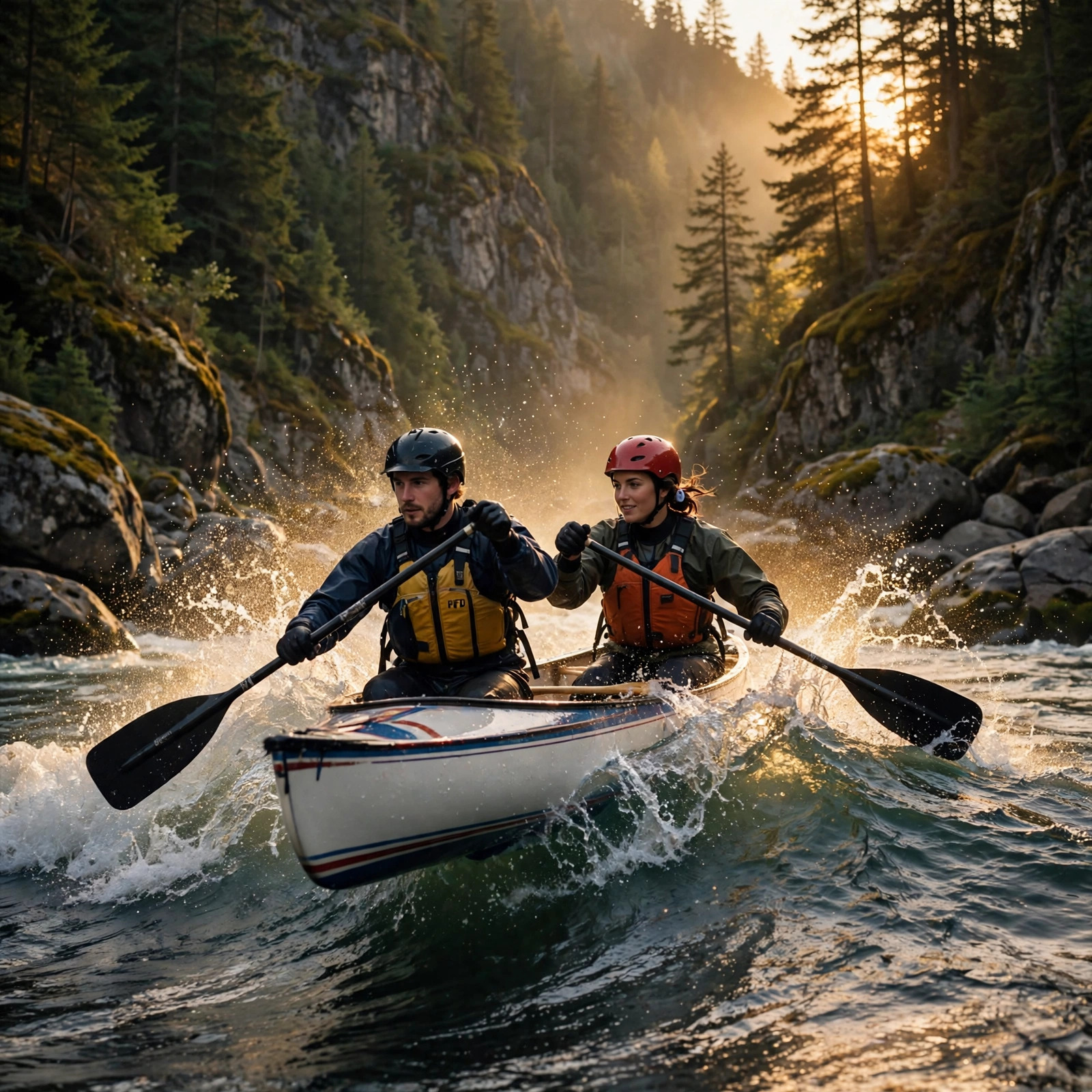
They trained three sessions a day and argued about texture. He was a concussive, explosive paddler who wanted to hit waves; she had learned, in her safety years, the paddler's deadliest sin: overcorrection. Their compromise emerged somewhere around Tuesday: his power, her architecture, his recovery reflex, her reading of the water three features ahead, the way she had learned from a thousand rescues to see a river not as a course but as a proposal that could be declined.
Physically it worked like a struck bell. Emotionally it worked like two people renovating a house they'd once set fire to, both determined to be careful around the smoke stains.
Wednesday, the regional sports desk ran a preview piece: HALE RETURNS, SEEKS MYSTERY FRONT-PADDER FOR QUALIFIER BID. Someone had photographed them at the put-in, Deacon steadying the boat while Mari rigged the C2 airbags, and the caption speculated. By Thursday a podcast had speculated harder. The gist, in both cases: the old magic, can it be recaptured, is the comeback real, and one commenter who claimed inside knowledge of the trials crash, writing, with the confidence of the anonymous: everyone knows the Voss girl froze on the middle drop, Hale carried that team.
She read it at her desk at Wolfe Run and felt the old drowning sensation, four years deep, rising like cold water in a wetsuit.
Deacon called at 9:40. 'You've seen it.'
'I've seen it.'
'Here's what's going to happen. I already emailed the desk, on the record, attaching the race footage timestamp and the two-line factual correction: my override, my rock, my knee, and the best call I ever ignored was hers. And here's the part persons says I'm constitutionally incapable of: I'm not going to do any more interviews about it until after the race, and even then, only if you want them, and only ever with you in the room, because the last time I told this story without you, I told it wrong, and a person's story is hers to co-sign.' He paused. 'Is that adequate amends behavior, per your protocol?'
She laughed the ugly kind of laugh, the one with salt in it. 'It's the best amends behavior in the history of the county. It's also terrifying, because people will look at me now. I spent four years becoming invisible on purpose, Hale. Invisibility was load-bearing.'
'I know.' Quiet, the water sounds between them. 'I'm not asking you to be visible. I'm asking you not to be mislabeled. Different job, smaller job, and this time I'm doing it, you're not carrying the mop for my spill.'
Friday, Tam Okafor cornered Mari at the safety school with her phone held like an indictment. 'Ms. Mari, is this you? In the boat with the comeback guy? Because Julian says you two are famous and I said no way, Ms. Mari is a rescue instructor, and then I watched the old trials video where your boat goes sideways at the drop, and honestly I have QUESTIONS.'
Mari sat down on the Kayak Yurt's steps with the kid, this sharp, bracingly honest child who reminded her of exactly who she had been before everything, and answered what could be answered.
'The boat went sideways,' she said, 'because my partner overrode my call, and I went in the water because I stayed with the boat. Staying with the boat was the bravest decision available to me that day and I don't regret it. What I regret is that I let the wrong narrator have the story for four years, which is a lesson, Tam, and the lesson is: when someone mislabels you, correct the record out loud, promptly, in daylight. Otherwise they'll be doing the labeling forever, and so will you, in your head, at 3 a.m.'
Tam considered this with the gravity of a supreme court. 'So you're racing him again to correct the record?'
'I'm racing him again because I'm good at it and the water misses me. The record's just luggage.'
'Cool,' said Tam. 'If you win I get to hold the paddle. Everyone at school will be so annoying.'
The undercut, again
On Saturday morning, with the qualifier two days out, they stood on the scout boulder above run three, above the exact chain of drops, and Deacon was quiet for a long moment.
'We don't have to race the line through the middle of it,' he said at last. 'Race line's the right channel. Cleaner, slower, safe under seeding. Persons drew it on the map like a coward and I've been agreeing with him all week.'
Mari looked down the tongue of the middle drop, at the-green-lit chaos, at the thing that four years ago had been a gate line and then had been a rock and then had been a rumor and then had been a scar, and found, to her mild astonishment, that it was just water. Moving, indifferent, generous and absolute water. Same rapid, different day.
'No,' she said. 'We race the honest line. The one I called in 2019. Because if I spend my comeback declining the middle drop, I'll be doing the thing where my past makes my decisions, and I promised myself I was done with that. One condition.' She looked at him, and the yearning in her chest had the exact dangerous width of an eddy line. 'If my body says no, mid-run, if the old shoulder memory or the new fear takes over, I pull for the eddy and you follow and we walk the portage and nobody, ever, makes it mean anything. Fear gets a vote, not a veto. That's the rule for both of us. Feel like we can hold to it?'
'The all-volunteer fear council meets daily,' Deacon said, 'and votes against dismissal of cases.' He rolled his shoulders, winced, then grinned, the old tilt of the head. 'But we hold to it. On three? We scout once, walk it once, and if either of us sleeps badly, we don't run it. Full stop, full grace.'
They walked the portage path slowly, pointing out the flow signature at each feature the way other couples point at real estate. At the undercut he stopped.
'You know I've been back four times,' he said. 'Comeback races, two_world Cups, I've passed this rock on busier rivers and never gone near a waterline like it. But I never once ran past your rock without my chest doing the thing. Physio says it's somatic. I say it's a debt. Can I say something about the debt?'
'You can say anything about the debt. You earned minutes ago the right to carry the mop.'
'The debt's paid,' he said. 'The rock didn't take anything from you that you didn't survive and rebuild better. It took a season from me and a decade of pride from my ego, and it made me a coach and a sponsor and a partner who listens, and I'd trade back none of it except the pain I caused you, which I can't trade back, so instead I build kid boats and show up to practice and email journalists at nine in the morning. And it ends here. On this boulder. I release us. I formally, publicly, in front of the undercut and two herons, declare the debt of 2019 closed.' He stuck out a hand, formal as a treaty. Then, ruinously, ruinously, he pulled his hand back and said, 'No. Handshakes are for business,' and hugged her instead, hard, river-smelling, briefly, both hands flat on her back like a man returning something he'd borrowed.
She held on one heartbeat longer than the treaty required. So did he.
'Okay,' she said into his shoulder. 'Now we go eat the Narrows Diner's pancake stack and we do not talk about the race, per the rules of athletics.'
'We'll talk about the race within ninety seconds,' he predicted.
It took forty.
Qualifier day
Race morning came up gold and cool. Two thousand people along the banks, a festival's worth of bounce houses and fish fry smoke, the announcer's voice stampeding across the water, and Mari in the staging eddy beside her mother, who pressed her thumb briefly, hard, into the back of Mari's hand, a touch that meant everything a woman of Doreen's generation could not say in public.
'Your father's watching from the bridge,' Doreen said. 'And he brought the lucky thermos. Don't tell persons I said his line selection is cowardly; he'll assign me extra parking duty.'
The event ran to a clock: two timed runs, best one counts, top three boats to nationals. There were eleven C2 entries, including Deacon's bailing-out cousin and a junior pair from Chattanooga with terrifyingly young knees. Media drones hovered like polite hornets. At the put-in, the announcer read their names into a hush that was half ovation, half held breath: 'And in boat nine, coming home after four years: Deacon Hale, and in the front seat, the return of a front-paddler the region still talks about, Mari Voss!'
The cheer that came off the banks surprised her. Not polite. Raw. People rose. She heard a kid's voice yell TAm-STYLE, WAIT, WRONG BOAT, and then Tam's actual voice, enormous, from the youth corral: 'THAT'S MY INSTRUCTOR! SLOW IS SMOOTH!'
Mari laughed the whole way to the start gate, and laughing was the finest pre-race condition ever discovered.
They seeded second after the first run, clean through the middle drop, two seconds off the Chattanooga juniors, and Deacon whooped so loudly coming into the finish eddy that persons had to remind him about dignity. The second run, they sent the honest line three seconds harder, and somewhere in the middle of it, in the seam between the fourth and fifth gates, the boat did the thing it had done at the trials, the hitch, the shove, the override-weight feeling, and for a tenth of a second the four years spun up around her like spray. Her hip snap came through. Her call came through: HIGH LEFT, COMMIT. And his paddle answered hers before the word left her mouth, exactly as promised, a motor in perfect faith, and they rode the tongue clean and threaded the gate and were through, through, through, the undercut foaming harmlessly behind them.
They finished first in the C2, second overall on combined time behind a single-boat legend whose lats had their own press agent. Nationals berth. The banks came apart cheering.
In the eddy below the finish, Deacon hauled the boat to the rocks and turned around, and whatever his face was doing, hers was doing it back, and neither of them managed words for a moment. Then he caught her face in his wet, cold, paddling-wrecked hands, mindful of the shoulder, and asked, in front of the two thousand and the drones and her mother's lucky thermos: 'This table. Food. Adults. Now? Or is there protocol?'
'There's protocol,' Mari said, already grinning. 'It involves the pancake stack. It always did. You just forgot, being clever instead of brave.'
The diner, and after

The Narrows Diner gave them the corner booth, which for generations had been reserved, by unspoken law, for couples and umpires, and often for both. They ordered the pancake stack and two coffees and a milkshake Tam would later demand to inspect for evidence.
'So,' Deacon said, when the plates came. 'The second version of my life. Nationals is in six weeks in Fort Collins. I'd be gone a month for the training block. I'm not asking you to wait. I'm asking, what does a person in your boat want, out loud? Per my growth arc, wanting is free, but I'd like yours too. Equal billing. Like a C2. Front and back, both seats, both names on the entry form.'
Mari stirred her coffee and let herself look at him for the length of an entire honest sentence.
'I want the business to grow and I want to run the rescue program for the county and I want a partner who tells me the truth at six a.m. and holds the line at six a.m. and a day. I want to stop doing all my joy secondhand through other people's children, and I want somebody who thinks my five-year plan is a fun time and not a diagnosis. Whether that's you, at altitude, in six weeks, I don't know yet. What I know is: I'd like to find out at a normal pace, with dinners, and texts, and one of those things where you call me on your way home from the shop for no reason. I'd like slow and I'd like real. And if the altitude block asks you to leave before we've finished finding out, then we do what good boats do, we keep the timing when the distance opens up, we keep the beats, one-two, one-two, because timing's the whole sport and I refuse to lose ours again to geography.'
Deacon put his fork down. This had, she could tell, the weight of ceremony.
'Then here's mine, out loud: I want to build the thing with you. Not around you, with you. Wolfe Run gets a HaleVoss junior program by next spring if you'll let me fund it, because I've been hoarding my money like a dragon with a knee brace and it's embarrassing. I want to be in the eddy with the kid boats and the snack schedule and the slow pace, and if nationals wants me it can have the summer and my signature discipline. Front seat of my life is yours if you'll keep calling the lines. I'll drive. I've gotten, in four years, phenomenally good at driving whatever's called.' He reached across the table and set his hand open on the formica between their plates, palm up, an offer with no invoice in the envelope. 'But mostly, tonight, I just want the second date. Whenever. Any diner. No shoulder harness, no press release. I want to find out what Mari Voss laughs about when nothing is at stake, because I bet it's better than everything that was ever at stake.'
Mari put her hand in his. Outside the window the Wolfe slid by, gold in the evening, already somewhere it had never been.
'Second date,' she said. 'But I'm picking the table. And there's a youth paddler who gets to hold the winning paddle for exactly one photograph, and she will absolutely stand too close, so wear something washable.'
'Voss,' he said, thumb moving over her knuckles, the tilt of the head turning the whole beautiful face toward her. 'Was that a yes to the future?'
'It's a yes to finding out,' she said. 'The rest is just water. And water, as somebody wise once almost believed, never repeats itself. Same river. Different day. Best day yet.'
He laughed then, out loud, unhidden, and people in the diner turned to look, because nobody in Wolfe Narrows had heard that particular sound in four years, and Tam Okafor, who had absolutely been dispatched by her mother to stand too close, took the photograph.
Author's note: Wolfe Narrows, its regatta, and every paddler in it are fiction, invented with love for every river town that keeps a scoreboard on the water and a first-aid kit in the heart.
Get notified when new stories drop
Noah Carrington
Noah covers sports romance and forced-proximity heat: rivalries, road trips, and the quiet moment after the crowd goes home.
Leave a comment
Comments