


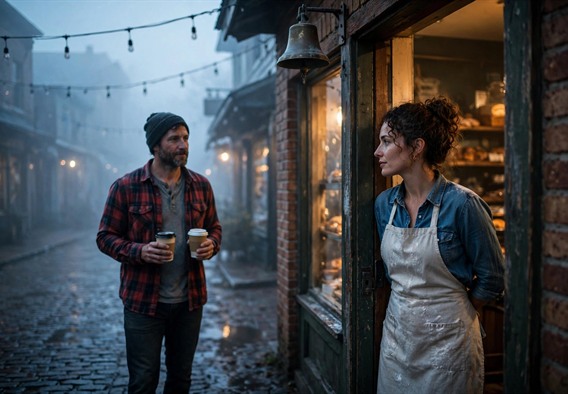

The Promise Hearth
The question Wren Halloway could not answer, in the days before the storm changed everything, was this: can a promise be love, or is love only the thing that survives when every promise you were given has been broken? She would learn the answer inside a house that would not let her lie.
One: The Inheritance Clause
The letter arrived in October, when the sumac along the county road went the color of old blood. Wren read it twice on the porch of her rented room in Fayetteville, then a third time standing in the road, because some sentences need three passes before the body accepts them.
To Wilhelmina Halloway, daughter of Rowan Halloway, daughter of Adabelle: the house on Cobbler's Notch passes to you, with its burdens, upon my death. You must light the hearth and keep it burning for seven nights from your arrival. If you fail to come at all, the inheritance lapses and the house chooses another.
Great-aunt Adabelle had been the family's quiet constant, the one who remembered birthdays across three generations and sent jars of elderberry syrup that fixed coughs ordinary syrup could not touch. Wren had spent the last nine years pretending she came from nowhere in particular. Magic, when your mother had been eaten alive by it, was less a legacy than a warning label.
Because here was the thing Wren knew and the letter did not need to say: every Halloway woman for four generations had been bound to that house by the hearth covenant, and the covenant had one rule, plain and cruel in its simplicity.
A promise spoken beneath that roof binds the speaker until it is kept.
Not legally. Not figuratively. The hearth listened, and the hearth held. Break a promise made under its smoke and the covenant took payment: one year of memory per promise, and it always took the sweetest memories first. Wren's mother had sworn, drunk and grieving in that house, that she would come back for her. She had not come back. The hearth had collected. Rowan Halloway had walked out of Cobbler's Notch lighter by the whole weight of her daughter's first six years, and she had looked at Wren afterward the way you look at a stranger on a bus.
Wren had sworn two vows of her own since. She would never speak a promise inside that house. And she would never again be the child left counting headlights on a dark road.
So of course she went. She was twenty-eight, underemployed, and curious in a way she hated about herself. She packed the Impala with a month of canned soup, her grandmother's poker for stirring coals, and every rationalization she owned, and she drove three hours into the hills as the first hard freeze came down behind her like a closing door.
Two: The Man in the Ditch
She found him eleven minutes up the mountain, which was nine minutes farther than anyone should be walking in freezing rain.
He was tall, mud to the knees, dragging a rolling suitcase through a landscape that had eaten the road's shoulders whole. He had the look of a man who had made eleven bad decisions and was committed to seeing all of them through. One hand held a phone with no bars. The other held a paperback dictionary of Ozark folk speech like it was a talisman.
Wren slowed, weighed every survival instinct she had, and rolled the window down. "You lost or cursed?"
"Stranded," he said. His voice was low and careful, the voice of someone who chose words the way other people chose footing on ice. "Rental car gave up at the creek crossing. I'm looking for the Halloway place on Cobbler's Notch. I was told there's a room."
"Told by whom?"
"Mrs. Odum, at the store down in Bugtussle. I'm doing fieldwork. Eli Marsh, folklore and material culture, University of Tennessee." He produced a laminated university ID the way a warrant badge is produced in movies, and it was so earnest that something in Wren's chest unclenched by a single degree.
"There's no room," she said. "There's one bed, a dead fireplace I have to relight, and me. Get in."
He hesitated exactly long enough for her to appreciate that he had a functioning sense of self-preservation, then folded himself into the passenger seat with his ruined suitcase and his folk-speech dictionary and said, "Thank you. I'll pay for half the wood, the groceries, whatever the arrangement needs."
"The arrangement needs you to not ask questions."
He smiled for the first time. It rearranged his whole face. "You'd be surprised how good I am at questions."
The Impala climbed. Ice began, small and percussive on the windshield, a sound like fingernails testing a coffin lid. In the rearview, Wren watched the weather in the valley behind them come down like a curtain being drawn across the world.
Three: The House That Listens
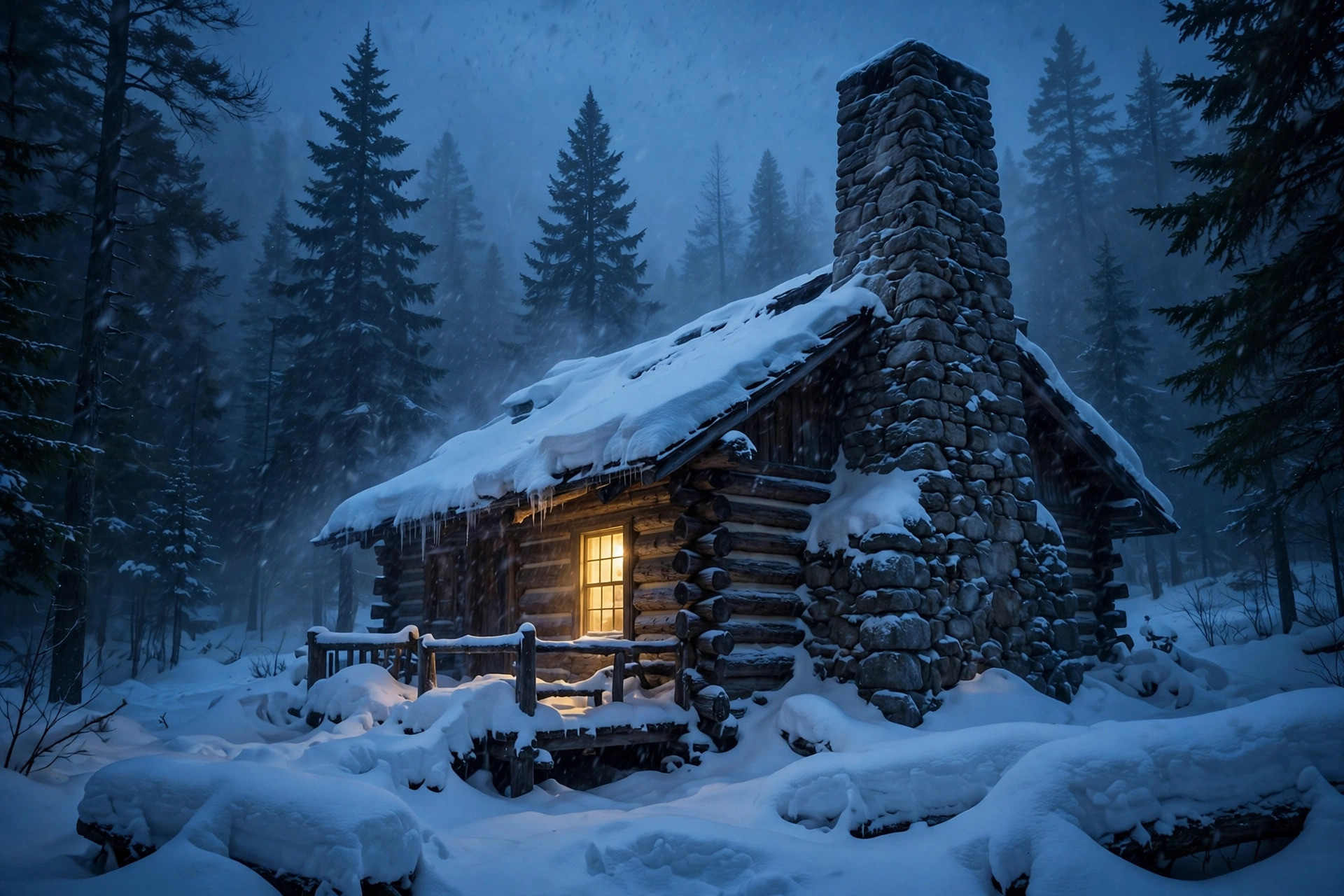
The Halloway cabin sat in a bowl of the notch, built of chestnut logs gone silver, with a stone chimney thick as a silo and a porch swing that had been mended so many times it was mostly new wood in an old shape. Eli stood in the yard staring at it with the expression of a man meeting a celebrity he did not believe in.
"This is on no register," he said. "I've been through every county archive. This place doesn't officially exist."
"It exists," Wren said. "It just doesn't volunteer."
Inside, the house smelled of dried sage, cold ash, and cedar. The main room was one open space: hearth at the heart, wide as a wagon, iron crane, and above the mantel a carved lintel where four generations of Halloway women had notched a mark for every promise kept, so the beam was dense as tally-hell. Eli ran a finger along the notches before Wren could stop him.
"Hundreds," he said. "Someone counted something here for a long time."
"Promises," she said, because lying to this man was going to be exhausting and he would find out in a library eventually. "The house holds them. Speak a promise under this roof and you're bound to keep it. Break it, and the hearth takes a year of your memory as payment. It takes the best ones first."
He looked at her the way skeptics look at the moment before they decide whether you're a fraud or a casualty. "That's a beautiful superstition."
"It's not a superstition. It's a rent agreement." She knelt at the cold hearth and began laying kindling with hands that remembered even when she wanted them not to. "Seven nights, the fire stays lit. That's my inheritance burning or dying, and the National Weather Service is about to dump two feet of snow on my deadline. So. House rules. You speak carefully under this roof, you eat what I cook, and you do not, under any circumstances, say the words I promise out loud unless you are prepared to bleed for them."
Eli set his suitcase down with the deliberateness of a man accepting asylum. "And if I don't believe you?"
"Then you'll learn the way everyone in my family learns," Wren said, and touched flame to kindling, and the fire caught with a sound like a held breath released. "Expensively."
Outside, the storm arrived.
Four: The Weather Makes the Rules
By nightfall the road was gone. By midnight the power was gone with it. The world beyond the windows became a white roaring void, wind combing the pines with claws, snow accumulating in the spruce branches until each tree bent like a woman carrying water.
They inventoryed by lamplight, because inventories are what people do when they are avoiding conversation. Wood: one and a half cords, which was enough if the fire burned steady and not desperate. Food: substantial, since Wren had panic-purchased like a woman expecting the apocalypse. Books: her aunt's library, three hundred volumes, half of them local folk history, which was when Eli lit up like a boy on Christmas.
"You have an unfilograiled copy of Marbury's Hearth Cults of the Southern Highlands," he said, holding it with both hands. "This alone is worth the storm."
"Keep it. Aunt Addy would like that someone wants it." She resealed the flue. "Sit. There's soup. There is always soup in this family, it's basically our crest."
He sat at the plank table across from her, steam rising between them, and asked his careful questions in the way he had. Did she grow up here. No. Why not. My mother left. Why. She made a promise here she couldn't keep. Silence, in which the wind made his objections for him.
"You sound certain," he said at last, "and it costs you something to sound certain. I hear that in informants all the time. The certainty is armor."
"You're psychoanalyzing a soup-eating situation."
"I'm a folklorist," he said. "I don't collect stories. I collect the cost of the stories. What people paid to be able to tell them." He turned his bowl. "What did you pay, Wren?"
She looked at him across the hearth-light and, for the first time in nine years, let herself say the true sentence out loud: "My mother forgot I existed. Not gradually. The covenant took it all at once, the day she broke her promise to come back for me. She drove past me once, on a Tuesday, and waved at me the way you wave at a stranger whose car looks like yours."
Eli set his spoon down. He did not say sorry, which she would have hated. He did not say you poor thing, which she would have hated more. He said, "Then you came here to break the covenant instead of to inherit it. To end it."
The fire popped. Somewhere up the chimney, the wind moaned through the flu gap like something with an opinion.
"I came here to light a fire," Wren said. "What I do after that is my business."
Five: Small Rituals, Shrinking Rooms
The storm, having arrived, showed no intention of leaving. It settled over the notch the way an old cat settles over a warm stove, and the days took on a shape, and the shape was them.
Morning: she fed the fire before her eyes opened, hands moving on old instinct, and he learned the sound of the poker and began waking to it, and to the smell of coffee made in a battered percolator on the hearthstone. Midday: they split wood, she with technique, he with enthusiasm, and mocked each other's form until the yard rang with it. Afternoon: he read aloud from the aunt's library while she transcribed her aunt's household book, all of them the receipts of four generations of covenant-keeping, and the room filled with language. Evening: soup or cornbread or pan bread with sorghum, cards on the floor by the hearth, and the notches above them like an audience of ancestors.
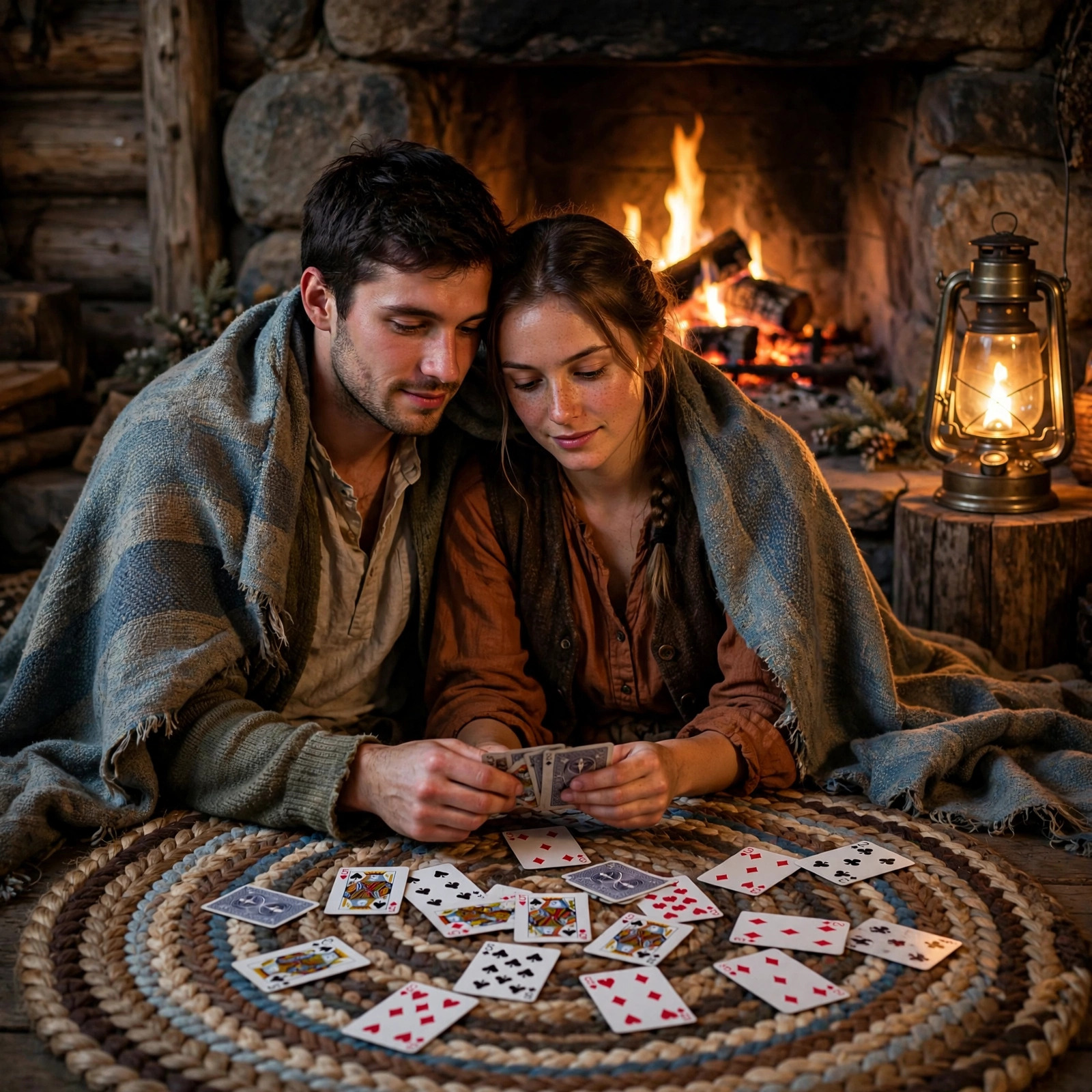
It was on the third evening that he broke rule one, and it broke over Wren like a wave.
They had been playing cards and he had been losing with a grace she found suspicious, and he had said, laughing, changing the subject away from the memory she'd shared that morning: "This storm won't last forever. I promise I'll be out of your hair by the weekend."
The hearth went still.
Not the fire. The fire kept burning. But the room pressed down the way air does before lightning, and every hair on Wren's arms rose, and on the mantel, in the cold stone above the lintel, a new notch appeared. Shallow. Faint. But there.
"Eli," she said. "What did you just say."
He had gone the color of old paper. "I said I'd be out of your hair by the weekend."
"Those are promise words. You know they're promise words, I told you."
"I was being polite," he said, and then, because he was a scholar and honesty was his disease, he turned to the lintel, and he saw the fresh notch, and he reached up and touched it, and it was warm, and she watched him understand in real time. She watched a skeptic's face come apart and rebuild itself around the impossible.
"Okay," he said, very quietly. "Okay. So the vow is spoken, and it's binding. What's the enforcement mechanism?"
"There isn't one. It's the promise itself. It holds you. You'll try to leave this house by the weekend and you won't be able to make yourself walk past the tree line, the way you can't make yourself break a word you've given your dying mother." She pulled the aunt's household book toward her and flipped to the pages of her aunt's careful hand, the field notes of four generations, and read aloud, so that the rule had a witness: The hearth holds the vow. The vow holds the speaker. Payment for breach: one year of memory, taken from the dearest shelf.
"Then I'll keep it," Eli said. "I'll leave by the weekend."
"You can't. The storm's pinned the county. You'd be leaving into a whiteout with no road."
"Then the promise is impossible," he said, "and I'm bound to an impossibility." And he looked at her with the expression of a man doing arithmetic on his own soul and arriving at an answer he did not like. "Unless I break it, and pay the fine, and lose a year of... this. Of these four days. Is that what you're telling me I've spent?"
Wren fed a log to the fire so she did not have to look at him. "You'd lose the best of it first. That's how it works. It takes the shelf closest to your heart."
The silence that followed was the longest of her life.
Six: The Silence That Speaks
The next day the storm reached its full authority, and the snow stood higher than the porch rail, and something broke in the sky's plumbing so that the wind stopped screaming and settled into a deep hush instead, the whole mountain breathing white.
They did not fight about the promise. That was the strange mercy of it. Eli the scholar turned his obsession onto the covenant itself, and Wren, who had spent nine years refusing to think about the thing that had eaten her childhood, found herself teaching it. He took notes. He treated her testimony like archive material, asked follow-up questions, never once looked at her with pity or pity's ugly cousin, fascination. By the third hour he understood the covenant better than she did, and then he said the thing that rearranged her:
"Your mother didn't abandon you," he said. "She was punished for a promise made while grieving, drunk, in a binding house, over something no one should promise. That's not a moral system. That's a trap with genealogy."
"Don't," Wren said. "Don't make me feel for her. It's easier to be angry."
"I know," he said gently. "I lost my father young. Anger is easier. It's also a landlord you can never pay off."
That evening they played no cards. They sat in the chairs he had dragged toward the hearth, close enough that their knees were a hand-span apart, and the fire did its slow language, and the snow did its slow language, and neither of them spoke.
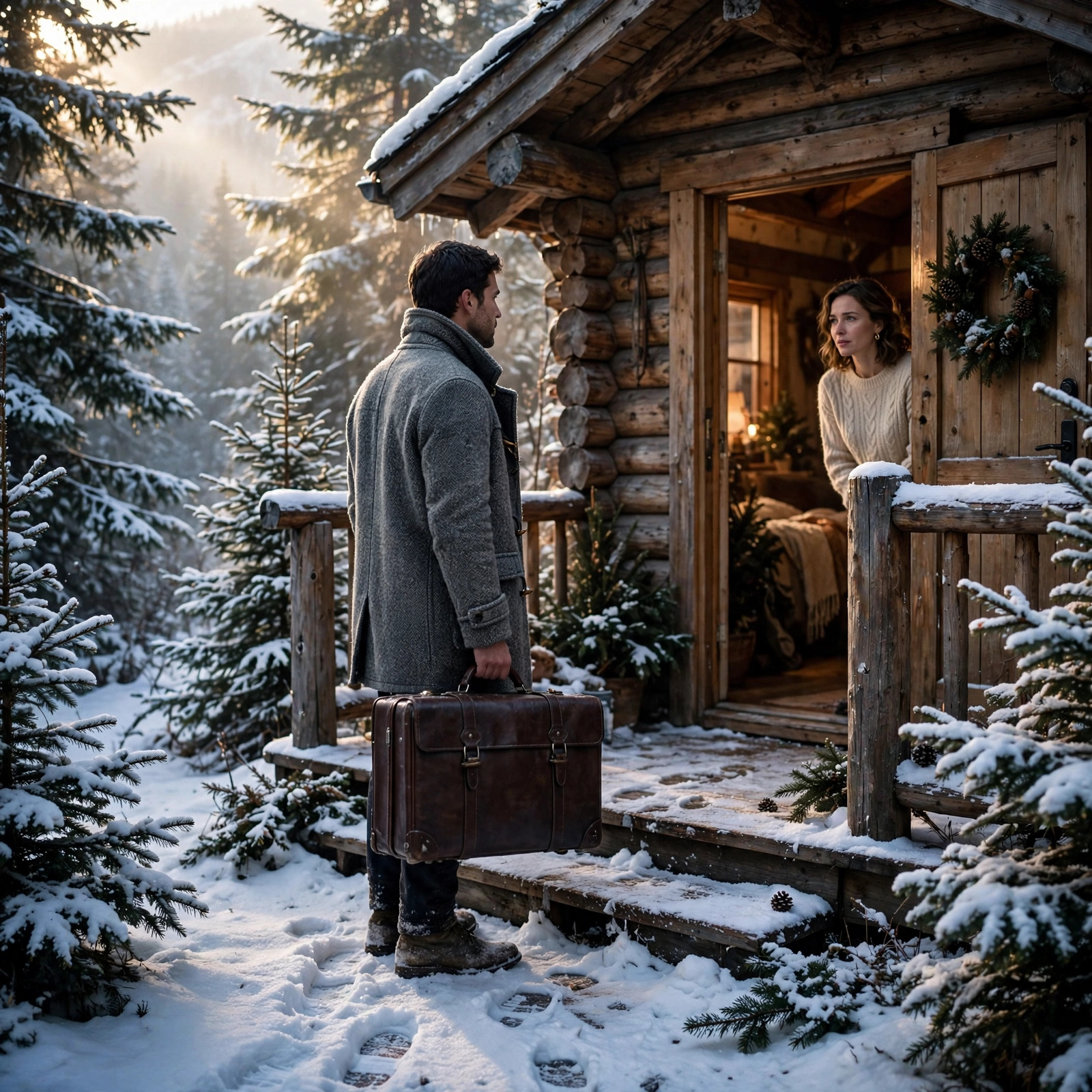
And the silence became charged the way dialogue never could.
Wren had spent her whole adult life talking, filling rooms with competence and deflection, and here, in this hush, with this man who had already paid for his one careless promise by sitting inside its weight for a full day, she discovered that silence is where the body tells the truth the mouth has been editing. She could hear him breathing. She could feel the warmth differential where his shoulder nearly touched hers, a seam of heat along a cold night. She became aware that he was not reading, not pretending to read, but sitting with his eyes on the fire and his attention, unmistakably, on her.
"I keep thinking," he said finally, in a voice like the embers, "that I have maybe two days of this left. The promise runs out Sunday whether the road does or not. And I'm sitting here deciding not to say a word, because every word I want to say sounds like the beginning of a promise, and I've learned what this house does to promises."
Her heart performed an act of structural failure. "What kind of word do you want to say?"
"The kind," he said, "that a person says with their whole future in it. And I'm not going to say it in a binding house, with a binding clause, while a woman who has been robbed by promises once watches me make another one. I won't put my vows where you live until I can be sure they're load-bearing."
Wren reached across the hand-span and, for the first time, took his hand. His palm was wood-scarred and warm. The fire said nothing, because the fire only listened for promises, and they had made none, and that refusal, that exactness, felt like the most intimate thing either of them had ever done.
They sat that way until the log burned through, saying nothing, holding everything.
Seven: The Vulnerability
The fifth night, the storm threw its last tantrum and the sky cracked open to hard cold and a moon like a filed coin. The road would clear by afternoon. The promise would run out. The world outside was going to reclaim them both, and they both knew it, and they stood in the yard at midnight looking at the stars because neither of them could stand to be indoors with that knowledge.
"Tell me about her," Eli said. "Your mother. Not the day she forgot. The before."
So Wren, for the first time in nine years, opened the sealed room. Rowan Halloway before the covenant took her payment had been luminous. She'd sung shape-note hymns off-key on purpose. She'd taught Wren to identify trees by their bark in the dark. She'd made up lullabies about the navigational habits of possums. And she'd loved, visibly, turbulently, so hard that when Wren's father died, the love curdled into grief, and grief into a rash promise sworn over whiskey in a binding house, and the covenant had reached into her and removed the dearest shelf entire.
"I used to think the house stole her," Wren said. "Now I don't know. Maybe the house just showed what she'd already done to herself."
"Wren." He turned her by the shoulders so she faced him, frost forming in the air between them. "I want to tell you something and I want you to hear the difference between this and a promise. I am not promising. I am stating a present-tense fact about myself."
"Say it."
"I don't want the storm to end. I would like this house to fall on us both, and I would like to spend the rest of my life doing this, this exact domestic nothing, coffee and wood and your terrible card technique and the way you talk to the fire like it owes you money." His voice cracked on the last of it, and that crack undid her. "That is not a vow. That is just what's true."
She kissed him then, or he kissed her, and it was impossible later to assign custody of the moment. It was cold and their faces were cold and his hand came up to cradle her jaw like she was something breakable, which she had been, for nine years, and which in that instant stopped being. The covenant rule, the notches, the payment schedule, her mother's Tuesday wave: all of it receded like the tide, and what remained was a man who had learned her whole tragedy and was still standing there, and the fact that standing there was, for her, the most erotic act she had ever witnessed.
They went inside. They did not speak a word of promise under that roof. But they stayed up until the fire was grey ash, learning each other in the vocabulary of hands and breath and the small domestic vocabulary of whispering, and it was consented, and slow, and it was the first night since she was nine years old that Wren Halloway slept without one ear listening for headlights.
Eight: The Keeping
Saturday afternoon, the plow came through, and the world reopened like a book they were expected to return.
Eli packed his suitcase with the deliberation of a man defusing something. The vow expired Sunday midnight; the road was open now. The covenant would count it kept, and the fresh notch on the lintel would set, and he would walk away whole, having lost nothing, having risked nothing further, free to return to Tennessee and tenure and a life where houses did not listen.
Wren walked him to the tree line. The snow squeaked under their boots. The sun came through the spruce in long cold blades.
"Well," he said.
"Well."
"I'll call when I get to Knoxville."
"You will," she said. "Because you're the kind of man who calls. That's not magic. That's just you."
He stood there a long moment. Then he walked back into the notch's bowl, and up onto the porch, and through the door of the house, and she heard, from inside, in a voice pitched at the hearthstone, deliberate and clear and ruinously calm:
"Hearth, hear me. My name is Eli Marsh, and I give you my promise: I will come back to this house. Not for the archive, not for the storm. I will come back to this house every winter, to the fire and the woman in it, for as long as she will have me, and if she'll have me forever, then forever is the term. That's my word. Hold it."
Wren stood at the tree line and heard the covenant take hold, and heard, faint and joyous, the sound of a new notch cutting itself into the lintel, deep and clean.
He came back out onto the porch with his suitcase still in his hand and his face white with what he'd just done, and she walked back through the snow to him fast, without dignity, and said, "You absolute idiot. You just promised a house."
"I promised you," he said. "The house was just the notary. Look, I did the research. Here's what the covenant actually is, from your own aunt's field notes, from all four generations of them." He took her face in his hands. "The payment for a broken promise is the dearest memory. But the payment for a kept promise is marked and remembered, notch by notch, forever. This house doesn't punish love, Wren. It archives it. Four generations of women kept their promises to this place because they loved what they'd promised to, and the notches are still here. Your mother isn't a cautionary tale. She's the one breach in a wall of people who stayed."
"And if you can't come back someday," she whispered, "some winter when you're old or I'm gone or the world takes it out of your hands."
"Then the hearth will take a year of my memory," he said, "and do you know what it will take? The dearest shelf. Which means it will take you last, and take me softest, and I will spend whatever it takes gladly, because a vow with no cost is just weather talk." He pressed his forehead to hers. "But I'll come back. I'm a man who keeps his word, and now I'm a man who keeps it under a contract your family has enforced for a hundred years. Baby, I have never been so safe in a promise in my life."
She laughed and cried into his coat, and the two young men in her, the guarded child and the grown witch, shook hands somewhere in her chest and dissolved.
Nine: The Epilogue in Tally Marks
He left Sunday morning, as promised, precisely on the last allowable day, and the notch on the lintel set firm, and Wren stood at the hearth and understood that she had misread the house her entire life. It was not a trap. It was a ledger of people who had chosen each other out loud.
She stayed the winter. She learned the covenant, wrote to her mother, and got back, six weeks later, a letter in shaky handwriting: I don't remember a daughter but I remember being sorry, which I think is the same door from the other side. Tell me about her. Tell me everything. The covenant had taken the memories. It had not taken the love that had made them dearest. Wren wrote back for months. By spring, her mother had a daughter again in every way that mattered, because love, unlike memory, can be rebuilt from the materials that remain.
And every winter, Eli Marsh came back. The first winter, he carried in firewood and a ring he had not yet spoken a word about, because he was a man who knew now that some words belong under particular roofs. The third winter, standing on the hearthstone with the tally above them like witnesses, he asked, and she said yes before he finished the sentence, and the hearth listened and heard no binding word at all, only a question and a joy, which were outside its jurisdiction and entirely within theirs.
On the lintel, years later, a child's crayon scrawl appeared below the last deep notch, and Eli lifted her onto his shoulders to see it, and Wren told their daughter the one rule of the house the way you tell a fairy tale that happens to be the constitution of your family.
"So be careful what you promise," the girl said solemnly, all four years old of her.
"Be certain what you promise," Wren corrected, and looked at her husband, and the fire, and the wall of kept words. "And then promise everything."
"The hearth holds the vow. The vow holds the speaker. And love holds both."
A standalone novelette. For readers who believe the best magic is the kind you have to keep.
Get notified when new stories drop

Cade Ellison
Cade specializes in romantasy and paranormal romance: magic systems with rules, courts with knives, and longing that rearranges destinies.
Leave a comment
Comments