


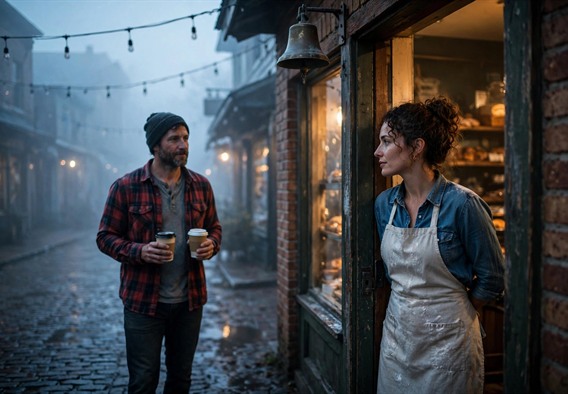

The Flour Dust Promise
The question had followed Nora Kessler the entire four hundred miles from Chicago: can you really go back to the town that watched you leave, and to the man you left behind, and build something that lasts this time? She was about to find out, because the bus was slowing at the Maple Crossing depot, and the man holding a cardboard sign with her name on it was none other than Owen Hartley.
The Sign at the Depot
She saw him before she saw the sign. Ten years had changed him in ways that were mostly jaw and shoulders, but he still stood the way he always had, weight on one heel, head tipped slightly, like a man listening to a building settle. The sign was ridiculous. Her name written in carpenter's pencil on the back of a piece of scrap plywood, the K crooked.
"You couldn't just wave?" she said, stepping off the last stair with her duffel over one shoulder and her laptop bag over the other.
"Couldn't risk you walking past me to the taxi stand." He set the plywood down against a bench. "Welcome home, Nora."
"I'm not home. I'm here for six weeks to get Aunt Ruthie's books straightened out and sell the bakery, and then I'm gone." She said it fast, the way you rip off a bandage, and watched his face do something complicated and settle back into polite.
"Six weeks," he repeated. "The bank sent the restoration contract two days ago. Structural work on the Kessler Building, foundation to cornice. Guess who signed to be the contractor on it."
"You're kidding."
"Wish I was." He reached for her duffel. She let him take it, mostly because her shoulder was burning and mostly because she was a coward about the small touch of their fingers when she didn't.
The last time she had seen Owen Hartley, they had been twenty three and twenty five, standing in the alley behind the bakery at two in the morning, and she had told him she was taking the job in Chicago and he had told her, in a voice she still heard sometimes when the apartment got too quiet, "Then go. You were always going to go." She had waited four full seconds for him to ask her to stay. He had not asked. She had not offered him the chance twice. That was the whole breakup, four seconds long, and she had carried it in her chest for a decade like a coin she couldn't spend.
They walked the two blocks to Main Street in a silence that had teeth. Maple Crossing in September smelled exactly the way it had when she left: cut hay off the Voss fields, the mineral cold coming off the river, someone grilling something with too much paprika. The streetlights came on in sequence, old habit, north to south, and she hated how her heart lifted at it.
"Ruthie's been gone seven months," Owen said as they turned the corner. "I'm sorry. I know I said it on the phone but I wanted to say it standing next to you."
"Thank you." Her aunt had raised her after her parents' accident, in the apartment above the bakery, on burnt sugar and stubbornness. The grief was still new shaped, still sharp at the edges. "How is she, the building? Be honest."
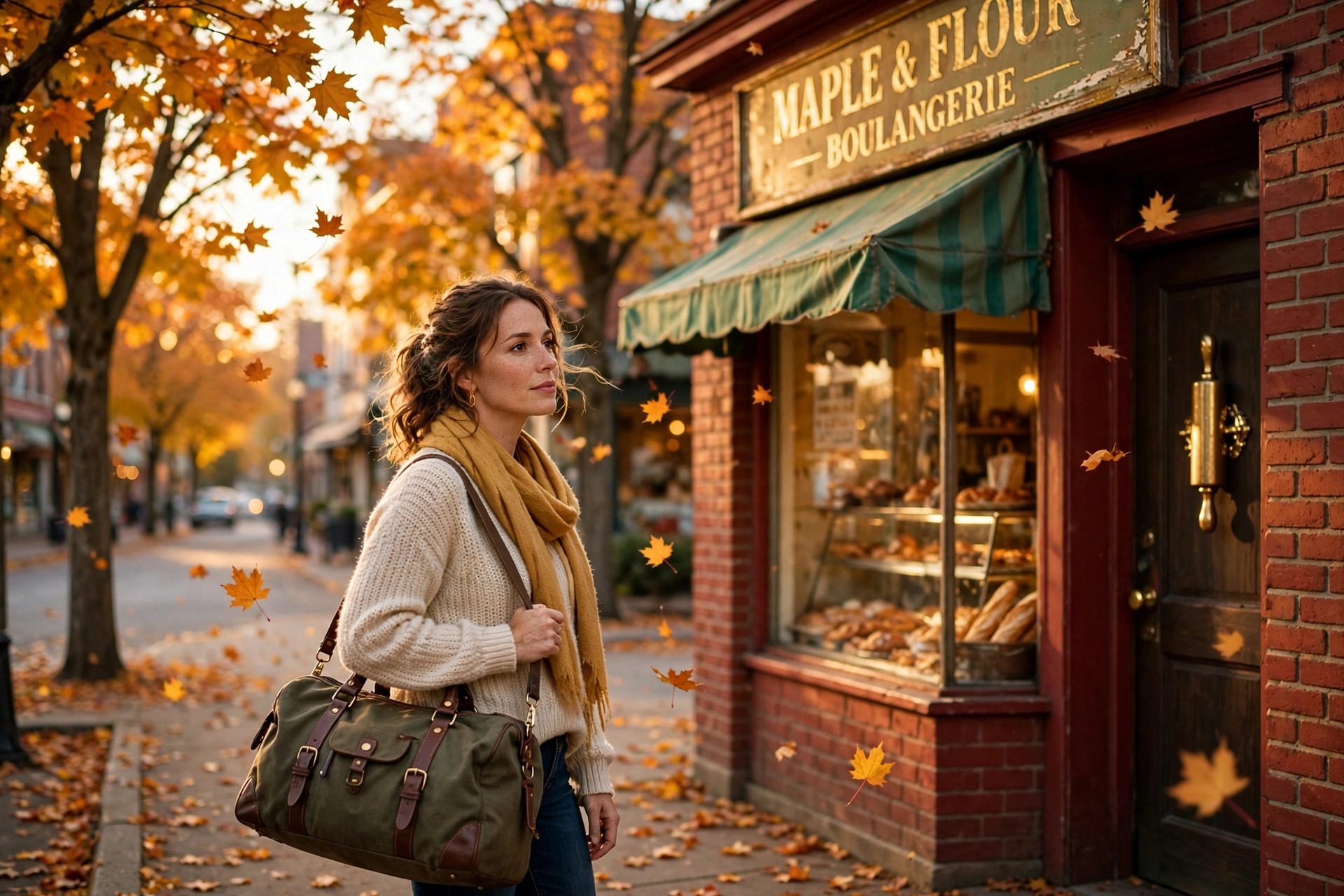
"Honest? The foundation's fine, the roof is a liar, and the ovens haven't been lit since the funeral. There's a raccoon situation in the storeroom that I have chosen not to escalate." He stopped at the corner of Main and Sycamore, and there it was. Kessler's Bakery, the gold leaf on the sign gone gray, one window papered over, but the brick as warm and red as ever, the awning still green, the door still wearing the little brass knocker shaped like a rolling pin that Ruthie had bought in 1987 and refused to replace.
Nora's throat closed. "Oh," she said, which was not a sentence, but Owen, to his credit, pretended it was.
"Take your time," he said. "I'll get your bags up. Key's under the frog."
"There's still a frog?"
"There will always be a frog. Ruthie made me swear."
She laughed before she could stop herself, and his mouth moved like he was holding a smile in quarantine, and they stood there on the sidewalk of her whole childhood while the streetlights hummed, two people who used to know each other's pulse rates, pretending to be strangers with a business arrangement.
Six weeks, she reminded herself. Six weeks, one building, one contractor, and absolutely zero feelings.
What the Ovens Remembered
The apartment above the bakery still smelled like her aunt. Not the bakery smell, yeast and browning butter, but the apartment smell: lavender hand cream, black tea, the ghost of the radio that had played opera at a volume designed to annoy the neighbors. Nora set her bags down inside the door and did not cry, which felt like an achievement until she opened the hall closet and found Ruthie's good coat, the camel colored one, still on its hanger with the dry cleaner's tag attached, waiting for an occasion that never came. Then she cried for a while, standing up, in a closet, which was exactly the kind of dignity her aunt would have found hilarious.
Afterward she washed her face and went downstairs, because the bakery pulled at her the way it always had, gravity with a storefront.
In the dark, with only the streetlight through the papered half of the window, she walked the floor she had mopped a thousand times. The display cases were empty and fogged with dust. The old register sat with its drawer closed. And there, on the back wall, the chalkboard menu, still holding the last thing Ruthie had ever written on it, in her tall looping hand: Saturday special: cardamom buns. Ask about Nora's recipe.
Nora put her hand over her mouth. The cardamom buns had been her contribution, the one recipe she'd ever brought home from her year of culinary school, the one Ruthie had adopted so completely that customers assumed it was a Kessler original. Ruthie used to introduce her to strangers as "my niece, the one who fixed my cardamom problem," and Nora had glowed every single time.
The note on the register said the ovens were cold but the pilot lines were capped, not cut, which meant Owen had kept them viable. She ran her fingers along the Peavey oven's handle, the one with the dent she'd made at seventeen with a cast iron skillet and a lie about a raccoon, and she felt the building decide something about her.
"You can't sell this place," she said out loud, to nobody, to the ovens, to the dust. "You absolutely cannot sell this place."
Unfortunately, she absolutely had to. The estate taxes were real. The bank's timeline was real. And the plan she had built on the train, careful and sensible, sell the building to a buyer who would keep a bakery in it, take the money back to Chicago, rebuild the savings she'd burned through paying off her mother's medical debts, that plan was the only responsible thing she had left. She had learned the hard way what happened when she bet everything on a feeling.
She climbed the stairs, found the frog, got the key, and let herself into her own past with her jaw set like a woman walking into a deposition.
The Contractor's Terms
Owen's crew arrived at seven the next morning, and Maple Crossing's main street economy announced itself through them: Dex Moreau on demo, who also fixed boats; his sister Camille on the saw, who also ran the hardware store; and a quiet kid named Telly, nineteen, on apprentice duty, who also, according to Dex, "did all our taxes for free, which should be illegal."
Nora made coffee in the apartment and brought it down in the bakery's old thermoses, and the crew looked at her the way towns look at returnees, warm and evaluating, like produce being weighed.
"You're the cardamom one," Camille said. Not a question.
"I'm the cardamom one."
"My kids still talk about those buns. Ruthie used to save us the ends of the tray." Camille's voice did something on Ruthie's name, and Nora understood that the whole town was still grieving in its own distributed way, and that she had missed all of it.
Owen came in last, carrying a clipboard and wearing a hat that said HARTLEY & SONS, and Nora did the math out loud before she could stop herself. "Sons? You don't have sons."
"Dad's knee finally gave out in March. He's on the books now as a consultant, which means he calls twice a day to tell me I'm doing it wrong." Owen flipped the clipboard around. "Walk with me. I want you to see what we're dealing with before you sign off on anything."
They walked the building together, and this was the problem with small towns and old buildings and shared histories: every room had a memory attached, and Owen knew all of them, and she could tell he was choosing which ones to say. He pointed out the sagging roofline over the kitchen and didn't mention the night they'd stood on a ladder together painting the fascia and she'd dropped the brush in his hair. He showed her the water damage in the storeroom and didn't mention the storeroom.
"The raccoon situation," she said.
"Escaped situation. The raccoon is free now. We're all moving on."
At the foundation wall in the basement, where the original 1920s stone met a newer concrete patch, he crouched and tapped the mortar and got serious in the way he got serious, which was quietly, and all at once. "Here's the honest picture. Roof, cornice, and the south sill are urgent. Everything else can wait. The bank's appraiser lowballed the repairs by about forty percent, which means either the scope gets cut or the money gets found." He looked up at her. "There's also a buyer who's been circling since spring. Hal Perrin. Wants to turn the whole block into short term rentals. He'd gut the ovens the first week."
"Hal Perrin." Nora knew the name from the estate paperwork, from a letter Ruthie had flagged with an angry red arrow. "Ruthie hated him."
"Ruthie hated him publicly, at the farmers market, with a pointing finger. It was a whole event."
Nora signed the scope sheet because there was no real alternative, but as she signed she watched Owen's hand steady hers on the clipboard, and she felt the four seconds from ten years ago open up in her chest like a drawer.
"Owen." He looked at her. "Why did you take this contract? You could have any job in three counties. You knew I was coming."
He was quiet long enough that Telly dropped something loud in the other room, grateful for the cover. "Because if I didn't," he said finally, "somebody else would've, and they'd have torn out the cardamom ovens to put in a pizza deck, and Ruthie would've come back from wherever she is to haunt all of us, and honestly, Nora, somebody has to make sure you sell this place without getting robbed, and it was always going to be me. It's always been me. That's the part I've never figured out how to quit."
He picked up his clipboard and went back to work, leaving her standing in the basement of her childhood with her heart hammering out a rhythm she refused to translate.
The Book Club Ambush
Maple Crossing did not do subtle, and it did not do slow. By Thursday, the whole town knew Nora Kessler was back, and the knowledge arrived in edible form. Mrs. Odette Brill, retired librarian and de facto intelligence agency, appeared at the bakery's half open door with a foil pan and a smile like a drawn curtain.
"Chicken and dumplings," Odette announced. "And a summons. The Historical Society meets Monday, seven o'clock, and you're presenting the Kessler Building's history. Ruthie promised you'd do it, back in June. It's in the minutes."
"She promised that while she was dying?"
"She promised it while she was bored in the hospital, which is worse. She knew exactly what she was doing. That woman weaponized obligation like nobody I ever met, God rest her." Odette set the pan on the counter and looked around the bakery, and her eyes went soft and wet at the empty cases. "It's good to see somebody in here. The street's been holding its breath since March. Perrin's been telling everyone it's a done deal."
"It's not a done deal."
"Then you'd best tell the street that, honey, because Main Street runs on confidence the way the ovens ran on gas." Odette patted her hand. "Monday. Seven. Bring the bun recipe story. People will cry."
People did cry. The Historical Society met in the back room of the Grange Hall, which held folding chairs, a coffee urn, and forty two people on a Monday night, including the mayor, including Owen, including, to Nora's horror, Hal Perrin himself, a broad soft man in a golf polo who sat in the back row radiating the patience of a man who owned liens.
Nora stood up front with her aunt's old photo album and told the story of the building because it was also the story of her life. The Kessler Building, 1924, built by a Hungarian immigrant named Agnes Kessler, no relation, who bought the name when she bought the bakery from the original Kesslers and liked it so much she kept it. The ovens installed in 1952. The flood of '78, when the whole street had showed up with mops and the bakery fed everyone for free for a week. Ruthie taking over in 1984 and refusing, for forty years, to change the Saturday special board. The cardamom buns, and the summer a sixteen year old Nora had begged her aunt to try one new thing, and Ruthie had said, "Fine, but if it flops, you mop for a month."
"It didn't flop," Nora said, and the room laughed, and someone in the third row was definitely crying.
Then Hal Perrin stood up, all teeth and regret. "Nobody respects that history more than me," he said, in a tone that suggested he had never once thought about history. "But respect doesn't pay a roof bill. The building needs north of eighty thousand in work. I'm offering a fair price, and I'm offering it to a family that's been through enough. Sometimes love means knowing when to let go."
The room went quiet in a way that Nora felt physically, like a pressure change. And then Owen stood up, unhurried, and said, "Eighty thousand is the number if you hire out of county and cut corners. I've had a crew on that building for a week. The number's eighty one, and I know where every dollar of it goes, because I wrote the scope." He looked around the room, then at Nora, and did the thing she would think about for the rest of her life. "And I'd like the record to show that if the money falls short, the labor difference comes out of my margin. That's not charity. Ruthie trained me in that kitchen when I was seventeen and flunking shop class. She paid me in buns and belief. I owe this building more than an invoice."
Hal sat down with the face of a man recalculating. Odette started a round of applause that turned into something longer and less polite. And Nora stood at the front of the Grange Hall holding a photo album, looking at the man who had once let her walk away without asking her to stay, and understood that he had just put his livelihood on the table in front of the whole town for her aunt's ovens.
Which raised an uncomfortable question about those four seconds in the alley, and who exactly had failed to ask what.
"You don't rebuild a main street with money. You rebuild it with people who can't imagine leaving."
The Storeroom Confession
He found her after, in the bakery, at ten at night, sitting on a five gallon bucket in the storeroom with a flashlight and the estate files, because she was the kind of tired that makes you want to look at paperwork you can't change.
"You didn't have to do that," she said, without turning around. She had known it was him from the doorway, from the specific way he knocked, two knuckles, apologetic.
"I did have to do that." He leaned in the doorframe. "Hal's numbers were fiction and the room needed somebody to say so."
"You offered your margin, Owen. On the record. In the minutes. Odette's going to have that typed up and laminated by Wednesday."
"Then Odette should also laminate the part where I've spent ten years being a coward, because that's the other thing on the record now, whether the minutes say it or not."
She turned around then. The flashlight lit the storeroom's old shelving, the sacks of flour still palletized from Ruthie's last order, and the space between them, four feet, the exact four feet that had existed between them at every important moment of their shared history.
"Say it, then," she said. "Ten years, Owen. I have rehearsed this conversation about nine hundred times, usually while falling asleep, occasionally in the shower, once out loud on a train platform in front of a nun. You do not get to open the door and then stand in it."
He came in and sat down on the bucket across from her, knees almost touching hers, and put his elbows on them like a man at a confessional with no priest available.
"You got the Chicago call in May," he said. "I remember the day because you made me taste three versions of a lemon thing and I couldn't tell you that I already knew. Your old professor had called Ruthie first. Ruthie told me at the farmers market. She said, quote, our girl is finally being asked to fly, and unquote, and then she handed me a bag of day old rolls and walked away so I'd have to sit with it." He rubbed the back of his neck. "I sat with it for six weeks, Nora. And every way I turned it, the ending was the same. If I asked you to stay, and you stayed, you'd resent this town, and this town includes me, so I'd be the thing you resent. If I asked and you went anyway, I'd have begged and lost, which is a worse shape to be in. So I did the math instead of the asking, and I chose the version where at least I kept my pride."
"You chose the version where I had to choose alone."
"Yeah." The word came out flat and heavy. "I told myself I was setting you free. What I actually did was make the hardest night of your life lonelier, and then let you believe the silence was the answer. That's on me. I've known it was on me for about nine years and eleven months, and I have started this apology in my head so many times that the draft has drafts." He looked up. "I'm sorry. Not I'm sorry but, not I'm sorry and also you. Just the plain thing. I was twenty five and scared and I made it about my pride, and it cost you the version of your life where somebody held your hand while you jumped."
The flashlight flickered. In the dark between flickers, Nora felt ten years rearrange themselves.
"Here's what I thought," she said slowly. "I thought you didn't ask because the answer was obvious. I thought I was the leaving kind and you knew it, and everyone in town probably had a betting pool."
"There was no betting pool. There was my mother, telling me every Sunday for a year that I'd ruined the best thing that ever happened to me. She's going to be unbearable when she finds out you're back, by the way. Consider yourself warned and hugged in advance."
Nora laughed, and it cracked in the middle, and Owen, who had once held her through her parents' funeral and her culinary school rejection and a broken wrist from a ladder, reached across the four feet and took her hand, and she let him, and his thumb found the scar on her palm from the mandoline, the one he'd driven her to the clinic for, and she had to close her eyes.
"I'm sorry too," she said. "I never once told you what I actually wanted. I wanted you to fight for it, and I decided that if you loved me you'd read my mind, and when you didn't, I filed it as proof." She swallowed. "I built a whole identity in Chicago out of that proof. Nora the one who left. Nora the one who doesn't need anybody. It took my mother getting sick for me to find out that needing people isn't the failure, it's the whole point."
"How's your mom?"
"Two years clear. She sends the town a Christmas card with a paragraph about her garden that's longer than most novellas."
"Ruthie read them out loud," Owen said. "Every year. Whole bakery got the update."
Nora looked at their hands, at the flour dust on both of them from the day's work, white and fine, settling on everything in this building the way the past settled on everything in this town. "Owen. I need to say the next part carefully, so listen to the whole thing. I'm not here to fall back in love with you. I'm here for six weeks to settle an estate. If something starts and I leave in November, it doesn't just hurt us. It hurts Dex and Camille and Telly and Odette and every person in that Grange Hall who just watched you put your margin on the line. So whatever this is, we go slow, and we go honest, and if at any point the math says I have to go, we say it out loud, on a Tuesday, in daylight, like adults. Deal?"
"Deal," he said. Then, because he was still Owen: "Can I say one more thing?"
"You've earned about one more thing."
"You taste tested three lemon versions for me the week before you left," he said, "and I never told you which one I liked. It was the second one. It was always the second one."
She threw a rag at him. It was, they both agreed later, the best either of them had felt in a decade.
Six Weeks of Mornings
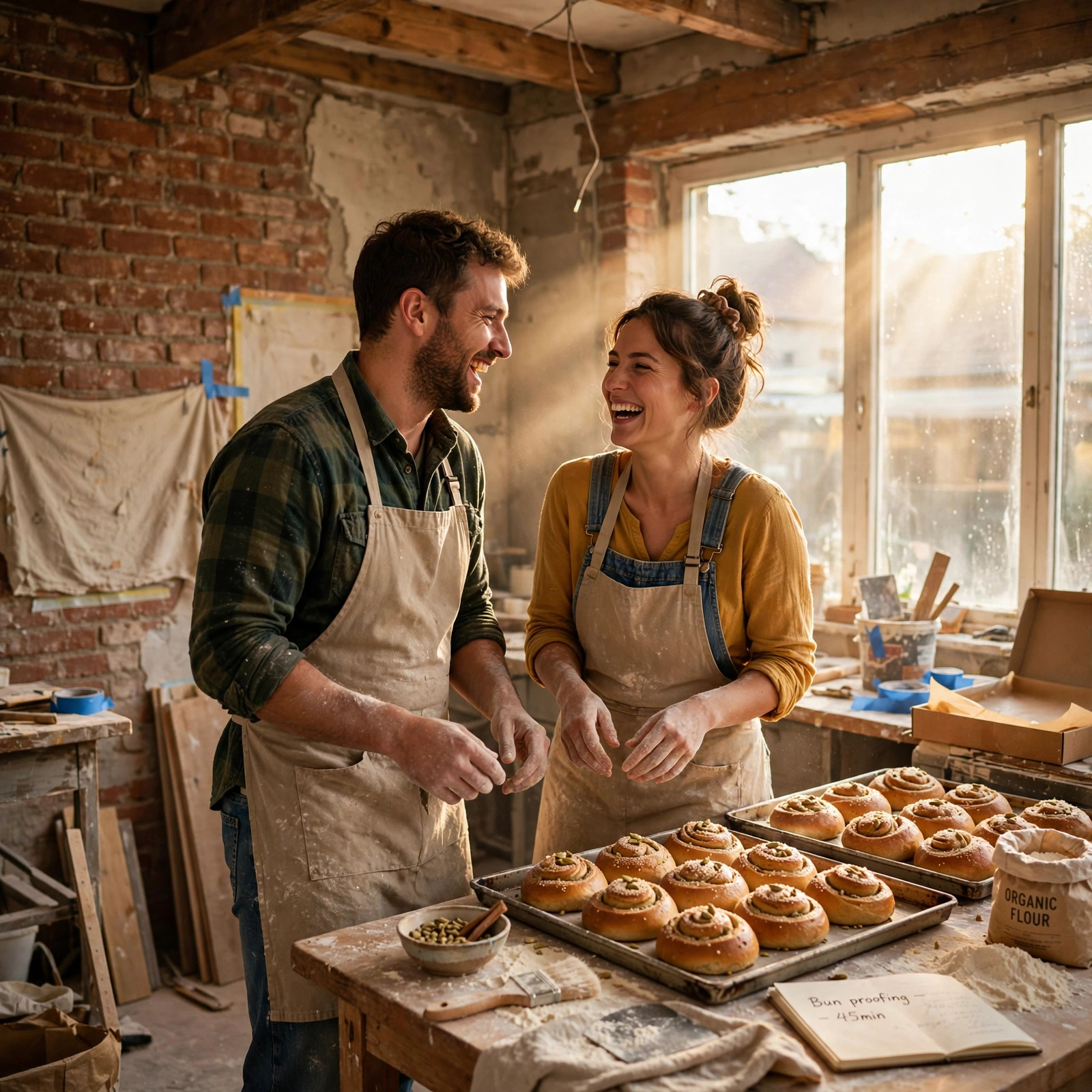
What nobody warns you about renovation is that it is a form of intimacy. Owen's crew opened walls, and walls in small towns are diaries. They found Ruthie's original recipe cards taped inside the pantry wall, in case of fire, a note said, Agnes Kessler 1953. They found a 1978 newspaper in the insulation. They found, behind the old radiator, a tin that made Camille shout and made Nora sit down on a sawhorse: the bakery's first dollar, framed in foil, and beneath it a photo of Agnes in front of the door, squinting, defiant, home.
Nora started baking again in week two, on a single working oven, because Telly had asked, shyly, if the cardamom buns were real or a legend, and she could not let a nineteen year old who did everyone's taxes for free believe in a false legend. She baked at five, before the crew arrived, and the smell moved up and down Main Street like a rumor. By six thirty, Mrs. Brill was at the door. By seven, there was a line. Dex started arriving early and lying about why. The hardware store sold out of cardamom and had to special order it, and Camille put a sign in the window that said CARDAMOM ON ORDER, ASK NORA, and Nora's name went up on Main Street for the first time in ten years, and she stood in the hardware store and cried in front of the paint swatches, and Camille pretended to restock something.
She and Owen developed a grammar of mornings. He brought her coffee at five fifteen and they reviewed the day's scope over the proofing trays. They argued about load bearing walls with the pleasure of people who had missed arguing. He fixed the dent in the oven door without mentioning the skillet, and she repainted the fascia without mentioning the brush, and both of these absences were understood, the way old love is understood, as a language with no textbook.
The town did what towns do, which was everything. Ruthie's old friend group rotated casseroles. The mayor came by twice and said nothing actionable but stood in the doorway breathing the smell like a man at church. And on a Friday in week four, Nora's mother called, having received, through channels, the full report.
"So you're renovating a bakery with Owen Hartley," her mother said, in the tone of a woman doing arithmetic she found delightful.
"I'm renovating a bakery. Owen has a contract."
"Mm. And the plan is still to sell and go back to Chicago."
"That's the plan, Mom."
"The plan," her mother said, "that you said the same sentence about in 2015, and I have never once gotten to say I told you so about anything, so I'm going to hang up now and save it." She hung up. Nora stood in the kitchen of her childhood holding a phone and a whisk and admitted, to the refrigerator, that the plan had a crack in it the size of a man who brought coffee at five fifteen.
The Perrin Problem
Then week five arrived and did what week fives do, which is test everything.
Hal Perrin, it turned out, had not been sulking. He had been working. He came to the bakery on a Tuesday morning, bought a cardamom bun, ate it standing up, and said, "Genuinely excellent, no notes," which was somehow more frightening than rudeness. Then he laid a folder on the counter.
"New offer," he said. "Eighty percent above the bank's number. And here's the part you'll like. I keep the building, but I'll license the bakery name back to a tenant. Kessler's Bakery, same sign, same knocker. You could even run it. Manager's salary, benefits, no capital risk, no eighty thousand dollar hole, no margin gambling by your contractor friend. It's the same bakery, Ms. Kessler. It's just not your bakery."
"That's the difference that matters."
"Is it?" He tapped the folder. "You've got six weeks of sweat in this place and a dead aunt and a town that loves a comeback story. I get it. But the bank note comes due in November regardless of how the town feels, and Hartley's margin gift covers maybe a third of the gap, and only if everything goes perfect, and nothing ever goes perfect. I'm not the villain here. I'm the math."
He left the folder. Nora sat down on the flour sack and read it twice, and the terrible thing was that it was good. It was good the way a shortcut is good. Keep the name, lose the ownership. Keep the town, lose the risk. Take care of yourself for once, Nora. You've spent enough years paying other people's bills.
She didn't tell Owen that night. She told herself it was because she wanted to think first, and then she told herself it was because he had enough weight on his shoulders, and by Thursday she had to admit the truth, which was that she was doing the exact thing she had promised not to do. Deciding alone. Filing the silence as an answer.
He figured it out on his own, of course, because Owen Hartley had been reading her for fifteen years. Friday morning he set the coffee down, looked at the folder sticking out of her bag, and said, "Perrin was here."
"Tuesday."
"And you've been sitting on it for three days, which tells me the offer's good, which means it's good enough to be dangerous." He sat down across from her, and this time there was no four feet. Their knees touched. "So let's do it the way we said. Daylight, Tuesday. It's Friday, close enough. Say the whole thing out loud."
She said the whole thing out loud, including the parts that were unflattering to her, the part where the shortcut looked like self care, the part where she was terrified of betting on this town a second time and losing twice.
When she finished, Owen was quiet for a moment, and then he did something she didn't expect. He agreed with some of it.
"The math is real," he said. "The gap is real. I can't close it alone, and I was wrong to stand up in the Grange Hall and make it sound like I could, because that was half generosity and half pride and you deserve to know the ratio." He turned his coffee cup in a slow circle. "So here's what I've got, and then I'm going to ask you for something, and you're allowed to say no."
"Go."
"What I've got: the roof comes in under scope because Dex found salvage lumber from the Voss barn teardown, Camille's sourcing the cornice at cost, and Telly's uncle is a roofer who owes me from a job in Cedar Falls. The real gap is thirty two thousand, not eighty one. I can carry eleven and stay solvent. I've run it three times." He looked up. "Here's what I want. I want to be your partner. Not your contractor, not the boy from the alley. Partner. I've got eleven thousand and a crew and fifteen years of wanting to build something with you. You've got the building, the name, the recipes, and the best cardamom bun in the county. We incorporate, we split it, we run it together, and we put the whole thing in writing so that if either of us ever gets scared again, the document does the talking that we were too proud to do at twenty three and twenty five."
Nora's hands were shaking. "Owen, if this fails, we both lose, and this time there's no Chicago to run to, because I'd have burned the Chicago money on the ovens."
"Yes."
"That's it? Yes?"
"That's the whole answer." He took her shaking hands and held them flat between his, steadying them the way he'd steadied the clipboard the first week, and said the new thing, the grown thing, the thing that had not existed in the alley ten years ago. "Nora. I am not asking you to bet on me. I'm asking you to let me bet on you, out loud, in front of the whole street, and then hold your hand while we find out together. If you say no, I'll finish the restoration, I'll wish you well, and I'll mean it, because I finally know how to lose you without making it your fault. But if you say yes, I promise you this: no more silence. Every fear, every number, every Tuesday. Even the ugly ones. Especially those."
The ovens ticked as they cooled. Out on Main Street, a truck went by, and somewhere the Vosses' dog registered its opinion. Nora Kessler, who had built an entire self out of not needing anything, looked down at their hands and made the choice that ten years and one apology and one tin of foil framed money had been building toward.
"Yes," she said. "Partner. In writing. And Owen? The second lemon version. I always knew. You taste like the second lemon version. You have for fifteen years."
He laughed until he had to put his head down on the counter, and she laughed too, and the flour dust settled on both of them like a blessing.
The Harvest Street Vote
The money problem did not politely vanish because two people held hands over a flour sack. It got solved the way things get solved in Maple Crossing, which is communally, loudly, and at the Harvest Festival.
Nora and Owen put the plan to the town on the second Saturday of October, at the festival, from the back of a hay wagon that served as the mayor's podium. Owen laid out the numbers on a whiteboard with carpenter's pencil, the gap, the partnership, the eleven thousand. Nora told them the rest: they needed thirty two thousand total, they could carry eleven, and they were asking the town for the rest as a community loan, paid back in bread, in jobs, in a Kessler's that never sold to Perrin, in a storefront that kept Main Street a street and not a row of rentals with wifi codes.
"You don't have to," she finished. "I spent ten years learning that nobody saves you but you. But if you want this bakery to be yours the way it was Ruthie's and Agnes's, this is the door, and it's open, and I'm standing in it."
For a second, nobody moved. Then Mrs. Odette Brill stood up in the front row, pulled an envelope out of her purse, and said, "Two thousand, from the Historical Society's roof fund, which Ruthie started in 2009 for exactly this paranoid purpose, because that woman planned for everything except leaving."
Then it was a stampede, in the politest possible sense. The Vosses pledged five hundred and first pick of every Saturday tray. Camille pledged a thousand from the hardware store and announced she was raising cardamom prices ten percent to fund it, "and nobody will complain, because where else are you going to get it." The Grange pledged the proceeds of the pie contest. Dex pledged labor. Telly, nineteen, tax doing, flour scented, stood on a hay bale and pledged five hundred dollars of his own savings, and Nora had to walk to the edge of the wagon and breathe for a second, because that was the moment she understood what Ruthie had actually spent her life building, and it was not a bakery.
They closed the gap by Sunday, with forty one pledges and one anonymous envelope containing nine thousand dollars and a note that said, in handwriting Nora knew better than her own, For the girl who fixed my cardamom problem. Spend it loud. R.K., filed in advance. Ruthie had put the money aside before she died. Of course she had. She had known exactly what she was doing, right to the end, and probably past it.

Hal Perrin came to the festival too. He ate a bun, shook Nora's hand longer than necessary, and said, "I withdrew the offer Monday. For what it's worth, my mother bought Ruthie's rye every week for thirty years. There are worse things than losing to a town." Then he bought a dozen to take home, which everyone agreed was the most Perrin thing that had ever happened, and Nora decided it was possible for a man to be the math and still be somebody's son.
The Second Promise
The ovens were relit on the first Saturday of November, one week before the bank note came due and six days before Nora's six weeks ran out, except that the six weeks had stopped meaning what they used to mean, because you cannot sell a bakery you own a third of, and Nora had not looked at a Chicago job listing in a month, and everyone including her mother knew it.
The relighting was not a ceremony, exactly. It was Ruthie's old crew of regulars, the full Hartley clan, the Historical Society with its laminated minutes, and one match held by Nora while Owen stood with his hand on the gas valve, and the whole room counted down from three like children.
The pilot caught. Then the burner, with a soft orange breath, and the old Peavey oven, dented door and all, came back to life for the first time in seven months, and the room made a sound Nora had never heard a room make, a low collective exhale, forty people remembering the same morning at once.
The first tray was cardamom buns. It had to be. Nora pulled them at seven, glazed them at the counter where she'd learned to glaze, and put the first one on a plate, and Owen cut it in half with the serrated knife that had hung by the sink since 1987, and they ate the halves standing up in the kitchen of the building they now owned together, in a town that had pledged them its roofs and its rye money and its belief.
"Second version?" she asked.
"Always the second version."
"Owen. The note comes due in six days. The pledge money has to clear, the incorporation papers aren't signed, Telly's still doing everyone's taxes for free, and my mother is coming for Thanksgiving and she will say the thing out loud. There are about forty reasons this could still fall apart."
"There are," he agreed, "and we'll handle them on Tuesdays, in daylight, like adults." He wiped glaze off her cheek with his thumb, unhurried, like a man with all the time he'd failed to spend a decade ago. "I have one more thing to say and then I'll let you have the kitchen."
"You've earned one more thing."
"I'm not going to ask you to stay," he said. "That was the old mistake, thinking staying was mine to ask for. So here's the new one. Wherever you're built, that's where I'm building. If it's here, there's an apartment upstairs with a closet that needs a better coat in it. If it's ever somewhere else, we'll figure out what this becomes together, on a Tuesday, out loud. I just needed you to hear it plainly, once, with flour on both of us, so it's on the record."
Nora Kessler looked around the kitchen: at the ovens breathing heat, at the chalkboard where someone, she suspected a conspiracy of Camille and Odette, had already written Saturday special: cardamom buns. Ask about Nora. in a hand that was trying very hard to look like Ruthie's; at the door with the rolling pin knocker; at the man who had apologized with the whole plain weight of the words and then bet his margin and his mornings on her twice.
"I'm staying," she said, and it did not feel like losing Chicago, it felt like putting down a bag she had carried four hundred miles. "I'm staying, and I want that in the minutes, laminated, and Owen? Kiss me like it's the second version."
He did. The flour dust settled around them, fine and white and patient, the way it settles on everything in a bakery that intends to outlive everyone in it, and out on Main Street the Saturday line was already forming, and the ovens were hot, and the town that had watched her leave was watching her come home, which is, when you finally let it happen, the same thing as being born in a place twice.
Maple Crossing appears in fiction only. Any resemblance to a real town's cardamom supply issues is between that town and its hardware store.
Get notified when new stories drop

Ivy Chen
Ivy writes historical and second-chance romance with period texture and modern emotional clarity. Courtship stakes, letters, and choices that cost.
Leave a comment
Comments