





Stroke Rate
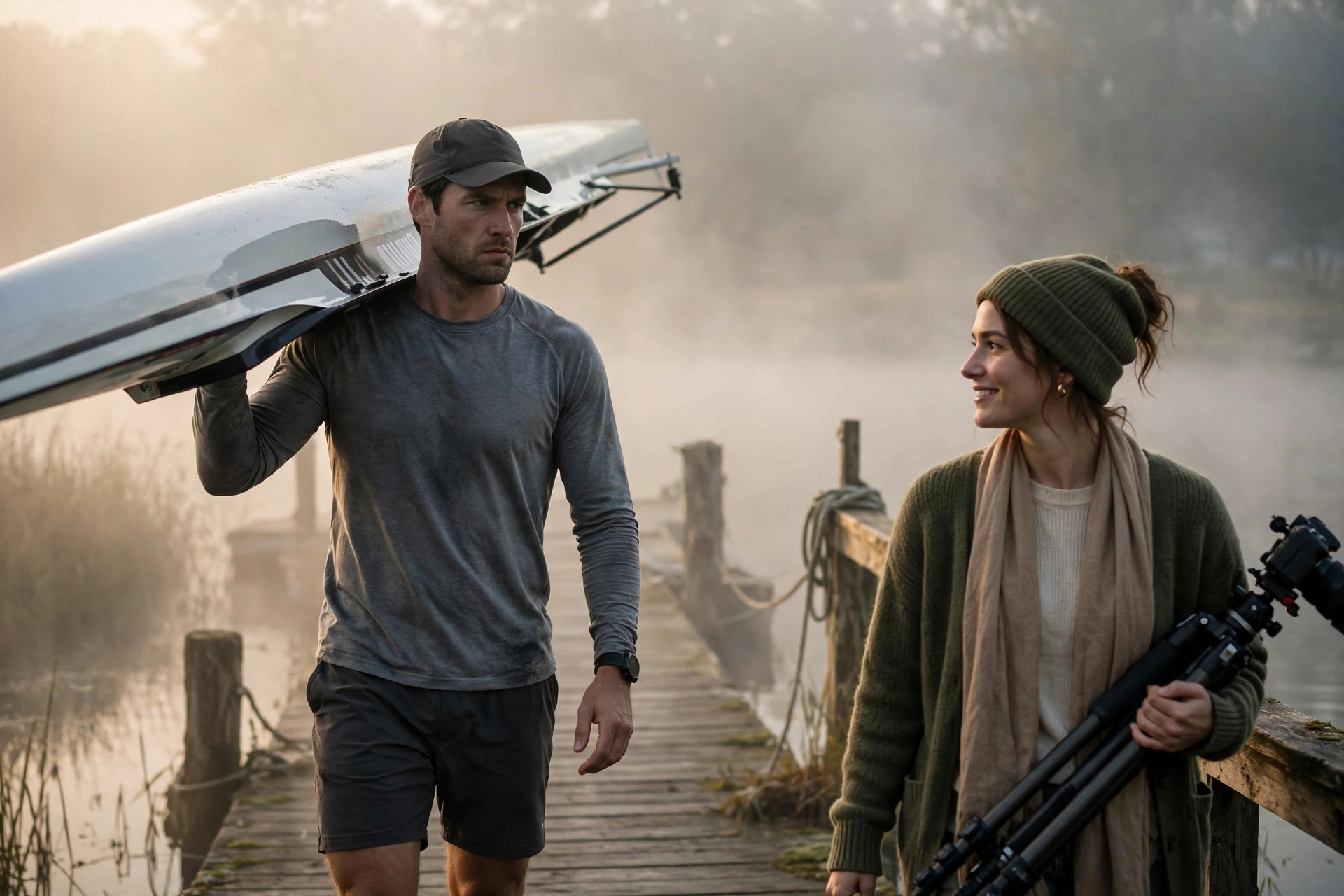
The mist on the Kishwaukee River was thick enough on Tuesday morning that Dahlia Reyes couldn't see the far bank, which was probably the only reason she didn't see the man carrying a single scull down the dock until she'd already set up her tripod in what turned out to be his path.
"Move."
Not excuse me. Not good morning. Just move, delivered in a voice like gravel settling.
She stepped left. He stepped right. They performed a small, furious square dance on wet boards, the sixty-pound racing shell between them like a dance partner neither had asked for, until Dahlia laughed out loud and lifted the tripod over her head like a surrender flag.
"Okay, you win the dock. I'll take the mud."
He was tall, early thirties, with a gray long-sleeve that said NATIONAL TEAM in faded letters and a face that suggested the national team had been an unpleasant experience. Dark eyes, dark hair cut close for efficiency, and a jaw that was doing something complicated she suspected was his version of a smile. It was not a smile.
"You're the new content person." He said it the way you'd say You're the raccoon in my chimney.
"Dahlia Reyes." She stuck out her free hand. "Media manager. The regatta committee hired me to make the training center look like something people under sixty want to watch. You must be Theo Lang. Two-time national teamer, reigning river grump."
"Two-time national teamer," he repeated. "That's what you're leading with?"
"It was on the fact sheet." She smiled at him, the real one, the one that had gotten her through five years of local TV newsrooms. "I also have the fact that you once gave a press interview that was four words long. I'm very excited to beat it."
"Beat it how?"
"Three words would be a start."
He looked at her for a long moment, river fog beading in his eyelashes, and she had the distinct sensation of being measured — not in a flattering way, but the way you'd measure a door to see if a couch would fit through it. She was apparently a couch that did not fit.
"No cameras on the dock," he said. "No cameras on the water. No cameras on me. That's the whole deal, Reyes. Enjoy the boathouse."
He dropped the scull in, stepped in after it with a fluidity that contradicted everything about his personality, and was fifteen meters out before she remembered to be annoyed.
"It's three words," she called after him. "No cameras on — that's four! You're already losing!"
The mist swallowed him. The river made a soft swallowing sound back, and Dahlia Reyes, who had been fired from the last job for caring too much about a story, adjusted her tripod and decided she'd make the boathouse so beautiful he'd have to say more than four words eventually.
The Boathouse at 5:04 a.m.
By Wednesday, Dahlia had learned three things about the Kishwaukee High Performance Training Center. One: the espresso machine in the lounge was sacred and had a hand-lettered sign that read DO NOT TOUCH — ASK COACH OKONKWO, which everyone obeyed out of a mixture of respect and fear. Two: the women's eight was delightful, media-friendly, and had already given her forty minutes of usable footage and a group impression of their head coach. Three: Theo Lang trained alone, at hours chosen, she suspected, specifically to avoid humanity.
He was on the ergometer in the back bay at 5:04 a.m. when she came in to shoot b-roll of the light on the water. She'd promised. No cameras on him. She kept promises; that was, in fact, the entire architecture of her life since the incident she did not think about. She angled her lens at the oar racks instead, at the dust hanging gold in the bay doors.
"Your shutter's loud," he said between pulls, not breaking rhythm. The erg's fan whirred like a held breath.
"Your face is louder," she said. "It's screaming. I can hear it from here."
"Screaming what?"
"Something like, nobody has ever understood me, and also, nobody should try."
He pulled ten more strokes before he answered, and she counted them, because his rhythm was the kind of thing you counted. "Funny," he said finally. "You should put that in a video. Caption it. Add music."
"I would, but you'd break my tripod."
"I've never broken equipment in my life." A pause, the fan spinning down as he eased to the finish. "I've broken a rib, a wrist, two oars, and one partnership. Equipment, never."
She turned around, mostly because her curiosity had outweighed her sense of self-preservation around Tuesday of her life. He was toweling off, watching her with that measuring look again. Up close, in the flat gray light, he had a scar at his eyebrow and eyes that weren't cold so much as carefully banked, like a fire someone had decided to stop feeding.
"The partnership," she said. "That's the doubles boat from three years ago, right? Ravi Anand. You two were supposed to go to worlds together and then it all —" she made a vague gesture — "exploded. Nobody ever says why."
"No cameras on me," he said quietly. "That includes words. You want content, shoot the eight. They laugh on command."
"I don't want people who laugh on command." She hadn't meant to say it that honestly. She heard it leave her mouth and tried to catch it, too late. "I mean — fine. Fine. Oar racks. Got it."
She packed up. He went back to rowing. And if she noticed that he'd moved the erg three feet so he could see her reflection in the bay door glass while she filmed the oars — well, she was a professional, and she did not put that in any video.
Camera Rules
Thursday it rained, so the whole training center moved indoors, which is how Dahlia found herself sitting on the floor of the equipment bay at seven a.m., holding a wrench, next to a nineteen-year-old junior rower named Camille who had stress-fractured her wrist and cried about it twice that week.
"The doctor says maybe eight weeks," Camille was saying, morosely. "Selection is in six. My whole season —"
"Hey." Dahlia handed her a protein bar from the emergency stash in her camera bag, because in her experience, despair and low blood sugar were frequently the same thing. "Eight weeks is a number, not a verdict. When I was twenty-five I got fired on a Tuesday and rehired in a completely different career by June. Life's long."
"That's not comforting," Camille said, but she took the bar.
"It's not comfort. It's data." Dahlia grinned. "Comfort costs extra."
She heard the door and knew without turning that it was Lang, because everyone else knocked. He stood there with rain still on his shoulders and a toolbox she had genuinely never noticed in the corner of his existence, and he looked at Camille's wrist brace and then at Dahlia on the floor and said, to Camille, not to her:
"Who's doing your single-leg work?"
"Um. Nobody? Coach Okonkwo said —"
"Come to the back bay at four. You can't row, you can still lift. Wrist's not your legs." He was already pulling a socket wrench out of the toolbox, and then, over his shoulder, in exactly the tone of a man ordering a war crime: "Reyes. Your bike's still locked to the rack outside, and your rear derailleur is hanging by a prayer. You're going to kill yourself on the bridge ramp."
Dahlia blinked. "You looked at my bike?"
"It's hard to miss. It's the color of a traffic cone and it makes a sound like a dying goose." He set the toolbox down between them. "Bring it in. I have ten minutes."
He fixed the derailleur in twelve minutes, during which he did not speak, and she narrated the entire time — about the eight's coxswain's new motivational speech, about the espresso machine's sign, about the heron she'd filmed that morning who had looked, in her professional opinion, like he was going through something. He said nothing to any of it. But at the end, when she wheeled the bike in a small triumphant circle on the wet concrete, he watched the gears run smooth and something moved at the corner of his mouth — not a smile, but its close relative, the one that lives next door.
"Dying goose cured," he said.
"You're welcome," said Dahlia, who had done absolutely nothing.
That afternoon she caught him in the back bay with Camille, walking her through squats with a broom handle across her shoulders, adjusting her form with two fingers on her elbow, his voice low and patient in a way that made her wonder who exactly this man thought he was fooling with the four-word interviews. She filmed exactly none of it. He looked up once, right at her, and she held up both hands — no camera, no camera — and he held her gaze a second longer than he needed to before going back to counting reps.
She thought about that look for the rest of the day, off and on, at odd moments, like a song stuck in her head. She was thirty feet away and it still felt like standing too close to a fire in a cold room.
The Erg Room, After Hours
Friday evening, the boathouse emptied out. Dahlia stayed to back up footage, and found Theo on the dock at sunset, not rowing, just sitting on the end with his legs hanging over the water like a teenager, which was so far outside her mental file on him that she sat down at a polite distance before she'd fully decided to.
"I'm not interrupting," she said. "I'm ambient."
"You've never been ambient in your life."
"That's fair."
The river was doing that thing evening rivers do, going copper and then pink, and a pair of mallards argued somewhere in the reeds. She let the silence sit for a whole minute, which she understood, from his expression, was a personal record for her.
"Tomorrow's the time trial," she said finally. "You're racing the clock, alone, 2,000 meters, and the winner gets the federation's single sculls spot for the fall circuit. That's the whole story, right?"
"That's the press release."
"Give me the other one."
He picked at a splinter on the dock boards. "The other one is that I had a partner, and the partnership was good, and then he sold a story about my family to a tabloid two weeks before selection, and I found out from a stranger with a microphone." His voice stayed level the whole way through, which was somehow worse than if it hadn't. "My dad gambled. It wasn't a secret from me, but it was mine. Ravi needed money and a byline and he got both. So now I race alone, and I don't talk to people who sell stories, and I don't —" he stopped, jaw working. "I don't do the thing where someone gets close enough to make me interesting."
Dahlia looked out at the water, because looking at him felt like too much honesty in one direction. "I got fired," she said, "because I protected a source who was lying to me. I stood up on air for a guy I believed in, and he'd used me as cover. My station apologized for my credibility and let me go in the same email." She laughed, and it came out a little cracked. "So now I make videos about oar racks, and I keep every single promise, and I don't push, ever, because pushing is how you find out you were wrong about someone."
"That's not why you don't push."
"Excuse me?"
"You push constantly. You pushed me on the dock Tuesday. You're pushing right now with your — your whole self. You just apologize while you do it, so nobody can be mad at you." He turned and looked at her, and the banked thing in his eyes had some heat in it now. "You don't avoid conflict, Reyes. You avoid the risk of not being liked. Different problem."
She opened her mouth to defend herself and discovered, to her genuine horror, that she was going to have to think about that instead.
"You're not allowed to be perceptive," she managed. "You're supposed to be the grumpy one. That's the arrangement."
"I'm still grumpy," Theo said. "I'm grumpy with accuracy."
She laughed then, really laughed, head back, and he watched her do it like he was memorizing the mechanics of it. The sun was almost gone. Her shoulder was, she realized, approximately one inch from his, and the inch was very loud.
"Six forty-two," he said quietly.
"What?"
"If I row six forty-two tomorrow, I win the spot." A pause. "I wanted to say it out loud to someone who'd remember it."
"I'll remember it," said Dahlia, and her voice came out softer than she'd planned. "I remember everything you say. It's not a lot of material, so it's easy."
He made the sound that was his version of a laugh — one exhale through the nose — and then, with the last light gone copper on his face, he leaned over and kissed her. It was careful, the way he was careful with everything — a question more than an answer, a door held open. She answered it. The dock boards were cold and the air smelled like water and cut grass, and the mallucks went on arguing in the reeds like the world was ordinary.
When they drew apart, he said, against all evidence of his personality, "I don't want to mess this up."
"You won't," she said, and, God help her, believed it, which was the exact moment she should have known better. Her whole life had taught her the exact moment things went wrong, and it was always the moment she believed something out loud.
Six Forty-Two
Saturday, the time trial, he rowed 6:41.8.
Dahlia watched from the finish pontoon with her heart in her throat doing figures. The federation spot was his. He came off the water shaking, spray still on his shoulders, and the first thing he did — before the official time, before Coach Okonkwo's rare, alarming hug — was look across the crowd for her, and the look on his face when he found her was so nakedly glad that she stood there grinning like an idiot with a camera she wasn't using in her hands.
Which was when everything broke.
She'd had a plan for the week — she'd scheduled the footage drop for the regatta channel on Friday night, before the trial: a hype package, the eight, the boathouse, the mist. And in the package, three seconds of b-roll she'd shot Tuesday morning before he'd set his rules, was Theo on the dock, and in those three seconds you could see him wince as he lifted the scull, see his hand go to the left side of his ribs, the side nobody outside the boathouse knew had a stress fracture two years back, the side he'd told her about Friday night in the dark like it was a confession.
By Saturday noon, the clip was everywhere. Lang's rib — is the favorite hiding an old fracture? Two rowing blogs, one aggregator with a red circle drawn around his torso. Her clip. Her schedule. Her edit.
She was still staring at her phone when Theo found her behind the equipment shed, and she knew from his face that he'd seen it, and she knew from her own hands that she'd started doing the thing she always did, which was arranging her face into something calming before she'd earned the right to be calm.
"Theodore —"
"Did you know?"
"No. Theo, no. It was in Tuesday's b-roll, from before — I never went back through it frame by frame, I was behind on the eight's footage, and I —" She heard herself, the rush, the apology stacking on apology like sandbags, and couldn't stop. "I'll put out a correction, I'll pull the clip, I'll —"
"Pull the clip." His voice was flat, and the flatness was worse than anger; it was a wall being built with her standing there. "You knew what that shot was. You knew what it would cost me, and you wanted a permanent job and a story, and —"
"Don't." The word came out of her with an edge she didn't recognize, and it stopped him. "Don't you dare finish that. You know what I did with the last person who traded a story for a career? I told the truth and got fired for it. That's not a defense of the clip — the clip is mine, my edit, my mistake, and I'll own it to anyone you want. But you don't get to make me Ravi. You don't get to decide I'm the last person who hurt you because I'm standing in the same spot."
He stood very still. The noise of the regatta went on behind the shed, applause for some junior final, and between them the silence did its work.
"You still should have checked," he said finally, quieter. "You promised no cameras on me."
"I promised it after that footage existed. And I should have gone back through everything and I didn't, because I was spread thin and I wanted —" she stopped. "I wanted you to be okay with me having it. That's the truth. I wanted both things, the promise and the footage, and that's on me."
"It's all over the federation feed," he said. "The sponsors saw it before I was dry. I have a call with the federation's press office at four where I get to explain that my new media manager made my medical history a hashtag."
"Then let me come with you. Let me stand up there and say it was my error and my —"
"No." Something closed, door after door after door, and she watched it happen. "You want to fix it by making people like you again. That's your whole playbook. You don't get to make my worst morning into your redemption arc, Reyes."
He walked away toward the boathouse, shoulders rigid, and Dahlia stood in the smell of cut grass and river and watched the only thing she'd believed out loud all week walk away from her.
The Clip
The federation press tent, Sunday, one hour before the final regatta of the season.
Dahlia had slept approximately none. At six a.m. she'd posted the full, unedited truth to the regatta channel: the timeline, the schedule error, the apology, the resignation offer — effective immediately if the committee wanted it. Her hands had shaken typing it, which she noted with clinical interest, and then she'd put on the yellow dress, because it was armor of a kind, and walked to the regatta to face whatever happened like a person with a spine instead of a person with an apology.
She hadn't expected the tent to be full. It was. Local press, the federation's communications director, two of the rowing blogs that had run the clip, and a sponsorship rep in a golf shirt whose lanyard said VELOCITEK — the boat sponsor, the one whose deal was the entire funding structure of Theo's fall season.
"Ms. Reyes." The Velocitek rep stood first, smiling with all of his teeth. "Quick one before the final. Given this morning's statement — the brand feels, and the federation agrees, that the cleanest path forward is a joint line: the training center acknowledges a staffing error, distances itself from the individual responsible, and we all move on to the racing. If you'll sign the prepared statement, we'll consider the matter closed and the fall sponsorship intact."
He slid a folder across the table. The prepared statement had her name in it three times and the word unauthorized twice. Nobody in the tent met her eyes except Camille, at the back, out of her wrist brace for the occasion, and Coach Okonkwo beside her, arms folded like a monument.
Dahlia looked at the folder for a long moment. She thought about five years of newsrooms, about a source who'd lied, about an apology email, about every time she'd made herself smaller so a room would stay warm. Then she thought about a man fixing her bike in twelve minutes without a word, and the sound of his laugh — one exhale, all he'd allow — and she stood up.
"I'm not signing that," she said. "The clip was my error. Not unauthorized — mine. I scheduled it, I edited it, I failed to review it, and I've said so publicly. I'll resign if the committee asks, but I'm not resigning into a story where I'm a stranger who broke in. And you —" she looked at the communications director — "can put out a statement with my name and the actual timeline in it, or you can put out nothing, but you don't get to have the apology and the smear. Pick one."
The tent went very quiet. Somewhere outside, a starter's horn sounded for a junior final, and Dahlia's heart was going like an ergometer at full pressure, and she did not sit down.
"You understand," the Velocitek rep said, dropping the warmth, "what this does to Lang's funding. He rows Velocitek or he rows uninsured. You're spending his money to feel better about your morning."
"Actually."
The voice came from the tent flap, and the whole tent turned. Theo stood there in his racing kit, the long red stripe of the single sculler down his side, hair still damp from warm-up, and he did not look at the sponsor at all. He looked at Dahlia, and his eyes were not banked anymore; they were wide open and burning.
"I've been standing outside long enough to hear it," he said. "So let me save everyone some time. If the sponsorship requires a statement blaming her, I don't row for Velocitek this fall. I row in a borrowed boat or I don't row. That's the deal — take it or leave it."
"Theo —" the rep started.
"You watched the clip, Marco. You all watched it. She posted the truth at six a.m., before anyone forced her hand, and offered her job on a plate. That's the opposite of a story. I've spent three years assuming everyone with a camera was the same person, and I was wrong about it out loud to the one person who —" he stopped, and made himself finish — "who told me the truth on a dock before she had any reason to."
He crossed the tent, picked up the prepared statement, and — in front of two blogs, the federation, and God — tore it in half, which was, Dahlia would think later, the most words and the most action anyone had ever spent on her behalf at once.
"My heat's in forty minutes," he said to the room, and then, only to her: "Walk with me?"
The Press Tent
They walked down to the dock through the whole crowd noise of the regatta, and he didn't touch her until they were at the water, and then it was just his hand finding hers, rough and sure, like he'd rehearsed it, which she'd have bet her camera he hadn't.
"I'm not done being angry," she said. "About the Ravi thing. You decided who I was in one phone screen."
"I know."
"I want you to actually believe I didn't do it for the job. Not just — say it in front of sponsors."
"I know that too." He watched the water for a second. "I've been rehearsing what's wrong with me on every warm-up piece since yesterday. It's a long list. I went through it twice." He looked at her sidelong, and there — the near-smile's close relative, actually arriving. "The sentence I kept landing on was: she told me the truth about my own footage before I even had to ask. And I punished her for looking like the last person who lied to me. That's mine. I'm keeping it."
Dahlia's eyes stung. "That's a lot of words for you."
"I've been saving up."
She laughed, watery, and squeezed his hand. "You can't row uninsured all fall."
"Velocitek will fold. They need a sculler at worlds more than they need a scapegoat — Marco's a shark, not an idiot. If they don't, Okonkwo already offered to buy the eight's old boat out of the equipment budget, and I've been meaning to eat rice and accountability for a season anyway." He shrugged. "It's money. You're not."
"Theo."
"Race starts in thirty minutes," he said. "Watch from the pontoon. Yell something embarrassing. That's your entire job."
Gold Medal Light
The final was 2,000 meters of the kind of pain that doesn't make good copy, so Dahlia filmed none of it and felt all of it. At 1,500 meters he was second, and she could see — even from shore, even without knowing what she was looking at — the moment his rhythm went from grim to something else, something with his whole life in it. He crossed the line first. She did not hear the announced time over her own screaming, which Camille later told her was audible across the entire course, and which Theo, asked about it that evening, would describe only as "the best sound I've ever heard at 2,000 meters."
Velocitek folded by Tuesday, exactly as predicted, with a gracious statement that Dahlia had not written but had, at the committee's request, reviewed for honesty.
In October, the first cold Sunday of fall, Dahlia set her tripod on the dock at 6 a.m. — dock filming now permitted, a rule change negotiated over one memorable dinner — and got the shot she'd been saving: Theo in the single scull on the misted river, and behind him, in the two-person boat he'd finally stopped pretending he didn't miss, Camille, back from her wrist and rowing like someone with something to prove to exactly one person on that dock.
He came in, and he was soaked and grim and doing the mouth-corner thing, and Dahlia handed him a protein bar because in her experience, despair and low blood sugar were frequently the same thing, and hope was mostly just breakfast.
"Six forty-one point two," he said.
"Camille's split?"
"The crew's. We're getting faster." He looked at her, at the camera, at the river going gold. "You're putting this one out?"
"With your okay."
"With my okay," he agreed, and kissed her there on the dock, in front of the whole quiet river, and it was not careful at all.
"You don't get to decide I'm the last person who hurt you because I'm standing in the same spot."
The Kishwaukee High Performance Training Center's fall season content, all eleven minutes of it, was shot, edited, and lovingly captioned by their media manager — who kept every promise, pushed constantly, and never once apologized for the yellow dress.
Get notified when new stories drop
Noah Carrington
Noah covers sports romance and forced-proximity heat: rivalries, road trips, and the quiet moment after the crowd goes home.
Leave a comment
Comments