





The Witness at Station Nine
The sedan smelled like burnt coffee and rain, and Delia March had been living in it for three hours.
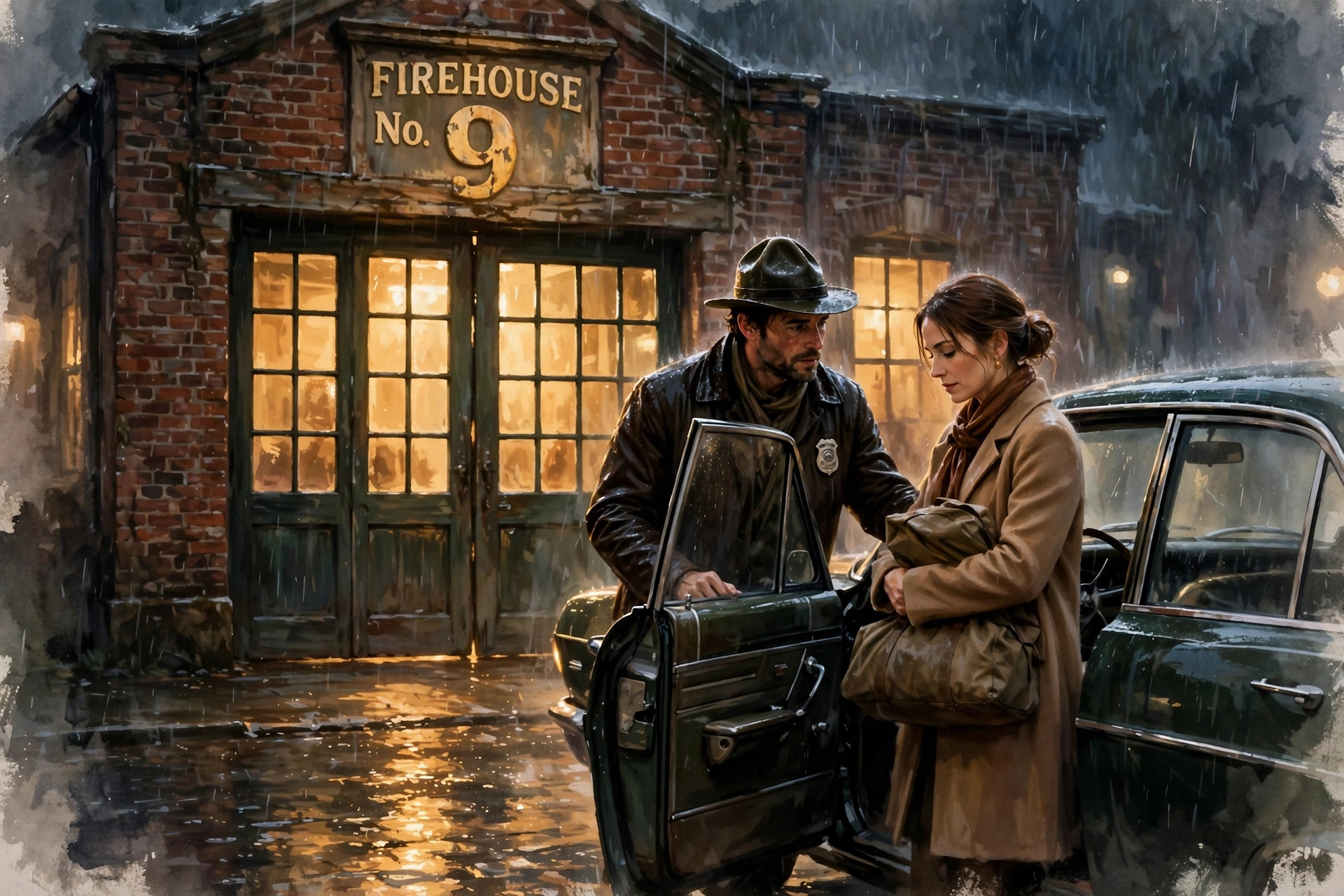
"Eyes forward," said the man beside her. "Hands where I can see them. Not because I think you're dangerous. Because I don't know what's behind us yet."
"You told me your name was Elias. That's it. Elias." She watched the streetlights slide across his jaw. "Usually when someone kidnaps me, I at least get a last name."
"Ward. Elias Ward." He changed lanes without looking at her. "And I didn't kidnap you. I extricated you."
"From my own apartment."
"From your own apartment eleven minutes after a gray sedan photographed your building from three angles. You were in the shower. Your coffee was still hot when I poured it out."
Delia had spent nine years doing forensic accounting for a regional bank, and eleven weeks tracing wire transfers that shouldn't exist back to a man named Carrasco. Eleven weeks of ledgers becoming testimony. And now — apparently — eleven minutes between her and whoever had just photographed her window.
"Where are we going?"
"Somewhere with thick walls."
"That's reassuring."
"It should be. Thin walls are how people get hurt."
The city thinned into warehouses, then into a stretch of road where the rain came down so hard it hissed. Elias turned twice, doubled back once, and finally pulled through a gate she would have missed in daylight. A building rose out of the dark — old brick, a faded number nine over the big doors, a bell tower.
"It's a firehouse," she said.
"It was. Decommissioned years ago. The department keeps a few of them for situations like yours." He cut the engine. "Concrete between the studs. No shared walls. One road in. I like one road in."
"One road in means one road out."
"Now you're thinking like a handler."
"I'm thinking like a person who reads maps."
Inside, the firehouse smelled of pine cleaner and cold dust, and under that, faintly, of old smoke — the kind that never fully leaves a building that once burned things for a living. A radiator in the corner clanged twice, like someone knocking from the inside. Rain drummed the flat metal section of roof above the common room. There was a cot made up with military corners, a kitchen, and a second cot against the far wall, already made.
"That one's mine," Elias said, nodding at the far cot. "You get the one near the radiator."
"The loud one."
"The warm one. You'll trade sleep for warmth exactly one night, then you'll stop complaining."
She set her bag down — one bag, always packed, a habit her sister called paranoid and Delia called Tuesday. Eleven weeks ago she'd stood in front of a grand jury and read numbers into a record, and somewhere in those eleven weeks, a leak had opened. Someone knew where she lived. Someone had sent a car with a camera.
"How long?" she asked.
"Prelim hearing is Thursday. Eight days." He was already walking the perimeter, touching window frames like a man reading braille. "You don't leave without me. You don't call anyone. If I say move, you move first and ask second. Clear?"
"Crystal." She sat on the cot, which was exactly as comfortable as it looked. "Do I get a say in any of this?"
"In dinner," he said. "There's pasta or pasta."
Despite everything — the gray sedan, the rain, the number nine over the door — she laughed, and the sound startled her so badly she stopped. It was the first time she'd laughed since the grand jury. Maybe longer.
Elias paused at the kitchen doorway. "You laugh like someone who's forgotten how," he said, not unkindly.
"You surveil people like someone who's never stopped."
"Occupational hazard."
"Which one of us?"
"Both," he said, and for the first time all night, he smiled, and it changed the whole geometry of his face.
Later, while she lay listening to the radiator knock and the rain argue with the roof, she heard him move through the dark. Not to sleep. He walked the room's edges, window to door, door to window, a man guarding something even when the only thing left to guard was silence.
She wanted to ask what he was so afraid of. She didn't. She had her own answer to that question, and she kept it in a bag by the door, packed and zipped, ready to run.
Burnt Coffee
By the second morning, Delia had claimed the big table in the common room as hers, and by the third, it looked like a crime scene made of paper.
"You know we have your copies," Elias said, setting down two mugs. "Certified. Sealed. Boring, apparently, is admissible."
"I don't trust other people's copies." She didn't look up. "I re-ran the Carrasco ledger from source documents. Twice."
"How'd it come out?"
"Same as the first time. Nine million through fourteen shells." She finally looked up. "I don't get wrong answers, Elias. I get answers I haven't checked yet."
"Terrifying."
"Accurate."
He'd been gone four hours that morning — a supply run, a check-in with his office, a route he refused to describe — and she'd hated how the firehouse had felt with him out of it. Too quiet. Too many windows. She'd worked twice as hard to fill the silence with numbers, which was, she was beginning to suspect, exactly what she did in every part of her life.
He sat down across from her and turned the mug in his hands. "Ask," he said. "You've been circling it since day one."
"Someone in your world told Carrasco's people where I live. That's the only way a sedan shows up eleven weeks into a sealed proceeding."
"That's the working theory, yes."
"Who?"
"Above my clearance. Above yours." He said it evenly, but his knuckles whitened around the mug. "I've asked. Twice. Loudly."
"And?"
"And I got told to hold the position and guard the asset." His jaw worked. "You're not an asset. You're a witness. There's a difference, and it matters to exactly one of us in this room, and he's drinking your coffee."
She slid the mug back toward him an inch. "It's yours now. I've had enough."
"You've had one sip."
"It's burnt."
"It's always burnt. I make it too strong on purpose."
"Why would you—"
"Because on night three of a protection detail, people start feeling the walls. Burnt coffee means someone made it for you. That's the whole trick." He looked genuinely embarrassed, which she filed away as new information.
That night he taught her chess, because the firehouse had a board with one white knight missing and a bishop that had clearly been replaced by a bottle cap years ago. He played fast, careless-looking, and beat her three times before she started seeing the shape of how he thought — that his carelessness was a lie, that every move he made had a second move hiding under it.
"You herd people," she said, mid-fourth game. "On the board. You don't take anything. You just keep taking away where I'm allowed to go until I'm standing where you wanted."
Elias's hand stopped over the knight. "Is that an accusation or a compliment?"
"An observation. I make those instead of friends."
"That sounds expensive."
"It keeps the books balanced." She moved her rook. "People are hard to audit. Numbers stay where you put them."
"Numbers also can't hold the door when something comes through it." He tipped the knight over with one finger, deliberately, toppling his own piece. "Check. And for the record — I'd notice if you left. I notice everything about this room. Weight on the stairs, heat in the pipes. I'd notice you gone before the door closed."
"That's your job."
"Mostly."
The word hung there in the pine-cleaner dark, and she looked at the board instead of at him, and moved a pawn for no reason except that it was something to do with her hands.
The Fuse Box
Day five brought a storm that took the power out at 9:40 in the evening, mid-sentence, mid-argument about whether the pasta had been salted correctly.
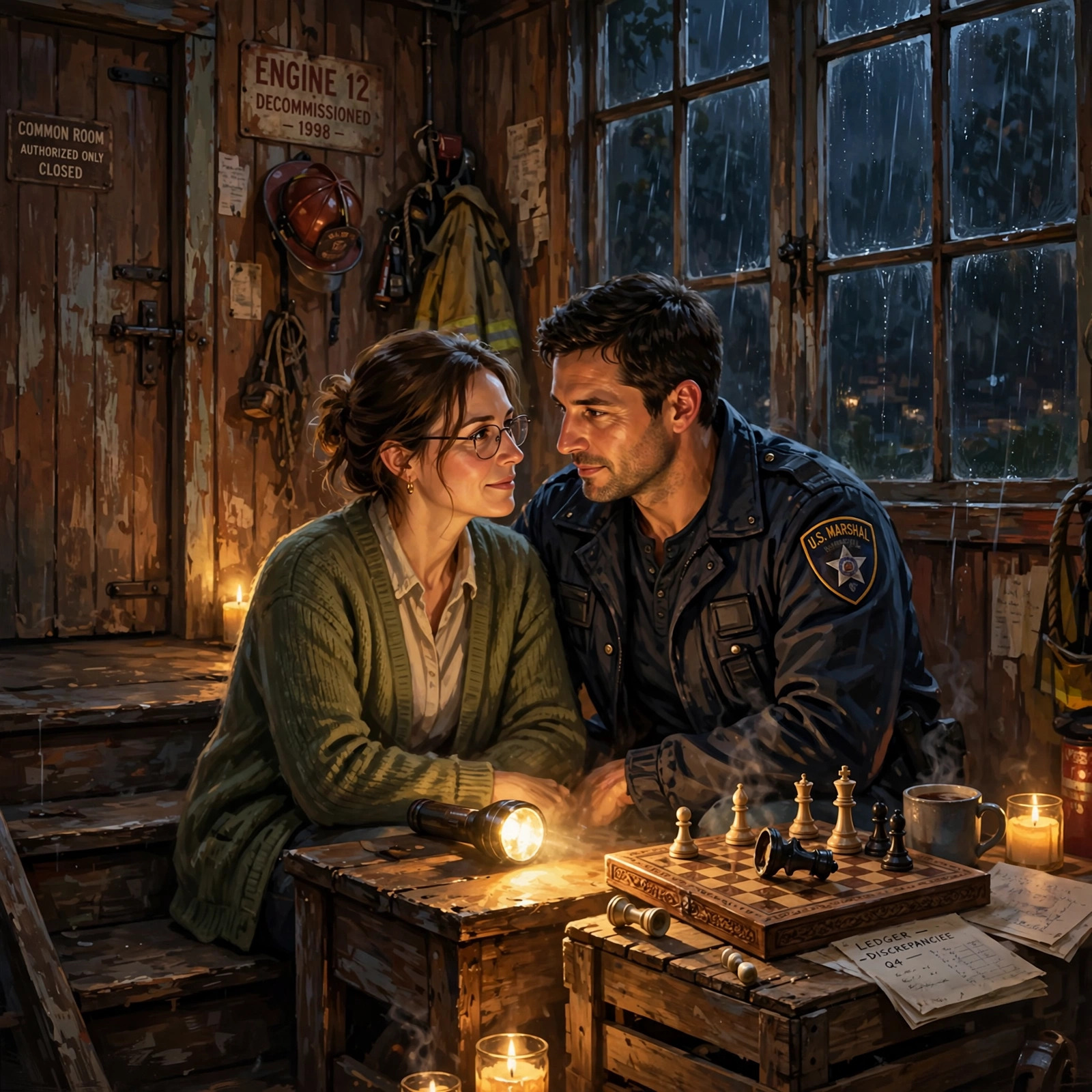
Darkness dropped over the firehouse like a lid. Delia heard Elias move before she heard him speak — his chair, then his footsteps, then his voice, low, from much closer than she'd expected.
"Stay put. There's a box in the stairwell, that's the outage. I need thirty seconds on the window."
"The window?"
"Lightning knocked a branch off the elm out front. I want to know if it fell, or if it's lying on something fresh."
She counted his footsteps to the front of the room. Then she heard him stop. Then nothing for a long ten seconds.
"Elias."
"It fell," he said. "We're fine. Sorry. Old habit — counting cars that aren't there."
She found the fuse box by touch, and he found her there, flashlight in hand, close enough that she could feel the warmth coming off him in the cold stairwell. He reached past her — his arm brushing her shoulder, deliberate in a way she suspected he'd never admit to — and threw the switch. Nothing. He threw it again. On the third try the lights shuddered awake, and the whole firehouse sighed: the radiator knocking, the fridge humming, the rain returning to its argument with the roof.
"There," he said. "All fixed."
"You said thirty seconds. That was four minutes."
"I got distracted."
"By what?"
"By the fact that you stood in the dark at the bottom of the stairs holding a wrench you don't know how to use, instead of hiding like I asked."
"I don't hide. I wait, and then I fix things."
"Wrenches don't fix fuse boxes, Delia."
"They also don't fix people, so we have something in common with them."
He laughed — a real one this time, startled out of him — and in the yellow stairwell light she saw his whole face do it, and something in her chest pulled like a stitch too tight.
They didn't go back to the common room. He sat down on the third step, and after a minute she sat down on the second, and they stayed there while the storm did its worst overhead.
"Can I ask you something that isn't about the case?" she said.
"You've been asking those all week. You just disguise them as observations."
"Fine. Then I'll ask one nakedly."
"Careful."
"Why do you walk the room at night? Every night. Window, door, window, door. I've heard you. I could set a clock by it."
He was quiet long enough that she thought he'd refuse. "Because a few years back I held a position like this one. Different building. Different witness." His thumb moved along the flashlight's edge. "Someone I trusted had vetted the location. I trusted them, so I didn't recheck it. I slept four hours a night and called it diligence."
"What happened?"
"The location leaked. It was fine — we got out. But a week later, at the prelim, a car ran the courthouse barricade." He set the flashlight down on the step between them, a small bright offering. "He lived, my witness. Six months of plates and pins. And I've never slept a full night since, and I recheck every lock twice, and I trust nobody's vetting but my own, and yes, Delia, I know what you're going to say."
"You don't. I wasn't going to say it's unhealthy. I was going to say I do the same thing with people."
"You keep them at arm's length and check the exit twice."
"My brother Danny." She hadn't said the name out loud in three years; it came out rougher than she'd planned. "He worked for a guy whose accounts I was auditing. I found what I found and I reported it, because I don't get wrong answers, and Danny went down with the rest. Five years. My mother stopped calling. My sister calls me "the auditor" at Christmas, like it's a dirty word." She looked at the flashlight between them. "So now I trust the numbers and keep a bag packed. Numbers have never left the room when I walked into it."
"That sounds lonely," Elias said softly.
"It's efficient."
"Those aren't different things with you."
She turned to look at him, and he was already looking at her, and the distance between the second step and the third was very small and then it wasn't, and his hand came up to move a piece of wet hair off her cheek — and the lights died again.
"The fuse," they both said at once, and neither of them moved for three full seconds, and then they both laughed, and went back to the common room, and did not talk about it.
The Packed Bag
Day six, Delia found the thing she shouldn't have found, and then she made everything worse.

Elias had gone for supplies at 10 a.m. — two hours, always two hours, always the same route, which she'd realized three days ago was a pattern, which meant it was a weakness. She was working that thought at the table when she went looking for a pen and opened the wrong drawer in the kitchen island.
A folder. Her name on the tab. Photocopies inside — her building, her floor, her — and a printed email chain, and one line highlighted in yellow by somebody's careful hand: Ward's detail is Station Nine, commencing Tuesday.
Tuesday. The day they'd arrived. Whoever had leaked her address knew about the firehouse. The firehouse was burned. And Elias had known, and had said above my clearance with that flat voice and his white knuckles, and had kept driving, and had kept saying we're fine, it fell, we're fine.
She did not panic. She did what she always did: she made a plan her family couldn't be hurt by, because nobody was in it. There was a notarized copy of her ledger annotations in a bank's night drop, forty minutes' walk away — her private insurance, planted week one, told to no one. If she moved it to her lawyer's building, it was untouchable even if something happened to her. One bag, one route, one hour. She'd be back before the pasta water boiled.
She was lacing her boots by the window when the door opened and Elias came in holding two paper bags and no expression at all.
"Sit down," he said.
"I was going to—"
"I can see what you were going to do. Bag's by the door. Boots are half on. You were going out the elm-side fence, because you think my road-in obsession means I don't watch the back." He set the bags down too carefully. "Sit. Down."
"You knew." Her voice came out shaking. "The leak. Station Nine. It's in that folder — someone emailed it, and you knew, and you brought me here anyway and let me sleep ten feet from you while—"
"While I fixed it. Yes."
"Fixed it how? By lying?"
"By leaving a trail." For the first time in six days, he was loud, and the radiator clanged like it agreed with him. "The leak thinks Station Nine is real, so Station Nine is bait now, and I am the trap, and you were going to walk out the back gate into a street I haven't cleared in three days because you don't trust anyone's work but your own."
"You're damn right I don't. You know what happens when I trust someone's work? I get a phone call from a lawyer and my brother's voice saying how could you, and then five years of silence, so yes, Elias, I checked your math, and your math was a lie."
"My math kept you alive."
"Your math kept you comfortable. You've been herding me since day one — the board, the exits, the one road in. You don't protect people. You cage them where you can count them, because somewhere back there you counted wrong once and you've never forgiven the arithmetic."
He went very still. "That's enough."
"No. And you know what you do, on your side of it? You decide. Alone. Every time. You knew about the leak on day one and you didn't tell me, because in your head I'm a number to guard, and numbers don't need to know things, they just need to stand where you put them."
"That is not—" He stopped. Started again, quieter, which was somehow worse. "The night my last witness got hurt, everything I'd done was right. Every check, every route. Someone else's lie, and a man in pins for six months. I decided that night I'd never let someone else's mistake reach anyone standing behind me again. And I decided it alone, because deciding alone is fast, and fast keeps people breathing." His hands were shaking; she watched him notice that and hate it. "So yes. I caged you. I'd do it again tonight. I've been doing it for six days and I have not slept more than four hours of any of them, and you snore, by the way, and I have memorized it, because it means you're still breathing."
The silence after that had weight. Outside, the rain started again.
Delia sat down slowly on the arm of the couch. "You should have told me," she said. "I could take the risk. I could choose it. You took the choosing away."
"And you should have asked me about the drop box before you planned to outrun me in boots on a rainy street." He exhaled. "We're the same person, Delia. That's the problem. Two people who'd rather be right than held."
"That's not the problem." She stood, wiped her eyes with the heel of her hand, furious at her own face for doing things without authorization. "The problem is that I finally trusted someone's math besides my own. And you knew it was wrong, and let me do it anyway."
She walked to her cot and turned her back to the room, and heard him, an hour later, begin the slow patrol. Window. Door. Window. Door.
The Decoy Route
Day seven, Elias Ward did the two hardest things he'd ever done in one afternoon, and only one of them involved a car.
At noon he set his phone on the table between them, screen up, and said, "I need you to hear this with me." Then he dialed his own field office, identified himself, and filed — out loud, on speaker, in front of her — a formal request that his own mentor, the man who had vetted Station Nine, be treated as the subject of the leak investigation.
"You understand what you're doing," said the voice on the phone, when he'd finished.
"I understand it's him. It's been him since Tuesday. The vetting log shows someone ran my location on a personal device at 11:40 that morning, and there are exactly three people who knew the detail existed. I'm one. You're two." Elias's voice stayed level. "That leaves Renner. Twenty-six years I've known him. He taught me the one-road-in rule."
"If you're wrong—"
"If I'm wrong, I've ended my career in this unit and betrayed the closest thing I have to family, and I'll live with it. If I'm right and I say nothing, my witness doesn't make Thursday." He looked across the table at Delia while he said it, and did not look away. "File it. Request a sealed pickup. Two vehicles. The sedan takes my usual route east at 14:00, driven by me. She goes west at 14:20 with Marshals Service plate eleven, and not before."
When he hung up, the room was very quiet.
"You'll be in the sedan," Delia said. "The route they think I'm on. In the car they've been waiting to find."
"That's the idea."
"That's not protection. That's you standing in front of a door."
"It's the only door they know how to kick." He picked up his bag. "It has to be my car and my silhouette and my driving, or it's nothing. If it goes wrong for me, it goes right for you, and Thursday happens, and Carrasco ends. That's the trade I'd make any day of the week and twice on this one."
"You don't get to decide that alone." She was on her feet. "Not after yesterday. Not after what you said to me on those stairs."
"Yesterday you told me exactly what I do. I cage people where I can count them." He pulled the car keys from his pocket and held them out to her, flat on his palm — and then, when she didn't take them, he pressed them into her hand and closed her fingers over them with both of his. "So I'm doing the opposite. Here's the firehouse, Delia. Both vehicles, the gate, the storeroom where the spare radio lives. I'm not taking them with me. I'm going out that door and you get to decide what this room is while I'm gone — a cage or a fort. That's yours now. It should have been yours on day one."
"Elias—"
"The sedan is the risk. The sedan is the whole point." He shouldered his bag. "If I don't radio in by 15:00, you go west with the plate eleven crew, and you don't look back, and Thursday happens without me in the room."
"And if you don't come back at all?"
"Then I was wrong about one more thing." He paused at the door, rain silvering the glass behind him, and for a second she thought he wouldn't say it, and then he did, plainly, like a man filing one more true thing into the record. "I'd have liked to find out what you're like when you're not leaving."
The door shut. The firehouse swallowed the sound of his engine.
Delia stood in the middle of the room holding his keys, and the radiator knocked twice, and she discovered she had been holding her breath since 14:01.
At 14:52 the radio on the kitchen counter crackled. Static, then his voice, ragged at the edges: "Sedan's done. It went exactly as designed, which is to say they took the bait and the bait drove away. Two in custody on the east route. Renner was in the second car. Renner." A breath. "Delia. You there?"
She got the mic to her mouth on the second try. "I'm here."
"Good. Stay put. I'm coming back to my firehouse."
The Spare Key
Thursday, the hearing took forty minutes, and Delia read her numbers into the record in a voice that only shook once, and Elias sat three rows back with his arm in a sling and watched her the whole time without pretending not to.
Carrasco's counsel didn't even cross-examine the ledger. You can't cross-examine arithmetic once the leak that fed your strategy is in custody and your fixer's sedan is in an evidence bay.
Afterward, in the courthouse hallway, an assistant DA shook her hand for a long time, and a marshal she'd never met handed Elias a folded document — the closure order on her detail — and that should have been the end of it. Protection ended. Doors opened. Everyone walks.
Except that evening, a sedan she recognized pulled up outside the apartment she wasn't supposed to return to yet, and Elias got out with a paper bag and stood by her building's buzzer looking like a man doing surveillance on his own courage.
"You're supposed to be resting," she said from the steps. "And that's your burned coffee smell from here."
"It's for you. The trick, remember. Burnt coffee means someone made it for you." He climbed the steps slowly, favoring the sling. "Also I need to give something back, and then one more thing, and then I'll go if you want."
"Back?"
He held out her spare bag — the one she'd packed for the drop-box run, the one she'd left half-laced at the firehouse. "Your exit bag. I packed it better. Sorry. Occupational reflex."
She took it. "And the one more thing?"
"So." He set the coffee on the step between them, exactly the way he'd set the flashlight on the stair between them, and she realized he was nervous, and that seeing it felt like being handed something. "Renner's case means months of review, and I've been reassigned off protective details — my request, which is a polite word for what it is. I'll be doing training work. Weekends free. Days free, actually. Terrible hours." He rubbed the back of his neck. "And I've been offered a teaching slot in the fall, and I have a car with a lot of empty passenger seat, and I find that I've spent six days memorizing the sound of someone breathing in a firehouse and I'd like to keep doing that in a building with better coffee, if you'll have me around. Unprofessionally. Slowly. I'm told I'm difficult at rest."
"By who?"
"By a woman who keeps a bag packed in case people leave."
"I don't need the bag anymore," Delia said. "I need a new one, actually. Somebody packed mine full of firehouse keys."
"That's the other thing." From his jacket pocket — carefully, with the good arm — he produced a small brass key on a plain ring. "Station Nine. They're decommissioning it for real next month, and I may have made one phone call and one small donation, and there may be a window box situation forming in the spring. I'm told the roof is the best place to watch storms from. Two chairs up there now. I only ever needed one before."
She took the key. It was heavier than a key had any right to be.
"You bought the firehouse," she said.
"I bought a building that means something to me. It had one good week in it. I'd like to see what it does with more."
"Elias."
"Yes?"
"I snore."
"I know," he said, "and I'd like to point out that I built the whole speech and you're nitpicking the appendix."
She laughed — all of it this time, nothing startled about it — and then she kissed him on the courthouse steps in the evening light, coffee going cold beside them, the exit bag full of keys sitting at their feet like a piece of luggage that had finally found the right destination.
"Stay for dinner," she said. "There's pasta or pasta."
"Those are my only two settings," Elias said, and followed her up the steps.
Later, at the firehouse — because they went, that night, both of them, to sit under the tin roof and listen to the weather argue — she put her chair close enough that the armrests touched, and he didn't walk the perimeter once. Not window, not door. He just stayed where she could count him, breathing, in a room that had stopped being anybody's cage and become, with two chairs and one burnt pot of coffee, something with a bell tower and a number nine and a door they'd both chosen to leave unlocked.
Get notified when new stories drop

Serena Blake
Serena writes romantic suspense and dark romance for readers who want pulse and payoff. Her stories chase trust as hard as they chase danger.
Leave a comment
Comments