





The Seven O'Clock Bell

The heavy brass ship's bell suspended from the front porch rafters of Oarlock Coffee & Hardware struck twice, sharp and bright against the fog rolling off The Ferry Slip. Maren Vance shifted her aluminum transit tripod to her left shoulder, her leather portfolio tucked tight against her ribs, and stepped off the wet asphalt of Harbor Street onto the scarred cedar planks of the porch.
Eight years of city concrete had softened her stride for slick dock wood. Her boot heel caught the edge of a worn threshold plank just as a man in a canvas apron let go of the braided hemp lanyard hanging from the bell's clapper.
The sound vibrated right through the soles of her boots. Morning commuters in yellow oilskins and wool watch caps crowded past her through the double doors, each of them reaching into pockets for small circles of stamped metal.
"Watch the tripod legs, please," Maren said, pulling the pointed steel shoes of her stand closer to her ankles as an older man in rubber waders brushed by.
Gideon Marsh paused on the threshold, squinting through salt-crusted spectacles at her face, then down at the county seal embossed on her black binder. "Morning," he muttered, though his brow furrowed with the slow, inexorable recognition of a town that never forgot a surname. He did not stop, moving inside toward the smell of dark roast and linseed oil.
Maren followed him into the warmth. The interior of the 1898 timber building was a strange, glorious marriage of two trades that had no business sharing a roof. To the left, bins of galvanized shackles, bronze wood screws, and coils of three-strand nylon rope lined the tongue-and-groove walls. To the right, an espresso bar built from salvaged hull planking hissed with live steam. Directly beside the espresso bar hung the Weather Slates Board, a wide panel of dark gray stone divided by chalk lines and studded with rows of cup hooks.
Tessa Lind stood at the board in flour-dusted coveralls, hooking a stamped brass tag under the chalk heading marked Gale Warning before claiming a ceramic mug from the counter. She caught sight of Maren, her hand freezing mid-reach for the raw sugar shaker.
"Maren?" Tessa's voice rose above the burr grinder. "Maren Vance? Did you swim across from the mainland, or were you hiding under a truck on the early boat?"
"Hello, Tessa." Maren offered a brief, guarded smile, keeping her grip firm on her portfolio. "I walked up from The Ferry Slip. Good to see you."
"It's been eight years," Tessa said, stepping around a display barrel of pitch brushes to squeeze Maren's free arm. "Since the auction at the boatyard. Nobody heard a word."
Behind the counter, the man who had rung the seven o'clock bell stepped through the doorway from the back room, wiping his hands on a blue shop towel. Callum Reid was broad-shouldered, his dark hair slightly unruly from the damp air, his sleeves rolled up over forearms corded from hauling hundred-pound burlap sacks and kegs of nails. When he heard the name, his gaze snapped from the espresso machine's pressure gauge to Maren's face.
He didn't know her from before. Callum had bought the building after her father's yard across the cove went under, paying his own commercial mortgage by roasting coffee at dawn and selling marine hardware until dusk. He didn't look at her with the soft nostalgia Tessa had shown. He looked at the aluminum tripod, then at the heavy black binder in her hand.
"You're three minutes past the seven o'clock bell," Callum said, his voice a low baritone that carried easily over the clatter of saucers. "If you're here for the historic trust audit, the letter said Monday."
"Today is Monday, Mr. Reid," Maren said, walking to the end of the counter where the espresso bar met the hardware scale. She set her leather portfolio down on the butcher block, careful to keep the corner away from a ring of spilled espresso, where her Seattle partnership contract sat tucked inside the zippered lining. "And I was on the porch when you pulled the rope."
"The porch is county easement," Callum replied, tossing the shop towel onto his workbench. "Inside is mine. For the next ten days of your inspection window, anyway."
Gideon took his black coffee from Tessa and leaned a hip against a rack of galvanized oarlocks, shamelessly listening. In Larkspur Cove, a structural inspection was better theater than the town council meetings.
"The county historic trust contracted me to evaluate the primary load-bearing timbers and the sixteen steel plates bolted to the upper roof trusses," Maren said, unclipping her binder. She reached into her wool coat pocket, her fingers brushing the cold metal of her brass calipers before she pulled out a steel tape measure. "If the 1898 beams meet load code, I sign the clearance and you get your preservation grant renewal. If the rot or the heat from your equipment has compromised the span, the trust withholds certification."
"Withholds certification," Callum repeated, stepping down the length of the counter until only thirty inches of scarred pine separated them. Up close, he smelled of roasted Sumatra beans and clean cedar shavings. "That's a polite phrase for condemning my roof and calling in my commercial note."
"I don't write the bank's covenants, Mr. Reid. I measure deflection and core density."
"You're Arthur Vance's daughter," Callum said quietly.
The shop went remarkably still, save for the tick of the cooling tray in the back room. Maren's jaw tightened. That was the old reflex, the urge to pack the kit, square the ledger, and get back on the boat before anyone could ask what it felt like to watch a family legacy hammered off in lots.
"My father's boatyard at Kestrel Point isn't on this docket," she said, keeping her voice level. "Your center beam is. And according to the floor plan on file, your counter extension is encroaching on the main support post by four inches, which blocks my plumb line."
"The counter clears the post by six," Callum countered. "I notched the slab myself."
"Show me."
Callum lifted the hinged flap of the counter and gestured her through. Maren didn't hesitate. She unstrapped her tripod, bringing it behind the counter line where a cooling rack of freshly roasted beans sat beside a cast-iron drum roaster near the doorway to the back room. The heavy black roaster exhaust flue rose behind the machine, vanishing into the ceiling timbers.
As Maren knelt to spread the three legs of her transit tripod near the base of the massive twelve-by-twelve heart-cedar post, Callum reached up to unlatch the cast-iron roaster hopper above the drum so she could get a clear sightline to the truss bracket. The bolt had expanded from the morning's five-hundred-degree heat cycle. Callum gave the release lever a sharp heel of his palm.
The pin sheared free at once. Forty pounds of cast iron and brass fittings lurched sideways off the collar mount, tipping directly toward the glass vials of Maren's level and her outstretched wrist.
"Hold it--" Callum lunged, his boot slipping on a stray scatter of green coffee beans.
Maren didn't pull back. Years of bracing boat ribs in her father's shed took over before thought did. She dropped the tape, planted her knee against the floorboard, and caught the flared lower rim of the hot cast-iron cone with both gloved hands, driving her shoulder up under Callum's forearm to take the shear weight off his wrenched wrist.
The iron was hot enough to send a wave of heat through her leather palm, and Callum's chest came down hard against her back as he braced the top rim against his ribs. For two seconds they were locked together in the narrow gap behind the bar, his breath warm against her temple, his left hand spanning her waist to keep them both from going into the galvanized nail bins.
"You've got the flange?" he asked, his voice rough right beside her ear.
"I have it. Lift the collar left."
They moved together on the count, her upward press matching the heave of his shoulders until the heavy iron lip seated back onto the steel retaining lugs with a solid ring. Callum drove the secondary safety pin home with his thumb, though he didn't step back right away. He looked down at her hands on the iron, then at her face, a smudge of dark chaff across his knuckles.
"Most county inspectors would've jumped clear and written me a citation from the doorway," he said.
"A dropped forty-pound hopper cracks floor joists," Maren said, stepping out from under his arm as her pulse thudded at the base of her throat. She adjusted her cuffs, refusing to rub her warmed palms. "Then I'd have to measure the subfloor too. And your floor planks here have a quarter-inch dip toward the harbor wall. My tripod won't sit level."
Callum watched her for a beat, the hard edge in his dark eyes shifting into something sharper and far more attentive. He turned to his workbench, picked up a block of clear red cedar and a sharp drawknife, and with one smooth pull shaved a tapered wedge four inches long. He walked back and held the fresh cedar shim out to her on his flat palm.
"Quarter-inch taper at the butt," he said. "Dry heartwood. It won't compress under the spike."
Maren took the shim. The wood was warm from the shop air and fragrant with pitch. She slid it beneath the forward steel shoe of her tripod, tapped it once with the heel of her boot, and watched the green bubble in the brass spirit level slide dead center between the etched lines.
"Ten days, Mr. Reid," she said, straightening up to meet his gaze. "I'll need access at six-thirty tomorrow morning before your crowd arrives."
"Door's open at six," Callum said. He turned back to his workbench, picked up a blank disk of heavy sheet brass and a steel scratch awl, and scored five fast, deep letters into the metal with practiced pressure. He walked to the Weather Slates Board beside the espresso bar and hooked the bright new tag directly under the column marked Squalls Likely.
The scratched brass caught the morning light: VANCE.
"House roast is paid for on that hook," Callum said, resting his hand on the edge of the slate. "Let's see if you stay in town long enough to drink it this time."
Red Cedar Dust
The iron wheels of the rolling library ladder squealed along the overhead track until Maren kicked the floor brake down with her boot heel. Two mornings into her ten-day window, the hardware side of Oarlock Coffee & Hardware smelled of linseed oil, dark roast, and the cold fog rolling up from The Ferry Slip. Above her head, the central nine-meter timber span stretched from the Harbor Street storefront to the back partition, held fast by sixteen steel plates bolted through the century-old wood.
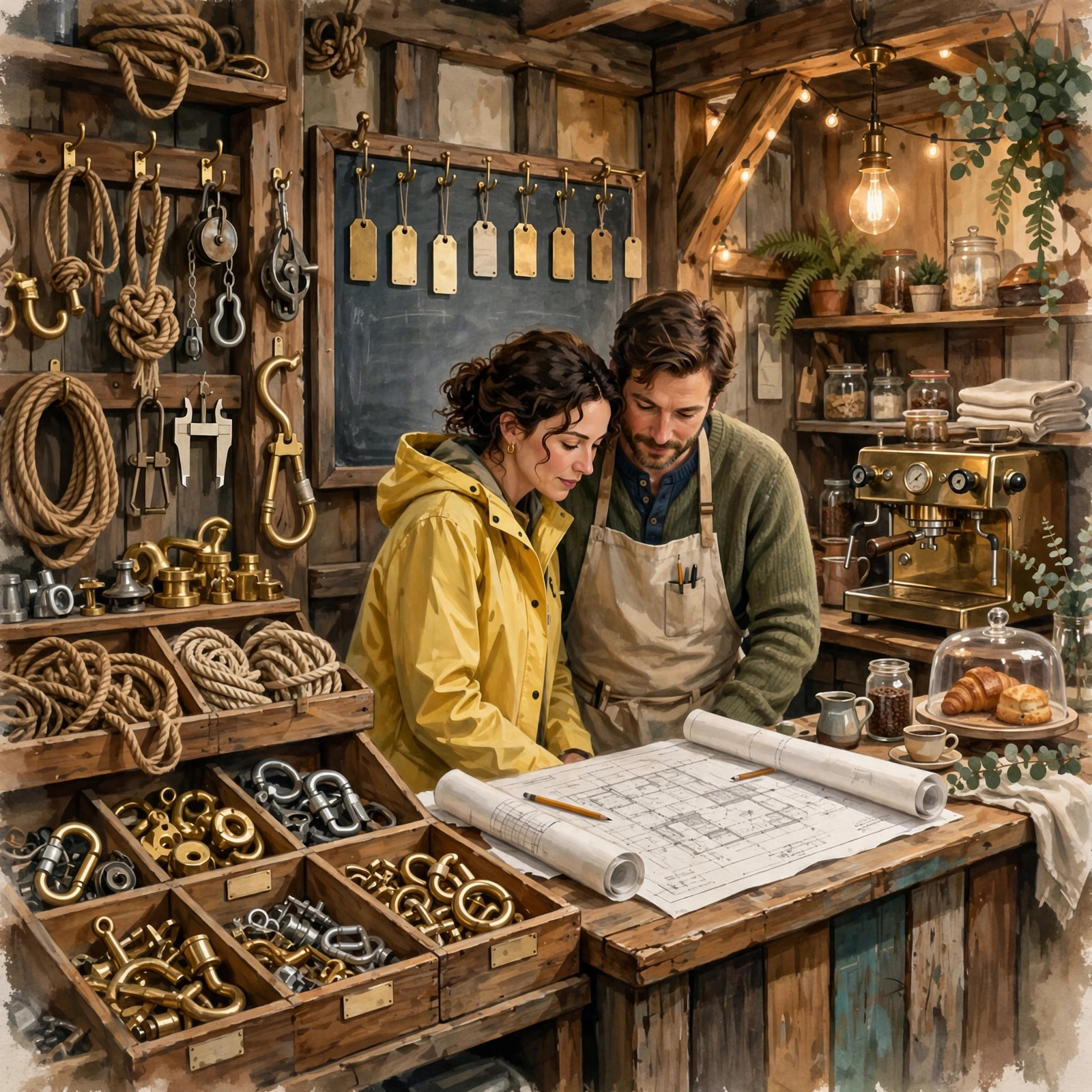
"That track rail hasn't carried anyone past the fifth rung since July," Tessa Lind said from the end of the marine fastener aisle. She balanced a crate of bronze boat nails on her hip, her bright raincoat still beaded with mist. "If you tip backward into the oarlocks, Maren, I'm not filling out the county paperwork."
"The rail is lagged into four-inch fir studs," Maren said, buckling her heavy canvas tool belt over her wool sweater. She checked the hollow steel increment borer in her hand, making sure the extractor spoon was seated inside the handle. "It'll hold."
"It'll hold if someone keeps the bottom casters from walking out on the sloped floorboards," Callum said. He stepped around the espresso counter, wiping his palms on a bar towel before tossing it onto the workbench beside the Weather Slates Board. The brass VANCE tag still hung untouched under the squall column. He wrapped both hands around the ladder's oak stiles, planting his boots wide. "Go on up. I've got the rails."
Maren glanced at his hands, broad and scarred across the knuckles from machine work, then at the unhooked brass tag. "I brought a thermos from the inn."
"I saw," Callum said. "Tastes like boiled bark from here. Climb."
Tessa snorted, sliding the crate onto a lower shelf. "I'm taking the skiff out toward Kestrel Point before the tide turns. Try not to drop a ceiling beam on him, Maren. Nobody else in Larkspur Cove knows how to set the burr grinder for my French press."
The front door latched behind Tessa, leaving the high-ceilinged room quiet except for the low tick of the cooling roaster in the back room. Maren climbed seven rungs until her shoulders were level with the top shelves of deadstock marine gear and her helmet grazed the shadow of the great central beam. Up here, the heat from the coffee bar gathered in a dense, fragrant layer.
She braced her knees against the oak rung, pulled her brass calipers from her coat pocket to verify the width of a checking crack near the truss plate, and tucked them back away. As she reached for her beeswax block to grease the borer threads, her elbow brushed a wooden tote wedged beside a coil of manila rope on the top shelf.
Maren paused. Burned into the box's pine end with a hot iron were the letters H. VANCE.
Below her, the ladder didn't shift a fraction of an inch. "Your father's planking clamps are in the crate behind that one," Callum said, his voice rising easily through the quiet shop. "And three of his bronze caulking irons."
Maren rested her gloved knuckles against the branded letters. "I thought the auctioneer sold the whole boatyard inventory to the salvage brokers from downsound."
"They bid on the heavy machinery," Callum said. She looked down and found him watching her, his chin tilted up, the morning light from the front windows catching the dark stubble along his jaw. "The hand tools were bundled into job lots at the end of the afternoon. Nobody wanted old lignum vitae mallets and custom steam-box clamps. I bought four crates for sixty dollars."
"You don't build wooden hulls."
"No," Callum said. "I sell galvanized shackles and eight-ounce lattes. And I rent those clamps out to every gillnetter in the harbor who cracks a rib against the pilings. Half the fleet out there is still held together by your dad's ironwork." He shifted his grip higher on the rail, his thumb brushing the heel of her boot on the fifth rung. "You could have come back for them. It's been eight years."
"I had two suitcases and a bus ticket," Maren said, turning back to the nine-meter beam so she didn't have to look at the pine tote. She pressed the sharp tip of the increment borer against the rough cedar, three inches clear of the nearest bolt head. "Old iron doesn't pay tuition."
"I kept them oiled," he said simply.
Her throat tightened. She leaned her weight into the T-handle and twisted clockwise. The starter threads bit into the outer crust of the timber, shedding a fine ribbon of dry red dust that drifted down onto Callum's flannel shoulders. The first two inches turned with the dry, crisp crunch of sound heartwood. Then the steel flute hit a dense pocket deep inside the timber, and the resistance doubled.
Maren grunted, shifting her stance on the narrow rung to throw her shoulder into the turn. The borer gave a sharp, resinous squeak and seized completely.
"Stop," Callum said below her. "You're torquing the ladder."
"The bit's bound in wet sapwood," she muttered, testing the handle. The steel shaft was locked tight, four inches deep in the beam. If she yanked it sideways, she would snap the hollow bit or split the grain along the check line, ruining both a three-hundred-dollar tool and the structural integrity of the sample. "There shouldn't be moisture this high up the span unless the roof flashing failed."
Before she could reach for her wrench, the ladder creaked under double weight. Callum came up the rungs behind her with silent, compact grace, stopping two steps below so his chest was just behind her shoulder. The warmth of him cut right through her wool sweater, carrying the scent of roasted Sumatra beans and cedar shavings.
"Move your left hand in toward the collar," he murmured near her ear, his breath warm against her temple. "If we lever the ends of the T-bar alone, we'll shear the tube."
Maren didn't argue. She slid her palm inward to the center hub. Callum reached around her, one arm bracing the ladder stile while his other hand closed directly over hers on the steel handle. His fingers were rough, dry, and steady, locking over her knuckles as they began to back the threads out together, quarter-turn by quarter-turn.
"Easy," he said, matching his pull to the flex of her wrist. "Feel the pitch let go first."
The wood groaned around the steel tube. With Callum's leverage steadying the center axis and Maren guiding the angle of the T-bar, they worked hand-over-hand in the cramped space beneath the rafters. Every movement pressed her shoulder blade against the front of his shirt. She could feel the deep, even rise of his chest and the solid iron of his forearm against hers. The borer gave another high squeak, yielded half an inch, and then spun free with a soft pop.
Neither of them moved for a second. Callum's hand stayed wrapped over hers on the warm steel, his thumb resting against the racing pulse at her wrist. Down on Harbor Street, a pickup truck rattled past, its tires humming on the wet bricks.
Maren cleared her throat and slid the thin metal extractor spoon up through the hollow bit, giving it a half twist before drawing it back out. Lying in the metal trough was a perfect, pencil-thick cylinder of red cedar, banded with tight centuries-old growth rings.
She lifted the core from the spoon and handed it down to him. Callum took the fragile wood cylinder between his thumb and forefinger, rolling it carefully in the light.
"Look at the dark band at the top half-inch," Maren said, leaning down to point. "Touch it."
Callum pressed his thumb to the darker wood, then brought it to his nose. His brow furrowed. "That's not salt rot. It smells like wet creosote and espresso."
"Give it here." Maren took the cedar core back from his palm, her fingers brushing the calluses at the base of his thumb. She smelled the damp end of the cylinder. It was rich with spicy cedar oil, sharp wood smoke, and the unmistakable sweet-bitter tang of roasting moisture. She looked past his shoulder toward the back room, following the line of the ceiling timber to where the galvanized roaster exhaust flue ran parallel to the beam before exiting through the transom wall.
A dark, weeping ring stained the galvanized slip-joint right beside the timber.
"Your roaster exhaust flue has a broken seal at the elbow," Maren said, her voice dropping as the math clicked together in her head. "Every time you run a batch on a cold morning, hot steam condenses at that joint and wicks straight along the top grain of this beam. It isn't sea rot coming through the pilings. The heartwood is completely sound."
Callum stared at the ductwork in the back room, then looked back at her face, inches from his own on the high ladder. The grim tightness he had carried around his eyes for two days vanished. "If I reroute that flue straight through the back masonry wall and seal the joint, the beam dries out."
"If we get the moisture content down before my final reading," Maren said, slipping the fragrant cedar core sample into the protective vial in her coat pocket, "the trust won't have grounds to condemn the span."
After the Last Ferry
The ten-inch galvanized collar refused to budge from the ceiling flange. Maren braced her boot against the third rung of the step-frame, wedging the flat steel blade of a pry bar into the seam where fifty-year-old roofing mastic had hardened like black glass. Five days into her ten-day window, the barometer had dropped through the floorboards.
Outside, a spring squall came off Kestrel Point and hit the harbor front broadside. The iron streetlamps along Harbor Street flickered twice, buzzed like trapped hornets, and went dead all the way down to The Ferry Slip.
Inside the back room of Oarlock Coffee & Hardware, the overhead bulbs died with a soft click. The shop plunged into thick, cedar-scented dark, broken only by the orange glow of the cast-iron roaster cooling in the corner and the beam of the brass lantern Callum had clamped to the workbench.
"Don't move," Callum said from the foot of her ladder. "I've got the other kerosene lamp right here."
A match flared, lighting the hard bridge of his nose and the dark stubble along his jaw. He touched the flame to the wick, lowered the glass chimney, and set the lantern on an overturned crate of galvanized lag bolts. Twin halos of amber light climbed the 1898 timbers, throwing their shadows twelve feet tall against the brick wall.
Maren wiped her forehead with the back of her flannel sleeve, leaving a smear of toasted chaff across her wrist. "The transformer by the slip always blows when the wind shifts southeast."
"You remembered." Callum climbed the opposite side of the double trestle, carrying a pair of tin snips and a heavy roll of sheet copper tucked under his arm. "Last boat cleared the dolphins twenty minutes ago. We're on our own until the county crew comes over on the morning run."
"Good thing we don't need juice for a pry bar." She set her weight into the tool. The mastic gave a sharp, dry crack. A shower of brown coffee chaff, flaky as dry autumn leaves, rained down out of the parted seam, coating her hair and the shoulders of Callum's thermal henley. Cold rain immediately drummed through the gap above the roof jack, spattering her knuckles.
"Watch your fingers," he said. He reached across the narrow gap between their ladders, wrapping both hands around the heavy galvanized roaster exhaust flue. The muscles in his forearms corded beneath his rolled sleeves as he took the dead weight of the six-foot vertical pipe. "Twist it left on three. One, two, three."
Maren wrenched the collar. Callum hauled down and back, his shoulder brushing hers as the pipe came free of the historic ceiling truss with a hollow metallic groan. Cold seawater and black soot spilled from the lower elbow, splashing across the front of his shirt and soaking the knees of Maren's jeans before they wrestled the awkward cylinder down to the floorboards.
Wind howled through the open eight-inch hole in the roof planking above the main cedar beam, driving needles of rain into the back room. The air smelled fiercely of wet wool, ozone, and roasted Sumatra beans.
"Hand me that copper flashing," Maren said, already reaching for her coat pocket. She pulled out her grandfather's brass calipers, slid the thumb wheel open with practiced precision, and measured the inside lip of the old roof jack before tucking the tool back into her pocket. "Seven and three-quarter inches clear. If we flange the copper up from the underside and bed it in marine sealant, it'll hold until the roofers can shingle over the top next week."
Callum didn't pass the copper immediately. He was looking up at her from two rungs below, rainwater glistening in his dark hair and a flake of golden chaff stuck to his collarbone. "You don't have to be up here doing contractor work at ten o'clock at night, Maren. Your contract with the trust only covers the audit."
"If this beam stays wet for another three days, it won't matter that the heartwood is clean," she said, taking the roll of copper from his hands. Their fingers overlapped on the cool metal. "Besides, I don't like half-finished jobs. Give me the snips."
For the next forty minutes, they worked in the tight golden cone of the lanterns. There was no room for hesitation with the squall trying to tear the tarp off the roof outside. Callum held the heavy square of copper sheet overhead, his biceps trembling slightly from the awkward angle, while Maren drove galvanized roofing nails into the collar decking with short, clean strokes of a sixteen-ounce hammer. Every time she swung, her hip bumped his chest. Every time he shifted his grip, his breath warmed the damp hair at her temple.
She knew the rhythm of working beside someone who understood timber and metal. Eight years in Seattle had given her clean office blueprints and polite engineering interns who didn't know a plumb bob from a sash weight. Callum anticipated where she needed the pry bar before she asked, his thumb steadying the copper edge three inches from her hammer head without flinching.
"Last two," she muttered, pulling a nail from between her teeth and setting it into the pine sheathing. Two sharp raps drove it flush. She dragged the caulking gun around the perimeter, smoothing the thick gray bead of marine urethane with a wet thumb until the drumming rain above them softened to a dull, watertight thud.
"Look at that," Callum said softly. "Dry as a bone."
They climbed down the trestle together. On the floorboards, the dismantled roaster exhaust flue lay in three heavy sections. Together they lifted the main elbow and fitted it into the new core hole Callum had cut straight through the lower masonry wall that afternoon, completely bypassing the historic truss overhead. When the final stainless clamp clicked shut, the old cedar timber above them sat entirely clear in the warm air rising off the cooling roaster.
Maren let out a long breath and leaned her shoulders back against the warm brick casing of the roaster. The masonry still held the afternoon's three-hundred-degree heat, soaking straight through her damp flannel shirt into her spine. Her hands were black with sealant and dusted with golden chaff.
Callum picked up a clean shop rag from the workbench, poured a splash of turpentine onto the corner, and stepped in front of her. He didn't ask. He took her right hand in his palm and began wiping the gray urethane from her knuckles.
His touch was slow, almost methodical, his rough thumb working across her skin. Maren looked down at the crown of his head, then up as he lifted his eyes. The lantern light caught the amber ring around his pupils.
"You've got chaff in your eyelashes," he said, his voice low under the drumming rain on the roof.
"You've got soot on your jaw."
"Fair trade." He tossed the rag onto the floorboards. His hands were warm and smelled faintly of pine spirits and roasted coffee as he framed her waist, his thumbs resting over the bottom ribs beneath her damp shirt. He didn't pull her forward; he stepped into the space between them, caging her lightly against the warm brick of the roaster. "Stay."
"I'm already here, Callum."
"Not just for the pipe."
She raised her clean hand and set her palm against the side of his neck, feeling the heavy, steady thud of his pulse beneath the damp skin. For eight years, coming back to Larkspur Cove had felt like walking onto thin ice over deep black water. With Callum's chest against hers and the smell of cedar and rain filling the shop, the floor beneath her boots felt solid enough to carry a lighthouse.
She rose onto her toes, and he met her halfway.
His mouth was warm, tasting of dark roast and salt air. There was nothing tentative about the way he kissed her. One of his hands slid up her spine, pressing her flush against him, while the other tangled in the damp hair at the nape of her neck. A soft sound caught in Maren's throat as she gripped the wet wool of his shirt at his shoulders, pulling him closer until the brass buttons of her coat clicked against his belt buckle. When he parted her lips, the heat of the brick behind her seemed to flare straight into her bloodstream, making her knees go loose.
He broke the kiss only far enough to press his forehead to hers, both of them breathing hard in the quiet shop. His thumb traced the line of her cheekbone.
"You're shivering," he whispered against her mouth. "The stove upstairs has been banked since five. Come up and get dry."
Maren looked at him, her heart hammering against her ribs, and nodded once.
As they turned toward the narrow wooden stairs at the back of the room, Maren slipped her hand into her damp coat pocket. Her fingers closed around her grandfather's brass calipers. Without breaking stride, she drew the worn brass tool out and laid it down on the oiled maple surface of Callum's workbench beside his wrench set.
Callum's hand closed warm and firm around hers. He blew out the lantern on the crate, leaving only the dying amber glow of the roaster behind them, and led her up the stairs. At the top landing, the heavy fir door of his apartment swung shut with a soft click of the latch.
Sixteen Steel Plates
Maren’s phone vibrated against the scarred pine of the rear drafting counter, skittering an inch toward the edge before she caught it. Outside the salt-streaked window of Oarlock Coffee & Hardware, the seventh morning of her ten-day window had dissolved into a thick coastal fog that swallowed Harbor Street whole. Up front, the espresso machine hissed, followed by the low rumble of Callum’s voice as he counted out bronze boat nails for a customer.

She glanced at the screen, then pressed the phone to her ear. "Hello?"
"Maren, thank God you have signal out there," her managing partner said from his thirty-second-floor office in Seattle. Traffic hummed faintly behind him. "Listen, the Mercer restoration bid just cleared the city council three weeks early. The board wants the new letterhead finalized before the press release goes out."
Maren’s fingers tightened around the casing. "My ten days here aren't up until Friday."
"We need the senior partner agreement signed and couriered back by Friday noon, Maren. Not next week. If you're on that letterhead, you're leading the Mercer structural overhaul. If you're still tied up in county timber assessments, we have to hand the lead to Harrison and hold your buy-in until next fiscal year."
Her gaze drifted toward the open doorway of the back room. The narrow wooden stairs leading up to Callum’s apartment stood in warm shadow. Her wool sweater still smelled faintly of his cedarwood soap and the woodsmoke from his upstairs stove. "Friday noon," she repeated, her voice dropping so it wouldn't carry past the shelving units.
"It’s what you’ve worked eighty-hour weeks for since you joined us. Don't let some rotting fishing village hold up your ink. Put the file to bed and get on the ferry."
The line clicked dead. Maren lowered the phone, her palm damp against the glass.
Up at the front register, Gideon Marsh laughed, a rough bark that echoed off the old 1898 ceiling joists. "Tell you what, Cal, if this fog sits on The Ferry Slip any thicker, the afternoon boat won't even drop her ramp. Just like that November before Vance’s yard went under."
Maren froze behind the tall rack of galvanized shackles.
"Man kept pouring his own savings into those rotten pilings," Gideon continued, his heavy boots shifting on the floorboards. "Thought the town would rally around him when the bank called the note. Instead, half the fleet moved their winter haul-outs up the coast, and the auctioneer took the rest for pennies. Once Larkspur Cove gets its hooks in your pockets, it bleeds you dry."
"Vance had bad luck with the winter storms, Gideon," Callum said, his tone flat and protective. "And a banker who didn't care about boats. Here's your change."
"Luck's got nothing to do with bad timber," Gideon muttered. The front door bell jangled as the older man stepped out into the mist.
Maren stared down at the cedar core sample resting on the blotter beside her open leather portfolio. The pale wood was dry, solid at the heart, needing only sistered joists and localized resin injection—work Callum could do himself at night without closing the shop for a single hour. Work that would require her to come back twice a month for the next six months to sign off on each staged phase for the county historic trust.
Six months of driving down to Kestrel Point. Six months of sleeping upstairs under Callum’s quilt, listening to the harbor buoys groan in the dark, letting this town wrap itself around her throat until some winter storm or failed roaster motor dragged them both under. Eight years ago, she had stood in the mud outside her father's padlocked shed and sworn she would never let a building in this town own her life.
Her throat felt tight, the air in the back room suddenly thick with coffee chaff and damp wool. She reached into her leather portfolio, pulled out the thick cream pages of the Seattle partnership contract, and laid them on the counter to reach the county carbon forms underneath.
Her pen shook slightly as she uncapped it. Instead of checking the box for staged timber sistering, she pressed the ballpoint hard into the top sheet of the county triplicate form. She wrote the specification that required zero follow-up visits from the inspecting engineer. One massive, standardized municipal overhaul, signed off by a county clerk upon delivery of the steel mill certificates.
Sixteen custom quarter-inch steel gusset plates, through-bolted across the central ceiling trusses.
It was bulletproof. No county board would ever question it. And to hoist sixteen forty-pound steel plates into the ceiling with hydraulic jacks, Callum would have to clear out the hardware aisles, shut down the roaster, and close Oarlock Coffee & Hardware for two full months right at the start of the summer fleet season.
Maren’s chest ached with a dull, hollow pressure as she filled in the load calculations. She didn't look at the stairs. She just wrote, the carbon paper whispering beneath her knuckles.
"Gideon doesn't know half as much as he thinks he does," Callum said, walking into the back room with two steaming ceramic mugs. He set one down near her elbow—dark roast, a splash of oat milk, no sugar. Then he reached into his apron pocket and drew out a newly stamped brass disk. "Found a blank in the drawer. Figured you earned a permanent spot on the Weather Slates Board."
He laid the brass coffee tag beside her mug. Her name, MAREN, was hand-stamped across the center in slightly crooked capitals.
"Callum," she started, moving her forearm to cover the triplicate form, "the roaster exhaust flue up at the roof jack needs another coat of high-temp silicone before I leave."
"I'll grab the tube." He turned toward his workbench, picked up a caulking gun, and paused. His eyes dropped to the far end of the counter where the cream pages of her Seattle contract lay next to the yellow carbon sheet she had just torn free to check her math.
Maren reached for the yellow sheet, her boot heel catching on the rung of the drafting stool. Callum’s oil-stained fingers got there first.
He didn't mean to snoop; he was just shifting the paper out of the way of a spilled ring of espresso grounds. Then the bolded header caught his eye, and his hand went still.
Silence settled over the back room, broken only by the steady drip of fog condensation falling from the porch eaves outside. Callum read the yellow county sheet, his jaw tightening until a muscle jumped beneath his beard. Slowly, his gaze shifted three inches to the left, landing on the cover page of the Seattle contract and the sticky note in Maren's handwriting reading: Sign & courier by Friday noon.
"Sixteen steel plates," Callum said. His voice wasn't loud, which somehow made it worse.
"It's the standard seismic and load upgrade for an 1898 commercial span," Maren said, her voice sounding tinny and rehearsed even to her own ears. "Once the steel is bolted in, the trust releases the historic grant restriction permanently."
"It'll take the foundry in Tacoma six weeks just to fab sixteen custom gussets." Callum looked up at her, the warmth draining out of his hazel eyes, leaving them the color of winter slate. "And another two weeks with scaffolding blocking every aisle in the shop. Two months with the doors locked, Maren. My commercial mortgage doesn't pause for steel fabrication."
"The sistered joists had a higher variance margin," she said, rising from the stool, her hands curling into fists at her sides. "If the humidity spikes again next winter—"
"Last night you stood right there and showed me the core sample," he cut in, pointing at the pale cylinder of cedar on the blotter. "You told me the heartwood was sound as the day it was milled. You said four sistered Douglas fir beams along the wall would carry the load for another fifty years."
"That requires a six-month conditional monitoring period."
Callum looked back down at the Seattle contract. A bitter, humorless sound escaped him. "And a newly minted senior partner in Seattle can't be driving down to Larkspur Cove once a month to check on a hardware store. You needed a one-page sign-off so you could close the file by Friday."
"That isn't why I wrote it."
"Then why?" He stepped closer, not to touch her, just standing over the counter with his palms flat on the scarred wood. "Because two hours ago you were in my bed, and the second the sun came up you remembered what happens to people who tie themselves to this harbor?"
She flinched, the movement small and sharp. It was answer enough.
Callum saw it. He straightened up slowly, pulling his hands back as if the pine counter had burned him. "You think I'm your dad's boatyard, Maren? You think I'm asking you to sink your life into rotten pilings?"
"I know what this town costs when the weather turns," she whispered, her throat raw. "My father had solid contracts too, right up until the week he didn't. I can't stay here waiting for the roof to come down."
"So you're pulling it down yourself just to get out the door clean." Callum turned to his workbench. He reached past the wrench set and picked up her grandfather’s brass calipers from the oiled maple surface where she had left them the night before.
He didn't slam them down. He held them out to her, handle first.
"Take your tools, Ms. Vance," he said quietly. "File your report with the county. I'll clear the aisles by Monday."
Maren took the calipers. The brass was cold, heavy as lead in her palm. She slid them into her coat pocket, shoved the unsigned Seattle contract and the yellow carbon copy back into her leather portfolio, and buckled the strap with trembling fingers.
She looked once at the newly stamped brass tag gleaming beside the untouched mug of coffee. She didn't pick it up. Turning her back on the warm brick of the roaster, she walked past the espresso bar, pushed open the heavy front door, and stepped out into the gray fog on Harbor Street with the calipers pressing cold against her hip, leaving the brass tag with her name lying flat on the counter behind her.
The Outbound Mail Sack
The afternoon wind coming off Kestrel Point rattled the corrugated tin roof of the passenger shelter at The Ferry Slip, carrying the sharp, briny tang of low tide and diesel exhaust. Maren leaned her hip against the salt-bleached railing of the waiting deck, turning the pale cylinder of the cedar core sample between her thumb and forefinger. She brought her brass folding loupe up to her eye, angling the wood toward the thin grey light breaking through the clouds.
Through the ground glass lens, the tight, resinous winter rings of the 1898 timber stood in crisp relief. Only the outer quarter-inch showed the feathery, honeycombed breakdown of dry rot from the old roof leak. Deeper in, where the wood had carried the roof load of Oarlock Coffee & Hardware for over a century, the grain was dense, dry, and intact. It smelled faintly of turpentine and cold smoke.
She didn't need a laboratory compression test to read the fibers. Her grandfather had taught her to read old-growth cedar before she was tall enough to reach the band saw switch, and her father had drilled the shear tables into her head every summer until the bankruptcy auction took the yard eight years ago. The heartwood was sound. The sixteen steel plates she had specified on the county form were overkill, a brute-force municipal cage designed for one purpose: to shift every ounce of legal liability off the inspecting engineer and onto a standardized state code table.
If you bolted sixteen steel plates through that beam, you never had to sign your own name to a conditional monitoring schedule. You never had to come back to Larkspur Cove every month to check the moisture meters. You never had to risk being the one whose math failed when the winter gales hit the harbor.
Wood-soled clogs clattered against the damp planks of the pier. Tessa Lind came around the corner of the shelter, a canvas bakery tote slung over one shoulder and a pink pastry box balanced on her forearm. Her dark curls were pinned back under a wool headband, and her cheeks were bright from the wind.
"Gideon said your truck was parked by the fuel dock," Tessa said, stopping beside the piling and nodding toward the battered leather suitcase sitting at Maren's feet. "The three-thirty boat hasn't even cleared the point yet. You're early."
"I had paperwork to finish before the horn blew," Maren said. She folded the loupe with a soft click and slipped it into her coat pocket, where her grandfather's brass calipers lay heavy against her hip.
Tessa set the pink box on the wide timber cap of the railing. "Rye sourdough boules for the inn over on the island, and two cardamom knots for you. Don't argue with me, Maren. Ferry coffee tastes like bilge water and you look like you haven't slept since Thursday."
"I haven't," Maren admitted. It was Saturday afternoon, the ninth day of her ten-day audit window, and the last forty-eight hours in her motel room at the top of Harbor Street had crawled by in a blur of cold tea and ceiling stains.
Tessa looked down at the cedar plug in Maren's palm, then at the open leather portfolio resting on the bench inside the shelter. "Callum closed the hardware aisles at noon today. He had twelve tarp-covered pallets stacked in the back alley, moving the marine brass out to the shed so the welders would have clearance on Monday."
A cold knot tightened behind Maren's ribs. "He doesn't need welders."
"Then why is he taking down the oarlocks?" Tessa didn't raise her voice. She just leaned her elbows on the railing, watching a pair of cormorants dive near the channel marker. "He didn't even ring the bell at seven o'clock yesterday, Maren. Or this morning. He still unlocked the door and poured the drip for the gillnetters, because he's Callum, and he'd rather lose his shirt than let the fleet go out cold. But the porch was dead quiet."
Maren stared down at the green waters swelling around the creosote pilings. "The county trust wants a zero-risk guarantee before they release the preservation grant. If I sign off on a traditional timber repair, my personal license sits on the file for the next five years. If that beam shifts a quarter of an inch during a January blow, the bond company comes after me."
"And if they bolt steel through it, the shop shuts down during the spring charter run and Callum loses the building before the tourists even get here," Tessa said. She reached out and tapped the cedar core sample with one flour-dusted knuckle. "Is the wood rotten, Maren?"
"No," Maren said, her voice barely carrying over the slap of the tide against the slip. "Just the sapwood on the north cheek. Five inches deep by forty inches long."
"My dad used to say your father could look at a schooner's keel and tell which side of the mountain the fir grew on," Tessa said softly. "Nobody blamed him when the cannery folded and defaulted on those three trawler hulls, Maren. The whole cove went under that winter. You're the only one still acting like the Vance name is a bad check."
Maren's throat constricted. For eight years, she had taken every sterile, high-rise steel retrofit her firm handed her. Concrete cores and rolled I-beams didn't rot, didn't carry family ghosts, and didn't require you to trust that a harbor town would hold you up when the economy turned. She had built an entire career out of making sure she could walk away clean before the roof came down.
Down the ramp, the heavy iron gate of the postal cart rattled. Gideon Marsh walked out onto the concrete apron, wearing his reflective harbor master vest over a faded flannel shirt. Slung over his shoulder was the thick canvas outbound mail sack, its brass grommets dull with verdigris, a heavy padlock hanging open from the iron hasp while he waited for the ferry clerk's final pouch.
"Afternoon, ladies," Gideon called out, setting the bottom of the sack on the timber bull-rail next to the town post box mounted by the slip. He squinted out toward Kestrel Point, where the white superstructure of the mainland ferry was just rounding the headland. "She's running ten minutes against the ebb. You headed back to the city a day early, Maren? County gave you ten days on that order."
Maren looked at the ferry cutting a white furrow across the grey strait. Then she looked down at the leather portfolio open on the bench. Right on top lay the heavy cream vellum of the Seattle partnership contract, along with the pre-addressed courier envelope the senior partners had given her before she drove north. All it needed was her signature on the bottom line and a drop into Gideon's canvas sack. By Monday morning, she would have a corner office on the fourteenth floor, a six-figure draw, and three days of paid transition leave before her new caseload buried Larkspur Cove forever.
She walked over to the bench, set the cedar core sample down beside a blank roll of 24-by-36-inch drafting vellum, and pulled the uncapped fountain pen from her pocket.
She didn't sign the signature block.
Instead, she turned to the cover letter clipped to the front of the Seattle contract. In neat, square architectural block lettering across the bottom margin, she wrote: *Thank you for the offer. I am declining the partnership to return to independent structural practice in Larkspur Cove. My notice is effective immediately.* She signed her name beneath it, the nib biting cleanly into the cotton paper.
Tessa stepped into the shelter, her eyebrows lifting as Maren folded the thick sheaf of partnership papers, slid them into the pre-paid courier envelope, and peeled the adhesive strip.
"What did you just do?" Tessa asked quietly.
"Cleared my schedule," Maren said.
She walked out of the shelter to where Gideon stood by the post box. She held out the sealed courier flat.
"Outbound for the mainland pouch, Gideon," Maren said. "Can you log that into the sack before the boat ties up?"
Gideon took the thick envelope, glancing down at the Seattle return address and then up at her face. The weathered creases around his eyes deepened. He didn't ask questions. He just held the mouth of the canvas mail sack wide, dropped the partnership contract to the bottom among the bundled harbor manifests, and pulled the thick hemp drawcord tight through the brass grommets. With a sharp snap of his thumb, he clicked the heavy brass padlock shut through the iron staple.
"Locked and manifested," Gideon said, patting the canvas side of the sack. "Once the clerk signs for the bag, nobody opens her till the main sorting annex at Pier 52."
"Good," Maren said. Her heart was hammering against her ribs, fast and fierce, yet for the first time since she had crossed the county line, her hands were completely steady.
She turned back to the wooden bench inside the shelter, spread a fresh sheet of drafting vellum across the scarred planks, and weighted the top corners with her leather portfolio and Tessa's pink pastry box. From her coat pocket, she drew her grandfather's brass calipers.
She picked up the cedar core sample and measured the exact depth of the sound heartwood with the brass jaws, reading the vernier scale before transferring the ratio to the vellum with a sharp metal scale and a mechanical pencil. Her fingers moved with the fast, practiced certainty of someone who had grown up breathing cedar dust. She didn't draw sixteen steel plates. She drew a classic four-foot keyed scarph joint, paring away only the compromised north sapwood cheek and splicing in a seasoned old-growth cedar prosthetic locked with four white-oak trunnels and two recessed bronze drift pins. No welding sparks. No floor jacks blocking the hardware aisles. The roaster exhaust flue wouldn't even need to be unbolted.
At the bottom right corner, inside the title block, she wrote out the structural remediation schedule: *Six-month load and moisture monitoring to be performed on-site on the first Monday of each month by the engineer of record.*
She reached into the bottom of her tool bag and pulled out the heavy circular embossing seal she hadn't used on an independent timber job in eight years. Sliding the corner of the vellum between the iron jaws, she pressed down with both palms until the metal clicked, raising the sharp circular relief of her state architectural license number directly over the conditional monitoring clause. She signed *Maren Vance, P.E.* right across the raised seal in black permanent ink.
Down in the slip, the ferry's air horn let out a long, low blast as the green-and-white vessel reversed its engines, churning white water against the pilings. The timber dolphins groaned as the hull settled into the rack.
"Boat's in, Maren," Gideon called, hoisting the locked canvas mail sack onto his shoulder as the deckhands threw the heavy mooring lines over the bollards.
Maren rolled the stamped blueprint into a tight cylinder and snapped a rubber band around the center. She slipped the cedar core sample and the brass calipers back into her coat pocket, buckled her leather portfolio, and picked up her canvas tool bag.
"Tessa," Maren said, nodding toward the battered suitcase sitting by the shelter post. "Can I leave my suitcase behind the bakery counter for an hour? I need to check the moisture content on a beam before the sun goes down."
A slow, wide grin broke across Tessa's face. She grabbed the suitcase handle with her free hand and tucked the pink pastry box under her arm. "I'll put the kettle on, just in case. Go."
As the ferry ramp clanked down onto the dock and passengers began filing toward the gangway, Maren turned her back on the water. With the rolled blueprints tucked firmly under her arm and her tool bag knocking against her knee, she walked past the ticket booth and headed straight back up the steep hill of Harbor Street toward Oarlock Coffee & Hardware.
The Brass Tag
The bronze clapper struck the lip of the ship's bell twice, sending a clear, ringing note down the length of Harbor Street just as the clock behind the espresso bar reached seven o'clock.
Maren stood on the bottom step of Oarlock Coffee & Hardware, her boots damp with the morning fog rolling off Larkspur Cove. She had spent the night on the narrow cot above Tessa's bakery after walking up from The Ferry Slip the evening before, only to find the hardware shop's front curtains drawn and the planer whining steadily behind the locked back door. Rather than pounding on the glass while the dust settled, she had waited for the morning light.
Gideon Marsh let go of the braided lanyard hanging from the porch beam, tucked his canvas mailbag higher on his hip, and tipped his cap to her. "Morning, Maren. Thought you were on yesterday's boat."
"Changed my ticket," she said, adjusting the rolled vellum cylinder under her arm.
"Good thing. The coffee on the mainland tastes like bilge water." Gideon pulled open the heavy fir door, letting out a warm gust of roasted Sumatra and fresh resin. Behind him, Tessa Lind hurried up the walk carrying a wire crate of warm sourdough loaves, her apron dusted with flour.
"Go on in," Tessa murmured, bumping the door wider with her hip. "He's been running the band saw since four in the morning. My oven walls were vibrating."
Maren stepped over the threshold into the bright, busy heat of the shop. Inside, half a dozen fishermen in yellow bibs were already clustered by the Weather Slates Board beside the espresso bar, unhooking stamped brass circles from the lower pegs and sliding them onto the top row to claim their mugs. Behind the scarred pine counter, Callum wasn't pulling espresso shots. He was wearing a canvas shop apron thick with pale orange sawdust, wiping his hands on a blue rag while the twin brass boilers hissed behind him. Shadows smudged the skin beneath his eyes, and a streak of dark machine grease crossed his left forearm.
When he looked up and saw her standing by the bolt bins with her canvas tool bag at her feet, his hands went still on the rag.
The chatter around the galvanized marine bins dropped an octave. Gideon cleared his throat, plucked a brass disk off the board, and laid it quietly beside the cash register without asking for his dark roast.
Maren walked to the counter. She didn't look at the sixteen steel plates stacked neatly on the bottom shelf of the rolling cart by the back doorway, still banded in their shipping wire from the foundry. Instead, she pulled the rubber band off the vellum cylinder, unrolled the blueprint across the scarred pine between the scale and the brass screw tray, and weighted the corners down with the cedar core sample and her brass calipers from her coat pocket.
"Today is day ten," Maren said, her voice steady over the low rumble of the roaster cooling fan in the back room. "The county trust gets their final structural determination by noon. If you fax this sheet to the assessor's office before twelve, the three days they gave you on that commercial lease buyout clause are null and void. The building passes under a conditional remediation schedule."
Callum looked down at the drawing. His eyes tracked the red ink cross-sections, the load calculations written in her neat block lettering, and the raised circular seal pressed into the lower right corner over her signature. He reached out, his thumb brushing the embossed paper without quite touching the ink.
"A keyed scarf joint," he said quietly. "With white-oak trunnels and recessed bronze drift pins."
"It takes the shear load off the checked cheek without boxing the heartwood in steel," she said. "You won't have to unbolt the roaster exhaust flue in the back room, and you won't lose the ceiling clearance over the hardware aisles. The catch is that an independent engineer has to sign off on the moisture readings every month for half a year. And the county won't pay a contractor to mill a custom timber splice."
"Meaning the engineer of record has to stay within driving distance of Kestrel Point," Callum said, his gaze lifting to meet hers. "What happened to the partnership desk in Seattle?"
"I mailed the contract back to them yesterday afternoon. Uncountersigned." She kept her palms flat on the edge of the paper so he wouldn't see her fingers trembling. "My father left me a crate of hand planes in Tessa's dry shed and twenty years of timber notes. Turns out there are enough historic barns and salt-water piers in this county to keep a one-woman consulting firm busy if she isn't too proud to climb into a bilge."
Callum's jaw worked. For three seconds, the only sound in the room was the rhythmic drip of the brew basket and the gulls crying down by the harbor.
"You stamped this with your own license," he said. "After I practically threw you off the porch yesterday."
"You were wrong about the county wanting to tear the roof down, and I was wrong to hide behind a clipboard and act like eight years away made me immune to this place." Maren swallowed hard. "I didn't want to watch another good timber frame get auctioned off in pieces because I was too scared to put my name on the line."
Callum let out a long breath that seemed to take the rigid set right out of his shoulders. Without a word, he reached under the counter, gripped two rope handles, and hoisted a heavy wooden tote box onto the pine surface beside her blueprint.
Maren looked inside. Nested in a bed of curly shavings were four precisely milled wedges of dense, tight-grained old-growth red cedar, cut to a twelve-degree scarf bevel, alongside four hand-turned white-oak trunnels and two heavy bronze collar brackets drilled for drift pins.
She reached into the box and lifted one of the cedar wedges. The wood was cool and heavy, smelling sharply of spice and decades of air-drying. On the butt end, faint but unmistakable in faded blue lumber crayon, was a stenciled mark: *VANCE BOATYARD - LOT 4*.
Her chest tightened. She looked up at him.
"I bought the last three bunks of your dad's salvaged keel stock at the yard auction eight years ago," Callum said, his voice rough and low enough that only she could hear it over the hiss of the steam wand. "Kept it racked under tarps in the coal shed out back because I couldn't stand seeing the off-island brokers haul it away for patio decking. Last night, after you walked down the hill, I looked at the chalk marks you left on the main tie beam."
"Callum..."
"I was angry because I thought you were leaving," he admitted, his dark eyes steady on hers. "Not because I doubted your math. Even when I was yelling about sixteen steel plates, I knew damn well you were the only person in this town who actually knew how this building stood up. So I went out to the shed at midnight, pulled down a ten-by-ten timber, and milled the splice blocks to match the chalk lines you drew on Tuesday."
He touched the brass calipers lying on the corner of her blueprint, then slid them six inches across the wood until they rested beside his workbench vise at the end of the counter. "I figured if I had the cedar cut and waiting, maybe I could talk you into missing the morning ferry."
A laugh caught in Maren's throat, warm and sudden, stinging the backs of her eyes. "Your bevel angle is off by a sixteenth of an inch on the top shoulder."
The corner of Callum's mouth kicked up. "Good thing I have a structural engineer on retainer. Grab that three-quarter-inch socket wrench out of your bag, Vance. Let's get the test collar up before Tessa starts throwing scones at us."
"You have three minutes before I commandeer the espresso machine myself," Tessa called from the pastry case, sliding a tray of warm cheddar biscuits onto the glass shelf while Gideon grinned into his sleeve.
Callum kicked the step-ladder out from behind the counter, setting its wide pine treads directly beneath the center of the main ceiling beam where the small bore hole from the cedar core sample showed pale against the dark wood. Maren didn't wait for him to hold it. She Shed her wool coat, draped it over a keg of galvanized nails, and climbed the first three rungs with the bronze test bracket and two drift pins tucked into her palm.
Callum came up the opposite side of the double ladder, bringing the smell of cedar dust, soap, and dark roast right into her space. Their knees brushed between the rails. When she held the heavy bronze collar flush against the underside of the beam, his large, calloused hand covered hers to steady the metal while she started the first lag bolt into the pre-drilled pilot hole.
"Hold the plumb line on the left flange," she murmured, leaning back slightly so he could reach past her shoulder with the ratchet.
"Right here," he said, his breath warm against her temple as his chest pressed lightly against her arm. The socket wrench clicked in a crisp, metallic rhythm. One turn, two, three, drawing the bronze collar tight against the hundred-year-old grain until the joint seated with a solid, resonant thud that vibrated through both their palms.
Down below, one of the gillnetters banged his coffee mug against the counter and let out a low whistle. "Looks like the roof's staying on for another century, Reid. How about turning the steam valve on?"
Callum didn't look down. Still standing on the top step with his hand over Maren's on the beam, he leaned in and pressed his mouth to the side of her neck, right below her jaw, before kissing her properly in front of the entire seven o'clock crowd. His lips were warm, tasting of salt and strong coffee, and when Maren curled her free hand into the front of his sawdust-covered apron and kissed him back, Tessa led a round of loud applause from behind the pastry case.
When they climbed down, Callum poured two mugs from the fresh carafe first, sliding one across the pine to Maren before handing the pot to Gideon and telling the room to pour their own for five minutes. While the fishermen crowded around the blueprint on the counter to admire the scarf-joint drawing, Callum reached behind the cash register and picked up a small circle of polished brass stamped with the number *14*.
He carried it over to the Weather Slates Board beside the espresso bar, where a single brass hook on the bottom row had sat empty beside the window frame.
"My grandfather stamped this one for your dad when the boatyard opened," Callum said, holding it out on his palm before hooking it onto the top "Paid in Full" rail. "It belongs in the rotation."
Maren wrapped both hands around her hot ceramic mug and followed him out onto the front porch. The morning sun had burned through the marine layer over Larkspur Cove, turning the water beyond The Ferry Slip into a sheet of hammered silver beneath the high green headland of Kestrel Point. Above them, the brass ship's bell hung quiet in the porch rafters, catching the light. Inside the open door, the sound of brass tags clinking against slate mingled with laughter and the hum of the grinder, and Maren leaned her shoulder against Callum's chest, staying right where she was.
Get notified when new stories drop

Lila Monroe
Lila writes contemporary and small-town romance with banter-forward leads and soft landings. She believes the best love stories sound like two specific people, not a trope checklist.
Leave a comment
Comments