





The Six O'Clock Whistle
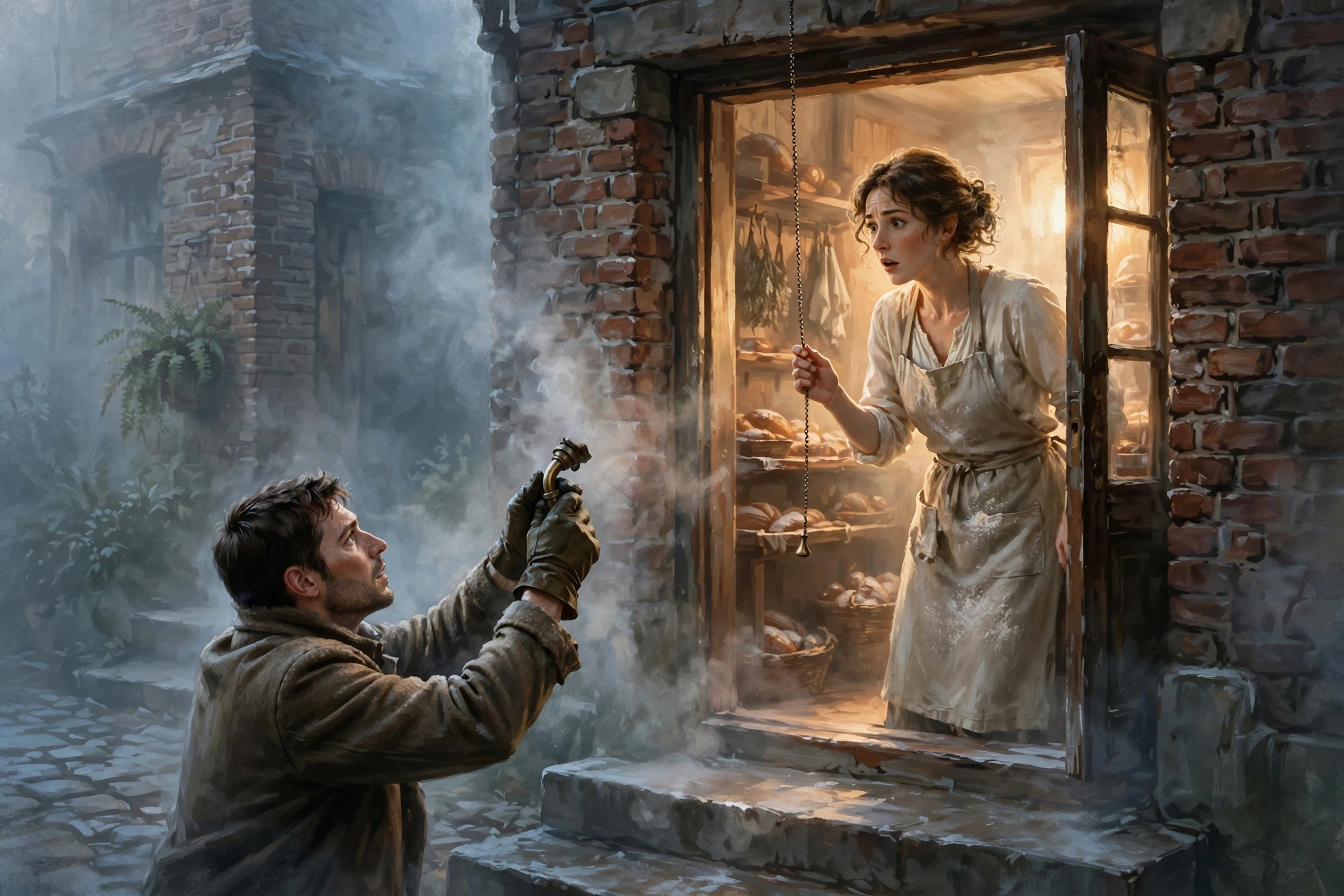
The brass pull-chain by the doorframe of Hearth & Whistle Bakery had been rubbed silver at thumb-height by three generations of thumbs, and at six o'clock sharp on Sycamore Street, Maren Vance wrapped her fingers around the cold links because the town expected noise before it expected bread.
Behind her, a dozen seeded rye loaves ticked as their crusts cooled on the wire racks. In the back office, inside the leather portfolio lying flat on the oak desk, sat the commercial sale contract that would pay off the last of her grandfather's medical estate bills and let her leave Alderford with a zero balance and a single suitcase. Twelve days until the regional restaurant group's closing deadline. Twelve mornings of firing the oven just to keep the hearth insurance valid while the paperwork cleared.
Through the steamed front glass, Toby Lin was already crossing from the corner curb with two empty canvas totes tucked under his elbow, and Bea Sutter was marching up the sidewalk in her quilted hardware-store vest with a clipboard wedged beneath her arm.
Maren tugged the chain down.
Instead of the high, clean blast of steam that had woken Sycamore Street every morning since her grandfather was a boy, a dry metallic shriek split the fog. High in the exterior brickwork above the Hearth & Whistle front door, rusted iron anchors gave way with a shower of red mortar dust. The heavy brass steam whistle wrenched loose from its pipe collar and tipped outward over the concrete steps.
Maren yanked the door open and lunged onto the threshold, hands out, three feet too far back to reach it.
A man stepped out from the brick corner beside Sutter Hardware's delivery alley, dropped a rolled canvas tool kit onto the damp stones, and caught fifteen pounds of falling brass and cast-iron mount in both gloved palms aninch above the concrete.
The impact drove his boots wider apart and knocked a puff of lime dust from the shoulders of his wool coat. He didn't drop it. He tucked the tarnished cylinder against his ribs, tested the snapped iron bracket with one thumb, and looked up.
The porch lamp caught the bridge of his nose, the faint white scar beneath his left eyebrow, the grey-green eyes she hadn't seen since a rainy curb in Burlington eight years ago.
Maren's fingers stayed curled around the slack brass chain. "Calder."
Calder Hayes didn't smile, though something in the corner of his mouth shifted before he schooled it flat. He looked taller in work boots and heavy canvas than he had in graduate-school wool, his dark hair shorter at the temples, a streak of dried mortar across his wrist. "Morning, Maren. Still pulling things down around your ears?"
"The anchors rusted through." Her voice came out thinner than she liked, scraped raw by four hours of hauling ash and shaping dough alone. "What are you doing on my steps?"
"Saving your sidewalk from a two-inch dent, looks like." Calder shifted the brass whistle into the crook of his arm and bent to retrieve his canvas tool roll from the bricks. The leather strap was stamped with worn initials she recognized because she had bought him that roll for a birthday she refused to count back to.
Bea Sutter reached the bottom step, heels clicking, her silver braid tucked neatly into her collar. "He's on time, is what he is. Which is more than I can say for that seventy-year-old wall bracket. Good catch, Mr. Hayes."
Toby jogged up behind Bea, blowing on his knuckles in the October chill. "No whistle today? Half of Sycamore Street's going to sleep through their alarms, Maren. Did the pipe burst?"
"Just the collar," Calder said, turning the heavy cylinder so they could see the sheared bolts protruding from the base plate. "The copper steam line is pinched off at the fascia, so you won't lose boiler pressure, but somebody used soft hardware-store bolts the last time they remounted this instead of bronze pins."
Bea narrowed her eyes behind her spectacles. "If those bolts came out of Sutter Hardware, they were sold in 1984 before I took over the fastener aisle. Maren, let the man inside before my toes freeze. And Toby, get the door."
Maren didn't move from the threshold. The smell of cooling caraway and birch smoke drifted around her shoulders, colliding with the clean, sharp scent of wet slate and cedar soap that always seemed to follow Calder. "Why is he here, Bea?"
"Because the Alderford Preservation Trust holds the historic covenant on the 1912 masonry in this building," Bea said briskly, stepping past Maren as Toby held the brass-trimmed door wide. The warmth of the bakehouse swallowed them in a rush. "And before your grandfather's estate transfers title to a restaurant conglomerate that thinks sourdough comes out of a freezer bag, the Trust has the legal right to inspect the Scotch oven."
"You never mentioned Calder."
"You never mentioned you knew the best historic masonry specialist in two states," Bea countered, setting her clipboard on the glass pastry case. "I hired him through the state preservation registry three months ago when he moved his shop down to the valley. Take two rye boules for the hardware counter, Toby, and put them on my tab."
Toby was already sliding two warm rounds into his canvas totes, his gaze darting between Maren's white-knuckled grip on the doorframe and Calder standing just inside the threshold with the brass whistle cradled against his chest. "Should I come back at seven for the cinnamon buns, or do I need a hard hat?"
"Seven is fine, Toby," Maren said without looking away from Calder. "They're rising in the proof box now."
"Right. Seven. Good seeing you, Calder." Toby backed out the door with the speed of a man who had lived in a twelve-street town long enough to recognize forty volts of history in a twenty-foot room.
Bea tapped her pen against her clipboard. "I have pallets coming off the six-thirty truck at Sutter Hardware. Mr. Hayes has the Trust's inspection sheet. Let him look at the firebox, Maren. Your buyers' bank won't clear the title transfer without my stamp, and I don't stamp anything until he signs off on the brick." She marched out, letting the door latch click shut behind her.
The sudden quiet left only the tick of the cooling racks and the low hum of the proof box.
Maren crossed her arms over her flour-streaked apron. She had spent her whole childhood in this town picking up the pieces her parents dropped, covering overdue light bills and burnt dinners until her grandfather took her in, and she had sworn when she left for culinary work in the city that she would never let Alderford tie her to a counter again. Seeing Calder standing on her pine floorboards made the walls feel six inches closer together.
"You moved to the valley," she said.
"Back in July." Calder's gaze traveled the room, taking in the glass jars of starter on the high shelf, the scrubbed maple shaping bench in the center of the floor, the cedar recipe ledger sticking half an inch out of the flour drawer beneath the bench. "I heard about Arthur in the spring. I was sorry, Maren. He was a good man."
Her throat tightened. She looked down at the pine boards between her clogs. "He worked right up until the stroke in February. Refused to let anyone else touch the peel. Left behind four hospital invoices and a bakery that eats twelve cords of hard maple a year."
"So you're selling it to a chain."
"I'm paying his debts," she said evenly, "and going back to my job before somebody in this town asks me to run the fall bake sale and take over the zoning board. Why didn't you decline the contract when you saw the Vance name on the Trust paperwork?"
"Because Bea Sutter only put Hearth & Whistle on the work order," Calder said. "And because there aren't ten genuine Scotch double-decker brick ovens left working in the northeast. I wasn't going to let some commercial contractor patch Arthur's crown with Portland cement." He walked past the pastry case toward the back wall where the massive cast-iron oven doors sat framed in glazed white brick. "May I?"
"I have twelve days before the closing," Maren said, following him to the edge of the maple shaping bench. "Look at the bricks, sign Bea's form, and let me get back to my cinnamon dough."
Calder set the brass whistle down on the corner of the hearth apron, unrolled his canvas tool kit on the floor, and slid a narrow keystamping trowel and a brass inspection mirror from the leather loops. He pulled on a pair of heat-resistant gauntlets, unlatched the heavy iron firing door with a practiced flick of his wrist, and leaned his shoulders into the wave of four-hundred-degree heat still radiating from the morning bake.
Maren watched his back. Eight years ago in Burlington, they had shared a third-floor apartment over a bookshop, arguing happily about timber frames and laminated pastry until the week she found the letter from Edinburgh under his drafting lamp. A prestigious fellowship in historic stone conservation in Scotland, accepted three weeks earlier without a word to her. When she asked why he'd hidden it, he'd said he didn't know how to tell her he was leaving until the flight was booked. So she had packed her knives before he could pack his calipers, refusing to be the woman left waving on a porch.
Now he was the one in her kitchen with a flashlight clenched between his teeth, angling the mirror toward the vaulted ceiling of the baking chamber.
He stayed there a long time. When he backed out and latched the cast-iron door, there was charcoal soot on his jaw and a crease between his brows that she knew meant bad mathematics.
He slid the keystamping trowel back into his canvas tool roll, picked up the detached brass steam whistle in both hands, and walked back to the center of the room. He set the heavy brass cylinder squarely in the middle of the flour-dusted maple shaping bench between them, leaving a dark ring in the white rye flour.
"You can't close in twelve days," Calder said quietly.
Maren's hand flattened on the edge of the bench. "The contract is already drafted in the office. The oven baked twenty-four loaves at four this morning."
"And you're lucky the center arch didn't drop into your rye," he said, meeting her eyes across the tarnished brass. "A key course in the main crown has sheared through, Maren. It needs forty-eight custom-tapered firebricks cut and laid by hand, or the whole upper vault will collapse the next time you bring it to full steam. No sale inspection is going to pass until I rebuild that arch."
Forty-Eight Firebricks
The forty-eighth brick slid off the ash plank in the truck bed and pinched Maren's left ring finger against the cold steel tailgate.

"Don't drop it," Calder said, catching the bottom edge of the yellow refractory wedge before its ten-pound corner could clip her knee. His leather-gloved knuckles brushed the underside of her wrist. "Lift your thumb. Three, two, up."
They swung the block clear together and set it onto the last open square of burlap on the rolling dough cart just inside the back threshold of Hearth & Whistle Bakery. Two days of forced cooling had brought the great masonry vault down from baking heat to the temperature of a radiator left on low, and the air in the back alley smelled of wet October leaves on Sycamore Street mixed with the sweet, toasted ghost of cardamon buns.
Maren pulled off her canvas work glove and sucked the knuckle where the coarse clay had grazed the skin. "You drove all the way up past Burlington to salvage bricks that bite?"
"A demolished foundry kiln outside town," Calder said. He unhooked the iron chains on the tailgate, lifted it shut with one hip, and latched both pins. "Same Scottish fireclay maker your grandfather's father used. You can't patch a nineteenth-century crown with modern hardware-store block. The expansion rates fight each other until the dome tears itself apart."
Toby Lin poked his head out the propped back door, a striped baker's towel slung over one shoulder and his motorcycle helmet tucked under his arm. "That's all forty-eight? Because if there's a forty-ninth hiding under your spare tire, I'm charging overtime in sticky buns."
"Count's forty-eight," Calder told him, stepping up onto the stone threshold. "Six rows of eight on the cart."
"Then I'm off the clock." Toby tapped the visor of his helmet against the doorframe and looked between the two of them with cheerful suspicion. "Front case is scrubbed, rye starter is fed for tomorrow's bench rest, and the six o'clock whistle is still sitting on the corner of the maple table looking lonely. Don't lock the deadbolt if you want me in at dawn, Boss."
"No baking tomorrow, Toby," Maren reminded him, wrapping the bruised finger in the hem of her apron. "Just prep and inventory while the arch goes up. I still have only ten days left on that twelve-day closing window before the restaurant group sends their inspector back through Alderford."
Toby gave a two-finger salute and trotted down the gravel alley toward his parked moped. A minute later the little engine sputtered to life and faded toward the hardware store at the corner of Sutter Hardware.
Inside, the bakehouse felt smaller with the dough cart loaded high. Maren pushed the heavy wooden wheels across the quarry tile until the cart rested beside the wide cast-iron mouth of the oven. On the corner of the maple shaping bench, the detached brass steam whistle gleamed dull gold next to Calder's unrolled canvas tool kit. Her leather portfolio remained upstairs on the office desk, its unsigned commercial sale contract waiting for a clean masonry certificate.
Calder carried in two galvanized buckets and a fifty-pound sack of hydraulic lime putty. He moved through her kitchen the way he had moved through their cramped apartment kitchen eight years ago, never looking down to find the trash bin or the water tap, his boots sidestepping the dip in the floorboards near the proofing cabinet without a pause. When he bent to slit the paper sack with his pocketknife, the flannel across his shoulders pulled taut.
"I can mix," Maren said, reaching for the long-handled iron hoe leaning against the sink.
"Lime mortar isn't brioche dough," he answered, though he stepped back half a pace to give her elbow room at the steel mixing trough. "Too much water and the arch slumps before the keystone locks. Too dry and it crumbs out the first time you fire to five hundred."
"I watched Granddad repoint the flue every third November from the time I could see over that maple bench," she said. She measured sharp river sand from the second bucket with an aluminum scoop—one, two, three mounds into the center of the gray lime—and opened the brass cold-water tap to a thin thread. "He used to say a mason was just a baker who couldn't eat his mistakes."
The ghost of a smile tugged at the corner of Calder's mouth. He knelt by the trough and tested the dampened gray heap with two bare fingers, rubbing the grit against his thumb. "Arthur told me the exact same thing the first week he let me touch the ash door."
Maren stopped her scoop mid-air. "When did my grandfather let you touch his oven?"
Calder didn't look up from the trough. He took the hoe handle just below her grip, his calloused palm warm against the iron three inches from hers, and began folding the sand through the lime in short, chopping strokes. "Wait until we pry out the dead course. Come hold the trouble light."
He hooked a caged work lamp inside the vaulted opening and handed her a flat cold chisel. The brick apron at chest height still held a gentle, bread-scented warmth that soaked through Maren's rolled sleeves as they leaned into the wide iron mouth together. Their shoulders pressed side by side in the twenty-four-inch opening. Every time Calder tapped the butt of the chisel with his club hammer, the scent of cedar soap and dry mortar dust drifted off his collar.
"Hold the pan under the third header," he murmured near her temple.
She braced the tin dustpan beneath the cracked arch brick. Two crisp rings of the hammer loosened the old lime joint. Calder worked the blackened wedge free with his fingers and passed it back to her. As the brick slid out of the cheek wall near the outer damper channel, something dark and square shifted in the dry rubble void behind the insulation space.
"Wait," Maren said. She set the scorched brick on the hearth lip and reached her smaller hand past Calder's forearm into the cool cavity between the outer red-brick facing and the inner fireclay dome.
Her fingertips closed over oilcloth wrapped in butcher's twine. When she drew it out into the amber glow of the caged bulb, soot cascaded across the maple bench.
She untied the brittle knot. Inside lay her grandfather's slender cedar-bound recipe ledger—not the household copy from the office, which had been missing from the flour drawer under the maple shaping bench since the funeral, but the old workshop book with the split wooden spine. She opened it on the corner of the bench beside the flour drawer and blew gray ash off the endpaper.
Halfway through the formulas for sour sponge and malt syrup, the neat blue fountain-pen script changed to pencil sketches of tapered arch bricks. Across the top of the page, in her grandfather's unmistakable shaky hand, was written: *Calder Hayes, summer field notes, hearth crown measurements—keep for the boy when he finishes his stone papers in Scotland.*
Maren looked up from the open cedar boards. Her pulse beat hard in her throat. "You were here."
Calder set the club hammer down on the hearthstone. He wiped his dusty palms on his jeans. "The summer before Burlington. Before we met at the winter market. I did six weeks of vernacular oven surveying across the county for my master's thesis. Arthur let me sleep over the carriage shed out back in exchange for rebuilding the rear ash pit."
"Eight years ago," she whispered, her fingers tightening on the cedar cover until the dried glue cracked. "We lived together for two of those years, Calder. You knew Hearth & Whistle was my family's shop and you never once said you'd worked with him?"
"You wouldn't even say the name of the town back then," Calder said quietly. The yellow work light caught the soot smudge along his cheekbone. "Every time your mother called asking for rent money or your father's truck broke down, you'd hang up the phone and bake until three in the morning so you wouldn't have to talk about Alderford. If I'd told you how much I loved this place—how much Arthur wanted one of us to take over the hearth—you would have thought I was trying to tie an anchor around your ankle."
"Instead you hid an Edinburgh letter under a lamp and let me find it while I was looking for stamps."
"Because the last time I brought up moving out of that third-floor flat, you went quiet for four days," he shot back, his voice low and rough in the quiet room. "And the night you found the offer, I came home with two train tickets to Montreal in my coat pocket to ask you to come with me. Only your knife roll was already gone from the counter."
The silence that followed was filled only by the tick of the cooling iron flue door. Maren stared down at the pencil drawings of the forty-eight arch wedges—drawn in Calder's precise hand, annotated in her grandfather's cursive—and carefully slid the cedar ledger into the top flour drawer under the maple shaping bench so the lime dust wouldn't stain the paper.
"We have forty-eight bricks to butter before midnight," she said, though her voice lacked its edge. She reached for Calder's canvas tool roll on the bench and pulled out his narrow keystamping trowel by its worn ash handle.
Calder didn't let her retreat behind the work. He scooped a pear-shaped dollop of smooth lime mortar onto his broad hawk board, lifted the first salvaged yellow firebrick from the cart, and stepped directly behind her at the hearth mouth.
"Angle's forty degrees on a Scotch springer joint," he said softly, reaching around her waist to cover her right hand on the handle of the keystamping trowel. His thumb settled over her bruised knuckle, warm and steady, guiding the steel blade through the gray butter along the tapered face of the brick. "Press from the heel of the blade, Maren. Don't feather the edge."
His chest brushed her shoulder blades as they slid the first new brick into the gap above the hearth door and tapped it home with the butt of the wooden handle. Across the room, the old pine back door rattled hard against its iron latch in a sudden gust of evening wind off Sycamore Street, but neither of them let go of the trowel handle or stepped back from the heat of the stone.
First Steam
Kindling caught against the dry birch curls at the back of the firebox, sending a thin ribbon of sweet gray smoke curling up through the newly parged throat of the Scotch oven. Calder knelt on the quarry tile floor of Hearth & Whistle Bakery, one hand braced against the warm iron threshold while he adjusted the lower draft slide half an inch to the left. Three days of slow lime curing had drawn the dampness out of the forty-eight new arch wedges without a single hairline crack, and now, at ten minutes past eleven on their sixth night of work, the real test had begun.
"Draft's pulling clean," Calder said, sitting back on his heels and wiping a smudge of charcoal from his wrist onto his flannel sleeve. His canvas tool roll lay tied and buckled beside the wood box, the narrow keystamping trowel tucked safely back into its stitched leather slot. "Give it twenty minutes to kiss the crown, and we can rake the first bed of coals across the sole."
Maren stood at the maple shaping bench with her sleeves rolled above her elbows, her forearms dusted white to the crease of her bends. Twelve oval banneton baskets lined the wood in two neat rows, each cradling a plump round of seeded rye risen nearly to the rim of the coiled cane. She had pulled the cedar recipe ledger from the top flour drawer an hour ago to check Arthur's winter hydration ratios, then tucked it carefully back into the drawer away from the flying ash.
"The sponge was livelier than I expected," she said, pressing two fingers lightly into the nearest loaf to test the spring. The dough pushed back slow and damp, smelling sharply of toasted caraway and sour mash. "If the sole hits four-fifty by two, we'll actually have loaves cool enough to slice for the six o'clock whistle crowd."
"Assuming the whistle goes back up before sunrise." Calder nodded toward the far corner of the maple bench, where the heavy brass steam whistle rested beside a pair of fresh bronze lag bolts he had picked up at Sutter Hardware before closing. He had spent the afternoon while the pilot fire smoldered soaking the corroded inner valve in vinegar and polishing the tarnished bell until the metal gleamed like dark honey under the work lamps.
"One hurdle at a time," she murmured, though her gaze lingered on the polished brass before dropping to the closed door of the tiny back office, where the leather portfolio sat waiting on the desk with the unsigned commercial sale contract inside. Six days left on the twelve-day inspection clock, and the room around them already felt too much like a living business instead of an estate asset being prepped for transfer.
For the next three hours, the rhythm of the bake room took over. Every thirty minutes Calder opened the heavy cast-iron door, letting a wave of dry radiant heat roll across the tiles as he fed split ash logs into the side firebox. By one in the morning, the black soot coating the forty-eight new bricks of the dome had burned away completely, leaving the masonry glowing clear bone-white—the mason's sign that the vault was fully saturated with heat.
Together they worked the long-handled iron scuffle and the brass-bristled sweep, raking the glowing embers down the chute into the ash pit below and swabbing the scorching quarry sole with wet burlap until the stone hissed cleanly. Maren moved with the practiced economy of someone who had grown up watching her grandfather's elbows at this exact hearth, tipping each risen round from its basket onto the wooden peel, slashing three swift chevrons across the top with her horn-handled lame, and sliding the loaves deep into the dim cavern.
When the twelfth loaf was set, Calder gripped the iron lever of the gravity water tank mounted beside the arch. "Ready for the shot?"
"Drop the door to an inch and open the valve," Maren said.
He lowered the heavy latch nearly shut and pulled the brass tap. Water rushed down the copper feed pipe onto the superheated cast-iron steam blocks built into the side wall. A deep, muffled boom vibrated through the brickwork as a pressurized cloud of live steam filled the baking chamber, gelatinizing the starches on the dough skins before a single drop could escape into the room. Only a faint, fragrant wisp of caraway-scented vapor curled around the iron lip.
Calder shut the tap and leaned his shoulder against the warm outer face of the brick breastwork, looking down at her. The radiant heat from the five-ton mass had turned the chilly bakery into a tropical cocoon, flushing Maren's cheeks dark rose and curling the loose dark strands that had escaped her braid around her temples.
"Thirty-five minutes," she said, setting the long wooden peel upright against the rack. Her shoulders dropped an inch as the adrenaline of the load faded. She walked back to the hearth wall and pressed both palms flat against the warm red facing bricks three feet from the door, letting the heat sink into her stiff fingers.
Calder didn't move away. He stayed propped beside her, close enough that she could smell woodsmoke and soap on his skin over the rich caramel scent beginning to leak from the oven seams. Outside, Sycamore Street was silent under the three-in-the-morning frost.
"I really did have the tickets, Maren," he said quietly, not looking at her hands on the brick. "Two coach seats from Burlington to Montreal on the Friday train. I'd been carrying them in my woolen coat for three days, waiting for your restaurant to get past the Valentine's rush so we could have forty-eight hours where nobody was calling your phone."
Maren kept her palms pressed to the mortar joints, her throat tightening. "Why didn't you just leave them on the kitchen table with the Edinburgh letter? Why hide the fellowship application under the lamp base in the first place?"
"Because the week before, your mother had called from Phoenix asking for nine hundred dollars to cover her car impounding," Calder said, turning his head so his temple rested against the warm masonry facing her. "I watched you work three double shifts in a row to wire her the money, and when I asked if I could cover half the rent that month so you could sleep, you looked at me like I was trying to lock you in a cellar. You told me you didn't owe anybody in the world a favor."
She flinched slightly because she remembered the exact coldness in her own voice that night, born of twenty years of cleaning up after parents who treated love like an open tab at the hardware store.
"I thought if I told you about the six-month lime fellowship in Scotland before I even knew I'd made the shortlist, you'd either offer to pay my airfare and resent me for it, or you'd decide I was one more person you had to manage," Calder continued, his voice low and steady over the faint crackle of the cooling ash pit. "I was twenty-six and stupid, and I thought if I waited until everything was neat and settled, I wouldn't scare you into bolting. Only waiting was the thing that made you run."
Maren turned her head against the warm brick until she was looking directly into his gray eyes. Eight years of rehearsed grievances seemed to thin out in the dry heat of the room. "I didn't leave Burlington because you got into the program, Calder. I left because when I saw that letter, I realized how badly I wanted to go with you, and it terrified me. In Alderford, needing somebody always meant getting stuck holding the mop when they walked out the door."
Calder reached out and slid his thumb beneath her chin, tipping her face up an inch. A streak of rye flour clung to the curve of her jaw; he brushed it away with knuckles roughened by lime mortar.
"I never walked out on you, Maren," he whispered. "Not eight years ago, and not now."
She didn't step back when he leaned in. Her hand came up to catch the front of his flannel shirt, her fingers curling into the soft washed cotton over his collarbone as his mouth met hers. The kiss started slow, hesitant with the weight of eight years, tasting of salt and warm air, and then deepened as Calder braced one broad hand against the warm brickwork beside her head and drew her against his chest with the other. Maren made a soft sound in the back of her throat, sliding both arms around his neck as the heat of the oven seemed to wrap around them both.
When they broke apart for air, Calder rested his forehead against hers, his breathing ragged, before the rich, unmistakable scent of blistered dark crust pulled them back to the room. Together they unloaded the twelve singing loaves onto the cooling wire racks, the dark mahogany domes crackling aloud in the quiet air as they contracted.
Neither of them spoke as Maren banked the main damper and snapped off the overhead work lights. When she walked toward the narrow back stairs leading up to the second-floor apartment above the shop, she reached back and caught Calder's hand by the fingers. He followed her up the creaking pine steps, and at the top landing, the heavy paneled bedroom door clicked shut behind them against the pre-dawn chill.
Gray light was just beginning to silver the frost on the front transom window on Day 7 when a brisk double rap rattled the lower glass of the street door. Down the back staircase came the hurried thud of boots, followed by Maren buttoning her cardigan over a fresh linen apron while her damp hair tumbled loose over her shoulders.
Calder was three steps ahead of her, already shrugging into his work jacket. While Maren snatched a warm round of seeded rye in brown wax paper from the cooling rack and hurried to unbolt the front lock for Bea Sutter, Calder scooped the polished brass steam whistle and a heavy socket wrench off the maple shaping bench. By the time Bea stepped across the threshold into the warm rush of caraway and woodsmoke, Calder was balanced on the third rung of the stepstool beside the entrance, driving the second bronze lag bolt tight into the exterior brickwork above the front door and hooking the brass pull chain back onto its iron eye just three minutes before six o'clock.
The Demolition Rider
The heavy linen envelope landed on the scarred maple shaping bench with a dry slap, scattering a fine cloud of bench flour across Maren's forearms. Outside on Sycamore Street, the delivery van's hazard lights flashed amber through the frosted glass of the Hearth & Whistle Bakery before the courier stepped back toward the door, his silver clipboard tucked under one arm.

"Just need an intake signature on the yellow slip, Ms. Vance," the courier said, tapping his pen against the carbon copy. "The Burlington office asked for a timestamp before noon."
Maren wiped her palms down the front of her apron, her gaze catching on the crimson priority sticker sealing the flap. Two mornings had passed since the first test bake, bringing them to Day 9 of the twelve-day window, and the air in the workroom still smelled faintly of toasted caraway and damp lime mortar. From the open doorway of the tiny back office, Bea Sutter looked up from a stack of utility invoices, her reading glasses sliding down the bridge of her nose. Near the mouth of the Scotch oven, Calder lowered his stiff-bristled mason's brush. He had been sweeping the last dried crumbs of pointing mortar from the forty-eight new firebricks forming the arch, and his knuckles went still against the cast-iron door latch.
"I thought the final copy was already in my portfolio on the desk," Maren said, though she reached for the brass letter opener beside the dough scale. She slid the blade beneath the heavy flap and pulled out a thick sheaf of bond paper clipped to a blue addendum.
Bea stepped out of the office, her rubber-soled shoes squeaking on the quarry tile. "Is that the title clearance from the restaurant group?"
"It's the revised commercial sale contract," Maren murmured, scanning the cover sheet. Her thumb caught the edge of the blue paper stapled to the back. "Schedule C. Interior Demolition and Site Preparation Rider."
Across the room, Calder set the horsehair brush down on the iron hearth ledge. It made a soft, deliberate click.
Maren read the dense paragraphs twice, the legal phrasing blurring before sharpening into cold focus. "They're gutting the back half of the ground floor," she said, her voice dropping an octave. "Paragraph four states the buyer has secured preliminary variance clearance to jackhammer the masonry core and haul the rubble out through the alley to make room for a walk-in beverage cooler."
"Let me see that." Bea crowded in beside her, squinting at the blue pages. "Tear it out? Why on earth would the Alderford Preservation Trust pay to rebuild a hundred-year-old oven just so a bunch of Burlington developers could take a sledgehammer to it three days before the twelve-day deadline expires?"
Maren didn't answer Bea. She raised her eyes from the page and looked directly at Calder. He hadn't moved toward the bench to read over her shoulder. He wasn't even looking at the blue rider. He was staring at the brass-handled pointing trowel resting near his open canvas tool roll, his jaw set hard under a smudge of gray refractory dust.
"You're not surprised," Maren said.
The courier shifted his weight from one boot to the other, glancing between the three of them. "Look, folks, I just drive the route down from Burlington. If there's an issue with the paperwork, you take it up with the attorneys. I just need a name on the line confirming the packet arrived."
"Give us one minute," Bea told the young man briskly, taking his elbow and steering him two paces toward the front counter, where a tray of cooled cinnamon buns sat under a glass dome. "Have a bun. Stay by the register."
Maren walked around the end of the maple bench, holding the heavy contract against her chest like a shield. The warmth that had lingered between them since the morning he bolted the six o'clock steam whistle above the front door seemed to evaporate, leaving the high-ceilinged room drafty and too bright. "Calder. Look at me."
He lifted his chin. The pale winter light coming through the alley window caught the tight corners of his mouth. "The Trust packet had the municipal zoning docket attached to the back of the work order."
"When?" she asked.
"Last week. When I picked up the key from Sutter Hardware."
A sharp, hollow ache opened behind Maren's ribs. "You knew they had applied for a gut-renovation permit before you mixed a single bucket of mortar. While we were hauling forty-eight bricks out of your truck. While you were teaching me how to read the heat on the crown." Her fingers tightened on the paper until the edges creased. "While you came upstairs with me."
"The permit was only an application, Maren," Calder said, his voice low and rough. He took half a step toward her, his palms open at his sides. "It wasn't granted yet. If I certified the oven as an active, intact historic structure with the county clerk before closing, the Trust could file an injunction to block the interior demolition. It would have tied the sale up in municipal review for six months."
"And what would happen to my grandfather's estate while the sale sat in municipal review for six months?" Her voice rose, ringing off the tin ceiling. "The hospital lien comes due on the fifteenth. If this closing stalls, the probate court freezes the accounts and forces an auction."
"The Trust has an emergency endowment loan program for heritage properties," Calder said, frustration breaking through his controlled tone. "I was already talking to the board director about bridging the debt."
"Without asking me!"
"Because you already had one foot out the door!" Calder's hand came down flat on the corner of the maple bench. "From the minute I walked in here, you made it clear you were counting the hours until you could dump the keys and get back out of Alderford. If I told you the buyers were going to wreck your grandfather's hearth, what would you have done? You would have told yourself it wasn't your problem anymore, signed the papers anyway, and driven away faster so you wouldn't have to watch them bring the sledgehammers in."
Maren flinched as if he had struck her, because the accusation cut straight into the oldest terrified part of her—the twenty-year-old girl who had spent her youth patching holes in her parents' disasters until she learned that staying meant drowning. "So you decided to manage me instead," she whispered. "You kept your mouth shut and worked behind my back until you could trap me into a decision I didn't make."
"I wasn't trying to trap you. I was trying to buy us time."
"It's the exact same thing you did eight years ago!" The words tore out of her throat before she could stop them. Across the shop by the front counter, Bea winced and turned her back, busying herself wrapping a bun in wax paper for the silent courier. Maren stepped closer to Calder, her eyes stinging with furious heat. "In Burlington, you hid that fellowship letter from Edinburgh in your dresser drawer for three weeks. You let me go on talking about renewing our lease while you arranged your whole life in secret, because you never trust anyone enough to let them have a say in what happens next."
Calder's shoulders went rigid under his flannel shirt. "I didn't tell you about Scotland because I didn't know how to ask you to come with me without watching you bolt."
"You didn't ask at all," she said, her voice trembling. "You just left a note on the kitchen table. And now you came in here, let me believe we were just fixing an oven together, and waited until the paperwork landed on my bench to spring the trap. Everyone in this town always wants me to stay and carry the weight for them, and you didn't even have the decency to be honest about it."
"I stayed in this room because of you, Maren," he said quietly. "Not the bricks."
"No," she said, stepping back out of his reach. "You stayed to fix a monument so you could feel like you didn't walk away this time. Well, I'm not a project you get to restore behind my back."
She spun on her heel, marched to the front counter, and snatched the silver clipboard out of the courier's hands. The cheap ballpoint pen scratched loudly as she signed her name across the yellow preliminary receipt, tearing the carbon slip free and shoving the clipboard back against the man's chest. Without looking at Calder, she carried the revised commercial sale contract into the back office and dropped it squarely onto the leather portfolio on her desk.
When she walked back out to the doorway, the courier was already slipping through the front door under the brass steam whistle, letting the bell jingle once in the cold air.
Calder stood beside the maple shaping bench. Slowly, methodically, he began sliding his chisels, his steel jointers, and his spirit level into the canvas pockets of his tool roll. He pulled the leather straps tight and buckled them with steady, dust-grayed fingers. Before he lifted the bundle, he drew his favorite brass-handled keystamping trowel from its narrow center slot and laid it flat on the floured wood of the maple bench, the worn metal stamped with his grandfather's initials gleaming dully in the overhead light.
"The mortar on the crown is cured," Calder said to the quiet room. "The hearth is yours, Maren. Do whatever you want with it."
He slung the canvas roll over one shoulder, walked past Bea without a word, and pushed through the front door onto Sycamore Street, leaving the brass pull chain of the six o'clock whistle swaying slightly against the brick doorframe.
Unsigned
Calder set the heavy Manila envelope square in the center of the scarred oak counter at Sutter Hardware, right between a tray of zinc washers and the cast-iron twine holder.
Bea didn't look down at the paper immediately. She took off her wire-rimmed reading glasses, folded the earpieces with a deliberate click, and tucked them into the pocket of her green canvas apron. Outside on Sycamore Street, a delivery truck rattled over the frost-heaved asphalt, its tires spitting slush against the curb. It was the eleventh day of the twelve-day window, and the gray morning light coming through the hardware store's front glass carried the flat, metallic chill of coming snow.
"You look like you haven't slept since Tuesday, Calder," Bea said, resting her knuckles on the worn oak. "And you've got lime dust in your eyebrows."
"I spent yesterday unloading the kiln truck down at the rail siding," Calder said. His voice was rough, scraped thin by thirty-six hours of cold air and silence. He tapped the top sheet clipped to the outside of the envelope. "That's my formal resignation from the Alderford Preservation Trust's regional advisory board. I had the clerk at the town hall notarize it twenty minutes ago. You're the recording secretary, so handing it to you makes it immediate."
Bea's eyebrows drew together. She pulled her glasses back out, slid them onto her nose, and picked up the notarized sheet. "Your regional retainer with the developer board pays for half your winter crew up in Burlington. If you walk out on the board before the quarterly review, they'll void your consulting contract for the whole county."
"Let them," Calder said. "I'm done taking checks from people who treat towns like museum displays. They wanted me to lock Maren's building into a heritage covenant without her consent so their hospitality partners would have a pretty brick backdrop across the street. I shouldn't have let them pay my invoice for a single day."
From the back aisle by the copper pipe fittings, Toby stepped out carrying a coil of braided steam hose over one shoulder. He had a white baker's towel tucked into his belt, though there wasn't a speck of flour on his black thermal shirt. He stopped beside the bolt bins, watching Calder with dark, careful eyes.
"That's not the only paper in the stack, is it?" Toby asked quietly.
Calder reached under the Manila flap and drew out a blue certified bank draft, a thick sheaf of county lien releases, and a two-page operating agreement already bearing Toby's signature at the bottom of the second sheet. He spread them out so Bea could see the county clerk's purple stamp.
"The medical estate's equipment debt and the commercial lien on the Hearth & Whistle Bakery are paid in full," Calder said. "Every cent the hospital billing department was holding over Maren's head is cleared. I wired the buyout from my personal savings account when the bank opened at eight."
Bea stared at the certified figures on the blue slip, then looked up at him sharply. "That's your restoration workshop fund, Calder. That's the capital you spent eight years putting aside since you got back from Scotland."
"It's brick and mortar money," Calder said, his jaw tightening as he looked down at his scarred knuckles. "I don't need a showroom in Burlington. The operating agreement puts Toby in as managing head baker with a controlling lease on the ground-floor kitchen. Maren keeps title to the building, free and clear of the debt, with zero obligation to run the ovens or manage the books. She can cash the rent checks from Burlington, or she can sell the deed to Toby over ten years on her own terms. Either way, nobody in Alderford owns a piece of her anymore."
"Wait a second," Toby said, setting the coil of hose down on a nail keg. "When I signed that operating agreement with you at dawn, I thought you were going to walk across the street and hand it to her yourself."
"If I hand it to her, it's just another chain," Calder said. He reached into his coat pocket, pulled out a yellow carbon receipt from the brickyard, and laid it beside the escrow release. "I hid things from her eight years ago because I was a coward who couldn't bear to hear her say no. And I walked into her grandfather's shop last week thinking if I just fixed the arch, I could earn my way back without asking what she actually wanted. She doesn't owe me a conversation just because I cleared a ledger. She deserves to walk out of this town clean if that's what makes her breathe easier."
Bea studied his face for a long moment, the stern lines around her mouth softening into something fiercely protective. "Where are you going now?"
"The alley behind the bakery," Calder said, turning toward the rear loading doors of the hardware store. "The forty-eight bricks inside the dome are cured, but there's still a half-pallet of dense clay spares sitting by the coal chute for the exterior flue collar. I'm going to haul them up the back ladder and seal the rooftop stack so Toby doesn't get rainwater in the damper when he fires up tomorrow morning. I'll be off the roof and on the highway before noon."
He didn't wait for Bea's answer. He pushed through the heavy swinging doors into the hardware store's stockroom, the rubber stripping slapping shut behind him just as the brass bell over the front entrance jingled.
Maren stepped inside from Sycamore Street, her cheeks stung bright pink by the wind and her dark wool coat buttoned to her chin. Under her left arm she carried her brown leather portfolio, and in her right hand she held a rolled canvas tube tied with red drafting ribbon. She stopped short when she saw Toby standing by the nail keg and Bea behind the counter, her gaze darting briefly toward the swinging doors at the back of the shop, where one wooden panel was still trembling on its hinges.
"I thought I saw Calder's truck parked down by the lumber shed," Maren said, her voice catching slightly before she steadied it.
"He was here," Bea said neutrally, resting both hands flat over the blue bank papers on the oak counter. "You're up early for someone with a noon courier pickup, Maren. I thought the restaurant group's lawyer was coming by at twelve to collect the signed deed."
"He was," Maren said. She walked to the counter, laid the brown leather portfolio down on the scarred wood, and unzipped it all the way around. Inside lay the commercial sale contract from the Burlington restaurant group. Across every single page, from the preliminary asset schedule to the final signature block, Maren had drawn a thick, diagonal black line with a broad-tipped drafting marker, writing VOID in block letters two inches high across the corporate seal.
Toby let out a low whistle, stepping closer to the counter. "Maren, that's their final buyout offer."
"I know what it is," Maren said. She pulled a crisp sheet of heavy cream stationery from the inside pocket of the portfolio and set it on top of the ruined contract. "And this is the signed termination letter for my senior partnership offer at the restoration firm in Burlington. I already sent the scanned copy to the managing partners at seven o'clock this morning, and I dropped the physical envelope in the post office slot on my way here."
Bea looked down at the cream letterhead, reading the three short paragraphs above Maren's neat, upright signature. "You turned down the partnership? Maren, you worked five years in that office to get your name on that door."
"I worked five years in that office so I'd always have an excuse not to come home," Maren said. Her fingers curled against the edge of the leather portfolio, her voice dropping until it was raw and steady. "I spent my whole life terrified that if I stayed in Alderford, I'd disappear into someone else's mess the way I did with my parents. So I made myself indispensable to strangers in Burlington instead. Last night I sat in that back office looking at that contract, and I realized if I let a corporate developer tear out my grandfather's Scotch oven just to prove nobody could trap me here, I wasn't free at all. I was just still running."
She untied the red ribbon on the canvas tube, unrolled a set of freshly drawn architectural blueprints across the hardware counter, and weighted the corners with a box of brass wood screws and the twine holder.
"It's the upstairs storage loft above the Hearth & Whistle Bakery," Maren said, tapping the north elevation where the tall arched windows faced Sycamore Street. "I stayed up all night drafting the conversion plans. Plenty of natural north light for drafting tables, structural beams strong enough for timber testing rigs, and a separate stairwell entrance off the alley. I'm moving my restoration practice here. And Toby, if you'll still have me as a landlord, I want to split the bakery's operating lease fifty-fifty with you so I can pay off the hospital lien out of my architectural retainers over the next two years."
Toby grinned, his shoulders dropping three inches as he picked up the corner of the blueprint. "Are you kidding? I've had four trays of sourdough starter sitting in my spare refrigerator since Wednesday waiting for you to come to your senses."
"You won't need your architectural retainers for the hospital lien, Maren," Bea said quietly.
Maren looked up from the blueprints. "What do you mean? Thetwelve-day grace period on the estate's equipment note expires tomorrow afternoon."
Bea lifted her hands from the oak counter and slid the Manila envelope, the notarized resignation letter, and the county clerk's stamped escrow release across the wood until they rested directly over the center of Maren's blueprints.
"Calder walked in here ten minutes ago," Bea said, watching Maren's face closely. "He resigned his regional retainer with the Preservation Trust's developer board so they couldn't touch your building. Then he took every dime of his personal savings from the last eight years and paid off your grandfather's equipment debt and the hospital lien himself. Look at the title transfer at the bottom of the escrow release."
Maren picked up the blue stamped document with trembling fingers. Her eyes moved rapidly down the dense legal lines to the beneficiary block. There were no developer covenants, no co-signer strings, and no repayment clauses tied to Calder's name. The property was released unconditionally to Maren Vance, with Toby Lin listed only on a revocable kitchen tenancy that required her counter-signature to take effect.
"He didn't even put a mechanic's lien on the masonry," Maren whispered, her throat tightening so hard it ached. "He emptied his workshop fund and left himself with nothing in Burlington, just so I wouldn't feel cornered."
"He left his brass-handled keystamping trowel on your maple shaping bench on Day Nine," Toby said softly, nodding toward the front window where the brass steam whistle gleamed above the bakery's doorframe across the street. "And he told Bea he didn't want to hand you another chain."
Maren's gaze dropped to the yellow brickyard receipt sitting beside the escrow release. She read the handwritten delivery note at the bottom: 1 half-pallet dense fireclay spares, rear alley drop, Hearth & Whistle.
"The rooftop flue collar," Maren said, her pulse kicking hard against her ribs as she looked up at the still-trembling stockroom doors at the back of Sutter Hardware. "He didn't go back to Burlington. He took the last pallet of brick up the alley ladder to seal the chimney before the six o'clock whistle tomorrow."
She didn't bother rolling up the blueprints or zipping the leather portfolio. Pressing the blue escrow release flat against her chest, Maren turned and ran out the front door onto Sycamore Street.
Sycamore Street at Six
Frost crusted the iron rungs of the service ladder bolted beside the front awning of Hearth & Whistle Bakery, and a thin ribbon of white condensation hissed from the copper pressure union just below the roofline. Calder stood on the third rung from the sidewalk, his canvas coat dark with brick dust at the elbows, easing a brass wrench a quarter-turn against the steam pipe valve. The sky over Sycamore Street was the deep slate blue that came ten minutes before six o'clock on the twelfth day, when the porch lamps down the block were still lit and the paving stones smelled of cold river fog and woodsmoke.
Maren came around the corner from the bakery's side door with her wool coat unbuttoned and her leather portfolio tucked beneath one arm. In her right hand she carried Calder's brass-handled pointing trowel, lifted from the maple shaping bench five minutes earlier while Toby banked the white-oak coals inside the forty-eight-brick vault.
Calder heard the crunch of rock salt under her boots and looked down over his shoulder. His breath plumed white in the cold air. He didn't climb down right away; he hooked the wrench into the loop of his canvas tool roll on the wide windowsill and stepped off the bottom rung onto the frost-rimed brick sidewalk, leaving two yards of cold air between them.
"The rooftop collar cured clean around four," Calder said, wiping his knuckles on a corner of his flannel shirt. His voice was hoarse from a night on the roof in the wind. "I bled the secondary line so the boiler wouldn't hammer when Toby opened the main damper. You've got ninety pounds of clean head pressure. That valve won't stick again."
"You stayed on the roof all night," Maren said.
"The lime putty needed a burlap wrap until the draft came up through the throat." He looked at the leather portfolio under her arm, his jaw tightening just enough to show the hollow below his cheekbone. "Bea wasn't supposed to hand you the county packet until the courthouse opened at nine. By then I figured I'd have the truck loaded and be past the county line."
"Leaving before anyone has to ask you for a room," Maren said softly. She took a step closer, stopping where the warm draft from the transom louver spilled down between them, smelling of toasted rye flour and hot fireclay. "That used to be my trick, Calder."
He looked down at his boots, which were gray with dried lime paste from the forty-eight bricks they had set into the crown inside. "Eight years ago in Burlington, I kept my mouth shut until the decision was already made, and it cost us everything we had. Yesterday I looked at that twelve-day bank notice on your desk and realized even if I asked you to stay, you'd always wonder if you only stayed because the masonry bill or the hospital lien backed you into a corner. I wanted the ledger at zero before you decided what town you lived in."
"You emptied eight years of your Burlington workshop fund to clear my grandfather's note," she said, her voice catching on the cold air. "And you left yourself without a shop."
"I've got a canvas roll and a flatbed truck," he said simply. "Brickwork's the same in every county."
"Not in this one." Maren held out the brass-handled pointing trowel, handle first, right between his chest and hers. "You forgot your keystamping iron on the maple bench."
Calder looked at the worn wood of the handle, where the brass ferrule was dented from forty-eight taps against the arch keystones, then up at her eyes. Slowly, he lifted his hand and closed his fingers around the steel blade instead of the grip, so they were both holding the tool between them.
"I didn't forget it," he said, his voice dropping low. "I left it in case you needed to call me back when the mortar settled."
Maren let go of the handle only so she could flip open the leather portfolio under her left arm. She pulled out two documents clipped together with one of Bea's heavy brass binder clips. The top sheet was the commercial sale contract with the regional restaurant group from Burlington; across the signature block, written in thick black carpenter's crayon and notarized at five-thirty that morning on the oak counter at Sutter Hardware, was a single word: VOID.
Calder stared at the black slash across the developer clauses. Before he could speak, Maren slid the top page behind the second sheet—a fresh county partnership deed drafted on heavy cream bond paper, bearing Bea Sutter's raised notary seal in the lower corner.
"Bea woke up the town clerk at four-thirty," Maren said, holding the paper steady in the amber light of the bakery window so he could read the typed lines. "Toby Lin takes a full managing partnership over the ground-floor bakehouse and the retail counter. He runs the dough, the starters, and the apprentice bench, and the kitchen lease pays back half the equipment note over five years."
Calder's thumb brushed the edge of the cream paper as his eyes moved down to the second covenant. "And the second floor?"
"The upstairs loft, the dry-storage hoist, and the rear alley yard are deeded fifty-fifty to Vance & Hayes Historic Drafting and Masonry," Maren said, her pulse drumming warm and fast in her throat. "I spent the last three hours redrawing the truss plans on your legal pad. There's sixty feet of clear north light under the dormer windows for my drafting tables, and the freight bay in the alley holds four pallets of fireclay brick and a mortar mixer."
Calder didn't move. A muscle worked in his cheek as he read both their names typed side by side above the recording line. "Maren, your commercial studio in Burlington—"
"Was four walls I rented so nobody could ever ask me to patch their roof," she interrupted, stepping inside the reach of his coat so the brass trowel in his hand pressed lightly against her ribs. "I spent ten years thinking if I built something permanent in Alderford, I'd vanish inside somebody else's mess. Then I watched you spend twelve days rebuilding a hearth you didn't even own, one brick at a time, until the chimney drew straight. I don't want a clean exit anymore, Calder. I want the workshop upstairs. And I want my partner in it."
Calder's fingers tightened on the partnership deed until the heavy bond paper crinkled slightly. He slid the pointing trowel into the open slot of his canvas tool roll on the windowsill, set the leather portfolio beside it, and framed her face in both of his rough, cold-reddened hands. His thumbs rested against her cheekbones, warm despite the morning frost.
"No quiet exits," Calder whispered, his forehead coming down to rest against hers. "Not for fifty years."
"Not even for ten minutes," Maren said, her hands coming up to grip the dusty lapels of his coat. "Sign the bottom line when we go inside, or I'm charging you storage rent on those spare bricks in the alley."
A low laugh broke from his chest, rough and bright, and the last guarded line around his eyes vanished.
Inside the bakery, the cast-iron oven doors clanged open. A wave of rich, dark warmth—blistered rye crust, caraway, and wood ash—rolled out through the transom vent as Toby slid the first ash peel across the forty-eight hearth bricks. A moment later, Toby rapped his flour-whitened knuckles twice against the inside of the front glass and held up his pocket watch, pointing to the dial. One minute to six o'clock.
Across Sycamore Street, the front door of Sutter Hardware clicked open. Bea Sutter stepped out onto the boardwalk carrying a lidded tin coffee pot and four enamel mugs hooked through her fingers, her heavy wool shawl pinned at the throat. Further down the block, three porch doors opened in sequence, and neighbors in quilted coats and knitted caps began crossing the frosted cobblestones toward the bakery awning, their breath rising in the blue morning light as they lined the sidewalk for the first bake in two years.
Calder looked up at the brass steam whistle mounted in the exterior brickwork above the front door. He reached up with his right hand and took hold of the iron ring at the bottom of the linkage rod, leaving the lower half of the ring bare.
"Your roof," Calder said, looking down at her with his eyes shining in the amber window glow. "Your town."
"Our roof," Maren corrected, reaching up to slide her fingers directly over his on the cold iron ring. "Wait until you hear how loud this thing actually is."
Together, they pulled their hands down six inches.
The brass valve above the transom snapped open with a sharp metallic click. A dense, snow-white plume of steam shot straight up into the freezing air over Sycamore Street, followed half a second later by a clear, deep, two-tone chord that echoed off the hardware store cornice, rolled across the valley, and set the windowpanes humming behind their shoulders. On the sidewalk, Bea lifted her coffee pot in salute, and someone down by the corner let out a sharp, ringing whistle in answer as Toby threw the brass deadbolt and swung the bakery's double doors wide open.
Maren didn't let go of Calder's hand when the steam valve settled back into its seat. Standing squarely on the flour-tracked threshold of Hearth & Whistle Bakery with the white steam plume rising into the cold morning air above them and the neighbors lining Sycamore Street, Maren pulled Calder down by his coat collar and kissed him in full view of the whole town.
Get notified when new stories drop

Lila Monroe
Lila writes contemporary and small-town romance with banter-forward leads and soft landings. She believes the best love stories sound like two specific people, not a trope checklist.
Leave a comment
Comments