





The Buyout Letter

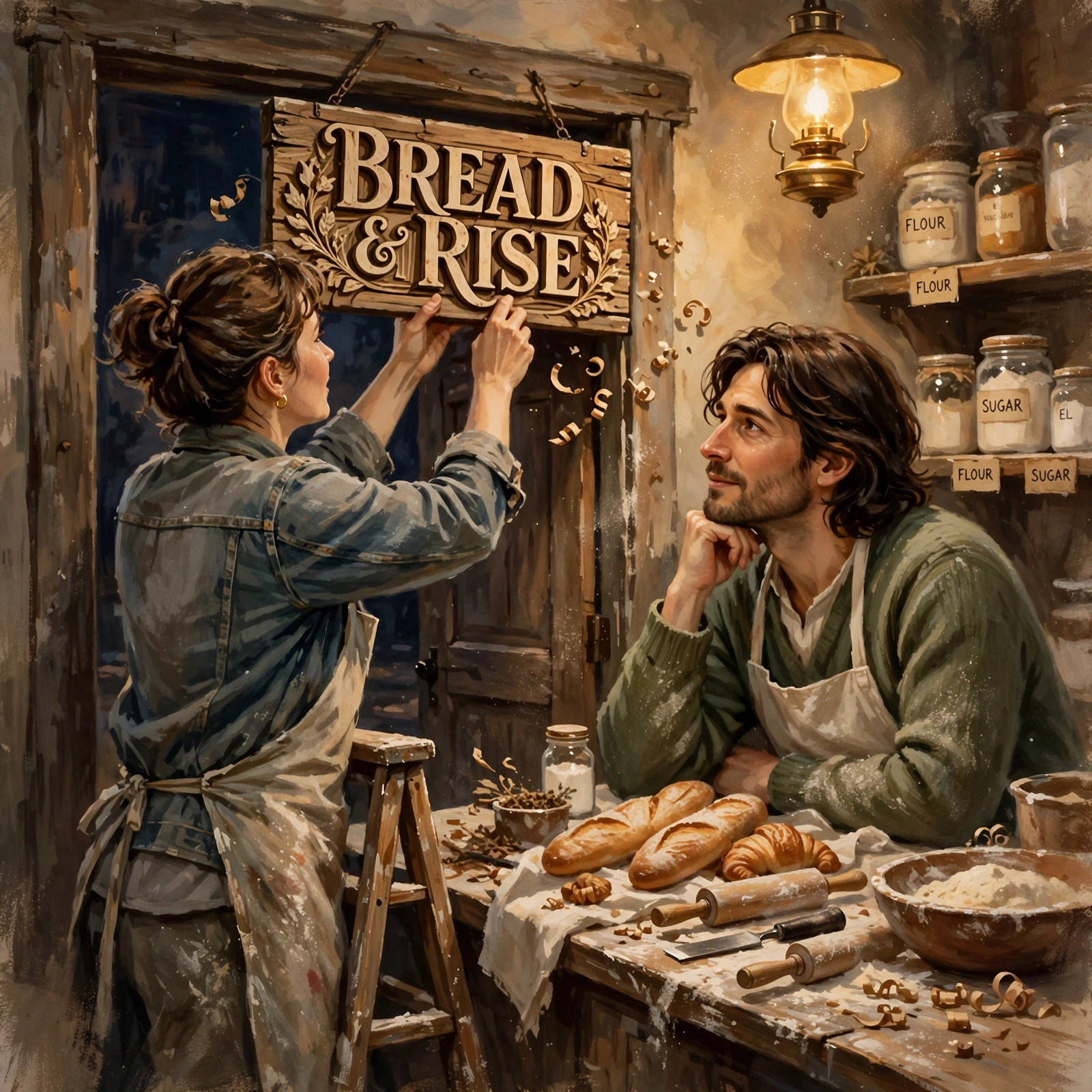
The oven had just ticked past 190 for the tart shells when the bell over the door rang against Walt's carved letterpress sign, and Delia looked up with flour on her wrists and a greeting already halfway out of her mouth.
The greeting died there.
Eleven years, and Sam Reyes still walked into a room like he was apologizing for the weather. Same dark hair, shorter now. Same shoulders set like a man carrying boxes he hadn't been asked to hold. He wore a gray coat that had to cost more than her oven, and he was holding a thick envelope in both hands, the way you'd carry something breakable.
"Morning," he said. "I'm looking for Delia Hart."
"She's found." Delia set down the rolling pin. Her heart was doing something stupid and loud against her ribs, and she hated it. "You know that, Sam. You're looking at her."
Behind the counter, Nadia froze with a tray of croissants halfway to the case. She'd only ever seen Sam in one photograph, the one Delia had thrown out years ago and would deny ever owning, but she knew. Delia could see her doing the math by the look on her face.
"Nadia," Delia said, "shells need turning in four minutes."
"On it." Nadia backed toward the kitchen, not taking her eyes off him until the swing door swallowed her.
Sam crossed the floor slowly, past the two-tops by the window, past the shelf of rye loaves, and stopped at the counter where the morning's tickets were clipped in a row. He set the envelope down on the cleanest stretch of marble, square to the edge, like it mattered.
"I'm here for Corrin Property Group," he said. "We're contacting all the tenants on Aldergate Row."
"Tenants." Delia laughed, and it came out sharper than she meant. "That's a nice word for it. What does Corrin Property want with a block of shops that's been standing longer than any of us?"
"They're acquiring the parcels. All of them." He slid the envelope toward her. "This explains the terms."
Delia didn't touch it. She looked at the envelope the way she'd look at a wasp that had landed on her counter. Manila, heavy stock, a corporate logo embossed in navy. Everything about it was exactly as warm as she'd expected from a company that had never once set foot on the Row.
"There's a number in there," Sam said quietly. "Forty-five thousand. Relocation assistance. It's meant to make the transition easier."
"Transition." She turned the word over. "You mean the part where my bakery stops existing."
"Delia."
"Miss Hart," she said. "That's what the letter'll say, isn't it? I've gotten enough of them to know the tone. Dear tenant. We regret to inform you. Please accept this generous sum and don't make a fuss on your way out the door."
He flinched. Good. She watched it land, the small tightening around his eyes, and felt a mean little spark of satisfaction that she wasn't proud of. Then he did the thing she remembered him doing a thousand times in a hot kitchen, back when they'd worked side by side and she'd have trusted him with anything: he took a breath and stayed anyway.
"Sixty days," he said. "That's the timeline in the packet. I know it's not much."
"You know what I was doing sixty days from now?" She pulled her order book from under the register and flipped it open to the flagged page. "The Aldergate harvest festival. Two hundred tart orders. Kids who come in every Saturday for the lemon ones. Walt Briggs, who's been carving signs on this street since before I could reach my own counter. You're going to hand him one of those envelopes too?"
"I'm going to hand everyone on the Row the same terms. That's my job."
"Your job." She leaned on the counter. Above the door, the letterpress sign he'd bought a tart from her once under, back when he was a different person with the same face, caught the morning light. LARKSPUR BAKERY, carved deep, painted green. "You had a job once. Right here, more or less. You remember. The little place we were going to open. You and me."
"Delia, don't."
"Two years of planning. You drew the floor plan on the back of a menu. You named it, Sam. Then a company like the one you work for now waved something shiny, and you were gone before the ink on the notice was dry. So no, I don't want to hear that this is just your job. Your job is standing on my flour with a checkbook."
He looked down at his shoes. They were city shoes, thin-soled, wrong for a bakery floor, and she saw him register the dusting of flour they'd already picked up. When he looked up, there was something raw in it.
"Forty-five thousand is real money," he said. "It's more than fair for the space, and you know it. I've seen what happens when people dig in on places like this. It doesn't end well for them."
"It doesn't end well for the building, you mean. Corrin wants it down. That's what this is. A tower, or a parking structure, or whatever renders well in the brochure. Sixty days and forty-five grand, and the Row's just gone."
He didn't answer that. That was answer enough.
Delia pulled a strip of tape from the dispenser by the register. She took the envelope off the marble, turned it over, and taped it flat to the front of the counter, face out, where every customer would see it the moment they walked in.
"There," she said. "Now it's part of the shop. And my answer's no. Tell Corrin Property no. Tell them they can send someone else, someone who didn't used to know how I take my coffee, and I'll tell them no too."
The swing door opened. Nadia came back out with a rag over her shoulder, having clearly heard every word through the gap in the frame, and took up a position at the far end of the counter like a witness who intended to be counted. She was carrying a clipboard these days, thick with pages, and Delia knew without asking that it was the petition, the one she'd been hauling door to door for weeks. One hundred and eighty-seven signatures and climbing. Sam's eyes went to it, then away, fast.
"I bought something," Sam said abruptly.
Delia blinked. "What?"
He nodded toward the end of the counter, and she saw it: the white box, twine-tied, sitting by the register. A tart box. Her own tart box, one of the lemon-curd shells she'd pulled from the oven twenty minutes ago, bought and paid for while she'd had her back turned. The receipt was folded on top of it.
"You came in here," she said slowly, "to hand me an eviction, and you bought a tart."
"I know what they taste like." His voice had gone low. "I wanted to see if I was right that they still would."
"Get out."
He held her eyes for a long moment. Whatever he was looking for in them, he didn't find it, and he didn't argue. He took one step back, then another, and the bell rang against Walt's sign a second time, and the door closed behind him with a soft click that was somehow worse than a slam.
Delia stood with her hands flat on the counter until his footsteps faded off down the Row. Then she looked at the tart box sitting there in its twine, warm underneath her palm when she finally made herself touch it.
"He left it," Nadia said.
"I can see that."
"You going to throw it out?"
Delia looked at the taped envelope, then at the box, then at the oven ticking away behind her, faithful and hot and hers for exactly sixty more days. She slid the tart box to the far end of the counter, out of reach of her own hands, and picked up the rolling pin.
"No," she said. "I'm going to let it sit there and go stale. And I'm going to make two hundred tarts for the festival, and every single one of them is going to sell."
Tab Two-Fifteen
Friday mornings, the Copper Kettle ran a gauntlet of its own. Delia came in through the door at seven sharp, past the chalkboard with its crooked smiley face, past the community board where someone was always losing a cat, and up to the counter where Walt Briggs held court behind the register like a man who had heard every opinion ever spoken aloud and ranked them all privately from best to worst.
"The usual," she said, which meant the biggest cup he had, black, no ceremony. Then she put a five on the counter, because she was a professional and professionals paid for their first cup.
It was the other cups that got written down. Borrowed cups. The ones she carried back to the bakery on a tray when the morning rush hit and there was no time to brew her own, the ones she promised to settle up for later and never quite did. Walt kept them all in a tin behind the register, an old shortbread tin with the lid gone soft at the corners, each tab a little slip of paper with a date and a tally. Two hundred and fourteen of them now, a number Walt announced to the room at large every so often, the way other men announced sports scores.
"Two hundred and fourteen," he announced today, sliding her cup across. "Just so you know the standings."
"You keep them like baseball cards."
"I keep them because you owe me a fortune in coffee and we both know you'll pay it in tarts anyway." He wiped a spot off the counter that didn't need wiping. "Speaking of which, the festival. You doing the lemon ones again?"
"Two hundred of them."
He whistled. "Ambitious, given the news."
She'd known it was coming. Everyone on the Row had known the letter was coming; she'd just been the first one to get it in an envelope. She wrapped both hands around the cup and said, "I'm not talking about the letter before eight in the morning, Walt. It's bad for the crumb."
"Fair." He leaned on the counter. "Nadia was in here yesterday with that clipboard of hers. She's got the whole Kettle on it. Me twice, actually, once under Briggs and once under Walter, which I told her was cheating but she wrote it down anyway."
Delia laughed, and it felt good, and then the bell over the door rang and the laugh went sideways in her chest.
Sam came in with his jacket done up wrong, one collar folded under, and stopped dead when he saw her. Of course he did. She was standing in the middle of his path with a coffee in her hands like a woman holding a shield.
"Walt," Sam said carefully.
Walt straightened up to his full height, which was considerable, and looked at him for a long, slow moment. "I know you. Kid who used to come in on Saturdays, back when you worked the line at that little place on Marrow Street. Before it closed." His eyes narrowed. "Large drip. Splash of cream. No sugar, because you said sugar was for people who couldn't handle their own bitterness."
Delia closed her eyes briefly. Eleven years, and the man had the order cold. He probably still had her order cold too, the double-shot with the burnt caramel she'd liked when she was twenty-three and certain about everything, and she hated that she'd just thought of her age, and she hated more that Sam's mouth had twitched, like he'd caught the same memory swimming past.
"That's the one," Sam said. He hadn't looked away from Delia. "Is it still on the board?"
"Never came off," Walt said, cheerful as a hangman. "You want it?"
"I'll take the drip."
"Big cup or little cup?"
"Big," Delia said, at the same moment Sam said, "Small's fine."
Walt looked between them, delighted beyond all reason. "One large drip," he decided, and turned to the machine, leaving them standing three feet apart with nothing between them but a pastry case and eleven years.
"You come in here," Delia said quietly.
"I come in here," Sam agreed. "I used to come in here, before. Saturdays. You knew that."
She had not known that. She had suspected it, back then, in the way you suspect a thing you don't ask about because the answer will cost you something. Saturday mornings, he'd come off shift at the Marrow Street kitchen and vanish for an hour, and come back smelling of other people's coffee, and she'd never once asked where, because asking would have been admitting she kept track of him.
"Why are you on the Row today?"
"Working."
"That's what you call it."
"Delia." He said her name like it was heavy to carry. "I'm not here about the letter. Not today. I was on the block early and I wanted..." He stopped. Started again. "Coffee. I wanted coffee."
Walt set the large drip down between them with the ceremony of a man laying a wreath. "On the house."
"I can pay."
"You can also take it," Walt said, and went back to his rag.
Delia looked at the cup, and at Sam's hand coming toward it, and something in her rose up, quick and hot, before she'd fully decided anything. She put her own cup down. "No," she said. "He's not a guest."
She walked around the end of the counter, past Walt's raised eyebrow, and reached up to the shelf where the shortbread tin lived, right where it had lived since before the Row had a bakery on it at all. She took it down. The lid came off with its soft, familiar sigh, and there they were, two hundred and fourteen slips of paper, folded and dated, years of mornings stacked like leaves.
"What is that?" Sam asked.
"My debts." She found the pad of blank tabs, the little pencil tied to it with string, and wrote in her baker's hand, quick and neat: Friday. One large drip. Hart. She folded it the way she folded all of them, once, twice, and set it in the tin. Two hundred and fifteen now.
Then she took it back out, because that wasn't the part that mattered, and held it out to him between two fingers.
He took it slowly, like it might be a trick. "You're giving me a tab."
"I'm giving you a debt. Mine. That's a cup I owe Walt, and now it's yours, and you can collect it from me whenever you want, in whatever mood you want." She met his eyes and kept her voice level. "But I'll tell you what it means. It means you're in the book. And nobody gets out of my book, Sam. Not the regulars, not the ones who moved away, not the ones who left. People in my book owe me their presence eventually. That's how it works."
Walt, behind her, had gone very still and very quiet in a way that meant he was memorizing all of it for later.
Sam looked down at the little folded slip. He turned it over once. When he looked up, something in his face had come loose, a bolt she hadn't known was there. "You kept a book for eleven years?"
"I kept a book for my whole life. It's called this street." She stepped back to her side of the counter and picked up her coffee, because her hands wanted something to do. "You bought a tart on Tuesday and left it behind. That's not how you settle anything with me. You drink the coffee. You come back."
"You told me to get out."
"I did. And now I'm telling you to stay. I'm allowed to change my mind. It's my street."
He laughed then, short and rough, and it cracked her heart right down the middle because it was the same laugh, exactly the same, from a man who was otherwise a stranger wearing a familiar jaw.
"One week," he said suddenly.
Delia frowned. "One week what?"
"Give me one week. There's something on the Row I need to show you, something I'm working on, and I can't tell you what it is yet, because if I tell you before it's done and it falls through, it'll be worse than the letter." He was talking fast now, the words crowding each other, and his hand had closed around the tab in his fist. "One week. Come walk the block with me next Friday and I'll show you everything. If, after that, you still want me gone, I'll hand the whole file back to Corrin myself and you never have to see me again."
Walt's rag had stopped moving entirely.
Delia looked at the tab crushed in his hand, at the tin still open on the counter, at eleven years of Saturdays she'd never asked about. Her mother had a saying about debts: never lend what you can't afford to lose. But Delia was a baker. She lent bread every day and lost a certain percentage of it to the birds, and the bakery still stood.
"Not Friday," she said. "Friday I bake. You have until Thursday."
"Thursday," he repeated, like a man taking an oath.
"And Walt," she said, raising her voice, "write it on the board. Large drip, splash of cream, no sugar, comes back Thursday. That way the whole Kettle can hold him to it."
Walt picked up the chalk with the reverence of a priest. "It'd be my pleasure."
Marrow Street
Monday morning, before the ovens were even warm, Sam was standing under the letterpress sign Walt had carved for her, holding two coffees and looking like a man who had lost an argument with himself.
"It's not Thursday," Delia said from the doorway, apron already on, flour already on her wrists.
"I know."
"You gave me your word on a chalkboard. The whole Kettle's holding you to it."
"I'm not breaking it. I'm moving it up." He held out one of the cups. "I couldn't sleep, and everything I want to say to you needs a room I can show you first. Ten minutes. That's all I'm asking."
Delia looked at the cup, at the pale sky behind him, at the sign over her door with its deep-cut letters that Walt had said would outlive the building. She took the coffee.
"Ten minutes."
He led her down Aldergate Row the long way, past the shuttered windows, past the plywood over the old flower stand, until they reached the mouth of Marrow Street, a narrow seam of a street most people walked past without noticing. Halfway down it, a shopfront with a painted sign so faded it had gone the color of weak tea. Reyes & Son, Letterpress.
"You said you worked the Row," Delia said slowly. "You never said you grew up on it."
"I didn't work the Row." Sam fished a key ring out of his jacket pocket, an old brass thing heavy with decades of keys. "I lived above it. Those windows, third floor. My father ran this shop for thirty-one years. I swept the floor, ran deliveries, learned to set type before I learned long division."
Delia stared at the faded sign. Eleven years she had known this man, and eleven more before that in the same kitchens, and he had never once said the word father that she could remember.
"You told me your family was in Phoenix."
"I told you they were far away. That was true." He fitted a key into the lock. It turned with a groan, the sound of a door that hadn't been opened in a long time. "He died four years ago. I kept the lease paid because I couldn't figure out what else to do with it. Coming inside felt like a conversation I wasn't ready to have."
The shop exhaled dust and machine oil and old paper when they stepped in. Sam found the light switch by memory, his hand going straight to it without looking, and a single bulb lit the middle of the room. There it stood in the half-dark: a cast-iron letterpress the size of a piano, a Chandler-style flatbed with a long lever arm, its bed still dressed with a chase of locked type from whatever job had been its last.
Delia walked toward it the way she walked toward any old, well-used tool, with her palms open.
"May I?"
"He'd have liked that." Sam's voice came out low. "He liked people who touched things."
She ran a fingertip along the lever. The iron was cold, but under the cold there was the memory of a thousand hands. On the workbench along the wall, paper was stacked in wrapped reams, and jars of ink sat in a row, their lids crusted shut. A calendar hung by the back door, stopped on a month four years gone.
"Sam."
p>"Yeah.""The tower. Corrin's tower. Where does it sit?"
He didn't answer right away. He crossed to the press and put his hand flat on the bed, next to the type, the way you'd steady a horse. "The footprint runs the length of the block. Marrow Street's inside it. This shop, the flat above it, the whole seam." He looked at the press, not at her. "When I took the job, they showed me a rendering. Glass and pale stone, very clean. I sat in a conference room and looked at a picture of this address with a lobby where my father's shop is, and I said the number out loud like it was any other number."
Delia set her coffee down on the workbench, on a spot she'd wiped first with her apron without thinking.
"You didn't know?"
"I told myself I didn't. There's a difference, and I've had a lot of nights to measure it." He picked up a sheet of blank paper from an open ream. "The city can stop it. Landmark designation. Nadia's petition, the one she keeps trying to get you to sign. The block needs its oldest business on the application, and the oldest business on this block isn't the bakery, Delia. It's this. Forty-one years. My father's name on the lease since before you were born."
"Then it's yours to sign."
"It's not. The estate's tangled, and Corrin knows it's tangled, and a tangled estate is easy to steamroll." He set the paper on the press bed, squaring it against the guides with two fingers, a motion so practiced it had to live in his body from boyhood. "Which is why I've been doing something I can't talk about yet. Thursday. I'm asking you to hold me to Thursday."
"You keep asking me to wait."
"I keep asking you to trust a man who didn't earn it. I know what that costs."
Delia looked at the blank page lying on the bed of the press, white against black iron. Eleven years ago he'd walked out of a shared dream and into a corner office, and she had spent every one of those years telling herself the story where he simply didn't care. The story was tidy. It fit in a drawer. And here he was in a dead man's shop, squaring paper by muscle memory, and the tidy story didn't fit in the room.
"Show me how it works," she said.
He blinked.
"The press. You said you learned type before long division. Show me."
Something eased in his shoulders. He rolled the bed under the platen and positioned her at the lever. "Both hands. It's not as easy as it looks."
"I knead dough for six businesses' worth of bread. I'll manage."
He laughed, and she felt it in the iron as much as heard it, because his hand was resting on the frame. "Pull steady. All the way through, or the impression comes out weak at the edges."
She pulled. The lever gave, heavy and smooth, and somewhere inside the machine a roller crossed the blank page with a sound like a held note. Sam rolled the bed back out and lifted the sheet, and they leaned over it together in the weak light. The paper had taken nothing, of course. No ink, no type. Just a faint rectangle pressed into the fiber, a ghost of a page, blank but for the promise that it could hold anything.
"There," he said quietly. "First print in four years. My father would call that a proof of life."
Delia took the page from him and held it up to the bulb. The pressed rectangle caught the light along its edges. She thought of every loaf she'd ever turned out blind, trusting the oven and her hands, not knowing until the crust spoke whether the day would be kind.
"Thursday," she said. "You're going to stand in my bakery and tell me everything, and I'm going to decide whether to believe you."
"Fair."
"But Sam." She set the blank page down on the workbench, squared it against the edge the way he had, a small theft she meant him to notice. "If you're steamrolled too, why does the letter on my counter say forty-five thousand dollars to walk away quietly?"
"Because they don't know what I'm doing either." His jaw worked. "And if I tell you and it falls through, you lose the bakery and the belief at the same time. I've cost you enough belief."
The bulb overhead buzzed and dimmed, and neither of them moved to fix it. In the half-dark the press stood there like something patient, and the calendar hung stopped, and the ghost rectangle on the page held its shape.
Delia reached over and found his hand in the dark, his fingers cold from the iron, hers still warm from the morning's ovens. He didn't pull away. He turned his hand slowly until their palms met, and they stood there, not speaking, while the old shop held its breath around them.
The Corrin Call
Thursday came in gray, and Delia was glad of it. Gray meant no glare on the cooling rack, no sun lie about the day being softer than it was. She had been up since four with the tart shells, ninety of them at 190 degrees, blind-baked in batches while she counted the minutes until the shop opened and Sam walked through the door to tell her everything.

The tart order box sat on the end of the rack, the big one, white string tied in a bow she was not proud of. Nadia's campaign office, a rented room above the Copper Kettle, had ordered for the petition volunteers. Lemon-curd tarts, the shells Delia made the way she'd made them for eleven years, since the week she signed her first lease on Aldergate Row and discovered she had no idea how to be alone with a dream.
She was sliding the last shells out when she heard Sam's voice through the propped rear door. He had come in the back way, early, the way he used to come in at their old kitchen, and he was on the phone, and he was not talking softly.
"The demolition filing goes forward regardless." A pause. Paper shuffling. "No, she doesn't know the terms yet. Nobody on the Row knows the terms yet. Corrin wants the notices out before the council can calendar the landmark hearing. If the signatures land first, the whole thing stalls."
Delia stood with the tray in her hands and did not put it down.
"The tower's not moving. The timeline's fixed. They're counting on me to clear the block by the end of the quarter." His voice dropped half a step. "I understand the penalties. I read the contract before I signed it."
She set the tray on the counter so slowly that not one shell rattled. It was a small skill, keeping her hands quiet when the rest of her was not, and she had learned it in the same kitchen where she'd learned everything else, standing next to him.
Sam came through the doorway tucking his phone into his jacket, and he saw her face and stopped with one hand still on the frame.
"Delia."
"The timeline's fixed." She untied the string on the box, one loop at a time. "The notices go out first. The tower's not moving. Whose phone was that, Sam? Or don't I get to know the terms either?"
"It's not what it sounded like."
"It never is, with you. It sounded like a kitchen once, too. It sounded like a plan with two names on it." She lifted the box off the rack. "Then it sounded like a different city, and a corporate title, and eleven years of nothing. And now it sounds like the man the buyer sent to clear my block, standing in my back room saying nobody here knows the terms. Nobody on the Row knows the terms."
"Let me explain the call."
"You had Sunday for that. You had the print shop and the whole dark walk home and you chose 'Thursday, I'll tell you everything.'" She crossed the kitchen and pushed the box into his chest so he had to take it or drop it. "Here. The week's tart order. For the volunteers. You can carry it to the Kettle, since you're going that way anyway, and you can tell them whatever you like on the walk. Tell them the fixed timeline. Tell them the quarter's end. Tell them the man from the notice works for Corrin Property, because I heard you say so yourself."
"Delia, wait."
"The front door's that way."
He stood there holding the box the whole way to the front, and she went ahead of him and pushed the door wide. Thursday meant the petition table on the corner was out early, and Nadia was there with her clipboard, and there were a dozen people from the Row between the bakery and the corner, half of them with coffee cups they'd borrowed from the Kettle and never returned, because that was the kind of block this was.
"Sam Reyes works for Corrin Property Group." Delia said it loud enough that it carried to the corner, and she watched it land on the crowd like a dropped tray. "He's been in my kitchen for a week. He's been at my counter and in my back room, and he's been on the phone confirming the demolition timeline while my shells baked. Whatever he's told you at the table, weigh it accordingly."
Walt Briggs was near the front, thermos in hand, and he looked from her to Sam with the particular unhappiness of a man who had carved a sign for a building that might not survive the argument.
"That true, boy?"
Sam held the tart box against his chest, and for a long moment he didn't answer, which was its own kind of answer, and everyone on the corner knew it.
"It's true I'm paid by Corrin," he said finally. "It's not true that I'm here for them."
"You heard the man." Delia stepped back inside and let the door swing almost to. Almost. She left it open a hand's width, and she hated herself for the width, and she left it anyway.
She did not cry until the bread cooler hummed on, and then she didn't cry then either. She washed the trays. She swept the flour that gathers at the base of a rack no matter how careful you are, the flour that is proof of work. Then the bell over the door went and Nadia came in alone, no clipboard, no crowd, and sat on the customer stool like her legs had opinions.
"Two hundred people, give or take, on that corner just now," Nadia said. "You'd think I'd be swimming in ink."
"How many?"
"One hundred eighty-seven." Nadia rubbed the space between her eyes. "We need two hundred seventeen by the filing deadline. The big storefronts on the block's other half won't sign while the Corrin notices are live. They think a tower means a buyout at tower prices, and I can't make them wrong fast enough."
"Thirty short."
"Thirty short, and I just watched you hand the best talker on this street to the other side." Nadia said it without heat, which was worse. "I'm not telling you what to feel. I'm telling you the math. We needed him, whatever he is."
Delia untied her apron and hung it on its hook. Then she took it down again, because the folded buyout letter was still in the pocket, and she had been carrying it there for eleven days like a stone she refused to put down. She set it on the counter, smoothed it flat, and did not look at the number on it.
"I need to go to the Kettle," she said.
The Kettle was warm and smelled of scorched milk, and Marisol behind the register took one look at her and started pouring before Delia asked. Delia didn't drink it there. She waited while Marisol climbed the step stool to the shelf behind the register and brought down the copper tab tin, the one the whole Row paid into or didn't, and she dug her fingers through the little paper promises until she found the newest one.
Tab two hundred fifteen. She'd written it herself, the week Corrin's letter arrived, when Sam Reyes was a name on a signature block and not a voice through her back door.
He was at the corner table, of course. He was eating one of her tarts out of the box he'd carried, and the box sat open in front of Nadia's volunteers, and there was a pen out beside it, and a fresh page on the clipboard that had a heading she refused to read.
She walked over and put tab 215 down on the wood in front of him.
"Eleven days ago I borrowed the cup I'd need to read that letter. Here's the tab back. And here's the question you never answered." Her voice stayed level, which cost her. "Did they send you here to close me down, or did you just happen to be useful to them?"
"I'm going to answer that."
"Everyone's going to answer everything on Thursday. It's Thursday." She walked out.
Larkspur was empty when she got back, and quiet, and hers for fifty more days. Above the door, Walt's letterpress sign hung on its wire, carved deep with the name she'd chosen at twenty-six, before the phone call that broke her kitchen in half. The wire had a twist in it from the year the sign swayed in a storm and never quite settled.
She got the step stool, climbed it, and worked the twist loose with her fingers, hard, harder than the wire deserved, until the loop gave and the sign came away heavy into her arms, and the hook above the door swung bare above a bakery with no name on it at all.
Resignation Paper
Sunday mornings Delia baked alone before the Row woke up, and this Sunday she had the shells in at 190 and the radio low and the letterpress sign propped behind the counter where it had been standing since Thursday night, face to the wall, because she couldn't decide whether she was protecting it or punishing it. At seven forty the oven ticked and she pulled the tray, and at seven fifty, before the shutters were even down, somebody knocked on the glass of her door.
Sam stood on the sidewalk with a leather folder under one arm and his jacket buttoned wrong at the bottom, which she had never once seen him do in the years when his hands were the steadiest thing in any kitchen they worked in. Behind him, parked crooked at the curb, was Nadia's hatchback, and Nadia herself was unfolding from the driver's seat with Walt Briggs easing out after her, moving the way he moved on damp mornings, one hip at a time.
Delia unlocked the door and let the cold in with all three of them.
"It's Sunday," she said.
"I know," Sam said. "I brought witnesses anyway. And a folder. The folder's the important part."
"Everything's the important part on Thursday."
"This couldn't wait for Thursday." He set the folder on her counter, on top of the buyout letter that had lived there smoothed flat since the day it arrived. Then, seeming to think better of the layering, he moved the letter off to the side and laid the folder down square, like a man serving something. "I resigned from Corrin. Friday. It's signed, it's filed, and the woman who signs my former paychecks confirmed receipt yesterday, which is why I look like this."
He did look like something. She had been too busy being furious at him for four days to notice the hollows under his eyes, and now, with him two feet away under her good light, she noticed.
Nadia pushed past him to the coffee pot like she owned it, which, in the economy of the Row, she more or less did. "He wouldn't even sit down at the Kettle yesterday. Just stood there vibrating while I got the petition copies made."
"One hundred eighty-seven names," Walt said, settling onto the stool by the window that everyone knew was his. "Nadia's got them all in a binder. Some of the letters people wrote." He tapped the counter. "You'd cry, Delia. I did."
"Walt." She kept her eyes on Sam. "What's in the folder?"
He opened it himself, because his hands needed something to do. Page one was the resignation, his signature at the bottom in the fast slanted hand she'd read a thousand times off prep lists and order sheets. Page two was thicker paper, cream, with a seal.
"Eleven years ago I chose a building full of people I'd never meet over a kitchen with one person I couldn't stop thinking about," he said. "You know that part. Here's the part you don't. Corrin sent me to Aldergate Row in September to clear it. And I started clearing it, and then I sat in your back room eating a day-old tart, and I stopped being able to do the job. So I did something worse for them and better for you. I spent my own money, everything I'd saved in those years I chose wrong, and I made an offer on the Row myself. The whole block. Marrow Street to the corner."
The bakery was very quiet. The cooling rack ticked as the shells gave up their heat.
"You," Delia said.
"Me. The sale hasn't closed. It's in escrow. That's what the escrow instructions are." He turned page two around so she could read it right side up. "The trust paperwork is behind it. When it closes, the buildings go into trust for the businesses that are already in them. Rents capped. No demolition clause, ever, and I had a lawyer fight me about that word for two hours. Corrin's tower dies on this block the day it records, because once the trust exists, the oldest business signs the landmark application automatically." He slid one sheet free and set it in front of her. "This one's yours. The deed application. It has a blank where a name goes. I couldn't put yours on it without asking, and I couldn't ask you over the phone while you were handing me back coffee tabs like a summons."
Delia put both hands flat on the counter, one on either side of the paper, and didn't pick it up.
"The forty-five thousand," she said. "The relocation offer. If you own the Row, who was paying me to leave?"
"Corrin was. Before my offer was accepted. I told them I'd deliver it, and I did, and then I told them I wouldn't collect it. That call got loud." His mouth moved into something that wasn't quite a smile. "You heard the end of it Thursday morning. Through your back door. I know you did, because you came out with your jaw set and you wouldn't look at me."
Delia had heard it, Thursday, through the door propped for the delivery man. She had heard Sam's voice saying no, and saying it the way he used to say no to chefs who wanted shortcuts, and she had walked back to her oven and told herself it was a no about something small, because believing the big version of him was too dangerous to do twice in one lifetime. Eleven years ago she had believed in the big version once. She had planned a bakery with it. She had chosen the name at twenty-six over a shared table in a shared walk-up, and the sign with the name on it was standing behind her own counter, facing the wall.
"The call," she said slowly. "'You can put the order in writing and I'll put my resignation in writing.' That was you. Refusing the demolition."
"That was me refusing the demolition."
"And the promotion."
"Gone with the resignation. And the payout. Partners don't get parachutes when they resign in the middle of a project they were sent in to finish." He said it plainly, without drama, the way he used to read out the counts on the evening sheet. "It's not noble. It's the difference between sleeping and not."
Nadia set a cup of coffee down next to the deed application with the ceremony of a woman placing a crown. Walt blew his nose.
Delia picked up the resignation page. She read it properly this time, top to bottom, the dated paragraphs, the release, and at the bottom his signature, Sam A. Reyes, the same fast slant he'd had at the bottom of every list he'd ever handed her, and she understood that the signature she'd hated for eleven years, the one on Corrin's letter, the one that had emptied her of sleep, was a signature she had been reading wrong. It had been on her side the whole time, buying the ground under her oven while she handed him back tabs and accused him of being a company's hand.
She put the page down before her hands could shake with it.
"You bought my block," she said.
"I'm trying to give it away to the people in it."
"You could have told me."
"You'd have laughed. Or thrown a tart at me. Both were earned." He reached into his jacket then, and brought out a ring of keys, heavy, a dozen of them, the kind of ring a landlord carries, and he took her hand, turned it over, and set the keys down in her open palm and closed her fingers around them with both of his. His hands were shaking and hers were not, anymore. "These are the Row's. Every front door, every storeroom, the gate on the service alley. The trust holds the paper, but somebody local holds the keys, and I've watched you hold this Row together for fourteen days with flour and stubbornness, so."
"Sam."
"There's a blank on that deed application," he said. "For a name."
Delia looked down at the keys in her hand, then at the sign behind the counter, face to the wall. She turned it around herself, set it on the counter beside the paperwork, and traced the carved letters with one thumb, the L and the S, the deep confident cuts Walt had made the spring she opened.
"There's a hook above my door," she said. "It's been bare for three days and I hate it. I can't reach it alone." She looked up at him. "Stay. Not for the hook. Stay and help me hang it, and then stay after, for whatever comes after the hanging. I have forty-six days of fight left in me and I'd rather not do it across a counter from you."
Sam let out a breath that had clearly been held since September, and Walt said, "There's a step stool in my truck," and Nadia said, "There's a step stool right behind you, Walt," and nobody moved for a second, because some moments insist on being stood in.
Then Delia picked up the letterpress sign, and Sam got the step stool, and above the door of Larkspur Bakery the bare hook waited for its name.
The Key Ring
Tuesday came in bright and cold, and by eight in the morning there were eleven people crowded into Larkspur Bakery when there was normally one.
Nadia arrived first, waving her phone over her head like a flag. "It's posted. City site, nine o'clock last night. Aldergate Row, landmark designation, granted." She read it aloud twice, once for the room and once, Delia suspected, for herself, because her voice cracked in different places each time.
Walt brought a crate of oranges from his truck and set it on the floor by the door, which was Walt's way of bringing champagne. The florist from two doors down brought a jar of paperwhites still in bulb. The print shop's old tenant, who had kept his key to the Marrow Street place out of pure spite, brought nothing at all and stood in the corner radiating satisfaction, which counted.
Delia had baked since five. Tart shells at 190, lemon curd cooled in the window, and a tray of the little almond things Sam had once eaten a whole pan of behind their instructor's back, back when they were both young enough to be that stupid. She set them on the counter and did not say they were for anyone in particular. Everyone in the room knew anyway. Rooms like that one know things.
Sam came in last, which felt right, because he had spent the morning at the printer on Marrow Street confirming that the deed paperwork for the trust had been filed, and the folded buyout letter had been in his jacket pocket for two days now, softened from crisp to something closer to cloth. He took his place at Delia's elbow without a word, and she let him stay there, which was its own sentence.
He ate two almond things. She watched him do it and did not comment, and he caught her not commenting, and neither of them apologized for any of the previous sixteen days, which was the only kind of forgiveness either of them had ever been fluent in.
"So we're saved," Nadia said, when the crowd had thinned to the four of them and the paperwhites had found a home on the windowsill. "A hundred and eighty-seven signatures, a lawyer who worked cheap, and a man who bought a city block just to annoy a property company."
"That is a reductive summary," Sam said.
"It's a correct summary."
"It's one of the correct summaries."
Delia untied her apron while they argued, which she took as a sign of the Row's health, and nodded toward the step stool still standing by the door. The sign lay on the counter where she had set it days before, face up beside the deed application, the carved L and S catching the morning light the way they had caught it every morning for years before she'd been foolish enough to take it down. Three bare days. She would not be taking it down again for anything short of structural failure.
"Hook's waiting," she said.
Sam picked up the sign like it was heavier than it was, which it wasn't, it was walnut and Walt's best carving, and it weighed perhaps four pounds. He climbed the stool. Delia held the wire, the old copper wire that had held through every wind the alley could produce, and threaded it through the sign's eye while his hands steadied the wood. Their fingers overlapped on the twist. Neither hurried the twist.
"Level?" he asked, from up there.
"Left side's low."
"It's not."
"Sam. Left side's low."
He adjusted it a quarter inch, and it was level, and they both knew whose eye was the one to trust in that shop. He came down off the stool, and they stood back together under the door, and Larkspur Bakery had its name again.
Walt looked at it a long time, thumbs in his tool belt. "Spring I carved that, you were hauling flour up those stairs on your back."
"I was younger."
"You were stubborn. That part held."
Later, when Walt had gone to his truck and Nadia had gone to text everyone she had ever met, Delia took the key ring out of her apron pocket. She had carried it for two days, a dozen keys and the weight of every door on the Row, and she had thought about it for two nights, turning it over the way she turned over a recipe that was almost right.
She had almost right figured out, now.
"Deed's filed," she said. "Trust holds the paper. And the blank line, the one for the local holder of the keys. It's still blank."
"I know," Sam said. "I filed it."
"You left it blank on purpose."
"I leave a lot of things on purpose. It's a defect."
"It's a question." She took his hand, turned it over the way he had turned hers, and set the key ring down in his open palm. It fit there like it had been cut for him, which, in every way that mattered, it had. "Eleven years ago you picked a hallway with better lighting. I never forgave the hallway. I'm offering you the whole building instead. Run it with me. Not the trust, not the paper. The ovens, the tabs, the leaks in the alley gate at two in the morning. Every day. With me."
He looked at the keys, then at her. His hands were not shaking this time, and she noted that, and filed it away with the recipes.
"You're sure. Forty-four days of lease fight left in you, and you'd spend them sharing a landlord's inbox."
"I've read your inbox," she said. "It's very organized. It's unsettling. Yes, I'm sure."
Sam closed his hand around the key ring, and then, because he was Sam, he opened it again and slid one key off the ring, the worn brass one, Larkspur's own, and pressed it back into her palm. "That one's yours," he said. "It always was. I just hold the others."
The afternoon went the way afternoons go after a thing has been decided: flour orders, a delivery, Nadia returning with a cake from somewhere she refused to name. At closing, they walked the half block to the Copper Kettle together, because Delia said there was one piece of business left and it wasn't at the bakery.
The Kettle's window was fogged with steam, the urn hissing behind the counter where Nadia had once worked three summers. Delia went up on her toes, took the copper tin down from the shelf behind the register, and opened it. Paper tabs, two hundred and fourteen of them, each one a borrowed cup from the years the bakery ran lean. She slid tab 215 out of her own apron pocket, the one she'd written the morning Sam came back, and she didn't put it in the tin. She handed it to him instead.
"Paid," she said. "In full."
He read it, front and back, like it was a deed. Then he folded it into his wallet, behind the card with the blank line, and the tin went back on its shelf lighter by one, and Delia counted that as a good day's ledger.
They crossed the Row as the streetlights came on. At Larkspur's blue door Sam unlocked it with his own key on his own ring, first time, and it turned clean. They stepped inside together, and Delia reached past him to pull the door shut, his hand coming to rest over hers on the latch, and outside the glass the Kettle's steam ghosted across the street, and the sign hung level above their heads, and the shop door closed on the two of them standing where the whole thing had started colliding.
Get notified when new stories drop

Lila Monroe
Lila writes contemporary and small-town romance with banter-forward leads and soft landings. She believes the best love stories sound like two specific people, not a trope checklist.
Leave a comment
Comments