





The Ninth Stone
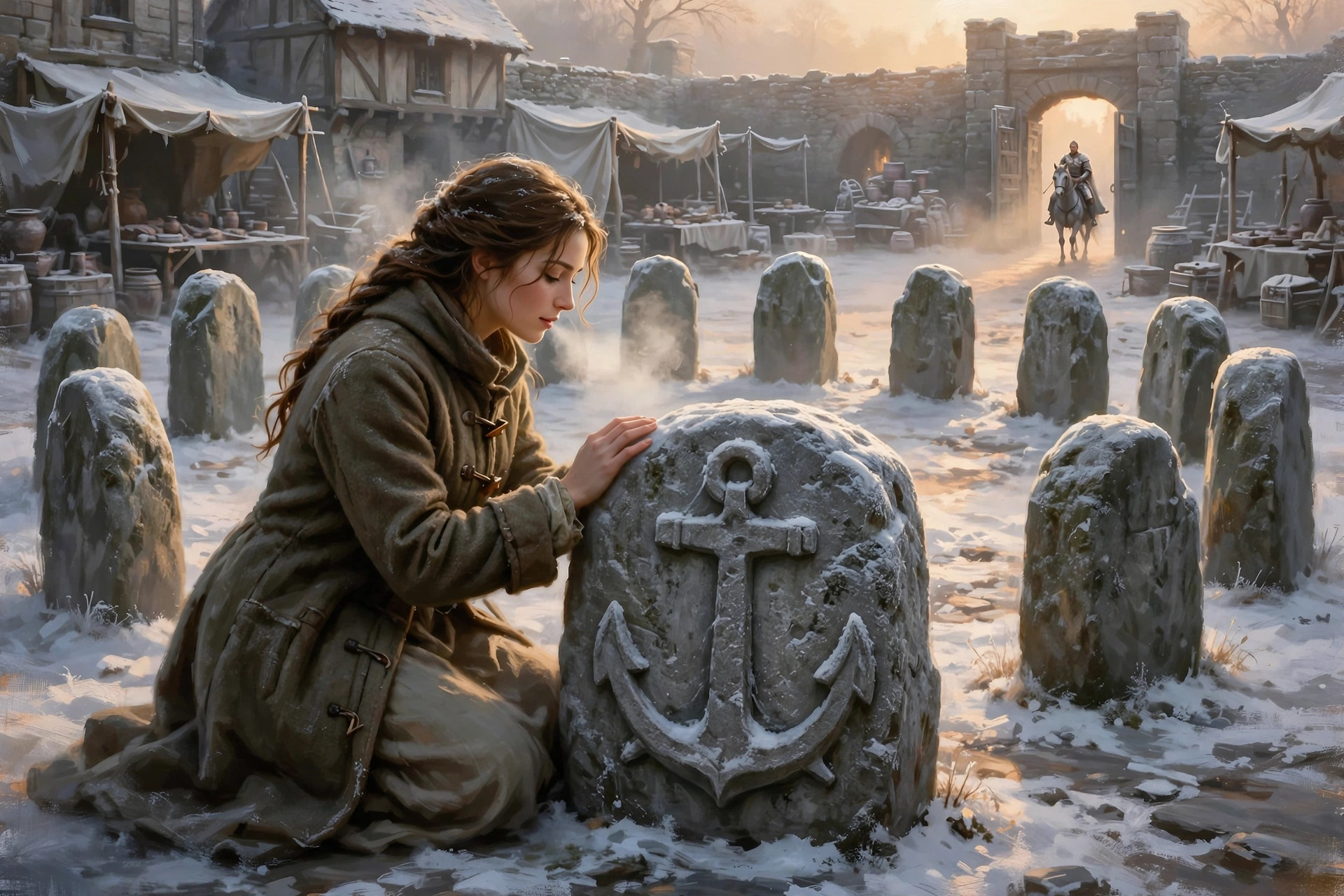
Maren found the first anchor stone at dawn, on her knees in the frost, with her bare hand flat against its top the way her mother had taught her. The stone was cold in the wrong way. Not frost-cold. Dead-cold, like a door that had stopped being a door.
She pulled her hand back and looked at it. Nine stones ringed the Thornveil market yard, waist-high, grey as old teeth, and she had walked past this one a thousand mornings on her way to the toll shed without thinking about it at all. Now she thought about nothing else.
"Come on," she said to it. "You're not supposed to do this for another three weeks."
Twenty-one days. That was the count the council had given her, twenty-one days until the frost market opened and the traders came through the pass with their sledges and their coin, and the whole point of a ward was that it was standing when they arrived. She pressed her palm to the stone again and pushed a little warmth into it, the small scribe's trick she used for sealing toll tallies. The stone drank it and gave nothing back.
She sat back on her heels and did arithmetic she hated. The ward failing on market day, with raiders wintering on the far side of the pass the way they always did in a hard season. The council paying her wages out of frost market tolls. No market, no tolls, no wages. That was the smallest of it. The largest of it was bodies in the snow, and she'd seen one winter of that already and had no wish to see a second.
Hooves on the frozen road. One horse, coming at a rider's pace, unhurried, which was somehow worse. She got up, wiped her hands on her coat, and watched the gap in the yard wall where the road came through.
He came in wearing grey and silver. Ferrow colors. Border-pact colors. She knew them the way anyone from Greymarch knew them, the way you know the shape of a wolf.
He reined in a few paces off and didn't dismount right away, which told her he'd been told the same thing about her that she'd been told about him. Dark hair under a riding cap, a scar through one eyebrow, a ring on his right hand that she recognized even at distance, because oath-rings were all made from the same river-iron and they never took polish.
"You're the scribe," he said.
"You're the rider."
"Ivo Kestrel." He swung down. "I've a writ from the council."
"I've a writ from the council," she said. "They didn't mention sending anyone."
"They mentioned you'd say that."
He held out a folded paper, sealed with the council's wax. She took it because refusing would have been childish, and read it standing where she was while he loosened the horse's girth and let it drink from the trough. The writ said what writs say, in the round careful hand of a clerk who charged by the word: the ward must be jointly rekeyed before the frost market opens, the scribe and the oath-rider together, each stone to be keyed by both parties, per the old pact.
"Jointly," she said.
"That's the word they used."
"The old ward was keyed by one woman. My mother." That wasn't the whole truth of it, but it was the part that was hers to say. "Alone. One keyer, one ring of stones. The council knows that."
"The council knows the old pact says two for a rekeying." He came and stood beside her at the stone, close enough that she could see frost melting on his shoulders. "I didn't write the pact. I just swore to it."
"And your House sent you because it's generous with its riders in winter."
"My House sent me because if raiders come through Thornveil, they come down to Ferrow land next. There's a map that makes that plain." He looked at the stone. "It's dead, then. You're sure."
She put her hand on it again, mostly to have something to do. "Cold as a ledger."
He crouched and set his palm where hers had been, and she watched his face change as he felt it, the politeness going out of it and something older coming in. "How long do we have?"
"Twenty-one days. If it fails the day the market opens, and it always fails at the worst hour, that's twenty-one days."
"That's time. That's plenty."
"That's nine stones," she said. "And we don't know how the keying takes."
"Then we find out." He straightened. "This one. Now. What's the shape of it?"
She could have told him to wait for the council's answer to her letter. She could have walked to the toll shed and locked the door and let the frost market be someone else's disaster. But the stone was dead under her hand, and the pass was white, and her mother's voice was in her ear the way it always was when she touched ward-iron. So she told him the truth of the craft instead.
"You speak your name into the stone. Your true name, all of it, the name your mother gave you and the name you carry now. The stone takes it and holds it. That's the key. Both of us, and the stone holds both, and then it's sealed." She paused. "And the stone knows a lie. If you feed it a false name, it doesn't just refuse the key. It burns a year of your own memory out of you. One year, gone, and you don't get to choose which year."
He went still. "Who told you that?"
"My mother keyed a stone once with a woman who tried a false name. The woman walked away lighter by a year. She couldn't remember her own wedding day. Everyone else could tell her about it and she just had to believe them."
"A year." He said it like a man checking coin against his teeth.
"A year."
He looked at the stone a long moment, and she had the sudden, unwelcome certainty that there was a year he'd pay not to lose, or a name he wasn't sure was wholly true, and that she was looking at her own reflection standing in front of her wearing Ferrow grey. She put the thought away. She had no right to it yet.
"Together, then," he said. "One stone. A test, not a keying. We speak and we see how it takes."
"If it takes half a key we'll know the shape of the work. If it takes none, we know we've got a bigger problem than raiders."
"And if it takes the year out of one of us?"
"Then we'll know whose name to worry about," she said, "won't we."
He almost smiled. She didn't. She set her satchel down, drew out the keying hammer, short-handled, its head wrapped in wool for the cold, and touched it once to the stone's crown the way her mother had shown her, tap and pause, tap and pause, a knock at a door.
"Now," she said. "Your name first. It's your writ."
"Ivo Kestrel, sworn of House Ferrow." His voice was even, and the stone took the words and something under the frost shivered, and the grey of it lightened by a shade, no more, like a coal breathed on once.
Half a key. She could see it had taken, and she could see it hadn't taken whole.
"Maren Vale," she said, and her voice did not shake, because she had spent a long time learning how not to let it, "scribe of Thornveil, born on the Greymarch side."
The stone took her name and gave back the same half-warmth, the same almost-light, and stopped short of anything like sealing. It had taken the name. She had not lost any year she knew of. She counted backward through her mother's face, her mother's hands, the letter in the false bottom of the satchel at her feet, and everything was where she'd left it.
But the stone knew something. She could feel it knowing, patient as frost.
"Half," Ivo said quietly. He'd seen it too.
"Half." She wrapped the hammer's head again, fingers stiff. "Two names, half a key. So it wants more than names, or it wants something truer than what we gave it, and either way, one stone isn't enough to hold a market yard."
He looked around the ring, stone to stone, counting them the way riders count a horizon. "Nine of them."
"Nine. Rekeyed together, all in one ring, or it doesn't hold. That's the old craft. I'll want to check my mother's notes, but I believe it's all nine or nothing."
"Then at first light we start at the north stone and walk the ring."
"We," she said.
"You don't trust my writ. I don't trust yours. But the stone took half from each of us, and neither of us went lighter by a year, which I'll count as a good morning." He pulled his gloves back on. "I've a bed at the border keep, or I can stable here. Whichever you hate less."
She looked at him, and at the dead stone, and at the white pass beyond the yard wall where the raiders were counting the same twenty-one days.
"Stable here," she said. "And rider, if your name has a lie in it anywhere, tell me tonight. The stone will find it before I do."
He met her eyes for a moment, and she watched him decide not to answer, and neither of them trusted the other's silence, and that was the agreement they actually made. First light. Nine stones. One ring.
Wax and Embers
They started at the north stone on the second morning and worked counterclockwise, because the old craft ran that way and Maren's mother's notes said so in a hand small enough to hide in. The second stone took their names without complaint. The third stone sat in a drift up to Maren's hip, and Ivo dug it out with the flat of his boot and his bare hands while she stood on the cleared cobbles and pretended to consult her notes, because he had shed his coat to do it and she was only human.

"You could help," he said, breath smoking.
"I'm the scribe. I supervise."
"You're watching me shovel."
"The notes need holding down. There's a wind."
He laughed, one short syllable, like something knocked loose, and she bent over the notes so she wouldn't have to do anything about her face. The stone took their names. Two names, and the pale almost-light spread a little wider through the ring than the first one had. She marked it in her ledger, the true number of keyed stones now three of nine, and tried not to think about how the ring felt warmer under her boots than the cobbles outside it.
That night he built the fire small and banked it with a rider's care, raking the embers into a shallow bowl of stone and covering them with ash so they'd live till morning. He caught her looking at it.
"For your ink," he said. "It'll freeze in that satchel by the second watch, and frozen ink is just dirt."
"I've been thawing my own ink for six winters."
"Over what, a candle?" He shook his head. "Candles gutter. Embers hold. A rider learns the fire before he learns the horse, or he dies the first cold night."
She set her inkpot in the bowl he'd made, close enough to warm, not close enough to spoil, and it was such a precise courtesy that for a moment she didn't say anything at all.
They ate market wax cheese, because it was what the yard stores had and it was what the yard stores would have for weeks. It came in rounds with a rind like old parchment, and it tasted of smoke and the cellar, and she hated it on the second day and by the fifth she was cutting it into even portions without being asked, which was a thing she noticed about herself and declined to examine.
"Teach me the marks," Ivo said on the third night, nodding at her ledger.
"Why? You can't write your reports in them. The council reads plain script."
"Because if you fall in a drift, I'd like to know what your notes say about which stone we stopped on." He said it lightly. He didn't mean it lightly. She'd worked long enough among people who paid her to know the difference.
So she taught him. The keying mark, first, a stroke like a hook closing, because it named the act the stone was waiting to perform. The record mark, the tally, the mark for north and the mark for the ring itself. He had a rider's memory, built for holds and distances, and he took to the tallies fastest and the keying mark slowest, tongue at the corner of his mouth, and she watched that tongue-corner concentration more than was strictly required of a teacher.
"Your hook curls left," he said, frowning at his own slate.
"It curls toward the stone. You write like you're fencing."
"I write like I've never done it before, because I haven't."
She put her hand over his to straighten the stroke, and then the stroke was very much not what either of them was thinking about, and she took her hand back and called the lesson done for the night, and he said, a beat too late, "Yes. Done," and neither of them moved for a moment, and then both moved at once, too much, and knocked the inkpot with a boot. He caught it. Of course he caught it. Riders' hands.
In the mornings he taught her the pass.
"The white line above the notch," he said, chin lifted, the fourth day, a wind coming down that she'd have called weather and he called a schedule. "That's not cloud. That's snow being carried. You've an hour before it lands on us."
"An hour."
"If it drops below the notch, half that. If it goes flat against the rock, get under a roof and stay there, because it isn't carrying, it's dumping." He said it the way her mother had said don't answer the door. "The pass tells you everything. It's the people who don't read it who end up in the ledgers."
"The death ledgers."
"Every registry has two books," he said. "The one you write in and the one your name goes into."
The fourth stone was the far stone, east side, the one whose face was turned toward the pass rather than the yard. She gave her name to it and the stone flared. Not the slow coal-glow of the others. A quick hot white, up out of the carved hook like a struck spark, and it held for the length of a heartbeat and sank back down to the ordinary almost-light, and the ring's warmth lurched under her feet like a floorboard stepped wrong.
Ivo's hand went to her elbow before either of them spoke. Then he took it off again, deliberately, and crouched at the stone.
"It liked something," he said. "Or it didn't. Which?"
"I don't know." Her voice came out even, which cost her. She counted backward through her memories, quick, private, the way she'd done at the first stone. Her mother's face. The letter in the satchel's false bottom, four hours' whole world away in a different sense. Everything where she'd left it. "It took the name. It gave more back than the others did. That's all I can say truly."
"Then say it truly again and let me listen this time." He stood. He was close, closer than the work required, and the wind off the pass moved between them and neither of them moved apart. "Maren Vale. Is that the whole of it?"
"It's my name."
"That's not what I asked."
"It's the only answer you're owed before the ninth stone, rider." She picked up her satchel and turned toward the fifth stone, and after a moment he followed, and he didn't ask again, and his silence was worse than the question because it had thinking in it.
The fifth stone took their names at dusk on the sixth day, quietly, and five of the ring's nine hooks now held their small light, and from the middle of the yard you could stand in one place and feel the whole lit half of the circle like a hearth at your back. Fifteen days left before the frost market opened and the old craft either held or didn't.
He cut the cheese into even thirds that night, because she'd lost count of the watch and he hadn't, and they sat on a cart bed with the banked embers breathing between them and her inkpot warming in the ash, and he was teaching her the pass again, pointing with a wedge of cheese at the notch, at the white line riding above it, when he stopped mid-sentence.
"You do it every time," he said.
"Do what."
"Key the stone. You give your name to it looking at the pass. Every stone, all five. Not the yard, not the stone, not the banner." He tipped his chin at the Ferrow banner over the gate, his own House's mark, stiff with frost. "Most people look at the thing they're speaking to. You look at the road out."
She looked at the pass then, because it was easier than looking at him. The notch. The white line above it, thin as a scribe's rule.
"Snow coming," she said.
"In an hour," he said. "Answer the other thing."
The embers ticked between them. Somewhere down the ring, the five lit stones gave off their faint heat, patient as anything, and she thought: the stones will find it before he does. She thought: they already know. And she took up her inkpot, warm now, warm because of him, and said, "Tomorrow. Ask me tomorrow, at the sixth stone."
"And you'll answer?"
"I'll be there," she said, which was the truest thing she'd said in days, and he seemed to know it, because he nodded once and banked the fire for the snow, and sat with her while the pass came on white and slow, and didn't ask again until morning.
The Banked Fire
The snow did not come in an hour. It came in half of one, sideways, off the pass, and by the time Maren had her satchel straps buckled the yard had gone white and the five lit stones were the only things in it with edges. Ivo took her elbow above the elbow, the way you'd guide someone over ice, and steered her through the gate arch into the gatehouse, and the wind slammed the door shut behind them as if it had been waiting all day for the chance.
The gatehouse was one room and a stair. Cold, but roofed, and dry where it mattered. A fire pit in the center held an old ring of stones and a bed of ash that still had heat in its heart when she crouched and blew on it, and Ivo came down the stair with an armload of split pine and a battered kettle, and neither of them said anything for a while because the storm was saying plenty.
"The sixth stone's at the wellhead," she said, when the fire had caught. "We'll lose the day."
"We'll lose more than that if a stone hasn't taken." He crouched beside her, fed the fire another split of pine, then looked at her sideways. "The fifth. Dusk keying, in a hurry, in the cold. Ward-craft's like solder. You rush the join, it holds light and looks sealed and isn't. Storm like this will find the flaw if there is one."
She was already reaching for the satchel before he finished, because he was right and she'd known it in her bones at dusk and had let the hour talk her out of it. The keying hammer was wrapped in oilcloth at the bottom, under the inkpot, under the rolled chart of the ring, and beneath all of it, under the false bottom she did not touch, the letter lay where it had lain for six days and would lie for six more if she had anything to say about it. Her fingers went past that seam without pausing. That was a skill. She hated that it was a skill.
The fifth stone stood in the gate arch itself, the sheltered one, the ward-ring's one stone a roof had ever loved. They keyed it at dusk yesterday with their collars up and the light dying, and she had given it her name looking at the pass, the road out, the way she always did, and the hook had taken the light and held it, and she had let herself believe that meant it held the seal.
Outside, the storm leaned on the door. Under the arch, snow came in fine and slow, spinning, and the stone's small light guttered when the wind found it. Just a flicker. Just once.
"There," Ivo said quietly.
"I saw."
"It's not a full failure. It'll take a re-keying over the same hook. It won't cost you anything extra." He paused. "It shouldn't."
The rule was the rule, and the rule was the only cruel thing about the ward-craft: a true name keyed a stone for nothing, and a false one burned a year out of the speaker's own memory for every stone it fed. She had given the same name to five stones now. Vale. When she spoke it, she looked at the pass, because the pass was easier than looking at anything true.
They dragged the fire out to the arch, or half of it, raking embers into a clay pan Ivo found under the stair, and the pan hissed and ticked and threw an orange light up the stone's flank. Maren knelt on her folded cloak, unwrapped the hammer, and set her palm flat against the anchor. The stone was warm where the light lived and cold everywhere else, and the cold was winning on the windward side, which was exactly the flaw he'd guessed: a hairline gap in the seal, thin as a scribe's rule, where the dusk keying had gone in too fast.
"Your name first," she said. "You're the steady hand."
"Yours first," he said. "It's your hammer."
"It's the council's hammer. I'm the council's hand." She flexed her fingers. "Fine. Mine first."
He knelt opposite her across the clay pan, the embers between them, and laid his own hand on the stone beside hers, and for a moment the wind dropped and she could hear the fire breathing and nothing else. The hammer's head was a flat, honey-colored disc of bronze. She set it against the stone's keel notch, and he wrapped his hand over hers on the handle, to keep the strike true, and his hand was warm from the fire and hard from the reins, and she lost the thread of what she was doing for one entire breath.
"Maren."
"Present," she said, and felt her face heat, and was grateful for the orange light, which made everything look like it was blushing already.
She spoke her name into the stone. He spoke his. The hammer came down once, clean, and the seal ran around the hook like frost crawling a window in reverse, closing the hairline, and the small light steadied and stopped flickering, and five of the ring's nine hooks were truly keyed now, and the sixth could wait for weather.
Neither of them moved their hands off the hammer. That was the thing. The work was done and the hands stayed, and the embers breathed between their knees, and he was looking at her the way he'd looked at the pass earlier, measuring distance, and she could have counted the moment on her fingers and instead she looked at his mouth, which was a mistake, and then at the fire, which was worse, because the fire was between them and made the geometry of the whole thing obvious.
"The snow's good for one thing," he said, low.
"What's that."
"Nobody can reach us." He didn't move closer. He was very still, the stillness of a man holding a rein. "Nobody's coming up that pass tonight. No council, no rider, no post. Just weather."
Her heart was going like a horse at a gallop. She thought, absurdly, of the false bottom of her satchel, ten feet away behind her, patient as the stones. She thought: if he kisses me, I'll have to tell him. She thought: no I won't. She thought: yes I will, because he's kind, and kindness is the one thing you can't hide a false name from forever.
She let go of the hammer first. Gently, the way you'd set down something borrowed.
"My mother had hands like this," she said instead, which was not what she'd meant to say and was exactly what she'd meant to say. "Small. Ink-stained at the cuticles no matter how she scrubbed. She copied documents for people who paid by the page, and she'd come home and soak her hands in warm water and complain about the ferryman's ledger, four hundred lines of grain tallies, and I'd sit on the floor and she'd tell me every line was a family somewhere eating that winter." Maren turned her palms up, looked at them in the firelight. "She used to say a scribe's hands should be honest even when nothing else can be. I was maybe twelve. I didn't know what she meant then."
Ivo listened the way he rode, unhurried, taking the whole road in. "She taught you the craft."
She nodded. "Everything I know about wards, she knew first, and better. The rule about names, the cost. She made me recite it every night like a prayer. One true name keys for free. One false name costs the speaker a year of their own memory, burned out, and the ward keeps the year and you don't." Her thumb traced the hammer's handle where his hand had been. "She was very careful with names, my mother. Very careful with everything she wrote down. You'd have liked how careful."
"She sounds like someone who'd have liked the yard," he said. "All this light she'd have understood."
Maren's throat closed. The letter in the satchel weighed what a letter weighs, which is nothing, which is everything. She had it on her tongue, the whole of it, the bought name, the flight, the reason she keyed every stone looking at the road out. She opened her mouth to give him the true shape of her life, and what came out instead was her mother's hands, the small true things, the ferryman's ledger, the warm water, the ink at the cuticles. Small and true, and the large and false sat behind them like a rider behind a hill.
Ivo watched her not say something. She could feel him doing it, feel the attention move over her like lantern light.
He reached out and took the keying hammer from between them, and set it in the pan's ash, and covered it, banking it against the morning, the way he banked everything, careful and even.
"I'm going to say something," he said, "and I want you to hear all of it before you decide what it is." The wind leaned on the door and let go. "I'm oath-sworn to House Ferrow under the border pact. You know that. What the oath means, the part nobody sings about at the fire, is that I'm bound to carry word of anything that threatens the pact to the keep. Anything. Raiders, a failed ward, a false name in the anchor stones." His voice stayed level, and gentle, and he kept his eyes on hers while he said it, taking none of it back. "I don't get to choose. That's the shape of me."
The fire ticked. Under the arch, the fifth stone held its steady light, sealed now, true, and she envied it.
"Maren." Quiet. "What are you hiding?"
Ferrow Colors
Sable Ferrow came into the yard on the morning of the nineteenth day, and the yard changed around her the way a room changes around a lit lamp. She rode through the gate arch without slowing, which told Maren everything before a word was said. People who belonged somewhere slowed at the gate. People who owned it did not.
Ivo stood up from the wellhead so fast the bucket chain swung and knocked. Maren was on her knees at the sixth stone, chalk in one hand, halfway through the third line of the keying, and she finished the stroke before she looked over, because half-keyed stones were worse than unkeyed ones and she would not leave one crooked for anyone, not even for whatever this was.
"Lady Ferrow." Ivo's fist to his chest, the ring on his right hand catching the gray light. "You weren't expected."
"No one's expected to fail, Kestrel. That's why they send me after they already know." She dismounted without waiting for help. She was not old, but she moved like someone whose knees had been ransomed long ago and were being spent carefully. Ferrow colors on her shoulder, deep green laid with silver thread, and Maren's stomach dropped through the frozen ground at the sight of them, because she knew that weave. She had slept under a blanket of it as a child, on a ferry, on a river, with her mother's hand over her eyes.
Sable walked the ring of stones counterclockwise, which was inspection order, the old way. Five stones hummed low and even as she passed them. At the sixth she stopped, crouched, and pressed two fingers to the half-finished key the way a physician touches a wound.
"Cold work," she said. "Who taught you the long vowels?"
"My mother." Maren kept her voice flat. "The council hired me from the toll rolls. I've keyed five stones in nineteen days, true names, and the sixth will hold by tonight if I'm left to finish it."
"Left to finish it." Sable rose. She looked at Maren then, actually looked, and Maren watched it happen: the eyes going over her face the way a hand goes over a shelf, searching for one particular jar. The pause before recognition was short. There was no kindness in it, but there was no cruelty either, only a kind of terrible bookkeeping.
"I know your face," Sable said. "Before your name, and I'll get to your name. Your face I know. You sat across a table from me once, a long time ago, in a lease hall that no longer stands. You were smaller. You had a mother who could draw a boundary line so clean the surveyors wept."
The yard went very quiet. Somewhere under the gate arch, the covered embers ticked.
"When a lease hall burns," Sable went on, "the paper burns with it, unless someone carries the paper out. A Ferrow lease, freehold, the lower meadows and the ferry income, carried out in a satchel by a widow who had no right to it. My father spent three winters hunting that paper. He died hunting it. So you'll understand that I looked at the council's letter, and the name Vale on it, and I thought, Vale, that's a bought name if I've ever heard one, and then I rode four hours to see the face underneath."
Four hours. The same road to the river, the same road back. Maren thought of the registry house at Coldbridge and its four hundred lines, every ferryman's crossing, and understood suddenly that she had not been the only one reading ledgers this winter.
"My lady," Ivo said. "She's keyed five stones. The work is sound. I've stood over every line, and the ward answers true under my hand. Whatever her mother did or didn't carry, the stones don't know it."
"The stones don't know it yet." Sable turned to face him, and her voice went soft, which was worse. "Oath-rider. You stood over every line. And it never once occurred to you to send word to the keep that the name on the council's hire had a history?"
Maren looked at Ivo. He was very still. His hand had come up, the one with the ring, and closed around his own wrist, and she watched his jaw work once, twice, the words gathering, the truth she could see him holding, whole and ready: her mother bought the name, the lease burned with the hall, the child carried nothing but a letter. He had it in his mouth. One sentence. She watched him weigh it against the green and silver on Sable's shoulder, against the ring, against whatever he'd sworn at whatever fire, in whatever words, on whichever knee.
He said nothing.
He stood at his inspection posture, spine straight, eyes forward, mouth shut, and the silence came down between them like a shutter. Maren heard her own blood. Nineteen days of his hands over her hands on the chalk, his voice steady under her voice on the vowels, the fire banked under the arch every night, careful and even. All of it, and when it cost him anything at all, he chose the anything else.
"These stones," Sable said, turning back to the ring, "are keyed by a false name, in the old judgment. A name bought is a name false. The ward will not hold a fraud's work. Better dead stones than a lying ring, that's the Ferrow doctrine, and the pact runs on Ferrow doctrine." She drew a short iron rod from her belt, black, ridged, the kind of tool used for unsealing. "I'm voiding the half-keyed one first. Then the council can hire someone whose name is worth the chalk it's written in."
"Lady Ferrow," Maren said. "The frost market opens in two days. Nine stones, and the pass is full of riders who know exactly when the old ward dies. Void my work and you hand them the yard."
"Then you should have thought of that before you signed a name that belongs to no one." Sable set the rod's tip to the sixth stone, and the half-finished keying came apart with a sound like ice letting go of a riverbank, a clean crack that Maren felt in her teeth. The light in the stone guttered and went out. Dead. The five beyond it kept humming, four steady and one, the fourth, stuttering faintly, as if it too were being asked a question it couldn't answer.
Sable straightened and wiped the rod on her cloak. "You have until the market horn to make your account to the council at Greymarch border keep, scribe. Ride fast. The roads are worse than the raiders." She looked once more at Ivo, long enough that Maren stopped being able to watch his face. "Kestrel. You'll come with me. The keep will want your account of the work, and of the days you spent not sending mine."
"Yes, my lady." His voice was level. It was the levelness Maren had trusted most of all, and hearing it now, aimed at nothing, spent on obedience, she found she hated the sound of it.
She went to the gatehouse for her satchel. Her hands did the work of buckling it, of gathering the chalk and the clean rags, and under the false bottom, at the weight of nothing, at the weight of everything, the letter lay exactly where it had lain for thirteen of the last nights, her mother's careful hand, her mother's true words, the one thing in the yard that had never once pretended. She could feel Ivo watching her from across the stones. He took half a step toward her, once. Sable's horse shifted, and he took the half step back.
Maren walked out through the gate arch, past the banked embers and the hammer sleeping in the ash, past the border stone that marked where Ferrow patience ended. Behind her the yard held its breath in stone: four stones humming low and true, whatever Sable's judgment said, and five dead between them, cold as the pass, waiting for names nobody in this yard could afford to speak.
She didn't look back to see which of them watched her go. It was four hours to the river, and she knew the road.
The Coldbridge Ledger
Maren came back into Thornveil market yard at first light because she could not make an account of anything without first making an account of herself, and she had gotten as far as the second bend of the river road before she admitted that.
She had spent the night in the lee of the border stone with her cloak pulled over her head, and somewhere in the dark she had taken the letter out of the false bottom of her satchel and read it by touch more than by light, the way she had read it the first night, and the fifth, and every night that week her resolve had lasted. Her mother's hand was small and certain. The name was bought, not stolen. Paid in full at Coldbridge, and the record stands. Whatever they call you there, you were born something else, and I am sorry, and I am not sorry, and you will understand when you are a mother, except you must never be one on this side of the pass.
The yard was gray and still. Four stones hummed low and true along the ring. The fourth still stuttered its faint question. The sixth stood at the wellhead where Sable's rod had killed the half-keyed light, cold as everything else, and there was a horse standing beside it, lathered to the shoulder, its breath coming in ragged white flags.
And there was Ivo.
He sat on the wellhead with his back against the dead stone, and he did not see her at first, which was how she saw the truth plainly: his right hand lay open on his knee, and the oath ring was gone. The skin where it had sat for years was paler than the rest of him, a band of untanned flesh, and Maren felt the shape of that absence before she understood any of the rest.
"You turned back," he said, without looking up.
"You're one to talk. You were summoned to the keep."
"I was." He turned his hand over, looked at it, then at her. "I went the other way."
She crossed the frost-stiff grass to him. Up close he was gray with exhaustion, two days of beard on him, and his eyes had the particular shine of a man who has made a decision so large it has quieted everything behind it. He held out a folded paper, and she saw it was a ledger page, torn cleanly along the binding, with the registry house's stamp at the bottom.
"Coldbridge," he said. "The registry house keeps a second copy of every sale of name. I rode through the night. Four hours down, four back. The clerk wouldn't release it to a sworn rider, so."
"So."
"So I'm not one anymore." He said it without drama, the way he said everything, and that was somehow the worst of it. "The seat goes back to the house. The pension with it. I left the ring with the duty officer at Greymarch border keep and told him to give it to Sable when she wakes, which she will, and she'll ride here by midday, so you should read it before then."
Maren took the page. Her mother's name was at the top, and beside it, in the registry's tidy columns, the sum paid, the date, the words sale of name, lawful, witnessed. And below, in the line for issue, the record of a daughter, born before the sale, entered under the only name she had carried in those first days: Ferrow.
"You didn't read it," she said.
"I didn't. It's yours. But the clerk read enough to argue with me for an hour, and I'll tell you the one thing he said that matters. A bought name is a lawful name. Vale is yours, Maren, truly yours, and no one can pull it out from under you. The ward doesn't want Vale, though." He looked at the dead stone between them. "It wants what was born in you. The same thing it wanted from me."
She sat down on the wellhead beside him, not touching, the ledger page shaking very slightly in her hands. "You gave up everything for a page you never read."
"I gave up a seat at a table where I'd spent nineteen days watching a woman do honest work under a name she was afraid of, and saying nothing, because my oath was to the house and the house wanted her silence. That's not everything." He rubbed his bare finger with his thumb, an old habit with nothing left to hold. "It's not even much. It's a chair and a stipend. Sable will say it's my whole life, and she may be right, but I've been living other people's lives on that stipend for a long time, and I'd rather be a landless man who did one clean thing."
"The false name costs a year," she said. "That's the rule. One year of your own memory, burned out, for every lie fed to a stone. I could speak Vale into it and pay a year for the lie."
"You could."
"I could also let the ward die and let the raiders have the yard and go somewhere no one has ever heard of Greymarch or Ferrow or any of it."
"You came back instead." He almost smiled. "I watched you ride out yesterday and I thought, she's gone, and it's right that she's gone, and I rode south because it was the only thing I could think of to do with my hands. And then here you are at dawn with frost in your hair."
Maren looked at the ledger page. Her mother had paid in full, and the record stood, and the record said that the daughter of that lawful sale had been born Ferrow, of the very house whose rod had killed the sixth stone yesterday evening. If she spoke it into the anchor, the ward would hold it. It would also be true in a way she could never take back, not with money, not with a border stone between her and the past. Sable would hear of it by nightfall. The whole keep would.
"You know what it means," she said. "The name. Who it belongs to."
"I know who Sable is," Ivo said. "I've carried her ring for years. It doesn't make you hers, Maren. It never made me hers either, though it took me nineteen days and a hard ride to learn that. A name is a fact. What you owe anyone for it is nothing."
She rose. The keying hammer was where she'd left nothing of herself, sleeping in the ash under the gate arch, and she fetched it, and the chalk, and knelt at the sixth stone the way she'd knelt at five of the nine before it. Ivo came and knelt at the other side without being asked, his bare right hand flat against the anchor, his true name ready in his mouth, given once already and given again freely.
"Ferrow," she said, before she could stop herself, and then, because the stone was listening and the stone had earned better: "Maren Ferrow."
She had not said it aloud since her mother's funeral. It came out of her like a splinter working loose, sharp and then clean, and the sixth stone took the full key with a low sound like a struck bell settling, light rising up through it steady and whole, and behind it the stuttering fourth stone steadied too, hummed, held. Five keyed before, and now six of the nine, and the yard's cold ring stronger than it had been at any hour in nineteen days.
Ivo was watching her across the light of it.
"Say it again sometime," he said. "Not to a stone. To me, when it's easy."
"It may never be easy."
"Then I'll wait badly," he said, "but I'll wait."
Market Morning
Maren woke in the gate arch with Ivo's cloak over her shoulders and the sound of wheels on frozen ruts in her ears. The first carts were coming down the pass road before sunup, as they always did, farmers who wanted the best stalls and the best light for their goods. Frost furred the boards of the yard. The six keyed stones glowed low and even, like banked fires, and the three that remained dark made gaps in the ring she could feel with her teeth.
"The wellhead one," Ivo said, crouched beside her, already tracing chalk on the seventh stone. "Then the north corner, then the gate. We keyed five in a day once."
"Six," she said. "And we nearly fell over afterward."
"Then we'll fall over after three. It's market morning. Falling over is traditional."
She laughed, and it surprised her, how easily it came on a morning like this. She laid her palm on the seventh anchor, and he laid his bare right hand opposite, the finger bare too where his oath ring had lived until two nights ago. They spoke their names into the stone together, and it took the key the way the others had learned to, a low bell-note and then light climbing through the grain of it.
The eighth was at the north corner, half-swallowed by an old stack of pallets. They dragged the pallets clear, and Maren's satchel swung against her hip, the letter in its false bottom and the registry page folded flat beside the hammer. She thought of the page and did not let the thought slow her hands. The eighth stone took their names and brightened, and beyond the yard wall a horn sounded, thin and far off, from the direction of the pass.
Ivo's head came up like a bird dog's.
"Raiders," she said.
"Probing. They always probe on the first morning, see if a market's soft." He was already moving toward the gate stone, the ninth, the one that had taken the hardest frost. "They'll find it anything but soft."
The carts were rolling through the gate now, the first of them, a hay wain and two cheese-laden carts, drivers calling to each other, breath steaming. One of the drivers saw them kneeling at the anchor stone and slowed, wary, and Maren lifted her free hand and said, "Open the stalls. The ward holds today."
The driver looked at the ring of stones, eight of nine burning pale in the dawn, and took his hat off, and rolled on through.
They keyed the ninth stone as the sun cleared the eastern wall. Maren spoke Maren Ferrow without hesitation this time, and Ivo gave his own name in that steady low voice of his, and the gate anchor drank the key and lit, and the whole ring of nine came up together with a sound she felt in the soles of her boots, a hum like a struck chord settling into one note and holding it. The yard's cold air seemed to tighten, pleasantly, like a well-made latch.
Far off, the horn sounded again. Then a third time, and then not at all. Later, the goose-girl who kept flocks up by the pass road would tell everyone in the ale tent that riders in dark leathers had come to the tree line, looked long at a market yard ringed in standing light, and turned their horses for easier country without a single arrow loosed. But that was later.
Sable Ferrow came at midmorning, riding through the gate with two of the keep's riders behind her, and the crowd's noise dropped wherever she passed. Maren was at the council table by then, ink on her fingers, recording the stall fees, because the council had discovered at dawn that their scribe was also the only person who knew which stones were which. Ivo stood at her shoulder. He had not stood anywhere but at her shoulder since Sable's letter had arrived two days before, saying only: Expect me on market morning.
Sable dismounted without hurry. She was gray at the temples and dressed plainly for a woman of her house, and she looked at the ring of nine lit stones the way a woman looks at a wall she has been told cannot be built.
"Ward-scribe Vale," she said.
"Lady Ferrow," Maren said, and did not move from behind the table, and did not put down her pen.
"The keep heard the pass horn. And the keep hears the market is standing light from wall to wall." Sable's eyes went over the yard, the stalls, the nine anchors. "Nine stones keyed full. On frost market morning. That ward hasn't held like that in a generation."
"It's keyed properly now," Maren said. "Both names true, both keyers willing, every stone."
Sable came to the table. Up close she had a tired look, and something else under it that Maren, to her own surprise, recognized. It was the look of a person who had ridden four hours in the cold to do an ugly thing and had spent the whole ride hoping to find a reason not to.
"I came about the registry," Sable said. "Coldbridge sent word of the page pulled. A Ferrow birthline. My clerks are already asking after it."
Maren laid the registry page flat on the table, turned so Sable could read it. The sale of a name, lawful, paid in full, witnessed. The birthline beneath it, entered in the registry house's own hand. She watched Sable read it, and she watched Sable's face go through weather.
"The mother bought the name," Sable said at last. "Fleeing the house."
"Fleeing the house's rod. The ledger says what it says. The daughter of that sale was born Ferrow, and lives lawfully as Vale, and keyed your market ward under both." Maren kept her voice level. "If you press the claim, you'll press it against the person who holds your market together. The council knows it. The drivers know it. The pass raiders know it, in their way."
Sable was quiet for a long moment. Somewhere behind them a cheese-seller was laughing at his own joke, loudly, and the sound carried, ordinary and warm.
"My brother held that rod," Sable said finally. "I've spent a long time deciding what to do about the things he left behind. Claims. Debts. Children who ran." She looked up from the page at Maren, and then, longer, at Ivo. "You gave back the ring."
"Gave it to your duty officer. He unwrapped it twice to be sure I meant it."
"And you're oathless now. What will you do, rider?"
Ivo didn't hesitate. "Council's advertising a scribe's assistant. I can write. I can count tolls. I've spent nineteen days learning every stone in this yard by name, and I'd rather learn them by heart on foot than on horseback."
"He also knows the pass roads," Maren said, not looking up from her ledger, "and the pass roads need knowing."
Sable looked from one of them to the other, and something in her tired face eased, like a knot worked loose with a thumb.
"Then the claim drops," she said. "A market needs its scribe more than a house needs an old grievance. I'll tell the clerks the page was checked and found lawful. Which it was." She folded her gloves in her hand. "Ferrow will trade at this market, ward-scribe. Openly. That's all I came to make sure of, whatever I told myself on the road."
She mounted, and her riders with her, and she rode out through a gate whose anchor stone burned like a lamp as she passed it, and the crowd's noise rose back up behind her like water finding its level.
The market ran all day, loud and bright and cold in the way people praise afterward. Maren took the tolls, and Ivo, with no authority whatsoever and a chalk stub, marked out the stall boundaries for the late arrivals better than the council's own proclamations had. He was good with the farmers, who liked that he asked twice and decided once. By late afternoon the frost had melted off the boards everywhere the sun touched, and stayed white in the shade of the stones.
At dusk the last carts rolled out, and the yard emptied, and the lantern-seller packed his tables, and quiet came down over Thornveil like a blanket shaken out. The ring of nine hummed its one low note around the walls, steady, alive, and the sound of it had become so much a part of the day to Maren that she noticed it only the way she noticed her own pulse.
Ivo met her at the gate arch, where they'd slept and eaten and argued for nineteen days. She had the satchel over her shoulder, and she took it off, and opened it, and took out the keying hammer.
She held it out to him across both her palms.
"The council confirmed your post at noon," she said. "Assistant to the ward-scribe. It pays badly."
"I've seen what you're paid. I have ambitions."
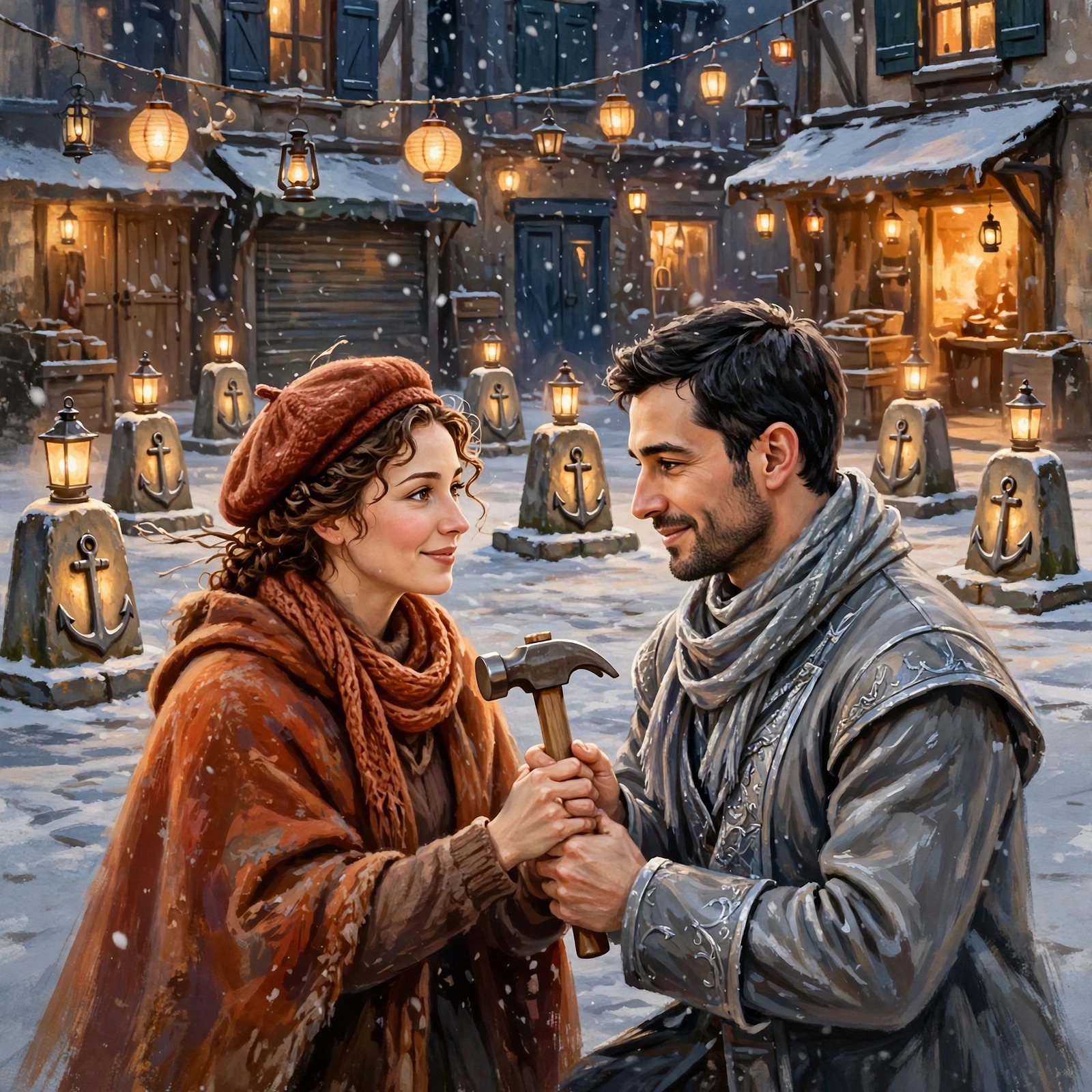
"The hammer should live with the assistant. That's how it's done. The scribe keeps the ledger, the keeper keeps the hammer." She turned it so the worn head caught the last light. "It's yours now. Yours, not borrowed, not held for a house or a duty or anyone."
Ivo took it, and weighed it, and looked at her over it.
"You're sure? You'll need it every season."
"I'll need you every season. The hammer can be the two of us or it can be an object in a drawer. I've thought about it all day, between cheese tolls." She smiled, and found her voice had gone rough. "Stay at Thornveil. Not for the post. With me."
"The post helped," he admitted. "The post is a fine excuse. But I'd have stayed for the scribe." He set the hammer on his palm, head balanced, like a man accepting a charge. "I can hear the ward from here."
"Everyone can hear the ward from here. That's rather the point of it."
"No. I mean I'll be hearing it from here for years, if you'll have me. Every market, every frost, every stone." He looked around the empty yard, the nine anchors glowing pale in the dusk, the boards swept, the gate open to the pass road and the safe dark beyond it. "I've ridden borders most of my life, and I never once rode toward anything. Only away. This is the first place I've wanted to be inside of."
Maren put her hand over the oath-bare finger of his right hand, where the ring had been, and left it there.
"Then be inside it," she said. "Maren Ferrow, of Thornveil market yard. Say it to me when it's easy."
He considered. "It's easy now," he said, and said it, and the ward hummed around them, holding everything they'd given it, and the market yard at dusk, and them.
Get notified when new stories drop
Cade Ellison
Cade specializes in romantasy and paranormal romance: magic systems with rules, courts with knives, and longing that rearranges destinies.
Leave a comment
Comments