





The Chandler's Shop
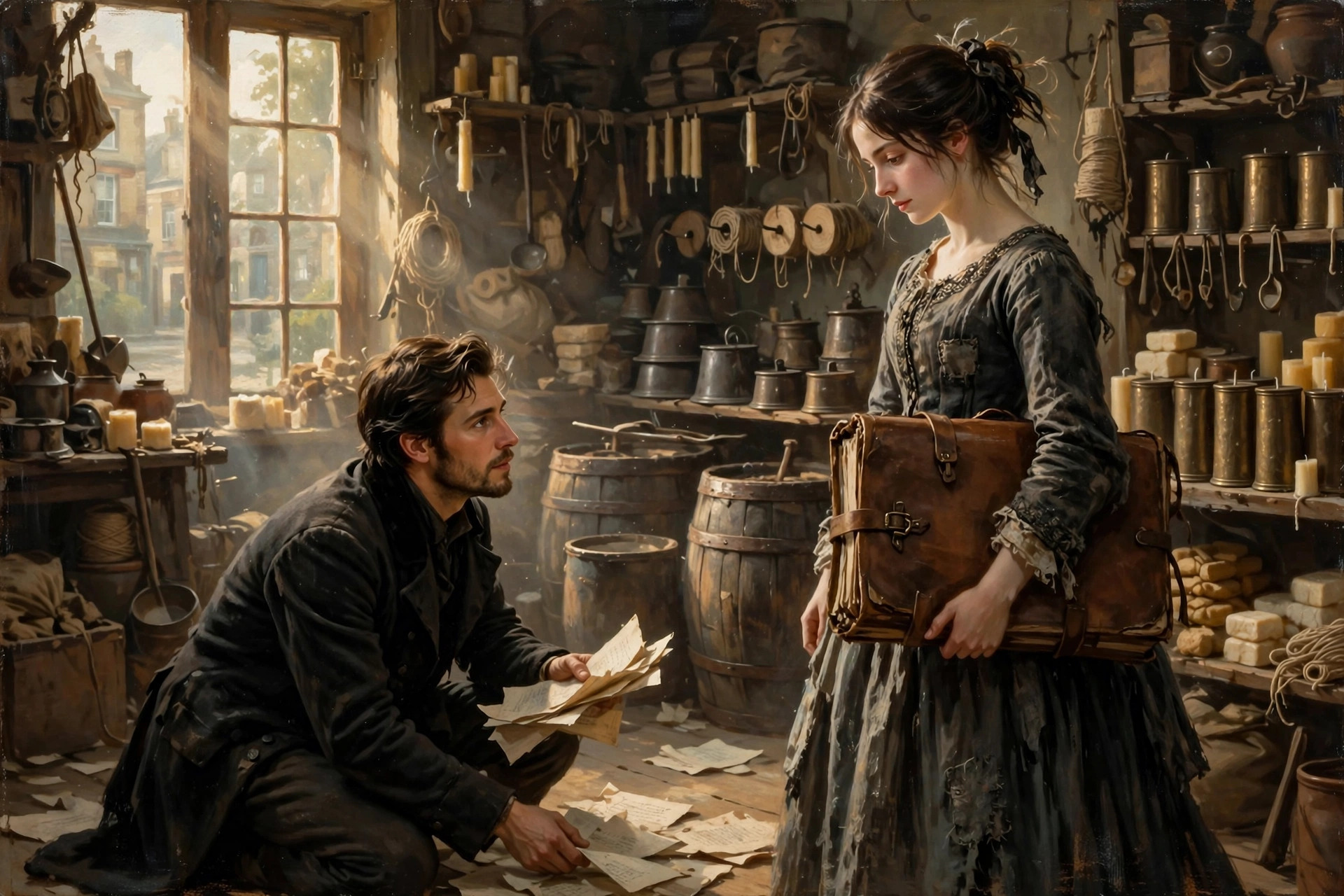
Margaret Fenwick balanced the ledger against her hip, two parcels of candle-ends under her arm, and pushed the shop door open with her shoulder because her hands were full and had been full, in one way or another, since the day of the funeral.
The bell over the door gave its tired clang. Inside, the chandler's shop smelled of tallow and salt and the particular sadness of a business that had once supplied half the ships on the river and now supplied whatever it could. Barrels of pitch. Bundles of wick. A wall of moulds that hadn't been warm in a month.
"Miss Fenwick." The chandler's wife looked up from the counter, and Margaret saw the calculation happen, quick as a blink. Debt, the look said. Widow's daughter. Careful. "Copywork's on the desk. The chandler wants the invoice fair-copied by closing."
"Then I'd best sit down," Margaret said pleasantly, because pleasantness was the only coin she had left that never ran out.
She set the parcels down, kept the ledger against her side, and turned toward the desk by the window. It happened the way small disasters do: her hem caught the edge of a crate, she corrected, the parcels shifted, and the ledger, her father's ledger, the fat leather one with the cracked spine, slid from her hip and struck the floorboards with a sound like a door slamming.
It fell open. Of course it fell open. It always fell open to the spring of the year before last, to the page with the shipping marks inked down the margin in her father's blunt hand: Meridian, Meridian, Meridian, and beside the third, a small hard note: survey signed under protest.
The whole shop went quiet. Two sailors by the pitch barrels stopped their argument mid-word. The chandler's wife bent over her needlework with sudden industry.
Everyone in Greenwich knew the name of the Meridian. Everyone knew what the broadsheets had printed after she went down, and what had been printed about the man who had signed her surveys.
Margaret crouched to gather the pages back in, and her fingers were not quite steady, which she despised, so she made them steady by force.
"Allow me."
A man was already down on one knee before she'd heard him cross the room. He collected the loose foolscap she'd copied that morning, squared it, and held the ledger open on his palm as though presenting a book to a queen. He had a dark coat, good boots, and the kind of face that had clearly been told all its life that it was handsome, and yet there was something watchful in it that hadn't been told anything at all.
His eyes went to the margin. She watched them move down the shipping marks. She watched him stop at the third one, at survey signed under protest, and she watched something change behind his eyes, a shutter drawn back an inch.
"You know these marks," she said. Not a question.
"I know ships." He rose, ledger still open on his palm. "I know this hand, too. Thomas Fenwick kept the clearest books on the river. I've sat across a table from worse ones and paid handsomely for the privilege."
"You've read my father's ledgers before?"
"I've read his reputation." He closed the ledger and held it out to her, covers flat, like a man returning something borrowed rather than rescued. "Reputations are cheaper and considerably less accurate."
She took it. His gloved fingers brushed hers, brief as a spark, and she stepped back a half-pace because she did not care for sparks, not from strangers, not from men in good boots who walked into tallow shops and knelt without rumpling.
"Julian Ashcombe," he said.
She had heard the name before she saw the man. Half of London had. Ashcombe, who bought stakes in ships the way other men bought horses, who was rumored to be assembling something large and quiet in the way of a fortune, and who was, according to the same rumor, in want of a wife because his investors had begun to say the word settlement to him in tones of concern.
"Mr. Ashcombe." She put the ledger into her satchel and buttoned it, which was a sensible action and gave her hands honest work. "You're a long way from Mayfair."
"I'm thirty seconds from the river, which is where my money lives, so I'm exactly where I belong." He glanced around the shop, at the barrels, at the cold moulds, at the desk with its fair-copying half done. "And you're a long way from a townhouse with your name still on the lease. I'm told the lease runs out inside the month. Three weeks, someone said."
"Twenty-one days," she said, before she could stop herself, and then could have bitten her tongue, because the number was hers, private, counted every morning like a rosary.
"Twenty-one days," he repeated, gently, as though handling something breakable. "And your father's debts, if the papers have it right, come to nine thousand pounds."
"The papers," Margaret said, "have never once had it right about my family, Mr. Ashcombe. Why should the arithmetic be the exception?"
Something flickered across his face that looked almost like delight. "There she is," he murmured, as if to himself, and then, louder: "May I be direct? I find indirection wastes both our mornings."
"By all means. Directness is so rare in Greenwich."
"I need a wife. Not a companion, not a flirtation, not a grand passion that ends in the usual litigation. A wife, in the legal sense, who will satisfy certain investors of mine who believe an unmarried man of my means is one bad season from recklessness." He said it the way other men discussed freight rates. "In return, those debts are settled. I've spoken with my solicitor at Lincoln's Inn Fields. The marriage articles would carry a provision of four thousand pounds to you, outright, beyond the settlement of what your father owed. Your name comes off every creditor's list in London by Thursday."
The shop was very warm suddenly, or she was very cold. The sailors had gone back to their argument, but quietly, the way men argue when they're listening.
"You would marry me," Margaret said, "to reassure your investors."
"I would marry you because it's the one arrangement in this city that benefits both parties and harms neither. Your scandal quiets mine. Mine is a quiet scandal to begin with, merely an inconvenient bachelorhood, but it's the one I can afford to fix." He paused, and for the first time the smoothness left him entirely. "I read what they printed about your father, Miss Fenwick. I read it before I ever walked in here. I'm not a man who offers rescue. I'm a man who offers a contract. The rescue, if there is any, would be incidental."
"Incidental." She turned the word over. "And when society says that the negligent man's daughter has caught the richest bachelor of the season, and laughs, and laughs, and prints cartoons? What does the contract say about that?"
"It says you'd be laughing from a carriage they can't afford to stop."
"My father did not sink that ship through negligence."
"I don't believe he did."
That stopped her. She had prepared, over these long months, answers to every variety of accusation, pity, and prurient curiosity, and she had no answer prepared for simple belief, delivered flat, without decoration.
"You don't," she said slowly, "know anything about it."
"I know his hand." He nodded at her satchel. "A negligent man doesn't write under protest in his own margin. He writes approved and pockets the fee. I've seen the other kind of man my whole career, Miss Fenwick. Your father wasn't one of them."
Her throat ached, which was ridiculous, and she covered it by lifting her chin. "Then you know something no magistrate, no underwriter, and no newspaperman in London could be troubled to learn."
"I know a clean book when a beautiful one falls open at my feet." He smiled, and the smile was, infuriatingly, kind. "Think on the terms. I'll be at Drayton House through the week."
"Mr. Ashcombe." She buttoned the last button of her satchel, ledger safe inside, her father's protest safe inside that. "You are very generous to a woman you've met for the length of a dropped ledger."
"I'm generous to a woman who needs twenty-one days and I have more days than I know what to do with."
"Then spend yours elsewhere. I'll spend mine copying invoices." She picked up her pen from the desk, an absurd little shield, but she held it like one. "I'm not for sale, and neither was my father, whatever the price the papers put on his name."
He studied her for a long moment. Then he drew a card from his coat, laid it on the counter beside her parcels, and touched two fingers to the brim of his hat.
"The offer keeps," he said. "The debts don't. They grow, Miss Fenwick, the way debts do, in the dark."
The bell clanged behind him. Through the window she watched him go along the river road, unhurried, past the men with the pitch, and she stood with the pen in her hand until the chandler's wife said, very softly, that the invoice wouldn't copy itself.
Margaret sat. She took out her ink. And she did not look at the card on the counter for a very long time, which is not the same as not looking at it at all.
Lady Osborn's Ball
Margaret had known, before the carriage door even opened, that attending Lady Osborn's ball would cost her something. She had not expected the bill to be presented so promptly.

The ballroom at Drayton House blazed with two hundred candles' worth of light and held, by her rough count as she descended the stairs, two hundred guests, which struck her as optimistic arithmetic on somebody's part. She had come because the chandler's wife had pressed the invitation into her hand with a look of such ferocious hope that refusing felt like cruelty, and because a woman with twenty-one days left on a lease and nine thousand pounds of debts does not turn down the chance to be seen in a good muslin. It was, she told herself, commerce. Visibility was currency. She wore her mother's pearls at her ears, the only jewels the creditors had not found, and she carried herself as though the room owed her money, which, in a sense, it did.
The matron was upon her before she reached the second landing.
"Miss Fenwick." The woman's fan snapped shut like a verdict. "I wondered whether you'd have the face to come. Poor Lady Osborn. She does so hate an unpleasant surprise among her dancers."
"Then it's fortunate," Margaret said, "that I've come to stand by the wall."
The matron's nostrils whitened. Around them, a small orbit of silk and diamonds adjusted itself to watch without appearing to watch, and Margaret felt the old familiar heat climb her neck, the heat of a name spoken in rooms she had once danced through as a girl everyone wished to know.
"You'll forgive my plain speaking, but nobody has told you the plain truth, so it falls to a friend of your poor mother. London has not forgotten the Merrow. Two hundred souls lost, and a captain's daughter still taking supper off honest tradesmen. There are those who say you should have gone to the continent. There are those who say worse."
"There always are," Margaret said. "It keeps the papers selling."
"It keeps good families from your door, is what it does." The fan opened again, flicking her away like ash. "My dear, you stand too near my daughter. She's to be presented this season."
Margaret stepped back. It was that or strike the woman with a fan of her own, and she hadn't brought one, having sold all three the previous spring.
The orchestra struck up a country dance. Margaret moved to the wall as promised, found a column to hold her up, and arranged her face into what she trusted was serene indifference rather than nausea. The pearls at her ears were her mother's voice, in a way: stand straight, Meg, the family never crumbled in public. The family had, of course, crumbled entirely in public, in six editions, with illustrations. But the voice was comforting all the same.
She was composing a mental invoice of the evening's humiliations, item one, item two, when the crowd at the far door parted the way water parts for a keel.
Julian Ashcombe crossed the ballroom the way he had crossed the chandler's shop floor, unhurried, certain of his welcome, and every head turned to follow him because heads always did. He was in black evening dress with a plain white waistcoat, and he looked, she thought with irritation, like a man arriving at a meeting he had called himself.
He stopped before her column and bowed. "Miss Fenwick."
"Mr. Ashcombe. You said you'd be at Drayton House through the week. I didn't understand you meant tonight, and I certainly didn't understand you meant to find me."
"I'm an efficient man. It saves time."
"Whose time?"
"Mine, mostly." He glanced at the dance floor, where lines were forming. "They're about to begin a quadrille. You'll want a partner standing here, or you'll want to leave, and I've noticed you don't leave."
"I don't leave because I can't afford to. Those are different things."
"Yes," he said. "I've begun to see that about you." He held out his hand. "One dance. Standing up with me will buy you an hour free of matrons. I'm very good insurance, Miss Fenwick. Nobody cuts a woman dancing with Ashcombe money."
"That's the most cynical offer I've had all year."
"It's the most honest. Will you?" His hand stayed out, steady, palm up, and there was in it, she noticed, no mockery at all. "You've been standing against this column long enough to warm it."
She put her hand in his.
The ballroom noticed. She felt the notice travel along the lines of dancers like wind through wheat, felt the whispers change pitch from the Fenwick girl to Ashcombe, Ashcombe, look, Ashcombe, and she hated how the second kind of whisper felt like armor after months of the first kind feeling like knives.
He danced well, which was inconvenient. He held her at exactly the correct distance, no farther, no nearer, and he counted nothing, ever, the way men did when they were concentrating on their feet instead of their partners.
"You came to look at me," she said, as the figures brought them together. "To see if the ledger woman scrubbed up."
"I came because you hadn't answered."
"I hadn't answered because the answer was no."
"It's day nine," he said. "Twelve days gone off your twenty-one. I keep a ledger too, Miss Fenwick. I know what a deadline does to a woman's nerve."
The figures separated them. When they rejoined, he said, quietly, "The debts have grown. Your chandler's man came to my office Thursday. Nine thousand and climbing. The interest doesn't sleep."
"You know my debts to the pound."
"I know them to the shilling."
The music turned for the last figure, and the room drew close, all the sets converging, and she saw, over his shoulder, the matron with the fan watching them with a face like curdled milk. Something in Margaret rose up, reckless and tired of walls.
"Mr. Ashcombe," she began, "if you imagine a dance licenses anything further, you are mistaken."
"I don't imagine," he said. "I announce."
The music ended. He did not release her hand. Instead he turned, still holding it, until they faced the long room together, and his voice, which she had only ever heard low and level, came out pitched to carry to the far mirrors.
"Ladies and gentlemen. Forgive me for interrupting the supper hour, but I find I'm incapable of waiting." A ripple of laughter, fond, expectant. Two hundred faces turned. "I have that evening asked Miss Margaret Fenwick to do me the honor of becoming my wife, and I could not stand in this room another hour without telling all of London that she has made me the happiest of men."
The applause began before she could draw breath.
It came from everywhere at once, the whole bright room breaking into smiles and gloved hands, and it was the worst thing that had ever happened to her, because it was not for her, it was for him, for Ashcombe money reclaiming a scandal and making it fashionable, and every person clapping had cut her or would have, and now they clapped. The matron's fan had stopped dead. Somewhere a dowager was already recalculating the season.
"You," Margaret said, through teeth she did not open, "have lost your mind. I never agreed."
"No," he said, pleasantly, still facing the room, bowing to the applause as though she had. "But now you can't refuse without becoming the woman who jilted me, and I can't be ruined twice by one family, can I."
"That's not, that is not how, Mr. Ashcombe, I will be a scandal again by Thursday."
"You're a scandal now. You'd be an engagement instead. Better trade."
The applause swelled. Someone began a cheer. Lady Osborn herself was bearing down upon them with tears in her eyes, and there was nowhere for Margaret to go, no column to hold her, no door that didn't cross a hundred smiling faces, and so she did the only thing left to a cornered woman with her mother's pearls in her ears and her father's name in her satchel across the river.
She gripped Julian Ashcombe's arm, hard enough to creave the wool, and pulled him down until her mouth was at his ear, and she whispered, "Four thousand pounds. A settlement of four thousand in my own name, mine, not held by any husband of mine. And the banns read at St. Alfege's in Greenwich, all three weeks of them, where my father is buried, where the whole parish can hear it. And you will never, never again announce anything about me before you have asked me. Those are my terms, Mr. Ashcombe. Take them to Lincoln's Inn or take your applause home alone."
He straightened. The applause was dying into supper chatter. Lady Osborn was three steps away and closing.
He looked at her hand on his arm, then at her face, and something in his expression gave way, briefly, to what she could only call relief.
"Done," he said. "I'll have the articles drawn by Monday."
"You were going to draw them anyway."
"I was," he admitted. "But now they're yours. That's different, Miss Fenwick. You'll find I'm a very different man once things are mine to give instead of yours to endure."
Lady Osborn arrived, radiant, to kiss them both. Margaret let her. The pearls were warm at her ears, and across the room, the matron with the fan was leaving early, which was, Margaret conceded, as she curtsied to the hostess, the first genuinely enjoyable moment of the entire evening.
The Desk Drawer
The knock came at four o'clock, when the light across Greenwich had gone the color of weak tea and Margaret had just finished hiding the ledger.
Not hiding. She had put it in the desk drawer, in the townhouse, beneath a fold of her mother's old shawl, which was not hiding so much as storing it in the one place in the house with a working lock. But her hands had shaken while she turned the key, and she was still standing over the desk like a woman guarding a grave when the housekeeper's girl came up to say Mr. Ashcombe was below with papers.
"Show him into the parlor," Margaret said.
"He's already in it, miss."
Of course he was. He had probably been in it since noon, arranging himself among her faded chairs like a man who owned the room and was merely letting her borrow it back.
He rose when she came in. He had the articles with him, a leather folio under his arm, and he held them out to her first thing, before greeting, before anything, which she found she had no defense prepared for.
"From Lincoln's Inn this morning," he said. "My man copies fair. The settlement's written exactly as you dictated it. Four thousand pounds, in your name, yours alone, no husband's hand on it while you live."
"Let me read it before you congratulate yourself."
"I'd be insulted if you didn't."
She read it. She read every line, twice, standing by the window while he sat and did not fidget, which she noticed because she kept waiting for him to fidget and he never did. The paper was good. The terms were hers. Somewhere in the third paragraph her eyes stopped tracking the words and started tracking the shape of her own name, Margaret Fenwick, written in a stranger's fair hand as a person to whom four thousand pounds would belong, and she had to begin the paragraph again.
"There's a blank," she said. "For the date of the wedding."
"The banns need three weeks at St. Alfege's. We start Sunday, if you'll allow it. That puts the wedding..."
"I can count, Mr. Ashcombe."
"You can count," he agreed. "I've relied on it."
She set the folio on the parlor table, open, and pressed it flat with both hands, and then, because his eyes had followed hers to the desk in the corner, the one with the lock, the one she had chosen to leave in the room while she received him, she heard herself say, "Do you know what my father actually did wrong?"
He was quiet a moment. "I know what's said."
"What's said is that he loaded a ship badly and let men drown and wrote lies in his books to cover it. What's said is that I inherited the lies along with nine thousand pounds of other people's money." She hadn't meant to begin here. She had planned to make it through the signing first, the tea second, the truth never. But the drawer was ten feet away and her hand was already pulling the key from her sleeve. "What's in the books is something else. Come and see, since you're marrying them."
She unlocked the drawer in front of him, so there could be no question of hiding, and lifted the shawl aside. The ledger was smaller than he expected, she could tell. Smaller than a scandal ought to be. Calf-bound, rubbed soft at the corners, her father's slanting hand all through it in two inks, brown for the entries he made himself and black for the ones his partner dictated to him and he copied without question, because that was the arrangement, that had always been the arrangement.
Julian took it when she offered, but he didn't carry it to the chair. He stood at the desk and read standing, the way she did, and after a while he said, "Show me the Marlowe cargo."
"Page ninety."
He found page ninety. She watched his finger move down the column. He was not a man whose face gave much away, but his finger stopped, and stopped, and stayed stopped.
"The stowage plan's entered twice," he said.
"Once in brown and once in black. The brown one is what was actually loaded, signed off by the master. The black one is what was recorded after the ship went down. Different weight. Different distribution. Whoever wrote the black version was building a story about my father's negligence, and my father kept both, side by side, because he knew."
"Knew what?"
"That he was being made into the story. He couldn't prove who. He died before he could try." She took the ledger back, gently, because her hands wanted it. "The chandler I copy for lets me bring it in and work from it, sometimes. As though it were practice. I've gone through every page, Mr. Ashcombe, every crossing, every advance. The black hand appears in exactly one set of entries, and it begins the same quarter the partner's son bought a house he shouldn't have been able to afford."
"You never told anyone."
"Who? I told the creditors' committee. They thanked me kindly and noted my grief. A drowned man's daughter weeping over arithmetic. It went exactly as you'd expect." She closed the ledger and set it on the desk, on top of the drawer, in the open. "So now you have it. That's the estate you're marrying. Not nine thousand pounds of debt. A book that no one will read."
"I'll read it."
"You're reading page ninety. There are two hundred and forty pages."
"Then we'd better start."
He sat down at the desk. Not at the parlor table with the articles, at her father's desk, in her father's chair, and pulled the lamp closer, and began at page one.
She should have objected. The chair was hers now, the desk was hers, the whole dwindling house was hers for another fortnight and then the lease went with everything else. Instead she went and stood beside him, and then, because leaning over a seated man's shoulder for two hundred pages was idiocy, she pulled the second chair around to the other side of the desk and sat, and they read facing each other with the ledger turned between them like a small shared country.
He asked good questions. That was the trouble. He asked where the second ink came from, and why the warehouse fees dropped in the spring quarter, and what the initials beside the Marlowe advance meant, and she answered them all, and the answering did something to her chest, because she had been answering these questions alone, silently, at the chandler's counter between customers, for a very long time.
"Here," he said, near seven, "your father wrote something in the margin."
"He did that. Little notes. Weather mostly."
"This one says, 'M. asked why I frown at partner. Told her ledgers frown on their own.'" Julian looked up. "M."
"Me."
"How old were you?"
"Old enough to be told the truth, evidently. He didn't take even that from me."
The candles had burned down. The housekeeper's girl had brought tea and taken it away untouched. Outside, the river smell came in through the cracked window, and somewhere down the street a man was calling the hour, and Margaret realized that the lamp had moved from her side of the desk to his at some point, or she had moved, or both, and that they were leaning over the same page so closely that she could see the lamp light in his eyes and the faint salt-and-paper smell of him, and that neither of them had said anything for some moments.
"Margaret," he said. Not Miss Fenwick.
The distance was nothing. The distance was the width of one page. She could feel the whole evening tilting toward it, and she wanted, with a fierceness that startled her, to let it tilt.
She straightened instead, and he let her, and the page turned.
"We should finish the Marlowe quarter," she said.
"We should," he said, and his voice was not quite steady, which she found she liked, and then he closed the ledger anyway.
"Tomorrow," he said. "It's dark, and I'll be reading brown ink as black and calling it proof. Proof deserves daylight." He rose, and she rose, and neither of them moved toward the parlor table where the articles lay open and waiting.
"The articles," she said.
"Not tonight." He gathered his coat, and looked at the folio a long moment, and left it exactly where it was, unsigned, the pen laid across it uninked. "I came to sign them. I find I'd rather you watched me do it after you've seen what I've seen. You'll believe the terms better. Leave them there. I'll come back."
He stopped in the doorway, half turned.
"Page ninety," he said. "Your father wasn't careless, Margaret. Whatever else is true tonight, that one's true."
Then he was gone, and she was alone with the lamp, the unlocked drawer, and two open books in the room, and it took her a while to decide which one she sat down with.
It was the ledger. She told herself it was habit.
Lincoln's Inn
The hackney cost her more than she liked, and she spent the whole ride telling herself she hadn't wasted it. Julian had written that the articles were ready. The banns had been read a second time that very morning at St. Alfege's, his note said, and the third reading would come, and after that there was nothing between her and a name that wasn't Fenwick but the ink. So she had dressed in her second-best grey, put the pearl earrings in her ears because her hands had wanted something to do, and gone up to town with the articles unsigned in her reticule, because she'd decided on the ride from Greenwich that she would rather sign them in front of him than before, and watch his face while she did it.
That had been the plan. Plans, in her experience, were things that survived exactly as long as it took other people to hear about them.
The solicitor's office sat on the square at Lincoln's Inn Fields, upstairs, with a narrow stair and a smell of sealing wax and coal. A clerk showed her in, said Mr. Ashcombe was expected within the half hour, and left her alone with the fire, a table, and the room's whole paper civilization.
She didn't mean to snoop. She wanted that understood with herself, later, standing in the wreck of it. She had only risen to warm her hands, because March had come in mean and the grey dress was thin at the elbows, and the fire was the only generous thing in the room. And the desk beside the hearth held a letter, left face up the way a letter is left when nobody expects company.
She saw her own name first. That was the trouble with names. They draw the eye like a lit window draws a moth.
She read it standing, one page, in a hand she knew before she had finished the salutation. She knew it the way you know a voice. The tall capitals. The looping F, begun with a flourish and finished with a scratch, like a man who started everything grandly and resented the ending. She had copied that hand for three winters. Her father's partner. The man whose entries ran beside her father's in every quarter of the ledger, the man who had stood at the funeral with his hat off and his eyes dry and said what a careless navigator Fenwick had always been, what a tragedy, what a lesson in leaving ships to those who understood them.
She made herself read it again, slowly, so that she couldn't later tell herself she'd mistaken it.
The letter was addressed to Julian. It thanked him for his good sense. It confirmed, in the tone of men confirming what they have already decided, that the investors' continued backing rested on the union proceeding, since the Fenwick records would then pass into Ashcombe's hands as a matter of course, husband and wife being one person in law, and the nine thousand pounds of Fenwick debt would be cleared from the Ashcombe account upon delivery of the books, complete. It hoped the four thousand settlement would be kept quiet, as it was an instrument, not a gift. It closed by assuring him that no one imagined he had let sentiment complicate a matter of access.
Access.
She read the word three times. The fire cracked a coal behind her, and she did not turn around.
So that was the shape of it. Not despite her father's ledgers. Because of them. Every evening at the desk in Greenwich, the lamp moving closer, the pages turned one after another, his voice going unsteady on her name, all of it retrieval. He had come for the books and stayed for the books and the courtship had been the crowbar, and she had nearly let the evening tilt, she had wanted it to tilt, and she stood in a stranger's office in her good grey dress and her mother's pearls and felt exactly as clever as she had ever been, which was not at all.
She heard him on the stair before the door. She had learned his tread without meaning to. Two steps, then a slight pause at the turn, then the rest.
He came in pulling off his gloves, and the smile started before he saw her face, and then stopped, the way a candle goes out in a draft.
"Margaret."
"The articles are on the table," she said. "Your man put them out. I brought my own pen, I'm afraid. Waste of a hackney fare."
"What's happened?" He crossed the room, and she stepped back from him, and the step cost her something, and she spent it anyway.
"There's a letter on the desk. I'd take it up before the fire gets to it. It seems to be yours."
He glanced past her. She watched him read it, and she watched what happened to his shoulders while he did, and some traitorous part of her noted that he looked like a man reading his own sentence. She did not care for the traitor, but it was hers.
"This is not what it appears."
"Which part? The nine thousand, or the four thousand, or the part where my father's books pass into your hands as a matter of course? It's very plainly written. You should see the hand, if you haven't. Though I expect you have. I expect you've seen a great deal of that hand."
"I've seen it once before today, and not in a letter." He set the page down, face down this time, as though the damage was in the ink. "In the ledger. Page ninety. Margaret, the man who wrote that letter forged entries in your father's books. I've half of it traced. The whole quarter's a false copy. He built the negligence with his own pen and let your father carry it to the grave, and he is one of my investors, and I found that out eight days ago, and I have spent eight days trying to get him out of my house without losing everything I've built, because if his money walks, the others walk with it."
"And the marriage."
"He wants the marriage. Yes. Because it puts the ledgers under my roof, where he thinks a husband's roof is his to search. He's wrong about that. I've been wrong about how to fight him, and I'll own that, but I never once, not on any evening at that desk, came for the books."
"You told me the terms yourself. Four thousand pounds, quiet, an instrument. Those were practically the words."
"I offered four thousand because your father's creditors are circling and the lease on the townhouse runs out inside the month and you're copying yourself blind for a chandler who pays you in permission to stay. I offered it because I wanted you to have a floor under you that no one could pull out. Not once in that letter's language. If the wording matches, it's because he wrote to me in the language of money and I answered in kind, and I should have burned my half of the correspondence."
"You should have told me."
"I was going to tell you tonight. After you signed. That was cowardice, and I'll carry it."
"You were going to let me sign, and then tell me my father was slandered by the man backing my husband. You'd have held the truth until the ink was dry, the way he held it until the coffin was."
He had no answer to that. She watched him reach for one, twice, and she found she preferred the silence to whatever he'd have built in it, because the silence at least wasn't clever.
"The banns were read again this morning," she said. "Third time next Sunday, and then the thing's done. You've been counting the Sundays, I imagine. I've been counting the days on the lease. Twenty-one days, Mr. Ashcombe, and I know exactly how long a thing lasts when the people holding it are only waiting for it to be convenient to let go."
"Nothing about you is convenient. I'd have thought you'd have noticed that by now."
It was nearly funny. That was the worst of it. Under everything else, the whole ruin of it, there was a small voice noting that he had never once treated her as a debt to be managed until this room, and here even he sounded like the letter.
She took the articles from the table. He didn't stop her. She thought he might, and part of her, the part that had leaned toward the lamp, waited for it, and he only stood with his gloves crushed in one hand and let her lift the folio, let her cross to the hearth, let her hold it a moment as though the decision were still open.
"Page ninety," she said. "You told me he wasn't careless. You knew what it would mean to me, and you left it on the table like bait."
"I left it because it was true."
"Then it can be true without me married to it."
The fire took the pages the way fire takes paper, all at once and then piece by piece. The corners of the settlement clause blackened first. Four thousand pounds went to ash in under a minute. She watched until the signature lines had gone, the blank ones, the two places where their names would have met in the middle of the page, and then she set down the pen she had brought, uninked, on the mantel, which was the only small cruelty she allowed herself.
"Good day, Mr. Ashcombe."
"Margaret."
She was already on the stair. The clerk half rose as she passed. Outside, the Fields were grey and wide and full of people walking somewhere on purpose, and she walked among them with her chin level and her mother's pearls cold at her ears, and she did not cry, and she did not look back at the window where a light stood in a room with a fire in it, and a man in it, and the ashes of a thing that had nearly had her name.
The Partnership Offer
The note had said seven o'clock, Drayton House, and had said nothing else, which was either an insult or an apology, and Margaret had spent the whole ride from Greenwich deciding which. The ledger sat on her knees in the hackney, wrapped in a shawl against the damp. She had not meant to bring it. She had meant to leave it in the desk drawer where it had lived for four years, fat with her father's small even hand, and then at the door she had turned back for it, because a woman walking into a great house unarmed is a fool, and her mother had raised no fools.
Drayton House stood lit from basement to roof. Carriages queued along the Mayfair pavement, and through the tall windows she could see men in dark coats and women in silk, forty or fifty of them, and the sound of it came out to the steps when the doors opened, that low continuous murmur money makes when it is pleased with itself.
A footman took her name and did not quite know what to do with it. She watched the hesitation travel up his face, from her cloak to her gloves to the pearls at her ears, doing arithmetic. She was used to that arithmetic. She had been the subject of it since the inquest, in shops, in church, at the chandler's counter where she copied invoices eleven hours a day to keep a roof. Nine thousand pounds of debt and a dead father and a name that made doors close softly rather than slam, so nobody could say when exactly they had shut.
Julian came down the staircase two at a time, and the room behind him hushed the way a room does when it notices something.
"You came."
"I came for my father's book. You wrote that you'd found something in it. That isn't yours to find, Mr. Ashcombe. Whatever it is, it's mine, and I'd thank you to hand it over and let me go home."
"It's in the library. And it is yours. All of it." He offered his arm as though they were entering a supper party and not a room full of his investors, and when she did not take it, his mouth moved through something that was almost a smile and settled on nothing. "Walk with me anyway. They'll want to see it."
"They'll want to see what?"
"A man lighting his own fortune on a table," he said, "for form's sake."
The long room at the back of Drayton House had been arranged for an announcement. She understood that the moment she crossed the threshold: the chairs set in rows, the table at the head with a document laid square upon it, the seal heavy and red and already broken, which meant it had been read, which meant it had been agreed to, which meant whatever was about to happen had already been decided somewhere without her. She had stood in a room like this once before, at the inquest, and the feeling in her stomach was the same. Chairs in rows. A table. A paper. Her family's name on everyone's tongue and nobody saying it aloud.
The men rose when Julian entered. One of them, older, with a watch chain like a river of gold across his waistcoat, looked at Margaret and then looked at Julian with a mild, unhurried distaste, the look of a man pricing something he had decided not to buy.
"Ashcombe. We're a private gathering."
"We're a public one now," Julian said, "since we've a lady's reputation among the assets. Sit down, gentlemen. I'll be brief."
He did not sit himself. He went to the head of the table and stood where the light from the candelabra fell across the partnership papers, and Margaret, placed by the fire with a glass of something she had no intention of drinking, watched the investors watch him and understood that every one of them had already counted him as theirs. He had the look of a man who belongs to a balance sheet. She had spent a month learning to read him against her will, the way she'd learned invoices, and she could see the cost in his shoulders even before he spoke it.
"The articles are generous," Julian said. "I've read them. Full backing for the line, my seat at the table, and my capital behind yours, which is the part you actually wanted. In exchange, one condition, which was never written down but was understood by everyone in this room except, I think, one person who has just arrived." He turned and looked at her, and it was not an apology in his face, it was worse, it was a kind of asking. "The condition was Miss Fenwick. Her name, and her silence, and her ledger, which her father left behind him, and which certain gentlemen in this room have spent four years hoping would stay shut in a drawer in Greenwich."
The man with the watch chain set down his glass. "That's a serious remark, Ashcombe."
"It's a true one, which is rarer. Here is the book." He drew it from under his coat, where he had been carrying it against his ribs like a wound dressed, and laid it on the partnership papers, on top of the seal, so that the two documents occupied the same square of table. "Every entry in the main columns is in Nathaniel Fenwick's hand. Every entry in the margins, the true figures, is also in his hand, and they don't agree, and the difference between them, over eleven voyages, is very nearly nine thousand pounds. The margin figures are the honest ones. The column figures were written to be shown to underwriters. Someone dictated what went in those columns. Someone who was in a position to profit when the underwriters were cheated and to let a dead man's name carry the whole of it."
"You're ruining yourself over a copyist," the older man said. His voice had not changed at all, which frightened her more than shouting would have. "Over a woman whose father drowned forty men."
"Whose father was fed to the inquiry by his partner," Julian said, "who sits in this room wearing a great deal of gold, and who wrote me three letters in the last month to make certain the Fenwick girl stayed buried. I declined the partnership this afternoon. In writing. My solicitor has the letter, and the margin figures, and a fair copy of both, so that burning this book tonight would accomplish nothing except making me warm."
It went very quiet. Somewhere behind her a woman's fan stopped.
Julian lifted the ledger off the partnership papers and crossed the room to Margaret, and the investors watched him do it, all of them, forty chairs of them, and he did not seem to feel it, or else he felt it and had decided that a man could stand it for the length of one long room.
"It's yours," he said. "Not bait. Not a settlement. Not four thousand pounds of anyone's terms. It's your father's hand, and it says he was honest, and I'm sorry it took me twenty-eight days and your walking out of my life to read it properly. Take it to the underwriters. Take it to the papers. Take it wherever a name can be mended, and use mine however you need to. I've nothing left to protect, so I can't be made to regret it."
He put the book into her hands and stepped back, and the distance he put between them was the whole of the room, and she understood that he was giving her the choosing of it, in front of everyone, with the fire warm at her back and her father's ledger heavier in her arms than it had ever been in the drawer.
She opened it where the ribbon marked it. Her father's small even hand ran down the columns, and beside it, cramped into the margins, the same hand again, freer, hurried, alive, and she read three lines and then four and then a page, and the numbers assembled themselves the way they always did, into a shape, into a story, and the story was not carelessness. The story was a man recording his own robbery entry by entry because he could not stop it and would not lie about it. He had left it to her in the margins the way he had left her everything, quietly, in a drawer, in the faith that she would one day count it.
Her eyes were hot. She let them be, in front of all of Mayfair.
"He kept the true figures," she said. "All along. He kept them where only I would look."
"Yes."
"You gave up the partnership for this. For a margin note."
"I gave it up because a man who'd read those margins and signed anyway would be the partner they deserved," he said, "and I find I'd rather be the man you deserved, even unpartnered, even poor, even standing in a room where nobody will insure a ship I touch for a decade."
She looked down at the page, and at the two hands of it, her father's and her own holding it, and then across the room at the man who had crossed it to hand her back her family's honor in front of the people who had priced it at nothing.
"Julian," she said.
He closed his eyes, briefly, like a man setting down something he had carried a long way. "Yes. That's my name. Say it again and I'll believe any number of impossible things."
"Julian," she said. "Take me somewhere quiet, and bring the book, and we'll begin at page one."
St. Alfege's Steps
The third time the banns were read, the curate's voice went out over the heads of the plain Sunday congregation and nobody stirred. Margaret had counted the first reading and the second the way she counted everything, twice, in the margin, and this third reading was the sum brought forward. Julian Ashcombe of Drayton House, Mayfair, and Margaret Fenwick of this parish. If God was listening, He had heard it three times now, and so had Greenwich, and Greenwich, unlike Mayfair, kept its opinions to the price of candles and the state of the tide.
They were married on a Tuesday, at nine in the morning, because Julian had learned by then that she liked the early hours best, when the ledgers were fresh in the mind and the ink not yet tired. The church smelled of cold stone and lamp oil. There were eleven people in the pews. The chandler's wife had cried before anything had even happened, just at the sight of Margaret in her gray silk with her mother's pearls at her ears, and the chandler himself stood with his hat in both hands like a man holding a bird he meant to release.
Julian wore the coat with the mended cuff. She had noticed it at the second reading of the banns and had said nothing, and he had worn it again on purpose, because he was a man who had learned the difference between a thing mended and a thing replaced, and had chosen the mended one, and wanted her to see that he had chosen it.
"You're sure?" he had asked her that morning, in the churchyard, while the sexton was still sweeping the steps. "Nine thousand pounds of debt is cleared, but the talk isn't. Talk doesn't clear. The two hundred people who watched you read that ledger at the ball will say what they like for a year."
"Let them say it to the ledger," she'd said. "The ledger answers better than I do."
He had laughed, then, the short unguarded laugh she had heard only four times and had privately numbered, and had said that he would marry her in the middle of the church with the whole of Mayfair standing in the aisles hissing, and she had said, no, Tuesday, nine o'clock, and he had said, yes, of course, Tuesday, because the choosing of it was hers and he had stopped trying to arrange things for her some weeks ago, around the same time she had stopped bracing for the moment he would.
Now it was done. The ring was on her finger, plain gold, no stone, because she had asked for plain and he had agreed before she finished the sentence. The curate shut the book. The chandler's wife wept on with great economy, producing a handkerchief already prepared for the purpose. And Margaret turned to her new husband in the half-empty church and found that her eyes were hot again, which was inconvenient, because she had not cried in eleven years and seemed now to be making up the arrears all in one season.
"Margaret," Julian said, quietly, testing the word the way a man tests ice.
"Julian." She had said it a hundred times since the night at Drayton House, in the counting of it, and it had not yet worn smooth. "There's a thing I have to do before we leave the church. It can't wait for the house."
She led him to the vestry door, out of the sight of the eleven, and took the pearls from her ears. Her fingers were not quite steady, which was unlike them, and he watched her without helping, because he knew better than to help her with a number or a jewel.
"My mother's," she said. "Her mother's before that, I think, though the paper's lost. When the debts came, nine thousand pounds of them, I sold everything that would sell. I priced these at a shop on the Strand and then I couldn't. I put them back in the box and I told myself it was because they were worth too little to matter." She put them into his palm and closed his fingers over them, and the pearls were warm from her skin, small and gray-white and imperfect, like everything that lasts. "It was because they were the last thing I had that my mother had chosen for love instead of for value. I couldn't sell them because I was afraid that once they were gone, there'd be no proof left that any Fenwick had ever been chosen that way."
"Margaret."
"They're yours now," she said. "Not a settlement. Not the four thousand in the articles, not a penny against the debt, nothing with a column to hold it. A gift with no entry. My father kept a whole second set of books in the margins of the first, and this is mine, and you're the first line in it."
He looked down at his closed hand for a long moment. Then he opened it, and instead of pocketing them he fastened them back at her ears, one and then the other, his hands slow and careful, and she stood very still under the vestry lamp and let him.
"I'll carry them on you," he said. "That's how I'll keep them. If that's allowed."
"It's allowed."
They came out of the church into a bright cold morning, and the eleven were on the steps, and beyond the churchyard wall the river ran with its usual indifference. A carriage from Mayfair stood in the lane, which was not theirs. Two people had come down from London for it after all, and stood at a careful distance, watching, and would carry the news back up the hill: married, actually married, in Greenwich, of all places, before God and a chandler. The cut direct had been tried at the ball and had failed, because a woman who has stood in a drawing room in Mayfair and read her father's true figures aloud to two hundred guests, while the man who forged the false ones sat three chairs away unable to meet her eye, cannot be cut. There is nothing left to cut. The scissors close on air.
Julian stopped on the top step. From inside his coat he took a folded paper, and she saw the shape of it before she saw the words, the long legal shape, the Lincoln's Inn hand.
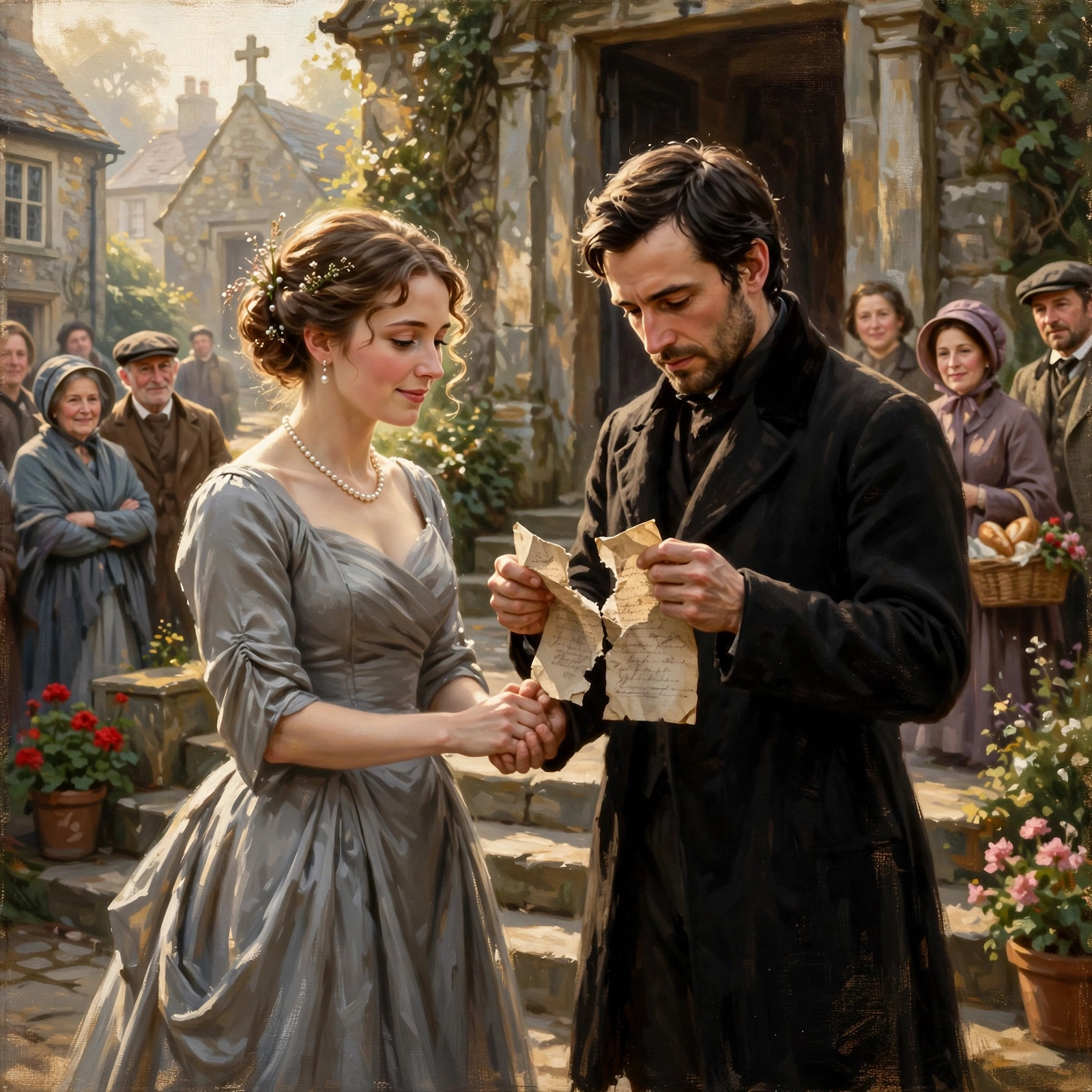
"The articles," he said. "The new ones, drawn after the fire. Unsigned. My solicitor wept, which was unprofessional, but he'd earned it. They give you the four thousand, the house, the income, everything, held entire, if you'll only sign where the mark is. And I've been carrying them for three days, and I keep arriving at the same place." He tore the paper in two, cleanly, down the fold. "I can't hand you a marriage that has terms in it. Not after watching you read what a man wrote when he had nothing left but the truth of what was taken from him. So here." He held out the halves. "You can have these instead of my hand, if you want them. It's the safer investment."
Margaret looked at the torn halves, and at the mended cuff, and at his face, which was doing the thing it did when he had decided something costly and was waiting to find out the price.
She let the paper halves drop between them onto the step.
She took his hand instead, the right one, the one that had held the ledger out to her in front of Mayfair, and she laced her fingers through his so that the ring pressed against his knuckles, and she said, "I'll take the hand. The hand, and page one, and Tuesday mornings, and the rest of the columns as they come."
"That's the whole settlement?"
"That's the whole of it. No further entries."
Below them in the lane, the chandler's wife was already explaining the pearls to the chandler, wrongly, warmly. The river went on. Julian Ashcombe, unpartnered, uninsured, and married on a Tuesday, lifted their joined hands into the light, and turned them over, and kissed the inside of her wrist where the pulse was doing its quiet arithmetic, and Margaret Fenwick, who had balanced every book her father ever kept, found that this one, at last, balanced on its own.
Get notified when new stories drop

Marcus Hale
Marcus writes slow-burn and marriage-of-convenience stories where logistics become intimacy and competence is a love language.
Leave a comment
Comments