





The Timing Beam
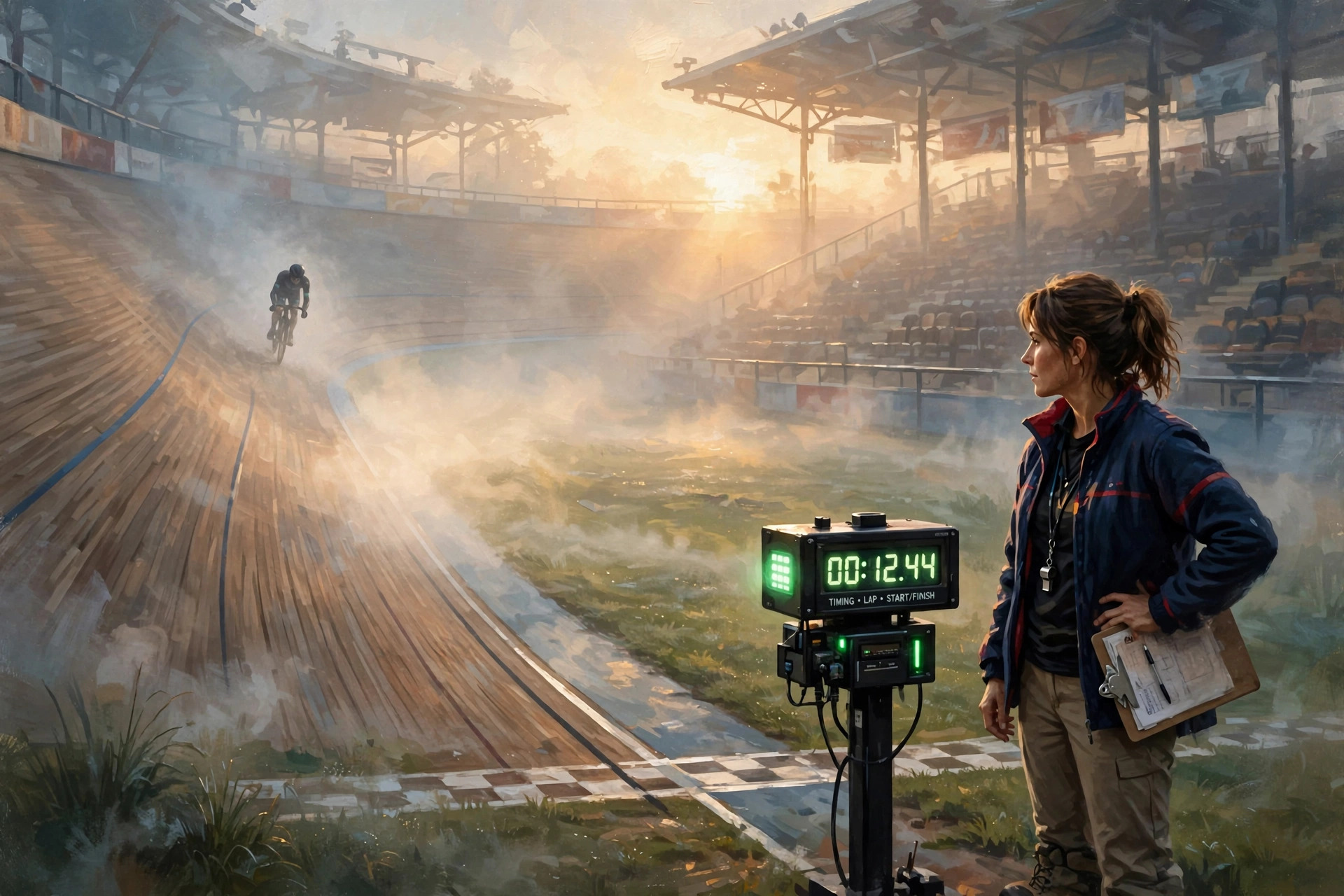
The timing beam at Pikes Peak Velodrome blinked green at 7:04 in the morning, and Nora Vance had already been standing at the finish line for twenty minutes, watching the fog burn off the infield grass. Forty days until trials. Forty days, and the federation had made it plain in a conference call she'd taken with her back against the cinder block of the equipment bay: put a rider on the Olympic sprint nomination, or the program's funding went to a development squad in another state. She'd written the number on the whiteboard in her office upstairs. 40. No exclamation point. She didn't believe in punctuation as motivation.
Jonah Petrie rolled through the warm-up area on the rollers, legs spinning easy, headphones on, a good kid with a tendency to check his chain tension three times before every effort. Six warm-up laps, that was the protocol, then standing starts, then the kilometer time trial. Nora had the clipboard against her hip and a stopwatch she no longer trusted, its face cracked from a fall she didn't like remembering, so the beam would do the counting today. The beam didn't care whose heart was in it.
Which was when a track bike she'd never seen came down the banking at full speed, out of turn four, no call of "rider," no nothing.
She stepped onto the apron with her hand up, and the bike swept past close enough that she felt the wind of it, and then it came around the bottom of the turn and stopped, and a man in a plain black kit looked down at her like she was a pothole.
"Track's open," he said.
"Track's booked. Private session, federation program, seven to ten." She didn't recognize the face, but she recognized the posture. Chin first, everything else after. "You're on a schedule I own. Who are you?"
"Declan Reyes." He unclipped one foot and set it on the boards like he was granting her a favor. "And I've got a flight at noon, so I'll be quick. Heard there was a sprint program out here. Figured I'd see what my country's money bought."
Jonah pulled one earbud out. "That's the guy from the European circuit. The one who beat the Italian at—" He stopped, looked at Nora, looked back. "The one who got dropped by his team last season."
"I left," Declan said. "There's a difference."
"There usually is," Nora said, "and it's usually expensive. Off the track, please. We're mid-session."
"You're mid-warm-up. I've been watching from the car park for ten minutes." He nodded at the beam. "Let me do one kilo. If I'm slower than your boy, I'll leave and you can have your track back, all quiet and tidy."
Jonah said, "Coach, I don't think he knows about the protocol—"
"He doesn't have to know about the protocol, because he's not riding the protocol." She kept her voice level. She kept the clipboard where it was, between her sternum and the rest of the world. "Six warm-up laps before anyone touches a standing start on this track. The turns run 42 percent banking. It's not a strait, it's a wall, and I don't put strangers on a wall at speed."
"I've ridden steeper."
"Not today you haven't. Not on my watch."
He looked at her for a second longer than the argument needed, and she had the uncomfortable feeling of being measured, split-timed, judged against something. Then he said, "Fine. Six laps. How do you want them?"
"Easy gears, high cadence, top of the blue band, both directions. If you can't follow that, the gate's behind you."
He followed it. That was the part that surprised her. Six laps, clean, head still, and he even called "rider" coming down for the first one, sarcastic the first time and then, she noticed, not sarcastic after. He clipped in at the start line without being told where it was. He waited for her nod before the standing start, which nobody did, which she had stopped expecting people to do.
"Beam's live," she said. "One kilo. One shot, then you're off my schedule."
He went. And she watched the first corner and forgot to be annoyed.
He was quick in a way that made the boards look slow. No hesitation at the line, no sitting up early, just the whole 250 meters of lap after lap eaten with the same ugly confidence he'd walked in with. The beam blinked, and Jonah read the number off the box in a voice that went up at the end like a question.
"Sixty-one point four."
Silence on the apron. Jonah's best on this track was 62.2, set three weeks ago on a day they'd both been proud of.
Declan circled back down, breathing through his nose, and stopped. "So," he said. "Quiet and tidy."
"You knew the number before you rolled on," Nora said.
"I keep track of who's riding what in my country. Someone should." He tipped his chin at Jonah. "You're good. You check your chain like it's going to confess something. But you sit up at 200 to go. Every time."
Jonah's ears went red. "I do not—"
"You do," Nora said quietly, because it was true and because it wasn't the point. "You're both benched. Session's over."
"Benched?" Declan laughed once, short. "I just rode a faster kilo than your program rider on your home track."
"You rode a faster kilo than a boy who did his full protocol while you freelanced into his session. That's not a result, that's a stunt." She was already walking toward the stairs to the office, and they followed, which she chose to take as a small victory. "And it's not your track, and it's not your program, and in forty days one rider from this program gets nominated to the trials for the Olympic sprint spot. One. Not the fastest man who happened to be passing through Colorado Springs with a flight at noon."
"My flight," Declan said, "I'll cancel."
She stopped on the landing and turned. Behind her the whiteboard hung in the window of her office, the day's schedule on it, Jonah's name on every line, and the big 40 in the corner.
"You want a seat at this table, you do it like everyone else. Full protocol. Every session I run. Or you keep your number and your attitude and get on your plane, and in four years somebody faster and younger does this to you."
"I had a three-year contract over there," he said. "I walked away from it. You think I'm scared of a clipboard?"
"I think you're scared of exactly one thing, and I haven't figured out what yet. But I've got forty days, so I will."
He looked at her, and for a half a second the arrogance slipped and something younger showed underneath, something that had spent a lot of years being told it wasn't enough. Then the chin came back up.
"Fine," he said. "Put me on the board."
She took the chalk off the ledge. Under Jonah's name, in the same neat block letters, she wrote: DECLAN REYES. Then, beneath both, she drew a single line and one word. TRIALS.
"Two riders," she said, capping it. "One spot. Nobody's name is bigger than that line, including mine. Warm-up's at six tomorrow. Both of you."
Jonah was grinning at the board like a kid who'd just been handed a rival instead of a problem. Declan looked at his own name in chalk like it was a contract, which, Nora thought, turning back toward the track, was exactly what it was.
Six Warm-Up Laps
Nora found the evidence at 5:40 on the ninth morning, which meant she'd spent eight days not looking for it, and she was annoyed at herself for that.
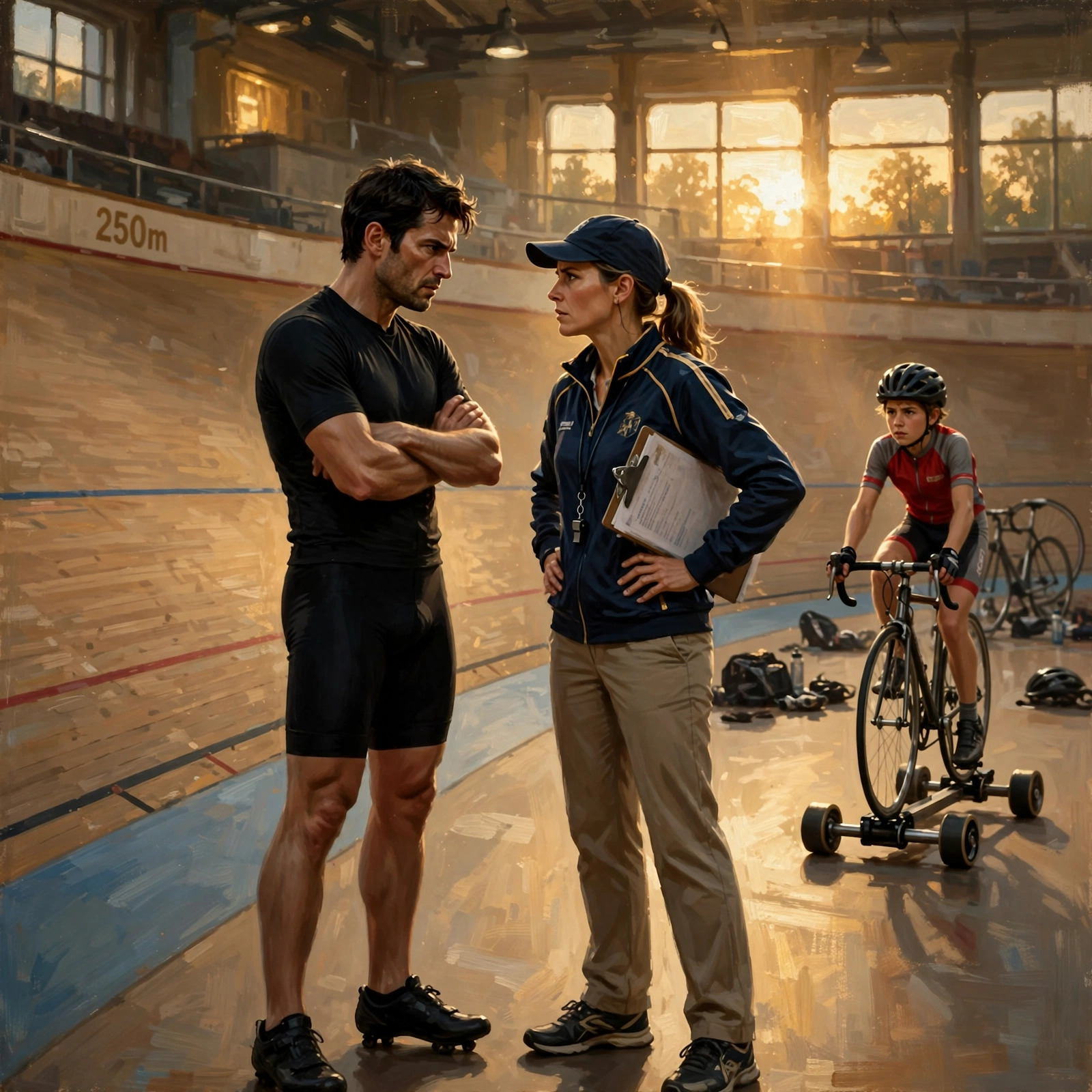
The timing beam at the finish line had a memory. It wasn't supposed to; it was supposed to reset every session, but the unit was old and half the buttons didn't work, and if you scrolled back through the dark hours between ten at night and five in the morning, you found things. Twenty-two sessions logged in the past eight nights. Splits on every one. Fast splits. Nobody's splits, the rider's name field blank, because whoever had been riding had made sure of that.
She stood at the finish line with her cracked watch pushed up her wrist and scrolled, and behind her the doors banged open and Declan came in with a coffee and his helmet dangling from two fingers, early, which was new, and Jonah trailed after him still zipping his jacket.
"You're both early," she said without turning around. "Growth mindset. I love it."
"You're holding the beam like it insulted your mother," Declan said.
"Twenty-two sessions." She scrolled again, slow, so the number landed. "Night sessions. Blank name field. Someone's been out on my track in the dark, alone, no coach, no radio, no spotter on a forty-two percent banking, and doing standing starts, which is how people end up in the boards." She turned. "Forty-two percent, by the way. You know what that means at speed? It means the track holds you up until it doesn't."
Jonah looked at Declan. Declan looked at his coffee.
"It's not your track," Declan said. "You said that yesterday."
"It's the federation's track, and you're a federation rider as of yesterday afternoon, which makes your femurs federation property, so yes, it's my track. Whose splits are these?"
"Mine," he said, too fast, and Jonah made a small sound into his fist that was absolutely a laugh.
"Jonah. Warm-up area. Rollers. Go spin."
"I get ejected for knowing things?"
"You get ejected for laughing at a man with a secret." Jonah went, grinning, bike on his shoulder. Declan didn't move. "Well?" she said. "Why at night?"
He turned the coffee cup a slow quarter rotation, both hands around it. "Because in the day there's a coach."
"And at night?"
"At night there's a clock, and the clock doesn't write anything down about you. It just counts. Sixty-one-four's my best over the kilo. Jonah's best is sixty point six. That's point-eight. Point-eight is nothing. Point-eight is a bad night's sleep and a headwind." He said it evenly, but there was a scrape under it, like he'd rehearsed the number in the dark more than once. "I've been closing it a tenth at a time, and I didn't need anybody watching me do it."
"You needed somebody watching you do it more than anybody I've met," she said. "But fine. New protocol. You want to ride in my program, you ride in daylight, with me, and you start every session with six warm-up laps. Gradual. Gears first, then cadence, then efforts. No standing start until your knees have said good morning."
"Six laps." He said it the way people said taxes. "That's fifteen hundred meters of jogging in circles. I've been doing standing starts since I was a teenager. My knees know how to get out of bed."
"Your knees are the reason you have a night protocol instead of a day one. I watched you walk in. You come up the stairs left leg first, you favor it on the turns, and yesterday you stood at the rail for two full minutes after your kilo before you'd sit. That's not a man stretching. That's a man negotiating."
Something crossed his face, the arrogance shifting to let it through and then closing back over it. "Everyone negotiates with their knees after a kilo."
"Not for two minutes. Not at your age."
"My knees," he said, "have survived a lot worse than six easy laps."
"Then six easy laps should be a vacation." She jerked her chin toward the warm-up area. "Track. Now. Six laps, and I'm timing your cadence on every one, because here's the thing about your standing start, Reyes. It's beautiful. It's violent and it's beautiful and it's leaking power out the left side on the first three pedal strokes. You drive the right leg and the left follows a fraction late, every time, which at the point-eight you care so much about is worth maybe two tenths on its own."
He stared at her. "You got that from watching one kilo. Yesterday. From the rail."
"I got that from watching one kilo and then checking the beam, which is also how I got your little night sessions. Go."
He went. She followed on foot, clipboard against her hip like always, and stood at the rail while he rolled out. Six laps of a 250-meter track, taken easy, was not a long time to watch a man, and she was aware of exactly how not-long it was, which she filed under information she did not need.
He mocked it through the first lap, riding no-hands for ten meters just to prove he could, and she said nothing, and by lap three he'd stopped performing and started riding, and by lap five he was actually warming up, hips loosening, shoulders dropping, and on the dismount he stood there flexing his left leg with a look she recognized. Relief, trying not to be seen.
"Say it," she said.
"Nothing to say."
"Your knee feels better."
"My knee feels the same as always."
"You're standing on it different."
He rolled his shoulders. "It feels," he allowed, "less like it's going to file a complaint." Then, quieter, almost thrown away: "How'd you know about the left leg?"
"Because I used to leak power out my left side, and my coach used to stand exactly where I'm standing, and it took him a season to say it out loud. I said it to you in two days. You're welcome. Rollers. Standing start work, low gear, and I want your left foot only for a minute. Just the left. Draw circles."
He set the bike up on the rollers in the warm-up area, and she crouched at pedal height, which was closer than she usually got to any rider, clipboard abandoned on the bench, and watched his left foot. "Slower," she said. "Slower. There. Feel that? You snap the ankle at the top of the stroke. You're dropping the heel and then slapping down instead of rolling through. Every slap costs you. That's your fraction."
He did it again, slower, and his whole body changed when the pedal stopped slapping and started rolling, and he made a sound into the warm Colorado Springs morning air that was closer to a groan than any noise he'd have made in daylight a week ago.
"That's it," he said. "That's the thing."
"That's the thing," she agreed, and didn't smile, and then did anyway, and he saw it, and looked away first.
He clicked out of the rollers and stood there breathing, and then, instead of the door or the coffee or the joke, he pulled a battered notebook out of the back pocket of his bibs. Small, water-stained, corners soft with sweat. He'd had it on him the whole time.
"Eight nights," he said. "Every split. Every gear. Cadence, tire pressure, what I ate, what my knee did the morning after. It's all in here, and nobody's ever seen it, and my father used to say data you give away is leverage you don't get back." He held it out, not quite all the way, so she'd have to reach. "Point-eight, right? Well. There's a page in the middle that says where I think it's hiding."
Nora took it. It weighed nothing and it weighed a lot, and she put it in her hand and did not open it, because some things you don't read standing up.
"Nine days," she said. "I'll have notes by tomorrow."
"Forty," he corrected.
"Thirty-one now," she said, tapping her cracked watch. "You've been busy."
Rain on the Roof
The storm came over the front range at two in the afternoon like it had been waiting for the sprinters to finish their standing starts, and then it stopped waiting. Rain hit the velodrome's curved roof hard enough to sound like gravel, and the timing beam at the finish line went haywire twice in ten minutes, registering splits from water droplets, and Nora called it.
"Off the track. Everybody."
Jonah had a car and a grocery list and left grumbling. Declan had a bicycle and no sense, and by the time he'd decided the rain was serious, the back straight was already shiny black and the apron was a river. Nora stood under the overhang by the equipment bay with her clipboard over her head, which was pointless, and watched him roll in laughing, soaked, his kit plastered to him like a second skin.
"Forty-two percent banking," he called, shaking water off one arm at a time. "Did you know it's steeper in the rain? I'm not sure that's physics. Might be poetry."
"Might be a concussion waiting for a place to happen. Inside. Now."
The equipment bay was a concrete room behind the track's turn two, big enough for the tool wall, the wheel racks, his track bike hanging on its hook like a sleeping animal, and a camp stove Nora kept in the back of a metal cabinet for early sessions. The bay heater ticked once, twice, and died with a sound like a small animal giving up.
Declan tried the dial. He smacked the housing. Nothing.
"Okay," Nora said, because there was no point arguing with a dead heater. "Stove. There's chocolate in the tin on the second shelf, behind the chain lube, because I am a person with a system and no shame."
He found the tin, held it up. "This is real chocolate. Shaved. You shave chocolate into a tin like a person who planned ahead."
"Milk's in the cooler under the workbench. Two pots. Don't use the one with the black handle, it's got a crack and I keep meaning to retire it."
He used the other one. Rain hammered the roof, and the room went that grey-blue that makes everything feel underwater, and Nora sat on an upturned cargo crate and watched him stir milk over a blue flame like he'd done it before, like maybe a hundred mornings in European track centers had taught him that the stove is where the warmth is.
"Six laps," he said, apropos of nothing.
"What?"
"Warm-up. You always want six before standing starts. Every coach I've ever had wanted four, or eight, or whatever their own coach did to them. You want six and you can tell me why. Nobody ever tells me why."
"Because the first three are for the legs and the second three are for the head," she said. "By lap five you've stopped thinking about the start and started thinking about the race, and I need you past the thinking part before I hand you a gear."
He turned that over while he stirred. Handed her the first pot-mug, which was a measuring cup, because the bay had no mugs. It was too hot and perfectly good and she wrapped both hands around it.
He sat down on the floor across from her crate, back against the wheel rack, knees up. Rain on the roof filled every silence so the silences didn't count, which is how it started.
"Your watch," he said.
She glanced at her wrist. "What about it."
"It's cracked and it's not running. You've worn it stopped for two weeks. I've been wanting to say something since day three and it felt like pointing at a limp."
Nora looked at the crystal, split clean across in a line she knew by heart, the hands frozen at a time from another year. "It stopped in the crash," she said, and heard herself say it, and decided not to walk it back.
"What crash?"
The rain kept going. She told it plainly, the way you tell a thing you've told doctors and insurance people and one very bad date. Her last season on the boards. A teammate swinging downtrack out of her turn without looking, no call, no reason. The tire catch. The boards at speed don't knock, they absorb. "Two vertebrae and a season and a federation that suddenly remembered I was thirty and expensive," she said. "The watch hit the track on the way into the wall. Never ran again. I never fixed it because it felt like fixing it would be saying it was fine."
Declan was quiet for a long moment. Then: "Is she racing still, your teammate?"
"No. She coaches juniors somewhere up north. I ran into her at a conference. She cried. I didn't. I'd already done my crying into a drain in a hospital parking lot." She sipped. "It was a careless move, not a cruel one. Somehow that's harder. Cruel you can hate."
He turned his measuring cup in his hands, twice around. "My old man timed me with a stopwatch before I could read," he said. "Six years old, fifty meters, and he'd read the number out like a weather report. If I got slower I knew before he said anything, because he'd set the watch down soft. Soft was the bad sound." He looked up. "He rode me until I was faster than every kid in the region and then he rode me out of the sport entirely, and I went to Europe mostly to be far away from his stopwatch. I've been arrogant on purpose ever since. It's easier than being scared in front of people."
"Declan."
"I know. You've got a clipboard to keep between us. I've got a mouth. We're not so different."
She laughed, and it came out real, and she hated that a little.
"Give me your wrist," he said.
"What?"
"Your watch. I'm not asking for the whole arm. Just the wrist."
She should have said no. Her whole system said no, clipboard-distance, six laps of warm-up before anything real. Instead she held her arm out over the space between the crate and the wheel rack, and he took her wrist in one hand, and his hands were warm from the stove and steadier than she'd expected.
He didn't take the watch off. He had a tiny screwdriver from the tool wall, one of the flat ones for derailleur stops, and he turned her wrist toward the grey window light and worked the caseback off right there, against her pulse. "Mainspring's probably fine," he murmured. "Shock usually just displaces things. Hairspring tangles, balance sticks. My father fixed watches when he was drunk, which was often, so it's the one useful thing I kept."
The rain came down. He breathed on the movement, touched something with the screwdriver tip that she couldn't see, and the watch ticked. Actually ticked, against her skin, faint as a moth. She felt her eyes go hot and stared at the ceiling and said, "Well."
"It's eleven minutes fast. I'll live with it. The crystal stays cracked, I don't have glass."
"Leave the crystal," she said, too fast, and he looked at her, and understood, and didn't tease her.
He closed the caseback and set the clasp, and to do it he had to hold her wrist with both hands, thumb resting light over the pulse point, and neither of them moved for a second that went on longer than it should have. The tick was under his thumb. Her pulse was under his thumb. The rain covered everything else.
"Nora," he said, low.
"Don't."
"I wasn't going to say anything. I was going to let it be the rain."
"Let it be the rain."
He let go of her wrist slowly, like the watch was the thing he didn't want to drop, and sat back against the wheel rack with his own chocolate going cold, and the heater stayed broken, and the room stayed warm anyway.
Later, when the storm had moved east over the plains and the track was steaming, Jonah texted her a photo of a rainbow over Pikes Peak with a caption she didn't show Declan. She and Declan were still in the bay, not talking, comfortable about it, her wrist ticking away, eleven minutes fast into whatever came next.
The Letter
Eight days after the storm, the federation mail came in a fat envelope with a Colorado Springs postmark and a rubber band around it, and Nora went through it at her desk with her coffee going cold, the way she did every Tuesday. Insurance certificates. A schedule revision. A reminder about athlete whereabouts filings. Then a carbon copy of a rider registration release, forwarded for her records, and her own name in the reference line, which was the only reason it had been sent to her at all.
She read it standing up.
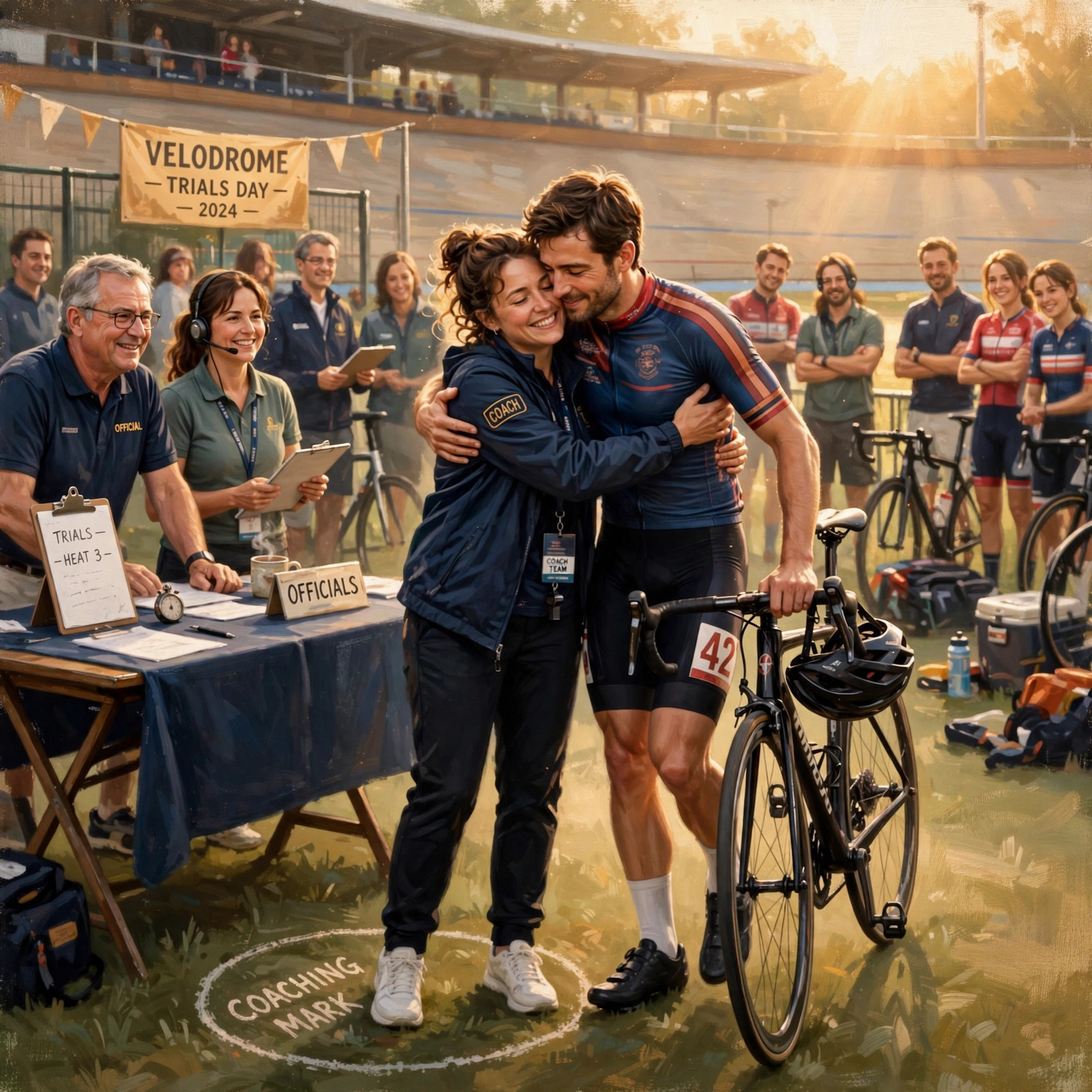
It was a contract. Declan's contract. Signed, dated, countersigned by a team administrator in a country she'd had to fly over to race against once. Three years with the rival squad, the one that had signed her old teammate out from under the national program the same season Nora had hit the boards and stopped being a rider. The start date sat after trials but the signature date did not. The signature date was eleven days old. Before the storm. Before the watch. Before he'd sat on a crate with his hands warm and fixed the one thing she'd stopped trusting anything else to fix.
She set the paper down on the desk, flat, both hands on it, as if it might blow away or as if she might. Through the office window the track gleamed below, all 250 meters of it, and Declan was out there on it, doing flying efforts with Jonah in the straightaway sun, and she watched him stand on the pedals through the turn, holding the black line against physics, and she thought about the 42 percent banking and how a body learns to trust a wall like that, and how a body also learns, eventually, what it costs.
He'd signed it eleven days ago. He'd sat across from her in the equipment bay four days ago with a screwdriver and her pulse under his thumb, and he'd never said a word.
She went down the stairs instead of the elevator because the elevator felt like somewhere she might have to be still.
Jonah saw her first. He was coasting on the apron, unclipping one foot, and he lifted two fingers off the bars in greeting and then took them off again when he saw her face. He was a quiet reader of rooms, Jonah. He rolled to the rail.
"Coach?"
Declan came off the turn, braked into the apron, and put a foot down. Sweat on his neck, the sun behind him. "If this is about the standing starts, I did the six laps. I did the six laps and then some, you can check the beam."
"My office," she said. "Both of you."
She let them take the stairs two at a time ahead of her, because she needed the thirty seconds to decide what her voice was going to do.
The office was small and smelled like whiteboard marker and old coffee. She put the contract on the desk, signature up, and stepped back with her arms folded, the clipboard hanging from her hand like a shield she hadn't decided to raise.
Declan looked at it for a long moment. Then he looked at the window, then at the track, then at the floor. Jonah looked at it, read it top to bottom in about fifteen seconds, and said, "Oh."
"When," Nora said.
"Nora."
"When. It's a short question."
"Eleven days ago. Twelve." He rubbed the back of his neck. "Before the."
"Before the what. Say the rest of the sentence."
"Before any of it," he said. "Before the watch, before the kilo block, before you started coaching me like I was worth the clipboard."
She laughed, and it came out wrong, one hard note. "So that's the story. You signed a three-year deal with the team that buys its riders out of national programs, and then you came here and let me build you a training plan, and let me stand at the finish line counting your splits, and let me put my program's whole funding case on your back, all while you were already gone. Is that the story?"
"That's not." He stopped. Started again. "They came to me in March. Before you ever got assigned here."
"So it's worse, then."
"It's not what you think."
"Then tell me what it is, because what I'm holding is a signed contract with a start date after trials, Declan, and there is one nomination spot in this program and a federation board that will cut my position if we don't put a rider on the podium, and you have been the fastest thing I've got. You are 0.8 seconds from Jonah's best and you know it and they know it. So explain to me how a signed rider on a rival squad trains in my program for eight weeks without mentioning it, and what exactly I was to them. Was I the tune-up? Was I the free coaching before you shipped out?"
"That's not what you were."
"Then what was I?"
He didn't answer fast enough, and Jonah, who had gone very still by the door, said quietly, "Maybe let him answer, Coach."
"He's had eight weeks."
"Eleven days," Declan said. "I asked them for eleven days. That was the deal I made with them, and you know what, it's the same one I was going to make with you."
"Make with me."
"After trials. I asked for the release to be dated after trials so it wouldn't touch your program's status, so nothing about your funding changes because of me. That's what the date is. That's what I paid for, the extra clause, the delay. I told them I'd only sign if the paper couldn't be used against you."
She stood there. The clipboard hung at her side. She was aware of it, how small it was, how little it was going to hold.
"You expect me to believe you negotiated a clause for my budget."
"I expect you to believe nothing, that's the problem, that's been the whole problem with you since day one. You decided what I was before I ever clipped in. Arrogant, here for himself, going to burn the program down on his way out. I've seen you look at me like that since the first week."
"Because I've met that rider. I've coached that rider. I've been left standing at a finish line by that rider while the paperwork went through in another country." Her voice came out flat, and she hated it, and she couldn't fix it. "You signed it, Declan. Whatever the date says. You signed it and you sat four feet from me in the rain and fixed my watch and you didn't say a word, and I have to run a selection process now, a fair one, with two riders and one spot, and you've been sitting on a signed contract for eleven days. Every split I've written for you, every plan, every night I've stayed late on your standing starts. You let me spend all of it on a rider who was already somebody else's."
Jonah said, from the door, "He's not, though. Not until the date."
"That's not how a federation reads it, and you know that, and he knows that. It's how I would have to read it for him, and I can't. I can't spend the program on faith in a rider who's already got a door open behind him."
Declan looked at the letter. Then at her. Something went out of his shoulders, and what was left looked younger than she'd ever let herself see him.
"So that's it."
"That's it."
He nodded once. Twice. He picked up his helmet from the desk where he'd dropped it, and she thought he'd put it on, but he just held it, turning it in his hands.
"For the record," he said, "the eleven days were for you. Not them."
"Out."
He went. Jonah lingered in the doorway, looking at the contract, then at her, and she could see him doing the arithmetic she'd already done, the nomination, the podium, the board. "Coach, if he's gone, the sprint spot is." He didn't finish it. He didn't have to.
"I know what it is, Jonah."
"You're going to erase him."
"Yes."
He left too, and she heard his shoes on the stairs for a long time.
The whiteboard still had the whole block on it, the kilo progression, the split targets, Declan's name at the top in her own handwriting with the little star she'd put next to it the day he'd gone 61.4. She stood in front of it with the eraser in her hand for longer than made sense. Below the window, on the track, Declan was walking his bike toward the equipment bay, not riding it, walking it along the apron with his helmet swinging from his fist.
She erased the star first. Then the name. She did it in one long stroke so she wouldn't have to do it twice, and the board went grey where he'd been.
Later, when he came for the evening session, she was waiting at the gate with the clipboard held against her chest like a closed door.
"The track's closed to you," she said. "Effective now."
"Nora."
"Closed. Give me your federation access card and your bike tag. Jonah's on the program. You're on a plane."
He stood there in the gate light with the evening warm behind him, and he didn't argue, which was somehow the worst thing he could have done. He dug the card out of his wallet, and the tag off his keyring, and put both in her hand, and his fingers touched her palm doing it, and she closed her fingers over them fast so nothing else could get in.
"Eleven days," he said. "You'll figure out what I meant."
Then he walked out through the gate and down toward the parking lot, and she stood there with his card and his tag and her watch ticking eleven minutes fast against her wrist, and she did not go after him.
Track Closed
The federation men came on a Tuesday, Day 31 on the wall calendar in her office, which meant nothing except that she'd been counting. Two of them, in polos with the logo embroidered over the heart, standing on the apron below the window with their arms crossed like they'd rehearsed it. They'd flown in for the announcement. Nora had gotten the email that morning: program review, funding structure, four o'clock. No mention of her name anywhere in it, which was the mention.
She went down the stairs with the clipboard because the clipboard went where she went. The track was empty. She'd closed it to the trial squad that afternoon, which was itself a message, though not the one the men thought they were reading. The whiteboard upstairs still had the grey rectangle where a name used to be. She hadn't rewritten anything over it. The grey had started to look intentional, like a memorial, and she'd stopped looking at it on her way to the coffee.
"Coach Vance." The taller one extended a hand. She took it because refusing would cost her something she couldn't afford. "We'll keep this brief. With trials in under six weeks, the board wants clarity on the sprint nomination."
"The nomination goes through me."
"The nomination goes through whoever's standing at the end of the funding cycle." He smiled with the bottom half of his face. "Your program produced one world-class kilo rider. He's leaving. Your other rider's numbers are, frankly, developmental. The board is asking what exactly they're paying for in Colorado Springs."
"You're paying for a podium," she said. "You're just doing the arithmetic wrong."
That was when she heard a bike on the boards.
Not on the apron. On the track. The sound carried in that place like a held note, tire hiss off the concrete of the turns, and she looked up before the men did, and it was Declan, out of the equipment bay where her lock had been cut and not cut, because of course he still had a key to the bay from the block before, of course he did. He was riding slow, up on the black line, no helmet, riding like a man on a boardwalk, and he had a folder under one arm, riding one-handed around a 250-meter track with turns banked at 42 percent like the whole thing was a dare he'd already won.
"That rider," the tall one said, "is not on your program."
"No," Nora said. "He's not."
Declan came down off the banking at the exit gate, rolled to a stop in front of them, and put his foot down. He was in a plain grey t-shirt and he hadn't shaved and Nora's whole body did the thing it did around him, which was to lock up and pretend it hadn't. He looked at the men. He looked at her clipboard.
"You're early," she said. "I said the track was closed."
"The track's not closed," he said. "Your gate lock is soft. I told you in March." He turned to the men. "Gentlemen. You're the ones who sent the contract."
The shorter one shifted his weight. "Mr. Reyes. We understood your decision was made."
"It was." He held up the folder. "Signed. Countersigned. Three years, guaranteed, medical, housing, the works. My agent wept actual tears of joy into his phone, which was a thing to hear." He looked at Nora when he said the next part, and did not look away. "The team told me the signing bonus was contingent on a clean break. No federation entanglements. No program affiliation. They wanted me cut loose from this place completely."
"Declan," Nora said, and heard her own voice come out wrong, too fast. "Don't."
"You don't even know what I'm going to say."
"I know what it costs. That's the problem."
Jonah came through the far gate then, still in his warm-up kit, towel around his neck, and stopped dead when he saw the polos. Nora watched him do the calculation, then keep coming anyway, which was the bravest dumb thing she'd seen anyone do in that building.
"Reyes," Jonah said. "Tell them what the team told you about the funding."
"Jonah," Declan said quietly.
"No, I've sat on it for a week and it's eating me." Jonah planted himself in front of the men, chest out, sweating, magnificent. "Declan got the contract because I turned mine down. They offered me the same deal in the spring. Know why they wanted us both? The team's technical director sits on the federation board. They offered Declan a roster spot to gut this program's budget line. His signing makes the case for them. 'World-class rider left, program failed, defund the coach.' It was never about his kilo. It was about this track." He pointed at the boards. "I've got a friend in their development office. I saw the draft budget. Your line item, Coach, gone by the autumn cycle either way."
The tall man didn't flinch, which was its own confirmation. "Speculation," he said. "Mr. Petrie, you're under a federation agreement. Careful."
"I'm under a program agreement," Jonah said. "There's a difference. My coach taught me that."
Nora's ears were ringing in a way she associated with crashing.
She looked at Declan. He'd gone still, the way he went still in a start gate, everything loaded. "Is that true? They told you what signing would do to the budget?"
"Not in words."
"Declan."
"In words," he said, "they told me my signing would 'clarify the federation's spending priorities.' I'm not stupid, Nora, I just play one on the podium." He turned the folder over in his hands. "Eleven days ago I stood in your office and let you think this was about a jersey. It was never about the jersey. It was about not being someone's rider down his whole life, and then the second the money showed up I went and did the exact thing anyway, signed myself over to the first outfit that flattered me, so." He stopped. Started again, quieter. "So here."
He tore the folder. Not dramatically, not for the men, though it played well on them. He gripped the top sheet and pulled it down the middle, and the tear was loud in that space, and he did it again, quarters, and let the pieces fall on the concrete between all of them. Three years of guaranteed money on the ground in four pieces.
The tall one said, "That's a legal document."
"That's litter," Declan said. "I ride for this program or I don't ride. That's my whole position. It's on file with my agent, who is currently drinking." He looked at the pieces. "I'd have burned it but I don't smoke."
"Your federation card is in my desk," Nora said, because her mouth had to do something while her chest sorted itself out. "Your bike tag too. The track is closed to you."
"I know. I cut around it."
"That's trespass."
"That's an eight-dollar padlock," he said. "Buy a real one. I'll bring the coffee money."
The shorter man had already taken out his phone. The tall one was still doing arithmetic out loud, the defunding, the timeline, the board call that evening, and Jonah was saying something about the draft budget he'd seen, and none of it reached her. Declan stepped over the torn contract, past the men as if they were furniture, and stood close enough that she had to tilt her chin.
"Unpaid," he said. "Trial squad. Six warm-up laps before standing starts, no helmet, no exceptions, I remember the whole litany. I'll do the rollers until my knees hate me. I'll do whatever you write on that board." He glanced up at the office window. "But do it like you mean it. Not like a clipboard. Not like you're coaching from behind glass so nobody on two wheels can ever touch you again. I know why you do it. Jonah told me about your teammate and the boards. He shouldn't have. I'm glad he did." His voice went rough. "Coach me like I'm allowed to matter to you. Because you matter to me, and I've got exactly nothing left to hold over that except the truth, so."
She looked at him for a long moment. Then she handed the clipboard to Jonah, who took it like it was a live grenade, and she went up the stairs two at a time.
The board was where it always was. The grey rectangle, the splits, the lap targets still legible around it. She picked up the chalk, and her hand was shaking, which she noted and ignored. She wrote REYES at the top of the kilo progression where he'd been, and the strokes came out too hard, chalk squeaking, and she stood there breathing over her own handwriting.
Then, because eleven days was eleven days too many, she went back down and said, "Warm-up area. Rollers. Six laps' worth of cadence before you're allowed near my track, and Reyes?"
"Coach."
"You're buying the padlock."
He smiled like the whole season had just turned with him.
Line One
Forty days had come down to a Tuesday in Colorado Springs with wind coming off the mountains and forty-two percent banking gleaming under the lights like it had never dropped anyone in its life.
Nora stood at the rail with the clipboard against her hip, which was where it lived, and Jonah stood beside her with his race wheels and his good manners, both of which he was pretending not to need. The stands held more people than the velodrome had seen in a season. Federation brass in the third row. A timing official at the beam. A chalked grid on the whiteboard upstairs in her office, and she'd written it herself, and it said LINE ONE: REYES.
"He's going to want to know the splits," Jonah said.
"I know."
"Loud ones."
"I know."
Declan rolled out of the equipment bay on the track bike she'd built him, and the crowd noise bent around him and he didn't seem to notice it was there. Six warm-up laps, full cadence, no skipping, because she'd made him do six since the first cold morning on the rollers and he'd stopped arguing about it somewhere around the second week. He took them smooth. On the last pass through the finish he looked down at her from the banking, and she held up the cracked watch on her wrist, and he nodded once and dropped to the rail.
"Line one," she said to him, close enough that it didn't need volume. "Home boards. The gate's the same one you've pushed out of two hundred times. The gap you're chasing is eight tenths. That's all it is. Two laps of patience and one of nerve."
"Eight tenths," he said. "That's not a gap. That's a Tuesday."
"Reyes."
"Sorry. Coach."
"Your best is 61.4. That's the number on my board and it's the number in your head and I need you to leave both of them at the gate. You don't ride a time. You ride a kilometer. Every meter of it, one at a time."
"You've said that before."
"I'll say it at your funeral, probably."
He laughed, short, and pushed his helmet down with the heel of his hand, and his eyes had gone somewhere else, and she recognized the somewhere because she'd gone there herself at his age, before the boards, before everything.
The official called the start window. Declan rolled to the gate. The velodrome went so quiet Nora could hear the wind working at the loose panel on the far straight, and then the beep, and then he was gone.
She called the first split loud, the way he needed, the way Jonah had known he needed. "Green!" Her voice carried up the track and she watched it land, watched his shoulders stay low, no panic, no grabbing. First lap done. Two hundred fifty meters, gone like a held breath released. She called the second split and it was green too, and the third, and now the last lap, and the boards were rising under him at the far turn, forty-two degrees of wood and paint, and her whole body remembered what that felt like from the inside, and she made her feet stay where they were.
He came off the last turn like water finding the low ground. The timing beam caught him at the line. The board lit up.
Nobody in the stands read it before she did, because she'd spent forty days learning to read that board before it finished deciding. 60.9. He'd gone under his best. He'd gone under Jonah's best. He'd taken the line.
The crowd did what crowds do. Jonah was on his feet next to her, both fists in the air, shouting something that had his mother's accent in it. The federation men in the third row were already putting their heads together over a phone.
Declan swung off the track at the back straight, the long way around from the gate, unclipped at the rail, and every convention of the sport said he'd coast to the results board, confirm the number, do the interviews.
He didn't.
He put the bike down on the infield grass and walked straight toward her.
Nora looked at the board. Then at him. Then at the clipboard in her hands, the grey rectangle of it, the splits, the litany, the whole architecture of the last three years of keeping something solid between herself and every rider who mattered. Her fingers were on the clip that held the sheets.
She set it on the rail.
She met him halfway across the infield, in front of the whole program, in front of the brass, in front of Jonah who was grinning like this was the medal ceremony, and she stopped close enough that there was nothing left to hold between them.
"You left the clipboard," Declan said.
"I know where it is."
"You never leave the clipboard."
"You never walk past the results board. We're both full of news today."
His face did something complicated, and then simple, which was worse for her heart. "Sixty-point-nine," he said. "You saw."
"I saw."
"I closed eight tenths."
"Five tenths under your best, and yes, I can do the arithmetic, I've been doing it for forty days. You were green on every split."
"Because you called them loud."
"Because you rode every meter of it."
Behind him, the officials were waving someone toward the podium area, and the brass were standing, and the afternoon was going to go on being an afternoon full of handshakes and paperwork no matter what happened on the infield grass. He glanced back at all of it once, the whole machinery, and she watched him do the arithmetic she'd watched him do at the office window, the contract he'd torn up, the three years in Europe he'd turned down to stand on line one here with her voice in his ears.
"They're going to want you," she said. "Up there. Microphones."
"They can want."
"Reyes."
"Coach." He stepped in, and his hand found hers, in front of everyone, warm and calloused and shaking slightly, which she noted and did not ignore. "Whatever they write on that board, whatever name goes to the nomination, I want you to hear it from me first. I'm not going anywhere. Not to Europe. Not to whoever waves the biggest number. I ride line one here, or I don't ride."
"That's your career talking."
"That's me talking. You told me to ride like I'm allowed to matter to somebody. Turns out it works both ways."
Jonah hollered something from the rail about the podium and cold beer and neither of them moved.
"You realize," Nora said, "that I'm still your coach, and the federation still signs my position, and half those men came here tonight to decide whether I keep it."
"Then you should know," Declan said, "that every rider in this program just watched you walk out on the grass without your clipboard, and every one of them would ride through a wall for you now. Including Petrie. Especially Petrie."
"I heard that!" Jonah called.
Nora laughed, and it came out of her like something that had been waiting in the dark for years. She turned her hand over and laced her fingers through Declan's, right there where the brass could see, where the timing beam could see, where the whole litany could see.
"Podium," she said. "Both of you. Now."
"Coach," Declan said, and didn't let go of her hand, and she didn't either, all the way across the infield.
The cracked watch on her wrist said the evening was getting on. She let it.
Get notified when new stories drop
Noah Carrington
Noah covers sports romance and forced-proximity heat: rivalries, road trips, and the quiet moment after the crowd goes home.
Leave a comment
Comments