





The Iron Bell
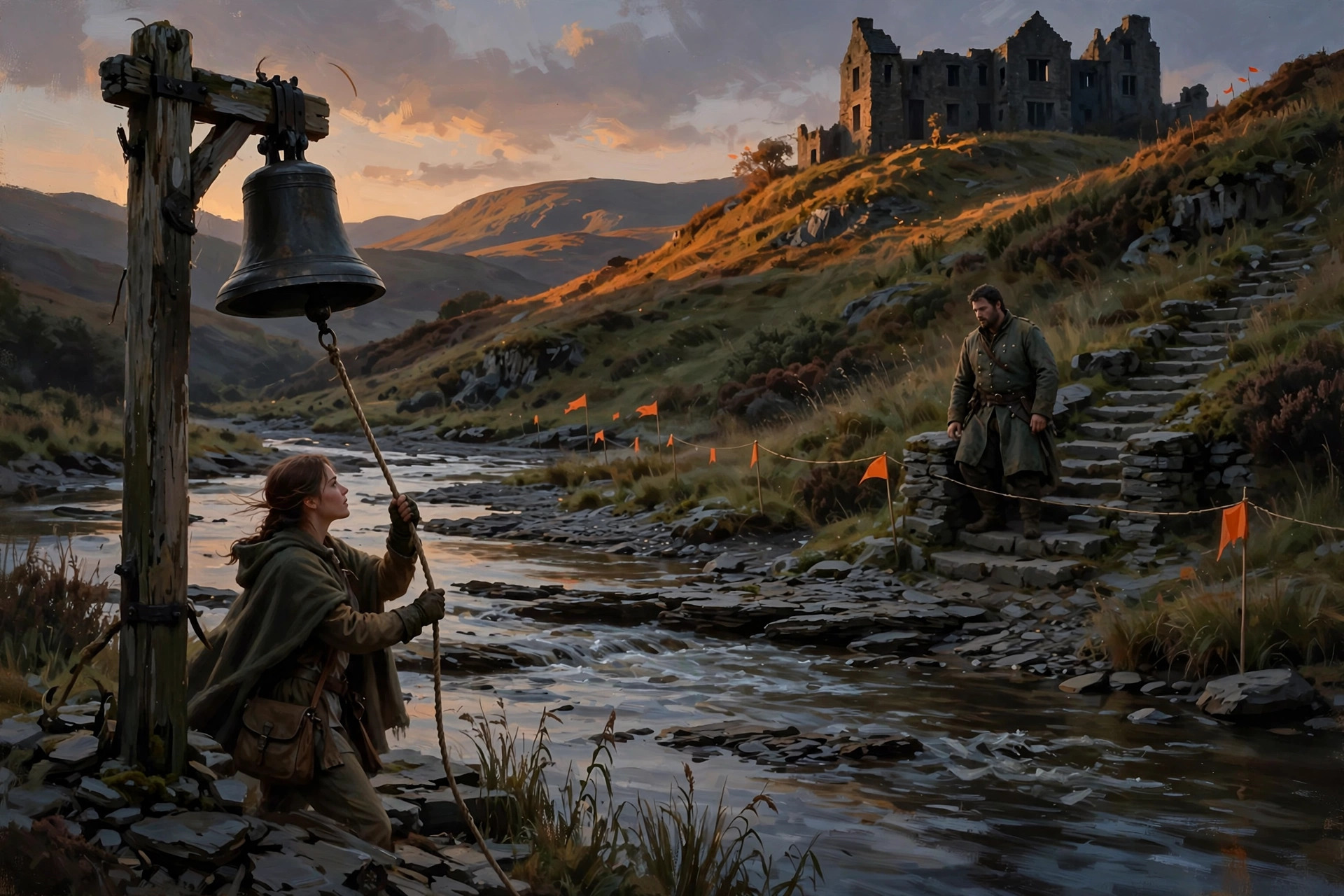
The notices had come on grey paper, three of them in one afternoon, and Wren Calloway had read each twice on the walk up from Hollow Bend before the wind took one and she let it go. The council wanted the boundary maps redrawn before the frost. The council wanted a great many things, and paid for exactly half of them, but she needed the sum this year more than most, so she climbed the ridge road with her satchel of pens and her mother's old compass and arrived at the river crossing with the sun going down behind Greywatch Ridge like a lamp being carried out of a room.
The river ran loud here, all shale and hurry. On the near bank stood a post, and on the post hung a bell of black iron, wide as a soup pot, its lip green with age. Wren had crossed at Hollow Bend perhaps a hundred times in her life and never once rung it, because there had never been anyone on the far side to ring it for.
There was now. She could see the flags through the trees on the opposite bank, little squares of orange cloth strung along the water's edge like laundry left by giants. Men moved between them with tripods and long poles, calling numbers to each other across the current.
"They're surveying the far bank," she said to the bell, and then, because it was the done thing and because her mother had taught her that done things matter, she took the striker rope in her hand and rang it once. The iron bell had a voice like winter. It rolled up the ridge, and the surveyors on the far side didn't even look, but something on the near side did.
Footsteps on the stair. There was a stair, she realized, cut into the hillside east of the crossing, stone steps climbing toward Ashfall Hall, which stood at the ridge's crown with its dark windows catching the last light. She had drawn the hall a dozen times for the council's records and never once drawn a figure on its stairs.
The figure was a man, broad through the shoulders, coming down with the unhurried tread of someone who had made these steps so many times they held no news for him. He wore a guard's coat, faded green, and his hair was cut short and going silver at the temples early, the way dark hair does. He stopped four steps from the bottom and looked at her the way you look at a deer you don't want to startle.
"You rang the bell," he said.
"That's what it's for, I assumed."
"It's for crossing." He came down the last four steps, unhurried still, and stood on the flat stone at the stair's foot, nearer the water than she was. "Nobody rings it to stand still on their own bank."
"I'm crossing. Up, not over. I'm Wren Calloway. The council pays me to keep the boundary maps, and they've sent notices, so the maps need redrawing before the frost. I'll need a night in the hall. I paid for a night in the hall, actually. There's a receipt in here somewhere."
She dug in the satchel. He watched her do it with an expression she couldn't read, one corner of his mouth up, like she was a cat trying to open a door.
"I'm Teo Vasha," he said. "The council pays me to keep the hall and watch the river. Which is the same job as yours, drawn from the other end of the leash." He nodded at the paper still in her fist. "You've got one of the notices. I've got three. They want the boundary recorded so it can be argued about properly. Lawyers need paper the way maps need ink."
"It's a boundary," Wren said. "It's been a boundary since before the hall was built, and the hall's been standing a hundred and forty years. That's not an argument. That's a river."
"Tell that to the men with the poles." Teo turned and looked across the water at the orange flags, and his easy half-smile went away for a moment, which told her more than the smile had. "They started yesterday morning. They've been very polite. They wave."
A shout carried over the current, one surveyor to another, and something metallic clattered down the far rocks. A moment later a long wooden stake came loose from a bundle at the water's edge, rolled, and dropped in, and the river took it immediately, tumbled it downstream along the near bank, and left it snagged in the roots of an alder not two meters from where Wren stood.
"Supply problem," she said, wading in before she'd decided to. The cold went through her boots like a sentence finishing. She got her hand on the stake, pulled it free, and nearly went down doing it.
Teo was already crouched on the bank above her, one arm out. "Give it here before you drown in front of me. That's paperwork I don't want."
She reached up. He took the stake with his left hand, and with his right he caught her wrist to steady her, and then everything stopped being ordinary.
The sting came first, sharp, like a nettle held too long. Wren looked down at her own left wrist, where his fingers pressed, and there under the skin was a pale mark, moon-colored, a crescent she had never seen before on her own arm. She looked up fast, and Teo was staring at his own wrist, at the same crescent, and his face had gone the color of the far bank's stones.
He let go of her. She sat down hard in the shallows, and the cold found everything.
"Get out of the water," he said, and it wasn't lazy anymore. He set the stake on the grass and put a hand under her elbow without asking, and she was too busy staring at her own wrist to refuse him.
"What is it," she said. Not a question, really. A demand for one.
"You don't know." He rubbed the mark on his wrist with his thumb, hard, the way you'd rub a stain. "Of course you don't know. You're the map woman."
"I'm the map woman, yes. Explain the moon on my arm."
Teo blew out a long breath and sat down on the flat stone, and this time the unhurriedness was a performance, she could see that now, a coat he put on. He looked across the river at his own boundary.
"It's called a bond-mark," he said. "Old arrangement. When two of us, ah. Of the river families. When two wolves touch and the mark comes up on both, it means the bond found a pair. It's rare. My grandmother used to say the mark only rises for people who'd find each other anyway, and the moon just likes its joke." He turned his wrist in the dusk. "It sets after three nights, if it's not. If it's not fed."
"Fed."
"Kept. Acknowledged. Chosen. Use whatever word your council pen likes." He was quiet a second, watching her watch him. "There's a rule that comes with it. Neither one crosses this river without the other. Not while the mark holds. And if one crosses alone, if one breaks it anyway, the mark takes its price. A season of the other's memory. Gone whole. A full season of everything, out of the bonded one's head."
Wren's mouth had gone dry. "Whose head?"
"The one left behind." He said it flat, like a man reading a verdict. "So nobody breaks it. That's the idea. Nobody breaks it."
"Whose mark," she said, "was on my mother?"
Teo stood up. It was full dark now, or near it, the ridge black against a sky going to plum, and the surveyors across the river were packing their poles by lantern light. "You'd be Marguerite Calloway's daughter," he said. "I forget that's a thing a person can be. She used to come up every autumn with her compass. Same satchel, I'd swear to it."
"She crossed alone," Wren said. "Years ago. There's a season of hers I know is gone. There's a gap in her like a page cut out. I grew up measuring it."
"I know," Teo said, and then, quieter, "I know the shape of it. You should come up out of the cold before we talk about Marguerite. My grandmother kept a kettle in the hall and I keep it lit."
The stair climbed dark and long above them, forty-four steps of it, stone holding the day's last warmth against her wet boots. Ashfall Hall stood at the top with one window already lit, gold as a struck match.
"The council paid me for a room," Wren said. "One night."
"The hall's mostly cold," Teo said. "It's big and it's old and I heat what I use. One room's warm, mine, and there's a bed in the archive that's a table with ambition. Archive's freezing after dark and gets colder than a grudge by morning." He paused at the base of the stair, the bell's rope still swaying faintly behind them in the river wind. "So. That's what there is. A warm room, or a cold one."
Wren looked at the mark on her wrist, pale as a sliver of the moon that wasn't up yet, and at the man already three steps above her, waiting without turning around, giving her the whole stair's length to decide.
"The warm one," she said. "And in the morning, you tell me about my mother, and I redraw your boundary before those men with poles get a lawyer's idea of where it goes."
"Morning, then," Teo said, and started up, and didn't argue about anything, which she would learn later was the most meaning he ever packed into two words.
Archive Drawer
Morning came into the archive sideways, through a slit of a window that had probably been fashionable when the hall was built, and was now just a slot for weather. Wren had been awake for an hour. Teo's kettle was not. It sat on the cold stove like an argument neither of them had started yet.
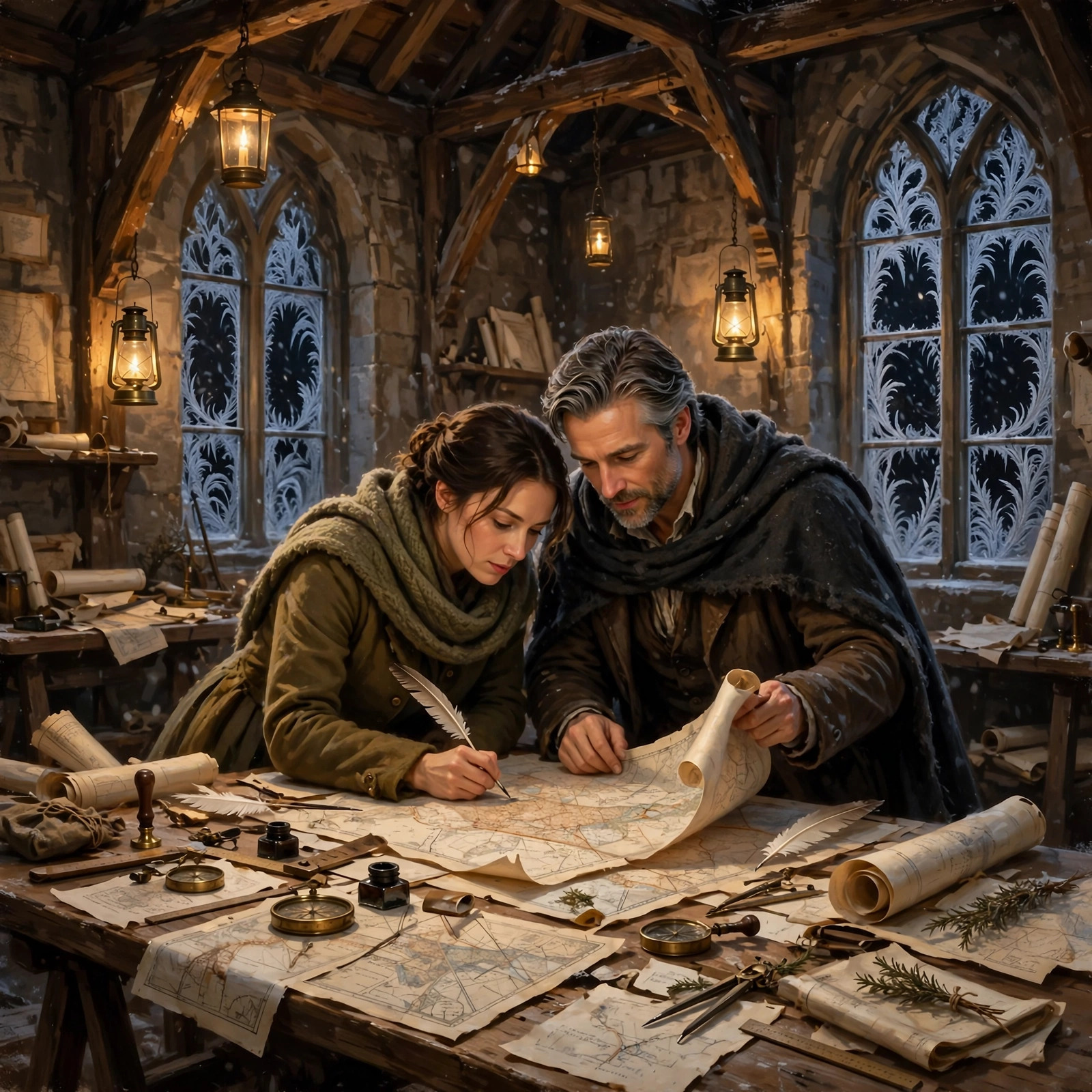
"There's oil for the lamp," he said from the doorway, already dressed, already holding a tin can in one hand like it had grown there. "You didn't light anything last night."
"I lit nothing last night. I slept like a stone." She flexed her left hand on the table. The mark under the skin of her wrist caught the grey light and gave back a pale shine, like something sealed in wax. "You said archive. Down here is the archive?"
"Down here is the archive." He set the lantern oil on the table's corner, well back from the papers, and she noticed he did it the way a man does a thing he's done a thousand mornings. "Drawer's under the window. My grandmother's rule was maps on the left, letters on the right, and anything nobody could name in the middle. The middle got crowded."
The drawer ran the width of the table on runners that complained. Maps on the left, sure enough, rolled and cracked with age, the oldest of them brown as tea. Wren worked through them with two fingers, careful, the way she handled a land survey for a paying client, which was what she was. Supposedly. She turned each one to the light. Greywatch Ridge. Hollow Bend, the crossing, the river bending. The paper got newer as she went down the stack, the ink bluer, and then her hands stopped on their own.
The compass rose was drawn by hand. Small, exact, wrong in one charming way: north tilted east by a degree or so, as if the draftsman had trusted something other than a needle. She knew that tilt. She'd grown up tracing it in the margins of her mother's grocery lists.
"That's hers," she said. Her voice came out lower than she meant.
Teo crossed the room and stood beside her, not crowding, just near. He smelled faintly of woodsmoke. "Sefa said she left some things here. I never opened them. Felt like reading somebody's mail."
"It is somebody's mail." Wren unrolled the last sheet flat. The river ran the length of it in her mother's particular thin line, and on the far bank, at the crossing, a small neat hand had written: markers verified, autumn survey, M.C.
Below that, in the same ink, smaller: Ask Teo's grandmother about the bell.
Wren looked up. "Your grandmother kept the bell?"
"Sefa kept the bell. Keeps." He frowned at the paper. "That's not for us to read."
"It's addressed to a member of your household. That's practically us."
"Practically." But he didn't take it from her, and he didn't leave, and when the stove needed lighting he lit it, and when the kettle went on he made tea for two without asking how she took it and got it right anyway, which unsettled her more than the mark did.
Old Sefa came up the stair at midday, when the light was at its flattest. She came the way old people walk uphill, as if the hill owed her patience, and she did not knock. Nobody knocked at Ashfall Hall. The door stood open and the wind came and went and that was the house's whole personality.
"So," Sefa said. She was small, dry, wrapped in a shawl the color of bark, with a face like a map her own self. "You're the daughter. Come here into the window. Don't argue, I've had a long stair."
Wren went. Sefa took her left wrist without ceremony, turned it to the light, pushed the sleeve back with two thumbs. Whatever she saw, she held it a long moment, her lips moving in a way that might have been counting or might have been swearing.
"Hers too," Teo said from the stove. He didn't sound surprised. He sounded like a man handing over bad news he'd already read.
"Hold out." Sefa beckoned. He came, and she read his wrist the same way, and then she sat down on the archive bench as if the matter was settled and she was merely the one left to announce it. "Bond-mark," she said. "Both wrists, same shape, moon-white, under the skin, no ache. That's what it is. There's no pretending it's a rash."
"I wasn't going to pretend it was a rash," Teo said.
"You were going to pretend it was nothing, which is worse." Sefa folded her hands. "I'll say it plain, because plain is what I've got. When two carry the mark, the river knows them as one. Neither crosses the boundary without the other. Not in a boat, not in a drought, not at midnight in a fog. If one crosses alone, the mark breaks."
"And breaks what else," Wren said. Her mouth was doing that dry thing again.
"A season of the one left behind. Taken clean out of memory." Sefa's eyes didn't blink and her voice didn't soften. "Not a bad season. Any season. It's not a punishment anyone chooses twice. Your mother was the last one who carried a mark off this bank, girl, and she went alone, and she paid. Whatever she went for, she'd tell you she'd pay it again. That's the part that worries me about you."
The kettle began to push its little sound into the quiet. Teo took it off without looking at it.
"How do you get rid of it," Wren said.
"You don't get rid of it. You either live by it or you break it on purpose, and you've seen the price list." Sefa stood, with effort, and pulled her shawl straight. "The mark sets in three nights. Like mortar. After that it's not coming off with wishing or lawyers or distance. You two had best decide what you're going to be to each other before it does."
Neither of them answered. Sefa waited the length of a slow breath, then snorted, and went out the door and down the stair, taking the forty-four steps with the grim pace of a woman who had counted them long ago and refused to be impressed.
They mapped all afternoon, because there was nothing else to do and because work was easier than the conversation neither had started. Wren laid her mother's survey flat on the table and set Teo's council documents beside it, and the differences came up fast. Her mother's line for the river matched his to within a hand's width, all the way down to Greywatch Ridge, and then, at the old crossing, the two maps disagreed by a whole field's length. One bend had moved, or someone had moved it, or someone had lied with a pen.
"There," Teo said, tapping the far bank. "That's where their poles went in yesterday."
"That's where the field is." Wren pulled her compass out of her satchel, an old brass one, her mother's, she'd confess that to nobody. "We walk it tomorrow with the map and the compass and we get the bank on paper so well a lawyer weeps. Both banks."
"Both banks means the crossing."
"I know what it means." She looked at him. "You don't cross without me. I don't cross without you. I heard the rule."
"You heard it." He was quiet a moment. "I'll bring lantern oil for two, then."
He brought more than oil. Bread, a wedge of hard cheese, pickled onions in a jar whose lid gave him a short fight and lost. They ate standing over the maps like generals, and she caught herself laughing twice, which felt strange in this room full of dead paper and her mother's handwriting. He was easy to stand next to. That was the problem with him. He stood where you needed him before you'd finished needing it.
Outside, the light went gold, then plum, then the blue-black of a bruise settling. The surveyors across the river had gone. Somewhere up on the ridge, a wolf called, long and low, and Teo's head turned toward it the way a man turns toward a knock.
"The mark sets in three nights," he said, not a question.
"Sefa wasn't subtle about it."
"She never has been." He rolled her mother's map with a gentleness that surprised her, squared it, and slid it back into the drawer on the left, under her hand but not out of it, because she'd slid the drawer to and he'd watched her do it and said nothing. "Sleep on the warm side of the hall tonight. We've an early river and a late decision."
Wren went to the window with her cold tea. Three nights. Her mother had needed one, apparently, to ruin a season. Wren had three to decide what a stranger's wrist was worth, and the moon hadn't even come up over the ridge yet, and it was going to be a long, bright, complicated night, and neither of them said one more word about it.
Lantern Oil
The archive smelled like warm dust and cold stone, which Wren was beginning to think of as the smell of Teo, since he carried both wherever he went. He'd set two lanterns on the long table before dusk, one at each end, and the light they threw made the archive feel less like a room that had swallowed a hundred and forty years of paper and more like a place where two people could sit and argue about a river.
"The bell rope," he said, unspool a length of braided cord from a cedar box she hadn't opened yet, and laid it across the table between them like an offering. "Council replaced it six years back. The old one was hemp, and hemp frays."
"Everything frays."
"Not this." He ran his thumb down the braid. "Wool core, waxed over. Old Sefa spun it herself, and Sefa doesn't make things that break."
Wren pulled her mother's map flat again and weighted the corners with the brass compass and a jar of pickled onions that had migrated up from the kitchen and back down twice already. Her pencil was down to a stub. She'd sharpened it with her teeth at some point and didn't remember doing it.
"So the bell works like this," Teo said. "Anyone at the crossing, either bank, rings it. One ring for a stranger. Two for a messenger. Three and any wolf within ear of the river runs." He tapped the map where the crossing narrowed. "There's been a bell post there since before the hall had glass in its windows. My grandmother rang it once for a flood, and the whole of Hollow Bend was up the ridge before the water was down."
"Your grandmother." Wren kept her eyes on the map. "So your people kept the crossing before you did."
"Before me, my mother, and her mother before that." He turned the rope over once, twice, then let it coil against his palm. "I've held the boundary eleven years now."
She looked up at that. Eleven years. He'd said it plainly, the way he said most things, but there was something underneath it she couldn't read, and she was getting good at reading him.
"Eleven years guarding a crossing," she said. "How many times have you gone across?"
He didn't answer right away. The lantern at the far end guttered, and he reached over and trimmed the wick with a short brass scissors that lived, apparently, in his pocket, because who else's pocket would it live in.
"None," he said.
"None at all."
"It's not mine to cross," he said. "I keep the near bank. The far bank keeps itself. That's the arrangement, and the arrangement has held since before either of us was born."
Wren set her pencil down. "Eleven years, and you've never once set foot on the other side of a river you look at every single day."
"I didn't say never once wanted to." A small smile moved through his voice without quite reaching his face. "I said never once did."
"That's worse, you know."
"I know."
She thought of her mother, then, without meaning to. Marguerite in this same room, probably, bent over this same table with this same stub of light, drawing lines on a river that she was going to cross alone anyway, whatever the lines said. Twelve letters in a box across the water, and not one of them had ever said why.
"My mother crossed," Wren said. "I told you that. What I didn't tell you is that she crossed alone, and it cost her." She turned her wrist over without thinking, the left one, where the mark sat under her skin like a coal banked in ash. "A season of memory. That's the price of breaking a bond-mark. Whoever gets left on the bank pays a season, whole, gone. And whatever season it took from her, she never got it back, and she never told me which one it was, so I've spent my whole life guessing."
Teo was very still. "Sefa says her letters got thin that winter. That whole year Marguerite wrote short."
"She wrote short forever after." Wren heard her own voice go hard and didn't bother softening it. "So when I ask how a man stands on one bank for eleven years, I'm not mocking you. I'm asking what you know that she didn't."
"I know what a season costs," Teo said. "I've watched it paid. My mother's sister waited at the crossing every autumn for a wolf who never came back over, and when the mark finally faded she was a different woman. Quieter. Like a room after the furniture's gone." He wound the bell rope back into its coil, slow, neat, hands doing the thinking his mouth had stopped doing. "I keep the near bank because the near bank is what I'm for. That's all. It's not grief. It's just where I stand."
"It's a little grief," Wren said.
"It's a little grief," he agreed, and laughed, short and surprised at himself, and the laugh did something to the room, opened a window in it, and she realized how far across the table she'd leaned without deciding to.
The lantern oil between them was warm. She could smell it, sweet and resinous, and under it the river, which ran three hundred meters below the hall and made itself known on quiet evenings like a voice in the next room. His eyes had gone to her mouth. She knew because hers had gone somewhere similar on him and both of them were pretending to be studying the map.
"Your river bend is wrong," she said. "The one your grandmother's generation surveyed. Someone drew the meander lazy."
"Draw it right, then."
"I'm trying to. You're close."
"I'm always close."
"You're extremely close," she said, and her voice had gone somewhere lower without her permission, and his hand had come to rest on the table not six inches from hers, and neither hand moved, and neither of them breathed for a second that lasted a year.
The bell rang.
Not close. Not a knock at the door. A long iron sound rolling up from the river and through the stone, one ring, then a second, then a third, and by the third they were both on their feet.
"Three rings," Teo said, already moving, snatching both lanterns, blowing one out and keeping the other lit because his hands did three things at once in a crisis and his voice did none. "Strangers at the crossing. Run."
They ran. Down the forty-four steps, him first with the light, her behind with her mother's compass still in her fist, out the hall doors and down the slope, through the bracken and the dark, the bell ringing again behind them, three and three and three, until the river came up flat and pale in the lantern light and the crossing narrowed ahead of them like a throat.
The near bank was empty. The post stood where it had always stood, rope taut, iron bell still swaying faintly, and the ringer was nowhere.
"There," Teo said.
Across the water, on the far bank, fresh-cut stakes stood in a line, pale wood, machine-sawed, a dozen of them marching up the field toward the ridge road, and beside the last stake a figure in a reflective vest was standing very still, watching them back.
Wren's hand found Teo's arm before she'd chosen to put it there. "They've been on the far bank all evening," she said. "While we sat in the archive talking about rope."
"While we did more than talk about rope." His jaw was set, but his hand came over hers and pressed it where it was. "They're past the waterline now. Stakes mean filings. Filings mean records."
"Then tomorrow we cross," she said, "and we put the real river on paper before they finish inventing theirs."
Across the water the figure in the vest raised a hand, unhurried, and began walking away from the river, up toward the ridge, like a man with nowhere he needed to be.
"Together," Teo said.
"Together," said Wren, and the bell rope hung loose and quiet under the moon coming up over Greywatch Ridge, and neither of them let go of the other all the way back up the slope.
Fresh Stakes
Old Sefa arrived before the porridge was off the stove, which was how Wren knew the morning had already gone wrong. Sefa did not climb the slope to Ashfall Hall for pleasantries. In the hundred and forty years the hall had stood, someone from Hollow Bend came up those forty-four steps only when the news was too heavy to send up the hill on paper.

She came in without taking off her shawl, which meant she would not stay, which meant she had come to say something and leave before anyone could argue with her about it. Her eyes went straight to the bond-mark on Wren's wrist, then to the matching one on Teo's, and her mouth thinned.
"So it's true, then. The whole crossing was talking about nothing else last night but the two of you ringing down the slope at midnight like the river was on fire."
"Surveyors," Teo said. He pulled out a chair for her anyway. She ignored it. "Fresh stakes on the far bank, a dozen of them, machine-sawed. They were past the waterline by dark."
"I know what they were." Sefa set a folded paper on the table, smoothing it flat with both palms as though it might fly off. "I had the courtesy of a notice this morning, hand-delivered to my door by a boy in a vest. Greywatch Ridge, the notice says. A land company filing a claim on the far bank and the ridge road above it. Filed at the county seat yesterday. Certified."
Wren's stomach dropped an inch and settled somewhere around her knees. She sat down slowly and pulled the paper toward her. The print was small and confident and had a seal at the bottom she didn't recognize, and every word of it was about the river her mother had drawn.
"They can't just take the far bank," she said. "The boundary's older than any of this. Older than the hall. There'll be records."
"There are records." Sefa's voice was dry as August grass. "That's not the trouble, girl. The trouble is where the records live. A claim filed at the county seat can only be rebutted by evidence filed from the far bank. Their own law says so. Any countering survey, any testimony, any proof of the old boundary has to be logged at the Hollow Bend post, on the far-bank ledger, at the postmistress's shelf. That's where the far bank keeps its paper. That's where it has always kept its paper."
Teo had gone very still by the window, arms crossed, watching the ridge through the glass. Now he turned around.
How long?"
"The notice gives ten days from filing. Nine left, counting today."
Wren was already moving in her head. Nine days was nothing and everything. She knew the river. She knew where the old markers ran, where her mother's ink matched the stones. And she knew, with a small cold jolt, exactly what sat on that shelf.
"The postmistress's shelf," she said slowly. "The one where they keep the undelivered post."
"The same," said Sefa.
"My mother's letters are on that shelf." Her voice came out steadier than she felt. "Twelve of them. Sealed, never claimed, sitting there since she crossed back. She wrote to the council every season, and no one ever opened them, because no one collects the letters of an exile." She looked up. "Twelve seasons of her handwriting, Sefa. Twelve seasons of where she was and what she saw on that bank. If she was surveying the boundary for anyone, it was in those pages. That's not just evidence of the river. That's her."
The room was quiet long enough for the porridge to burn. It didn't, because Teo lifted it off without being asked and without looking at it, which was the kind of thing his hands did while the rest of him was somewhere else entirely.
"No," he said.
"No what?"
"No, you don't cross." He set the pot down. "The bond-mark isn't a decoration, Wren. Three nights, that's all it's had to set, and it sets faster than anyone likes to say. You cross that river alone before it's whole, you break it. And what it costs isn't yours to gamble with. A season. A full season of memory off the one left behind. That's the price, and it lands on me."
"Then come with me."
"I have to be here when their surveyors come back to the near bank, which they will, because the near bank is what the council pays me to hold. I can't be on your side of the water and mine at the same time."
"So don't be on any side," Wren said. "Come with me for one morning. The stakes took them a day to plant. It'll take us less to walk past a shelf and pick up twelve letters."
"It's not the walking." His voice had dropped, which was worse than if he'd raised it. "It's the water. The rule doesn't care why you cross. It doesn't care if you cross for good reasons, or brave reasons, or the best reasons anyone ever had. Alone is alone."
Wren heard the second sentence under the first one, the way she'd been hearing it since she was old enough to know what her mother had done. It doesn't care about your reasons. She'd grown up inside that sentence. Her mother had crossed that river alone to keep somebody safe, some name nobody would say in front of Wren, and the rule had taken its season out of her anyway, and the woman who came back up the slope had gaps where Wren's childhood used to be. Marguerite Calloway had done the right thing and been billed for it in memories.
"You sound like her," Wren said, and heard how unfair it was even as it left her mouth.
"Like who?"
"Like everyone. Like the council. Like the rule itself." She stood up. "You've stood on this side of the water so long you think the rule is the river. She crossed for somebody, Teo. Somebody she never named, and it cost her a season of me, and every person who loved her stood right where you're standing and said it doesn't care about your reasons like that settled something. She chose a person over a rule and the rule punished her for it. You'd have stood at the crossing and told her no too. Wouldn't you."
He didn't answer, which was an answer. Sefa looked at the tablecloth like it had become fascinating.
"And now her letters are on that shelf," Wren went on, quieter, which was worse for both of them, "nine days from being inside a land company's file cabinet, and you're telling me the correct thing is to let her stay filed under exile, unclaimed. That's what everyone's always decided was correct about her. Don't rock the boat. Don't cross. Don't make the rule look at us."
"That's not what I'm saying."
"It's what it adds up to." She was shaking and hated it. "You're not choosing me, Teo. You're choosing the boundary. You'd choose it every time. It's the only thing that's never disappointed you."
He flinched like she'd put a hand on a bruise, and she was glad, and immediately not glad.
Sefa stood, finally, and put her shawl straight. "I'll say one thing and then I'm going back down before I'm needed for opinions. That mark on your wrists is new, and nine days is long, and rules look different from a cold shelf than they do from a warm hall. Think on which side of the water you want to be doing your thinking." She let herself out. The door knocked twice behind her in the wind off the ridge.
Teo and Wren stood on opposite sides of the table like it was the river.
"I'll write to the council," he said finally. "There may be a way to move the letters to our side. An official request. It takes time but there are channels."
"There are nine days."
"There are channels."
"My mother waited on channels her whole life and died on the near bank with twelve seasons of proof of herself sitting across the water where she wasn't allowed to go." Wren pressed her wrist, where the mark sat warm under her thumb. "I'm not her. I'm not waiting."
"Wren."
"Don't. Please don't say anything I'll have to forgive you for."
He didn't. That night, while he walked the near-bank line with the lantern because his legs wouldn't let him sit still, Wren took her mother's compass from the archive and put it in her satchel, and the lamp oil, and bread wrapped in cloth, and the folded paper with the company's seal. At the bottom of everything, careful, she slid her mother's map. The sky in the east over Greywatch Ridge was still black, but black turns grey before anyone notices it happening.
Dawn, then. Alone, then. The mark on her wrist hummed like something deciding whether to hold. She cinched the satchel tight and stood in the hall doorway listening down the dark for his lantern, and did not go to it.
Dawn Crossing
The river was loud at dawn, the way it always was, as if the water had been arguing all night and only now got loud enough to hear. Wren came down the last of the bank path with her satchel knocking her hip and stopped.
Teo was on the far side.
Not on the near side, not on his side, where the rule said he belonged unless she stood beside him. On the far bank, on the Hollow Bend side, sitting on the crossing stone with the postmistress's letter box on his knees and his hands folded on top of it like he'd been there for hours. His lantern sat beside him, burned down to a coin of oil, guttering in the grey light.
Wren's whole body went cold in the warm way dawn hadn't earned yet. She looked at her wrist. The mark was there, faint, the pale crescent of it, but thinner. Spent. Like a coal pulled from a fire too early.
"Teo."
He looked up. His face did the polite thing, the guard thing, the thing he gave strangers at the boundary line. Nothing behind it knew her.
"Good morning," he said. "You'll be the daughter, then. The mapmaker's." A pause, careful, embarrassed. "I'm afraid I've lost some things. Recent things. It's the crossing. I crossed before first light, alone, and the price came due on the bank over here, and I've been sitting here since trying to find the edges of what's missing." He said it steadily, like a man reading a weather report about his own house burning.
"Three evenings," Wren said. Her voice came out wrong, small. "We had three evenings."
"I believe you." He said it gently and it was the worst thing he could have said, because it was the sentence of a stranger being kind. "There's a shape where you were. I know the shape and not the picture. There was a table. There was a woman who argued with me about a bell." He glanced at the boundary post, at the iron bell hanging from its bracket, still and dull in the early light. "I know I love that bell in a way I can't produce reasons for."
Wren sat down on the near bank stone because her legs asked her to. Across the water, which was maybe eight strides wide and moving fast with spring in it, this man who had kissed her hand at the archive door two nights ago looked at her with courtesy and no history.
"You crossed alone," she said. "You knew what it costs."
"A season," he said. "One full season of what's mine. I chose the season I'd already spent, if I could. The council taught me the shape of the choice years ago. I didn't expect it to take you." He looked down at the box. "This is yours. It was on the shelf inside. I took it because it was the only thing on that shelf with your family's name, and I thought, whoever this Calloway is, she shouldn't have to row for it." He held it out over the water as far as his arm went, which was not far enough, and understood that, and looked frustrated with geometry.
There were stones under the surface at the crossing, flat ones, placed there a hundred years before anyone living. Wren took off her boots and crossed through water that bit her ankles, took the box from his hand, and stood dripping on the far bank, on illegal ground, on her mother's ground.
"You gave up a season for a box of letters," she said.
"No," Teo said. "I gave up a season so you wouldn't have to give up yours. The letters are just what I could carry." He paused. "I hope that was the order of it. The reasons are the part that's gone soft around the edges."
The letter box was cedar, worn smooth, sealed with wax that had gone amber with age. Twelve seals. Twelve letters, one for each season her mother had been gone, if the counting Wren had done a hundred times was right.
She didn't get to break the first seal.
"You'll want a knife for that," said a voice from the path to the post office, "or your thumbnails, if you're stubborn, which you are, and get it from me."
Wren turned and the river kept running and the world kept standing and her mother stood at the top of the bank with bread in one hand and a pair of spectacles pushed up into her grey hair.
Wren had a thousand things to say and produced, out of the whole inventory, "You're dead."
"I'm exiled," Marguerite said, coming down the path, "which the pack treats as the same thing until it's inconvenient. Hello, Wren. You got tall. You also got the map work, I hear, and I hear it from everyone, because Hollow Bend has nothing to do in the evenings but talk to the postmistress." She stopped a step away, and her eyes went soft and scared, and she said, much quieter, "You're allowed to be angry. I've budgeted for it."
Wren looked at her mother's face, older by the number of seasons the letters counted, and at Teo, sitting lost on a stone with his lantern dying, and found that what came up out of her was not anger but exhaustion, the specific tiredness of having been the only Calloway for a year.
"Twelve letters," she said. "Twelve seasons of proof. And you're standing here the whole time on the far bank."
"Where the boundary can't touch me," Marguerite said, "and can't touch anyone through me. Sit. Both of you. This is a story with a debt in it and I'd rather tell it once."
They sat on the crossing stones, and Marguerite took the box onto her lap, and broke the first seal with a knife from her pocket, and didn't read that letter. She read the last one, twelfth in the stack, thinnest of them, written in the winter of the first year.
"'To whoever holds my place,'" she read, and her voice was steady the way a bridge is steady, "'know that I did not cross for myself. The company that is measuring the far bank now is the child of the company that measured it then. Its founders wanted the crossing, and the crossing meant the boundary, and the boundary meant the Vasha line, which had guarded it for three generations and owed the pack nothing but its word. A word was not enough for men with paper. They wanted a flaw in the line, and they wanted it in the family that held the line, and I was the pack's recorder, and I found the flaw first, and I put it in my own hand so it would be my hand they punished.'" She lowered the page. "I crossed to keep their surveyors from breaking the Vashas. I crossed so the flaw would live on my side of the water and die there."
Teo had gone still. His thumb was moving over the inside of his left wrist, over the blank pale place where the mark had been, pressing on nothing.
"Vasha," he said. "That's my line. My grandmother held this crossing." He looked up at Marguerite, and then at Wren, and she watched him try to fit a debt that size into a morning. "You ruined yourself for my family. And the council let you stay ruined."
"The council let me stay alive," Marguerite said, "at a distance. Which is a mercy, of a kind, the kind that keeps its hands clean." She folded the letter and put it into Wren's palm and closed her daughter's fingers over it. "Read it to him. The whole of it. He's the one it's owed to."
So Wren read the last letter aloud on the far bank, her voice unsteady on her mother's old sentences, while the river ran and the sky over Greywatch Ridge turned from grey to the color of something deciding to be warm. Teo listened with his head bowed and his thumb pressed to his blank wrist the whole way through, as if the missing season were something he could hold still and listen for, and when she reached the end, the place where her mother had written the line is only ever as good as the people it refuses to lose, he looked up at Wren with his stranger's courtesy cracking clean down the middle.
"Say your name for me," he said. "I want to hear it in a voice I trust."
"Wren Calloway."
"Wren Calloway," he repeated, careful, like a man setting a boundary stone. "I'm going to keep that one."
Greywatch Ridge
Old Sefa found the paperwork first, because Old Sefa found everything first.
"The council met at noon," she said, spreading the pages on the archive table with the flat of her hand. "The land company filed their survey. The far bank markers are recorded. Legal, stamped, done." She tapped the page twice. "Except the council can petition the boundary back if a recorder of the line produces an older record within the season. Ashfall Hall has an archive. Ashfall Hall has a recorder who is paid a stipend to keep it." Her eyes went to Wren. "That would be you."
"I took the stipend," Wren said slowly, "so I could leave. File what I owed, take the money, go somewhere the river isn't."
"I know what you took it for." Sefa folded her hands. "So here is the shape of it. You file the boundary case for the pack, you keep the stipend, and you're free of us by the next moon. Or you rebuild the case properly, from the ground, season's work, and the stipend goes to the paper and the ink and nothing left over for leaving." She let that sit. "Nobody will call it a debt. But it's the same thing with kinder clothes on."
Wren looked at her mother. Marguerite had been quiet since the far bank, quiet in a way that had weight, the way stones in a river are quiet. She sat by the archive window with the letter box open on her knees, twelve letters, every one of them opened now, read aloud or read alone, and she was looking out at Greywatch Ridge going gold in the late light.
"You'd be staying for the boundary," Marguerite said, not turning. "And for the line that held it. And for a hall that stood a hundred and forty years before either of you was born and will stand after, if someone keeps its records straight."
"And for you," Wren said.
Her mother's hands stopped on the letters.
"You crossed and lost a season of him," Wren said, and her own wrist ached when she said it, the faded mark inside her left wrist aching like a word she couldn't finish. "You spent your whole exile keeping the line safe from your side of the water. I'm not filing papers and getting on a boat. I'm staying, and we rebuild the boundary case together, your letters and my drawings and whatever the archive drawer's been hiding. All of it. Mother and daughter, both sides of the river, one record."
Marguerite turned then. Whatever she had been about to say, she didn't say it. She pressed her lips together, blinked hard at the window, and held out one hand, and Wren crossed the forty-four steps between the table and the window, counted them without meaning to, the way she'd counted them all her life, and took it.
Teo watched from the doorway. He had been in the doorway a great deal since the far bank, which was its own kind of speech.
"Three nights," he said, when Sefa had gone and the lamps were lit and the ridge outside had gone the color of a struck match cooling. "That's what's left, isn't it. The mark holds three nights before it sets. Then it's set, faded, done, and neither of us carries it again."
"That's the rule."
"Then whoever decided the rule should come up with me tonight." He lifted a lantern in one hand and, in the other, something small that rang faintly against his palm as he moved. "There's a bell missing from the river crossing. I took it off the post this afternoon. Nobody stopped me, which in Hollow Bend means permission."
"You stole the boundary bell."
"I borrowed the boundary bell. There's a difference, and it's that I intend to bring it back." He paused. "Eventually."
So they went up. Greywatch Ridge at dusk was all long grass and exposed stone, and the hall below them lit window by window until the whole building hung in the valley like something set down gently, and from up there you could see the river too, a pale seam three hundred meters down, stitched between the trees. Teo set the lantern on a flat rock. He sat. He didn't ask her to sit, because she was already sitting, and they were both pretending that was an accident.
"Tell me one," he said. "One evening we had, before the crossing. Before I knew your face had a name attached to it. Pick a real one, not a flattering one."
"The fish," Wren said immediately.
"The fish was flattering to no one."
"The fish was a disaster. You netted it, it got away, you went in after it, and you came up with your shirt full of river and your dignity somewhere downstream, and I laughed so hard I dropped my sketchbook in the shallows."
"You laughed."
"I laughed until I couldn't stand. And you stood there dripping, holding this dead-eyed fish you'd caught with your hands, and you said, 'This is the crossing's fault, not mine,' and I thought, that's the most honest man on this river." She watched the lantern light move on his face. "I drew you that night, after. Dripping. Fish and all. It's in the archive somewhere."
"I'd like to see it."
"Then you'll have to keep visiting the archive."
Inside her left wrist, the faded mark warmed.
The second night he told his own, and she learned his evenings were a ledger kept by a careful man, and her name had been in it for longer than she'd guessed. The night of the flood warning, when he'd run the whole length of the near bank to be sure the recorder's daughter was above the water line. The night of the meteor shower over the ridge, when he'd almost climbed up to where the laughing woman was sitting alone and had talked himself out of it in the doorway instead. The night she'd first come to the hall, satchel and ink-stained cuffs, and he'd thought, that one will leave by spring, and had guarded his voice around her for a year to prove himself right.
"I kept my certainty," he said, "the way my grandmother kept the crossing. Like it was a thing I'd inherited and owed. Careful with it. Watching it. Never once asking if it was worth what I paid." His thumb moved over the inside of his wrist. "You know what's under here now? Nothing. A season's worth of nothing. The rule says if I'd crossed alone, you'd have paid a season of memory for it. Well. I didn't cross. But I've been carrying my certainty across a line my whole life, alone, every day, and you paid for it anyway. Every evening I didn't climb up here, you paid."
"Then stop paying me back," Wren said. "Just be here. That's the whole of the invoice."
The mark that night was a warm thread under her skin, and when she looked, the lines had darkened at their edges, the way old ink does when it's been damp.
The third night, Marguerite came up with them, and Old Sefa, and for a while the ridge held four people and a lantern and a stolen bell that nobody had mentioned returning. Marguerite told the story of the hall's founding stone, which Wren had heard a hundred times, and which Teo had never heard at all, and Wren watched him listen to her mother the way he'd listened to the last letter, with his whole body leaning toward being convinced.
Then Sefa and Marguerite went down the ridge, unhurried, giving them the last of the light on purpose, because Old Sefa was subtle the way weather is subtle.
The moon came up over the far trees. Full, or near enough that it didn't matter.
Teo took the small hall bell out of his pocket.
"I've carried this for three days," he said. "It's been ringing in my pocket every time I climbed, like it wanted to get out. Like it was a question I kept almost asking." He turned it over once. "It's a boundary bell. It's meant to be answered from the far side. That's the whole point of it. One side rings, the other answers, and the crossing is known and kept." He looked up at her, moonlight on his face, and his certainty was nowhere in it. "Wren Calloway. Ring or answer. Whichever you want. I'll do the other one."
Wren took his hand instead, turned it over, and pressed her thumb to the inside of his wrist, where the mark had faded to a pale ghost and then, under her thumb, warmed, and darkened, and drew itself back in, line by careful line, whole.
Teo looked down at it and let out a breath that had been held, in some form or another, for a season.
"Answered," she said.
He rang the bell once, bright and small under the moon, and the sound went down the ridge toward the river, toward the crossing, toward the hall where her mother sat with twelve letters and a daughter who was staying, and neither of them rang again, because the crossing was already known, and kept, and had been for some time.
"I'm keeping you," Teo said. "Same as your name."
"Then we're even," Wren said, "because I've been keeping you since the fish."
The mark on her wrist, whole again, agreed.
Get notified when new stories drop
Cade Ellison
Cade specializes in romantasy and paranormal romance: magic systems with rules, courts with knives, and longing that rearranges destinies.
Leave a comment
Comments