





The Copper Kettle

The key still lived on the same nail inside the back door of the farmhouse, between Gran's spare reading glasses and a rubber band Maren had put there when she was ten. Eighteen months of dust on everything else, and the nail was polished bright from being touched. Maren stood in the mudroom with her coat half on and her thumb pressed to the brass until it warmed.
She drove into Bellwick with the heater rattling and the past twelve years riding shotgun, which was a joke, because they'd ridden with her the whole time. Every kitchen she'd worked in since she left, every 4 a.m. shift, every sugar sculpture that cracked because her hands knew her grandmother's recipes better than her head knew anything. Twelve years gone and she still couldn't read the word butter without hearing Gran say it with the t clipped off.
Main Street looked like a photograph left in a window. Same awnings. Same angled parking. The Kettle sat at the corner with its copper sign, green with nobody's polishing, and its plywood window, and its shutter painted shut by weather and grief.
And a man on a ladder in front of it.
Maren parked crooked and got out into the cold. He was up near the roofline, sanding a bracket with short, patient strokes, sawdust drifting down past his elbows like the world's slowest snow. A toolbox the size of a chest freezer sat in the bed of a truck at the curb, strapped down with the kind of care that said more about him than a résumé would.
"Excuse me," she called up. "This is my building."
He didn't startle, which she liked immediately. He finished the stroke, then looked down at her under the brim of a cap that had given up on shape years ago. "I know. You look like her, a little. Around the chin."
"I'm sorry, do I know you?"
"Wes Calloway. The shopkeepers' council hired me. Shoring's overdue. That storefront's been leaning toward traffic since October, and I got tired of watching it, so I started without paperwork." He came down two rungs. "You'd be Maren."
Of course she was Maren. There was nobody else it could be, standing in the middle of Main Street with a key in her fist and no idea what to do next.
"The council didn't say anything about the facade," she said. "I've been in Chicago. I got a letter about a health inspection."
"You got more than that, if the letter was honest. But the building comes first. It's a domino problem. The frame shifts, the wall shifts, then the plumbing goes, then your bread goes flat from a bad seal you never saw coming." He tapped the ladder. "This one holds the rest up."
"That's very informative. It's also my decision. My bakery."
"Agreed." He didn't move off the ladder. "Want to unlock it before you fire me?"
The shutters. That was the thing. Gran had pulled them herself the morning of the funeral, one hand on each, and slid the lock, and Maren had flown back to Chicago four days later without undoing it. She'd told herself the building would keep. Buildings keep. They don't need anybody the way people do.
The lock fought her. Fifty-some years of a dead woman's habits ground into the mechanism, and Maren hauled the shutter up with both hands, and the right-hand track let go with a dry crack and the whole panel swung out over the sidewalk like a guillotine in reverse.
"Whoa," Wes said, and then there was no more talking, because he'd come off the ladder in one motion and caught the shutter's edge before it cleared the bracket, took the whole weight against his forearms, and walked it backward until his shoulders hit the brick.
Abruptly they were very close. Sawdust and cedar shavings and the cold coming off his jacket. He was breathing hard, and the shutter creaked between them.
"Okay," he said. "Track's done. But I'll take that as my yes on the shoring."
"That was the shutter expressing an opinion. Not me."
"Same thing, in old buildings." He walked the panel to the ground, laid it flat with a gentleness that surprised her, and crouched at the track with a stub of pencil, making a mark on the wood like a doctor noting a symptom. "You all right?"
"I didn't touch anything." Her hands were shaking anyway. She hid them in her coat pockets. "It just came loose."
"It's been wanting to come loose since before I got the contract. I braced it from outside in December." He tipped his head at a two-by-four screwed flat across the window frame, weathered and unobtrusive, the kind of thing you stopped seeing once you knew it was holding you together. "Council thought I was paranoid. I thought the alternative was your whole window on the hood of Dot Prue's hatchback."
"You put that up in December."
"And January. And I checked it every week after. Somebody had to." He said it lightly, the way people say things that aren't light at all, and then he went back to the ladder before she could decide what her face was doing.
The shop behind the door smelled like flour that had given up. Eighteen months of still air, and still her nose found the ghost of cardamom, the faint sweet shadow under the dust of the proofing bench. The copper kettle itself hung over the cold hearth where Gran had always said it was less for cooking than for company.
Maren walked the aisle like a stranger in her own memory. The counter was wiped. Gran hadn't known she was dying, but she'd wiped the counter anyway, because that's what you did, you left things ready for whoever came after.
On the back shelf, past the register, was the recipe box.
Cedar. Hinge worn silver. A rubber band around it, one of Gran's, older than the nail. Maren took it down and the dust came off on her sleeve in a gray crescent, and the box was lighter than it should have been, because of course the cards were gone, Gran had taken them to the hospital for the last six weeks to rewrite them, she'd said, so the oven temperatures make sense to a modern person, Maren, because you were raised on Celsius and lies.
She was standing there with the empty box when the market bell rang.
It hung on the post outside Dot Prue's stall, and Dot rang it the way she rang everything, three sharp strokes, like the world had been waiting for her permission. She crossed Main Street with her mail bag still on, the way Maren had never once seen her without it, and put both hands on her hips at the threshold.
"You opened it."
"It opened," Maren said. "With help."
"I saw. Whole town saw, probably. That shutter's been making noises like a tired dog since November." Dot looked at the cold hearth, the counter, the box in Maren's hands, and her face did something private and fast. "Well. I'll get to it. First Frost's in under two weeks, girl. Lantern Market's forty-two tables this year, biggest yet. And your Bread Line."
"My what?"
"Your Gran's Sunday Bread Line. Folks buy a lantern loaf off a neighbor's porch, three loaves each, mind, it adds up. Then they stand in line Sunday morning and we hand them to whoever's short. Every week. And every week, they end up here." Dot pointed at the door like it was obvious, because in Bellwick it was. "The Line walks past a closed bakery, Maren. It walks past it slow. I've watched them do it."
"Dot, I can't. There's a health inspection, there's a reinspection, the letter said before market day or the doors lock for good, and I've been gone twelve years, I don't even know what's broken in there."
"Then you'd better find out before market day, hadn't you." Dot rang the bell once more, purely for punctuation, and went back across the street.
Maren turned to Wes because he was the only other living soul in the conversation. He was halfway up the ladder again, pencil behind his ear.
"Is she always..."
"Yes," he said.
She set the recipe box on the counter and dug in her pocket for the key, and it wasn't there, and it wasn't in her other pocket, and it wasn't on the floor where she'd have sworn it fell when the shutter swung. She was still patting herself like a fool when Wes held out his palm without looking up.
The brass key sat in it, gray with the same dust that had been on the shelf.
"You dropped it. Out front." He climbed down, handed it over, and stood there a second longer than the handoff required. "For what it's worth, the storefront would've been in Main Street by February. It's not. Nobody hired me for the winter, Mrs. Ellison. I just kept checking."
"You knew her."
"I knew the building." He got the pencil from behind his ear and made another mark. "Start with the cellar stairs. They're the worst of it, and I'd bet the inspection finds them before anything else."
Maren closed her fingers over the key, still warm from his hand, and looked up at the copper sign, at the brace across the window, at nine months of a stranger's quiet work holding her grandmother's building out of the street. Somewhere under the dust, the shop was waiting. Somewhere in her chest, so was she.
"Then show me the cellar," she said.
Sanding and Sugar
By the third morning, The Copper Kettle had developed a rhythm, though nobody had agreed to one.
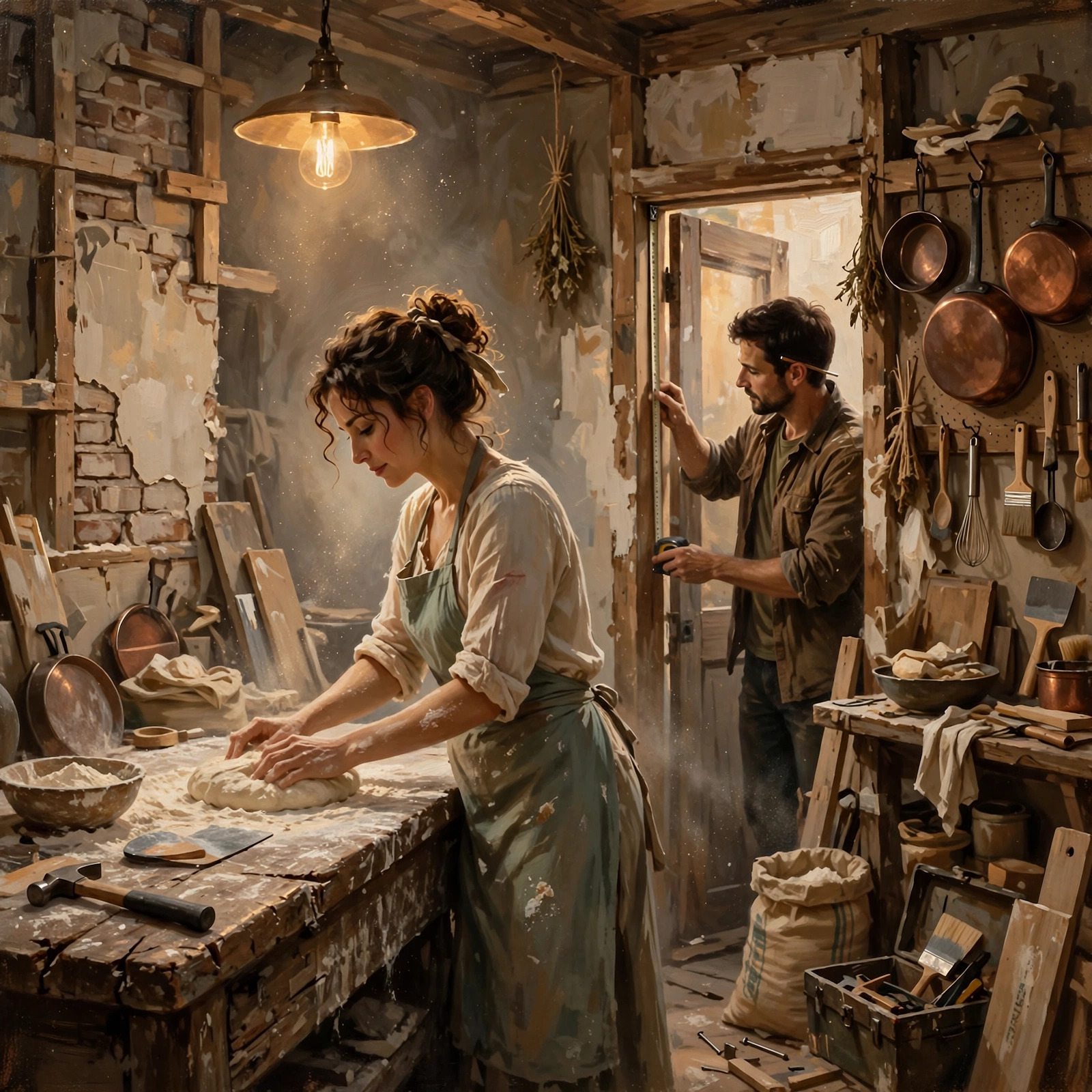
Wes started at seven with the cellar stairs, because he'd been right, they were the worst of it. Treads soft as sponge, the stringer split under the third step where the damp came up every spring. He'd pulled the rotten boards Thursday and cut new ones Friday, and now the shop smelled of pine and sawdust in equal measure, which Maren kept insisting was ruining her nose for the butter.
"It's a clean smell," Wes called up the stairwell.
"It's a loud smell. I'm trying to proof dough over a man who sounds like a woodworking convention."
"Proof it louder, then."
She proofed it louder. That was the whole arrangement, really, and it had never once been discussed. He worked; she baked; they got in each other's way with a politeness that had worn down to something more like choreography. When she needed the counter by the window, he moved his clamps without being asked. When he needed the back hall clear, she shifted the cooling racks two feet left and didn't say anything about it, and he noticed she didn't say anything about it.
The coffee was her doing. She'd brought the big enameled pot from the farmhouse on the second morning because the shop's percolator had died with the rest of the equipment, and now there was a mug waiting on the sawhorse by the cellar door every time he came up, black, no sugar, which she'd learned by watching him on day one and had never confirmed out loud. He paid it back in sawdust. That was a joke she'd made to Tam on the phone, that the man paid his coffee tab in sawdust, and Tam had laughed so hard she dropped her stitch markers.
Tam arrived Saturday at noon with a shoebox under one arm and a casserole balanced on her palm like a waiter.
"You look terrible," Tam said, which in their family was a greeting.
"I've been awake since four."
"You look fantastic, then, considering." Tam set the casserole on the one clear stretch of counter and lifted the lid on the shoebox. "Gran's photos. I got to the farmhouse attic before Dot could organize them, which was the point."
Wes had come up for his mug and stopped at the sight of the box, and Maren watched something move across his face before he turned back toward the stairs.
"You can look, you know," Tam said, not unkindly. "Half of them are that building."
He looked. Maren expected him to be polite about it, flip through, hand them back. Instead he took the box to the loading step and sat down with it like a man who had somewhere to be later but not soon.
"There's the awning," he said quietly. "Before the storm took it."
"You knew the awning?" Maren came and sat, leaving room between them for the shoebox.
"I've got a picture of it somewhere too. Job shots, before and after. That's all mine are." He set down the one he was holding, a color print of Gran on this same step, flour to the elbows, squinting at the camera like it had interrupted her. Maren turned it over. In Gran's handwriting, pencil, faded: First Frost. Forty-two tables. She'll be home for it.
No year. No name. Maren looked at it for a long moment and then put it face down on her knee and didn't say anything, and Tam, who knew her sister better than anyone alive, picked that exact second to demand lunch.
They ate on the loading step, all three of them, casserole and bread torn from the first test loaves, which were dense and a little burnt on the bottom because the oven door hung crooked and let the heat out one side.
"That door's a hinge problem," Wes said around a mouthful. "Twenty minutes."
"It's a sixty-year-old oven problem," Tam said.
"It's a hinge problem that's been on a sixty-year-old oven, which is worse, but it's still a hinge problem." He stood, brushing crumbs off his knees, and went inside for his tools, and Tam watched him go with her chin in her hand.
"He talks about that oven like other men talk about cars."
"He talks about everything like that. The cellar stairs. The window brace. He told me the health inspector's checklist like he'd written it himself."
"Maren." Tam put down her fork. "He's been in that shop before."
"He fixed the window. He told me."
"Not the window. This week I mean. Before." Tam was speaking carefully, the way she did when she was sure and being kind about it. "He came to the hospital. Last spring. He sat with her on the good days, and one bad one I'm not supposed to know about. Nobody hired him, Maren. He just kept coming."
Inside, the drill bit whined against the hinge. Maren looked through the door at Wes's bent head, at the screwdriver tucked behind his ear where the pencil lived, at the small careful work of a man rehanging a door on an oven he had no reason to love.
"Why wouldn't she tell me?"
"Would you have come home for it?"
That was the question Maren had been not answering for twelve years, and she didn't answer it now either. She picked up Gran's photo instead and put it back in the shoebox, face down, and carried the box to the counter and didn't look at it again.
Tam left at four with the empty casserole dish and a loaf under her arm, and the shop went quiet in the way it only did after dark. Wes worked by drop light on the oven door. Maren measured flour. The kneading was the best thinking she'd done all week, and somewhere in the fourth turn of the dough she heard the oven door swing open and shut, open and shut, smooth as a hinge could be.
"Try it now," he said.
She did. It opened and closed on a whisper, and the heat held in the box like it was meant to, and the first loaf off the rehung door came out even browned all the way around, the crust singing when she thumped it with a knuckle.
"Oh," she said, and then, "okay," and then she laughed.
She heard it before she recognized it, her own laugh, big and surprised, bouncing off the copper sign and the brace and the new pine stairs. She had been back in Bellwick for four days and this was the first time it had come out of her, and she couldn't have said what finally loosened it, the bread or the door or the man wiping his hands on his jeans like a hinge whispering was a normal Tuesday.
Wes's phone buzzed in his jacket, hanging off the ladder by the cellar door. He glanced at it, saw the number, and put it face down on the workbench without answering. Maren noticed, because she noticed everything now, but she was holding a warm loaf and didn't ask.
"Feed me," she said instead. "Tailgate. There's butter somewhere."
They sat on the open tailgate of his truck with the shop lights off behind them and the lantern frames glinting across the green where the market crew was setting up for First Frost. Forty-two tables, she could see them from here, half-built, waiting on string lights. The butter was in his cooler, because he'd started keeping butter in his cooler for her on day two, and she had decided not to make anything of that either.
The loaf steamed when she tore it. They ate in silence for a while, passing the butter knife back and forth, and the bread was good, genuinely good, the first thing out of that oven in eighteen months that deserved the copper sign.
"Six days," Wes said. "That's my honest number for the rest of it. The inspection list, all of it. Six days if we don't find rot behind the sink wall."
"And if we do?"
"Then I tell you it was six days and I'm sorry."
She laughed again, smaller, and his face did something careful at the sound of it, like he was filing it away with the hinge and the brace and all the other things he meant to keep working.
"You could eat with me while it goes," she said. "While the six days go. I mean. There'll be loaves."
"There'll be loaves," he agreed, and didn't move from the tailgate, and the phone buzzed once more against his jacket seam, and he let it.
Across the green, a market volunteer hung the first test lantern on the first finished frame, and the little bulb caught, and Maren thought: she'll be home for it.
Bread Line Sunday
Maren lit the ovens at four in the morning and did not burn anything, which felt like a sign. By six the copper kettle sign was swinging clean on its new brace, and by seven there were people on the sidewalk.
Not a crowd. Bellwick didn't do crowds before eight. But there was Dot Prue at the front of it with her postal coat still buttoned, and Tam behind her with flour already on her sleeves from helping, and behind them a line that bent past the barber's window and out of sight. Maren stood at the door with her hand on the latch and her heart going like a kettle at full boil.
"You going to let us in," Dot said, "or are we admiring the paint?"
"The paint took four coats," Wes said behind her. "Let them admire it."
He'd been there since five, and Maren had stopped asking why. He'd set the counter stools to rights, run the taps until the water ran clear, and stacked chair after chair that she hadn't asked him to stack. Now he stood by the cellar door with his sleeves pushed up and his toolchest still in his truck bed, because today he was not the carpenter. Today, Dot had decided over her coffee an hour ago, he was the tall one who would carry trays.
"Him," she'd said, pointing. "That one. He's hired."
"I have a job," Wes had said.
"You have arms," Dot said. "Same thing on Bread Line Sunday."
So it went the way it had always gone, which Maren knew only from Gran's telling of it and not from living it, because she'd spent twelve years making sure she was somewhere else on Sunday mornings. The neighbors came through the door and wrote their names on the slate by the register. Three loaves suspended each, the old rate, the old ritual. Pay for three now and someone hungry gets three later, or pay nothing now and owe the pot three loaves when your luck turns. Nobody had ever written down the rules. Everybody knew them.
Wes carried trays from the oven rack to the counter until his forearms had to be aching, and Dot ordered him about like a foreman, and he took it, grinning a little every time she landed on him. Maren watched him out of the corner of her eye while she scored loaves and Tam ran the register with a pencil behind her ear and the line kept coming.
"Ellison," people said. "An Ellison loaf. Well, all right."
By half past nine the slate had forty names on it and the pot was up to eleven loaves and the shop smelled like the inside of every good memory Maren had ever tried not to have. She was elbow-deep in the day, laughing at something Tam had said, when she looked up and saw the line through the front window, all the way around the corner now, patient in the cold, and understood with a sudden and total clarity that she was standing inside the thing she had run from.
Twelve years. She'd told herself it was about kitchens, about proving she could make it in the city, about the craft of it, the fine sugar work, the competition. Some of that had even been true. But underneath the true part there was this: the shop had been Gran's hands and Gran's voice and Gran's Sunday, and Maren had been afraid that if she stood in it long enough she would never leave, and if she left it would take her whole self with her when Gran went. So she had gone, and stayed gone, and then it was eighteen months since Gran died and the shop had stood shuttered, and the leaving had cost her every Sunday she'd never come back for.
"Maren." Tam's hand on her shoulder. "You're burning that one."
She pulled the loaf. It was barely dark on one edge. Fine, actually. But her hands were shaking a little and Tam had seen it, and said nothing, and slid a glass of water across the counter without a word about it.
At eleven the line wound down. Dot came around the counter last, as she always did, and Maren knew she always did this because Dot told her so while she did it. From under her market coat Dot drew a long wooden ladle, worn smooth as river stone, the bowl of it dark with decades of loaf-handling.
"Your grandmother gave me this back when my knees were still mine," Dot said. "The keeper of the Bread Line carries the ladle. That's all there is to it. There's no paperwork. There's just the handing." She put it across both palms and held it out. "It's not a gift, mind. It's a load. You'll feel it some Sundays."
Maren took it. The wood was warm from Dot's body and lighter than it looked, and she held it a moment before setting it on the shelf behind the register, in the empty spot that had clearly been waiting for it.
"I don't know the whole ritual," she said. "I should have learned it years ago. I should have asked her to teach me."
"You're learning it now," Dot said. "That's the only Sunday there ever is." And then she turned, because Dot never let a moment get bigger than it could hold, and hollered at Wes to bring the last trays out to the truck before the market crew came looking for their bread.
The market crew did come, three of them, and went away with arms full. The First Frost Lantern Market was two Sundays out now, forty-two vendor tables going up across the green, and half of Bellwick it seemed had been through the door that morning to make sure the bakery would still be standing for it.
They closed at two. Tam swept, hugged her twice, and left with a jar of honey Maren didn't remember giving her. Dot left with three loaves she'd paid for and three she'd suspended, and a look at the ladle on the shelf like she was checking that it had settled right.
And then it was quiet, and the chairs needed stacking, and Wes stayed to stack them.
He did it the way he did everything, without ceremony, four to a hand, set down soft. Maren wiped the counter and watched him and thought about the phone in his jacket that buzzed and buzzed some days, and the city on the other end of it he never mentioned.
"You didn't have to stay for this part," she said.
"Chairs don't stack themselves."
"That's not what I meant."
He set the last four down and looked at them, not at her. She told him then, because he'd earned it, and because the day had made her brave: "I left because of her. Not because of a fight. Because I knew if I stayed, I'd never be anything but her granddaughter in her shop, and I loved her so much I would've let it happen. So I went twelve years proving I was my own baker. And the whole time, the thing I was scared of losing was the thing I was walking away from. That's it. That's the true thing. Nobody here knows that but you."
Wes was quiet for a while. He picked a splinter off the chair back, a small unnecessary kindness to something wooden.
"I'm not great at staying," he said. "Nine towns now. I finish a job and I'm gone before anyone thinks to ask me to dinner twice. It's not noble. It's just easier."
She waited. He didn't say more. He didn't say where, or who called, or why the phone buzzed. But she heard the shape of what he'd left out, the way you hear the bottom of a kettle under the whistle, and she knew a load when she saw one being carried.
"Dinner twice," she said. "Is that the number?"
"Around there."
"Then eat here Sunday. You're already in the line, Wes. Dot wrote your name on the slate."
He looked over at the slate by the register, and there it was, in Dot's postal hand, above three suspended loaves.
The Cellar Steps
Maren came down early on the seventh morning and found her aunt already at the counter, surrounded by the wreckage of the back office. Tam had the ledgers out, all three of them, and Gran's reading glasses pushed up into her gray hair like a headband that had given up halfway.

"You've been at this since dawn," Maren said.
"Since the kettle noise woke me, and that was before dawn." Tam tapped a page with two fingers. "Come sit. I found something."
There was flour on Maren's hands already and dough rising under a cloth, but she sat. Tam had that voice, the one that had talked her into her first piano recital and out of her last bad haircut, and it still worked on her like a bell on a cow.
"The cellar steps," Tam said. "The new ones. The ones your carpenter put the rail on."
"Wes finished the stringers Tuesday. He's doing the landing today so we can get the inspector down there without him writing us up for a death trap." Maren said it lightly. It came out heavier than she meant, the way things did when she'd been sleeping four hours and carrying a bakery.
"Maren." Tam turned the ledger around on the counter and set her finger under a line of Gran's handwriting, that slanted, certain script that hadn't changed since Maren was small enough to stand on a stool and watch her write out orders. The line said what it said. Maren read it twice, which was one time more than it needed.
Cellar steps, paid in full. W. Calloway, wouldn't take a check.
The date was a month and a half before the funeral. Before the funeral. Before the hospital, even. Before anyone in the family knew enough to be settling accounts, Gran had written a payment into her book for work nobody had asked her to pay for.
"He told me he never took her money," Maren said. "He stood in this kitchen and told me he did it for free."
"That's not what this says."
"That's not what he said." Maren heard her own voice climb and didn't stop it. "She was ninety-one, Tam. She was sick and confused and writing checks to a stranger who showed up with a truck and a smile, and he took it. He took her money and then he told me he didn't, and I've had him in my cellar for a week."
"She wasn't confused," Tam said, patient as bread. "I sat with her that month. She beat me at cards four times and made me a lemon tart that was better than anything you've made since you got back."
"That's not the point."
"It's exactly the point. She knew what she was paying for. The question is why she was paying for it in October, and I can't answer that one." Tam slid the ledger across. "But you should ask him, not me."
He was already in the cellar, of course. He was always already somewhere, quiet as a splinter, before anyone told him where to be. Maren took the ledger with her and went down the new steps, which didn't creak, and hated that they didn't.
He had the rail half-installed, straddling the stringer with a level in one hand, and he looked up at the sound of her shoes and smiled before he saw her face, and she watched the smile get recalled like a library book.
"You took her money," Maren said.
"Good morning to you too."
She held out the ledger, open, and didn't trust herself to point. He set down the level, wiped his hands on his jeans, and took it. He read the line. Then he read it again, slower, like maybe the words would rearrange into something that wasn't a rope thrown to a drowning woman.
"I didn't take her money," Wes said.
"It's her handwriting, Wes. In her book. W. Calloway, wouldn't take a check. That's you, isn't it? How many Calloways are fixing cellars in Bellwick?"
"That's me." He was still looking at the page. "That's my name. But I never cashed anything. She wrote that because she liked writing things down, she said the book was how she kept her mind a... a fence around the yard. I told her I didn't want pay and she wrote it in anyway. She called it a debt on her side, not mine. She'd..." He stopped. Started again with his jaw set wrong. "She'd mail me letters. I'd get them on the road and read them and not answer, because answering meant staying in one place long enough for the mail to find me."
"So you were her friend and her fix-it man, and she paid you under the table, and you didn't think to mention any of this when you showed up at my door?"
"There was no under-the-table about it. She never gave me a dollar."
"Then explain the book."
"I just did. She was keeping score because she couldn't stand not to, and I let her, because it made her happy, and because..." He put the ledger down on the step like it was hot. "Because it was easier to be somebody's letters than somebody's Sunday dinner. Because I finish jobs and go. That's what I do. She knew it. She wrote it in the book, probably, under something I couldn't read."
"And the calls." Maren crossed her arms. It was her grandmother's move; it felt like her grandmother's elbow in it too. "The buzzing in your jacket. Every day this week. Who calls a man who's supposed to be gone by the weekend?"
He was quiet long enough that she could hear the kettle upstairs, faint, starting its climb. Then he said it flat, like pulling a nail out with the wrong end of the hammer.
"There's a job in the city. A full winter's contract, custom interiors, good money, and I told them months ago I'd take it. It starts the first of the month. That's the phone. That's who wants me."
"Months ago." She almost laughed and it came out with a hard edge that startled her. "You knew. You knew you were leaving the whole time you've been standing in my kitchen telling me we'd pass inspection together."
"I wasn't lying. Six days, the work, the oven, I meant all of it. I just didn't tell you the end of the sentence."
"That's the only part I needed."
"Maren."
"No. You know what my grandmother did with people who only stayed for the part they were paid for?" She was shaking and she didn't know if it was anger or the cellar cold or something worse under both. "Nothing. She let them go. She let me go, Wes. Twelve years, and she never once asked me to come back, because she'd rather have me gone and free than here and half."
"And you think that's me. Half."
"I think you've got a contract in a city four hours from here and a look on your face like a man checking the exits." She took a breath and it didn't help. "You know what? Fine. Go. I'm gone by month's end too, maybe. There's an apartment in the city that'll take me and my hands anywhere. There was a deposit slip in my coat this morning before I ever came downstairs. So don't stand there looking like I'm the one ending something."
He didn't say anything. He picked up the level, put it down, and rubbed the back of his neck like the words were all stuck in the same place.
"I'll finish the landing," he said finally.
"It's paid for, apparently."
"Yeah. Apparently."
She went up the steps. Halfway she stopped, because the rail was solid, because the treads didn't shift under her weight, because some man had cut every one of them by hand and asked for nothing and told nobody, and none of that made any of it easier to hold.
By the time the two o'clock quiet came, Tam had gone home with the ledger under her arm and a face that said she was sorry and would be staying out of it, and the shop was empty except for the flour smell. Maren got her coat from the hook by the register. The deposit slip was still there in the pocket, folded into eighths, softened at the creases like something she'd taken out and looked at more than once this week.
Through the front window she watched Wes go out to his truck. He stood by the tailgate a minute with his hands on the bed rail, looking at the toolchest in it, the whole box, everything he owned that mattered. She figured he'd load it. That's what a man leaving does.
He didn't. He lifted it down on his own, took it up the steps, and set it inside the bakery cellar door, inside, on the new landing, on wood he'd planed that morning.
Maren turned the lock on the front door and told herself it was the money, and the letters, and the hiding, and the city, in that order.
It was the order she'd defend to anybody. It just wasn't the order it was true in.
A Month of Lanterns
Maren came to the post office at nine because her mailbox had been stuffed since Tuesday and because staying in the bakery meant watching Wes sand the cellar door for the sixth straight hour without either of them saying a word about the night before. Dot's window smelled like pencil shavings and the rubber bands she snapped around bundles. Maren had three letters and a paper sack of the morning's rolls, because you didn't come to Dot's window empty-handed in Bellwick, and she was mid-sentence about the mail when the phone behind the counter rang.
Dot looked at it. Looked at Maren. Picked it up, said, "Post office," and then held it out across the counter like a serving dish. "It's for you, Wes Calloway. Line two."
Wes was by the poster of parcel rates, hat in his hands, which was how he'd been carrying his hat since he came in, turning it, not looking at anybody. He took the receiver. Maren stood there with her letters and her rolls and her whole body pointed at the door.
"Calloway." A pause. "Yes, I got the papers." Another pause, longer. "No. I'm not taking it."
Dot went on stamping a bundle like she couldn't hear, which meant she could hear everything.
"I understand what it is," Wes said into the phone. "Four months, whole winter, your whole shop. I know what it pays." He turned the hat once more. "The man you want is out there, and I can give you two names. But it's not me. I've got work here that isn't finished and I'm not leaving it."
He listened a while. Maren could hear the voice on the other end as weather, low and insisting.
"Then keep the deposit," Wes said. "Mail it back or don't. I'm sorry for the trouble. I hope the build goes well." He set the receiver in the cradle the careful way you set down something that isn't yours anymore.
The post office was very quiet. Dot had stopped stamping.
"That was the winter contract," she said, not asking.
"That was the winter contract."
"The big one. The city one."
"The biggest job I've had offered in nine towns of working," Wes said. "Yes."
Maren's mouth was dry. "You turned it down. On a payphone in a post office. In front of me."
"In front of you. On the phone Dot handed me." He looked at his hat. "I wasn't going to take it, Maren. I was going to call yesterday and I let myself think about it for a night, which was a night too long."
"The bakery can't pay you," she said. "Whatever you think you owe my grandmother, whatever you think you owe me, there isn't money for it. The oven work alone is six days of a man your rate, and I've got a re-inspection and a market and a shop that's been shut for a year and a half."
"I know how long it's been shut," Wes said. "I was here."
The bundle of mail sat between Dot's elbows. She took her glasses off, which in Bellwick meant somebody was about to say something true.
"He was here," Dot said. "Your gran had him in that cellar before she passed, Maren. Those steps were going to kill somebody, the stringers were split through, and she knew it. She called him up out of the blue. He drove in from two towns over on a Sunday and she walked him down there with a lamp and said, fix it, and don't tell my granddaughter till she's home to see it."
"She paid me in advance," Wes said quietly. "Before she'd even let me measure. Full amount, in cash, in a bank envelope. I told her it was too much and she said, and I'm quoting, 'You'll argue with me about money and then you'll take it, because the steps need doing and you do them straight.' I took it."
Maren put the paper sack of rolls down on Dot's counter because her hands wanted something to do.
"She asked me to keep an eye out," Wes went on. "For you. She said, 'My granddaughter's been gone twelve years and one of these days the city will get tired of her and she'll come home, and when she does, I want the floor to hold her up.' Those weren't the exact words. She said it better. But that was the shape of it."
"You're making this up," Maren said, and her voice cracked in the middle of it, which was answer enough.
"He's not," Dot said. "I posted the envelope to him myself. Registered. I remember the day."
Wes set his hat on the counter, reached into the inside pocket of his jacket, and brought out a folded paper, soft at the creases, the way paper gets when it's been carried a long time. He unfolded it and laid it flat on the marble between the rolls and Dot's stamp.
Maren looked at her grandmother's handwriting, the looping g's, the pressed-down periods. She knew it like she knew the copper kettle sign out front of the shop, like she knew her own hands.
Wes, the boy from the fair year, if you're reading this I've gone on ahead. The steps, the oven, the shop, in that order. And the girl. Look after my girl. She comes home heavy. Let her set things down.
"The fair year," Maren said. Her throat was doing something it hadn't done since the funeral. "You're the one who built the lantern frames. When I was a kid. You were at our green every First Frost with a mallet in your back pocket."
"I was seventeen and you were nine and you told me my frames were crooked," Wes said. "They were crooked. I'd only ever built one thing before that and it was a birdhouse and the birds refused."
Dot laughed, a short surprised sound, and then covered it with her hand.
Maren picked up the note, careful of the creases, and read it twice more, and the second time she got to she comes home heavy and had to stop and press the flat of her hand against the counter. Gran had known. Eighteen months of knowing and planning and paying ahead, all of it sitting quiet in a bank envelope, waiting for Maren to come home heavy and set things down.
She put the note back on the counter and took the deposit slip out of her coat pocket, the one folded into eighths, soft at the creases, the apartment in the city, the other life. She'd looked at it every morning for a week. She'd told herself it was a door and not an exit.
"Come outside," she said.
Wes frowned but followed her, Dot watching them both through the window with her glasses back on. The October air was cold enough to matter. The steps of the post office were three broad stone slabs worn in the middle by a hundred years of boots.
Maren unfolded the deposit slip one last time, looked at the number on it, the number that meant a lease and a city and a kitchen that belonged to somebody else, and tore it in half. Then in half again. She held the pieces out to Wes.
"I'm staying," she said. "The Kettle's mine and the oven's almost true and I'm not leaving my grandmother's shop to be a story on a sign that fades. But I can't pay you what that contract was. I can't pay you anything close."
"I don't need close."
"Then here's what I can do." She pushed the pieces of paper into his hand and closed his fingers over them, and her hands were cold and his were warm and she let that be true for a second before stepping back. "Market's in three weeks. Forty-two vendor tables on the green and not one lantern frame up because the man who builds them is standing here holding my torn-up apartment. Build them with me. After shifts, evenings, whatever the oven allows. I'll bake for the line and you build frames and we'll call it even, and if it isn't even, Gran already settled it, so."
Wes looked down at the torn pieces in his palm, then at her, and something in his shoulders came down an inch, some weight he'd been carrying since she didn't know when.
"Forty-two tables," he said. "And the frames go on the north edge first, because the wind comes off the mill road and takes the corners."
"You know that green that well?"
"Maren." He put the pieces in his jacket pocket, over the pocket where the note had been. "I know the measurements of that market green better than anybody in Bellwick. Ask Dot. Ask your gran, if you're still in the habit of talking to her, which I think you are."
"I am," Maren said. "Lately."
Behind them the post office door opened and Dot leaned out with her cardigan half on. "You two are going to stand there till the mail truck comes or till one of you says a sensible thing. I've got cocoa on the stove and I've heard every word through this door, so come in or go on, but pick."
Maren looked at Wes. Wes looked at Maren. He turned his hat right side around and put it on, which was the first time all morning it had been on his head where it belonged.
"Cocoa," she said. "And then the north edge."
First Frost Green
The county inspector signed the paper on The Copper Kettle counter at ten in the morning, and Dot, who had come over on the excuse of buying a cardamom roll, read the signature upside down and announced it to the whole shop before the man had capped his pen.
"Passed," she said. "First try. Maren Ellison, your grandmother is doing a dance on some cloud and don't let anybody tell you different."
Maren put both hands flat on the counter and let herself breathe all the way down for the first time in what felt like years. The oven ticked behind her, warm and true, holding the last of the morning's loaves. The inspector gathered his clipboard, wished her a good market, and let himself out past the ladder and the sawhorses that still crowded the aisle, because Wes had been up before dawn hanging the new door trim and the paint on it wasn't dry yet and the shop smelled like bread over fresh pine, which Maren had decided was going to be the smell of her whole winter.
By three, the green was full. Forty-two vendor tables ran in rows from the mill road to the war memorial, and the frost had come on schedule overnight, sugar-white on the grass, and the whole of Bellwick had turned out in scarves and boots. Tam ran the bakery stall with a clipboard and no mercy, calling the Sunday Bread Line down the row the way she'd called order in the Ellison farmhouse kitchen her whole life.
"Three loaves per household," Tam called, "and no, Mr. Prue, being married to the postmaster doesn't make your household four."
"One loaf and a kiss on the cheek, then," said the voice from the front of the line, and the line laughed, and Dot, working the stall beside them with the wooden bread ladle in her hand, rapped the counter with it like a gavel.
"Move along, all of you. Bread's not getting younger and neither are we."
Maren worked the oven-side of the stall, wrapping loaves in paper, and every time she looked up, the green looked different than it had an hour before, because the lanterns kept going up. Wes had built the frames all through those cold evenings after shifts, north edge first exactly as he'd promised, and now half the town was up ladders hanging them while the other half stood below saying which angle looked crooked. The frames were simple and handsome, pine and brass hinges, and when the lighters came through at dusk and lit the first one, the crowd on the green made a sound together, low and glad, like the town itself had a voice and had decided to use it.
Maren came out from behind the stall table and stood at the edge of the lantern row with a cooling loaf still in her hands, and watched.
He was on a ladder near the north corner, sleeves pushed up, working a lantern into its frame with the kind of care he gave everything, checking it twice, steadying it with two fingers until it hung right. He'd built every frame on that row. He'd turned down a full winter of good city pay to be here doing it, and he'd never once, in nine days, said so out loud.
Nine towns, she thought. Nine towns with his tools in the truck bed and his hat on his head and no reason to stay past the last invoice. Bellwick was the tenth, and Bellwick had a market green lit up with his work, and a bakery whose cellar steps didn't wobble anymore, and a woman standing in the middle of it with bread in her hands and no idea how to say any of it in front of forty-two tables' worth of neighbors.
So she didn't say it in front of them. She walked over, past the ladder's feet, and tugged his boot, the way you'd knock on a door.
"Ma'am," he said, looking down.
"Come off that ladder a minute."
"This one's not hung true yet."
"Wes. It'll hang true. You hung the whole row true. Come down."
He came down, wiping his palms on his jeans, and the lantern above him swung a little in the wind off the mill road and threw its light across his shoulders. Around them, Bellwick moved and buzzed, Tam calling the line, Dot ladling out rolls, kids chasing along the table rows, and none of it stopped for them, which was the whole point of a small town: nothing stops for you, and everything notices you anyway.
"The paper's dry on the trim," Maren said. "The inspector signed before lunch. The Kettle passed and the doors are open and the bread line's moving and I have exactly one thing left on my list today."
"What's that?"
"A lantern."
"You want a lantern. I've built you eleven lanterns."
"I want one lantern hung on the front of my shop, tonight, before the lighters finish the row, by the man who built the row." She held up the loaf. "And then I want that man to stand in the doorway with me, and I want to tell him something while the whole town watches, because I've spent twelve years being private about my business and I'm done."
Wes went still. Up the green, Dot had stopped ladling. Tam had stopped calling. Word had traveled the way it does, which is to say instantly and with embellishment.
"Maren," he said quietly. "There's people watching."
"I know. That's the idea."
He looked at her for a long second, then took the loaf out of her hands and set it on the ladder's rung like he was setting down something he'd been asked to hold for a long time. "All right," he said. "Then let's do it right."
They walked the green together, past the rows, and the crowd let them through the way the crowd lets through anyone carrying light. Dot fell in behind with the wooden ladle over her shoulder like a rifle at a homecoming. Tam locked the stall cashbox and followed at a distance with her arms crossed and her chin up, because she'd waited a long time for her sister to come home and she was going to see the whole of it.
The Copper Kettle's copper kettle sign hung over the door, polished that morning, catching lantern light down the whole row of shops. Wes went up the short ladder he'd left leaning there, took the last lantern frame from the crate, and fixed it to the fascia board beside the sign, exactly where a sign like that wanted company. He set the lantern in it. He checked it twice. He steadied it with two fingers until it hung true.
Then he climbed down and stood in the doorway of the shop he'd fixed, and the light from his own lantern fell across them both.
"Say it," he said.
"I'm not going anywhere," Maren said. "The Kettle's mine and I'm keeping it, and I kept the recipe box and I found your note, and I know now why you knew my shop before I ever walked in. You're not a town I work in and leave, Wes Calloway. You're the tenth town and I'm asking you to stay, out loud, on my green, in my doorway. Stay."
Around them, Bellwick whooped. Somebody's kids hollered from the top of a fence. Dot's voice carried over all of it: "Well, it's about time, and I'm taking credit, and don't argue."
Wes took off his hat, turned it once in his hands, and put it back on, right side around, where it belonged.
"I turned the city contract down already," he said. "Told them last week. I figured if you didn't ask me to stay, I'd stay anyway and build something until you noticed."
"You'd have waited long?"
"I'd have waited out the winter."
"That's a long time."
"I know what I built," he said, and nodded up the green, at the row of lit frames running north, at the forty-two tables glowing under frost, at the whole lit length of a town that had his work in it now whether he left or not. "I build things to last."
She took his hand. He closed his fingers around hers the way she'd closed his around the torn paper on the post office steps, and his were warm and hers weren't, and they let that be true in front of everybody.
Behind them the oven ticked and held its heat. Above them his lantern hung beside her grandmother's sign and threw its light down on the step. Somewhere up the green Tam was calling the line again and Dot was arguing with a Prue about rolls, and the market burned on into the evening, and they stayed, both of them, on purpose.
Get notified when new stories drop

Ivy Chen
Ivy writes historical and second-chance romance with period texture and modern emotional clarity. Courtship stakes, letters, and choices that cost.
Leave a comment
Comments