





The Brass Crescent

Nell Ambrose arrived at the Harborlight Theater twenty minutes early, with a clipboard, a headlamp, and a lump in her throat the size of a doorknob. The marquee letters had been taken down years ago, but the shadow of the word still showed on the brick, ghost-gray against ghost-red, and she stood on the sidewalk looking up at it until a county sedan pulled in behind her truck.
Geraldine Hsu got out first, keys already in hand, sensible shoes on wet pavement. "You're the carpenter."
"Nell Ambrose. Stabilization contract." She offered her paperwork like a shield.
"I know. I signed it." Geraldine squinted up at the facade. "Eighty-five thousand dollars of the county's money, and on day twelve I need to know whether it was well spent or thrown at a lost cause. Where's my engineer?"
As if summoned, a second vehicle rolled in, silver and clean, with a magnetic door sign that read ODELL ENGINEERING. The man who climbed out was tall, dark-jacketed, carrying a tablet like it was a serving tray. He looked at the building the way a doctor looks at a chart before breaking news to the family.
"Marcus Odell," Geraldine said. "Assessment contract. Same building, different money."
"Nell Ambrose." She did not offer her hand. The name Odell meant nothing to her except paperwork, and paperwork had taken things from her before.
Something crossed his face when she said Ambrose, quick as a shadow under a door, gone before she could name it. "Ambrose," he repeated. "Any relation to the boatbuilder out past the point?"
"He's my father." She watched him. "You know him?"
"The name, mostly." He turned to the doors. "Should we go in?"
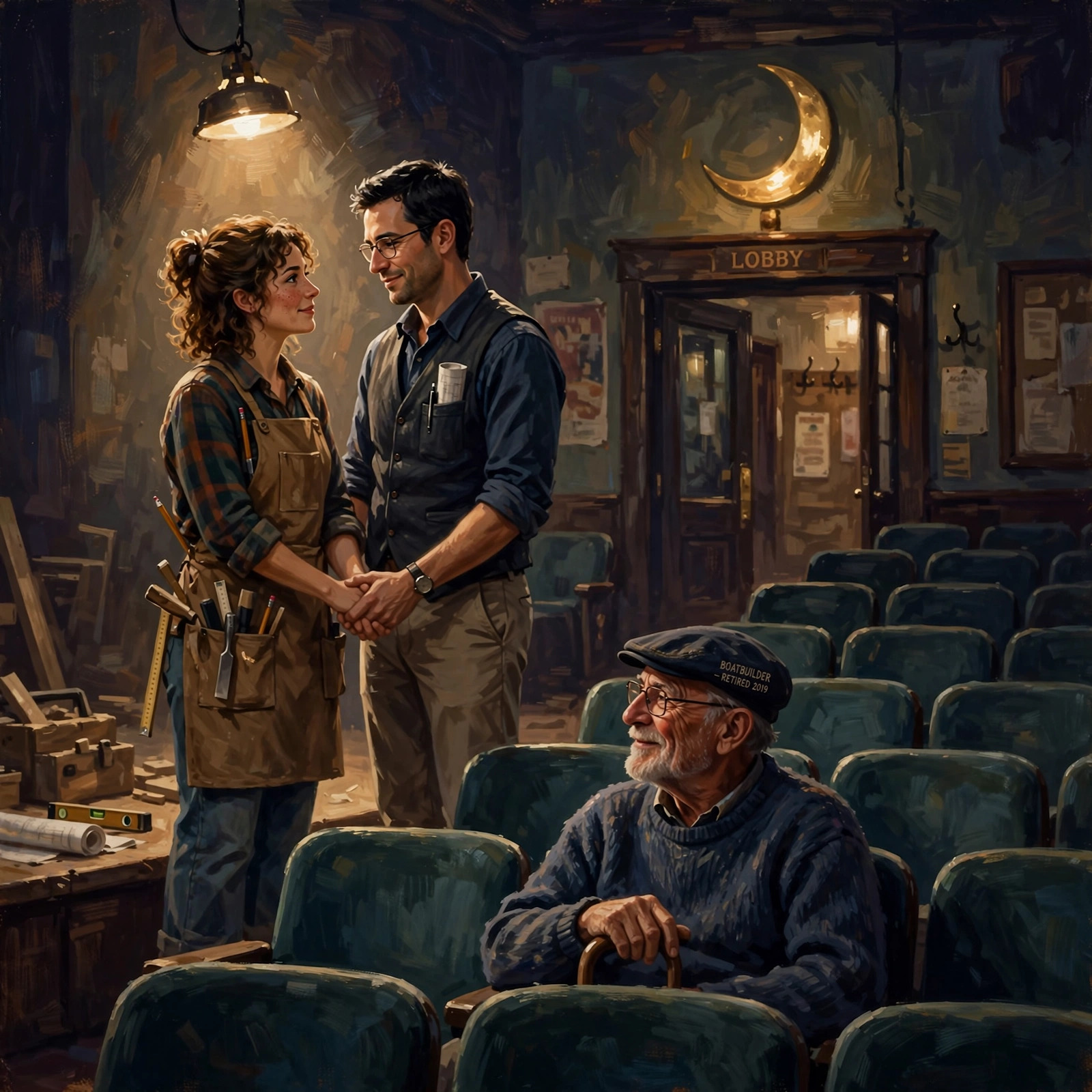
The lobby smelled like dust and old varnish and rain finding its way through a roof nobody loved anymore. Nell's headlamp cut a cone through the dimness and lit on the far wall, and there it was, right where the 1928 builders had screwed it in above the ticket window: a brass crescent, tarnished nearly black, its points still sharp, still reaching.
"That's original," she said. "The crescent from the old marquee. They mounted it inside when they replaced the sign."
Geraldine unlocked the house doors. "Save the love letter for the meeting. I need the two of you looking at structure."
They looked at structure. For an hour they moved through the building in an uneasy triangle, Geraldine between them like a chaperone at a dance neither wanted to attend. Nell found the good news and said it out loud: true plank flooring, sound, dry underfoot. Timber roof decking you could drive a truck over. Masonry that had been repointed sometime in living memory and repointed well.
Marcus found the other kind. He stood at the base of the fly gallery stairs and did not climb them. "Stringers are checking. There's daylight through that splice. And this column," he said, rapping a steel lally column with a knuckle, "is carrying the gridiron load on a base plate sitting in standing water. How long has that puddle been there?"
"Since the roof failed over the stage house. Which is fixable."
"Everything's fixable." He said it gently, which made it worse. "The question the county's asking is whether it's sensible."
"The county built it in 1928 and let it rot for the last decade. That's not the building's fault."
"No. But the building doesn't get a pass on physics because of history." He held up his tablet, numbers glowing on it. "I'll have load calculations done before I say anything definitive. I don't sign reports on vibes."
"And I don't write off four hundred seats on a tablet walk-through." She heard her own voice climbing and did not care. "You've been in here ninety minutes. I've spent my life in buildings like this."
"Then you know what a failed fly gallery does when it comes down."
"It comes down on an empty stage, because nobody's been in here since it closed, and I'm proposing we brace it before anyone goes up. Four days of shoring with my crew and that gallery holds anything you put on it."
"Six people can't shore a gallery in four days."
"Six people who know timber can. My father's crew could've done it in two."
That stopped him. He looked at her a long moment, and again she had the sense of a shadow moving behind his eyes, something he was choosing not to say. "Four days," he said finally, like a man conceding a card he'd already counted. "If your bracing is in, I'll run a load test on it. Instrumented. My rig, my numbers."
"Fine."
"And if the numbers say it fails, it fails. I won't soften them for you."
"I'm not asking you to soften them. I'm asking you to actually run them before you bury this place." She pulled her clipboard up like a drawbridge. "That's all. Test it. Don't just sign it away because it's faster."
Something in his jaw set, and she understood, suddenly, that she'd said a wrong thing to a man who had a private reason for it. He didn't tell her what the reason was. He wrote on his tablet. "Load test, day nine. Report to Dr. Hsu by day twelve."
"Day twelve," Geraldine confirmed from the doorway, where she'd been watching them both like a woman scoring a tennis match. "That's the deadline on both your contracts, and I don't extend deadlines. I've got a developer calling me every other day about this site, so whatever you two decide, decide it with math."
"Cobalt," Nell said. It wasn't a question.
"I don't discuss bidders." Geraldine's face said it anyway.
They finished the walkthrough in a silence that had friction in it, the productive kind, like two boards being jointed edge to edge. At the lobby doors Nell stopped, and went back, and stood in front of the brass crescent.
She shouldn't touch it. She knew she shouldn't touch it. Her fingers went up anyway, tracing the curve of the tarnished metal, feeling for the mounting screws, and the left screw turned under her thumb like it had been waiting. The crescent came off the wall into her hands, heavier than it looked, its back stamped with a foundry mark and the year, and she stood there holding a piece of the building like a heart taken out of a chest.
"Ma'am, that's county property," Geraldine said.
"It's a loose object on a failing wall." Nell wrapped it in a rag from her tool belt. "If the ceiling in here lets go, this becomes a projectile. I'm removing the hazard. It goes back up when the theater's standing."
"If," Marcus said quietly behind her.
She turned. He was watching her hold it, and his expression had gone complicated, the way a man looks at someone he's about to argue with for twelve straight days and doesn't entirely mind.
"When," she said.
Geraldine sighed the sigh of a woman with two contracts and one building. "Day nine, load test. Day twelve, report. Play nice." And she was gone into the gray afternoon.
Marcus lingered. He looked at the bare patch on the lobby wall where the crescent had hung, then at the rag-wrapped shape in Nell's hands, and something almost like a smile touched his mouth.
"You're going to carry that thing around for three weeks, aren't you."
"It's coming home with me tonight, if that's what you mean." She put it in her jacket pocket, where it rode against her ribs, cold and solid and hers to answer for. "Somebody has to keep the pieces safe until there's a wall to hang them on."
He shouldered his bag, and she saw the corner of a laptop sleeve bulging with a draft report she'd bet her grant money was already half written. "Day five," he said at the door. "I'll bring the rig Saturday. Have your shoring started."
"It'll be halfway done."
"Then I'll bring coffee."
He left her standing in the dark lobby with a crescent in her pocket and twelve days on the clock, and Nell Ambrose, who distrusted engineers on principle and this one's paperwork in particular, caught herself smiling at a closed door anyway.
Corner Sparrow Coffee
Saturday came in with fog off the water, and Nell's crew came in with it, six carpenters and a flatbed of rough-sawn Douglas fir that had cost her a third of the grant before lunch on day one. She stood in the fly gallery of the Harborlight Theater with her boots on the boards that mattered and pointed.

"Braces on the quarter lines first. If that header picks up a load before we're under it, I want it sharing with something that doesn't move."
Tomás, who had been with her since her first bridge job, spat into his palm and grinned. "She means don't drop anything on the engineer's toys."
"The engineer's toys aren't here yet," Nell said.
They were, though. Ten minutes later the side door opened and Marcus Odell came up through the house with a hydraulic jack cradled in both arms and a hard case of gauges hanging off one shoulder, looking like a man carrying his own verdict. He set the jack down at the base of the gallery stairs and stood a moment with his hand flat on the rail, reading the building through his palm the way she read it through her fingers.
"You're early," she said.
"You're halfway." He looked up at the timber already snugged against the old header, and something in his shoulders settled. "This is good shoring."
"It's four days of shoring. It better be good." She'd told Geraldine four days, and she'd used every one of them, and her crew had used their backs.
He climbed. She climbed after him, because it was her building to climb in, and watched him rig the jack between a doubled plate and the roof beam, running his gauge lines out along the timber with zip ties and a small drill that made almost no sound. He worked clean. She hated that she noticed. Every gauge got a number penciled on the wood beside it, every hose got a loop, and when he finished, the rig sat under the beam like it had grown there.
"Load test is Wednesday," he said. "I'll pump it in increments. The gauges tell me how the beam takes it. Numbers don't get nervous."
"People do, though." She said it without meaning to say it, and he paused with his hand still on the jack handle.
"People do," he agreed, and didn't ask what she meant, which she suspected cost him something.
They worked the afternoon into the gallery together, actually together, which she had not planned. Her crew hauled the long braces up the stairs two men at a time, and Marcus called out where he wanted clearance for his gauge lines, and once, when a brace started to skate on the old boards, his hand shot out and caught the end of it before her own did, and they stood there a second holding six hundred board feet of Douglas fir between them, breathing sawdust.
"Got it?" he said.
"Got it."
By five the gallery stood braced on the quarter lines and the jack sat rigged and waiting, and Tomás called up that the crew was knocking off, and the building went quiet the way an empty theater does, holding its breath without a breath in it. Nell climbed down and looked up at the work, and it looked like a building that intended to stay.
"Coffee," Marcus said behind her. "I promised coffee."
The Corner Sparrow sat on the corner of Main and Harbor with its lights already yellow against the fog, and Della Pruitt stood behind the counter the way she had stood behind it for seventeen years, which was to say like the counter was a fortification and the whole town was an army she fed anyway. The back wall behind the register was papered in ticket stubs, hundreds of them, decades of them, torn halves in faded inks: HARBORLIGHT, HARBORLIGHT, HARBORLIGHT.
"Carpenter," Della said. "Engineer. Sit down before you drip on my floor."
They sat. She brought two coffees without being asked and a plate of lemon bread that nobody ordered, and then she leaned on the counter with both forearms and looked at them the way she looked at everybody, which was like she already knew the ending.
"That wall's my wall," she said, nodding at the stubs. "Started it the year I bought this place. Every show I ever saw in there is on it. My husband took me to a musical there in a raincoat, and I still have the stub." She tapped a pale blue one, high up, gone soft at the edges. "You two are going to tell me if I have to take my wall down."
"Nobody's taking your wall down," Nell said.
"That's not an answer, honey, that's a position." Della turned her eyes on Marcus, which was worse. "What's yours?"
"Wednesday," he said. "The numbers come in Wednesday."
"Numbers." Della snorted and pushed the lemon bread an inch closer to them, which was how she forgave people. "The man from Cobalt was in here Tuesday. Bought a coffee, tipped a dollar, told me a retail block would bring two hundred jobs to this waterfront. I told him my coffee's two dollars and my theater's not for sale, and he laughed like I'd made a joke." She straightened up. "I've buried people this town loved less than that theater."
Nell drank her coffee and said nothing, because the alternative was saying too much. The brass crescent rode against her ribs in her jacket pocket where it had ridden for four days, and she was aware that Marcus had noticed her hand go to it twice.
"You carry it everywhere," he said, when Della had moved off to the register.
"It's safer with me than on a wall that might come down."
"That's not why."
She looked at him. He looked back, unhurried, and there was something in his face she hadn't seen in the lobby, something that wasn't the report in his bag. "No," she said finally. "It's not."
He didn't push. He drank his coffee and looked at the stub wall, and she watched him read it, stub by stub, all those torn halves of evenings, and she thought: he's counting them. He's counting what the building holds besides people.
"Can I ask you something?" he said. "And you answer it straight."
"Try me."
"If Wednesday the beam fails, if the numbers say it fails, what do you do?"
The fog had come into the café windows and made the whole room soft. She thought about lying, and then she thought about the jack under the beam, sitting there patient as a question. "I fight it. I shore it, I rebuild it, I go back to Geraldine with a new plan and a smaller number and I fight it."
"Even if the numbers are right."
"The numbers are about the roof. I'm not only about the roof." She turned her cup a quarter turn on the saucer. "Now mine. If Wednesday the beam holds, if your own gauges say it holds, what do you write?"
He was quiet long enough that Della glanced over from the register. "I write what the gauges say," he said. "That's the job."
"That's the cover," she said, and watched it land, and didn't know why it landed so hard, only that he flinched like she'd hit a bruise he hadn't shown her yet.
They sat with the lemon bread between them, and outside the fog thickened over Harbor Street, and neither of them said the thing that both of them had been circling since the fly gallery, since the jack went under the beam, since Wednesday had become the day the building spoke and they had to say what they'd heard. Whether the roof would hold.
And under that, quieter still, the question she'd been not asking herself all week, and could see now he hadn't been asking either, both of them working so carefully, so technically, so by the numbers: whether they wanted it to.
Because if it held, he'd have to write the truth against his firm's interests, and she'd have to keep a building alive on eighty-five thousand dollars and stubbornness. And if it failed, she'd have to let them take another wall down, and stand there and watch it, again.
Della came back and refilled their cups without asking.
"Wednesday," she said. "I'll be here after. Either way, somebody's going to need the lemon bread."
The Gauges Hold
Wednesday came in gray and cold, and Nell was in the fly gallery before sunrise, checking her braces one last time with a flashlight clamped under her chin. Four days her crew had worked the timber, sistering the old beam with new Douglas fir, lag bolts driven in a staggered line she could have set blindfolded. Six carpenters stood below on the deck now, thermoses steaming, waiting for the verdict on a building they'd all sat in as kids.
Marcus arrived at seven with his laptop bag and a hard-shell case of gauges, and he didn't say good morning. He went straight to the jack, knelt, and checked the fittings with both hands, and she let him, because this part was his and she knew better than to breathe on it.
"Pump schedule," he said. "Ten percent increments, hold each for five minutes. If anything moves more than the threshold, we stop."
"I know the schedule. I helped you write it."
"I'm restating it for the record." He nodded at the recorder she'd propped on a paint can. "Say the date for the log."
She leaned toward the little microphone. "Wednesday, day nine. Harborlight Theater, fly gallery. Braces by Ambrose crew. Test by Odell Engineering. Everybody's nervous, including the building."
His mouth twitched. "Strike that last part."
"It's an honest characterization."
He started pumping.
The jack took the load in slow, deliberate strokes, and the needles on the gauges climbed in their little glass windows, and Nell watched the old beam the way you watch a person on thin ice. Not the gauges. The beam. Wood talks before it fails, her father used to say. It creaks a warning, it gives you one syllable of regret. This beam, sistered and braced, sat there and said nothing at all.
"Forty percent," Marcus said. "Deflection within band."
"Sixty," he said, four minutes later. "Holding."
At eighty percent, one of her crew, a big quiet man named Tomás, whispered something to the man beside him, and the whole gallery got still in the way a church gets still. The needles quivered and settled. Quivered and settled. The braces took the load with a long, low groan, wood accepting work, and then the sound stopped and there was only the hiss of the lamp and six people not breathing loud.
"Full design load," Marcus said. His voice had gone flat and careful, the voice he used when he didn't trust himself to have a tone. "Deflection is one quarter of the limit. It's holding."
Nell's eyes stung and she blamed the dust. "Say it again for the log."
He said it again for the log, and this time she heard the crack in it, the smallest give, like ice in a spring pond, and she looked away from him because he hadn't looked away from her and one of them had to be professional.
The crew came down off the deck in a loose cheering knot, and Tomás shook her hand so hard her shoulder complained, and someone produced a bag of donut holes from somewhere, cold-weather carpenters being prepared people, and for twenty minutes the theater had voices in it again, echoing around the empty 400-seat house like the building had been waiting four days for exactly this sound.
Then the crew packed up and left, and the light outside went from gray to blue-gray to the particular bruised color of a coastal afternoon folding toward dark, and it was just the two of them and the gauges and the jack, holding steady, still on the clock, still doing their quiet work.
They sat in the tenth row because the tenth row was where Nell had decided, at some point she couldn't name, that she always sat. The seats were original, cane backs gone soft, and they didn't touch, but they didn't not touch either.
"You were right about the braces," Marcus said.
"I know."
"You're not going to make that easy."
"I spent four days on a ladder. Let me have it."
He laughed, actually laughed, and the sound went up into the dark ceiling where the rigging hung like a forest of ropes, and she thought: there's a person in there under the clipboard.
She told him then. Not all of it, but a piece, the piece she usually kept in the drawer with the broken things. "I was nine when they condemned my father's shop. The boatshop, out past the point. They put a paper on the door and a fence around it, and I used to stand at the fence and think if I stared hard enough the paper would fall off." She turned the flashlight off between them so only the work lamps lit the edges of things. "I watched them take it down in a morning. A whole building. My father built his first hull in that shop at sixteen, and it came down in a morning while he stood next to me and didn't say a word, and after that he never really said much of anything."
Marcus was quiet for a long moment. "How long ago?"
"Twenty-four years. He still lives out there. By the ruins. Hasn't set foot in here since the Harborlight closed, and this theater was half his life." She looked at the dark shape of the proscenium. "That's why I do this. Not the grant. Not the eighty-five thousand. I couldn't save his shop. So I save everything else I can get my hands on."
"Nell."
"Don't be sorry at me. Be sorry with a checkbook."
He smiled at that, but it faded fast, and she watched something move through him, a decision being made and unmade behind his face.
"When I was starting out," he said, "I signed off on a scaffold. Temporary structure, event build. A colleague flagged a fitting he didn't like, and I overruled him. I was the senior on site, and I'd checked it, and it was fine, it was fine when I looked at it." He stopped. Started again. "It wasn't fine two hours later. A worker went down with it. Broke his back. He walks now, mostly, but I get one email from him every year on the anniversary, and it's polite, and the politeness is the worst part."
She didn't say anything. She let it sit in the dark between them the way it wanted to.
"So that's why I don't bend," he said. "Even when I want to. Especially when I want to. The gauges are the only thing I trust, because the one time I trusted myself over them, I ruined a man's spine." He exhaled. "There's more to it than that. There's something about my father, about why I took this contract in the first place, and if Wednesday had gone the other way, I'd..."
He stopped. She watched him stop. Watched the sentence close its own door.
"Marcus."
"It doesn't matter. Not tonight."
"It clearly matters."
"The gauges held." He stood, too quickly, and gathered his case. "That's tonight."
She let it go, because some doors you don't force, you just leave them unlocked.
While he packed down the rig by the work lamps, she took her jacket from the seat where she'd thrown it and pulled the brass crescent from the pocket. The lobby ornament, off its wall since day one, its broken mounting plate riding along with it all this time like a patient waiting for surgery. She carried it to her workbench down front, dragged the lamp closer, and laid out the plate, the solder, the little iron arms she'd bent to shape two nights ago at home.
"What's that?" Marcus said, coming over.
"The crescent. Off the lobby wall. The plate sheared, so I'm mending it before it goes back up. Silver brazing, new stainless arms, and it'll hold better than it did in 1928." She fired the little torch, and the flame hissed blue at the edge of the light.
He watched the metal run, watched her draw it along the seam in one steady pass, and when she quenched it, the plate came up whole, a bright scar across the old brass where it had been broken and was now, plainly, not.
"You fix things like other people give speeches," he said.
She held it up to the lamp. "That's the whole point of me."
He looked at the mended plate, then at her, and she saw the thing he wasn't saying come all the way up to the front of his eyes, and she saw him set it down again, gently, the way you set down something you intend to pick back up.
"Saturday," he said. "I file the report Saturday. Before Geraldine's deadline." He zipped the case closed. "The gauges held, Nell. Whatever else is true, that's true."
And she believed him, and she didn't, and both feelings sat in her chest all the way to the doors, listening to the jack sigh as he bled off the last of the pressure, the building settling, held, holding, behind them in the dark.
The Shop Ruins
The rain came in off the water before dawn and settled in like it had paid rent. Nell drove out past the harbor road with the truck wipers keeping their tired time, and the brass crescent rode in her jacket pocket where it had lived all week, mended and waiting for a wall to go back onto.
Her father had called at six. Just three sentences, which for Royce Ambrose was a speech. The wind's taken the tarp off the lean-to. Come when you can. Bring your gloves.
She brought her gloves. She also brought everything else she hadn't said to anybody, which was heavier.
Because at nine that morning, in a county annex with fogged windows, Geraldine Hsu's inbox had chimed, and the Odell Engineering report on the Harborlight Theater had arrived with hours to spare. Recommendation: demolition. She'd read it in the parking lot on her phone, rain drumming the cab roof, reading it twice because the first time her eyes kept sliding off the words as if they were too hot to touch.
Structurally deficient beyond economical repair. Immediate hazard classification. The load test results appended, the deflection a quarter of the limit, the braces credited in a footnote, and then the conclusion anyway, signed M. Odell, P.E., in a clean digital script that looked nothing like a hand.
The gauges held, Nell. Whatever else is true, that's true.
She'd called him. He'd answered on the second ring and said, "I know. I filed at nine. Nell, I have to explain," and she'd said, "Come to the shop," because she couldn't have this fight in the theater, not in front of the building that had just been sentenced by a man she'd begun, stupidly, to trust.
The ruins sat back off the harbor road the way they had for twenty-four years. Concrete pad cracked and greening, two stone foundation walls standing like pulled teeth, the lean-to her father had built of salvaged lumber leaning a little worse every winter. Royce was in the lean-to when she pulled in, wrestling the flapping tarp, and behind him, leaning against the truck she hadn't noticed yet, stood Marcus in a rain jacket that looked bought yesterday, holding two coffees from The Corner Sparrow like a man arriving at a peace talk he already knew he'd lost.
"Dad," she said, getting out. "You didn't say company was coming."
"Didn't know it was." Royce looked at Marcus for a long moment, the way he looked at wood before cutting it. "You're the engineer."
"Yes, sir. Marcus Odell."
Something crossed her father's face. Brief, and old, and she couldn't name it, and she was too angry to try.
"You filed this morning," she said to Marcus. She didn't ask. She held up her phone with the report on it, the rain beading the screen. "Condemned. Your word, your seal. Demolition."
"The county pressured the filing," Marcus said. "Samir Haddad has been in Geraldine's office twice this week. Cobalt wants the answer before the grant window closes, and my partners want the rebuild contract, and Geraldine wanted the report today regardless of what it said. But that's not why it said what it said. Nell, the roof trusses at the north wall. The test held because your braces carried the load. The original connections didn't. If I sign a stabilization letter and a winter storm takes that gallery down onto a stage crew, I've done that once already. I won't do it twice."
"So a footnote thanks my crew and a signature buries us. There's eighty-five thousand dollars of county money in that building and six carpenters who've been up in that gallery since Tuesday believing it meant something."
"It meant something. It means the salvage assessment is honest."
"Salvage." She heard her own voice go flat. "That's a good word. Very county."
Royce had stopped fighting the tarp. He stood holding a corner of it, dripping, watching them both, and his eyes kept going to Marcus's face the way a man checks a knot he doesn't trust.
"Twenty-four years ago," Royce said, quiet, "a man came out to a shop like this one and walked it for forty minutes with a clipboard. Nice fella. Polite. Shook my hand after." He let the tarp corner drop. "Condemned. Same word."
"Dad, don't." Nell knew where this went. It went to the trailer and the silence and the years her father stopped coming into town, and she couldn't stand it with Marcus standing right there in his new rain jacket holding peace-talk coffee.
"I'm not looking for sympathy. I'm saying the man was doing his job, far as he knew. It's the paperwork I never got to answer." Royce crouched at the lean-to's back corner and dragged out an old wooden toolbox, salt-stained, brass corners gone green, the kind of box a man keeps because it outlived the shop it lived in. He set it on the pad, knelt, and worked the swollen lid with both thumbs.
"Wind would've had this open and the papers soaked," he muttered. "Wanted it dry."
Inside, under a rusted square of chisels, lay a bundle wrapped in oilcloth, tied with waxed string. He lifted it out with both hands, careful, and Nell saw there was a single envelope loose against the cloth, thick, yellowed, sealed shut, never sent. On its face, in her father's young handwriting, an address in Fernbrook, and a name.
She read it before she understood she was reading it. A. Odell. Odell Engineering.
The rain filled the pause.
"Alden Odell," Royce said. "Signed the condemnation. I wrote him that November. Never could bring myself to drive it over. Kept it in the box. Figured someday." He looked up at Marcus, and his voice was gentler than Nell had heard it in years. "You'll be his boy, then. Knew it when I heard whose firm held the county job. You've got his way of standing."
Nell turned to Marcus slowly. The coffee cups were still in his hands. He hadn't moved, and the stillness was wrong, was the stillness of a man who had been braced for something for twelve days and had still been hoping to be wrong.
"You knew," she said. "From day one. The walkthrough. My name was on the county sheet, and you knew, and you stood in my theater, in my shop's shadow, and you said nothing."
"Nell."
"Say it plain."
He set the cups down on the concrete, deliberately, like a man clearing his hands. "Alden Odell was my father. He's dead four years now. I saw Ambrose on the assignment sheet and I took the contract anyway, and I told myself it was because the assessment needed to be honest. And then I couldn't find a good moment, and then there wasn't one, and then Wednesday night I tried and I stopped, and I'm not going to stand here and tell you stopping was modesty. It was cowardice with better manners."
"Wednesday you said, 'There's something about my father.' You had the sentence in your mouth and you swallowed it, and I left the door unlocked because I thought you'd walk through it."
"I know."
"Was anything yours? The coffee, the load test, the way you watched me braze that plate. Or was it all a man standing in his father's shadow trying to outrun the family signature?"
He flinched, and she was glad, and immediately ashamed of being glad, which made her angrier.
Her father was watching the sealed envelope in his own hands like it had come back from the dead, which, in a way, Nell thought, it had.
"You want to know the worst part?" she said. "The trusses might really be failing. You might be right. And I'll never know if you're right, because you hid this, and now every honest thing you've said to me comes with an asterisk. My father lost his shop to an Odell report and I never got to read the fine print, and now the theater goes the same way, by the same name, and you let me hand you coffee and trust you in the dark."
"I'm not him," Marcus said. "The report is mine and it's what the structure told me, not what Cobalt wanted. You can hate the report. Don't make me him."
"Then you should have been somebody I could tell apart."
Royce held the envelope out, not to her, not to Marcus, somewhere between them, resting on his open palm. "Somebody ought to read this," he said. "Been sealed longer than you two have been alive."
"Not today," Nell said.
She took the envelope from her father's hand, because it belonged to her family and not to the rain, and she put it inside her jacket, against the brass crescent, the two of them riding together over her heart like a theater and a boatshop pressed flat into one pocket. Then she zipped her jacket to the chin.
"Nell," Marcus said, "the meeting's Wednesday. Geraldine's, at the annex. Sixteen days in, they take public comment before the vote. Whatever you think of me, be there and fight it. Your braces earned that."
"I'll be there. Don't be surprised who I'm fighting."
She got in the truck. Her father stayed kneeling by the toolbox in the rain, and Marcus stayed standing by two untouched coffees, and she did not look back at either of them until the mirror forced her to, and then she looked anyway, one long look, the two men and the pulled-teeth walls of the shop getting small together, the rain erasing them by degrees.
The crescent pressed its mended edge against her ribs the whole way home. Held, she thought, and didn't believe it, and drove.
The Unsent Letter
Nell sat in the annex's folding chair with the envelope unsealed on her lap, and for four days she had told herself she wouldn't open it here. She'd open it at home, at the workbench, alone. She'd open it never. Then Geraldine Hsu called the room to order, and the seat beside her stayed empty one minute longer than she could stand, and her thumb was already under the flap before she'd decided anything.
The glue gave with a sigh, the way old things do. Three pages, her father's draftsman hand, the letters squared and careful the way a boatbuilder letters a name on a transom, because a name on a transom has to survive weather.
"Ms. Ambrose." Geraldine, at the front, glasses low, patient. "Public comment comes after the engineer's summary. You'll have your turn."
"I know." Nell folded the first page against her knee. "I just need to read something before I can speak. It won't take long."
The room wasn't large. Forty chairs, most of them filled. Della Pruitt sat near the back with her thermos and her opinions. Two of the Cobalt people had clipboards. The door opened once, and Royce Ambrose came in with his cap in his hands, and the sound of the room changed, people who had known him his whole life making room and saying nothing, because what was there to say. He took the aisle seat at the front. He had not been inside a county building since the shop came down, Nell was fairly sure. His eyes went past her to the map of the waterfront on the wall, to the little shaded parcel where the boatshop used to stand, and stayed there like a man checking whether a scar was still where he'd left it.
Then Marcus came in, and the empty seat beside Nell stayed empty, because he walked past it to the front and set a folder on Geraldine's table.
"Before we begin," he said. "I need to amend the record."
Geraldine looked at the folder, then at him. "Mr. Odell, the report is filed."
"I know where it is. I put it there." He turned so he was addressing the room, and Nell watched him do the thing she'd watched him do at the load test, which was stand still and let the reading speak. "The recommendation for demolition is withdrawn. The underlying data stands. The trusses in the fly gallery are sound at full design load. The deflection we measured was a quarter of the allowable. The failure was in the load path, not the timber, and the load path has been braced. I filed the wrong conclusion against my own data, and I did it for reasons that had nothing to do with the structure."
Someone in the Cobalt row said something under his breath. Marcus didn't look at him.
"There's more," Marcus said. "Odell Engineering has been positioned for the rebuild contract on this site if the county condemned. That contract is Cobalt's to award. As of this morning I've informed my partners I won't lead it, won't staff it, won't profit from it. My name goes on the stabilization plan instead, at cost, no fee. That plan is in the folder. It's thorough. It's fundable under the grant. And it's going to make some people at my firm very unhappy, which is mine to carry, not the county's."
Geraldine took her glasses all the way off, which Nell had learned, over sixteen days of emails and phone calls, meant she was genuinely listening. "You understand what you're telling me is that the report in my inbox this morning said demolish and the report in your hand says stabilize."
"Both from me. The second one's true."
"And I should trust the second one because."
"Because it's the one that costs me something."
The room got quiet in the way rooms do when a man sets fire to his own livelihood in public. Della, in the back, uncrossed and re-crossed her arms. Royce was watching Marcus now instead of the map. Nell looked down at the letter in her lap, because she had just understood, with the whole of her, what the wrong conclusion had been protecting, and what standing up here without it was costing him, and both of those things had an Odell at the bottom of them.
She stood up.
"Ms. Ambrose," Geraldine said, "you're still not next on the card."
"Then I'll be quick and out of turn." She kept the pages low against her hip so her hands wouldn't shake visibly. "This is a letter my father wrote and never sent. It's been sealed since before I was old enough to know it existed. I read it in the parking lot an hour ago because I couldn't stand to hear it from anyone but him. I'm going to read you one part, and then I'm going to sit down and let the county do its business."
She found the passage by the crease her father had worn into the paper, as if he'd read it to himself a thousand times without ever sending it.
"'Mr. Odell. You signed your name under my shop and my shop came down. I have carried that for a long time, and I have carried it wrong. A neighbor sent me the paper your firm relied on, the one the county read aloud, and it is a careful paper. My sills were gone. Anyone with eyes could see it. What I couldn't get past was that you never once came and said so to my face, man to man, before the machines came. I have sons' worth of things I never built because of that shop, and I wrote to ask you a question I already know the answer to, which is why this letter sat sealed: did you ever once, after, drive past the empty lot and wonder what you'd taken?' And then it's signed, Royce Ambrose. And the name at the top of the address, the man he wrote it to, is Alden Odell."
The Cobalt clipboard stopped scratching. Geraldine's pen stopped.
"Alden Odell," Nell said, "is the man whose son just stood up here and tore up his own report because it was wrong." She looked at Marcus, and he didn't drop her eyes, and she made herself hold them anyway, because she had driven home in the rain four days ago rehearsing every cold thing she would say to him in this room, and every one of those things had just gone out of him standing there with the folder. "My father's shop wasn't condemned by a cruel report. It was condemned by an honest one, delivered badly, by a man who never came to the door. That's the inheritance on both sides of this room. So the question in front of the county isn't whether the trusses hold. That's measured. It's whether we're the kind of place that reads the fine print out loud to people's faces."
She sat down. Her father's hand came over and covered hers on the armrest, dry and heavy, and stayed.
Geraldine let the silence do its work, then pulled the meeting back on course, because that was her job and she was good at it. Public comment, questions, the Cobalt manager reading a statement about timelines and waterfront opportunity with the flat confidence of a man who had counted on the room being smaller. Della stood up with her ticket-stub wall on a poster board she'd clearly made at midnight and let forty years of Harborlight stubs argue for her.
Afterward, in the annex lobby, Marcus stood by the drinking fountain with his folder under his arm and two missed calls from his partners glowing on the phone in his hand. Nell watched him watch the phone, and not answer it, and put it in his pocket, and that small pocketing did more to her than the whole speech had.
"Your father's letter," Marcus said quietly. "He wrote my dad a fairer hearing than my dad gave him."
"You knew the name the whole time."
"Since the first walkthrough. I kept almost telling you. I kept not managing it."
"I know exactly how that goes," she said, and some of the rain-in-the-ruins cold went out of her voice and she let it. She turned the brass crescent over in her pocket, the mended edge under her thumb. "They'll vote on the stabilization plan before the grant window closes. That's four days. Give me four days. Come to the theater Sunday. Bring the plan and a hammer, and say the fine print to my father's face, standing inside the building it saves, and I'll believe you're not him."
He said, "Sunday," the way a man takes hold of a rope offered over open water. Behind them, Royce Ambrose stood in the lobby light, cap still in his hands, looking at his daughter for the first time in sixteen days, and waiting to see what she'd build.
Front Row, Reopened
Sunday came in bright and cold, and by ten o'clock the Harborlight lobby smelled like sawdust and coffee because Della Pruitt had set up two urns by the ticket window and refused, politely, to take money for any of it.
Nell had been there since six. Her crew of six had finished the last rail cap on Friday, and now she walked the house one more time with her hands in her jacket pockets, touching nothing, checking everything. Four hundred seats, every one reanchored or replaced. The fly gallery stood quiet above the dark stage, her braces bolted into the old timber like ribs of a rebuilt hull, and she knew, the way a carpenter knows, that it would hold.
Geraldine Hsu arrived at ten-thirty with a county folder and no expression she was willing to share. She shook Nell's hand, then stood in the middle of the aisle a long moment, looking up at the ceiling she'd been told for years was a lost cause.
"The vote came through Saturday night," she said. "I'll announce it at noon, but you should hear it from me first, standing in it. Seven to two. Stabilization plan accepted, the full eighty-five thousand released, and the Cobalt offer is off the table. Samir Haddad withdrew the application Friday afternoon. Something about a community assessment, he said."
Nell felt the words land and couldn't say anything for a second. "They walked away?"
"They walked away." Geraldine almost smiled, which for her was a parade. "The deflection numbers didn't help their case. Neither did the ticket-stub poster. Della Pruitt is never to be underestimated again, and I intend to tell her so."
People began arriving at eleven. Not a crowd, not yet. A soft reopening, Nell had called it. Doors open, lights on, come see what standing looks like. Della came through first, of course, with a box of stubs from her café wall that she planned to tape up in the lobby herself, and half the harbor followed her in, coats still buttoned, voices hushed the way people hush in a church they'd thought was gone.
Royce Ambrose did not come in.
Nell saw him through the lobby glass at quarter to noon, standing on the sidewalk with his cap in his hands the way he'd stood in the annex lobby, the way he'd stood outside every building in this town for twenty-four years. She did not go out to him. That was the hardest thing she'd done all month, harder than the braces, harder than reading the letter aloud. She stood where he could see her, in the open door, and she waited.
He came up the steps one at a time. He stopped under the lintel where the brass crescent ought to hang and wasn't, because she'd taken it down weeks ago and kept it in her pocket through rain and county meetings, and he looked at the empty spot for a long moment. Then he stepped inside the Harborlight Theater for the first time since it closed, and the sound he made was not quite a word.
"Front row," Nell said. "Center aisle. I saved it."
"Didn't know I needed saving a seat," he said, but his voice caught, and he went and sat down in the front row like a man walking into water up to his chest, one breath at a time. Della appeared with a coffee before he'd finished settling, black, no sugar, the way she'd somehow known he took it, and set it on the floor beside his boot and said nothing at all.
Noon. Geraldine stood at the front of the stage with a microphone that worked, mostly, and read the county's decision into the warm air of the old house. Stabilize, not demolish. The words went out over the seats, and the seats, four hundred of them, held people who clapped until the balcony rang. Nell watched her father through it. He clapped too, low, his big boatbuilder's hands making a sound like slow applause in a church, and when the theater's name was said out loud and followed by the word saved, he put his cap over his face for a second and then took it off his face again, and that was all, and it was everything.
Marcus arrived at one.
He came in through the lobby door with a toolbox in one hand and a ladder over his shoulder, dressed like a man who had somewhere fancier to be and had chosen not to be there. Nell heard the door and knew him before she turned, which she was not going to examine too closely.
"You came," she said.
"You said bring a hammer and the fine print." He set the ladder down. "I brought the plan. The hammer's yours. I remembered the rules."
She took the brass crescent out of her jacket, the last place it had lived, and put it in his hand. He turned it over and found the seam where the mended edge was, the little weld she'd had done at the marine shop, nearly invisible.
"You fixed it," he said.
"I asked somebody to fix it. I'm a carpenter, not a jeweler." She unfolded the ladder and set its feet on the terrazzo and held the rail. "Go on. I've got you."
He climbed. He was careful the whole way up, which she'd expected, and at the top he held the crescent against the lintel and looked down at her holding the ladder, and something passed between them that neither of them named. She handed up the screws one at a time. He drove them home with the drill, four turns each, and when he came down and stepped aside, the brass crescent hung above the rebuilt lobby door the way it had hung since the theater opened, catching the afternoon light, the mended edge toward the sea.
The crowd thinned through the afternoon. Della taped up her stubs by the ticket window, forty years of Harborlight nights going up in rows. Geraldine shook hands, posed for one photo she clearly regretted, and left with her folder and a promise of paperwork. Royce stayed in the front row long past the coffee, and near the end he walked himself up onto the stage, slowly, one boot testing the boards he'd refused to look at for decades, and stood where Nell had stood every working day that season. He didn't say much. He tapped the deck once with his heel, listening for rot the old way, and nodded.
"Sound underfoot," he told her. "Somebody knew what they were doing."
"Somebody," she agreed, and watched him go down the aisle and out into the light with his cap on, a man walking back into town.
At six the theater was empty. The work lights were on, the house lights off, and Nell stood at the lip of the stage with her boots hanging over the edge and her list finished, every line of it, and Marcus came up the stage-left steps because she'd left the door unlocked for him and he'd known what that meant.
He sat down beside her. Not too close. Close enough.
"My partners offered me a graceful exit," he said. "A sabbatical, they're calling it. I told them I'd think about it, which I won't. I've been thinking about what I do next. There's work in this town. Old buildings, honest numbers. Somebody's got to walk through them with people like you."
"People like me."
"You know what I mean. The kind who check the work twice and never sign what they haven't stood inside of." He looked out at the dark house, four hundred empty seats holding the day's applause somewhere in the velvet. "I owe your family a debt I can't file a report about. I'd like to spend a while paying it down. Here, if you'll have the help."
"We're not paying much."
"Good. I work free now. Ask the county."
She laughed, and the laugh loosened something in her chest that had been braced a long time. Then she turned and looked at him, in the work light, on the stage she'd fought twenty days for, and said the fine print out loud, to his face, the way it should always be said.
"I'm asking you to come to things. Sundays and load tests and county meetings and whatever bad movie Della puts on that wall next. I'm asking you to say things to me straight, even the parts that cost you. I'm asking for the rest of it. Not the job. Not the plan. You."
He took her hand, the one with the crescent's screws still ghost-printed on the palm, and said, "Then I'm staying."
Out in the house, the front row sat empty and quiet in the work light, holding the shape of everything it had held that day. On the stage, in the last of the light, she leaned her forehead against his, and the Harborlight stood around them, saved, and so were they.
Get notified when new stories drop

Lila Monroe
Lila writes contemporary and small-town romance with banter-forward leads and soft landings. She believes the best love stories sound like two specific people, not a trope checklist.
Leave a comment
Comments