





Under Truce Flag
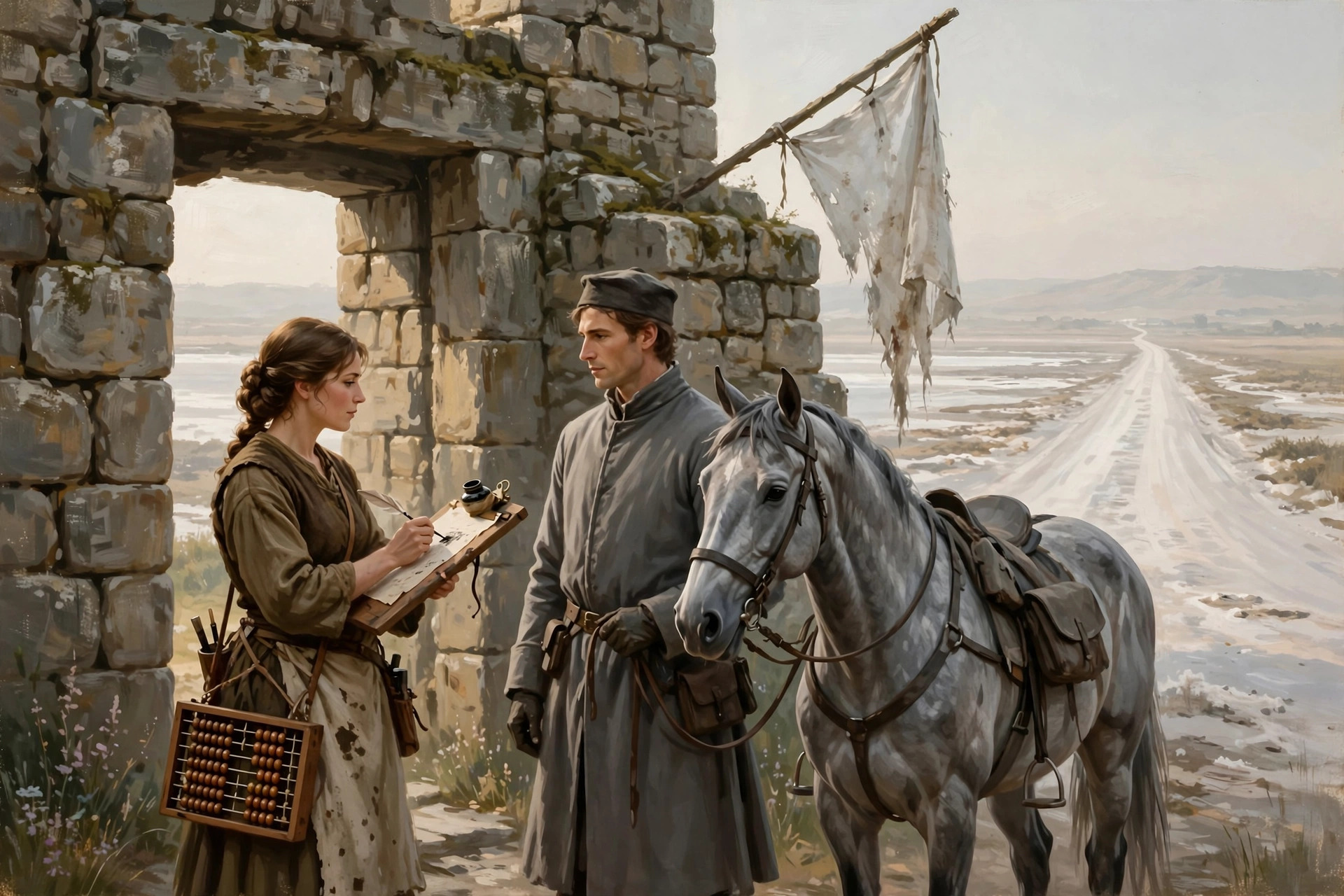
Tamsin had scribed nine treaties in her eight years at Thornwake Keep, and every one of them had begun the same way: with a man on horseback deciding whether the white truce flag meant what it said.
This one did not dismount.
"Envoy of the Vale of Corr," a warden called down from the gate. "He asks for the oath-scribe by name."
Of course he did. Marshal Vairn had sent word three days past that the Corr envoy would come as hostage-guarantor for the armistice, and that Tamsin would record his oath at the gate before the man set one boot inside the walls. Thirty days, the truce would run once it was sealed. Thirty days for seven border clauses, or the Corr levies burned the salt road and took the ferry crossing for their own. She had weighed that arithmetic every night since the marshal's summons, and it never came out lighter.
She came down from the scribing tower with her board, her ink, and her mother beside her, because Hessa Brandt had rowed the envoy across the Mirewater herself that morning and had opinions already formed.
"Four crowns a cart, he paid without haggling," Hessa said. "No Corr man has ever paid my crossing without haggling. Mind that."
"I'll mind it."
"And he watched the water the whole way over. Not the shore. The water. Like he was counting something in it."
Tamsin carried the counting-board down the ward stair and out through the gate's shadow into the flat morning light. The salt road ran east of the keep, pale as a scar in the green. The rider sat a gray horse under a white flag gone yellow-gray at the hem, and he did not look like any envoy the Vale of Corr had ever sent. No gilt on his saddle. A warden's plain coat, though the badge was Corr's.
"Oath-scribe," he said. "Dovan Rusk. Chief warden of the Vale." He did not smile, and he did not lie with his face either, which she noted, because she had spent a lifetime learning the difference.
"Tamsin Orel. If you'll dismount, Envoy, I record gate oaths standing, but I record them better when I can see both hands."
He swung down. Close, he was taller than the gate ledger had suggested, and younger than his office, and he looked at the keep the way she looked at a bad contract: line by line, for what it would cost.
Marshal Vairn arrived at the gate before the formalities could stiffen, which was her way of keeping things honest. Fourteen years commanding Thornwake, and she still came to gates herself when the ink mattered.
"Envoy." Vairn inclined her head the exact degree one inclined it to a hostage-guarantor. "You know the terms of your presence."
"I wrote half of them, Marshal." A dry, quiet voice. "I know them to the comma."
"Then you know the scribe takes your oath at the gate, and your token before the table. Tamsin."
Tamsin set the board on the mounting block, dipped her pen, and waited while the wind made up its mind. "Say your name and your office, and swear to the truce as written, or say it in your own words and I'll take it in your own words. The salt hears either."
"The salt hears," he repeated, and something in his face went careful. "You keep river-salt oaths here. Not wax seals."
"Wax breaks. Salt remembers." She said it the way she said it to every envoy, but her mother's shoulder brushed hers as Hessa leaned on the gatepost, and the old pride in the words caught on something. Her father had sworn on river-salt too. Sworn and run the salt road by night and drowned in the Mirewater with the Council calling him wrecker. She kept her pen steady. "Your oath, Envoy."
"I, Dovan Rusk, chief warden of the Vale of Corr, swear to keep the armistice between the Vale and the Marcher Council of Veylet, to hold my men from the road and the crossing, and to answer any breach of this truce with my own person." He paused, and his hand went to his coat, and came out holding a small linen pouch that he did not offer yet. "And I give my token freely, knowing what it is."
"Knowing what it is" was not in the form. She wrote it anyway, because the salt did not care for forms, and because a man who added clauses to his own surrender was a man worth reading closely.
"Show it," Vairn said.
He loosened the drawstring and tipped the pouch into his palm. A twist of coarse gray crystal, river-salt from the Mirewater's own beds, about the weight of two silver marks. Salt tokens carried the oath; whoever held one held the surety of the man who'd sworn it. It was old law, older than the keep, and it had teeth.
"Two hundred grams," Tamsin said, weighing it in her palm before the marshal could ask. "Mirewater salt, twisted by hand. It carries his oath while the truce holds. It's a good token."
"It's a blank," Hessa said from the gatepost, sharp as a gull. "No oath worked into the twist. I've salted this crossing six years, girl, I know a plain twist from a sworn one."
"Because the oath isn't in it yet," Tamsin said. "It goes in at the table, when the clause is read. That's the order of it." She turned the crystal in the light. Her father had taught her the order of it, on this bank, before the Council taught her the other kind. She put the token down on the board beside her ink. "Marshal, the clause I proposed, for the surety. Read it to him."
Vairn drew the folded draft from her breastplate. "In the event a sworn party to this armistice cannot discharge the obligations of his oath, the oath and its surety pass, by freely given token, to another who accepts the same in the presence of river-salt. Upon acceptance, the obligations bind the acceptor, and the original swearer stands released."
Silence took the gate. Even the wind sat down.
"That is not standard," Dovan said at last, slowly, like a man finding a loose board in a bridge he'd built himself.
"It's not. It's mine." Tamsin kept her eyes on the draft in Vairn's hands. "Standard surety law hangs the whole weight on one neck. This lets a warden share the load, or pass it to a successor if he's called away mid-truce. Your own council can't complain of it. It favors the envoy with the heavier obligations." Which was him. Which was the point, or so she had told herself at midnight, drafting it by candle. She had told herself a great many things at midnight.
"It lets the oath pass to anyone who takes the token freely," he said.
"To anyone who accepts before salt, yes."
"Then I'll accept it," Vairn said, "as the marshal's surety, so long as I hold the token in the keep's chest."
"No." Tamsin heard her own voice come out harder than the morning called for, and Hessa's hand stilled on the gatepost behind her. She softened it by one degree only. "Beg pardon, Marshal. It should hang at the gate of the man who swore it, or not at all. If the token sits in your chest, the salt reads that as Veylet holding Corr's neck in a box. That's not peace. That's a leash."
Vairn looked at her for a long moment. "You've grown opinions, scribe."
"I've grown eight years of watching salt oaths hold where wax ones slid. It hangs on him."
Dovan had gone very still beside his horse, and when he spoke it was not to the marshal. "You'd hang my own oath around my neck, and keep the clause that lets it pass hands. You've thought about who might take it."
Not a question. She met it anyway. "I've thought about who always takes the crossing when the road opens, Envoy. That's all. He doesn't have it yet."
"No," he said. "Yet."
Vairn rolled the draft and tucked it away. "Then record it. Day one of the truce-talks, oath given at the gate by Dovan Rusk, surety clause as drafted by the oath-scribe, token to be worked and worn. Scribe, do the working."
Tamsin took up the blank twist of salt. It sat small and gray in her palm, lighter than a man's life ought to sit, and the words of the clause ran through her head again the way they had every night that week. Freely given. Passes to another. She had built a door into his oath, for his sake, for the ferry's sake, and doors opened from both sides.
She worked the oath into the twist as her father had taught her: thumb pressing the words into the crystal's grain, one line of the oath to each facet, until the salt held them the way paper never could. River-salt remembered. That was the whole of the law, and the whole of her fear, and she pressed the words in anyway, because the truce needed the clause, and the clause needed the token, and the token needed her hands.
"Done," she said. Her voice stayed even, which cost her something.
He bent his head without being asked. She lifted the cord over it herself, her own choice, her own two hands, and the salt settled gray at his throat where the morning could reach it.
"It binds you now," she said. "Thirty days, once it's sealed. Wear it into the keep, Envoy, and we'll begin."
He didn't move at once. He looked at the little twist of salt at his own neck as if it were a sentence he intended to read to the end. "Thirty days," he said. "I've counted longer."
From the gatepost, Hessa Brandt said nothing at all, which from her mother was a whole speech, and Tamsin picked up her ink and led the way in.
Seven Ward-Lines
The first ward-line ran along the inner face of the keep's south wall, and Tamsin started there because starting was easier than arguing about where to start.
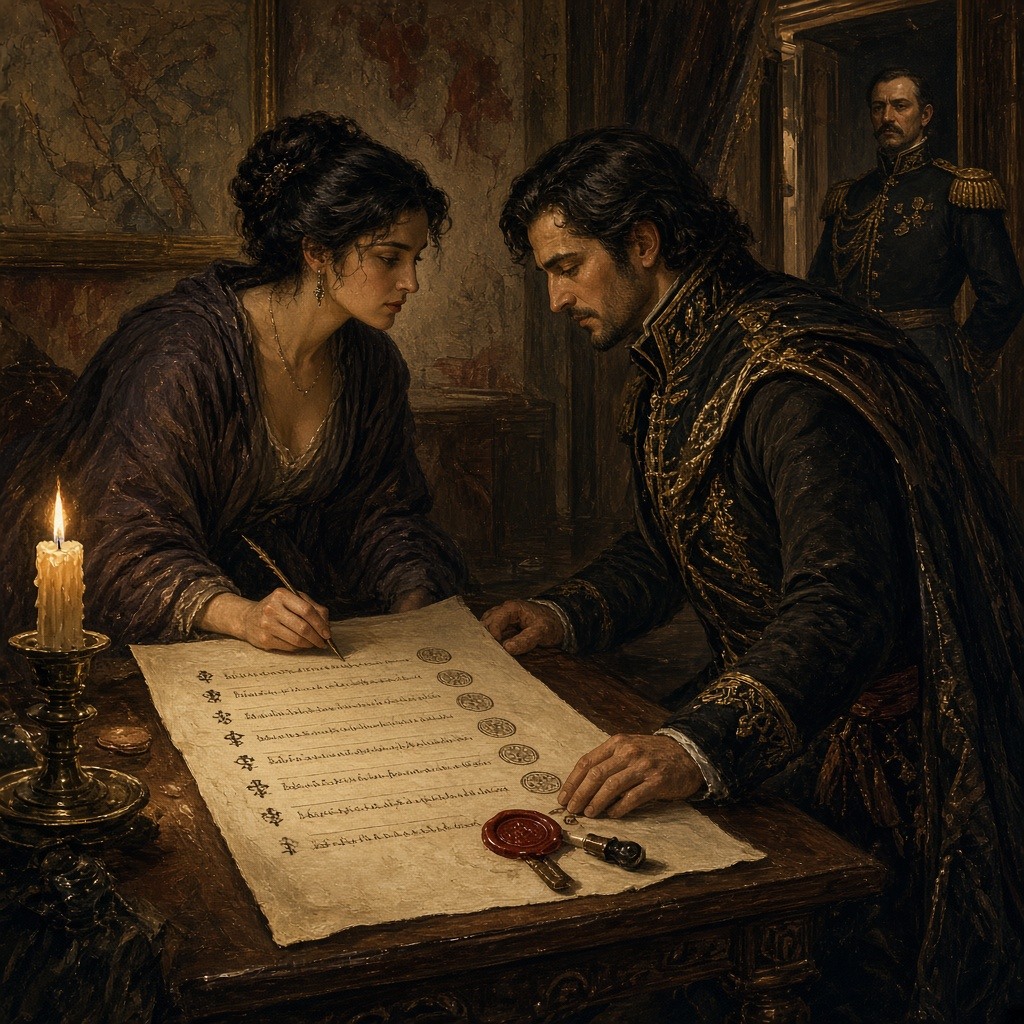
"Seven lines," she said, walking it with her board flat against her forearm. "One for every sworn treaty this keep has held. The Council counts them like a miser counts coins. Walk them with me, Envoy, and we'll draft as we go."
Dovan Rusk fell in beside her without a word, which she had already decided was his way of agreeing. He walked like a man used to covering ground, boots finding the dry stones and skipping the wet ones without looking, and he kept glancing up at the wall in a way that told her he was reading it. Not the lines. The mortar. The age of it.
"How old is the wall?" he asked.
"Older than the treaty it holds. They built it first and found things to swear on it after."
"That's usually how it goes," he said.
Marshal Vairn met them at the second line, at the corner where the wall turned toward the river, and she did not waste the morning on greetings. "I want the reprisal clause in before noon. If Corr raids cross the line during the thirty days, Veylet answers in kind, and the armistice holds anyway. Write it plain, scribe. No scribe's flourishes."
Tamsin wrote the demand into her running record, because a demand was a fact of the talks and facts were her trade. Then she read it back, and she watched Dovan's jaw change before he said anything at all.
"No," he said.
Vairn's head came around slowly, the way a weapon comes around. "You are here to carry terms, Envoy, not to refuse them."
"I'm here to make a peace that holds," Dovan said. "A reprisal clause inside an armistice isn't a clause. It's a promise to break the armistice and call the breaking lawful. I've read enough orders to know one when I hear it, and I won't put my name under that."
Tamsin kept her pen still and her eyes on her board, and she was aware, in a way she found inconvenient, of exactly where he was standing. Three paces off, at the turn of the wall, with the morning behind him.
"You'll record the marshal's position," Vairn said to Tamsin, "and the envoy's refusal, and the talks will continue, because thirty days is thirty days whether he likes the arithmetic or not."
"I'll record both," Tamsin said. "As they were said."
"Good. The third line is the well court. Walk it after him and get me something I can seal."
The marshal went up the stair toward the gate tower, and the sound of her boots faded into the stones, and Tamsin was left standing at the second ward-line with a man who had just refused her employer to her face on the second day of talks that had thirty days to run.
"You could have softened that," she said.
"So could you. You could have written it softer than I said it. You didn't."
"I write what's said. That's the office."
"That's one way to hold it," he said, and they walked on.
The third line ran the well court, low and moss-grown, and the fourth ran out along the garden wall where the keep's kitchen herbs grew in defiance of every treaty ever sworn over them. Tamsin walked and drafted, and the drafting was, in defiance of everything she'd braced for, good. He knew treaties from the inside, the way a warden knows them, from the side of the paper that gets ignored when the paper is finished. He caught a border description that would have drowned the ferry crossing in ambiguity. He caught a toll line that would have taxed the salt road twice at the same mile. He caught, on the fifth line, a word she'd used out of habit that meant one thing in Veylet and another thing entirely in the Vale of Corr, and he stopped walking to say so.
"That word," he said. "In Corr it means the levy's been paid. Here it means the levy's been promised. Put the promise word in and every toll-taker on the road will read your armistice as a bill."
She crossed it out and wrote the other, and she was aware that he had leaned in over her board to check her hand, close enough that she could see the salt twist at his throat catch the light, close enough that she moved her elbow a half-inch and then was annoyed with herself for the half-inch.
"You read like a scribe," she said.
"I read like a man who's had to live inside what scribes write." He straightened. "There's a difference."
"I've noticed it," she said, and kept her eyes on the line, because looking up felt like a decision and she hadn't made it.
The sixth line ran the stable court, and the seventh, the oldest, ran along the north wall where the stones were dark with old water and the river could be heard beyond them, the Mirewater moving slow and gray toward the ferry crossing. They walked it in the afternoon light, and the drafting was nearly done, and Tamsin had the whole armistice in her hand, corrected and clean, and she was thinking that the third day of thirty had gone better than the first two deserved.
Then Dovan stopped at the middle of the seventh line and put his finger on the page, on the reprisal clause she had carried forward at Vairn's order, written plain, no scribe's flourishes.
"This goes," he said.
"It's the marshal's clause."
"It goes, or my name doesn't."
Tamsin stood on the oldest ward-line in Thornwake Keep, on the third day of a truce that would run thirty days from its sealing, with the armistice nearly whole in her hand and a man refusing to sign the piece of it that would let her own side answer a raid without unmaking the peace. And she thought of her father, who had carried things across the Mirewater for years without once asking whether the carrying was written down, and she thought of the ferry, and she thought of the gray twist of salt at this man's throat, worked by her own hands, binding him to thirty days of a peace he was trying to make honest in the writing.
"You know what it costs you," she said. "Refusing a marshal's clause on her own wall."
"I know what it costs everyone if I don't," he said. "I've paid that bill before. I'd rather not sign another one."
There was something under the words, and she didn't reach for it, and he didn't offer it, and the river moved beyond the wall.
Tamsin looked at the clause, and at her own hand, and at the page she had been pushing at men for eight years, saying sign it, sign it, the record needs it signed, and she set her pen down on the board instead.
"Then it stays out," she said. "Recorded as refused. The marshal can have it in the talks, but it doesn't go in the armistice."
Dovan looked at her for a long moment, and the look was not gratitude and it was not triumph, it was something closer to a man checking a knot twice because he couldn't believe it had held.
"You didn't push the page back at me," he said.
"No," said Tamsin. "I didn't."
And she picked up her ink and led the way in, because the light was going, and the fourth day of thirty was already waiting on the other side of it.
Night Crossing
Two days later the river had its voice back. The wind came off the Mirewater carrying cold and the smell of wet rope, and Hessa Brandt sent a boy up the lane to Thornwake Keep with a message scratched on a scrap: crossing's quiet, ledger wants a look, come before the light goes.
Tamsin read it twice, then folded it into her sleeve and went to find the Corr envoy.
"My mother keeps the ferry ledger," she told Dovan on the wall walk. "Every cart, every crossing, six years of tolls in her own hand. She wants the record seen before the ink on this truce gets any heavier."
"Seen by who?"
"By whoever's going to sign under it." She hesitated. "The Vale of Corr's carts cross too. She thinks you should know what your side's been paying."
Dovan turned the salt twist at his throat between two fingers, the blank gray knot she'd worked and hung there on the first night, two hundred grams of Mirewater salt to bind him to thirty days of peace. "Then I should," he said. "A man who won't look at a ledger has no business writing in one."
They went down together in the last of the light. The salt road ran soft and gray ahead of them, rutted from the week's carts, and the ferry house stood at the bottom of it with its lamp already lit. Hessa was on the step, and Tamsin knew before either of them spoke that her mother had chosen the lamp on purpose, because Hessa Brandt never lit the good lamp for a toll collector.
"Envoy," Hessa said. She didn't curtsy. She'd given up curtsying around the same time she'd given up the ferry, six years back, when her knees told her the toll booth was one ladder too many. "You'll be the one writing the peace."
"I'm the one carrying it," Dovan said. "Tamsin does the writing."
"So I hear." Hessa's eyes went to Tamsin, and something passed between them that had been passing for nineteen years, since the night Tamsin had first come up the lane with a satchel and a surname people whispered. "Come in, then. Both of you. It's too cold for standing, and I've soup."
The ferry house was one room and smelled of tar and thyme. The ledger lay open on the table by the window, oak boards bound with cord Hessa had twisted herself, thick as a wrist where the knots crossed. Tamsin had paged through it a hundred times. Every cart, every crossing, every four crowns. It was the most honest book in either valley, and she'd said so at more than one Council table.
Hessa poured the soup, then sat, then put her hand flat on the open page as if steadying a horse. "There's a page in here I don't show," she said. "Not to toll men, not to the Council's tally-readers, not to anyone. I'm showing it tonight, because if this truce gets sealed and I've kept it dark, I'll have done the same thing the river does. Held something under until it drowns somebody."
She turned the leaves back. Past the tolls, past the seasons, back to a page that had gone brown at the edges, and Tamsin's chest tightened before she even saw the words, because she knew the date at the top of it. She'd known it since she was twenty-one. She'd counted it against every year of her life since, the way you count a scar.
The wreck page. The night list. Carts over, carts under, and in the middle, in Hessa's steady hand, the tally of what the Mirewater took.
"There," Hessa said, and didn't touch the name.
Dovan read it the way he read everything, Tamsin had noticed, like a man who'd had to live inside what scribes write. Slow, twice, his finger resting at the margin. "Two carts lost," he said. "Four crowns a cart, that's the toll. But this line here isn't a toll." His finger stopped. "This is a person."
"That's my father," Tamsin said. Her voice came out level, which cost her something. "Jorrel. He ran the night crossings. The Council wrote it up as his wreck, his fault, his debt. There was a fine levied on our family that took nine years to clear."
"And is it true?" Dovan asked it plainly, without softening, and she was obscurely grateful for that, because she'd spent nineteen years watching people arrange their faces before they asked.
"The carts went down on his run. That much is true." She looked at the ledger, at the brown-edged page, at her mother's hand resting beside it. "The rest of it, I can't say, because the only people who could say are dead or lying."
Hessa's mouth pressed thin, and Tamsin saw her mother weigh something and set it down again, unfinished, and knew the page would have to carry it alone for now.
Dovan was quiet a long moment. Then he pulled the salt twist out from under his collar and held it in his fist, and when he spoke it was slower than his usual reading voice, like a man reciting from a page only he could see.
"I was a clerk in the Vale before I was a warden. Nineteen, twenty, quick with a pen, glad of the wage. Corr was short of scribes that year, so they put me on enforcement orders. Requisition lists. Reprisal lists." He turned the salt over in his hand. "One of them, I copied out fair, three copies, my hand, my name in the corner. I didn't even read it whole. It was an order to close a ford and seize the boats on it, upriver, on a night in autumn."
"Dovan," Tamsin said, but he lifted a hand, not done.
"The ford was somebody's only crossing. A man took his family over anyway, in a cart, in the dark, because the boats had been dragged up the bank and chained. The water was high." His jaw worked. "My brother was nineteen that autumn, too. Same age as me, near enough, we were twins. He was on the chain crew, the warden's own son, there to show the Vale's boys how it's done. He went in after the cart." He set the salt twist down on the table, gently, the way you'd set down something sleeping. "The order was mine. Not the fault of it. Mine. My hand wrote the words that moved everything else. I've sworn since then, on that salt and on everything else I hold, never to put my name under an order I don't believe, and I broke that oath once already this week by even carrying a reprisal clause to this table. That's why it goes, Tamsin. That's the whole of why."
The lamp hissed. Outside, the river went on saying what it always said.
"You were a boy," Hessa said at last. "Ordered to write."
"The river doesn't ask who held the pen." He looked up at Tamsin, and his eyes were dry and terrible. "Your Council did the same thing to your father's name that I did to my own hand. Wrote the tidy version and filed it. I'm sorry for it. For all of it. That's a cheap word from the far side of a river, but it's yours if you'll take it."
Tamsin thought of the clause she'd struck from the armistice, the marshal's reprisal clause, refused and recorded as refused, and of the man who'd refused it standing in her mother's kitchen with his grief laid out on the table next to her family's. She thought, unexpectedly and clearly: this one reads the whole page before he signs it, and I have spent eight years pushing pages at men who never did.
"I'll take it," she said. "And I'll trade you truth for truth. I don't believe my father's account is straight. I've believed that for years. I've just never had anything but the believing."
"Now you have the page," Hessa said. She closed the ledger, cords creaking, and stood. "And now it's been seen, which is all I wanted. Go on out to the rail, both of you. It's stopped raining. I'll not have two mourners in my kitchen on a Thursday."
They went out. The ferry rail was rough and cold under Tamsin's hands, and the lantern Hessa pressed on them swung a little as she took it, throwing their shadows long down the water. The Mirewater moved below, black and busy, the same river that had taken a cart and a boy and a fine of nine years and a brother on a chain crew, and kept none of the accounts itself.
Dovan set the lantern on the rail post between them. The wreck page was in Tamsin's sleeve, where she'd slipped it before her mother could stop her, and her mother had let her, and the two of them sat shoulder to shoulder with the light over the water, and neither of them said anything at all, and it was enough.
Pike's Toll
Pike Sonel arrived at Thornwake Keep on the twelfth day of the truce with a cartload of his own salt and the smile of a man who never paid a toll in his life. Tamsin watched from the scribe's alcove as the keep boys unloaded it, white sacks stamped with his mark, the same mark that had ridden her father's crates down the salt road for years.

"He doesn't come to dinner for the stew," Hessa said at her shoulder. Hessa had come up for the evening, bringing the ferry accounts for the Marshal's table, the crossing ledger left safely at the house. "He comes to be seen eating it."
Marshal Vairn seated Pike at her right hand, which said everything about what the Council needed from the salt road and what the salt road knew about the Council. Dovan sat across from him, and Tamsin sat at the foot of the table with her ink, because a scribe at dinner is furniture until the moment she is not.
"Good bread," Pike said. "Your miller's honest. Rare thing on this river. I've known ferry men to short the toll by a crown a cart and call it river-luck." He looked down the table at Hessa, pleasant as you please. "Four crowns a cart, isn't it, Mistress Brandt. Always has been. Not that everyone's always paid it."
"Everyone's always paid it," Hessa said flatly.
"Well." Pike salted his stew. "Everyone living."
Tamsin's hand went still on the page. He hadn't looked at her. He hadn't needed to.
Dovan set down his spoon. "The Vale's tolls are collected at the weir," he said. "Written in a book before they're collected. Every clerk signs what he counts."
"Books." Pike smiled. "I've a healthy respect for books, Warden. I've seen a page turn a man's name into a smuggler overnight. And I've seen the same page turn him back, if the right hand holds it." He drank. "Funny thing, ink. It remembers whatever you dip it in."
Vairn's voice cut the murmur short. "The armistice terms will be sealed before this table is cleared of salt. Sonel, the Council wants the road open and the crossing kept. Warden, your Vale wants the same or it says it does. Scribe, the record shows where we stand."
Tamsin read the tally aloud: eleven clauses agreed, the surety-transfer clause among them, and the reprisal clause outstanding. "The Warden of Corr refuses the reprisal clause," she said. "Recorded as refused, Day Three."
"Then it goes in over his refusal," Vairn said. "I'll have it sealed by morning with or without his hand. Corr levies burned two granaries on the salt road last autumn. The Council demands reprisal terms or there is no armistice, and without an armistice, Sonel, your road stays shut and your toll with it. Seal it, Tamsin. Add the clause, date it, and bring it to me for the wax."
The room went quiet in the way rooms do when everyone is watching one person's hands. Pike watched hers. Dovan watched hers. The wreck page sat against her forearm inside her sleeve, thin as a lie, and she thought of her father's name in it, and of Pike's smile, and of what a whisper from Pike Sonel could do to a Council that had already spent years believing the tidy version.
"No," Tamsin said.
Vairn's chair scraped. "I gave you an order."
"And only you can order a treaty sealed, Marshal, I know my office better than that. But the drafting is mine until it reaches your wax, and I won't write a reprisal clause into a truce meant to hold thirty days. A reprisal clause is a promise to break the truce the first time someone's wronged. It's a knife sewn into the hem. I won't sew it."
"Your father talked like that," Pike said, almost gently. "About contracts. About which ones a body ought to honor." He tore his bread. "Course, he had his own ideas about which ferry contracts were broke, and by whose hands. Terrible thing, the Mirewater. Keeps what it takes." He looked up at Dovan. "You'd know something of rivers keeping men, I hear. Corr's full of chain crews and drowned boats."
"It is," Dovan said. "I've carried the count of it for eleven years. I know exactly what a reprisal order does once it's written, because I've read what comes after. That's why I won't record one, and that's why she's right not to draft it, and I'd thank you not to fish in my river, Sonel."
"Everything on this river is my river," Pike said, pleasant again. "Ask your Marshal what the Council's salt costs without my road. Ask her what it costs if I start remembering, at the wrong table, whose hands broke the ferry contract nine years back." He stood, unhurried, and pushed his chair in. "Marshal. Warden. Scribe. Lovely stew." And he went out into the dark with his men, and his cart rattled off down the salt road, and Tamsin sat with her ink and did not move until the sound of it faded.
Vairn spoke first. "He can end this truce with a whisper, Tamsin. He's done worse with less."
"Then we give him nothing to whisper about by being clean, not by being quick."
"Day seventeen of thirty." Vairn stood. "You have until the wax cools tomorrow. Write the clause or bring me your refusal written plain, and I'll send to the Council for another scribe and seal it over both your heads." She left the hall, and the servants went with her, and the lamps guttered low.
Dovan hadn't moved. He reached into his collar and drew out the salt twist, the blank Mirewater twist she'd worked and hung herself on the third day, two hundred grams of river-salt on a cord, his surety, his hostage-weight, the token that made him more than a promise at this table. He set it on the boards between them, and the salt of it caught the lamplight, white as the sacks outside.
"Give me your refusal to carry to her," he said. "And give me this back to her with it, if it helps. It's yours to hang. Take it to the Marshal yourself and tell her the Corr side stands on the draft as written, without the clause. She can't hold a hostage against his own giving."
Tamsin looked at the token, then at him. "It's your surety. If you hand it back, you're a man on parole from nothing. Vairn can order you held, or turned out, or worse, once you're not bound by it."
"I know what I am without it. I know what it costs you, too, your place, maybe, if she takes the refusal badly. That's a cleaner trade than a reprisal clause." His jaw worked. "Your family's mess is sitting in that hall with Sonel's smile on it, and if my token buys you room to write your way out from under him, then it's not a cost. It's a toll. I'll pay it."
"No," she said. "You don't hand over your surety to fix my family's mess. That's not yours to carry."
"It's exactly mine. I've carried worse for less reason."
"Then carry it in your fist where it belongs and don't make a gift of yourself to a woman you've known twelve days."
"Twelve days of watching you push pages at men who won't read them! You think I don't know what it costs to keep the tidy version? I've done it. I did it for years, and a boy drowned for it, and I swore on this river I'd never record another order I didn't believe, and I have not, not once, not in eleven years, and I won't start with a gift of my own neck to make it easier for you to go on sitting in your alcove keeping everyone's secrets safe in your sleeve!"
His fist had closed on the token. The cord snapped taut, and the salt twist cracked against his signet ring, a clean sharp sound, and a flake of white broke off and lay on the dark boards between them.
They both looked at it. The river said what it always said, far off, below the walls.
"It's cracked," she said stupidly, because it was easier than the rest.
"It's salt. It's meant to break if I break. That's the whole of what it's for." He wound the cord once around his cracked knuckles, careful, and put it away in his collar, and stood, and did not look at her.
Tamsin stood too, and her voice came out colder than the page she wanted it to be. "You hide behind that oath of yours the same way I hide behind my ink. Refuse, record, refuse, record, and neither of us ever has to decide anything, do we. We just keep clean hands and let the river keep the rest."
Dovan went very still. "Good night, Scribe."
"Good night, Warden."
He crossed the courtyard under the watch lanterns, straight-backed, his shadow going before him, and did not turn at the gate. She stood on the keep steps with the wreck page against her arm and her ink drying on nothing, and watched him go, and the night of the twelfth day became the seventeenth around her without her once noticing the days going past, and the wax was cooling on the Marshal's table somewhere above, waiting for a hand she had not yet decided would be hers.
Hessa came and stood beside her. Neither of them said anything. Below the wall the Mirewater ran on, keeping its accounts, keeping hers, keeping his.
The Landing
Five days of silence, and Tamsin spent them the only way she knew how: with the draft open on her desk and a candle burning down to its collar. On the twenty-second night she carried the pages down to the ferry landing, because the ferry house was the one place in Thornwake where the river's noise drowned out the sound of her own thinking.
Hessa was there, of course. Her mother was always there, the way the ledger was always there, open on its oak stand by the window, cord-bound, patient. Six years of toll-taking sat in those pages. Tamsin set her draft on the sill where the lantern light reached and read the transfer clause aloud, mostly to hear a voice that wasn't her own.
"'Any oath so bound may pass whole to another by token freely given, and the penalty pass with it.'" She read it twice more. The words were hers. She'd written them clean, the way she wrote everything clean.
"Say it plainer," Hessa said, not looking up from her mending.
"It means if an oath breaks, whoever holds the token carries the debt." Tamsin turned the page over, as if the back of it might tell her something the front didn't. "I wrote it so envoys could go home. So a man could hand his bond to a friend and cross the border without carrying his neck in his pocket."
"And?"
Her stomach went cold before her mind caught up, which was how she knew it was true. "Pike Sonel deals in tokens. He's held half the salt road's paper at one time or another. If my father's oath was sworn on river-salt, and it broke, and someone holds the token..." She stood very still. "Mother. Whose hands did the ferry token pass through?"
Hessa put the mending down. "Your father gave Pike the token for safekeeping the spring before the wreck. Pike never gave it back. Said it was payment for the crossing debt."
"Then Pike holds a broken oath. Freely given, so it passed whole, and the penalty passed with it." Tamsin's voice came out flat, the way it did when the sums were right and she hated them. "Every word of it. A memory for every word. And he's spent five days telling anyone who'll listen that my father survived to name him. He doesn't want the armistice. He wants the salt trade open on his terms, and the easiest way to open it is to come to the Marshal and offer her the truth about the wreck, priced."
"Priced how?"
"The transfer clause. If he gives the broken oath forward, someone else carries the penalty. He can hand it to the Marshal as a gift of goodwill and walk away clean while the debt lands wherever he aims it." She pressed her hand flat on the draft. "And I wrote the clause. Nine years ago the debt was his. Tonight I could hand him the tool to set it on my own shoulders, or I could refuse to seal anything at all and watch him take the ferry crossing when the truce fails."
The river said what it always said.
Boots on the planking. She knew the tread before she turned, because in twenty-two days a body learns a stride the way it learns a river's sound. Dovan Rusk came down the landing with his collar buttoned to the throat, and stopped three boards away, which had become his distance since the seventeenth night.
"Scribe." A nod to Hessa. "Ferry-keeper."
"Warden." Tamsin didn't cover the draft. Let him read it. He read everything anyway, like a man who'd had to live inside what scribes write. "You've not come for a crossing. It's dark for one."
"I've come because I owe you a word I've owed for five days and been too much the coward to carry over." He looked at the lantern swinging on the rail, then at her. "My token. The salt twist I carry for the Vale's guarantee. It cracked the night we quarreled. You saw it."
"I saw a flake fall."
"You thought I cracked it in temper." He unbuttoned his collar and drew out the cord, and she saw the twist of river-salt, two hundred grams of it once, smaller now, a white seam running through it like a scar through a hand. "I didn't. Or I did, but not in temper. I came to your alcove that night meaning to give it to you. Freely. So the Vale's bond would stand behind your refusal to draft the Marshal's clause, and you could refuse with weight behind you."
"Why didn't you?"
"Because I read your transfer clause on the walk over. All of it. And if I gave you my token whole, everything I'm bound by passes to you. Every word. And I have words in me I won't put on another person, least of all..." He stopped. Started again, lower. "I've carried one bad order for eleven years and it drowned my brother. I can carry my own bond. But I couldn't stand in your alcove and make a gift of my neck, and I couldn't say that in front of you without saying the rest, so I quarreled instead, and cracked it instead, and let you think worse of me."
Tamsin looked at the salt twist for a long moment. "The penalty of an oath passes with the token," she said slowly. "You knew that. You knew giving it to me would pass the Vale's debts onto my shoulders, freely given, no appeal."
"Yes."
"And Pike Sonel holds my father's broken oath the same way." Something in her chest unlocked, or broke, she couldn't have said which. "He's known for years that the wrecks and the blame would all come out right if he claimed it, and claiming it costs him the penalty, so instead he keeps the token and keeps the silence and sells it by the whisper. And my father's name stays in the mud, and my mother keeps her ledger shut, and I keep my clean hands."
Hessa's needle had stopped. Neither of them looked at her.
"I refused to give you mine," Dovan said. "That's the confession. I'd rather stand here cracked and shamed than see you forfeit one true memory for my sake. A memory for every broken word. I know the arithmetic of that better than any man alive."
Tamsin took the cord from his hand. He let her. She turned the cracked twist under the lantern, and the seam of it showed white and clean, and her mother was already rising, because Hessa Brandt had kept a ferry house for forty years and knew what a body needed before the body did. She set a bowl on the sill, and the salt crock, and a measure of river water drawn up slim and gray.
"Press it," Hessa said. "Wet the seam, pack it fine, bind it fresh. Salt remembers what hands it came from."
So Tamsin packed the crack with wet salt, working it in with her thumb the way her father had taught her on the riverbank a lifetime of springs ago, and bound the cord twice around it, and the twist held, whole where it had been broken. "It's mended," she said. "It'll seal." Then she reached into her own sleeve, where the wreck page lay against her arm, warm from her, and above it a small twist of river-salt she'd pressed on the sixth night for reasons she hadn't had words for until now.
"You refused to give me yours," she said. "You stood in my alcove with your neck in your hand and you wouldn't put it on me. Nobody's ever refused me anything for that reason. So take mine."
She put her token into his palm and folded his fingers over it with both her hands. "Freely given. I know the clause. I wrote the clause. Everything I'm bound by passes to you now, whole, and I'm telling you I want it to."
"Tamsin."
"My father's oath is mine to carry, whatever Pike does with his half of the river. Let him whisper. He can't claim a debt that's already passed." She was still holding his hands, and they were both looking down at them, at the salt between them, and then she wasn't looking down anymore because she'd risen on her toes and put her mouth against his, soft and certain, on the ferry landing, with the lantern swinging on the rail above their joined hands and the Mirewater running on below, keeping its accounts, and this one, at last, paid open.
The Open Ledger
Two days after the landing, the ferry crossing got a table that had never stood there before. Four trestle legs and a slate top, carried down from the keep by two wardens who complained the whole way, and set on the gravel where the Corr road met the water. Marshal Vairn wanted the sealing done in the open air, on the line itself, where neither side's banners could hang above the other's. Tamsin had spent the morning arranging the chairs so no back faced the river, and now she stood at the head of the slate with the armistice draft under one hand and her ink pot open against the wind, and waited for the last of them to sit.
Vairn sat. Dovan sat, with her river-salt twist still in the breast of his coat, where he'd carried it since the sixth night and would not say so aloud but wore it like a man wears a letter he means to keep. Hessa Brandt sat with the crossing ledger on her knees, cord-bound, shut. Pike Sonel came late, of course, down the salt road with two polemen behind him, and he looked at the empty chair left for him a long moment before he took it, because Pike never sat where a chair had been set for him without first counting who had set it.
"The clause stands as drafted," Tamsin said, and turned the draft so the others could read the final page. "Article the ninth. Either party may withdraw from this armistice by returning their token to the crossing table, unbroken, within the thirty days of its hold. No reprisal attaches to a peaceful withdrawal. No blood price. The token goes home whole, and so does everyone else."
"A blank clause," Pike said. "A treaty with a door in it."
"Every treaty has a door in it," Tamsin said. "Most of them just don't label the door. I'd rather people know where the exit is than fall through it in the dark."
Vairn's eyes came up over the table. She had wanted the reprisal clause back in, and Tamsin had refused twice in two days, once in the scriptorium and once in front of the wardens' breakfast, and each time Vairn had gone quiet in the way a storm goes quiet. Now the Marshal turned the draft toward herself, read the ninth article through, and set it down.
"I'll sign a treaty that can be walked away from," Vairn said. "My grandmother would have called me a fool for it."
"Your grandmother burned three ferries," Hessa said, not looking up from the ledger. "We counted."
Somebody at the far end of the table laughed into their sleeve. Vairn didn't. "Then she'd know the arithmetic better than most. Salt tokens on the table, wardens. All of them."
They came out of sleeves and pockets and one boot, the whole way down the line. The Vale of Corr's tokens in a shallow row, Veylet's across from them, and Dovan set down Tamsin's twist of river-salt with a care that made Pike Sonel's mouth flatten, because Pike had been watching hands his whole life and knew what that kind of care meant.
"Then we're sealed," Tamsin said, "on the count of the tokens present." She wrote the day into the margin. "In witness at the ferry crossing on the Mirewater, the armistice between the Marcher authority of Veylet and the Vale of Corr holds for thirty days from this sealing, salt to salt, token to token."
Vairn signed. Dovan signed for the Vale, and his hand didn't shake, which surprised Tamsin a little, because she had watched that same hand hover over ink before and go pale. Maybe the difference was that this was an order he could believe in. She pressed wax with the keep's ring, and it was done, and for a moment nobody at the table breathed on it, as if a word too soon would blow the ink off the slate.
Then Hessa Brandt stood, and the moment changed shape.
"Before the witnesses go," Hessa said, "this crossing keeps a ledger, and the ledger has a page that's been shut for nine years." She set the oak-bound book on the slate top and worked the cord loose with both thumbs, unhurried, the way a woman does a thing she has rehearsed a hundred times at her own table. She opened the ledger to the marked leaf, took up the ferry pen, and dipped it. "Pike Sonel. You'll answer for the wreck of the night ferry, ninth of harvest month, year 1400. You'll answer here, in the open, where the whole road can read it."
The table went very still. Pike looked at the ledger, then at Tamsin, and Tamsin looked back at him with nothing on her face at all, which was the hardest thing she had done in eight years of sealings.
"The night ferry took on water past her lines," Hessa went on, pen waiting over the page. "Because she was loaded past her lines. Because a toll-taker on the salt road wanted a full run and didn't count what he put aboard. And a man died in the Mirewater carrying goods that weren't his, and this ledger was made to say the goods and the wreck were both his doing. That entry was wrong. I've known it was wrong since the ink dried. So has my daughter. So have you."
Pike's jaw worked. He looked at Vairn, and Vairn looked back with the stillness of a Marshal who has just heard a smuggler hold the Council's version of a drowning up to the light. He looked at the Corr side of the table, and Dovan Rusk watched him back with a warden's flat patience, a man who had recorded too many orders to be shocked by one more.
"I put the load on her," Pike said at last, low, to the slate top. "Nine years I've put tolls on that road and I never once counted a ferryman's draft line. That one night. I paid the boat's master to look the other way, and the master drowned, and the man who drowned with him was the better man of the two." His throat moved. "Write it. Write it and be damned to me."
Hessa wrote it. The pen scratched loud in the river quiet, and the true page went into the open ledger in fresh ink, entry by entry, load and toll and toll-taker, and above it, in the column where the ferryman's name had stood wrong for nine years, she struck the line through and entered the correction, and Tamsin watched her father's name come clean out of the pen's nib like something raised up out of the water at last, wrung out, dried, given back.
"Let the record show," Hessa said, and shut the ledger, "that the wreck of the night ferry was the doing of Pike Sonel of the salt road, answered for by his own mouth, before the Marshal of Thornwake Keep, the envoy of the Vale of Corr, and the oath-scribe of Veylet."
"It shows," Tamsin said, and her voice came out rough, and she let it.
Vairn stood. "Sonel. The salt road's tolls come under this armistice's ninth article like everything else. Walk away clean and stay clean, or don't." She gathered her copy of the draft, and her wardens, and left the table to the river.
Pike went up the road with his polemen, slower than he'd come down it, and he did not look back at Tamsin, which was its own kind of answer.
Dovan stayed. He came around the slate table while the wardens' boots were still loud on the gravel, and together he and Tamsin hung the salt medallion at the ferry rail, the great pressed twist of it, two hundred grams of river-salt on a cord, twisting slow in the wind off the Mirewater where every crossing for forty years had been counted and paid. The blank token. The door in the treaty, labeled and hung where both sides could see it, four crowns a cart still chalked on the toll board beside it, the crossing fee Hessa had kept through six years of taking it.
"Your father's name is in the open ledger," Dovan said. He was standing close enough that his shoulder touched hers, both of them facing the water. "Your token's in my coat. And I'm told the clause you drafted lets a body pass a debt forward freely, once, if it's given clean."
"It does."
"Then I'm giving it back." He took the twist from his breast and turned to her, and held it out on his open palm, and his hand was steady in a way it hadn't been over any ink since the day he'd arrived under truce flag. "Not to hand the debts off. To share the carrying. There's a difference, and you taught it to me. Freely given. I want it read that way, before witnesses."
Tamsin put her hands around his, around the salt, both pairs of their hands closed on the blank token between them, the medallion turning above their heads on the rail, and the river running on below, keeping its accounts.
"Witnessed," she said. "Sealed. And Dovan Rusk, you great stubborn clerk of the Vale of Corr, come here."
He came here, and the rail held them both.
Get notified when new stories drop

Marcus Hale
Marcus writes slow-burn and marriage-of-convenience stories where logistics become intimacy and competence is a love language.
Leave a comment
Comments