





The Worn Stone
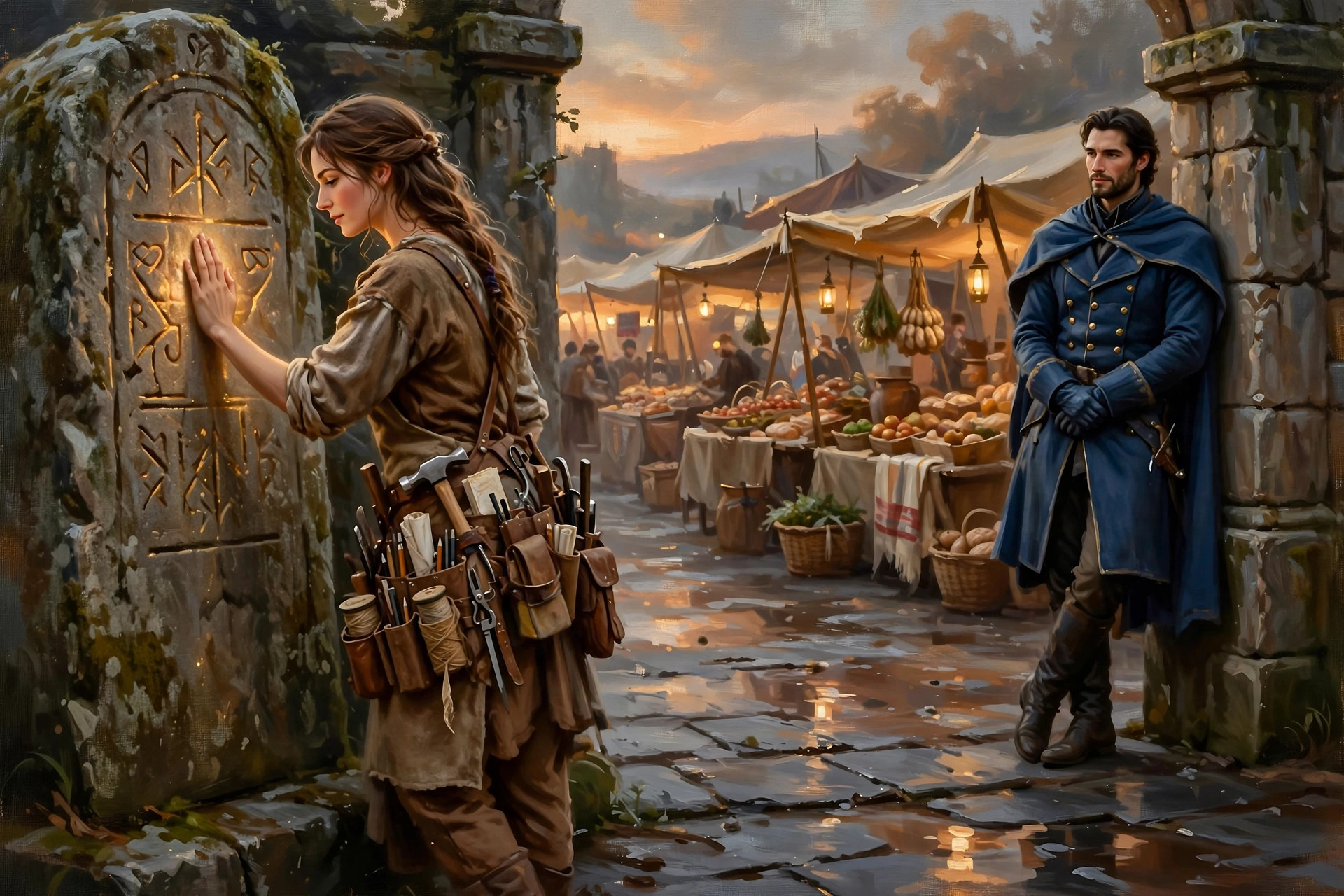
The gate at Coldfen smelled of wet slate and frying onions, and Imogen Tallis arrived at a walk that wanted to be a run. Her aunt's letter rode in her breast pocket, sealed twice in grey wax, and it had said only: Survey the stone. Do not cut. Which was fine. She could survey. She was very good at doing exactly what her aunt paid her to do, for eight years running, and if her hands itched whenever a rule stood between her and a finished ward, that was her own business.
The market opened around the gate the way ivy opens around a fence. Forty stalls, more or less, ranged under canvas in two crooked rows, Tallis cloth on the south side and Falke metalwork on the north, the old truce written into everything from the way the awnings leaned to the spot where the two rows stopped short of each other. Beyond the gate, the border road ran out through the fens toward a stretch no one patrolled, two hundred paces of reed and darkness where the ward-line was all that kept the road from the raiders who used it whenever the wards thinned.
The wardstone stood at the gate's hinge, hip-high to nothing, shoulder-high to her. Grey river granite flecked with mica, set there by the founders of both houses, carved with both sigils, weathered by four generations of rain. Imogen had walked past it a thousand mornings. She had never, until today, been ordered to look at it closely.
She looked. Then she crouched, then she stood, then she put her palm flat against the granite as if she could feel the words her eyes were telling her weren't true.
The Tallis sigil was gone. Not faded. Gone, worn to a shallow ghost, a suggestion of a line, like a footprint after a week of rain. The Falke falcon beside it had fared no better. Its wing was a smear, its eye a dimple.
"You're touching it."
The voice came from her shoulder height, which meant the man was tall. He stood at the gate's north post with a watch badge pinned at his collar, and he'd been there long enough that she should have marked him first. She was slipping. Or he was quiet. Both, probably.
"I'm inspecting it," she said. "There's a difference."
"There isn't, under house law." He pushed off the post and came toward her, unhurried, hands loose at his sides. Falke blue in his coat, the falcon worked in tin at the pin. His eyes went to her tool roll before they came back to her face, which told her he knew what a wardwright's apprentice carried and what she'd want it for. "That stone carries the Falke sigil. No Tallis hand lays steel on it without a Falke officer present."
"That stone carries both sigils," Imogen said, "or it's supposed to, and it's supposed to be renewed by both houses, which is why I'm here, with a sealed order from my aunt the patron, on the first morning of the truce, while it's still possible to do something about it." She heard her own voice climbing and made it come down. "Where's your cutter?"
That stopped him. A small stop, a hitch like a dropped stitch, but she'd spent her life listening for the sound of someone not answering a question.
"I'm the watch," he said. "I don't manage the treasury's schedule."
"The treasury sends a sigil-cutter every renewal," she said. "Both houses do. It's in the truce. I've stood at this gate for four renewals and watched them chalk the outlines side by side." She pointed at the falcon's ruined wing. "Your cutter should be here on day one. The moon turns on day eight, and after that the truce lapses, and when the truce lapses the wards fail, and when the wards fail, that road out there belongs to whoever rides in on it."
"I know what lapses means," he said. "I patrol what it protects."
He said it flatly, but he turned and looked down the border road as he said it, the way a man looks at a thing he's measured with his feet. Something in the set of his shoulders made her revise him, from tall and annoying to tall and annoyed, which was different. Annoyed men had counted things too.
"Then you know we have nine days," she said, "counting today, and the stone needs both sigils cut fresh on the same night before the moon turns, or none of it holds. One hand from each house. Together. That's the rule. The founders built the stone so no house could renew alone."
"I know the rule." His jaw worked once. "I've been on this border five years."
"Then you know your house hasn't sent anyone."
Silence. A cart rattled through the gate behind them, wheels popping on the cobbles, and a cloth merchant called out to someone about the damp eating her stock. Somewhere south, a Tallis bell rang the market hour. The stone sat between them with its two ghosts of sigils, and Imogen watched the man's face do the same arithmetic hers had done at first light, standing in her aunt's study with the order open in her hands.
Survey the stone. Do not cut.
She'd read it three times, looking for a second page. Her aunt did not write short letters. Her aunt did not write instructions without the name of the Falke officer who would stand beside her niece at the stone, because the renewal needed both houses, and Marguerite Tallis forgot nothing, least of all an enemy's schedule.
He was doing it too. She could see it. His thumb moved along the edge of his badge, once, the way a man touches a thing to check it's still real.
"Captain Ruse sent me to observe," he said at last. Carefully. Each word set down like a foot on ice. "The Tallis cutter. That was the posting. Observe the Tallis cutter, day watch, gate duty." A pause. "I assumed your house sent you to cut."
"My aunt sent me to survey." Imogen heard how it sounded and hated it. "Measure the stone. Report the wear. No chisel." Her own words sat wrong in her mouth, and she'd been turning them over all morning, and now they sounded worse said aloud in front of a stranger. "Why would she send me to measure a stone no one intends to cut?"
"Why would my captain send a man to observe a cutter who isn't coming?"
They looked at each other over the stone. The mica in the granite caught the morning and threw it back at both of them, small cold lights in the ghosts of two sigils.
Imogen knelt and unrolled her tool roll on the cobbles, because her hands wanted a job and measuring was a job and she could think with a cord in her fingers. The flat ward-chisel lay in its oiled cloth at the top of the roll, walnut haft worn dark where her mother's grip had been and lighter where hers had begun to rub the same groove. She left it where it was. She took the knotted cord instead, and a stub of chalk, and she stood and ran the cord up the stone's face.
He watched her do it. He did not stop her. She marked the height in chalk on her own cuff, shoulder-high, a hand under the old measure, and he read it upside down from where he stood.
"A hundred and twenty centimeters," he said. "Give or take."
"Give or take," she agreed, and wrote it again properly on her cuff. "It was cut taller once. Or the ground's risen. Foundations shift." She was talking too much, and she heard it, and she kept going anyway. "The lines have to be deep enough to hold a year's weather. Four generations of renewals, and this is the shallowest I've ever seen them. If your cutter had come on day one, we'd have had the full truce to do it properly. Now it's eight days and the moon."
"Seven, if you don't count today."
"Eight," she said. "I'm counting today."
He almost smiled. She saw the beginning of it, the corner of his mouth moving, and then he looked at the tool roll on the cobbles instead, at the chisel in its cloth, and the almost-smile closed.
"You said no chisel."
"I said no orders to use one." She stood, and folded the cord around her fingers, and the itch in her palms was back, worse now, because the stone was worse than she'd feared and the days were fewer than she'd hoped and somebody was supposed to be standing on his side of the granite with a steel of his own. "There's a difference."
"There isn't," he said, but gently this time, like an apology, and offered her nothing else. His thumb had gone back to the edge of his badge.
The market bell rang the second hour. Down the rows, forty stalls were opening their canvas, Tallis and Falke both, traders who set out their goods every morning under the shelter of two worn-away sigils and never once looked up at the stone that kept them.
"Dorian," he said, after a moment. "Falke. Border watch."
"Imogen. Tallis. Apparently surveyor." She wound the cord tight around her hand, one loop, two. "So. Watchman. Observer. Whichever you are. Tell me why a captain posts a man to watch a cutter who never comes, and I'll tell you why a patron sends an apprentice to measure a stone no one means to carve."
He didn't answer. He looked at her cuff, where the chalk figures sat, and at the chisel she hadn't touched, and Imogen understood that he had nothing either, that his orders had a hole in them the same shape as hers, and that whatever filled the hole was going to have to be cut by somebody.
Chalk Lines
The chalk woke before the market did. Imogen was on her knees at the gate by first light, working the stub of white along the granite, and the stone came up cool and damp under her fingers, drinking the dew faster than she could draw against it.
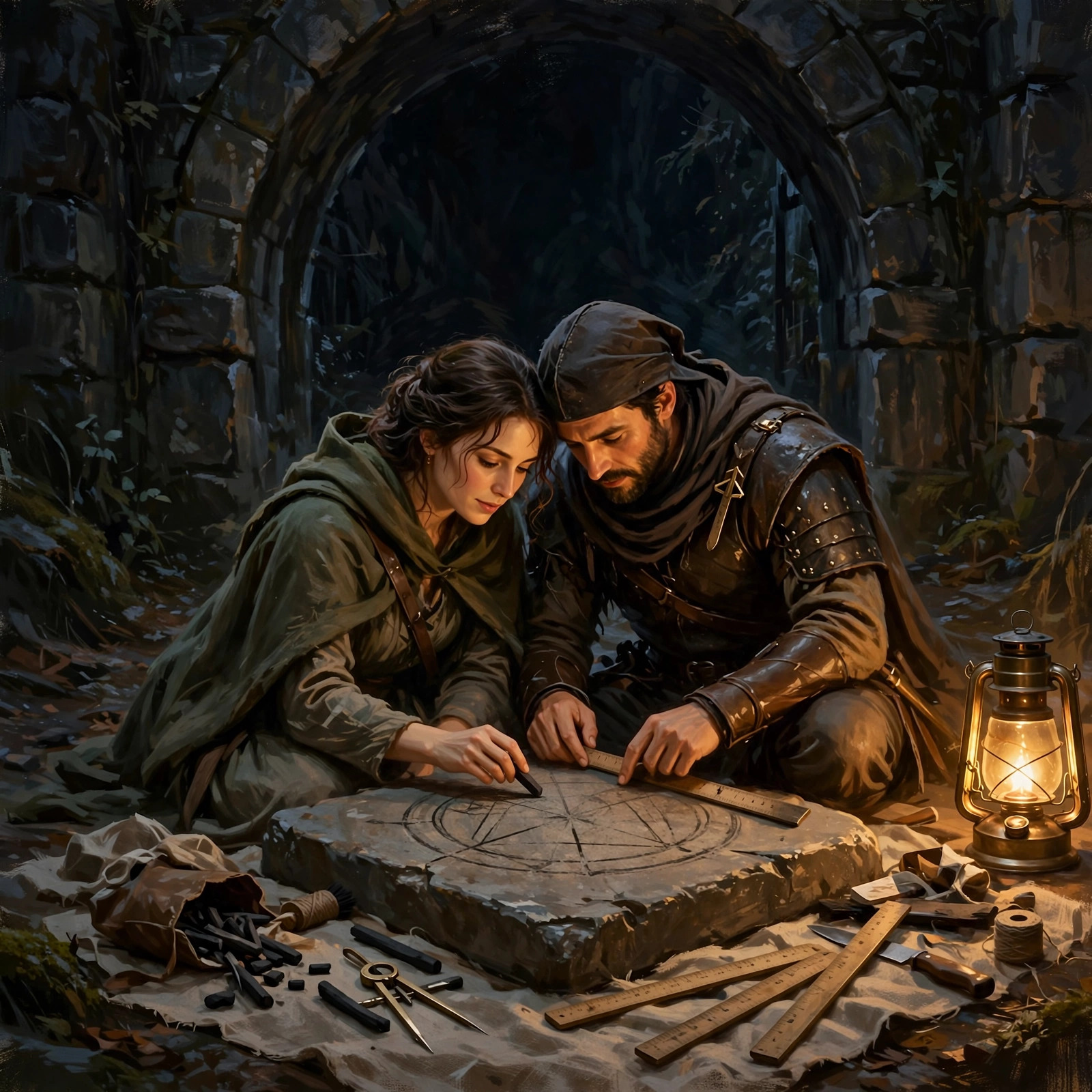
She chalked the Tallis sigil first, because it was the nearer face and because it was hers. Two wing-lines meeting over a bar, worn now to a suggestion, a shadow of what the founders had cut four generations back. She measured twice at every turn, pressed hard where the dew clung, and by the time the market bell rang the traders were streaming past her ankles with handcart wheels rattling on the cobbles.
"You'll be trampled, you know," a voice said above her. Dorian, off shift by the look of him, no spear, his coat collar turned up against the morning chill. "Or at the least you'll be selling something. That's the rule here. Everyone at the gate is either buying or selling."
"I'm measuring."
"You were measuring yesterday. Today you've moved on to drawing."
"Drawing is measuring, with ambition." She sat back on her heels and blew chalk dust off her thumb. The Tallis outline stood clean against the grey granite, mica catching the early sun in little sparks, like the stone was pleased with itself. "Your side's next. Don't loom, it puts the lines off."
He didn't loom, exactly. He leaned on the gatepost with his arms folded and watched her cross to the far face and chalk the Falke falcon, the wing-tips, the fierce little head that had rubbed nearly featureless against four generations of coats and hands and weather. She had to stand close to the stone to reach the top lines and her shoulder almost touched his arm, and she found she didn't mind, which surprised her, and then she found she'd stopped drawing to notice that she didn't mind, which annoyed her, and she drew harder.
"There," she said, when the second outline was done. "Both houses. Chalk for both. That's fair, at least. Everything past this point is steel."
"You're not to use steel."
"I'm not to use steel yet." She stood and brushed her knees. "Yet is doing a lot of work in that sentence. The moon turns on the eighth night, Dorian. The stone has to carry a fresh cut from each house by then, cut together, or the wards fail and that road out there becomes everyone's road. Two hundred paces past the gate, your patrol stops. I measured that too, while I was being ambitious."
"Two hundred and six," he said. "I'll grant you six."
"Generous."
"I try."
A woman at the nearest stall, Falke by her sash, was frying onions in a pan the size of a cartwheel, and the smell came down the rows warm and sweet, and Imogen's stomach betrayed her with an audible growl. Dorian glanced at her. She looked at the sky as if she had heard thunder.
"There's a baker four rows down," he said. "Tallis side, but the bread doesn't hold opinions. I'll buy, you're a guest in my market."
"It's not your market. It's both houses' market, which is the entire point of the stone."
"Then I'll buy as both houses," he said gravely. "Split the cost with myself. Come on, before your aunt's traders eat everything warm."
The market swallowed them the way it swallowed everyone, forty stalls under canvas in the shelter of the gate, Tallis rows running into Falke rows with nothing between them but good sense. He was right about the bakery. They ate standing, half-loaves torn and passed between them, and she told him which stall sold the good wool and which the honest scales, and he told her which of the Falke traders watered their cider and which one had once chased a thief the whole length of the rows in his nightshirt.
"Did he catch him?"
"Caught his shirt. The man ran out of it. It's the only pursuit we've ever won in the dark." He pulled a face around his bread. "You know every stall."
"I should. Eight years of renewals and surveys and patch-writes, and most of it done walking these rows. My aunt signs the warrants, I do the walking." She turned the heel of the loaf in her fingers. "I know which stallholders set out early and which send their children to hold the pitch when the wind comes off the border. I know that the onion woman's pan was her grandmother's. You learn a market or you don't, and if you don't, you're not much use as wardwright to it."
"Your aunt must send you everywhere, then."
"My aunt sends me where the ledgers need numbers," Imogen said, and heard the edge in her own voice, and gentled it. "It's still walking."
He didn't push at it. She watched him decide not to, watched the question form and get set down somewhere behind his eyes, and it made her curious about what was behind his, and she had a rule about curiosity, which was that she followed it.
"The chisel," she said instead, nodding down at her hip, where the tool roll rode slung crosswise. "You looked at it twice yesterday."
"It's good steel. And walnut, which you don't see. Everyone here uses ash, because ash is cheap and grows straight."
"It was my mother's." Imogen said it plainly, because there was no way to say it that didn't sound like opening a door, so she just opened it. "She was wardwright before me. For the Tallis side, under her own seal, not my aunt's. She forged it herself and had a man in the workshop haft it for her the year I started." She ran her thumb along the cloth edge, over the shape of the flat blade underneath. "She taught me lines before letters. Said letters would lie to you if you let them, but a line shows you exactly what it is."
"She sounds like she'd have had opinions about this truce."
"She'd have had opinions about the truce, the stone, both houses, and your captain," Imogen said, and he laughed, a short surprised sound, and she liked that too. "She died when I was nineteen. A fever came up the road one winter, the kind the market wards were never widened to catch, and I sat with her for it. Afterward my aunt took me on as apprentice because someone had to hold the chisel and I already knew how." She tore the last of her bread in half and gave him the bigger piece without thinking about it. "So when I say the lines have to be deep, I'm not being difficult. I've seen what shallow wards let through."
He took the bread. "I'm sorry about your mother."
"So am I," she said. "Mostly I've stopped being angry, which took longer than the grief."
"Imogen Tallis." Her aunt's voice arrived before her aunt did, the way it always had, like a frost forming on the inside of a window. Marguerite came down the Tallis row with her ledger under one arm, grey-gowned, unhurried, and the traders near her straightened without seeming to decide to. Imogen straightened too, in the same way, and hated it. "On your feet, good. You've the chalk outlines up."
"Both faces, aunt. I measured the wear. The Tallis lines can take a recut as they stand. The falcon needs widening at the beak, or the new line will sheer."
"Mm." Marguerite looked at the stone the way she looked at ledgers, reading it, finding the entry she'd already decided upon. "A thorough survey. I'm pleased." It was the warmest three words Imogen had got from her in a season, and it landed cold anyway. "You'll continue in this fashion. Observe, measure, report to me each evening. You will not cut. Not one line before the truce hour is formally called, is that understood? Whatever the Falke side does or does not do, you will not be the one to put steel to that stone out of turn. Our house has been blamed for enough without our apprentice handing them a fresh tale."
"Aunt, if no one cuts before the moon turns, the wards fail. I've chalked the lines, I know the depth needed, I could do the Tallis face in a morning if the Falke cutter came, and there's no Falke cutter come. I've asked at three stalls, he's asked at the watch-house. Nobody's coming, Dorian. Say it to her."
Dorian had gone very still beside her, and Imogen understood, dimly, that she had just done something to him, put him forward into her family's weather, and that he was deciding whether to be angry about it. "No cutter's come to my knowledge," he said evenly. "I've none expected."
"There." Marguerite's eyes moved over him like scales weighing. "Captain Ruse's man. Well. You'll take my meaning back to your captain, warden: House Tallis honors the truce, and will be seen honoring it, and expects nothing less in return. Imogen. Home by lamp-out, your figures in my ledger before you sleep. And girl." The pause was a blade she had spent years honing. "The Falke watch is not to be trusted. Not their captain, not their courtesy, and not this one's pleasant manners at your elbow. Bread is not friendship. Come home."
She left the way she'd come, unhurried, and the market noise closed in behind her like water over a stone.
"Bread is not friendship," Dorian repeated, when she was gone.
"You heard the expert."
"I did." He looked down at what was left in his hand, the half of her half, and then he ate it, deliberately, and Imogen laughed before she could stop herself. "For the record, my captain would say the same of your house. Word for word. I could time them."
"Two houses," she said, "reading from the same page and calling it two books."
The market bell rang the sixth hour. He had to go, she could see it arrive, the shift pulling him back into his post, and he went a step, then stopped. "Your mother's chisel. It's good steel. Bring it tonight, if you're at the gate after lamps. Not to cut. Just. Someone ought to look at the far face with you while you're measuring it. Two sets of eyes."
"You're off shift at lamps?"
"I'm off shift at lamps," he said, and went, and Imogen stood a moment in the onion-smelling rows with her chalk dust and her mother's tool roll and her aunt's warning lying across her shoulders like a wet coat.
She did not go home at lamp-out. She sat on the gate's low wall after the lamps were lit and the stalls were down and the traders had gone in to their suppers, and the chalk outlines glowed faintly, both houses' marks plain as a promise on the granite, and her palms itched the way they had itched since she was nineteen, which was to say, like the lines were already in her hands and only waiting for permission to get out. Eight days. The moon on the eighth night. No cutter from Falke, no leave from Tallis, and the wards weren't going to hold a promise or a warning or a single polite word from either house.
Lines don't lie, her mother had said. And a line was what nobody in this market seemed willing to give her.
She unrolled the cloth anyway, there under the lamp at the empty gate, and took out the walnut haft and held it in the dark, not cutting, only holding, and waited for the sky to give her a reason to do more.
One Test Line
He came at lamp-half, when the market was empty and the lamps along the wall had burned down to their quiet blue. Imogen heard his boots on the cobbles before she saw him, a measured pace she was beginning to know, and she didn't turn around, because turning around would have been admitting she'd been waiting.
"You're still here," Dorian said.
"So are you."
"I'm paid to be." He stopped a few feet off, near enough that she could smell the woodsmoke on his coat. "You're off shift."
"I'm surveying."
"In the dark."
"The chalk shows better in the dark. Any wardwright knows that." She finally looked at him. His badge had lost its shine in the lamplight, and there was a smudge of ash along his jaw where he'd leaned on something, and she was not going to remark on either of those things, because remarking was a kind of looking, and she had already done too much of it today.
"Your aunt thinks I'll eat you," he said.
"My aunt thinks the whole of House Falke is a wolf with a ledger."
"And my captain thinks House Tallis would sell the road out from under us for a good price on salt." He came to the wall and leaned on it, not beside her, exactly, but in the neighborhood of beside her. "So we're both warned off. Wonderful. Two of the most obedient people in Coldfen, standing at the same gate in the dark."
"I'm not obedient."
"No?"
"I'm here with a chisel at night because nobody official will be." She set the tool roll on the wall and unrolled it, and her mother's chisel caught the lamplight along its edge. "The falcon's beak needs widening, I told you that. The Tallis lines are shallower than I'd like. And the moon turns in five days, and if the stone isn't recut by two hands on the same night, the wards drop, and the road opens." She heard her own voice climb and made it come down again. "You know all this."
"I know the shape of it. My captain keeps the arithmetic to himself." He looked at the chalked outlines on the granite, both houses' marks side by side, faint and pale. "Which lines are yours?"
"Technically none of them. Technically I was told to survey." She said it flat, and watched him flinch a little, and understood that she'd just told him something true about herself that she hadn't meant to hand over so easily.
"Technically," he said slowly, "I was told to observe the Tallis cutter. Who, my captain was quite clear, would never come." A pause. "He seemed very certain about that."
That stuck in her like a burr, and she set it aside to worry later. "Then we're both technically here, doing nothing, in the dark."
"We could be untechnically useful," Dorian said. "One line. A test. Not a sigil, not the renewal. Just to know the stone will still take a cut, before the eighth night, when it's two hands or nothing." He gestured at her chisel. "That's good steel. My grandfather would've wept over that haft."
"My mother made it." She ran her thumb along the walnut. "She held the Tallis chisel before me."
"And the rule still stands for the pair of you? One hand from each house?"
"One hand from each house, on the same night. It's carved inside the founders' chamber, both houses' script. The stone doesn't care whose grandmother held what." She turned the chisel over once. "If I cut alone, it drinks. Three days of memory for every line I take. That's also carved."
"And if we cut together?"
"Then it's a shared line. Both houses in one cut. The old way." She looked at him. "It means putting your hand on my chisel. At night. Against both our orders."
"Oh, I'm not against orders," Dorian said. "I'm very fond of orders. I've built a whole life on them." Something moved through his voice that she didn't have a name for yet, something under the dryness, and he pushed off the wall. "Show me where."
She chose a place between the two chalked sigils, a hand's width of blank granite, and set the edge against it. "Flat of your hand on the haft, over mine. Not to guide. Just to be the second house." The words came out steadier than her pulse.
He stepped behind her shoulder, close, and laid his hand over hers. His palm was warm and rough, a soldier's hand, and it covered hers almost entirely. "Like this?"
"Like that." She could feel his breathing change the weight on her knuckles. "Don't grip."
"I won't."
She struck. One thin line, the chisel's edge biting through the mica with a sound like a struck bell dying away, and the granite lit from inside. A thread of light ran the length of the cut, silver-white, and warmth bloomed up through the stone and into her palm and through his hand into his arm, she saw it happen, saw the light climb him, and the whole gate stood in that glow for the space of three heartbeats before it settled to a faint ember and went out.
Neither of them moved.
"It's warm," Dorian said, sounding entirely undone by this. "Why is it still warm?"
"Because both houses were in the cut. That's the answer, that's what it does." She was aware that his hand was still on hers and that neither of them had decided anything about that. "A lone cut goes cold and grey. My mother showed me once, a hairline in a practice stone, and it was like touching a dead thing."
He drew his hand back then, slowly, and she felt the cold arrive where his warmth had been, and then he did something stranger. He pushed his sleeve up to the elbow and turned his wrist to the lamp.
The scar ran from his wrist bone halfway to his forearm, a rope of shiny tissue, the kind of burn that doesn't come from one moment but from one long held one.
"Hollowmere Keep," he said. "Four years back. My captain ordered us to hold the road and let the outer village go, so the keep's grain wouldn't burn. I held the road." His voice was level and terrible. "I held it very well. I'm good at holding things."
"Dorian."
"The fire followed me here, is what I'm telling you. In my head, every night, somewhere between the second bell and sleep. That's why I took the border watch. Nothing burns on a border if the truce holds. You just have to keep the truce held." He looked at the thin bright line they'd cut together. "And now there's a date on it, and a stone, and a rule that says two hands, and my captain won't send a cutter, and I keep hearing that certainty in his voice and I don't know what to do with it. So tonight I put my hand on your chisel, which is the first order I've disobeyed in nine years of service, and it felt like the first honest thing I've done since Hollowmere."
Imogen put her chisel down on the wall. Carefully, the way you put down anything you don't want to drop.
"My mother died of a road fever," she said. "The wards were never widened to catch it. Everyone followed the rules and the rules had a hole in them, and she fell through." She swallowed. "I've been trying to close holes ever since. Alone, mostly. It's a bad habit."
"Mine's worse," he said. "Mine comes with a salute."
She laughed, wet and unwilling, and he laughed too, low, and the empty market held both sounds like it was keeping them.
She put her hand flat on the granite then, over the thread of their test line, where the warmth still lived. After a moment he did the same, beside hers, not touching, the two hands resting on the stone the way the two sigils rested, close and joined at nothing but the light between them.
"Five nights," she said.
"I know."
"I'll be here every one of them."
"Then so will I." He said it before she'd finished hearing it, quick, like something slipping out before the guard could catch it, and then he didn't take it back. He straightened, and squared his coat, and looked at her with the lamplight in his eyes and his sleeve still rolled to the elbow, scar and all. "My watch, your survey. Every night to the moon's turn. If they won't send us cutters, they can watch us be untechnical together."
"They'll hate it."
"Both houses," he agreed. "Equally. It's the most peace they've ever offered anyone."
She rolled her mother's chisel back into its cloth, and the stone kept its small warmth behind them in the dark, one thin line, two houses in it, holding.
The Dropped Letter
Morning came to the gate with carts in it, and Halden Ruse came with the morning.
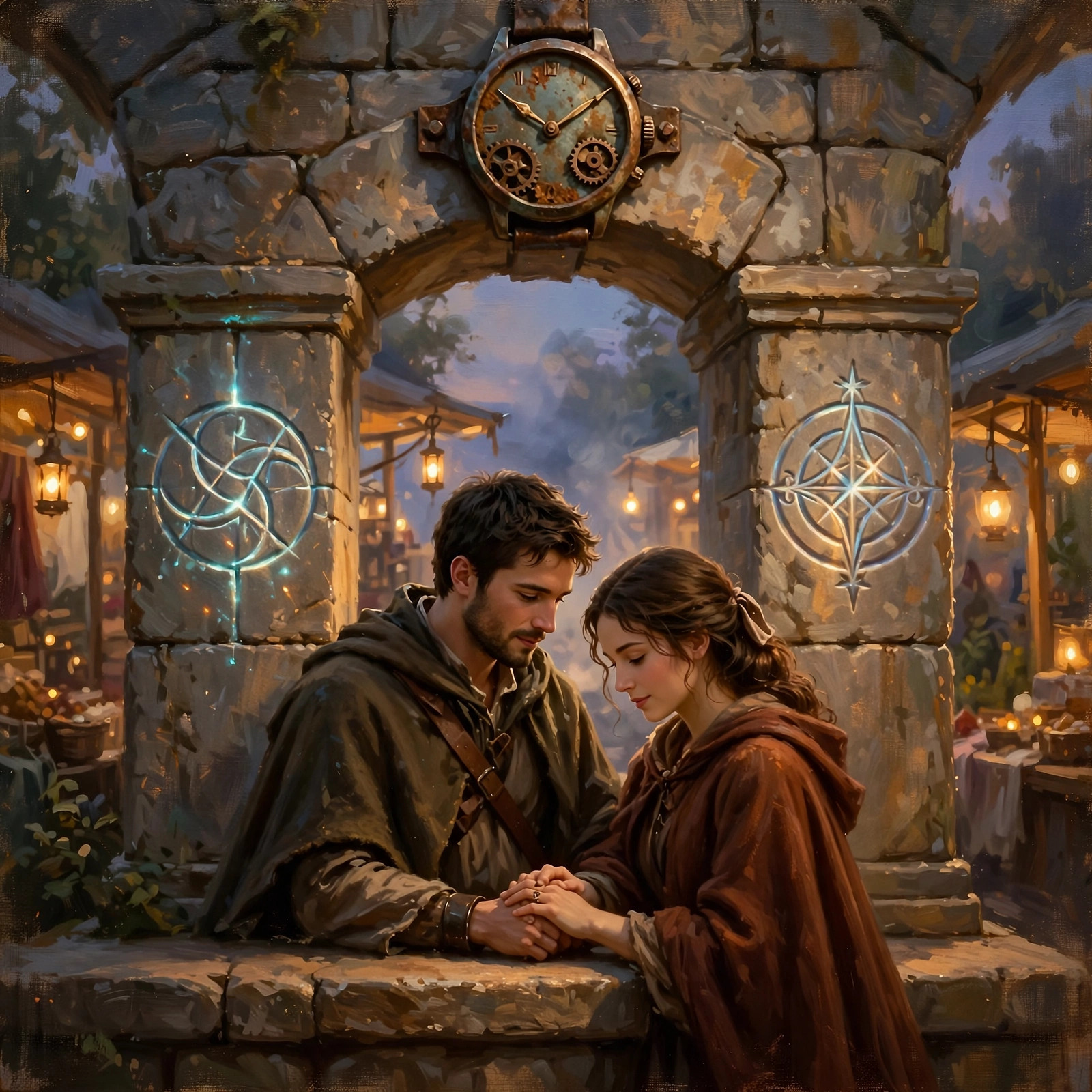
Imogen saw him first from the top of the wall, where she'd gone to check the lantern brackets. He rode the road from the Falke side with two men behind him, and he did not stop at the market's edge the way most of his house did. He came straight through the stalls as if the truce were a door he'd been told was his, and the traders closed around his wake and opened again after.
"He's never come onto our stones before," Dorian said. He'd arrived at first light, as promised, and had been leaning on the gatepost watching her chalk the last of the falcon's tail-fan when the hoofbeats started. Now his voice had gone flat somewhere at the back of his throat. "He inspects the road. He doesn't inspect the market."
"Then he's inspecting something else."
Her aunt was already in the square, Imogen knew. Marguerite Tallis kept a stall of dyed wool near the fountain on market days, and she'd been there since the bells, gloved and gracious, buying more goodwill than the wool warranted. Imogen had avoided her twice already this morning. She was not going to manage a third.
She came down the wall steps as Ruse drew up his horse before the wardstone itself. It stood about shoulder-high on a woman, that stone, grey river stone flecked with mica that caught the light even on a dull day, and it had watched four generations of both houses pass under it. Ruse looked at it the way a man looks at a fence he intends to remove.
"Apprentice," he said, without turning. "Your aunt's girl. Tell me the truce hour holds."
"The moon turns on the eighth night," Imogen said. "Five nights from tonight."
"So long," Ruse said, to no one, and smiled at the stone.
Behind him a courier had dismounted, a boy of maybe twenty winters with a satchel worn shiny at the flap, and he was picking his way between the horses and the stall ropes when a basket of onions caught his elbow. He steadied the basket. The satchel flap, bumped, did not hold. A single letter came out with the motion, folded and sealed in grey wax, and slid under the foot traffic and against the base of the wardstone itself, and the boy never stopped walking.
Imogen stopped it with her boot before the next cart could grind it into the mud.
"You've dropped," she called after him, and he turned, and then he saw who stood beside her, and he went pale as the wax.
"It's not for the market," he said quickly. "It's house post."
"It's on our stones," Imogen said.
"Give the boy his bag," Ruse said from above, mild as milk.
Dorian had come off the gatepost. He stood at Imogen's shoulder now, and he hadn't moved for the letter at all, and Imogen understood suddenly that he was reading the seal from where he stood, the way she was. Grey wax. A falcon pressed into it. She'd have known that bird anywhere; she'd chalked its outline on this stone with her own hands.
A Falke seal. On a letter that had come from the Tallis side of the road, where the courier had been walking. Addressed, when she turned it over, in a hand she knew better than her own.
Her aunt's.
"Give it here," Ruse said, and there was nothing mild left in it.
"It's addressed to you, Captain," Imogen said. "From my aunt's own desk. On market day. Carried through a truce road." She held it up between two fingers. "It fell. Things that fall in the market belong to whoever picks them up. House law."
"Girl," Ruse said.
"Halden." Her aunt's voice, from the fountain side, bright and carrying, gloved hand waving its wool-sample cheer. "You've met my ward. Imogen, come, don't bother the man's post."
The square had gone quiet in rings around them, the way water goes quiet when something large moves under it. Forty stalls, near enough, and every one of them listening.
"The seal's broken at the corner," Dorian said quietly, and it was. The drop had cracked the wax through. "Broken post is dead post, Captain. House law cuts both ways."
Ruse looked at Dorian for a long moment, and Imogen watched the look land, and she understood that whatever was in the letter, Dorian's commander had expected him to hand it over blind. And that some part of Dorian had just failed a test he hadn't known he was sitting.
"Read it, then," Ruse said, and smiled again at the stone, at her, at the whole listening square. "Since the market's so fond of house post."
Her aunt had gone still by the fountain. Not moving toward them. Not moving at all.
Imogen unfolded the letter where they could all see it.
She read it once silently. Then she had to read it again, because the words refused the first time to mean what they meant.
...no cutter will come from my house, as agreed. Let the hour lapse. The road opens, the traders bleed, and every eye turns to the falcon. Blame needs only one night to set, Halden. My wardwright's girl will keep her chisel holstered; she does what I tell her. Yours will keep his hands at his sides; he does what you tell him. By the time the moon turns, the road is ours to divide, and neither house's hands are dirty...
The paper went on. She stopped reading it aloud somewhere around the road is ours to divide, because her voice had stopped working.
Five nights. Five nights, and no cutter coming from either house, ever, because both houses had sat down over wax and agreed to let the wards die so they could divide a road between them and blame each other for the bleeding. The market would learn it by nightfall, all forty stalls of it, and the market would learn something worse with it: that the truce hour would pass with the old sigils worn smooth and nothing cut in their place, and the road would open, and everything her mother had died of came up that road.
Unless someone cut.
Her aunt was walking toward her now, fast, gloves coming off. "Imogen. Give that to me."
"You told me to survey," Imogen said. Her voice sounded far away to her own ears. "Not to cut. That was an order."
"It was," Marguerite said, and had the grace to say nothing else.
"She said no cutter would come," Dorian said, very low, beside her. He was staring at the letter. "He told me to observe the Tallis cutter. He told me he was certain none would come. He knew. He's known since before I rode here."
"Witnesses," Imogen said. "We need the market council, we need the stallholders, we need, we need, there's no time, we need someone to see while the hour's still ours to cut in. Two houses, two hands, same night. That's the rule. That's the only rule."
"Imogen." Her aunt's hand closed on her sleeve. "The moon turns on the eighth. Nothing can be cut tonight. Come home."
"Nothing can be cut tonight by anyone whose house sends them," Imogen said, and heard her own voice go strange and thin, "and neither house is sending anyone, so it has to be cut tonight, it has to be cut now, before anyone can stop it, because if I wait for permission this road opens and I know what comes up open roads, I've buried what comes up open roads."
"Imogen," Dorian said.
She was already moving. Her tool roll was where it always was, against the gatepost, and her mother's chisel came out of its cloth into her hand with the ease of nineteen years, steel and walnut, forged the year her apprenticeship began. She put her left palm flat on the stone to brace it and set the edge into the old Tallis sigil's worn groove and began.
"Stop," Dorian said. "Stop, listen to me, the rule says two hands, the stone takes a lone line and it cracks, it drinks, Imogen, it drinks three days of memory for every line, you told me that yourself."
"Then it can have them."
The first line went in and the stone went cold under her palm. She knew cold stone; she'd known it all her working life. This was not that. This was stone pulling, the way a mouth pulls, and the warmth of last night's shared test line, the one that had glowed, the one they'd pressed their hands over together, went out of the rock like a snuffed wick.
She cut anyway. Her mother had cut this sigil. Her mother had held this exact haft. She set the second line's start and the mica flecks along the groove had gone grey, all the shine drunk out of them, and something in her head went soft at the edges.
What had her mother's laugh sounded like?
She knew that. Of course she knew that. She knew the workshop and the forge smell and the way her mother held chalk, loose, elegant, nothing like her own cramped grip. She knew. She knew the fever year, she was nineteen, she knew the bed and the window and she knew her mother's face above the blanket, she knew it, she knew, she
The face was blurring. Not gone. Blurring, like a face across water, like a name you have to say aloud to keep.
Three days. For every line. She'd taken one line and started a second and the stone was already at her mother's laugh, at her mother's face, at nineteen years old and holding a cold hand, and it was so calm about it, so patient, and the crack had begun, a hairline, fine as thread, running out from under her chisel's point through the old Tallis sigil and down toward the Falke bird's worn beak.
"Witnesses later," she heard herself say, and her voice was shaking and she kept the chisel moving anyway. "Two houses later. Tonight it's one hand."
Dorian's hand closed over the chisel. Not over her hand, over the haft, above hers, and he wrenched it sideways and out of her grip, and the second line broke off half-cut, and the stone's cold pull stopped all at once, like a door slamming.
The silence afterward was enormous.
Imogen turned on him with the grief still running and nowhere to put it, and her mother's face still soft in her memory's water, half-formed, half-saved, and she was shouting before she knew she'd begun.
"Give it back. Give it back, that was hers, that was my mother's chisel and my mother's sigil and my hand, and you don't get to choose, you don't get to stand there with your orders and your salute and choose, they chose, they all chose, everyone's chosen for me my whole life and you were supposed to be the one who didn't."
Dorian stood holding the chisel flat across both palms, not giving it back, not dropping it, the crack running thin and naked between them down the face of the stone, and he didn't flinch.
"I know," he said. "I know what I just did. I disobeyed the only man I've obeyed for nine years, and I did it to you, in front of your whole market."
"Then give it back!"
"No," he said, and his voice cracked on it, on that one small word, and he held her mother's chisel out between them like something breakable he was refusing to break. "Not while it's taking her from you. I'll carry it. I'll carry anything you want. But I stood at Hollowmere with my hands at my sides because I was ordered to, and I watched, and I will not watch this. Not you. There's no order in either house that makes me watch this."
Her aunt had stopped ten feet away. Ruse had not dismounted. The square held its breath around the three of them and the stone and the thread-thin crack and the half-cut line, cold and grey and alone in the rock.
"You've no right," Imogen said, but the fury had gone out from under it, and what was left standing was only the loss, and the blur where her mother's face had been.
"I know that too," Dorian said. "Give me a way to earn it. Name anything."
She looked at the stone. At the crack. At the two half-ruined sigils and the four nights left and the letter still open on the ground where she'd dropped it, her aunt's hand and Ruse's, agreeing over wax to let them all bleed.
"The council," she said at last, hoarse. "Tonight. Every stallholder, both sides. They have to see what our houses are. Both of them."
"Then we go together," Dorian said, and put her mother's chisel into her hands, and closed her fingers over the walnut himself. "Two hands. Same night. It's the only rule that's ever held."
Grinding It Out
Dawn found her on her knees at the stone with a whetstone, a horse brush, and her own two palms, and none of them equal to the work.
The crack had not spread in the night. That was the only mercy. It ran thin as a hair from the Tallis sigil down toward the falcon's beak, and the half-cut line she'd taken alone sat grey and cold in its channel, still drinking. She could feel it drinking. All night she had felt it, like a draft under a door, except the draft was going out of her and not in.
"You shouldn't be up here alone," Dorian said. He came through the gate lamps with two cups of the onion broth the stall women poured at first light, and stood a careful pace off her shoulder, watching the crack and not her face. "The mason's boy in me says you can't grind granite with a brush."
"The brush is for the dust. I need to see the true edges." She turned her palm up without thinking, and he looked at it, and she closed her fist. "It's fine."
"It's skinned to the wrist. I watched you work yesterday."
"Yesterday I was paying a debt. Today I'm canceling one." She set the brush down. "A line cut alone is a line taken alone. That's the old wording. My mother beat it into the workshop wall with a nail, so nobody could claim they'd never been told. Taken isn't the same as cut. If the line's still on the stone, the stone keeps taking. But if the line comes off, if the channel is ground back out to nothing, then the taking stops."
He crouched. Set the cups down on the cobbles. "Ground out by hand."
"By hand. A chisel would follow the crack. A chisel opens lines, it doesn't close them. But a carborundum block and two hours and every skill I've got, that takes the whole line back to raw stone. The crack will stay. Cracks don't heal. But it won't run further, and it won't drink further, and we can cut fresh lines beside it on the moon's turn that hold anyway, if the stone's sound on either side of it."
"Your hands won't be sound on either side of anything."
"That's the price of my mistake. I'll pay my own prices from now on. That's the whole of what I've decided this week." She picked the block up. It was rough as a cat's tongue and grey with her own dust already. "You could hold the lamp."
He held the lamp.
It took until midday. She worked the channel in short strokes, block flat, her wrists aching, her palms going from pink to raw to blistered to broken in three places, and Dorian held the lamp and said nothing, and fetched water when she asked, and once, when she stopped and put her forehead against the cold flank of the stone and shook for ten seconds without a sound, he put one hand very lightly on the back of her neck and took it away again before she could decide whether to object.
The grey line came out of its channel a finger-width at a time. Where her mother's chalk outline ran, the chalk stayed. Where her own chisel had bitten, she took the stone back to bare rock, clean, unclaimed, hers the hard way instead of the wrong way. The dust piled fine in the channels and she brushed it out and it fell on the cobbles like grey snow, and the crack remained, thin and honest, a scar she'd put on a four-generation stone with her own hand because she'd been afraid of missing a deadline. Her aunt would call it the family's shame. Let her. It would be the truest thing in the square.
At midday the last of the grey came away. Imogen sat back on her heels, breathing hard, palms wrapped now in the strips of her own apron because Dorian had made her, and put her flat hand over the raw channel. Nothing. No draft. No drinking. Empty rock.
"It's stopped," she said, and heard her voice crack like his had, on the small word, and didn't care.
"It's stopped," he agreed. "Now the other thing."
The other thing was standing across the square, had been standing across the square since the second hour, arms crossed, hating to watch and unable to look away. Marguerite Tallis in her house grey. And at the market's far gate, mounted, come down at Halden Ruse's own insistence so he could witness his own cleverness going wrong, sat Ruse himself.
Dorian straightened. He looked at the square, then at her. "You said tonight. The council."
"I did."
"Then I'm not waiting for tonight." He reached up to his collar. His fingers stopped for a moment on the pin, and she watched him make himself do it, the same slow motion she'd just spent a morning making. The badge came loose. Pewter, the falcon cast with its wings up, polished by five years of a careful thumb along the wing-edge. He looked at it once, the way she'd looked at her palms. Then he laid it on top of the wardstone, in the dust, in plain sight of both gates.
"You'll lose your post," she said.
"I know what I'll lose. I've known since yesterday." He picked up her dropped letter from where it had lain folded in her kit, her aunt's seal and Ruse's signature both on it, and held it out flat on his open palm between them, the way he'd held her mother's chisel. "I spent nine years learning to tell the difference between an order and a right. This one's easy. Come on."
The council was the market's own, forty stallholders of both sides, and neither patron could stop it, because the market's charter sat above both houses at Coldfen, which was the one thing everyone's grandmother agreed on. They met at three in the afternoon under the long awning by the weigh-scale, and Imogen stood with her bandaged hands wrapped around her mother's chisel like a woman holding a relic, and Dorian stood beside her and read the letter aloud.
Every word. In his watch voice, flat and carrying. Marguerite's hand agreeing to let the truce lapse. Ruse's hand agreeing to the same. Both pledging in writing to blame the other, and neither house to send a cutter at all.
The square went dead quiet, and then it did not, and the noise was not good.
"You're reading a stolen letter," Ruse said from horseback.
"It was dropped at my post," Dorian said, "in front of two witnesses, by the man your own signature names as your courier." He did not salute. He stood easy, hands at his sides, and Imogen watched him not salute and understood what that cost him the way she understood her own ground palms. "I'll sign testimony to it before your own clerk, sir, and before the market's. I resign the badge either way. It's on the stone. You can send a man for it."
"The truce runs out at the moon's turn," Marguerite said, and her voice was smooth as ever and reached nothing anymore. "Four nights is no time to repair nonsense."
"Then witness it," a fruit-seller called out, and a Tallis stallholder seconded it, and a Falke one thirded it, and then the whole awning was talking at once. Witnesses. Both houses. On the eighth night, at the stone, whatever the patrons decided to be about it.
Imogen stood in the middle of the noise and felt, for the first time since her mother, like a person standing where her own name had put her, and not somebody's else's.
They walked back to the gate at dusk, slow, nobody waiting for them anywhere. The lamps came up along the wall one by one. Her hands throbbed with every pulse of her heart, and the stone sat cracked and scarred and chalked and waiting, and four nights lay between them and the moon's turn.
"Your badge is still up there," she said.
"I know where it is."
"You could take it back before he sends someone."
"No." He stopped at the wall's edge where the lamplight ended, and turned, and she saw him gather it the way he'd gathered the badge pin, one small thing done deliberately. "I'd rather lose it than watch you pay that price alone. I'd rather lose anything they've got. I watched a village go for a road once, and I've got the wrist to prove it, and I swore the next thing would be different, and then I took a post where all I did was stand. And then it was you. On your knees, bleeding, at six in the morning, alone, because everyone you've ever trusted was late. I'm not going back to standing. Whatever it costs."
He'd never once, in five days, said so many words in a row without a pause to check them for orders.
She looked at his face in the lamplight, and at the crack behind him, and at the empty channel she'd paid a morning of her own skin to take back. Then she took one more step, closed the distance, and kissed him, dust still on her bandaged hands, her ruined palms flat and careful against his coat.
He made a small startled sound and then his hand came up, very gently, and cradled the back of her head like something that had been cracked and could not be cracked again. The lamplight moved on the mica in the old stone. Somewhere off toward the stalls, someone was frying onions.
"That," he said, when they broke apart, "is also against orders, I'm fairly sure."
"Let them write me up," Imogen said.
He laughed, low, and she felt it through her palms where they rested on his chest. Above them on the stone, his badge sat in the grey dust, and her chalk sigils waited, and four nights waited, and the wards held.
Moon's Turn
By the time the sky went copper over the roofline, the market had emptied of everything but people. Forty stalls stood shuttered and dark, and in front of every one of them a stallholder had come out to stand at the gate, because the council had ordered witnesses of both houses and the stallholders had decided that meant everyone. Imogen had never seen the lane so full at dusk. She stood at the wall with her tool roll open on the coping, and her bandaged palms sweated inside the linen.
"You've counted them twice," Dorian said, at her shoulder.
"Three times."
"Any of them going to blink out if you look away?"
"That's not the part I'm counting. I'm counting who's holding a chisel." Which was nobody. Every hand in the lane was bare, or gloved, or wrapped around a tankard someone had brought out for the wait. The cutting was hers and his alone, and the whole market knew it, and knowing it had brought them all out to watch in a silence that pressed on her ears.
She heard Halden Ruse before she saw him, his boots distinctive on the cobbles, and then he was at the front of the Falke side with his arms folded, glowering at the stone as if it had personally disappointed him. Marguerite came from the other end in her house cloak, unhurried, a woman arriving at a function she had publicly organized and privately never wanted. She stopped an arm's length from Imogen and looked at her niece's bandages for a long moment.
"You found your letter," Marguerite said.
"You dropped it where I would."
"I dropped it where the wind took it." Her aunt's mouth did something that was almost a wry thing. "The wind has opinions, it turns out."
Before Imogen could decide what to answer, the first pale lift came into the eastern sky, and the crowd's murmur dropped off all at once, the way a market never went quiet for anything except weather. The moon cleared the roof of the tall house down the lane, one day short of fat, and the wardstone's old chalk lines showed silver in the light.
"Moon's turn," the council clerk called out, from the gate post. "The truce hour stands. Cut, or let it pass."
Imogen unrolled the cloth. Her mother's flat chisel lay where it had lain for eight years of working days, steel gone blue-bright at the edge, walnut haft worn to the shape of her grip. She lifted it out, and her ruined palms complained, and she didn't let it show on her face.
Dorian moved to the Tallis side of the stone. Not the Falke side. He came and stood beside her, shoulder to shoulder, so close his coat brushed her sleeve.
"You're on my line," she said.
"I'm on the stone." He held up his own chisel, Falke-stamped, treasury steel. "Your aunt's watching. Whole market's watching. I thought I'd do the one thing I came to do correctly, for once."
"You've done things correctly for years. That was the problem."
He almost smiled. Above them, nailed to the gate post over the stone, his pewter falcon badge sat where he'd hammered it that morning, wings out, glinting. His resignation, hung up where everyone could read it. She had watched him nail it there at dawn and had not asked him to take it down.
"Together," she said.
"Together."
She set her chisel into the chalked beginning of the Tallis sigil, the deep old knot her mother had taught her wrist-first, and he set his at the head of the falcon's wing, and the moon came up over the roofline full enough to silver the mica in the stone. She cut the first stroke. He cut the second. And the stone answered.
Not the cold grey nothing of her lone line. Not the small warm flicker of their test cut. This was a sound first, low, felt in the teeth, a hum that rose out of the ground under her boots and up through the coping into the whole gate wall, and then light, gold-white, running ahead of her chisel tip and ahead of his, the two lines of light climbing the stone side by side. Somewhere behind her a stallholder began to laugh, high and amazed, and then somebody's child, up long past any bedtime, shrieked with pure delight, and the whole lane made a noise like a wave coming in.
"Keep cutting," Imogen said, and her voice shook, and she kept cutting, and so did he.
The Tallis knot closed under her hand, warm as a held cup. The falcon's wing closed under his. The last stroke of each sigil crossed at the stone's crown, the two houses' lines meeting, and where they met the light fused and ran down both lines at once and out along the ground, out under the stalls, out toward the dark stretch of border road beyond the wall, so that she saw the whole warded boundary glow briefly like a vein of fire under skin, two hundred paces of it, all the way to where the road bent off toward the hills.
Then it settled, and the light banked itself down into the stone, and the gate was simply a gate again, warm to the touch, humming faintly, holding.
The market roared. Imogen put her chisel down on the coping because her hands were done being reliable, and stood there breathing while forty stalls' worth of people shouted and embraced and banged tankards on shutters. Dorian's hand found hers on the stone, bandaged palm to scarred wrist, and gripped.
"It held," he said. Roughly. "You absolute marvel. It held."
The clerk's bell rang and rang until the lane quieted by degrees. The council came forward, all nine of them, and behind them, somewhat apart, Marguerite and Halden Ruse stood like two people at the same funeral for different reasons.
"The wards are renewed," the council head said. "Witnessed and recorded. The truce stands for its full term, and the road stays shut to raiders. House Tallis, House Falke, the gate thanks you both. Now." She turned, of all people, to Marguerite. "Your house cut the Tallis sigil. Who holds the wardwright's authority for it?"
Her aunt came forward. It cost her something, Imogen could see that, and she watched it cost her, and made herself watch every step, because she had earned the watching.
"The cut was made by my wardwright's apprentice," Marguerite said, loud enough for both ends of the lane. "Under her own hand. It's past time it was under her own name." She drew something from her cloak: a seal, brass, the Tallis knot stamped into it, the wardwright's mark Imogen had pressed into wax a hundred times with her aunt's hand hovering over hers. Marguerite set it on the coping beside the chisel. "Imogen Tallis, wardwright of the market gate. Signed and witnessed if you like."
"I'd like," Imogen said, and half the market laughed, and Marguerite, to her lasting credit, laughed too, a short real bark of it.
"And the Falke sigil," the council head went on, turning to the other side. "Warden Falke cut it wearing no house authority. Captain Ruse, your watch claims him?"
Halden Ruse's jaw worked. He looked at the badge nailed above the stone, at his own falcon stamped there in the post where every trader passing the gate would see it, and something in his face closed like a door. "He resigned my watch by that badge. I don't claim what's walked out."
"Then the council claims him," the head said, "as we claimed the gate itself, both houses' stone, both houses' wards. Warden of the market gate, sworn to the council, joint charge with Wardwright Tallis. It's a poor idea to split the pair that just made the stone sing." A ripple of amusement ran the lane. "If he'll take the post."
Every face turned to Dorian. He hadn't let go of Imogen's hand.
"Sworn to the market," he said slowly, "and not to a house."
"And not to a house."
"To the traders and the road." He looked down at Imogen, and then at his badge overhead, nailed wings and all. "Then I take it."
The crowd noise came back and carried everything else away with it. The witnesses dispersed into it, the clerk into her ledger, the council into handshakes, Marguerite into a knot of Tallis stallholders who wanted things from her. Halden Ruse walked off down the dark lane alone, and nobody followed him, which was its own verdict.
Imogen picked up her mother's chisel and the brass seal, and rolled them together into the tool roll, which was a thing she had done eight years of evenings and had never once done as her own name.
Dusk came down slowly over the shutters. The market lamps went up along the wall one by one, and the lane emptied in the way of places after a thing has happened, in eddies and small talk and the smell of someone's supper starting. The stone hummed under her palm, warm, holding, both sigils fresh and gold-flecked in the last light.
They were alone at the gate. She had waited all day for this without knowing she'd been waiting.
"Warden of the gate," she said. "You'll be sick of me within a month."
"I've stood at this gate every night for five nights," Dorian said, "and I was never once sick of it. I've been trying to work out why, and then you kissed me and the problem solved itself, so."
She laughed, and it came out wet at the edges, and she didn't fix that either. He reached to push the hair off her face, careful of the bandages, and she caught his hand before he could draw it back, and turned it over, and pushed his sleeve up above the wrist where the old burn ran pale and roped from Hollowmere Keep to his knuckle. He let her. That alone was new.
She set his scarred hand flat on the stone, beside her own.
"Both hands," she said. "That's the whole rule. That's all it ever was. One of each, on the same night, on the same stone. I'll be at this gate at every moon's turn for the rest of my working life, and so will you, and I've decided that's not a duty. It's the best thing I've ever been handed by a council."
"Joint charge," he said. "You'll be my wardwright."
"You'll be my warden."
"That's the whole of it, then."
"That's the whole of it."
His hand stayed where she'd set it, palm to the stone, hers beside it, and the hum came up through both their hands like something that had been waiting under the ground a long time and was in no hurry now to stop. The moon stood clear of the roofline. Somewhere off among the stalls, someone was laughing over supper, forty roofs deep in lamplight, all of it held.
Get notified when new stories drop

Cade Ellison
Cade specializes in romantasy and paranormal romance: magic systems with rules, courts with knives, and longing that rearranges destinies.
Leave a comment
Comments