





One Hundred Eight Steps
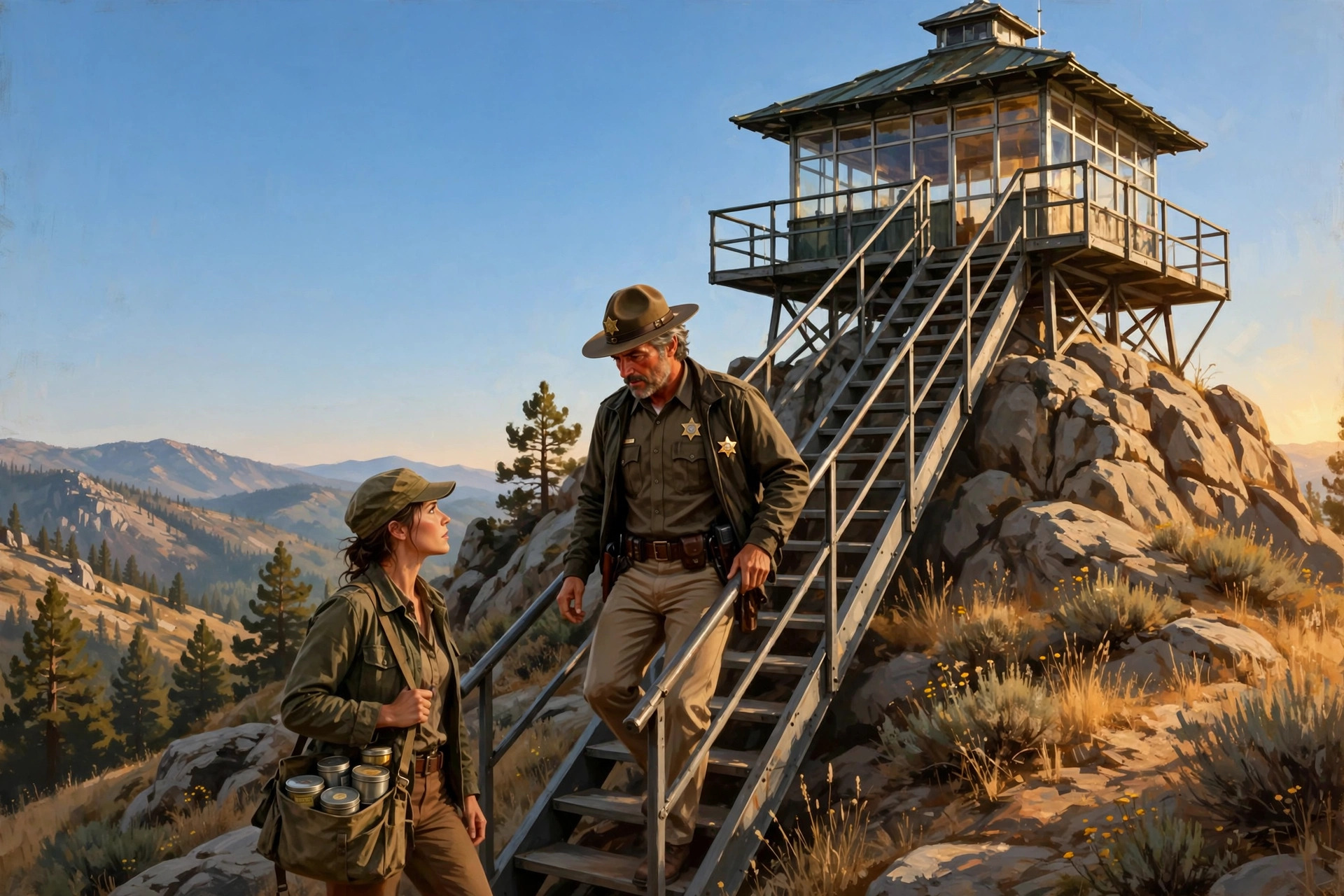
The county truck bottomed out on the last switchback at noon, and Delphine Okonkwo counted the switchbacks out of habit the way she counted everything, because numbers didn't change their story halfway through an interview. Cinder Peak Fire Lookout stood at the top of the dry slope above her, steel legs planted in granite, the cab a glass box glittering against a hard blue sky. Fourteen meters of tower. She'd read the file on the drive up from Kestrel Falls, sixty kilometers of gravel and dust, and the file said the stairs numbered one hundred eight.
She'd verify that herself.
The truck door complained when she shoved it open. Her satchel held the prosecution binder, sealed, and beneath it the kit with nine charcoal tins packed in foam, each tin labeled in her own block printing, because she'd learned the hard way that other people's printing could be argued with. The hearing was in five days. She had five days to keep her samples clean, her chain of custody airtight, and herself in one piece at a podium in front of a grand jury.
Warren Vint had other plans. She didn't know the shape of them yet. She only knew that a woman who'd been scheduled to testify before her had developed a convenient case of amnesia, and that the state had decided the safest place for its arson investigator was a fire tower in the middle of nowhere, guarded by a county deputy.
A deputy who was already halfway down the stairs to meet her.
He came down easy, boots finding each tread without looking, the way a man walks a staircase he's walked ten thousand times. Sunburned neck, gray at the temples, a county badge on his belt and a radio on his shoulder. He stopped three steps up from the bottom, which put them at eye level, and she noted that. Men who managed eye level on purpose were worth noting.
"You're the state's," he said.
"Delphine Okonkwo. Fire Marshal's Office."
"Gale Bromley. I look after the tower in the off-season. Rest of the year I'm a deputy, which mostly means telling tourists the road ends where it ends." He glanced at her satchel, then away from it, polite about it. "Pearl said you'd come up with the mail run. She also said you'd be trouble, but Pearl says that about everyone, so don't take it personal."
"Is she right?"
"About you, no idea. About everyone else, always." He turned and started back up. "Cab's at the top. Water's full, five hundred gallons in the cistern on the north leg, and I checked the striker plate on the stove myself this morning, so if you were about to ask, save it."
She hadn't been about to ask. She'd been about to inspect it. She climbed behind him and counted the steps under her breath, and at the top the count came to one hundred eight, and something in her chest loosened a quarter inch, the way it did when a fact held.
The cab was one room and a catwalk, fourteen meters of air underneath it. A map table, a cot, a woodstove, a wall of glass facing the slope. Someone had left a coffee tin out with a note in pencil: grounds are fresh, don't thank me all at once. The handwriting slanted left, the same hand she'd bet was on the stove log.
"You can see the whole south drainage from here," Gale said. "On a clear day, the far ridge."
She set her satchel on the table but didn't unclip it. "Who else comes up here?"
"Nobody, this time of year. Loggers use the road below, the Vint crews mostly, but they don't come past the second gate." He said it flat, a man reporting weather, but his hand went to his shirt pocket, touched something there, and came back out empty. Old habit, worn smooth. She filed that too.
"The radio," she said. "I need a check with dispatch before I do anything else."
He unclipped his own set and keyed it. "Cinder to Kestrel, got my passenger aboard, want a check."
The speaker crackled, and a woman's voice came through, unhurried, warm as a kitchen. "Kestrel to Cinder, read you fine, Gale. Miss Okonkwo, you there? This is Pearl Yazzie, I'm the voice that knows where everybody is."
"I'm here. What's channel protocol up here?"
"Channel seven, county repeater, it's the only one that reaches over the ridge. You want weather, you call me. You want gossip, you also call me, but the weather comes first." A pause, paper rustling. "Wind's out of the southwest today, eight, maybe ten. Dry. Dry as a sermon. Anything else, sugar?"
"Not yet."
"Then I'll leave you to it. Kestrel out."
Delphine clipped her own radio to her belt, set to seven, and turned to the glass.
The slope below fell away in a long sweep of rust-colored brush and dead lodgepoles, and beyond it the drainage ran south toward a blue haze of ridgelines stacked like paper. She let her eyes go lazy the way her first instructor taught her, not hunting, just letting the wrong thing announce itself.
It took four minutes.
A gray thread, thin as spider silk, standing off the far ridge where the haze met the timber. Not a cloud. Clouds drifted. This stood still and leaned, leaning the way smoke leans when it's got a day's climb to do and no hurry about it.
"Gale."
He was at the glass before she finished the syllable, and he looked a long time, longer than she expected, his jaw working once.
"That's the Miller drainage," he said finally. "Or it was, before Vint bought the timber rights. Too far to tell if it's a snag or a ground fire, but it's October and nothing up there has been wet since August." He reached for the radio, then stopped himself and turned to her instead. "Your call. It's your show this week, the county signed off on it."
She thought about that. A man eleven years in a county uniform, handing a fire call to a stranger on day one, and doing it without a flinch. She'd worked with captains who couldn't do that in eleven years.
"Call it in to Pearl. Ground fire, possible, far ridge, we watch it and log it hourly. If it crowns, we'll know soon enough by the color."
He keyed the radio and gave Pearl the bearing, calm as reading a grocery list, and Pearl came back with copy, Cinder, no other reports, I'll put eyes on it from town if the light lasts. Delphine wrote the time in the stove log herself, in her own block printing, and started a fresh page beneath it: Day one, 13:40, smoke far ridge, southwest wind.
"You keep a fire log?" Gale asked.
"I keep everything. Twice." She unclipped the satchel at last, laid the sealed binder flat on the map table where the afternoon light hit it, and squared it to the table's edge until it sat exactly parallel. Nine tins, one binder, five days. She looked up and caught him watching her square the binder, and braced for the joke.
He didn't make one. He just nodded slowly, like a man recognizing something. "My father kept a log like that," he said. "Every entry in the same hand, forty years of fire reports. Never missed a day." Something crossed his face and moved on before she could name it. "Anyway. Coffee's in the tin. I'm below if the wind comes up."
He went down the stairs with that same unbothered rhythm, and she stood at the glass with her hand flat on the sealed binder, watching the gray thread stand off the far ridge.
By the time the sun dropped behind the western ridge, the thread had thickened to a rope, and the evening wind, still out of the southwest, still dry as Pearl's sermon, had pushed it a full ridge closer. Not close. Not yet. But fires that move while you watch are fires with opinions, and she'd spent nine years learning to respect a fire that had made up its mind.
She set her satchel on the cab table beside the log, dead center, where she'd see it first thing in the morning, and turned on the small light over the map, and began to work.
Below her in the dark, a match flared once in the cupped hands of a man lighting his stove, held to the kindling, and went out.
The Burned Cabin
Delphine woke on day two to the smell of smoke, and for three seconds she was somewhere else entirely, a rented room above a burned-out hardware store, an examiner with a clipboard telling her the finding wouldn't hold. Then the glass walls of the cab came back, and the smell was thin and old, and she understood it had come up the mountain on the night wind, riding sixty kilometers of forest from somewhere new.
She took the stairs down and counted them out of habit. One hundred and eight. Gale was already at the bottom, crouched beside the truck with a thermos, and the look on his face when he straightened told her the morning had started before hers.
"Cabin burned in the night," he said. "Old Vint company cabin, lower switchback. Pearl flagged it at four in the morning. A hunter called it in."
"Vint Timber cabin."
"There's a lot of those on this mountain. They built half the county." He said it evenly, but his hand went to his shirt pocket, touched the brass matchsafe there, and came away again, the way a man checks for keys he doesn't need.
"I need to see it before anyone else walks it."
"I figured." He handed her the thermos. "Trail's steep. You'll want the boots you wore yesterday."
The trail dropped off the south flank in long switchbacks through lodgepole and deadfall, the kind of country where a fire could run uphill for a day and a half without meeting anything that cared. He walked ahead of her the whole way, testing footing, calling back the turns, and twice he stopped without being asked and pointed out things she hadn't seen yet: a rockfall the trail skirted, a dead snag leaning over the path like a man listening at a door. He didn't offer his hand at the steep parts. She noticed that. She filed it the way she filed everything.
They smelled the cabin before they saw it, that wet-char smell that means a fire burned hot and then got rained on, except it hadn't rained. Someone had hauled water. That was the first thing wrong.
The second thing wrong was the cabin itself. It stood in a clearing no bigger than a barn floor, walls still up at two corners, roof gone, and the burn pattern ran backward from every cabin fire she'd ever read. Wildfire takes the uphill side first, feeds on the windward wall, leaves a V. This had a V too, but it pointed at the door.
Delphine stood at the treeline and didn't move for a long moment.
"Somebody lit this from inside," she said. "Or from the threshold. There's your origin, right at the entry. It burned low and slow until the floor dropped, then went up the walls." She pointed without stepping past the stones. "Accelerant, probably. See the pooling on the stones? It puddled before it lit."
Gale crouched at the edge of the clearing, forearms on his knees, saying nothing.
"You don't agree?"
"I agree." He turned his head and looked at the tire ruts pressed into the mud of the old skid road, two parallel grooves running in and back out, fresh enough that the water hadn't even settled in them flat. A truck had come in last night and left last night. He looked at them the way you look at a letter you're not sure you want to open.
"Those are fresh," Delphine said.
"They are."
"You going to call them in?"
"To Pearl, sure. When we're back up top. Radio's better from the tower." He said it easily, and it was even mostly true, and Delphine had spent nine years listening to people say mostly true things in exactly that tone. But the ruts were evidence, and evidence didn't keep, and he knew both of those facts better than she did.
She let it lie. She had her own work to do first, and her own rule about it: never argue with a scene before you've read it.
She worked the cabin floor for an hour on her knees with gloves and a hand trowel, reading the char like print. The door threshold stones held a deep, even carbon crust with a distinct pour shadow, the shape a liquid makes when it finds its level before ignition. She photographed it, measured it, drew it into the map in her binder, and then took the tin from her satchel, the first of nine, and lifted a thumb-sized flake of the threshold char with tweezers and sealed it. Eight tins left. She wrote the location on the tin's label in her block printing: cabin threshold, lower switchback, day two, 09:55.
"You take one piece?" Gale had come up behind her, quiet as weather.
"One good piece, sealed, with a documented location. That's what survives cross-examination. A bucket of guesses doesn't." She didn't look up. "I was taught that the hard way."
"Somebody didn't believe you once."
Her tweezers stopped for half a second, then went on. "An examiner with a clipboard and a nice suit told a room full of people my origin finding was 'enthusiasm dressed as methodology.' The finding was right. I proved it two years later, after the appeal, when nobody was watching. Since then I take the piece, I seal it, I write it down, and I do it twice." She snapped the tin shut. "So yes. One piece."
Gale was quiet. Then he said, "My father would have liked you," and it was the first thing he'd said all morning that cost him something. He touched the pocket again and turned away to study the ruts.
They climbed back toward the tower in the early afternoon heat, and Delphine's legs burned by the fourth switchback, and Gale kept slowing his pace without ever appearing to slow it, so that she never quite had to ask. At the top, she dropped the satchel on the cab table, set the tin beside it, and keyed the radio on channel seven to give Pearl her report.
"Dispatch, this is Cinder. Delphine Okonkwo, Fire Marshal's Office, reporting on the lower switchback cabin. Origin is interior, threshold area, probable ignitable liquid, pour pattern on the entry stones. Sample secured, one tin, logged 09:55. Fire was set, not spread. Recommend the site be treated as a crime scene, no foot traffic. Over."
Pearl's voice came back warm and steady from Kestrel Falls. "Copy that, Cinder. I'll log it and route it to the Fire Marshal. You want a deputy out to that cabin before the weekend?"
Delphine looked at Gale. Gale was looking at the radio.
"Negative on the deputy for now," Delphine said. "Site's documented. Over."
"Copy. Weather's the same sermon, southwest and dry. You two eat something. Dispatch out."
The channel went quiet. And then it didn't. There was a squelch, the brief carrier hiss a radio makes when someone keys the mic and says nothing, the way a person breathes against an open phone. It lasted two seconds, maybe three, and cut off.
Gale's hand moved to the radio's volume knob and didn't turn it.
"Squelch break," Delphine said. "Could be a stuck mic somewhere in the county."
"Could be." His voice had gone flat, and his thumb was resting on the knob the way you rest a hand on a door you don't want opened.
She stood there with the tin still in her hand, warm from her pocket, and ran the morning back. The squelch had come after her report, not before. A stuck mic keys randomly, on and off, all day, on every call. This had come once, right after her voice, on her channel, like someone lifting their foot off a pedal a half-second too late.
She set the tin down on the map table beside the satchel, dead center, and squared it to the table's edge, and looked at Gale, who was still looking at the radio, and thought: somebody heard that. Somebody heard all of it. And Gale, who walked these woods like they were his own hallway, who had seen those tire ruts and made a decision about them in under a minute, was not meeting her eyes.
"Gale," she said. "Who else listens to channel seven?"
Charcoal and Coffee
The rain came up the slope the third morning like something that had been waiting behind the ridge for its cue. Delphine watched it cross the burn scar below the tower, a gray wall walking on a hundred legs of falling water, and by the time she and Gale got the shutters latched on the north side of the cab, it had swallowed the far ridge entirely.
"Pearl's forecast was right," she said, shaking water off her sleeves.
"Pearl's forecast is always right. It's the one thing in this county you can set a clock by." Gale wedged the last shutter pin home and stood back. Thunder rolled somewhere south, long and low, more suggestion than threat. "Nobody's flying in this. Nobody's driving up that switchback either, not with the wash coming off that scar."
"So we're boxed in."
"For a few hours. Coffee?"
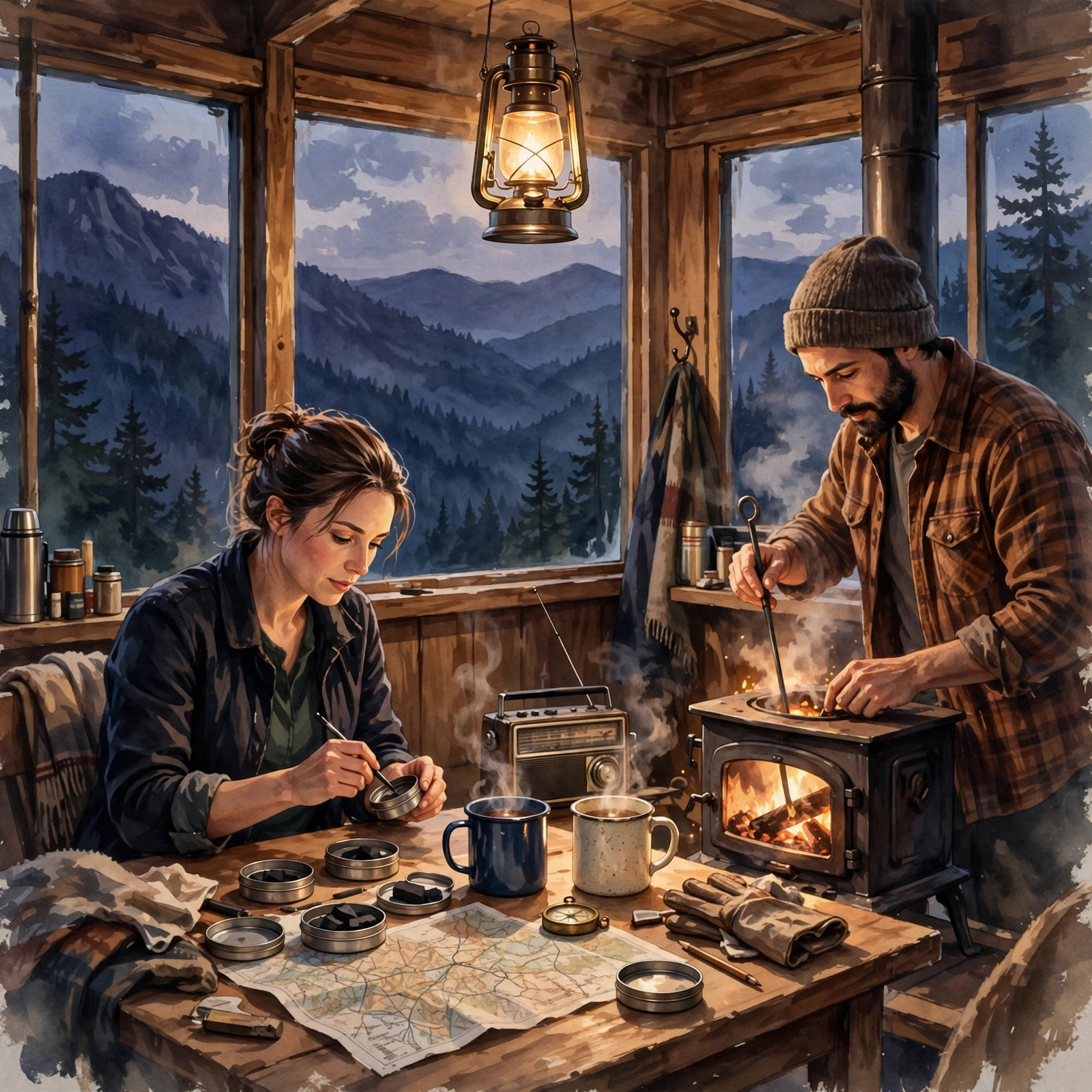
The cab was fourteen meters of wind-worn steel and glass with a table in the middle of it, and now it was the whole world. Gale lit the little propane burner and set the dented pot on it, and Delphine pulled her satchel onto the table and unbuckled it while the rain hammered the roof like applause that wouldn't stop.
She laid the nine tins out in a row.
All nine. The sealed one from the cabin, logged at 09:55 yesterday, and the eight still empty, waiting. She checked each one in order, turning it in her hands, reading the tape seam, the marker ink, the way a jeweler reads a stone for cracks. The rain made the light gray and even, good light for close work.
"You're doing it again," Gale said.
"Doing what."
"Checking things you already checked."
"I checked them in different light." She held the fourth tin up to the window. "Tape fails at the seam when it fails. Ink smears when it smears. I'd rather find it here than on a witness stand with somebody's lawyer asking me why I didn't."
He poured coffee into two enamel cups, chipped at the rims in different places, and set one down beside her row of tins without asking whether she wanted it. She noted that and let it go. The coffee was black and slightly burnt and better than it had any right to be.
"The man with the clipboard," he said. "From yesterday. Tell me the rest of it."
Delphine ran her thumb along the seam of the sealed tin and didn't answer right away. The rain filled the silence for her, patient, unbothered.
"An examiner did. Not a lawyer. A man from the state lab who thought origin analysis was junk science with a ruler." She set the tin down, squared it to the table edge. "I had a fire in a warehouse, well, the reading was clean, my reading. He took my charts apart in front of twelve people and enjoyed it. The finding held up anyway, later, in a second review. But I stood there in that room and learned the lesson he didn't intend. Which is that nobody carries your proof but you."
"So now you count your tins twice in the rain."
"Now I count everything twice." She looked up. "You think that's a flaw in me."
"No." He drank his coffee standing, shoulder against the window frame, watching water sheet down the glass in ropes. "I think it's expensive, is all. I know a little about expensive habits."
She waited. The rain kept on. The burner ticked as it cooled.
"This tower," he said finally, "there were nine of them in this county when my father started in the fire service. Nine lookouts. This is the one left. They talk about decommissioning it every budget year. Snow load, steel fatigue, the cost of a truck coming up sixty kilometers of bad road to bolt a new tank on the leg." He nodded toward the window, toward the cistern riding the tower's leg with its five hundred gallons going nowhere. "Every October I write a letter saying it held. Every spring I come up and prove it."
"How long have you kept it standing?"
"Longer than anybody thought it would." He smiled a little, down into the cup. "Longer than some people wanted it to, honestly. There's outfits that would do well with this ridge opened up, timber outfits, but the road up here is fire-service road, and as long as the tower stands, it stays a fire-service road."
Delphine's hands went still on the tin she was holding. Timber outfits. She didn't say the name that rose in her mouth. She set the tin back in its place, ninth in the row, and watched him instead.
"So you hold it," she said. "That's the job."
"That's the job," he agreed, a shade too quickly, the way a man agrees to the version of a thing he can afford to have heard.
The rain eased a notch, enough that she could hear the cistern gutter running, feeding the tank drop by drop. Gale set his cup down and pulled something from his shirt pocket. She'd seen him touch it a hundred times without seeing it, the way you don't see a wedding ring or a scar. Now he put it on the table between them, in the gap behind the row of tins.
A matchsafe. Brass, dark with handling, a striker plate worn bright along one edge. Engraved across the lid in letters cut by hand, deep enough to survive forty years of pockets. E. Bromley.
"Your father's," she said.
"He carried it his whole career. Old habit from the days when a lookout lit his stove with what was in his pocket." Gale worked the lid open with his thumb. It clicked, a small precise sound under all that rain. "I put matches in it when I took it over. For years I carried it full. Felt like keeping the stove going for him."
He tipped it over the table. Three wooden matches slid out, old, fat-headed, the strike strips gone soft. He lined them up next to the brass, and then, with two fingers, pushed the matchsafe down the table toward her until it touched the edge of the sealed tin, the one that held yesterday's fire.
"Empty now," he said. "Empty's honest. I don't light anything out here with the ridge this dry. And a man who carries matches on a dry ridge is carrying an argument against himself."
Delphine looked at the little brass box sitting against her evidence, the striker plate bright as a promise, and understood that she was being told something sideways that couldn't be said straight. She reached out and turned the matchsafe a quarter, reading the engraving under the gray light, and her fingers were still on it when his hand came to rest on the table not six inches away. Not touching. Close enough that she could feel the warmth off his knuckles in the cold of the cab, close enough that neither of them moved for a long moment, the rain going soft above them like it was giving them room.
"He kept fire logs," she said quietly. "Forty years of them, you told me. Same hand the whole way."
"Same hand." Gale's voice had gone somewhere she hadn't heard it go before, lower and easier at once. "He believed you write down what happened and you don't improve it. I've tried to run my career on that. Some days I do better than others."
She almost asked him which days he did worse on. The ruts at the cabin yesterday, the squelch on channel seven, the flatness in his voice when he'd said could be. The questions lined up like the tins, nine neat doubts she could seal and label.
She asked none of them. Not today. The coffee was warm and the rain had boxed them in together, and the matchsafe sat open and empty between her proof and his, which was as close to a truce as either of them knew how to offer.
Thunder moved off south. She went back to the tins, third pass now, because the light was failing and failing light found seam flaws that honest light missed. Somewhere in the sixth or seventh tin her eyes started closing on their own. Two short nights, the climb, the burn scar, the report. The third morning arrived in full.
"You're done," Gale said. "Third pass, Doc. Even your warehouse man can't ask for a fourth."
"He could. He's creative."
"Then he can get rained on for it." He took the tin gently out of her hand and set it in its place, ninth, squared. "Sleep. I've got the watch. That's the actual job description, they mail it to you."
"Channel seven," she murmured, already halfway down into her folded arms on the table. "Keep an ear."
"I keep both of them," he said. "All the time."
She was too far under to weigh that the way she'd have weighed it awake. The last things she registered were the rain going gentle, the coffee smell going cold, and the matchsafe still open on the table an inch from her hand, empty, striker bright, honest in the only way brass knows how.
Gale pulled the wool blanket off the cot and settled it over her shoulders without waking her, then took his coffee to the window and kept the watch, closer to her than any duty on the mountain required.
The Second Radio
The rain quit before dawn, and by the time the sun cleared the far ridge the boards of the catwalk had begun to steam. Delphine woke with the wool blanket still tented over her shoulders and the print of the binder's edge across one cheek. Gale's cot was empty, made tight, the pillow squared like it had been inspected.
She found him below, at the base of the tower, working the cap off the cistern. Five hundred gallons in that tank, and he dipped a test strip into the sample tap like a man checking his own pulse.
"Water's clean," he said, without turning. "Pearl had the forecast an hour ago. Wind's swinging west by noon. That puts any smoke on this slope."
"I heard her." She had, half-waking, his voice and Pearl's trading weather through channel seven, the repeater on the peak between them carrying it clean. "She say anything about the road?"
"Washed out past the second switchback. Nobody's coming up. Nobody's going down, either." He capped the tank and wiped his hands on his thighs. "You've got two days of food in that crate if we're careful."
"I'm never careful with food."
"I noticed."
It should have been an easy morning. That was the thing she'd think later, turning it over the way she turned a charred joist, looking for the honest edge. It should have been coffee and a checklist and Pearl's voice on the radio saying the hearing in Kestrel Falls was confirmed for day six, in person, no exceptions, and it was all of those things for almost three hours.
Then she went looking for the battery pack for her kit lamp, and Gale's supply crate was the only dry place left to search.
He'd gone up to walk the catwalk, his binoculars and his habit of counting what he could see. She knelt over the crate in the shade of the tower's leg, moved the coil of wire, the spare fuses, the coffee tin of nails, and under a folded tarp, wedged flat against the plywood wall, lay a radio.
Not the county radio. Not her state unit. A company handset, black and scuffed, the kind with a logging outfit's numbers etched on the case, and the etching said VINT.
She held it in both hands for a long moment. Fourteen meters of steel above her, and every one of them suddenly felt like a stranger's.
She climbed. He heard her coming, because he always heard her coming, and turned from the catwalk rail with the binoculars still up.
"You want to tell me what this is doing in your crate?"
He lowered the glasses slowly, the way a man does when he's buying a second he knows he doesn't deserve. His eyes went to the radio and stayed there. "Delphine."
"Channel seven." Her voice came out flatter than she meant it to. "That squelch after my report on day two. Somebody keyed a mic. I told myself it was the repeater cycling, because repeaters do that, they hiccup, and I don't, I don't accuse a colleague on a hiccup." She set the radio on the cab table, next to the open matchsafe, and the two brass-and-black objects sat there like exhibits. "This isn't a hiccup, Gale. This is a company radio keyed to the county channel, in your crate, on my mountain."
"It's not your mountain."
"You know what I mean."
"I know what you mean." He came in from the catwalk, and the door swung shut behind him with the sound the mountain made when it wanted you quiet. He didn't reach for the radio. She watched him decide not to reach for it, watched the decision travel down his arm and stop at his wrist.
"Say it," she said. "Say whatever it is, because right now the version I'm building has you on the phone to Vint Timber's people the night I sealed that tin, and I have to tell you, my version holds up. I over-prove. It's a character problem, ask anyone who's ever cross-examined me."
"Nobody has to ask me. I've watched you do it for four days." He pulled the chair out and didn't sit in it, just stood holding the back of it. "It's not what you're building."
"Then take it apart for me."
The silence went on long enough that Pearl's voice came up through the county radio on the shelf, reading the ten o'clock weather for the district, wind and humidity and a red-flag notice for the afternoon, and neither of them moved until she'd finished and signed off with the little click she always left, like a period.
"My cousin crews for Vint," Gale said. "Denny's crew, the one working the north flank. Every outfit man on that hill carries a company radio, and every company radio in this county ends up keyed to channel seven inside a month, because the county repeater's the only signal that reaches anything and the company repeater's junk. It's not a plan. It's a habit. They key up, they listen to dispatch, they complain about Pearl's tone. Half of them don't even know they're doing it."
"And you knew."
"I knew."
"Since when?"
He looked at the matchsafe. She watched him look at it, and something in the look made her not press, for exactly one second, before she pressed anyway.
"Since I logged," he said. "Eleven years I've been up here part of the year and down in the valley the rest, and loggers talk on seven like it's a bar. I kept one in the crate so I'd know what they were saying. About the road. About the tower." His jaw worked. "About you, this week."
"About me."
"They know you're here. They know about the hearing. Vint can't touch you up here, Delphine, you're state, you're a witness, the man's a lot of things but he's not stupid enough to send somebody up a closed road. So he's using what he's got. Fire and talk. The cabin they burned on day two was one of the old company cabins, and there'll be another one tonight or tomorrow, because every one that goes up is a record that goes with it."
Her nine tins sat in their rack, sealed, labeled, her whole case in a wooden box, and she thought of the examiner at that hearing years ago, the one who'd stood up in front of everyone and called her origin analysis a guess in a lab coat. She'd sworn she'd never be the one who missed the truth in the room. And here she'd slept under a stranger's blanket while a radio in his crate listened to her whole operation.
"Your father," she said, because the matchsafe was still lying open and she was tired of walking around it. "The logs. Forty years. What happened to him, Gale?"
The question landed wrong, or right, she couldn't tell, only that his whole body changed around it, the way a house changes when a door opens onto a room you've kept shut.
"There was a fire," he said. "Back when I was a kid. Slash burn that jumped its line on a dry slope, and the slope was below a Vint job site, and the job site's paperwork said the burn was permitted and controlled and closed out clean." He turned the matchsafe over with one finger, striker plate down. "My father went up that slope with the fire service. He didn't come down. And when the state came in to read the origin, the job site had been cleared, graded, and replanted. There was nothing left to read. The finding was inconclusive. I've had that word in my house for a lot of years."
"Inconclusive," she repeated. It was the worst word she knew. It was the word the examiner had tried to hang on her.
"So when you stood in that cabin doorway on day two and read the pour trail off the threshold like it was a sentence," he said, "I knew exactly what Vint was doing, because I'd seen it done before, to better people, for less money. And I said nothing about the radio because saying it put my cousin's crew in it, and my cousin's got kids, and because," his hand closed over the matchsafe and then opened again, empty, "because I've spent my whole life keeping that tower standing and that name clean, and I didn't want you looking at either one of them the way you're looking at me right now."
"How am I looking at you?"
"Like a seam flaw."
She almost laughed. It came out as something smaller. "The binder's open," she said, because it was, splayed on the table between them, her lab sheets and her maps, the whole case lying there while they talked around it. "Every call I've made from this cab since day one went out over a channel that crew listens to. My chain of custody isn't just my samples anymore. It's my radio traffic. Vint's lawyer will stand up in that hearing and ask me who else heard my reports, and when, and I'll have to say a timber outfit did, because the deputy guarding me had their radio in his crate."
"Yes," he said. No flinch, no case for himself. "You'll have to say that. All of it's true."
She looked at him for a long time. The trouble with over-proving everything was that you eventually proved things you'd have paid not to know.
"I need to not be in this room," she said.
He nodded once and stepped away from the door, and she took the blanket off the cot, gathered the binder and the tin rack into the satchel, and went down the stairs with her hand on the cold rail, all the way to the county truck parked in the shade at the tower's foot. She folded herself into the passenger seat with the satchel against her ribs like a splint and let the exhaustion take her under, hard and fast, the way it only does after trust breaks.
The last thing she saw through the windshield, before sleep closed over her, was Gale at the base of the tower, sitting on the crate he'd hidden it in, the black radio in one hand, turning it over and over, not keying it, not putting it down.
Deciding. Even from below, even half gone, she could see him deciding.
What the Matchsafe Held
The wind woke her before dawn did, and the smell with it. Delphine sat up in the truck cab with her heart going like a snare drum, and through the windshield she could see it, low on the south slope, an orange seam where no orange seam had been when she'd closed her eyes. Somebody had fired the dry brush below the road cut in the night. Somebody who wanted the wind to do the rest of the work for them.
She was out of the truck and on the stairs before her boots felt fully awake, taking the switchbacks of the fire road at a jog, the binder clamped under one arm. One hundred and eight steps up to the cab, and she counted every one of them out of pure spite, because counting was a thing she could do while her head was shouting that the fire was between her and the hearing, between her and everything she'd come up this mountain to prove.
Gale was already on the catwalk with binoculars, and the second radio, the company one, lay on the rail beside him like something dead.
"Below the road cut," he said without turning. "Two points of origin, maybe three. Set in the night, laid to run uphill." He lowered the binoculars. "They want the tower. They want you running, and the tower burning behind you, and a grand jury that never hears a word."
"Then they don't get either one." She set the binder on the table inside the cab, weighted it against the wind with a tin case. Nine tins. Her whole case in nine small sealed cans and a stack of lab sheets, and a fire coming up the mountain to eat the paper.
Gale crossed to the far corner of the cab, knelt, and pulled a floor panel up. Underneath, coiled like a sleeping snake, ran a wire, old cloth-wrapped telephone line, the kind the county had strung to lookouts before repeaters made it obsolete.
"This goes down the mountain to the ranger junction box," he said. "It's dead to the county system, but Pearl's desk sits ten feet from the junction. If she patches her end, we've got a private line that never touches channel seven. Vint's ears are on that channel. They're not on copper wire in the ground."
"You knew this line was here."
"I've maintained it off the books for years. Along with everything else I maintained off the books." He looked at her straight. "That stops today. All of it."
He lifted the desk phone off the cab's wall bracket, an ancient black thing with a crank, stripped two inches of the buried line with his pocketknife, and twisted the copper to the phone's leads with hands that clearly had done this before and never told anyone. He cranked. Cranked again. Then a small crackle, and Pearl Yazzie's voice came up out of the ground like water from a well, flat and unhurried and better than any sound Delphine had heard in five days.
"Cinder Peak, this is dispatch. Gale, is that you on the dead line?"
"It's me, Pearl. And Deputy Okonkwo's here with me, so consider this line official. You recording?"
"Dispatch records everything, you know that."
"Good." He took a breath like a man stepping off something high. "Then take my statement. Yesterday I found a company radio in my supply crate, keyed to county channel seven. It belongs to a Vint Timber crew. My cousin's crew. They've been riding our channel for years, and I knew it, and I kept quiet about it because they're family and because I was protecting this tower and a lot of things that aren't mine to protect. That radio's compromised every call made from this mountain since the investigator arrived."
Delphine stood very still. On the rail, the wind moved the binoculars strap back and forth.
"This morning, somebody fired the slope below the Cinder Peak road cut. Multiple origins, night ignition, laid to run at the tower. I want that on record too. And Pearl, one more thing, and I want you to write this one down word for word."
"Go ahead, Gale."
"Twenty-two years ago, my father, Ellis Bromley, died on the draw fire above a Vint Timber slash burn, along with half a crew. The burn was never properly cleared with the county. Vint's outfit burned the paperwork after. I've known that, and I've been quiet about that too, and I'm done being quiet." His voice stayed level the whole way through, which cost him something, she could see it costing him, a small tremor in the hand holding the phone. "That's my statement. Sworn, recorded, and you can hand it to whoever needs it."
A long pause on the line. Then Pearl, softer than Delphine had yet heard her: "Copy all, Gale. I'll walk it over myself. You take care of that mountain."
He set the phone down. Delphine realized she had been holding the rail hard enough that her fingers ached.
"Your cousin," she said.
"My cousin. My family name in a grand jury file by noon." He shrugged, and the shrug didn't cover it. "The road stays closed either way. The tower stays standing either way. I finally figured out the only thing I was actually protecting by hiding was the hiding."
Then he reached into his breast pocket and brought out the matchsafe, and put it in her palm.
The brass was warm from his body. She turned it over. The striker plate was worn silver in the middle, and on the underside, small as a signature, three letters were engraved: E. BROMLEY, and a year. The season before he retired, Gale had said. She did the arithmetic without wanting to, and the arithmetic put Ellis Bromley's last engraved season two fires before the draw.
"Gale. This was your father's hands on this."
"I know what it is. I've carried it eleven years and I know exactly what it is." He closed her fingers over it with both of his. "It's evidence. It puts him on a Vint job site, in the year, with the company's own matchplate pattern. Delphine, look at the striker. That's a Vint issue plate. He swapped the original out, company men did, so the safe would strike their matches. Your lab can match that plate to the ones in your tins from the cabin."
She looked at it in her palm, the little brass box, the whole grief of this man folded up inside it, and she had prosecuted enough to know what a thing like this did to a case and what it did to the person who handed it over.
"I'll log it into evidence," she said quietly. "Chain of custody starts with me. And when the hearing's done, I'm bringing it back up those stairs to you. That's not procedure. That's a promise."
"Procedure never came up this mountain anyway."
Below them the fire had found the slope's spine and started to walk. They worked fast after that, and they worked in rhythm, no words wasted. The cistern tank sat bolted to the tower's north leg, five hundred gallons, county steel, and Gale dragged the hose reel out from under the stairs while she took the nozzle end and paid it out down the switchbacks until they had a wet line strung across the road cut like a dark stitch in the hillside. He opened the valve and the tank thumped and the hose fattened, and they soaked the cut brush until the ground went black with wet and the fire's advance turned into an argument, flame meeting ground that would not burn.
Then the sky, which had been piling gray all morning behind the peak, finally leaned in.
The first rain came fat and scattered, striking dust on the catwalk, one drop, then ten, then a soft gray curtain walking across the slope. Delphine stood at the rail with the nozzle dripping in her hand and watched the smoke on the ridge bend, lean, and start to come apart like wet paper.
Gale came and stood beside her. Rain ran off the brim of his hat. The fire backed down the slope away from them, hissing, losing its nerve.
"Pearl says the front sits over us through tomorrow," he said. "Fire'll creep but it won't run. Not in this."
"Then tomorrow I testify."
"Then tomorrow you testify." He was quiet a moment. "I'd have understood if you took the truck this morning and never came back up the stairs."
"I counted the stairs on the way up." She set the nozzle down. "All of them. I wasn't leaving before I finished counting."
He turned to look at her, rain between them, and she found she had already moved, or he had, and it didn't matter which, because the distance closed. She kissed him with rain coming down on both of them and the matchsafe a small hard weight between their joined hands, and it was not careful, the way she had been careful with everything for years, and it was not a question either. His hand came up to the side of her face, cold fingers, warm palm, and the fire below them surrendered the ridge one slow yard at a time.
When they broke apart, neither of them stepped back. The smoke had gone off the ridge entirely, pushed down and sideways, dissolving into the gray.
"The hearing's at nine," she said against his collar. "Sixty kilometers of wet road."
"Then we leave at first light." He laced his fingers through hers on the rail, over the little brass box. "I'll drive."
They stood on the catwalk while the rain came on steady and the mountain drank, his hand and hers linked around everything he'd given up and everything she'd promised to bring back.
The Tower Road
First light came gray and dripping, and the county truck took the switchbacks down slow, wipers slapping, the burned slope below the road still steaming faintly where the backfire had eaten its strip. Delphine rode with the nine tins in a crate between her boots and the binder flat on her knees. Gale drove with both hands on the wheel and said almost nothing for the first ten kilometers, which she understood. Sixty kilometers of wet road gives a person room to arrange their face.
"Pearl confirmed the escort meets us at the highway," he said finally. "Two state cars. Your office takes no chances with you."
"The office takes no chances with the tins."
"Same thing this morning."
She looked at him. His knuckles were white on the wheel, and she knew it wasn't the road. He'd named his cousin's crew on a recorded line yesterday morning, and today the recording would be played in a room full of people he'd known his whole life, and he was driving her there anyway.
"You don't have to come inside," she said.
"I do, actually." He took the last curve before the highway. "I'm the one who held that radio in a crate and called it standing guard. I'll stand somewhere better today."
The escort vehicles were waiting under the overpass, lights off, patient in the rain. The drive into Kestrel Falls took an hour, and the whole way Pearl's voice came through the patched line on the truck's hand unit, steady as a dispatcher's clock, reading them the weather and the road and, at 8:40, one more thing.
"Warren Vint's outside the courthouse," Pearl said. "Been there since seven. His lawyer's with him. You want I should hold your call until you're inside?"
Delphine pressed the handset. "Is he on channel seven, Pearl?"
"He can't hear this line. That's the point of it, honey."
Gale huffed something close to a laugh, and Delphine felt her own mouth pull sideways. Vint could stand on those steps all morning with his ears pinned to every county frequency, and nothing he heard would help him, because the two people he needed to fear weren't using the county's air anymore.
The courthouse had a broad stone staircase and wet flags snapping above the doors. Vint stood on the fourth step in a good coat, and when the state cars pulled in behind the county truck he came down to meet them, hand extended, voice pitched for the reporters under the awning.
"Ms. Okonkwo. I hope the ride down was safe. Wild country up there. Debris everywhere this time of year."
Delphine took her crate of tins out of the truck and did not take his hand. "Mr. Vint. You'd know about debris."
"Now, that sounds like an accusation."
"It's an observation," she said. "You'll hear the accusations inside."
His smile held while Gale came around the truck, and then it did something smaller. Gale said nothing at all. He only stood there in his rain-stiff hat with the recorder's case number already typed on a transcript inside Delphine's binder, and Vint looked at him the way a man looks at a door he thought he'd locked.
It went wrong for Vint on the steps, and it went wrong fast. A deputy U.S. marshal met them at the doors with a warrant, and the words "unlawful interception of county communications" came out into the open air before anyone could move it inside. Someone had sold him a copy of the channel seven recording, the recording Gale had given freely, and the sale was the crime that handcuffs fit. Vint's lawyer was still objecting to the rain when they took him down the steps past his own flags. He didn't look at Delphine. He looked at Gale, and Gale let him look, and then Gale held the door for Delphine and her crate like none of it had touched him, though his jaw said otherwise.
Inside, the grand jury room smelled of coffee and wet wool. Delphine testified for two hours. She walked them through the cabin fire from origin outward, tin by tin, the char patterns blown up on the projection screen, the ignition trail that started not at the stove but at the doorframe, poured from a can, lit with a match struck away from the body. She showed the matchsafe's striker plate beside the lab photograph of the cabin's plate, the same Vint issue pattern, cast and engraved by a fireman named Ellis Bromley the season before he retired from the fire service, seasons before he died on a Vint slash burn, recovered decades later from a cabin Vint's outfit wanted burned. She showed Gale's statement. She answered every question twice when asked, because over-proving was what she did, and today, for the first time, it wasn't armor. It was just thorough.
When the forewoman announced the vote, Delphine felt Gale's shoulder press hers once, briefly, in the back row. Indictment on all counts.
Outside, the rain had thinned to mist. Pearl met them under the awning, off shift, holding two cups of vending machine coffee like an offering.
"I listened to every word on the patched line they ran into the room," Pearl said. "Don't tell anybody. Twenty-two years I've patched lines for this county and today's the first day I was proud of it."
"Pearl," Gale said, "you got us through the week."
"I got you through six days." She handed him a cup. "You want the seventh, that's between you two. There's a posting notice on my desk for the summer caretaker job. State money, your office approved it this afternoon, Ms. Okonkwo. Somebody in that building was listening to you testify for a different reason than the jury was."
Delphine felt her face go warm. "The tower keeps the road closed. That's worth funding."
"Mm-hm," said Pearl, and walked off smiling into the mist.
Gale drove them back up in the last of the light, the tires hissing on wet blacktop, the ridge above them showing green again through the black strips where the fire had tried and failed. They didn't talk much. There didn't seem to be a need. His hand came off the wheel at the long straight stretch and rested on the seat between them, palm up, and she set her hand in it, and that was the whole conversation, and it was enough.
The stairs were slick and smelled of rain on hot steel. Delphine climbed the hundred and eight steps behind him, counting by habit, and when they came up through the trapdoor into the cab, the last light was lying across the table where the map case sat and the little brass box had lived for a week. Gale lit the lamp. The storm was gone off the ridge entirely, the sky rinsed and rinsing, the smoke a memory the wind was already erasing.
He took the folded posting notice out of his jacket and pinned it to the wall beside the window, four pins, square. SUMMER CARETAKER, CINDER PEAK FIRE LOOKOUT. His hands were steady on the last pin, and she watched them be steady, and thought of all the things those hands had let go of this week to stand in this room.
"It's ours if we want it," he said. "The job's mine. The tower could be ours."
"I have to be in the city half the month."
"I know how to drive."
"I know how to drive too."
"Then we'll fight about it," he said, "up here, where it's quiet."
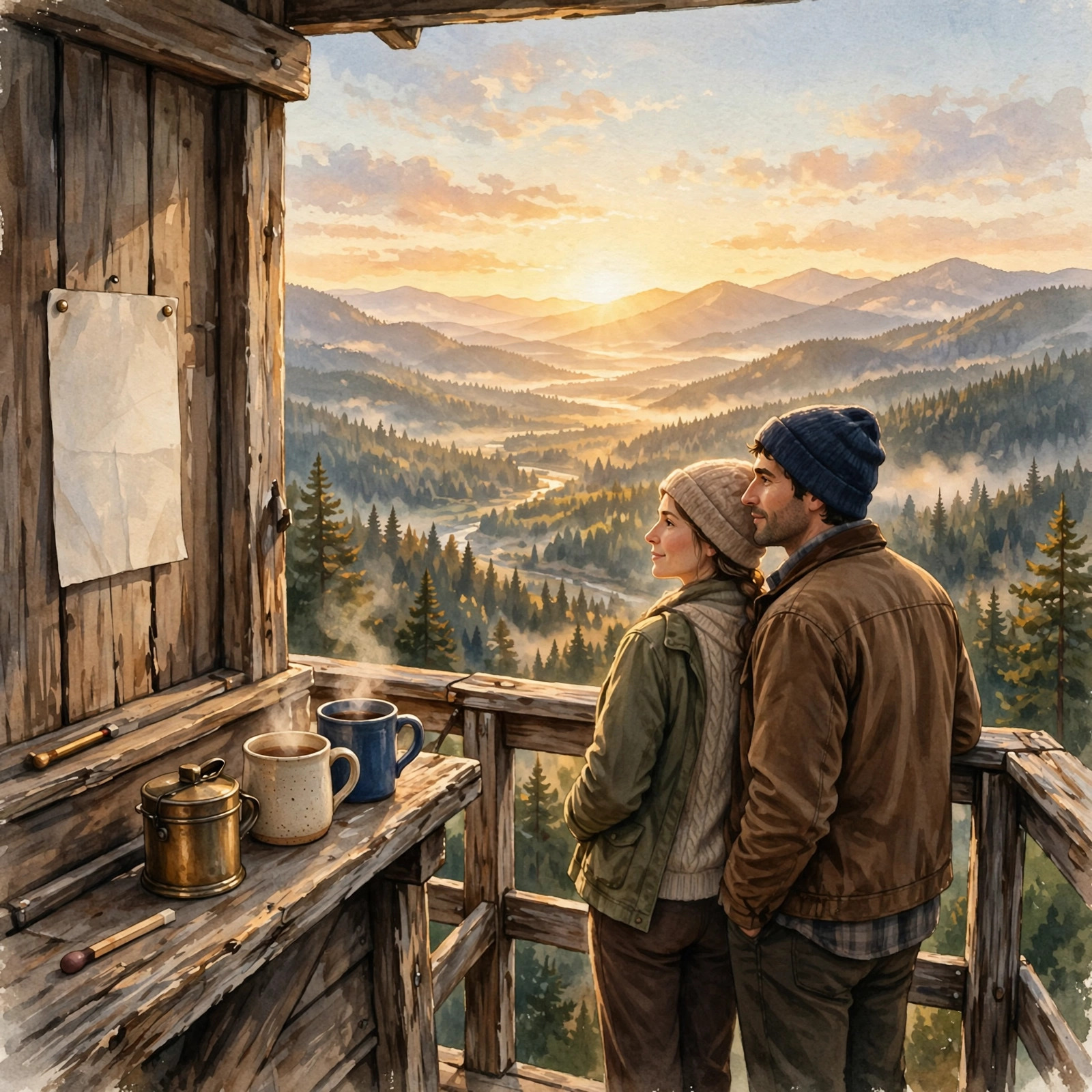
She laughed, and it came out easy, and she poured coffee from the pot into the two mugs that had been sitting side by side on the shelf all week like they'd been waiting to be a pair. She set them on the sill. Then she took the matchsafe from her jacket pocket, his father's brass, striker worn bright by a dead man's thumb and by all the years Gale had carried it, and she stood it on the sill between the two mugs, striker up, facing the window, facing the draw where Ellis Bromley had gone in and not come out.
"He should get the view," she said.
Gale looked at the little box for a long moment. Then he reached out and turned it a few degrees, angling the striker toward the sunrise side, and his hand shook once and then didn't.
"He'd have liked you," Gale said. "He over-proved everything too."
"He'd have liked that I made you tell the truth."
"He'd have liked," Gale said, "that it counted."
On the seventh day, the fire gone and the ridge green and the tower theirs, Delphine Okonkwo drank her coffee in the cab of the last lookout in the county, beside a man who had given up his secrets to stand there, and the brass box between their mugs caught the first of the evening light and held it.
Get notified when new stories drop

Serena Blake
Serena writes romantic suspense and dark romance for readers who want pulse and payoff. Her stories chase trust as hard as they chase danger.
Leave a comment
Comments