





The Orange Tape
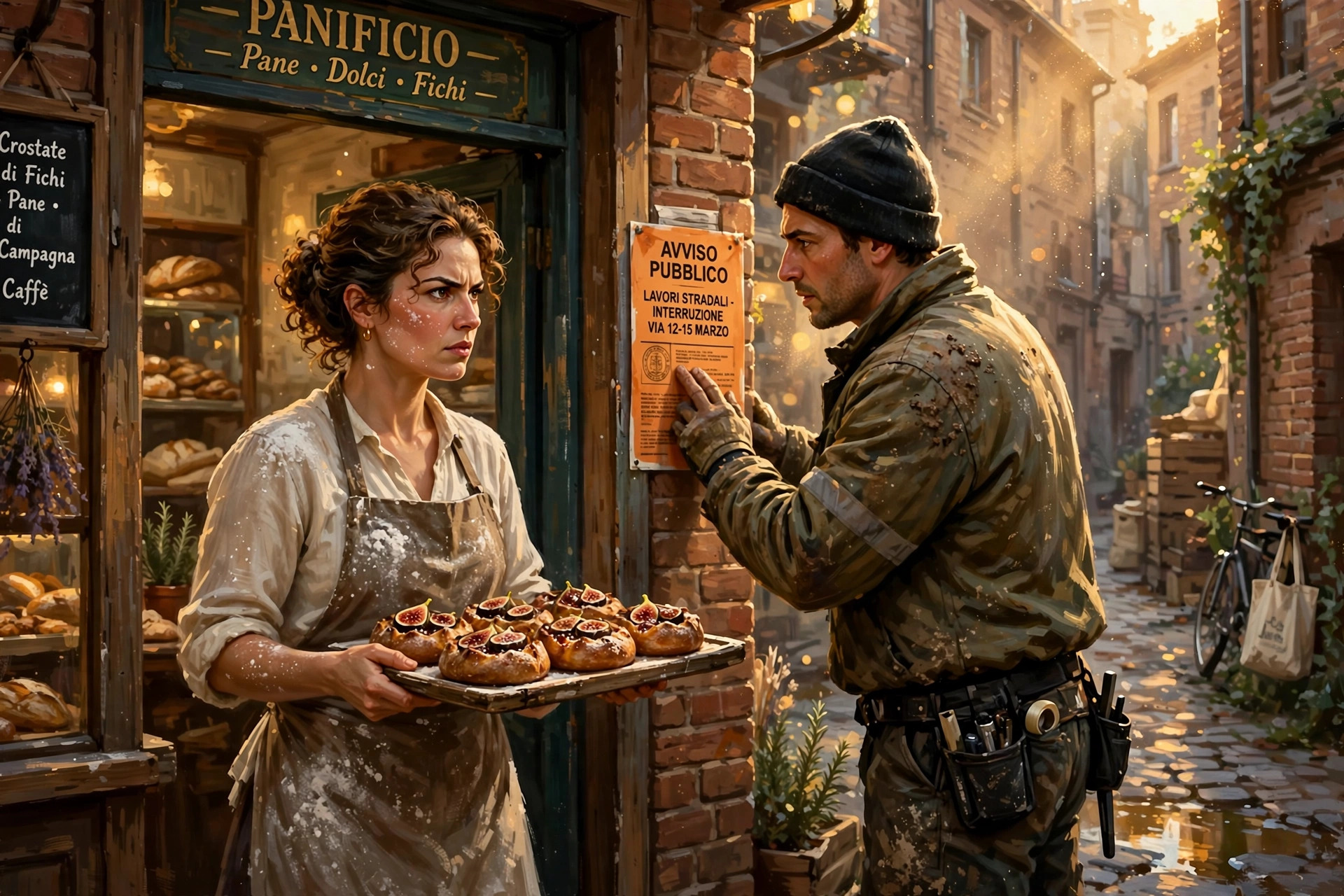
Delia Marchetti was carrying a tray of fig crostatas through the back door of The Fig Counter when she saw a man's arm stretched over the alley side of it, smoothing a sheet of paper flat against the wood.
"You're taping over my hinge," she said.
He turned, and she took him in the way she took in anyone standing too close to her ovens: quickly, completely, and with a plan already forming. Clipboard under one arm. Crestline Engineering windbreaker, muddy at the cuffs. A crease between his brows like he'd been apologizing since breakfast.
"Sorry. There's a hinge?" He peeled one corner of the orange tape up and re-laid it an inch to the left. "I'm Cole Danvers. Crestline. This is the public notice for the Fig Tree Lane utility spur."
"I can read the header from here." She set the crostatas down on the crate by the door, wiped her hands on her apron, and looked at the paper the way she looked at invoices. "Posted easement. Thirty-day comment window. You're the field office?"
"Managing engineer for the alignment, yeah." He offered a pen, of all things, as if she might want to sign for the thing. "There's a hearing date on page two."
"I saw it." She put a fingertip on the paper, held it against the door, and read every line while he stood there. Half the people who posted notices on Fig Tree Lane couldn't tell you what they'd posted. She gave him the full silence, top to bottom, twice. The spur ran the length of the lane. The easement zone hugged the rear property line of every shop on the block, hers included. "It comes four meters off the lane."
"The alignment needs the width for the utility corridor and maintenance access."
"The alignment needs my alley." She said it without heat, which was worse, and he seemed to know it, because he took half a step back. "Behind this wall there are two ovens, and they breathe through that alley. There's a vent, and there's clearance behind it, and if your corridor takes the width it says it takes, the fence goes where my air goes."
He glanced past her at the low brick wall, the vent hood, the stacked flour pallets she kept exactly where she kept them. "How much clearance are we talking?"
"Enough that I measured it with my own tape and wrote the number on the wall in pencil, because I don't trust other people's numbers." She could feel her grandmother in that sentence, the whole shape of her, and put it aside. "You want to come inside and see it? Or do you want to stand behind orange tape and tell me the numbers are the numbers?"
Something crossed his face at that, quick as a shadow under a door. "I'd rather show you the filed sheet than argue in an alley," he said. "But I'll take the tour if you're offering it later. Right now I have two more doors on this block."
"Then let me take it down."
"Ma'am, it has to stay posted for the notice period."
"It stays posted." She worked a thumbnail under the orange tape, careful, until the whole sheet came free with the tape still framing it, and held it up between them like a small flag. "On my corkboard, inside, where my customers can read it while they eat. Posted is posted. It says posted, not nailed to my door."
He looked at his clipboard as if there might be a line in the manual about women who peeled notices off with their thumbnails. "That's technically compliant," he admitted.
"Most things are, if you read them twice." She walked past him into the kitchen, and after a beat he followed, which told her something too. Most officials didn't come inside when invited. They stood on tape and waited.
The Fig Counter smelled like Monday mornings: burnt sugar from the tray, the dark toast smell of the ovens warming, coffee pulling through the machine up front. Pia was behind the counter with her sleeves shoved up, and she looked Cole over the way she looked over a till count that was going to come up short.
"Crestline," Pia said. Not a question. She'd been watching through the pass-through window; Delia knew because the milk pitcher was still spinning in her hand.
"Guilty." Cole lifted the clipboard a little. "Coffee, if you have time. Whatever's in the urn. Black."
Pia poured it, and Delia watched her sister watch him take the first sip. Pia had a look she reserved for people she was deciding about, and behind it, Delia knew, a ledger was opening. Small cup, no sugar, took it black without tasting it first. That would all go in the book Pia kept in her head about everyone who came through the door, and about this man it would be a long entry.
"You're the engineer," Pia said. "The one who signed the alignment."
"I manage the alignment," Cole said. "The signature's a stamp. There's a difference."
"Not to the fence," said Delia.
He set the cup down. "No. Not to the fence."
Delia crossed to the corkboard that hung between the pastry case and the register, the one she kept for licenses and the health inspection and the note about the delivery man who came Thursdays. She pinned the notice dead center, orange tape still around its edges, and next to it, because it was already in her hand's memory, she straightened the old photograph she kept there. A storefront, narrow, a hand-lettered sign, a woman in an apron squinting into the sun.
Cole leaned toward it. "That's not this block."
"No." She smoothed the thumbtack down with her palm. "It's not."
He didn't ask, which she appreciated more than she wanted to. His eyes went from the photograph to the wall behind the pastry case, where the rolling pin hung on its brass hooks, pale beech wood worn glossy at the grip, out of reach of every customer who asked if it was for sale. It wasn't, and she had stopped explaining why.
"That's a nice pin," he said instead.
"It's not for dough days," Delia said. "Today isn't dough day. Today is read-your-notice day." She pulled open the drawer under the register, took out the stack of flyers she'd run off the night before, when Pia had read the notice first through the back window and called her at home, and slid one across the counter to him. "Two hundred and forty signatures is what I have already. I started Thursday, when the field office marked the corridor with stakes. I'm not starting this fight, Mr. Danvers. I'm finishing it."
He took the flyer. Petition to the Ashby Falls council. Her handwriting, her bullet points, her measurements. He read it the same way she'd read his notice, top to bottom, twice, and she found herself respecting that against her will.
"You'll want the vent clearance in writing," he said. "Not pencil on a wall. I can tell you which sheet in the filing has the rear line offsets."
"You can tell me at the hearing."
"Or before." He folded the flyer once, carefully, and put it in the inside pocket of his jacket, and Delia noticed that he did not fold it small or stuff it in a pocket with his keys. He folded it like something he intended to keep flat.
Pia said nothing, but Delia heard the urn click as her sister poured the man a refill he hadn't asked for, and knew the ledger had turned a page.
Cole lifted his cup toward the corkboard, toward the notice and the narrow sunlit storefront beside it. "I'll be back about the vent," he said. "Thursday, maybe. If the coffee's like this, that won't be a hardship."
"Thursday's my delivery morning," Delia said. "The alley's full of flour until ten."
He smiled, quick and surprised, like the smile had gotten out ahead of him. "Then I'll come when the alley's empty."
She watched him go out through the front, jacket and clipboard and all, and stood a moment with her hand still on the flyer stack. Above the pastry case, the rolling pin hung in its brass hooks, quiet, kept, waiting for dough day like she was waiting for the hearing. On the corkboard, the orange tape framed the notice as if she'd hung it there herself on purpose, a border, a line drawn. She could work with a line drawn. Her whole life had taught her that much, and taught her the rest too: nobody else was going to read the fine print for her. She'd read it. She'd read it twice.
Pia came around the counter, arms crossed. "Black coffee. No sugar. Read the whole flyer standing up." She tapped the urn. "I'm giving him three visits before he stops being helpful."
"Give him four," Delia said, and turned the thumbtack on the photograph a quarter-inch, so Lucia's storefront hung level, so the woman in the apron looked straight out at the notice pinned beside her. "He folds things carefully."
Two Sugars
He came back Tuesday at seven-forty, which Pia announced from the espresso station in the voice she reserved for weather reports. "Engineer. Window seat. Same jacket." She marked something on the pad she kept beside the sugar caddies, and Delia did not ask what. Tuesday he drank one coffee and read a folded sheet of paper with crest lines on it and left a two-dollar bill under his saucer. Wednesday he came at seven-fifty, ordered a coffee and a croissant, ate the croissant in four careful bites while looking at the corkboard, and asked Pia whether the ovens ran on gas. "Gas and a lot of it," Pia said, and wrote something down. Thursday morning he was at the window table by quarter to eight, and Delia decided three visits was enough of anything, and carried the petition clipboard over before her courage could file an objection.
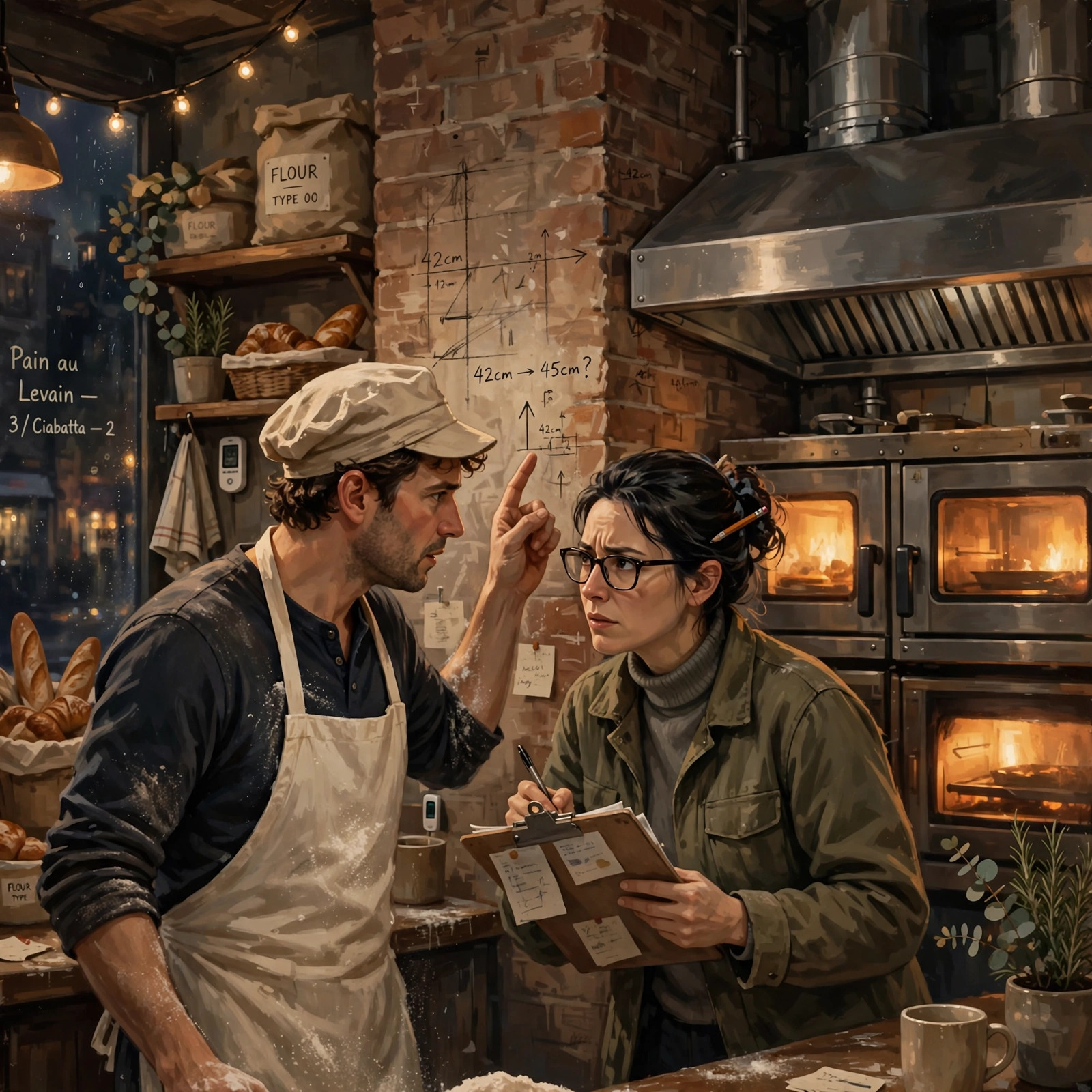
The clipboard was heavy. She'd counted the pages at the kitchen table the night before, and the count had not changed since: two hundred and forty names, in blue ink and black ink and one in green marker from the woman who ran the frame shop, all of them against the easement as filed. She set the clipboard down on his table hard enough that his coffee shivered in its cup.
"Two hundred and forty," she said. "Ashby Falls signatures. The frame shop, the barber, the whole Thursday bread line, the woman who's bought a fig crostata from me every Friday for eleven years. That's the filing I care about."
Cole put his pen down. He did that, she'd noticed. When someone spoke, the pen went down first, like he was clearing a desk.
"That's a strong number for four streets."
"It's a strong number for one alley." She turned the clipboard so the pages faced him. "You said you'd come back about the vent. It's Thursday. Talk."
He looked at the signatures longer than a man skims signatures. He read the top page the way he'd read the flyer, top to bottom, and she watched him find her name at the top of it, and Pia's under hers in the slanted handwriting their grandmother had straightened out with a ruler and a threat.
"Your rear line," he said finally. "The easement as filed puts the fence at the back property line, full width of the alley. That's standard for a utility spur."
"And my vent."
"Your ovens exhaust through the back wall. I looked Tuesday." He said it plainly, and then, as if he heard how it sounded, added, "From the alley. I didn't go in your kitchen."
"I know where you looked. I watched you from here." She hadn't, not exactly, but Pia had, and Pia reported. "The fence would sit where, exactly?"
He took the notice off the corkboard. He did it with both hands, lifted it off the pin, and Delia felt something in her jaw go tight, because that was her wall, her paper, her line drawn, and he handled it like it was his. Then he laid it flat on the window table and she saw the marks. Pencil, fine, engineer-neat, in the margins and along the alley. Little check marks. A dimension written in against the back wall. An arrow at the corner where her vent housing showed above the awning. He had been reading her alley into that sheet for days, and the sheet had been hanging on her corkboard the whole time, in her cafe, over her pastry case, three feet from her grandmother's rolling pin.
"You marked up my notice."
"I marked up the alignment." He turned the sheet toward her. "Here. Your vent needs ninety centimeters behind the wall to draw properly. That's in the mechanical code, it's not my opinion. The fence as filed sits at the property line, and the property line is closer than ninety centimeters to your wall. So yes." He tapped the arrow once. "As filed, the fence walls off your vent. The ovens can't clear. I'll say that at the hearing if you want it on the record."
Delia sat down across from him without deciding to. Under the table her knees wanted to pace; she made them stay.
"You signed this."
"I signed the survey. The survey is correct."
"The survey puts a fence in front of my vent."
"The survey puts a fence at the line the plat describes." His voice had gone flat and careful, the voice of a man reading off a page. "The numbers are the numbers."
"The numbers are numbers," Delia said. "Somebody chose where to measure them from. Somebody chose that line. My ovens were here first, my vent was here first, and some field office chose a line that bricks up my wall, and you're telling me the line is the line because it's written down."
"I'm telling you what's filed."
"I know what's filed. I read it twice. I read everything twice, because the last time my family trusted a piece of paper with a line on it, the paper won." She hadn't meant to say that much. She pulled it back. "Two hundred and forty people read it too."
"Petitions don't move alignments."
"Petitions move council members, and council members move filings, and that's the hearing, and that's Friday next, and you'll be there with your clipboard saying the numbers are the numbers." She stood up. The chair scraped. "You know what I heard just now? You said 'as filed' three times. Not once did you say 'right.'"
He was quiet for a second. Behind him the window gave back the street, the fig tree the lane was named for, the morning. "It's not my call what's right," he said. "I do the math. Other people decide what it's for."
"That's the most frightened thing anyone's ever said to me over coffee."
He looked, briefly, like she'd slapped him with the clipboard instead of setting it down. She picked it back up. At the counter Pia was pretending to polish the urn with one hand and write with the other.
"Two sugars," Delia said to her, not quite under her voice. "He orders black, but he takes two sugars from the caddy when he thinks nobody's counting. Three visits."
"I have a column for sugar," Pia said.
"Add him to the tally, then." Delia set the clipboard on the counter, took the pencil off its string, and wrote COLE in the margin of Pia's pad, under three coffee marks and a croissant note. Then she looked at it, at his name sitting in her sister's ledger in her cafe beside her two hundred and forty signatures, and she drew one line through it. "No. He's not a regular. He's a filing."
"He's a filing who marks your alley on his own time," Pia said.
Delia put the pencil back on its string. When she turned, Cole was standing at the window table with the notice in both hands, rehanging it on her corkboard, on her pin, straight, so the orange tape framed it evenly again. He'd squared the corners. He stepped back from her wall like a man leaving someone else's church.
He put a card on the counter on his way out. Cream stock, Crestline Engineering, his name, a cell number, a line number. "The vent figures," he said. "If you want them before the hearing. Ninety centimeters is code, and code is worth more than a petition if you say it right."
"I say everything right."
"You say everything loud." He was almost to the door. "Loud works on council members, for the record. Dana Ruiz likes a full room."
Then he was gone into Thursday, and the bell settled, and Pia turned the pad around on the counter so Delia could see it. COLE, lined out once, still legible under the strike. Three coffee marks. A croissant. A little sugar tally, two dots, in its own column.
"You crossed him out," Pia said, "and then you counted his sugar."
"I count everything," Delia said, and put his card in the drawer under the register, face down, which was not the same as throwing it away, and both of them knew it.
The Vent Stack
Sunday mornings belonged to the ovens. Delia came in at four with the streetlights still on, fired all four decks, and by six the whole alley behind The Fig Counter smelled like char and butter, which was the smell of her whole childhood, and which she had been afraid for six days was about to become the smell of something she used to have.
She took the rolling pin down off the brass hooks above the pastry case at four-thirty, the way she did every dough day. Beech wood, worn smooth at the ends where two generations of palms had worked it, carved by her grandmother Lucia in 1971 in a bakery that no longer existed on a corner that no longer existed, because the county had needed the corner more than the neighborhood did. Delia never took it down for anything but dough. Pia called it the sacred object. Pia was not entirely joking.
So when the bell went at seven-fifteen and it was Cole Danvers with his reflective vest half-zipped over a flannel shirt, he walked into a room that was already running, and the first thing he saw was her with the pin in her hands, flour to her elbows, and he stopped as if he'd caught her mid-ritual. Which, in fairness, he had.
"It's Sunday," he said.
"It's dough day. Sunday and dough day are the same thing. Pia, don't give him a table, he'll just look at the wall."
"I don't need a table." He held up a canvas satchel instead, the heavy kind, the kind that meant tools. "You said Thursday the fence would cut the vent. I want to see what the fence would actually do. If you'll let me back there."
Pia appeared at the pass with a cup already going, black, and did not hand it over. "Why."
"Because the numbers are the numbers," he said, "until you stand next to them."
"Four visits," Pia told Delia, aside. "And a Sunday. Sundays aren't even in the tally. I'd have to open a new column."
"Open the column," Delia said. "But he pays for the alley tour in dishes. Sink's behind the case."
He paid in dishes. She worked the fig dough at the marble bench and watched him in the stainless reflection, sleeves rolled, scrubbing sheet pans with more attention than the pans deserved, and she did not say anything, and he did not say anything, and the ovens ticked like a room full of clocks.
Then the dough was rested and she said, "Come on," and led him through the kitchen, past the proofing cabinet, to the back door, and out into the alley.
The alley behind The Fig Counter ran eight shops long, brick on both sides, narrow enough that two people had to turn sideways for a bicycle. Her vent stack came off the back wall of her kitchen at shoulder height, a steel duct painted black, breathing warm air that fogged faintly in the November morning. Below it, the utilities ran at grade, and the orange tape from day one was still flapping on its stakes, marking the Crestline corridor like a long thin sentence she hadn't finished reading.
"There," she said, and put her hand flat on the duct. "This is the vent. All four ovens push through it. It's rated for the load because there's room behind it for the air to move and the heat to get out. Code says ninety centimeters of clearance." She walked the ninety centimeters off herself, heel to toe, eleven steps, to the survey stake with the orange flag, and slapped the stake. "Your easement puts the fence here. Which puts the fence ninety centimeters from my vent, which is to say against my vent, which is to say I have four ovens that can't run past first shift or I cook my own brickwork. No commercial ovens, no commercial baking. No commercial baking, no Fig Counter. There's a woman two doors down who's been bringing her son in for a fig bar every Saturday since he could walk, and I know that's not a number, but I want you to have it in your head next to your numbers."
Silence. She turned around. He was standing very still, looking at the vent, then at the stake, then at the vent again, and his jaw was doing a thing she'd seen once before, on Thursday, when she'd put the petition down in front of him.
"Say something."
"You know what this is," he said, "better than most engineers I've worked with. That's not flattery, that's just true." He crouched at the stake. He read the number on it. He looked up at the brick of her building, counting courses of brick from the ground, his lips moving, which she understood was him measuring something against something else, and which she also understood was him doing math on her kitchen.
"My grandmother taught me to read a vent gauge before I could ride a bike," Delia said, and heard herself start it and decided to let it run. "You know that pin in there? She carved it in 1971 for her first bakery. On Delgado Street, if that means anything to you. It doesn't mean anything to anyone under fifty, because the street's gone. County ran a road-widening through when I was small. Put up notices, took some corners, hers included. She fought it alone, by herself, with a lawyer who took her savings and a filing cabinet full of letters, and the road went through anyway in about a year, and she baked out of other people's kitchens until she stopped baking altogether."
He had gone from crouching to standing somewhere in the middle of that, and he was facing her now.
"That's why the petition," he said.
"That's why everything. I have copies of everything. I have photos of everything. I have the vent figures, which you gave me, and I have two hundred and forty signatures, and I have a folder, and I'll be in that hearing room on Friday with the folder, because in my family we learned what happens when you fight the paperwork alone. You lose the corner. You lose the street. You lose the bakery and eventually the baker." She hadn't meant to say the last part. It came out anyway. "So I don't do this alone, and I don't do it quiet, and I don't trust a man with a satchel who shows up on a Sunday unless I know which side of the stakes he's standing on."
"Delia."
"That's the tour," she said. "Dishes are still on you."
But he didn't go back inside. He said, "Would it be all right if I walked the alley? The whole run. Both sides."
"It's a public alley. Walk it four times if you want."
He took a steel tape out of the satchel, the kind that hooks on its own and sings when it snaps back, and he walked the alley from her stakes toward Fig Tree Lane, tape out, reading the brick, reading the curb, pausing at the storm drain, pausing at the old property pin three shops down that everyone's grandfather swore was two feet off where it should be. Then he walked back on the other side, doing it again, slower. Pia came to the back door with his coffee, took one look at the tape and the tape, and did not come out.
"What are you doing?" Delia called.
"Checking the baselines."
"Against what?"
He didn't answer. He hooked the tape on her vent stack, ran it out to the stake, then walked it out to the street, and she saw him stop at the mouth of the alley, at the corner where the lane bent, and stand there with the tape sagging between his hands, looking at the stakes, looking at the street, looking at the stakes. He pulled a folded sheet out of the satchel, the filed easement, creased eight ways, soft at the folds. He put his finger on it. He walked the whole run again, third time, and this time he was talking under his breath, numbers, mostly, and one word that wasn't a number, which was there, said twice.
Delia stayed where she was, arms crossed, flour drying on her forearms, watching this man measure the distance between her ovens and her ruin. He crouched at the stake again. He measured from the stake to the curb. He measured from the curb to the pin. He stood up very slowly, the way people do when they've found something in the numbers that they wish weren't there.
Then, at the mouth of the alley, holding the tape loose in both hands, he said it so quietly that even the bricks barely caught it, so quietly that she almost didn't, and he clearly didn't mean her to.
"I can fix this," he said, to nobody. To the stakes. To himself.
He didn't say it to her. He folded the sheet back along its worn creases, put it away, rewound the tape until it sang home, and when he turned around his face had already been put back on, the Thursday face, the numbers face, and he came up the alley toward her with the coffee Pia had left on the step getting cold behind him.
"Thank you for the tour," he said.
"What did you find?"
"Baselines," he said. "I need to check some baselines."
"You said that already."
"Then I still need it," he said, and looked at her vent one more time, the ninety centimeters of it, the whole breathing length of it, in a way she thought of later, and went inside to finish his dishes.
The Hearing Room
The Ashby Falls council hearing room smelled like burnt coffee and floor wax, and every folding chair was full by six. Delia had dressed like it mattered, which meant the good apron was gone and the gray wool dress had come out of the back of the closet, and the petition was in a canvas bag over her shoulder because she hadn't trusted it to a folder. Two hundred forty signatures. She'd counted them twice last night at the kitchen table, once out loud, and Pia had counted them a third time this morning just to be sure, because that was the kind of family they were.

Pia sat in the second row with a thermos and a scowl she aimed at the Crestline table. Elaine Park sat there, spine straight, blazer the color of a storm drain, with a pen she hadn't once uncapped. And beside her, Cole, in a shirt Delia had never seen, looking like a man dressed by someone who expected things of him.
"Twenty-four pages," Pia whispered. "You could paper the whole alley with it."
"Hush."
Dana Ruiz called the item at four minutes past six, which Delia noted, because a council member who started late was a council member who wanted to go home, and she'd rehearsed around that. When the floor opened, she walked up with the bag and laid the pages on the dais in a squared stack, one hand flat on top of them.
"My name is Delia Marchetti. I own The Fig Counter on Fig Tree Lane. I've baked there for four years, and I've lived in this town eleven. The easement as filed puts a fence across the alley behind my ovens, and my ovens need ninety centimeters of clear vent to pass code. I know that because your own engineer measured it, on record, standing in my kitchen."
She let that sit. Dana Ruiz was writing, which was a good sign.
"I'm not against the spur. I'm against this line, here, where it's drawn. And I'm not alone." She turned the top page around so it faced the dais. "Two hundred forty signatures. Shopkeepers, neighbors, the mail carrier, the man who repairs the awnings on Third. They signed because they read the notice and did the same math I did."
A woman in the back clapped once and was shushed. Delia didn't look at the Crestline table. She looked at Dana Ruiz, who tapped her pen twice and turned to the side.
"Ms. Park. Crestline filed this alignment. Is the line as drawn accurate?"
Elaine didn't move. "The alignment was field-verified and filed by my office."
"By whom?"
"Mr. Danvers is the project engineer. He signed it."
Delia's stomach went cold in a way that had nothing to do with the room's air conditioning. She hadn't known that. Cole had left his card in her drawer and his vent figures on her counter, and he had never once said the words signed it.
Dana Ruiz turned. "Mr. Danvers. The alignment as filed. Is it accurate?"
He stood, and he buttoned his jacket, and Delia watched his hands do it and thought, absurdly, of how careful they'd been with her pastry tray. He looked at the dais, and then, once, at the canvas bag with two hundred forty names in it.
"The alignment as filed is accurate."
The words came out level. Too level. She'd heard enough ovens to know the sound of a door shut with weight behind it.
"You measured my vent," she said, before Dana Ruiz could move on. "You stood in my kitchen and read the code off the sheet and said the fence would cut it off."
"That's correct, ma'am. The vent would require a variance."
"And the line?"
"The line is where the line is."
Someone in the third row laughed, short and ugly. Dana Ruiz called the room to order over it.
Delia stood there with her hand still flat on her signatures and felt eleven years of this town slide under her like a drawer coming off its runners. He'd walked her alley twice. He'd said her grandmother was right to measure. He'd said the spur was where it was, and hadn't been able to finish the sentence, and she'd let it go because it was Sunday and because he'd stirred his own sugar in.
She heard it then. Not loud. Elaine Park leaned toward Cole with her pen still capped, and her voice was the kind that carries only three seats, and Delia was in one of them.
"Thank you," Elaine murmured. "You say nothing about the shift, we close as filed, and the bonus holds. You've worked too long to hand your track to a bakery."
The room went on around it. Dana Ruiz was asking something about the recording date, fourteen days from posting, and Delia heard every word as if from underwater. The shift. He had a shift and he'd said nothing about it, and his boss had told him to keep it in a drawer, and he'd stood up in front of a full room and said the line was accurate, and he'd said it while two hundred forty people waited for him not to.
He didn't look at Elaine. He looked at the floor, and his jaw worked once, and that was all.
Delia picked up her bag. The stack stayed on the dais, because it belonged to the record now.
"Council member Ruiz. Keep the pages. Every one of those people knows where this room is."
"Ms. Marchetti, we'll continue the item next week, and I'd encourage the parties to talk in the meantime."
Next week. Fourteen days from posting was Monday morning, and the recording would beat her to it if nobody refiled, and the only person who could refile was the man who'd just said the line was accurate under oath.
She came down off the podium step and the room got warm and close. Cole was up, the Crestline papers squared under his arm, and he half-turned toward her, and his hand came up, not all the way, just to the height of a handshake that hadn't been offered yet, palm open like he had something to give back.
"Delia."
She walked past it. Past him. Down the center aisle between the folding chairs, past Pia standing with the thermos, past the doors and their brass plate worn soft, out into the November evening where the streetlights were coming on down Fig Tree Lane.
Pia caught up at the corner. "I heard it too. The shift."
"Everyone in those three seats heard it."
"You okay?"
"No."
"Good. Me neither."
The cafe was dark when they let themselves in, and it was strange to be on this side of the counter after six, with the chairs upturned on the tables and the pastry case empty and wiped. Delia's eyes went up without asking them to, to the brass hooks over the case, where her grandmother's rolling pin hung untouched, worn smooth, beech wood gone the color of dark honey. Lucia had carved it herself, in her first bakery, back when a road took four meters where two had been noticed, because nobody rechecked in the field. It had come through that. It would come through this too, hanging there over a kitchen that might not have bread in it by the following Tuesday.
She didn't take it down. There was no dough until morning, and anyway she couldn't have held it just then.
Pia locked the register drawer and didn't make coffee for anyone, and the tally behind the counter said four visits, black, sugar stirred, and Delia looked at it and thought about a man who measured things twice and said nothing once, and took the back stool by the window so nobody walking by would see her sitting alone in her own dark cafe, which was, she suspected, exactly what he'd done on Sunday, and what he'd do tonight, wherever he was.
"Tomorrow," Pia said from the kitchen, "we figure out what a shift is."
"We figure out who else knows what a shift is," Delia said. "Because someone drew it, and someone buried it, and one of them left his card in my drawer."
The Corrected Sheet
Sunday, two days after the hearing, Delia was in the alley at seven with a broom she wasn't using. The vent stack above her threw its shadow down the brick, and she swept one clean line along the wall and then stopped and leaned on the handle and watched the mouth of the alley instead.
Pia had gone to the copy place on Main to run another forty pages of the petition, "in case anyone downtown loses theirs," she'd said, which meant in case they needed somewhere to put their hands. The shop was still dark behind Delia. She hadn't turned on the lights in two days. She'd told herself it was the ovens, that there was no sense heating them for nothing, but the truth was she couldn't stand the cafe lit and empty, all that glass with nobody in it, so she'd been opening late and closing early and sitting in the back booth where the street couldn't see her.
His truck turned in at the far end before eight. She knew the sound of it now, that low diesel idle, and she hated that her chest did something when she heard it. He parked crooked, half on the curb, like a man who hadn't planned to stay.
He came down the alley carrying a cardboard tube and nothing else. No bag. No vest. His hair was pushed the wrong way, like he'd been driving with the window down.
"You filed it," she said. Not a question. She'd seen the county recorder's site over her coffee at five, the timestamp, 6:41 in the morning, a corrected alignment sheet for the Fig Tree Lane utility spur, signed Danvers.
"At a quarter to seven." He stopped a few feet off, on the seam of the concrete where the tape had been, the tape he'd strung on day one. "Three meters. The spur shifts three meters off the lane, misses every storefront on the block, yours included. Dana Ruiz has a copy. The recorder has the original. Elaine has a voice mail she won't listen to twice."
"The bonus."
"Twenty-eight thousand. Gone. The team's, not just mine." He set the tube down against the wall, carefully, like it was still worth something. "And the director track. Elaine sponsored me for it six years ago. She called it an investment. This morning she called it something else."
Delia swept the broom the width of one brick and stopped again. "You told me at the hearing it was accurate. On record."
"It was accurate as filed. I checked it twice in this alley before I knew it was wrong, and then I sat on it for six days because it was easier to be accurate than to be right." He looked at the wall, at the vent, at the ninety centimeters of brick that mattered more to her than to anyone in that hearing room. "My first project out of school, I signed off on a drainage line in my hometown. Moved a hardware store off its corner for it. The math held. The math always holds. That's the trap of it. I told myself the math was the whole job, and I've been telling myself that for three years, and then I measured your alley on a Sunday and I couldn't tell anyone what I found."
"You told me the fence would clear the vent."
"I told you what the sheet said. And I let you believe it." He rubbed the back of his neck. "My boss told me to keep quiet and I kept quiet. That's the whole of it. I'm not asking you to make it smaller."
"I don't make things smaller." She looked at the tube. "Is that the sheet?"
"A copy. For you. You'll want your own record of where the line runs now, and I thought, I don't know what I thought, that you'd want it from me and not from a clerk."
She didn't take it. "Pia keeps a tally of your coffees, did you know that? Four visits. Black, sugar already stirred in. She's had you marked since day one."
"She's not wrong to. I'd have marked me too."
"That's not an answer to anything."
"No." He looked at her then, straight, and she saw he'd decided something before he came down the alley, that all of this had been decided in the truck and he was only delivering it. "Here's the answer. I came back the second time for the crostatas. I'm not going to pretend otherwise, they're the best thing on that block and I've eaten my way down it twice. But I came back the third time for you, and the fourth, and I filed that sheet this morning knowing you might never speak to me again, and I did it anyway, and I'd do it again tomorrow. Not for the crostatas."
Delia held the broom with both hands. The alley was cold enough that she could see her breath, and his.
"My grandmother lost her bakery to four meters," she said. "Four, where they'd noticed two. Nobody rechecked. She rechecked, but she was one woman with a lawyer she couldn't afford, and the road went through and we moved here and she started over at fifty with her rolling pin and a borrowed oven." He was quiet. She let the quiet sit. "I promised myself I'd never be one woman against paperwork. I'd file everything. I'd trust nothing with a stamp on it. And then a man from the stamp side of things walked into my alley with orange tape and I handed him the only thing I had, a petition, two hundred and forty names, and he took it home and read every page. I know you did. Pia saw the creases."
"Every page. Twice."
"I know how you measure." She set the broom against the wall. "You kept coming back."
"I kept coming back."
"You also stood in a hearing room and let me lose."
"Yes." He didn't move off it. "Both of those are true. I can't make the second one smaller either."
Pia's car turned onto Fig Tree Lane at the top of the block, and Delia watched her sister pull in past Cole's truck, watched her clock the truck, the man, the tube, and stay in the driver's seat with the engine running, a sentry with a thermos. It made Delia want to laugh for the first time in days. She didn't, but it was close.
"I'm not going to say thank you," she said. "Not yet. You did the right thing on day fourteen. It was sitting in a drawer since day seven, and I lost two days of sleep and one night of bread to what was in that drawer."
"I know."
"But." She took the tube off the wall where he'd leaned it, unscrewed the cap, and let the sheet slide into her hand. The line ran clean along the far side of the lane, three meters off, and there at the margin, in his small blocky handwriting, was her address with a check beside it. She rolled it back up. "Dough day is Tuesday. First delivery with the alley open. I start at four in the morning and I could use someone who reads plans and doesn't talk before five."
His whole face changed, and she watched him try to keep it level and fail. "Four?"
"You measured my alley twice on your own time. You can carry flour." She walked to the back door, the one that had held the notice for fourteen days, and put the key in. The lock turned over. "Aprons are on the hook. They're clean."
She reached inside and hit the switch, and the lights came on the length of the cafe, warm yellow over the counter and the pastry case and the brass hooks where Lucia's rolling pin hung, and for the first time since the hearing the place looked like what it was, which was hers, and full of morning, and open.
Cole stood in the doorway with the tube under his arm and didn't come in yet. "Delia."
"Apron's the green one," she said. "Pia hides the good ones."
First Bread
The ovens had been warm for an hour when the back door of The Fig Counter opened at four minutes past four, and Cole came through it carrying a fifty-pound sack of flour on his shoulder like it had personally offended him.
Delia looked up from the bench. "You're late."
"I'm four minutes late." He set the sack down by the shelf where she'd cleared space the night before. He was wearing the green apron, the one she'd left on the hook, and underneath it a white shirt and a tie the color of a ripe fig, knotted too carefully for a man who was about to be up to his elbows in dough.
"You're dressed for court."
"Interview." He touched the knot once, like checking it was still there. "Nine o'clock. City engineer's office. Dana Ruiz called Monday and said the county's short-staffed and I have a, uh, a reputation now for accurate sheets." A breath of a laugh. "Apparently filing a correction against your own boss makes you employable somewhere else."
"Does Elaine know?"
"Elaine had me sign my exit paperwork Monday." He said it evenly, hands loose at his sides. "The bonus would've been twenty-eight thousand. Split four ways, but mine was the signature on the original. It's gone. The track's gone with it." He looked at her across the warm room. "I keep doing the arithmetic on it and it keeps coming out fine, and that's the strangest part."
Pia's key rattled in the front door. She came in with the thermos, took one look at Cole in the green apron, and stopped dead with her hand still on the lock.
"No," she said.
"Good morning to you too," Delia said.
"He's in the apron. On a delivery day. In my kitchen." Pia set the thermos down on the counter with a click. Then she looked at him longer, and something in her shoulders came down half an inch. "You filed the sheet. I read the county notice board. Twice, because I didn't believe it the first time."
"It was the right sheet," Cole said.
"It was the right sheet two days before you filed it, and you sat on it." Pia pulled her own apron off the hook, the good one, and put it on. "But you filed it. So." She went past him to the ovens, and Delia watched her sister check the vent clearance behind them, the ninety centimeters that were still ninety centimeters, that would stay ninety centimeters, that had a county stamp on them now saying so. Pia put her palm flat against the warm steel and left it there a second longer than she needed to.
Then she turned around and pointed at the bench.
"Loaves are proofed. First tray's fig. You." The finger swung to Cole. "You're carrying. And I'm not writing you on the tally anymore, so don't ask."
"He wasn't going to ask," Delia said.
"He was absolutely going to ask."
He was, a little, and they both knew it, and he grinned at the floor and got out of the way.
The morning went the way dough mornings go, which is to say it didn't go anywhere, it only rose. Delia turned the first batch out onto the bench while Cole learned that flour sacks have a gravity to them and that a proofed loaf is a live thing you cup, not a parcel you grip. He was a fast study and a quiet one, exactly as advertised, and when he wasn't watching his hands he was watching hers, and she let him, because four in the morning had stopped feeling like a thing she did alone somewhere around the second tray.
"Your grandmother's pin," he said, when they paused for the coffee Pia put down without asking anyone's order. He nodded up at the brass hooks above the case, where the beech wood hung in the lamplight, worn smooth along its middle from years of Lucia's hands and then hers. "You don't use it?"
"Dough days." She flexed her fingers inside the flour dust. "It comes down for dough days. It's coming down today."
She lifted it off the hooks. It was heavier than it looked and lighter than it was, and her grandmother had lost a bakery to four meters of road that nobody had rechecked, and this morning the fence line sat three meters off Fig Tree Lane where the corrected sheet said it sat, and every storefront on the block was still a storefront. Delia rolled the first fig loaf flat with a stroke she'd been making since she was small enough to need a stool, and it felt like every one of them.
By six the trays were out and the alley door stood open to the gray going gold. The first van was due at seven. Pia boxed the first finished loaf herself, the one with the split top and the dark sugar crust, and instead of setting it on the rack she walked it over and put it straight into Cole's hands.
"First loaf of delivery day," she said. "House rule. It goes to whoever the day belongs to." She picked up her thermos. "Don't read anything into it. I'm going to open the front."
She went, and the door chimed behind her, and Cole stood there holding warm bread in an apron, and Delia wiped her hands and laughed, really laughed, for the first time since the notice had gone up on that door sixteen days ago.
"She likes you," she said.
"She threatened me with a loaf."
"That's how she likes people. Ask anyone." She came around the bench. Outside, the alley lay open and ordinary, the corrected line running somewhere past the far wall where it would never touch her ovens, and his truck sat at the end of it with the dew still on the hood. "You should go. Interview."
"I should go." He didn't move. "Delia. If I get it, I'm on Fig Tree Lane four days a week. Inspecting lines. Walking blocks." His voice dropped. "I'd be back here anyway. I want to be back here anyway. Those aren't the same thing, and I know which one I'm choosing."
"I know which one I'm choosing too," she said. "Come here."
She took the loaf out of his hands and set it on the bench, and she kissed him there in the doorway between the warm room and the open alley, flour on both of them, the ovens ticking behind her and the whole lane waking up in front. He kissed her back like a man who had finally stopped measuring the distance between things.
Then she pulled back and looked at him, and had one more thing to give him.
"Glovebox," she said.
He blinked. "What?"
"The old sheet. The filed one. You still have it folded in your glovebox, don't pretend you don't, you're exactly the kind of person who keeps the wrong thing because it's a thing." She tipped her chin toward the truck. "Go get it."
He went, and came back holding the folded paper, soft at its creases, the alignment that had cost her sleep and him a bonus and both of them two weeks of the wrong kind of careful. Delia took it from him, smoothed it flat once against the doorframe, and folded it in half, and in half again, until it was small.
"It's not evidence anymore," she said. "It's not anything. It's paper." She put it in his breast pocket, behind the interview tie, and pressed her hand flat against it once. "Keep it wherever you like. Just not on my door."
He put his hand over hers and held it there.
"Not on your door," he said.
Behind them the ovens came up to temperature with a low hiss, and the second tray was ready, and Pia was laughing at something through the front window and the smell of fig and burnt sugar was reaching the whole length of Fig Tree Lane. Delia took him by the apron, by the green apron that was hers and now a little his, and pulled him backward through the door into the light and the warmth and the morning's work.
"Four o'clock tomorrow," she said. "Don't be late."
Get notified when new stories drop

Lila Monroe
Lila writes contemporary and small-town romance with banter-forward leads and soft landings. She believes the best love stories sound like two specific people, not a trope checklist.
Leave a comment
Comments