





The Cold Lamps
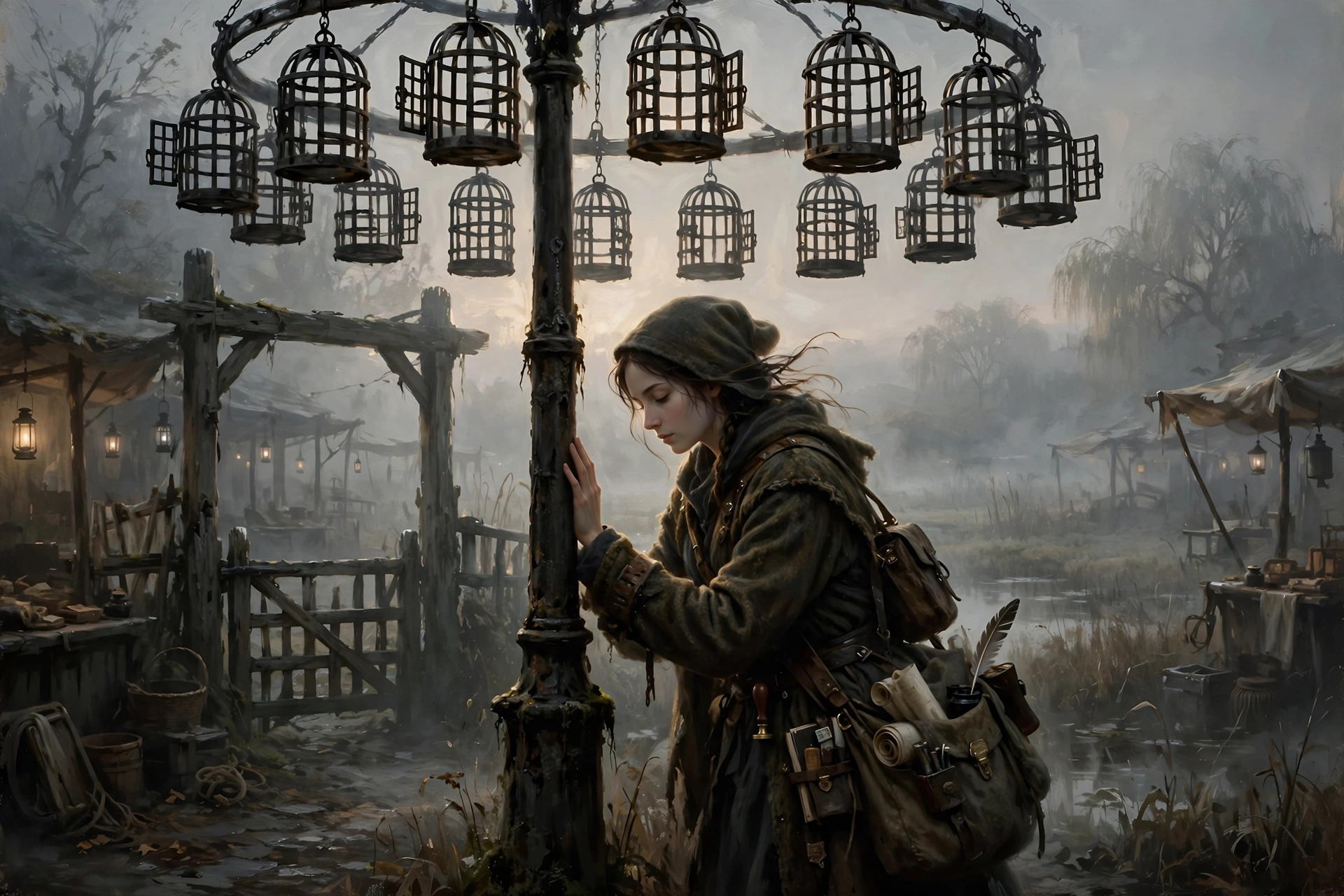
Maud Kilraven counted the dark lamps twice before she let herself believe it. Three. Three cold crowns on the ring of nine, their ward-cages empty and their posts standing like teeth knocked from a jaw. She walked the circuit at first light with her satchel bumping her hip and her burin cold in her pocket, and at each dead lamp she pressed her palm flat against the post the way her first master had taught her, listening for the hum that meant the fen was still being kept out.
Nothing. The posts were as quiet as fence rails.
She stood at lamp six, the one nearest the market gate, and looked east across the Emberfen. Grey water, brown reeds, a haze that sat on everything like a lid. Somewhere past that haze was the crossing, and past the crossing were the riders who had promised, in writing, seven years of peace. The truce had eight days left on it. She had counted those too, last night, lying awake and doing sums against the ceiling.
"Kilraven." Almon Greeve came along the ring path with his coat buttoned wrong at the top, the way it always was when he'd been up since before the lamplighters. He held out a folded paper with a wax seal on it, and she took it because there was nothing else to do with her hands.
"Three of mine are dead, Steward."
"I can see the dark from my own window, thank you." He rubbed his jaw. "That's the council's summons. The truce talks convene in the gatehouse on the fourth day, and the fen sends an envoy across this morning. You're to attend, as keeper of the ring."
"An envoy. Across the water." She looked at the fen again, at the place where the road ran down under the haze. "They're sending somebody early."
"They're sending a smith, if the papers read true. A glass man." Greeve said it the way he said prices at the council table, flat and careful. "There's talk he wants to treat for a stall. Old business." He didn't say whose old business, and she didn't ask, because the summons in her hand was heavy enough already without carrying anyone else's.
"If the talks fail," she said, "the ring had better hold."
"Then you'd best go make it hold." He was already turning away, coat flapping. "Nine lamps, Kilraven. I'd like to see nine lit before the ninth day."
She put the summons in her satchel and walked to the gate.
The market was waking around her, shutters going up, the smell of bread and hot metal mixing the way it always did in Duskwell Market, the smell she'd been breathing for twenty-two years without once thinking of it as a thing she could lose. She had thought of nothing else since the first lamp had gone dark a week past. It was strange what darkness made you notice.
The fen road came down out of the haze and ran straight to the gate, and there was a figure on it. She saw him at a quarter mile, because there was nothing else moving out there. He came on steady, a crate roped across his shoulders, boots grey to the knee with fen mud. When he was near enough for the gate guards to straighten up, she could see the ribbon at his arm, a delegate's ribbon, blue with the crossing worked into it in silver thread, and his face under a hat that had done some years. He stopped at the painted line and set the crate down in the mud without ceremony, and then he looked at her, at her satchel, at the burin cord at her wrist, and something in his shoulders settled.
"You'd be the ward-scribe," he said. His voice was low and even, like a man used to talking over a flame. "Hew Marish. I've come for the talks."
"Maud Kilraven." She didn't move from the line. "You're early, smith. The talks are in three days."
"The talks are. My glass isn't." He tipped his chin at the crate without touching it. "Word came up the water that your lamps were failing. I make hearts. Ember-glass, blown over fen-gas. They seat in a ward-cage same as any oil heart, and they burn longer than oil." He paused. "They burn cleaner, too."
"Fen glass in a Duskwell ward." She let that sit. "You'll forgive me if I don't take a fen man's word for it at my own gate."
"I'd think less of you if you did." He crouched, cut the ropes with a knife he had out before she'd tracked his hand moving, and lifted the lid. Inside, packed in fen flax, lay glass shapes the size of two fists, red-gold, each one ribbed like something that had been alive once. "Take one out. Any one. Put it in a cage and light it. I'll stand here while you do it."
She considered the gate, the guards, the three dark posts behind her, and the arithmetic she'd been doing against every ceiling for a week. Then she put her satchel down, worked her hands under the flax, and lifted a heart. It was warm. Not from the sun, which was barely up; warm from the inside, the way a stone from a fire stays warm through the night.
"They keep their own heat," he said. "It's the fen gas in the melt."
"It's strange glass." She turned it over. Inside the ribbing, something moved slowly, a drift of light like a spark settling. "It doesn't look like trade glass."
"It isn't. It's my grandfather's melt, and his father's before him." He said it plainly, but his hand had gone, without his seeming to notice, to rest against his coat pocket, where something small made a flat shape under the wool. He took the hand away again when he saw her looking. "Seat it, scribe. Lamp six's nearest, and its cage is cold. I'll watch."
She carried the heart to lamp six, aware of him following at the line's edge, aware of the guards watching him watch her. The cage was a cage of nine iron tines, made for oil hearts, and she'd sworn she'd never put anything fen-blown inside one. She fitted the glass in. It seated like a held breath let out, like something coming home, and when she touched her burin to the post and spoke the ring's old words, the lamp caught. Not the yellow of oil. A deep ember red, steady, throwing light clear across the market yard where the oil lamps only managed a haze of their own.
The vendors at the nearest stalls went quiet. Somewhere a woman laughed, short and surprised.
"Well," Maud said.
"Well," Hew agreed. He was looking at the lamp with an expression she couldn't read at all, half pride and half something older and sadder than pride. "It holds."
"It holds." She came back to the line and took his ribbon stamp-pad out of the guard's box, because the guards had the sense to hand it to her and not to him. "You'll forgive me, Marish. We test what crosses."
"You test what crosses," he said. "Good. Then test this." He stood very still while she pressed the market's seal against the blue ribbon, marking him a delegate under truce law, entitled to the gate, the road, and a stall by the day. "I want a forge stall while I'm here. I'll pay the day rate. I don't hold a market stall and I don't ask to."
"No fen smith holds a stall in Duskwell." She said it before she could stop, the old law coming out of her like a reflex. "Market law."
"I know the law better than the council does," he said, mild as milk, and there was something under the mildness, a banked heat. "Day rate. That's all I'm asking. My grandfather's stall is another man's counter now, and that's a debt with years on it, and none of it is this morning's business." He picked up his crate and settled the ropes across his shoulders again, easy, like it weighed nothing, though she'd felt the weight of one heart. "Lamp six burns. That's this morning's business."
She looked at him a long moment. The market behind her was filling with light, his light, the red of it lying warm along the cobblestones in a way oil had never managed. Eight days. Three dark lamps. A fen man at her gate with glass that worked.
"The forge stall's the third on the north row," she said. "Rate's paid to the council office by dusk, and I'll want the second heart out of that crate for lamp seven by tomorrow morning, because I don't buy on faith and I don't buy on one lamp." She stepped off the line and stood aside from the gate. "Welcome to Duskwell, delegate. Mind the mud on your boots. It's what we're known for."
"I heard you were known for lamps," Hew said, and came through.
She watched him pass, the crate on his shoulders and his hand once again resting, without his noticing, on the flat shape in his coat pocket. Then she turned back east, to the haze over the water, and counted lamps the way other people said prayers. Six burning. Three dark. Nine days. And a stranger's glass, warm as a living thing, burning in her cage like it had always meant to.
Ember-Glass
The forge stall third door down had a flue that leaned like a drunk leaning on a friend, and Hew Marish stood under it the next morning with his sleeves shoved past his elbows and his crate open on the bench, and Maud Kilraven stopped three stalls short of him and watched the fen-gas hiss up blue at the mouth of the furnace.
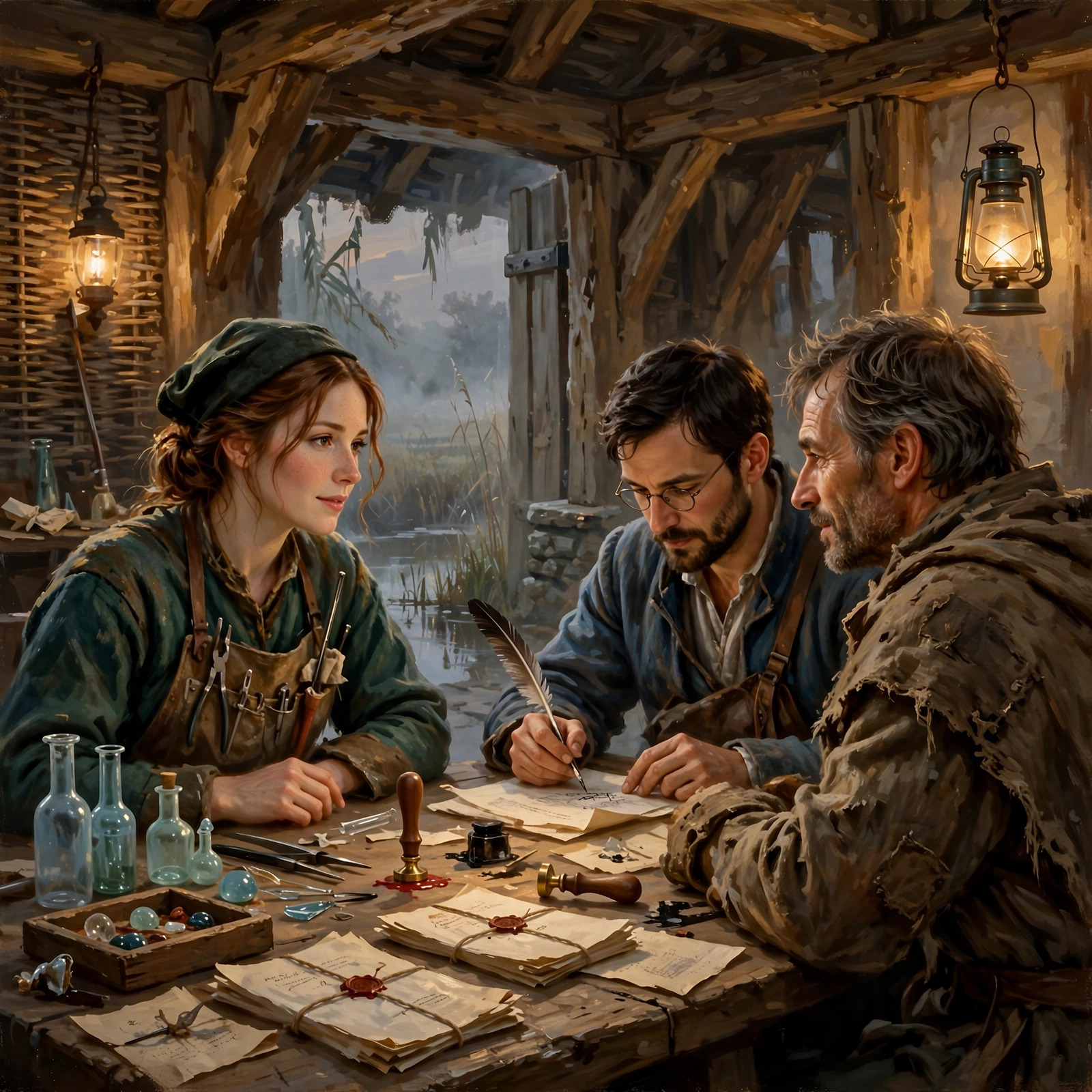
He'd lit it before she got there. That was the first thing wrong with the morning. The second was that he'd set out his tools in the order she would have set them out, pipe on the left, the marver centered, the block wet and waiting in its bucket, as if he'd reached into her head and copied the page.
"You pay your day-rent early," she said.
"I pay it in the dark so I'm not paying daylight for lighting." He didn't turn from the furnace. "Rent's rent. Daylight's work."
"That's a fen answer."
"That's a man-with-a-crooked-flue answer." He tipped his chin at the pipe above them. "Whoever set this flue didn't seat the collar. It draws off-kilter. You lose a finger's width of heat out the seam."
"I know," Maud said. "I've known for four years. The council won't pay a tinker."
"Then today it draws crooked for free." He picked up the pipe, looked at her over the top of it, and his eyes were the color the flame turned right before it settled. "You came to watch or you came to work?"
"I came," she said, "because my lamps are dark, and yesterday you told me your hearts would hold in my cages, and I've heard that speech from every tin-peddler who ever blew a bubble through a straw."
"Then you'll want to see it done."
"I want to see it done twice."
He laughed. It surprised her, and it didn't surprise him, and that was annoying, the way he laughed like she'd said something friendly instead of something sharp. "Sit down, scribe. Or stand. Stand there, where you can see the gather."
She stood where he pointed. She told herself it was because he pointed.
The first gather came out of the furnace on the end of the pipe like a bead of caught sunset, and he turned it constant, slow, even, and Maud had scribed wards for seven years, had held a burin over glass and felt the material decide whether it would take a line or shatter under it, and she knew before the marver touched it that the batch was good. She knew it in her teeth. She hated knowing it that fast.
"Watch the bubble," he said, and put his mouth to the pipe.
The glass swelled. Even, round, a chest rising. He turned it as it grew, and the heat came off it in a shimmer that bent the stalls behind it, the fishmonger's awning and the rope-seller's rack all wobbling in the air above the glass like the market itself was only a rumor the heart was telling.
"Your lungs," she said. "That's all that is? Air and heat?"
"Air and heat and a fen flame." He turned the heart on the marver, and the shape of it came up under his palm, the two shoulders of it, the taper. "Fen-gas burns dirty. Dirty flame, long flame. Soft glass. Ember-glass, the guild calls it, but that's just fen glass with a pedigree."
"So it holds because it bends."
"It holds because it bends before it breaks." He gave her a look sidelong. "Your tin hearts crack in the cages because the cage shakes and the tin doesn't. This'll shake with the cage. Same weather, same cold, same road."
"You know what shakes my cages."
"Everyone on the fen knows what shakes Duskwell." He lifted the heart to the light. "It shakes."
That was the third wrong thing about the morning, and she stopped counting after three because four would have meant she was keeping a list about him, and she wasn't keeping a list about him. He knew the flue. He knew the rent. He knew which stall. Yesterday she'd stamped his ribbon on the strength of the glass and the nine days left in the truce, and today, standing in the heat of his forge, the questions she'd filed away last night came back up like smoke off a wet fire.
"Who taught you the fen flame?" she asked.
"The guild."
"Whose bench? Where?"
"Across the water." He set the finished heart on the bench rack, where it ticked as it cooled, a small bright sound like a fingernail on a cup. "You ask like a customs officer, scribe."
"I ask like a woman with three dark lamps and a stranger in her forge row."
"Your forge row." He smiled into the furnace. "It's a day rental."
"You know the one I mean."
"I know the one you mean." And then he reached for the pipe again, and the conversation was over, the way a door is over when it shuts, and he gathered the next gather and blew, and Maud stood with her questions in her mouth like coins she hadn't decided to spend.
By noon he'd blown six hearts and cracked two of them on purpose, cracked them on the flagstones, sharp little breaks, and handed her the pieces. "Run your thumb along the edge," he said. "It'll hold a burin. That's your trade, isn't it. Lines in glass."
"It's my trade."
"Then you can scribe a tile to fit the cage-lock if you want the ring to be truly yours. Cage-lock and heart together." He said it casually. He said everything casually, the way a man says things casually when he has practiced them.
She took the fragments to her satchel for the burin test, and the edge took the line, clean, no shatter, and she looked up and found him watching her, not the glass, her, and she looked back a half second too long before she bent over the work.
Lamp four stood dark at the end of the row, its cage dull with a year of soot, and they walked to it together in the flat afternoon light with the heart wrapped in fen flax between them, her hand on one shoulder of the cloth and his on the other, and if the cloth had been smaller their hands would have met, and Maud thought that the cloth was the right size and that this was the second thought about him she was refusing to have today.
The cage door had a hinge that screamed. She oiled it every month and it screamed anyway. Hew winced at the sound, respectfully, like a man hearing a relative complain.
"Grind the pin," he said.
"I grind the pin."
"Grind it to a point, not flat."
"I grind it to a point."
"Then the council bought you a cheap hinge," he said, "and you've my sympathy."
The heart slid into the cradle inside the cage, and it fit the way a word fits when it's the right word, no forcing, no rattle, seating into the old tin heart's outline like the tin heart had only ever been a rumor of this one. Maud took her taper from her satchel, lit it off his lantern rather than her own because his was closer and because she didn't examine that, and touched the flame to the wick.
The lamp caught. It caught and sat up, and the light came off the ember-glass warm, the color of the flame doubled in the heart, and the whole cage went from dead iron to something with a pulse in it, and Maud stood there with her taper dripping and watched lamp four burn for the first time in two years, and the back of her throat did something she had no professional term for.
"Say it," Hew said quietly.
"It holds."
"It holds."
She should have gone home. The ward-book wanted lamp four entered, the entry wanted her official hand, her official hand wanted her kitchen and her supper and her bed, and instead she stood at lamp four with a man from across the fen and watched the flame through the glass, and when he shifted his weight to ease his shoulder, she shifted with him without deciding to, and found herself at his shoulder, close enough to smell the smoke and fen-gas in his collar.
"Two more," she said.
"Two more," he agreed.
"Six days."
"Seven, if you count tonight."
"I count nights," she said, "the way I count lamps. By what's still standing in the morning."
He looked at her then, longer than a look about glass needed, and she thought he might say something true, something with a name in it, something from across the fen. She waited for it with her burin-hand itching, and instead he rolled his own sleeve down over the burn-scars on his forearm and said, "I'll have three hearts blown for tomorrow, scribe. Come count them."
"I'll come count them," she said, and did not go home.
The Ring Walk
Dusk came down on Duskwell Market the way it always did, from the top first, the eaves going blue while the cobbles still held the day's warmth. Maud had spent the afternoon at the ward-book, entering lamp four in her official hand, and now the book was shut and her satchel was over her shoulder and Hew Marish was waiting for her at the corner of the fish row with a crate balanced on his hip and three wrapped hearts riding inside it like eggs.
"You said three," she said.
"I said three. I blew four. The fourth's for the council to hold against my thumb." He nodded at the sky. "We've light enough to walk by if we go now."
"We could go at noon like sensible people."
"Noon's for selling. Dusk is for wards." He said it easily, the way he said most things about the trade, as though it were printed somewhere she ought to have read. "The ring reads truer at dusk. Any scribe knows."
Any scribe did know, and it irked her that he knew it too. She came out from under the fishmongers' awning and fell into step beside him, and they went down the long row toward the north gate, where lamp five stood in its iron cage at the turn of the wall.
The market at dusk had a different sound to it. The stalls shutting, the day-rents being counted back into palms, the flue of his rented forge ticking as it cooled, third door down, the one with the crooked flue that drew badly and that he had already learned to humor by propping the damper with a brick. He knew the market the way she knew it, which was the thing about him that she kept setting down and picking back up. Twelve years of coming to a town you never slept in, to a stall you never held, will do that, she supposed. It didn't explain the rest. It didn't explain why he walked the ring like a man walking his own fence.
"Lamp four's holding," she said, because it was true and because it was safer than the other things she might say.
"I saw it from the forge door this morning. It sat up straight." He glanced at her sidelong. "You entered it in your book?"
"In the ward-book, in my hand, with the date. That's the whole ceremony. There's no wine."
"Shame about the wine."
Lamp five stood dark at the turn of the wall, and its cage was colder to the touch than the air around it, the way a dark lamp always was, the iron remembering being unlit. He set the crate down on the cobbles and unwrapped the second heart, and the ember-glass caught the last of the daylight and held it, red going to rose going to a color that had no market name, and she watched his hands on it and thought again, as she had thought on day one, that he handled glass like a man who had been handed something breakable early and had never once put the habit down.
"Give us your taper," he said.
"It's my taper."
"And I'm asking to borrow it, scribe, not to marry it."
She gave him the taper. He held it unlit between two fingers while he opened the cage door, and then he looked at her, and she understood he was waiting, and she took the heart from the crate herself and carried it to the cage, because it was her ring, and the seating was hers, and he knew it, and he had handed it over without a word of argument, which no smith on the row would have done.
The heart slid into the cradle at lamp five and seated the way lamp four's had, no forcing, no rattle, and she lit the taper off his lantern again, again without examining why his lantern and not her own, and touched the wick. The flame took. The cage filled up with doubled light, red and gold, and the wall behind it turned from gray stone to warm stone, and somewhere down the row a shutter went up because someone had seen a lamp catch and wanted to see it better.
"Two more," she said. "Six and eight."
"I'll blow tomorrow's three before the council sits." He was quiet a moment, watching the flame through the glass. "You'll be at the table tomorrow."
"I'm summoned. I keep the ring. They want the ring's keeper where they can consult her."
"They'll ask you about the dark ones. Four, six, eight. You'll say snuffed, not burned down."
"I'll say snuffed. Because that's what the iron says."
"The iron says what happened to it," he agreed. "It doesn't say who." And there he went still again, the way he went still whenever a question came near the water, his thumb finding a seam on the crate's edge and worrying it.
They walked on. That was the way of the ring, you didn't stand at one lamp, you walked it, and she had walked it alone for seven years, one full circuit every dusk, checking flame and iron and wick, and it was strange to walk it with the pace set half by her and half by a man with burn-scars up his forearm who read her market's iron as fluently as she did. The shutters were going up all along the row now. Somewhere behind them a dog complained about supper.
"You never talk about across the water," she said. "You know our lamps, our law, our rents, our flues. And you give me nothing back. Where'd you learn the flame, Hew? Who held your hands over the fire?"
"People who aren't at this market," he said. "Leave it, scribe."
"I've left it twice."
"Then leave it a third time and you'll have a habit."
She laughed before she could stop it, and he looked pleased with himself, and that was worse.
Lamp six stood dark at the next turn, and they didn't stop, because the hearts for it were still in his crate, but she put her hand flat on the cold iron of its cage as she passed, the way she did every dusk, an apology for the delay. He watched her do it. She could feel him watching.
"You do that to all of them," he said.
"They're mine." She took her hand back. "I had a brother." It came out before she'd decided to give it air, and then it was out, and she couldn't take it back, so she went on, walking, eyes on the cobbles. "Elder than me. He learned glass young, the way you did, I'd guess. He used to hold my satchel while I scribed, and tell me my hand was better than our teacher's, which was a lie, but he told it every day like it was news. He went across the water when I was still an apprentice. Nobody sent him. He just went."
Hew's hands went still on the crate.
Not slow, not thoughtful. Still. All at once, the way a clock stops.
She heard herself stop talking and heard the market around the silence, the shutters, the dog, the far-off clink of someone's till. She didn't look at him. She looked at lamp seven, burning bright in its cage, doing its work, keeping its side of the bargain.
"The fen takes people," she said. "That's all. That's the whole story. It took my teacher's nerve and half our trade and it took him, and I stayed, and I keep the ring, and that's the whole of it, and now you know the one true thing about me, so we're uneven, and I'd like us to be even."
He hadn't moved. His knuckles had gone pale where he gripped the crate's rope handle, and the dusk stood around the two of them and did nothing helpful at all.
"Hew."
"I heard you," he said, and his voice had gone somewhere she didn't have a map for. "I'm not going to answer it tonight."
"I wasn't asking a question."
"You were asking six." He breathed out. "Ask me tomorrow. After the table. I'll answer more than you want, and less than I should, and I'd rather do it sober and standing." He looked at her then, and his face in the lamplight was open in a way it hadn't been all day, no smith's ease over it, just a man looking at a woman who'd handed him something breakable. "You keep the ring. I know what that costs. Nobody keeps a thing that long without knowing what it is to lose one."
They had come round the curve of the wall to lamp five again without her noticing, the circuit closing on itself, and they stood in its doubled light, and the space between them had gone narrow the way dusk goes narrow, and she could have counted his lashes if she'd been the counting kind, which she was, professionally, and she wasn't counting.
"Tomorrow, then," she said.
"Tomorrow," he said, and neither of them moved, and his hand came up slowly, slowly, the way you come at glass that's still hot, toward a loose strand of her hair where the wind had put it, and she stood very still and let him, and his fingers stopped short of it and hovered, and the heat off his palm was the only thing touching her.
The steward's bell rang from the gatehouse. Once, twice, the deep note that meant delegates to the table, and a boy's voice came down the row after it crying the summons for the morning council, delegates to the gatehouse, delegates to the table.
Hew's hand closed on air and went to his side. He stepped back, and the dusk rushed into the space where he'd been.
"That's me," he said, rough, "before the wine, apparently."
"Apparently," said Maud, and her heart was going like a smith's hammer, and she told it, in her official hand, to stop.
He gave her a short bow, the fen fashion, hand flat over the heart, and took up his crate of hearts and went up the row toward the gatehouse light, and she stood at lamp five with her taper burnt down and watched him go, and did not go home for a long while after.
The Truce Table
The gatehouse smelled of cold stone, tallow, and forty years of men deciding things in it. Maud arrived before the delegates, because she was the ward-keeper and the ward-keeper sat where she could see the door, and she had learned the shape of the room the way she had learned the ring itself: what would burn, what would crack, where the drafts ran.
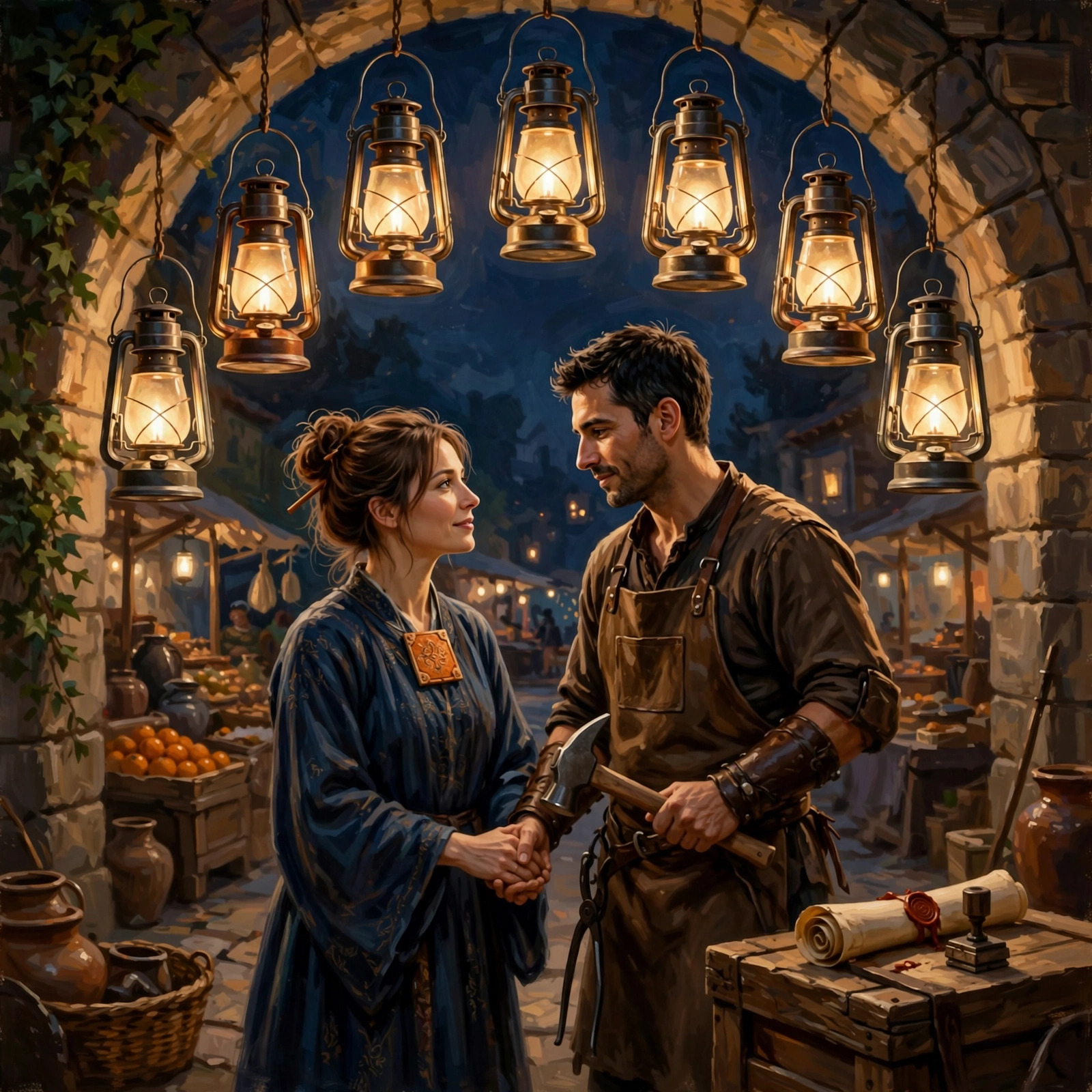
The truce table was older than the truce. Nine planks, one for each lamp in the ring, planed smooth by hands nobody living could name, scarred at the near end where somebody had once put a hot pan down on it in triumph or despair. Almon Greeve sat at the scarred end with his papers squared in front of him and his steward's chain doing its slow work of catching the candlelight. He nodded to her the way he nodded at everyone, which was the nod of a man keeping a ledger behind his eyes.
"Scribe," he said. "You'll sit. Not talk, unless asked."
"I know the arrangement," said Maud.
"I know you know it. I say it anyway, so that when you forget, I can say I said it."
She took her seat along the wall, and the delegates came in out of the morning in their ribbons and their damp cloaks, the market side to the left, the fen side to the right, and the fen side's man was Hew, and the sight of him in daylight in her gatehouse did something to her chest she declined to examine. He did not look at her. That was the first wrong thing. All day yesterday he had looked at her like a man counting coins he couldn't spend, and now nothing, and she sat with her hands folded on her knees and waited for the second wrong thing.
Greeve began with the numbers, and the numbers were bad. Three lamps dark, and the fen truce lapsing on the ninth day, and the riders across the water who had never once in her lifetime ridden for anything but fire. The market side offered grain, salt, road-tolls waived. The fen side offered terms of its own, and the terms were read from a paper by a fen courier with rain still in his collar, and the terms were small and mean and mostly about water rights, and Maud sat and kept her face closed and watched Hew sit with his hands flat on the table, still as a man at a forge waiting for the glass to settle.
Then the courier turned his paper over, and said, "Names of the craft-hands sent across to serve the terms, as surety for the fen's good faith."
Greeve lifted a hand. "Read them."
"Dena Wicke, rush-weaver. Coll Tam, ferry-man. Bram Kilraven, glass apprentice, twelve years at the bench."
The room went on with its business. The courier read more names, and Greeve wrote, and somewhere a clerk dropped a pen and swore. Maud did not hear any of it. Bram Kilraven. Glass apprentice. Glass, and the bench, and twelve years, and the courier's mouth had shaped the name like any other name, like it was a thing that could just be said out loud in a room, in front of people.
Her brother had a name that people said.
She looked down the table at Hew, and Hew was not looking at the courier or at Greeve. He was looking at her. He had known the name was coming. He had known it the way a smith knows where the crack will run, and he had sat there and let it come, and she watched him watch her take it, and she watched his hands on the table, and his hands had gone still.
She stood up. Nobody stopped her. She had the ward-keeper's place and the ward-keeper's standing, and she walked around the long scarred planks, past the courier, past two delegates who drew their elbows in, and she stopped at Hew's shoulder and put her hand flat on the table in front of him, and said, quietly, under the reading, "Outside. Now."
He came. Of course he came. He followed her out through the side door into the little stone yard where the gatehouse kept its wood and its rain-barrels, and he shut the door on the murmur of the terms behind them, and he stood there with his back to the wet wall and said nothing at all, which was an answer, and she made herself count to five before she spoke.
"Bram Kilraven."
"Maud."
"Glass apprentice. Twelve years at the bench." Her voice came out level, which was her craft and her curse. "You've known him. You've known him the whole, you've known him since the gate, since you handed me that first heart, since you told me you learned the fen flame across the water. You sat in my market for three days and you let me tell you I'd lost him."
"I didn't let you. I just didn't fix it."
"Yesterday at lamp five I told you he was gone and your hands went still, and I thought, that's grief, that's a man who knows the water." She heard her own voice bend and straightened it. "You weren't grieving. You were caught."
"Maud."
"Don't. Don't say my name like it's an argument." She had rehearsed fury on the walk out and what arrived instead was something colder and worse. "You put his name on a surety list. His. Of every fen hand your side could offer, you sent my brother across that water to sit at a table that's one word from collapsing, and you didn't tell me he was breathing. How long? How long have you known me, and known him, and kept the two of us on either side of you like I was a term to be negotiated?"
"Seven years," he said. "Since I was twenty-four and he pulled me out of a sink-channel in the dark and I coughed half the fen into his lap." He said it flat, spent, no smith's polish on it. "He talked about you every winter. The lamps. The ring. His little sister who kept the light on this side and hated the water for it."
"He left willingly. That's what I told you, and you didn't blink."
"Because it's true, and because it's not mine to hand you." He pushed off the wall, and the rain-barrel behind him drip, driped its small patience into the quiet. "He made me swear it. His leaving was his, and his coming back would be his, and I don't get to spend a man's own choice for him. Not even for you."
"And the list? Was the list his?"
He didn't answer, and the not-answer was the whole of it, and she understood, standing in the wet yard with the terms murmuring through the door, exactly what he had done. A surety named by the fen sits at the talks. A surety crosses the water. A surety is a hostage with better manners, and Hew had put Bram Kilraven's name on the paper because it was the one name with weight enough to hold a bargain, and he had done it knowing, knowing, that the man's sister kept the lamps.
"You bargained with him," she said. "You set my brother on the table like brass, like grain, like road-toll, and you knew, every day you stood next to me, you knew what it would do to me to hear it read out of a stranger's mouth."
"I knew what it would do to the talks if you heard it from mine first."
"Yes," she said. "That's what I'm saying."
The door opened behind them. Almon Greeve's head came through the gap, chain swinging. "Marish. They're asking for the fen's answer on the water rights."
"Coming," said Hew, not moving.
"Now, smith."
Hew looked at her a moment longer, and there was a thing in his face she had no ledger for, and then he went in, and the door thumped shut, and through it she heard the courier's voice rise and fall and rise, and she stood alone in the yard with the rain-barrel and the grey morning and the name of her brother going around and around inside her like a coin in a shaken cup.
She did not go back in. She walked out through the gate, past the keeper who touched his cap to her, and the great gate began to swing for the delegates' dinner hour, and she stopped on the market side of it and looked back, and through the narrowing gap she could see the gatehouse steps, and Hew came out alone with his coat buttoned wrong, and the gate closed between them, slow, on its greased rail, and she stood on the outside of it and let it shut.
Lamp six stood dark in its cage halfway down the wall, a cold shape against the grey. She counted it, because it was her work to count, and it was still three lamps down, and it was day four, and her brother was alive, and the gate was shut, and she had never in her life felt so precisely the difference between a lamp gone out and a door.
The Buy-Back
Two mornings after the gate had shut between them, Maud stood in the gatehouse yard again, because the steward's boy had rung her own doorbell at dawn and said her presence was asked at the table, and because a ward-scribe who refused the asking would not be a ward-scribe by nightfall.
The talks had moved to the long room off the gatehouse kitchen, where the rain came down the north window in ropes and everyone's papers curled at the corners. Almon Greeve sat at the head with his spectacles low on his nose. The fen courier sat opposite with her ledger open and her finger on a line she had been reading aloud since Maud came in. Maud did not hear the line. She heard the rain, and she heard Hew not looking at her, which was louder.
"The water rights stand agreed," the courier said. "What remains is the surety. The fen will not send its man to sign without a bond on the market side, and the market will not receive him without a bond on yours. Someone crosses or nobody crosses, and if nobody crosses, the truce lapses on the ninth day and we all find out what the fen does with a lapsed paper."
"Then we are stopped," said Almon Greeve, "because no market family will bond a fen man's passage, and the fen has no coin the market will take."
"The market takes more than coin," Hew said.
He had been sitting with his hand in his coat pocket for the whole of the morning, and now he took the hand out, and the brass came with it. Maud knew the seal before he set it on the wood. She had seen it once as a girl, pressed into the wax on a bill of lading at her father's stall: a thumb-sized stamp, brass, warm-colored where a thumb had rubbed it for fifty years. Odell Marish's mark. The smith's guild seal. The thing that said the Marish name owned a stall in Duskwell Market, and had owned one before the law came in and took the stalls away from fen folk, and would own one again the day somebody paid the buy-back and put this stamp on the paper.
He had told her about it on day three, walking the ring at dusk with her. Twelve years of saving, he had said, and six hundred still owed, and the seal in his grandfather's line, and the stall standing empty at the row's end with another man's name on the rent card. He had said it the way men say a thing they have carried so long it has gone flat and smooth in the carrying.
"What is that?" said Almon Greeve.
"A bond," said Hew. "The market takes brass. You take it every day at the assay window. That seal is the Marish claim on stall fourteen, and it's worth more than six hundred, and I'll put it on the table against Bram Kilraven's passage. He crosses, he signs, he crosses home again before the ninth day, and the market keeps the seal until the truce money clears. If the truce doesn't hold, the market keeps it for good and the claim dies with me."
The room went quiet enough that Maud could hear the rain sorting itself on the glass.
"That's your grandfather's stall," she said. It came out before she had decided to say anything.
"It's a stall," said Hew, not looking at her still. "It's four posts and a roof and a place at the ring. I've carried the seal twelve years and it has bought me nothing but a pocket to keep it in. It can buy a man's road."
Almon Greeve took his spectacles off and looked at the brass for a long moment, and then at Hew, and Maud watched the old steward do the arithmetic that stewards do, the arithmetic that has no figures in it. "The market accepts the bond," he said. "Courier, note it. Passage under market surety for the fen's signatory, Bram Kilraven, glass apprentice, to cross at the Emberfen Crossing this day and return by the eighth day. Marish seal held in the market chest against performance."
The courier wrote it down. Nobody asked Maud anything, and that was correct, because there was nothing in the paper that needed a scribe. But her hands were cold anyway, and she sat with them flat on her knees like a girl at her first benching.
They all went out to the crossing at noon, because that was the form of it, and the rain had thinned to a mist that hung in the air without falling. The Emberfen Crossing was a timber bridge over black water, and Maud had stood at the market end of it a hundred times in her seven years of keeping lamps, and she had never once seen anyone come over it from the fen side. The water smoked where it met the cold air. On the far bank the reeds stood in their ranks, and there was a figure in the reeds, small with distance, standing at the fen end of the bridge with a pack on his back.
He was tall. That was the first thing. He had been tall at sixteen and he was taller now, and he walked the bridge planks the way he had always walked the stairs at home, two at a time, like the floor owed him money. Maud's chest did something that had no ward against it.
Bram Kilraven came off the bridge onto Duskwell ground and looked at the collected faces of the market, and then past all of them, and found her, and stopped.
"Maudy," he said.
She had rehearsed nothing, because she had not known until two days ago that there was anything to rehearse. "You're sunburned," she said. "You were never sunburned. You used to burn in lamplight."
"There's a lot of sun over the water." He came to her. His hands were a man's hands now, nicked and stained with the blue of glass-work, and he held one out and then did not know what to do with it, and she took it anyway, because it was hers to take. "The smith said you kept the lamps."
"I keep the lamps."
"He said you'd want to know why I didn't send word. He didn't say you'd want to know why I left."
"I know why you left," she said. "You've always wanted the far side of things. You left a kite on the roof when you were nine because it flew better loose."
Bram laughed, and the laugh was his, unchanged, and it went into her like a lamp going into a cage. Behind him the clerk was already calling for the table and the paper, and the afternoon swallowed him, and she watched her brother sign the truce terms in the gatehouse in a handwriting she had copied out of her own schoolbooks, and it was evening before she could get him alone for an hour, and it was dark when she went to find Hew at the forge stall he rented by the day.
He was banking his fen-flame for the night, and the stall smelled of hot glass and charcoal, and he did not look up when she came in, and then he did, and then he set down his iron and turned his back to the fire and waited, which was a thing she had learned he could do for a very long time.
"You paid his road with your grandfather's seal," she said.
"The market will return it when the money clears."
"If the truce holds. If the ninth day goes right. If. You've said more ifs this week than any man I've met." She put her hands on the stall's counter. "I owe you a thing before this goes any further. You put brass on the table for a man you didn't tell me was alive, and I've been carrying something heavier than that for seven years, and it's time you knew what it is."
"You don't owe me anything."
"Yes, I do. Sit down, smith." She waited until he perched on the stool by the wheel. "Twelve years ago there was a caravan of fen folk at the crossing, before the truce, refugees out of the burning season, and the market sent me out to ward the bridge against them. I was an apprentice. I was seventeen and I was proud of my hand, and I scribed the turning-ward whole and clean, the finest thing I had ever cut, and it worked. It worked perfectly. They came to the timber and they could not cross, every one of them, and they turned back into the weather with their carts and their children, and it snowed that night."
He had gone very still by the fire.
"Your mother was with them," Maud said. "Dellis Marish. She was on the road home when the snow came down. The fen folk buried her at the third mile-stone. I have known her name for twelve years and I have never once said it out loud in this market, because saying it out loud makes it a thing that happened, and I have been keeping it a thing that didn't. And you have spent this whole week putting glass in my lamps and brass on my brother's road, and you did it with her name in your pocket." Her voice went and she waited for it to come back. "So. Now you know what I am. Say whatever you're going to say."
Hew looked into the banked flame for a while. "I know the third mile-stone," he said at last. "I put the stone up myself, the spring after. I didn't know who cut the ward that turned her back. I only knew somebody's daughter did, somebody young, doing as she was told. The fen doesn't blame the hand for the order, Maud. It never has."
"I blame the hand."
"Then that's yours to carry, and I won't take it from you. But you don't hand it to me, because I won't carry it either. My mother went home in the snow because the market was cruel and the weather was worse, and a girl did what girls are made to do when men in gatehouses say do it. That's the whole of it, and I've known it for years, and I'd have told you on day one if I'd known you were that girl." He turned his hand over on his knee, palm up. "You weren't. You were the scribe with the fine burin and the temper of a boiling kettle. I fell for the kettle."
She took her burin from her coat. She had brought it, though she had not let herself think on the walk over about why. She laid a slim tile of fen glass on the counter, a spare from his crate, and she scribed the personal ward into it right there, quick, with the fire for light: a ward for one man, for Hew Marish, to hold against fen-burn and road-ill and every named thing that had ever come at him across the water.
"You know what that costs," he said, quietly.
"One year of my own memory. I know the price. I've known it since I was fifteen. It's why nobody sells these." She blew the glass dust from the cuts. "I'm paying it gladly. I'm giving up the year I turned seventeen. Take it. I don't want it anymore."
The tile sat on the counter between them, and the firelight ran along the cuts and made them gold. Hew picked it up as if it were a live coal, and looked at it, and looked at her, and set it down, and reached across the counter and took her hand, seal-less, staying, and drew her to him, and kissed her there by the banked fire, his hand warm from the flame and hers cold from the road, and she let the year go, and it went.
Nine Lamps
The ninth day came in gray and thin, the kind of morning that makes a person count things twice. Maud counted the lamps on her walk up from the water stairs, because counting was what her hands did when the rest of her was afraid. Six burning. Three dark still: seven, eight, and the gate lamp at nine, standing over the market gate like a tooth gone bad in an otherwise decent smile.
Almon Greeve had the trestle set up in the gate shadow, the truce papers weighted with river stones against a wind that hadn't decided yet whether to come. He looked older in the mornings now. He'd looked older every day since day four.
"Scribe," he said, "the rolls."
She carried the ward-book under her arm, same as every morning for seven years, except that today her brother was somewhere behind her in the crowd, and that changed the weight of everything, including a book.
Bram had taken a room above the chandler's. He'd walked her to the water stairs the last two nights, and both nights they had run out of things to say at the same moment and stood in the lamplight like two people learning a shared language from its beginning. Twelve years sat between them like a third chair at the table. But he laughed like their mother, and he had their father's way of holding a cup, and every time he did either of those things she felt the year she'd given away go soft at the edges, as if the fen had known which year she could most easily spare.
Hew came through the crowd carrying the crate himself, though the steward had offered him a porter twice. The last three hearts rode in it, packed in fen moss, each one a fist of ember-glass with a heart of flame folded inside, the color of a coal coaxed back from ash.
"Morning, scribe," he said.
"Morning, smith."
They had gotten formal again in the last three days, in the way of two people who had kissed by a banked fire and then had to go sit across a table from each other with a steward and a fen-delegate between them, discussing water rights. It was a good formality. It had heat under it.
"Seven first," Almon said. "We sign at the turning of the noon bell, whether the ring is whole or not. The truce lapses at dusk and I'll not have it said Duskwell asked for one hour's grace."
"It'll be whole by noon," Hew said.
Maud looked at him over the crate. "You've been saying that since day two."
"And I've been right since lamp four. You're the one who taught me the cages are stubborn. The threads have to be walked in, not forced."
"I never taught you anything. You watched me over my shoulder and pretended to look at the glass."
"I was looking at the glass." He set the crate down at the foot of lamp seven. "Some of the time."
Almon made a sound that in a younger man would have been a snort, and went off to argue with the rope-and-bell men about the noon bell.
Lamp seven took the heart on the first seating. Maud walked the ward threads while Hew held the cage door, and the flame came up through the ember-glass slow and then all at once, and the light that fell on the cobbles was the deep fen red that had become the color of her whole month. Eight went harder. The cage on eight had been mended badly years ago, by someone who had not cared, and the threads fought the glass. Hew held the lamp steady while she worked, his hands around the cage, hers inside it, and for a full minute they were close enough that she could feel the heat of the forge still living in his knuckles.
"There," she said, when the flame took. "Eight."
"One left," he said, and did not let go of the lamp right away.
The gate lamp was the oldest and the highest, and they needed the ladder man, who came at Almon's shout and steadied the rungs while Hew climbed with the last heart wrapped against his chest. Maud stood below with her hand flat on the lamp post, feeling the ward threads run under the iron like harp strings under her palm, and she thought about the caravan ward. She had thought about little else for three days. She had told Hew the whole of it by the fire, the ward she'd cut at seventeen, the one that had turned a line of refugees back from the crossing in the snow, and the name at the end of that line. He had kissed her afterward. He had kissed her afterward, which was a thing she would be working out for the rest of her natural life. But he had not said it was forgiven, because it wasn't, and they both knew it wasn't, and the not-forgiving had a shape she could live inside. He carried what he carried. She carried what she carried. They had agreed, without ever saying so, to carry those things in the same room.
"Thread's walked," Hew called down. "Heart's seated. Say it, scribe."
She said the words, the old words, the ones the market paid her to say nine times a season whether the lamps were lit or not, and the ward threads ran true, and up at the top of the gate the ninth flame came up through the ember-glass and stood.
Nine lamps. Whole.
The crowd that had gathered, and it had gathered, all the fishwives and the chandler and the rope-men and half the stalls, went quiet in the way of people watching a debt get paid. Then the noon bell rang, one clean note over the red-lit gate, and Almon Greeve put his hand flat on the truce papers.
"Sign," he said, "and be quick, the fen-delegate's already got his pen out like it's a race."
They signed. Hew signed for the fen side, Bram's name under his as surety, the boy standing at his shoulder with his hands in his pockets and his chin up, and when Bram leaned in to sign, Maud watched her own surname go onto a market paper for the first time in twelve years. Kilraven, in a hand that had once pressed flowers in her primer and stolen the good pen.
Then Almon raised the brass seal, the Marish guild seal, thumb-sized, fifty years old, the thing Hew's grandfather had cast and Hew had laid on the truce table with his whole buy-back future under it, and he pressed it into the wax, and then, because the steward was a man who liked a thing done thoroughly, he turned to the market rolls and pressed it there too.
"Let the record show," Almon said, in his fair-day voice, "that by terms of the renewed truce, the old law barring fen smiths from Duskwell Market is repealed, and the holder of this seal is entered on the rolls, his claim on stall fourteen to be settled in coin when the trice money clears, which it will, because I'll chase it myself."
Someone laughed. The fishwives started it, and it went around the square like the light had.
"Stall fourteen," Maud said to Hew, when the crowd had begun to break into its ordinary noises. "Your grandfather's pitch."
"The very one." He was looking up at the gate lamp, at the red standing flame in its cage. "Six hundred still owed on it. That's a year of good work, less than it sounds."
"You gave it up."
"I bonded a brother with it. Cheapest surety I ever posted. He turned out to be the making of the whole truce, your Bram. The fen-delegate wouldn't cross the water for me, but he'd cross for a Kilraven who'd gone over and stayed. Twelve years at the bench, they kept saying, like it was a title." Hew turned and looked at her, and the lamp light went across his face and made him briefly a stranger, then briefly not. "I'd have told you on day one, if he'd let me."
"I know why he didn't." She said it plainly, because it was true now and hadn't been on day four. "A man gone twelve years doesn't come back through his sister's ward. He comes back through the front gate, with his name on a paper, so nobody can ever turn him away again. Not even me."
"Not even you," Hew agreed.
The square emptied the way a market does, in clumps and calls, the fishwives off to their ice, Almon off with his papers and his bell-men. Bram came and kissed the top of her head, which he had no right to do, having only learned it three days ago from the chandler's wife, and went off whistling, and left her standing under the gate lamp with a smith.
"Ward-book," Hew said. "The steward said the rolls. Your book. I saw you carry it up. Is my name going in it, or do fen smiths not rate?"
"Give me the pen and hold your lamp still."
She set the book on the flat of the gate post, and turned to the page for the season, and wrote: Hearts blown and seated by Hew Marish, smith, of the Emberfen, stall fourteen. And beneath it, because the book was hers and had been for seven years and she was done keeping the things she loved at arm's length: Ward cut and kept by Maud Kilraven, scribe.
Two names, one under the other, in the red light of a whole ring.
"There," she said. "Now the fen can read it from across the water."
"Good," Hew said, and put his arm around her, warm hand, staying, under nine lamps and not one of them dark.
Get notified when new stories drop
Cade Ellison
Cade specializes in romantasy and paranormal romance: magic systems with rules, courts with knives, and longing that rearranges destinies.
Leave a comment
Comments