





Merchant Row
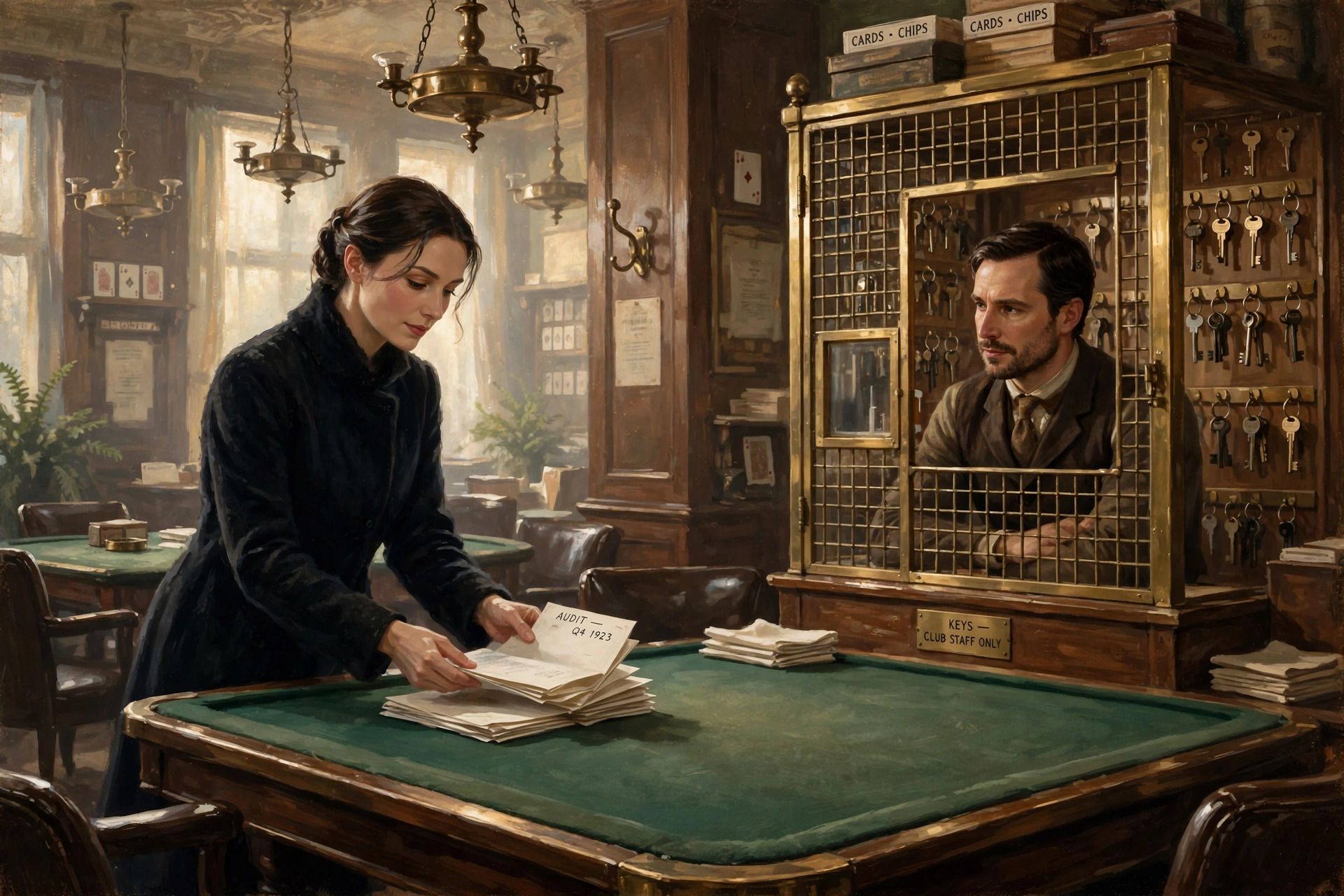
Merchant Row at six in the morning smelled like wet stone and yesterday's cigarettes, and Vesna Calloway counted the doors as she passed them because that was what she did with everything. Twelve storefronts, one dead clock above the jeweler's, and then the Vellam Rooms, which announced itself with nothing but a brass plate and a door she'd walked past for six years without once going through.
She went through it now with Ferrance's order folded in her coat pocket, four pages, his signature at the bottom like a blade laid flat on the table.
Inside, the club was empty the way a church is empty. Three chandeliers, unlit. Green felt on the tables under their canvas covers, and the smell of cards, which is a real smell, slightly sweet, like old money that has been handled too much. A woman in a gray coat was moving along the back bar with a rag, and a man stood at the cage with a ring of keys, sorting them.
The man at the cage looked up first.
"We open at eight," he said.
"I know. I've read your hours." She took the folded pages out and set them on the nearest covered table, smoothing them flat. "Vesna Calloway, collections auditor for the Ferrance Group. Mr. Ferrance holds your paper. He's ordered an audit of the Vellam Rooms' books. Fourteen days. You'll want to read it before you decide how rude to be."
The rag stopped moving. The woman in the gray coat came around the bar without a word and picked up the second page, read it, and set it back exactly where it had been, square to the table's edge. Then she looked at the man, and Vesna watched the look pass between them, quick as a card played face down.
"Emil Voss," he said. "The paper's mine, so I suppose the books are yours." He didn't offer a hand. He weighed her instead, the way she'd been weighed her whole career by men who owned things, and she stood still for it, because being weighed correctly was half the job. "Fourteen days."
"Fourteen. Today's the first."
"Then you'll want coffee." He turned toward the back bar. "Rudy. Company."
A head came up from behind the beer taps, and Vesna felt the morning tilt.
"Vessie," Rudy Calloway said, straightening, and there it was, out loud, in front of her employer's largest debtor, the nickname from the kitchen on Delver Street when she was small enough to be picked up and put on the counter. He came around the bar drying his hands on a towel, grinning like they were children and she'd caught him at something. "What in the world are you doing here at six in the morning?"
"Working," she said. "You're the bartender here."
"Two years now." He was already pulling the cup down, already pouring, because Rudy had never once in his life let an awkward moment stop him from being hospitable. "You didn't know. Of course you didn't know, you don't come anywhere."
Voss had not moved. He was watching them the way she watched columns of figures, and she understood that everything she did next was already being entered somewhere she couldn't audit.
"Calloway," he said slowly. "Any relation?"
"My brother," Vesna said, and let it sit there, plain, because a lie in this room would cost more than the truth. "I hadn't been assigned this club when you hired him, Mr. Voss. I'll note the relation in my report, and Mr. Ferrance can pull me off the job if he wants it done by someone with cleaner hands."
Rudy set the coffee down in front of her. "Since when do you say hands like that?"
"Since always." She drank the coffee. It was good, which annoyed her, because it meant he'd learned something in two years besides pulling taps.
"He's the best hire I ever made," Voss said. "Punctual, honest, remembers what every regular drinks. If Ferrance sent you here to tell me different, you can tell him the bartender's not part of the paper."
"Ferrance sent me to count, Mr. Voss. That's all. What the count says is the count's business."
"Odile," Voss said, and the woman in the gray coat stepped to the cage. He put the key ring in her hand for a moment, then took it back, chose one key, and turned it in the lock himself. The little gate swung open on a sound like a held breath, if a door could breathe. "Tally book's under the counter. She keeps it fair. Seven years she's kept it, and I've never once caught a figure out of place."
"Odile Kerr," the woman said, and shook hands with a grip like a pump handle. "You'll find the book the way I left it. You'll also find I don't like strangers in my cage, so let's both be quick about it."
Odile lifted the counter's hinged lid, reached beneath, and brought out a leather-bound book with hand-ruled columns, the binding cracked at the spine where a thumb had held it open a thousand nights. She set it in Vesna's hands with a weight that had nothing to do with paper.
"Drop box counts against chips issued, every night," Odile said. "I rule the columns myself. If your numbers don't match mine, it won't be my arithmetic that's wrong."
Vesna opened the book. The columns were clean, the ink two colors, red for payouts, black for intake, and the handwriting never hurried, never slurred, even at the ends of the long rows where most people's hands tire. She closed it again, and kept her face still, because she had learned a long time ago that the face is the first column anyone reads.
"I'll need a desk," she said. "A light. And the deposit slips, when you have them."
"Deposits go in through the courier," Voss said. "You'll have to take that up with Ferrance's end."
"I will." She looked around the cage, at the stool, the lamp, the little shelf. "I'll work in here, if that's agreeable. The book lives here. I'd rather not carry it around Merchant Row."
"Agreeable to me," Odile said, in a tone that made it clear it was not entirely agreeable.
Voss dragged a small writing desk from against the back wall, wood gone soft-cornered with use, and set it inside the cage beside the stool. He put the lamp on it, tested that it lit, and adjusted the shade so the light fell on the desk's center and nowhere else. He did it with one hand, absent, a man who had made this little desk ready for somebody before, or had sat at it himself on bad nights.
Rudy leaned on the cage's open gate with his towel over his shoulder. "She'll eat you alive, Voss. She used to do my homework just to prove she could."
"Somebody had to," Vesna said.
"You were seven."
"You were worse at ten."
Voss almost smiled at that, she saw it arrive and get turned away at the door. Then he stood aside and let her carry the tally book through the little gate, and she sat down on the stool and set the book on the desk under the lamp, and the cage closed around her with Odile's counter at her back and the whole green-lit floor of the club spread out in front of her through the bars, which was, she supposed, exactly the view Voss kept for himself every night.
"Fourteen days," Voss said. He stood outside the bars with his hands loose at his sides. "You'll find the books don't lie, Mrs. Calloway. I've made sure of it."
"Miss," she said. "And books don't lie, no. But I've met liars who kept beautiful books, so I'll be counting everything twice."
"Count it three times," Voss said. "I've got nothing but nights."
He took the key ring off the counter where Odile had left it, slid the cage key off its hook, and dropped it into his coat pocket, and he did it the way other men put a photograph away, careful, thumb pressed flat against the brass, a man locking up the one thing he trusted and carrying it against his chest. Then he went up the back stairs, seventeen steps, she counted them without meaning to, and the club went quiet enough that she could hear Odile's rag start again at the far end of the bar.
Vesna opened the tally book to the first ruled page, clicked her pen, and began where every honest count begins, at the beginning, with the date, and the day's first figure, and her brother's coffee going cold on the corner of her desk.
The Drop Box
Two nights of reading taught Vesna the book's habits. Odile Kerr ruled her columns straight enough to land a plane on, and she counted the way some people pray, the same words in the same order every night, no hurry in it anywhere. On the third night of the audit, a Monday, Odile came to the cage at eleven with the drop box in both hands and set it on the counter like it was a sleeping thing she didn't want to wake.

"Box gets opened at close," Odile said. "Counted at close, logged at close. Eleven years I've done it this way, and seven of them in that book. You'll want to see it from the top."
She said seven years lightly, the way you'd say a street address. Vesna wrote it down anyway, in the margin, in pencil. Numbers were the only gossip she trusted.
The box was steel and the size of a bread loaf, with a slot in the top and a lock like a bank's. Odile turned the key, tipped it, and the night's take slid out onto the counter in canvas rolls and loose envelopes, a green and paper tide that hissed when it moved. The room smelled of it, Vesna thought, of ink and cloth and the hand oil of every dealer who had ever pushed a chip across felt.
"House chips issued first," Odile said, opening the book to that night's page. "Then the box. Issued minus returned, that's the drop. We count the drop against the box, to the dollar. Always to the dollar."
Vesna counted it herself, twice, the way she counted everything. Bills in twenties, fifties, the occasional hundred, rubber-banded in rolls by table. She stacked them, rerolled them, wrote each table's figure in her own ledger next to Odile's, and matched the two columns line by line. The arithmetic sat down obediently at eleven forty, and the total for the night was the total for the night, and it was still wrong.
Wrong against what, though. That was the question. She sat with her pen stopped on the page and looked at it.
"That's the drop," Odile said. "It matches the chips, every dollar. But you're not here for the drop, are you. You're here for the deposits."
Voss came down the back stairs while she was still arranging that sentence in her head. Seventeen steps, she'd counted them again without meaning to, some habit of hers that couldn't leave a staircase alone. He crossed the green floor with his coat over his arm, and when he reached the cage he didn't ask permission, he took a key ring from his coat pocket, the same ring, the same key, and unlocked the back room door behind Odile's counter without a word about it.
"Bring the box," he said to Odile. "And the book. Mrs. Calloway will want the safe open."
"Miss," Vesna said, out of pure reflex, and he didn't even slow down.
The back room was narrow and smelled of paint and old brass. The safe stood in the corner, taller than Odile, older than everybody in the building, and Voss spun the dial with the flat of his hand, no drama in it, a man opening a thing he opened every night of his life. Inside were cloth bags, ledgers bound in string, a cash tray with straps of fifties, and a small steel tray that he drew out and set on top of the safe.
In the tray, on a bed of grey velvet gone shiny with age, lay a piece of brass the size of a domino.
Vesna knew what it was before he touched it. She'd audited enough of Ferrance's paper to know the seal on sight, the crossed F, the little wreath, stamped and then hand-engraved around the rim in a script some engraver two years back had been paid by the piece to make handsome. Markers were made to be ugly. This one had been made to be looked at.
"You've seen these," Voss said. Not a question.
"I've counted them." She kept her voice level and her eyes on the brass. "Ferrance's engraver does the seals. The rim work tells me the amount's over ten. The serial's under a hundred, so it's one of his early holdings, and the early ones get framed, not spent. He likes to keep them close."
"Forty-eight thousand," Voss said. He didn't pick it up. He put one fingertip on the tray's edge, not the marker, an inch of restraint that looked practiced. "Your brother's. He signed it the night I hired him, off the books, from a table upstairs in room two. Sal had the paper in his pocket before Rudy had his jacket back on. I wasn't in the room. I heard about it after, from Rudy, laughing, in the third round of a story he tells better every year."
He turned the tray a quarter so the seal faced her. "I hold it in my safe because Sal trusts my safe more than he trusts his own floor, which should tell you something about Sal's floor. Rudy works here, and the marker lives here, and every week the interest goes to Sal on Tuesdays, in cash, counted by Odile, out of Rudy's pay against my advice. I've told him twice to let me clear it. He's told me twice whose debt it is." Voss looked up from the brass then, and his eyes were the only steady thing in the room, and they weren't hard, which was worse. "So you'll write in your report that the auditor's brother is the house bartender, and that his paper sits in the house safe, and you'll write it before you write one word about me. Yes?"
"It's already written," Vesna said. "First page, first margin. I don't work blind and I don't work bent. Ferrance knows I'm Rudy's sister. He knew it when he handed me this job, and he smiled when he did, so I've spent two days deciding what that smile was for. You've just told me. It's for you. He wants you watching me, and me watching him, and both of us thinking about that forty-eight thousand every time we look at each other."
Voss was quiet a moment. "And which does it make you, Miss Calloway. His eyes, or his hostage?"
"Neither," she said. "I'm arithmetic. It's the only one of the three that sleeps at night."
Odile coughed softly at the door. "The slips, Mr. Voss. She should have the slips."
"She should have everything." He lifted the tray off the safe, carried it to the worktable under the back room's one bulb, and set it down beside the deposit slips Odile had stacked there, the courier's carbons, one per week, in a soft fan of grey and blue. Then he stood back from the table with his arms folded, and it was understood, without a word spent on it, that the room was hers now and he was only furniture in it.
Vesna pulled the lamp closer and worked. Chips issued, per Odile's columns. Drop counted, per the box. Deposit slips, per the courier's carbons, week by week, back through the ledger. Her pencil moved down the page and the columns marched along beside each other, obedient, twin after twin, until they didn't.
She stopped. Ran the week again from the top. Same result. Ran the week before it, the one before that, all the way back through seven weeks of Odile's honest hand, and the gap sat there every single time, patient as a tenant, a fixed and regular shortfall between what the box held and what the slip said left the building.
Six thousand two hundred dollars. Every week. Not a wild number, not a greedy one. A number chosen by somebody who knew exactly what a week could hide.
She wrote it in the margin of the tally book in pencil, then wrote it again in her own ledger, twice, the way she counted everything, and the sound of her own hand was very loud in the small room.
"Say it," Voss said quietly.
"You know what it says."
"I know what it's going to look like it says, when Sal reads it. I want to hear you say what it says."
"The box is short against the book. Every week. Sixty-two hundred, seven weeks running, and tonight makes eight." She laid the pencil down flat. "It doesn't move at all, Mr. Voss. Week over week, it never moves. Skimmers get greedy. Skimmers take more at Christmas. This isn't a hand in the till. This is rent."
Voss came around the table then, unhurried, and leaned over the page she'd penciled, one hand flat on the ledger's leather edge, and he was close enough that she could smell the card-room smoke caught in his collar, felt and tobacco and the cold off the stairwell, a smell that belonged to the building and to him about equally. His shadow crossed her figures and she didn't move her page out of it.
"Eight weeks," he said. "I've counted every one of them, Miss Calloway. Every Tuesday, since before you came, I have stood at that counter and watched that box leave in a courier's bag, sealed, counted, honest. And every week the number that lands at the bank is lighter than the number that left my floor." His finger came down on the margin, on her pencil figure, not hard, just enough to pin it. "Somebody's taking their cut out of my money between my door and Sal's. And Sal has handed me fourteen days and you, and a report that says exactly what he wants it to say. So now you know what I know, and I know what you cost, and you know what my club costs, and we can both stand here being very polite about it. Or."
"Or what," she said.
"Or you count it three times," Voss said, "like I told you to. And we find out together what's true before anybody decides what's useful. I've got nothing but nights, Miss Calloway. It turns out you've got eleven."
He straightened off the page. Odile was already relocking the safe, and the brass marker sat in its tray under the bulb, seal-side up, forty-eight thousand dollars of her brother's bad Tuesday, six inches from her hand, and Vesna picked her pencil back up and went back to the top of the week, because that was where every honest count began, and she had stopped believing, somewhere in the last four minutes, that anyone in the building wanted an honest count except the woman with the rag at the far end of the bar and the man whose smoke she could still smell on the back of her own collar.
Night Nine
Nine nights in, Vesna had learned the club's hours the way she'd learned to read a ledger: by what closed and what stayed open. The floor shut at two. By half past, Odile Kerr had the drop box out and the cage wiped down, and the back room smelled of coffee gone cold and the lemon rag she ran over the brass. The tally book lay open under the bulb where it had lived all week, leather warm at the edges, Vesna's pencil figures crowding Odile's ruled columns in a hand small enough to be sorry.
Voss came down from the third room near three, coat still on, and put a second cup on the table without being asked. He'd done that every night since the fourth. She'd stopped pretending she was going to refuse it around the sixth.
"How's the week look?"
"Short," she said. "Same as the last eight. Six thousand two hundred, to the dollar, and I'd stake my standing on Odile's counts."
"I'd stake the club on them." He pulled the chair out and sat, turning his cup on its saucer. "She's run that box seven years. If Odile says the floor's count was honest, the floor's count was honest."
Odile didn't look up from the cage. "Flatter me slower, Mr. Voss, I'm counting."
Vesna worked the column while they talked, because that was what her hands were for. Nine nights of nights. She'd stopped going home before two altogether; there was a cot behind the stairs and she'd used it twice, and the tally book had started to feel like a place she lived. She caught herself on the ninth night, at three in the morning, with her coat on the hook and her pencil worn to a stub, and made herself say the thing she'd been carrying up from the bar all evening.
"My brother thinks I'm here on a routine floor review," she said. "He asked me tonight if I wanted the good rye or the well. Like I'm company."
"Rudy's good behind that bar. Best hire I ever made, and I don't say that to be kind to you, Miss Calloway. He talks to the regulars, he spots a man drinking angry before I do, and he's never once been light on the bottle count." Voss drank. "He also owes Sal Ferrance forty-eight thousand dollars on a brass chit, and you're the one who came in here with the fourteen-day order, so I imagine you'd rather I didn't finish the arithmetic out loud."
"I can finish it myself. I've been finishing it since I was nineteen."
He waited. She hadn't meant to say the year. But the room was warm and the count was short and Voss had spent nine nights not asking her a single question, and it turned out that made her want to answer some.
"My father kept a shop on Merchant Row, before your time. Hardware. He sold it, the whole thing, the building and the stock and the key rack with my name on it, to cover Rudy's first debts. He didn't tell me. I found out from the new owner when I went in for a box of tacks and he asked me what I was doing behind his counter." She kept her pencil moving. "I was nineteen and I'd kept that shop's books since I was small enough to sit on the counter. I could have found the money. I could have found half of it. He sold my whole life out from under me to keep from asking me for anything, and he died before I could tell him I'd have chosen Rudy too, I'd just have chosen it on paper."
Voss was quiet long enough that she made herself look up.
"My father had a supper club," he said. "Up where the Vellam's third room sits now, more or less, if you stretched it. He built it with his hands, and a lender took it in a bad season, fair and legal and complete, and my father shook the man's hand at the door and walked home and never once said a hard word about it, which was worse somehow. I used to stand out front as a boy and look up at the sign and think, that's ours." He turned the cup a slow half-circle. "I built this one nine years ago, on the same street, out of the ash of that one, and I promised myself nobody would ever take a room of it from me. So when Sal put the paper on me, I signed, and I have paid every Tuesday since like it was a religion, and I keep these books clean enough that a bank could eat off them. Because the day it isn't clean is the day they take it, and I know exactly what that looks like from the outside of the glass."
Odile came over with the drop box empty and the rag over her shoulder. "You two are the saddest eleven o'clock news I ever heard," she said, and set down the tray. "Sixty-two hundred short again, Miss Calloway. Confirmed and initialed. And something else, while we're in a telling mood." She laid a rubber-banded envelope on the table, fat and soft with age. "Deposit slips. Copies. Every week the courier's bag lands at Sal's bank, there's a deposit slip filed against it, and a friend of mine at that bank owed me a favor older than your audit. She copied me every week since the short started. You wanted to count it three times. Count it against these."
Vesna looked at her. "You've had these how long?"
"Since Tuesday. I was going to hand them over the night you were polite enough to yell at me about the box count. Then I decided I liked you." Odile went back to the cage. "You're both quick to bleed and slow to trust. You'll get along."
Vesna broke the band with her thumb and spread the slips along the worktable, one week to a slip, then pulled the tally book to her and laid them side by side, courier's sealed count to bank's received count, week over week, her pencil moving down the line of differences like a woman checking a lock she already knew was thrown.
The room got quiet enough to hear the ice settle in Rudy's last rinse down at the bar.
"Same number," she said. "Every slip. The bag leaves this floor with the box count sealed on it, and the amount that gets deposited is light by six thousand two hundred dollars, to the dollar, the same week it walks out the door. It's not short here, Mr. Voss. Odile's counts are honest, I've checked them nine nights. The money is all there when the bag is sealed." She laid the pencil down flat between the pages, and looked up at him across the slips. "It's leaving after it leaves the building. Between your door and Sal's bank, somebody's opening that bag."
Voss went very still. Not the stillness of a man surprised. The stillness of a man who had been standing out in front of a glass window for nine years, watching, and had just had the sign light up.
"I know whose hands seal it," he said, very quietly, "and it isn't Odile's."
The Cage Room
Voss did not say another name out loud. He didn't have to. Vesna had spent six years reading men who stopped talking one word before the dangerous one, and she watched him do it now, standing over the spread slips with his thumb hooked in his coat pocket, right where the cage key rode.

"Say it anyway," she said. "For the record."
"There is no record of this." He moved the slips together, square, like a man tidying evidence. "The courier's been Sal's man since before I signed my paper. He drives the bag from this door to that bank every week, alone, and I have never once been permitted to ride along. I asked, the first year. Sal said a man who trusts his lender doesn't need to watch the road."
"And you believed him."
"I believed he'd want his interest too much to let any of it leak." He looked at her. "Nine years I've paid every Tuesday, in cash, on time. And Sal hands me an auditor with fourteen days and a mandate that says find the skim in Voss's rooms. Not find the skim. Find it in my rooms. You've read the order. You know the wording."
She did. Fourteen days, prove the shortfall against the owner, or the paper gets called. Three hundred and ten thousand dollars of paper, and a man who'd built the place with his own hands out of a hole in Merchant Row. She'd spent enough nights in this back room to know the walls weren't old money. They were new lumber, nine years old, still smelling faintly of it.
"Then the order's a frame," she said, "and I'm the frame's tool."
"You're the frame's auditor," he said. "There's a difference, and I've spent nine nights deciding which one you are."
"Decided?"
"Night four. When you re-counted Odile's box three times and initialed it anyway." He came around the worktable. The tally book lay open between them, her pencil still flat in the gutter of the pages, and the slips squared beside it like a hand of cards someone had finally shown. "An honest tool initials the first count. You did the third one at two in the morning and didn't charge the hours."
"I don't charge hours I can't prove."
"No. You don't charge anything you can't prove." He was close now, on her side of the book, which he had never been. Nine nights he'd kept to his side of every table, every page, every count, a man careful with distance the way some men are careful with money. "That's the trouble with you, Miss Calloway. You trust ink. Ink's never lied to you."
"Ink's never had a reason to."
"People lie for a reason too. Mostly the same one." He put his hand flat on the open book, not closing it, just holding it, the way she'd seen him hold a bad hand of cards. "Fear. Somebody's got something of yours and you can't stand the shape of your life if they keep it."
Her brother, downstairs, wiping down the service bar. Forty-eight thousand dollars of him, in a safe three feet from her elbow. She looked at Voss and found he was already looking at her the way no one had since she was nineteen and learned what her father had sold without telling her, and something in her chest went over a line she'd drawn on day one.
"You knew about the marker before I walked in," she said. "Sal told you he had my brother's paper."
"Sal told me the day he made me sign mine. He likes me to know who's standing on the ladder and in what order." His hand slid off the book. "I gave Rudy the bar because he was good, not because he was yours. You can ask Odile. But somewhere in there, I stopped being sure which it was."
She reached up, and it wasn't a reach, really, it was two thirds of a decision, and he met the last third himself.
He kissed her over the open tally book, one hand coming to rest against the back of the cage behind her, and the pages under her palm were warm from the lamp, and for a moment the whole nine nights balanced in her head at once, every number quiet, and she let them go.
Then glass rang, faintly, from the floor, and the service door opened on Rudy with a tray of empties, and they were a full step apart by the time the light reached them. Rudy stopped in the doorway. He looked at the two of them, at the open book, at the slips, at the pencil.
"Front's dead," he said. "Odile says lock the cash and go home, both of you. She's counting the till." He didn't move. "Ves."
"Tomorrow, Rudy."
"You've been here nine nights. Ma called me twice." He set the tray down too carefully, the way he did when he was deciding not to say something. "Whatever this is, don't." He went back through the door, and it clicked shut.
And the room went cold the way rooms do when a door closes on them. Vesna heard her own pulse. Voss had stepped back to his side of the table, and his face had gone somewhere she hadn't seen it go before, somewhere behind the glass.
"Your brother doesn't know about the marker," he said.
"No."
"But your employer does. And your employer sent you." He picked up her pencil and set it down out of the book, deliberate, like a man clearing a hand. "Nine nights, Miss Calloway. You in my cage with my books, and every night Sal gets a call about the temperature in this room. Did you think I didn't know that? He tells me. He enjoys telling me. And tonight the slips come out, and they point past me, and the very next thing you'll do is write it up."
"Yes. That's the job."
"The job," he said, "was to prove it in my rooms. That's written. That's what the order says. And you're going to write a true page instead, and hand it to Sal, and Sal will read past it to the fact that his courier can't be the courier anymore, and the first thing that man does when he's cornered is burn the room he was cornered in. You think Sal seizes this club over a skim he can pin on me? Fine, that's a Tuesday. But prove it's his own man, and you've made him look blind or crooked, and I'm the nearest thing to a witness, and this place is the receipt. He won't call the loan. He'll do worse than call it."
He was shaking. Very slightly, and only in the hands, and he was watching her the whole time to see if she'd noticed, and she had, and they both knew she had.
"So you knew," she said slowly. "Nine nights. You knew it pointed at the courier, you sat across from me every count and said nothing, because as long as it stayed vague, it stayed in your rooms and I stayed here, and you could watch me, and Sal stays paid. You kept the theory in your pocket like a spare key."
"I kept it because a theory without proof is a confession with better spelling. And whose word would it be? Mine? The man the order says did it?" He snapped the tally book shut, and the sound of it was like a door. "You don't file truths in this town. You file weapons. And I have watched you nine nights build one on my table with my lamp and my books and my barkeep's sister."
"Careful," she said.
"I'm being careful. I'm being the most careful man in Sableport." He took the cage key off his coat pocket and locked the cage, over the book, over the slips, over nine nights of her initials, and the click was small and final. "You came in here on day one with Sal's order and your brother's debt in the same coat, and you let me think the coat only had one pocket."
She took her coat off the chair. At the door she stopped, because there was one true thing left and she had never once in six years left a true thing unsaid.
"The third count," she said, "was for you. Not for Sal."
He didn't answer. He'd gone to the safe, and turned the dial, and taken out the brass marker, Rudy's marker, stamped with the Ferrance seal, and he stood holding it in both hands, looking down at it, and the lamp shone on the seal like water.
She went out through the alley door, and the night air took the warmth off her mouth in a second, and behind her, through the wall, she could hear nothing at all.
He stood where she'd left him, in the cage room light, holding forty-eight thousand dollars of her brother in brass, and neither of them said a word.
The Burn Barrel
Vesna did not sleep on night nine. She sat in her rooms off Merchant Row with the lamp on and a fresh sheet of audit paper in front of her, and she wrote the useful report. It took forty minutes. It was clean. The drop box short against the tally book, week upon week, six thousand two hundred dollars unvarying, room skim on the owner's side of the floor, and Emil Voss's name typed at the bottom of it like a signature waiting for a headman's axe. Sal would seize on day fourteen. The rooms would go to Ferrance paper, and Sal would be pleased with her, and Rudy's note would sit safe in Sal's drawer for as long as Sal found her useful, which was a word for a leash.
She read it twice. It was the best work of her year. Every line of it was true except the one it closed over, the one that said where the money went.
She held the corner of the page over the lamp chimney and watched it take, and then she dropped the whole thing into the iron sink and stood while it went to ash, and the ash was lighter than she expected. Six years of standing, gone in under a minute. She put on her coat.
Voss was already at the club when she came through the alley door the next afternoon, day ten, and the burn barrel was already lit behind the kitchen, a small fire of receipt stubs and a broken chair leg, because November in Sableport makes a business of warmth. He had a bandage on one knuckle. He looked like a man who had been awake as long as she had.
"Don't say it," he said.
"I wasn't going to."
"You were going to say you quit."
"I typed it," she said. "It's different. Typing it has a sound."
He almost smiled. It got halfway. Then he took his hand out of his coat and showed her the brass marker, Rudy's marker, the Ferrance seal stamped and hand-engraved into it, and he turned it so the light from the barrel ran over the seal. "I bought it this morning," he said. "Full figure. Sal's price. He was very gracious about it, which is how you know you've been robbed."
Her breath stopped somewhere below her ribs. "That was your cushion. On the loan. You just spent your cushion."
"It was paper," he said. "Now it's going to be brass, and then it's going to be nothing, and nothing is the only thing in this town nobody can hold over a Calloway."
"Emil."
"/Emil,"" he agreed, and dropped it in the barrel.
The fire took it the way fire takes everything small and honest, all at once. The brass went dark, then bright, then began to lose its edges. The seal ran first, the engraved lines filling and smoothing until Sal's mark was a smear, and then the smear was a shine, and then it was only a hot coin losing its shape in the coals, and Vesna stood next to him and watched the last thing her family owed anyone become a liquid.
Rudy came out the kitchen door with two glasses and no idea, because Rudy never had any idea, that was his whole gift. He stopped when he saw what was in the barrel.
"That's my chit," he said slowly.
"That was your chit," said Vesna.
"It's paid?"
"It's better than paid," said Voss. "It's gone."
Rudy set the glasses down on the barrel's rim very carefully, the way a man does when his hands want to shake and he won't let them. He watched the brass cool. Odile Kerr appeared in the doorway behind him with the cage key and said nothing at all, just stood with her arms folded in the cold.
"What did it cost?" Rudy asked.
"Less than it was worth," Voss said.
Then Rudy looked at Vesna, and she could see him doing the arithmetic, and she could see the moment the arithmetic told him nothing, because he had never once in his life been able to follow the money, only leave it places for other people to find. So she put her hand flat on his shoulder, which she had not done since they were kids, and said, "Ask me in a year. I'll have a better answer."
That was the afternoon. That night, and into day eleven, they did the real work.
Odile brought the cage key and unlocked the book and laid everything out on the floor by the light of the cage lamp: the tally book open, hand-ruled columns in her own steady pen, seven years of nightly counts, and beside it the stack of deposit slips Vesna had pulled, Ferrance's own slips, the bank's own ink. Odile set them down like a woman laying a table for a meal she'd been waiting seven years to serve.
"I count honest," she said. "Every night. I always have."
"I know," said Vesna. "Your counts are the whole reason there's a case at all."
Odile nodded once, as if a medal had been pinned somewhere inside her, and then said nothing more for two hours, because Odile's economy was a thing of stone.
They worked the match line by line. Drop box on one side, deposit slip on the other, eight weeks of it, and every week the same shape: the box full, sealed, signed across the seal by Voss's own hand, the courier's tag on the bag, and then the bank's slip short by six thousand two hundred, fixed, unvarying, week after week, as regular as rent. The bag left the floor heavy and reached the bank light, and everything between those two moments belonged to one man, and it was not Emil Voss and it was not a Calloway and it was not Odile, and the slips said so in two kinds of ink.
Voss leaned over her shoulder with his hands in his pockets so he wouldn't put them on the table, because the table was work now, and she had made it work again, and they both felt the change and let it be.
"There," she said, on the fourth week. "See the seal line. You sign at the floor. The bank stamps at intake. Both figures on the same bag. The bag doesn't get lighter walking down Merchant Row on its own."
"No," he said quietly. "It needs hands."
It took until two in the morning to finish all eight weeks, with Odile initialing each matched page in her small upright hand and Voss pulling the cage ledger for the bag numbers, and Vesna writing the audit itself, the true one, on fresh paper, slowly, in a hand that would stand up in any room in Sableport. She named the bag. She named the intake stamps. She named the man whose hands the bag passed through, Sal's own man, and she wrote it without flinching and without ornament, and when she set her pen down the room was so quiet she could hear the barrel out back still ticking as it cooled.
"He'll burn you for this," Voss said. Not arguing. Stating.
"He'll burn slower than you think. I've been worth six years of salary to him. Now I'm worth one page." She squared the pages. "It's the best trade I've ever made and I'd like it noted that I did not enjoy it."
"Noted," said Odile, and Rudy, who had been drying the same glass for an hour, said nothing but stopped drying it.
Voss walked her to the alley door. The marker ash had gone to gray in the barrel, a little brass puddle gone dull, and Rudy was still standing over it with his collar up, watching it cool, as if it might change its mind.
The report sat in Vesna's bag, unsigned until day fourteen, going nowhere yet, not to any postbox and not to any man, and that was the state of everything when Voss put his hand on the door and held it half open for her.
"Third count," he said. "For me. You said."
"I did."
"Was it true?"
"It was true last night," she said, "and it's truer tonight, which I understand is a problem for both of us, and I'm not solving it in an alley."
He laughed, an actual laugh, tired and low, and it landed in her chest like a coin into a box.
"Come back tomorrow," he said.
"I'm coming back tomorrow," she said. "I've still got a job for three more days."
She went out into the cold with the true report under her arm, and behind her Rudy finally looked away from the cooled brass and asked his question into the kitchen light, and Voss answered it the only way he knew, less than it was worth, and meant by it: more than anything.
Seventeen Steps
Sal Ferrance came for the report at noon on the last day, which told Vesna everything before he opened his mouth. A man who trusts his auditor sends a clerk. A man who suspects her comes himself, in a gray coat, with his hat in his hand like he's calling on family.
The Vellam Rooms was empty at noon, the tables draped, the floor swept, Odile's tally book locked in the cage where it had lived all week. Vesna had the report on the round table near the rail, squared, signed that morning at the post office counter, no, at the post office window, in front of a clerk who stamped it and said nothing. The stamped copy sat on top. The original was already in the mail.
"You mailed it," Sal said. Not a question. He'd seen the stamp on the copy.
"I mailed it."
He sat down across from her without being asked and put his hat on the table, and Rudy, who had no business polishing glasses at noon, kept polishing them at the far end of the bar. Odile stood at the cage door with her keys in her hand and did not pretend to be anywhere else.
Sal read the copy the way he'd taught her to read things, which she noted and did not enjoy. Page by page, top to bottom, no skipping. When he reached the part where she named his own man, the one who carried the sealed bag from the club to the bank, the man whose intake stamps matched and whose deposits ran six thousand two hundred short every single week, he went very still, and then he turned back a page and read it again, as if the name might improve.
"This is a true report," he said.
"It is."
"You understand what it does to you."
"I do. I wrote it twice. Once on paper and once out loud to myself in my room, so I'd stop being surprised."
He looked at her for a long moment, and there was something almost like grief in it, which was worse than anger, because anger she could have filed. "Six years," he said. "You were the best I had. You know that."
"I know that. It's on the page too. I didn't hide it. I put my own name on every finding and my employment on the first line, so nobody has to wonder who paid for the audit."
Sal turned his hat over on the table. "You cost me a tidy arrangement, Vesna."
"Your man cost you a tidy arrangement. I cost you the version of it where you got to take this club for free." She didn't raise her voice. She'd learned that from him too. "You wanted the shortfall pinned on Mr. Voss so the seizure would look clean. It wasn't going to look clean. It was going to look like what it was."
From the bar came the small sound of a glass being set down very carefully. Sal didn't turn around. "And the marker," he said. "The Calloway marker. You'll be pleased to know I sold it."
"I know who bought it," Vesna said. "I was here when it went in the barrel."
Something moved behind Sal's eyes, arithmetic and annoyance in equal parts. He'd paid a full price for paper he'd expected to hold forever, and he'd only just worked out that the buyer had wanted it out of his hands more than he'd wanted the interest. "Well," he said. "Everyone's spending money this week."
He stood, and took the copy, and put on his hat. "You're done at the Group. I'll have your last pay at the office by Friday, and I'd tell you not to make trouble, except you've never once made trouble I could point at. That's the worst kind." He paused at the door. "You'll land somewhere. People who burn themselves down honestly always do. It's the rest of us you should worry about."
Then he was gone, and the door swung, and the room exhaled.
Odile came over and picked up the sugar bowl Sal hadn't touched and put it back where it belonged. "He took it well," she said.
"He took it like a man reading his own obituary written by the help," Rudy said from the bar. "Ves. Six years. You okay?"
"I'm unemployed," she said. "Ask me in a month."
He came around the bar and hugged her, which he hadn't done since he was tall and she wasn't, and she let him, and over his shoulder she could see Odile locking the cage with the particular firmness of a woman putting a week away. The club stayed. That was the whole of it. The club stayed Voss's, because the missing money had left in Sal's own bag with Sal's own stamp on it, and there was no clean cause left in Sableport to call a loan over dirty arithmetic. She had checked. She had checked twice, alone, on the last morning, because hope was a number too and she wanted it audited.
The club filled that night the way it always did, warm and loud, three rooms of cards upstairs and the smell of Odile's coffee going around. Vesna didn't work. She sat at the rail and drank a tonic water Rudy brought her without asking, and somewhere around eleven she reached into her coat pocket and found the marker there, warped and cooled, the brass gone dull and shapeless, the seal a smear. Voss had fished it out of the ash for her the day after, handed it over without a speech, which was how she knew he meant it. She turned it over in her palm under the rail light. Forty-eight, it had been. It weighed nothing now.
Voss came up beside her when his floor was settled. "He came himself," he said.
"He did."
"And?"
"And I'm expensive and unemployed." She put the marker back in her pocket. "Your club's clean, Mr. Voss. Enjoy it."
"Come up with me," he said. "There's a stair."
She knew the stair. The back service stair, behind the kitchen, seventeen steps up from the alley door, where the ice came in and the empties went out and nobody stood unless they were waiting for something. She went with him out through the kitchen, past the barrel with its gray ash gone cold, and up. He stopped on the eleventh step, which was the widest one, worn hollow in the middle by nine years of boots, and sat, and she sat beside him, and through the half-open door above them came the sound of the club running without either of them.
"Why eleven?" she said.
"It's the one with room for two. I checked." He looked at his hands. "I bought that marker with my cushion. Odile says I'm a fool. Odile's usually right."
"Odile's usually right," Vesna agreed. "I tore up a career for a page. We're both fools. We'll manage."
Below them the alley was dark and the street beyond it was bright, and the club was lit and full and Voss's, every room of it, and nobody held paper on any of it anymore except the bank, which was nobody's enemy so long as you paid on the first. Vesna leaned over and put her head on his shoulder, and the warped marker sat in her pocket over her heart like a coin she'd never spend, and neither of them said anything for a while, because there was nothing owed and nothing to collect.
"You'll stay in Sableport?" Voss asked finally.
"I've got six years of salary coming Friday and a brother on this side of the bar." She felt him laugh more than she heard it. "I'm staying."
"Good," he said. "The books need keeping."
"The books are beautiful. Odile does them better than I ever did."
"Not the books," he said. "Everything else."
She turned her head enough to look at him, seventeen steps above the alley door with the whole lit club under her, and she found she was out of debt to everyone in the world except the man beside her, and that she'd already decided to run that account as long as he'd have it. "Everything else," she said, "I'll take."
He reached over and took her hand off her knee and held it in both of his, the way you hold something you mean to keep, and above them the door swung on its hinge, and below them the night went on being nobody's collateral.
Get notified when new stories drop

Serena Blake
Serena writes romantic suspense and dark romance for readers who want pulse and payoff. Her stories chase trust as hard as they chase danger.
Leave a comment
Comments