





The Boards
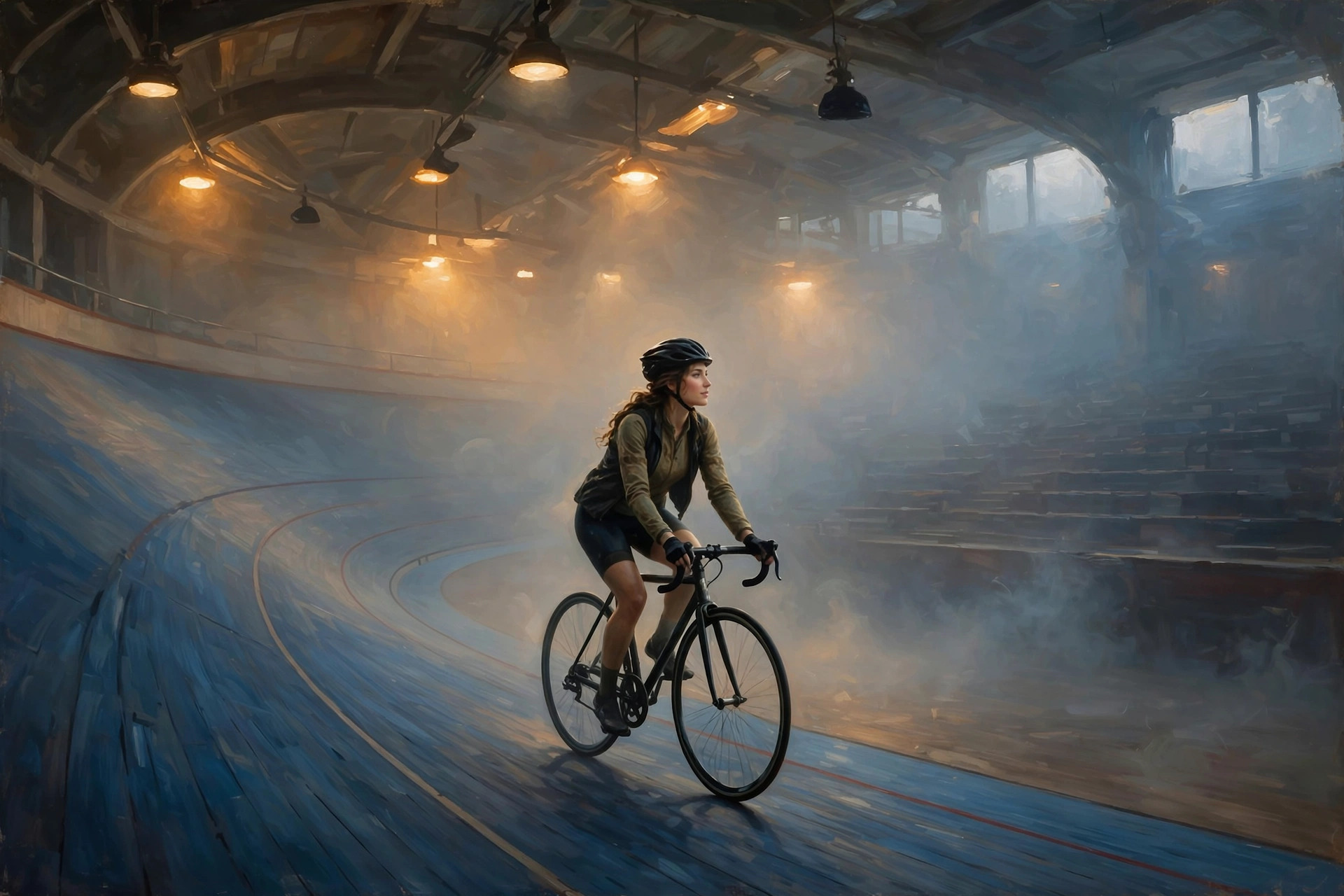
The Bellhaven Velodrome held its breath at five in the morning, and Camille Rook was the only one in it. She liked it that way. Empty track, empty infield, the overheads still half off so the blue band glowed like a strip of glacier lit from below. She'd been on these boards for nine years, and she still rolled her first lap slow, letting the wheels read the surface back to her, checking for the seam near turn two where the timber had settled over a long winter.
Today the seam was quiet. Her knee was not.
It had been eighteen months since it gave out under her in a corner not unlike this one, and most mornings it only muttered. She kept a routine for it, warming the joint in slow figures of eight before any real effort, and she kept it private. Nobody at the velodrome needed a running tally of what her body cost her before eight o'clock. She'd learned that the hard way, at a kitchen table, from a man who built bicycles.
She was forty minutes into the session, alone, halfway up the banking on a tempo effort, when the gate at the top of the ramp clicked.
Riders didn't come in through the ramp gate. Riders came in through the tunnel, signed the book, nodded at the desk. The ramp gate was for staff and for the truck that laid the track mat down for indoor football, and it did not, as a rule, produce a tall man in street shoes carrying a bike that was clearly not his.
He came down the ramp like he owned the grade of it, which was the first thing she noticed, because nobody walked a ramp like that without spending a lot of hours around one. The second thing she noticed was the bike. Matte black, aluminum, a hire-fleet number welded to the stem, and a saddle bag that did not belong to any hire fleet in the world. He'd brought his own pedals. His own saddle, from the look of the tilt. He'd dressed a borrowed frame in everything he owned, which struck her as either very serious or very temporary.
She kept pedaling. Half the people who walked into Bellhaven at some odd hour were lost delivery drivers. She wasn't going to stop her effort for a lost delivery driver.
He didn't shout across the track. He waited until she swept around turn four and came down the home straight, and then he held up a folded piece of paper, like a man at an auction who knew exactly what he'd come to buy.
She rolled down off the banking and stopped at the rail, breathing hard enough that she didn't have to talk first. That was a policy with her.
"Morning," he said. His accent was flat and northern, and he smiled while he said it, which she distrusted on principle before eight o'clock. "You're the first person I've seen on an actual track in three weeks. I was starting to think they'd all been exaggerated."
"The gate at the top is for staff."
"The tunnel was locked. I took that as a challenge." He offered the paper across the rail. "I'm supposed to find a Coach Chen. Letter says she's expecting me, but the letter also says 'trial,' so I thought I'd get a feel for the boards before anyone could form an opinion about me on them."
She took the letter because her hands were idle and it was that or the water bottle. Chen's letterhead. Bellhaven Velodrome, endurance program, and beneath it, in Chen's narrow hand: Anders Lindt, pursuit, trial period, single slot, worlds selection open.
Camille read it twice. The words didn't change between readings, which she felt was inconsiderate of them.
"Single slot," she said.
"That's the rumor I brought with me, yeah."
"The open spot on the pursuit squad." The four-rider squad. Three names already inked, one seat empty, and a selection ride on the ninth day of this month that she had circled on three separate calendars because she did not trust any single one of them.
"I don't want to keep you from your session," Anders said, and he said it easily, in the tone of a man who had practiced sounding harmless in places where being harmless got you sent home. "I'll just spin. I'm Anders, by the way. Lindt. Since the letter didn't do the introductions and you clearly weren't going to."
"I wasn't." She handed the letter back. "There's a hire fleet downstairs. If you take that thing onto the boards, someone will assume you stole it."
"I borrowed it from the desk."
"At five in the morning."
"The night man left it where I could find it." He was already clipping in, rolling down toward the bottom of the track with the loose, unhurried confidence of someone who had done exactly this in a dozen velodromes she'd never see. "He seemed happy to have the company."
She should have gone back up the track. She had a schedule, printed, laminated, in her head, and it did not include a man she'd known for four minutes. But the boards were hers, and if a stranger was going to ride them, she wanted to see how.
So she took the pace back up, and he slid onto the track below her, and for ten laps they said nothing at all, which was the most pleasant surprise of her morning. Most people who arrived with trial letters wanted to talk. He wanted to pedal. She could respect a man who wanted to pedal.
He rode neat. That was the word for it. No wasted motion, hands quiet on the bars, holding a line on the blue band like the blue band had been painted there for his personal convenience. He rode like someone who had been told, at some point in his life, that if he made one visible mistake he'd be measured by it. She recognized the handwriting of that. She'd written some of it herself.
He also, on the eleventh lap, drifted up the banking into her line.
Not rudely. Not even consciously, probably. But the pursuit line through turn two was hers, she'd called it out of habit even though the track was empty, and he was sitting on it like a man in a rented flat putting his feet on someone's coffee table. She chopped across him, two wheels, a shoulder's width, close enough to hear his breathing stutter as he corrected.
"Sorry," he called up. "Habit. I take the line that's fastest."
"The line's mine."
"The track's public."
She rolled down even with him, and they traded a look at thirty-five kilometers an hour, which is a bad place to trade anything. "The boards belong to whoever's holding them," she said. "And I'm holding them."
"Noted." He grinned, and it was an infuriating grin, the kind that arrived too quickly, covering something the way a saddle bag covers a hire frame. "You want to tell me your name, or should I keep calling you 'the line's mine'?"
"No."
"That's fair. I've been called worse by people with more reason."
Before she could decide what that meant, the tunnel door swung open, and Marisol Chen came out onto the apron with a clipboard and her reading glasses pushed up into her hair, which meant she'd been at her desk since four, which meant whatever this was had been planned longer than the letter suggested.
"Lindt," Chen called. "You found the track."
"The night man was generous, Coach."
"The night man is going to get a talking-to about the ramp gate." Chen came to the rail, and her eyes went from him to Camille and back, and her face did the thing it did when she was about to be fair to everybody in a way that would satisfy nobody. "Good. You've met. That saves time."
"We've met the way you meet a road sign," Camille said, coming down off the track. "He read me and didn't stop."
Chen took her glasses down out of her hair, which she only did for sentences that mattered. "Camille. Anders is here on trial for the open seat. Same ride as you, on the ninth. I wanted you to hear it from me before you heard it from the board."
From the board, meaning from Dee, meaning from the whole endurance squad by lunch. Camille looked at the hire bike, the trial letter folded into Anders's back pocket, the easy way he sat on the boards like they owed him something.
Eighteen months of rebuilding a knee in this building, every morning before anyone arrived, so no one could see what it took. Eighteen months, and they'd brought in a stranger to race her for it.
"Fine," she said. She clipped a foot back in. "Then he can watch how it's done. Track's yours till seven, Lindt. After that, it's mine until the ninth."
She dropped back onto the banking and wound the pace up, and she heard, behind her, the small dry sound of him laughing at something on the boards that she hadn't said.
Saddle Slip
Chen's clipboard had a gear-check list on it, which meant effort rides, which meant pairing, which meant, on the third morning, that Camille's name came up on the board next to Lindt's with a line drawn between them like the start of a bad diagram.
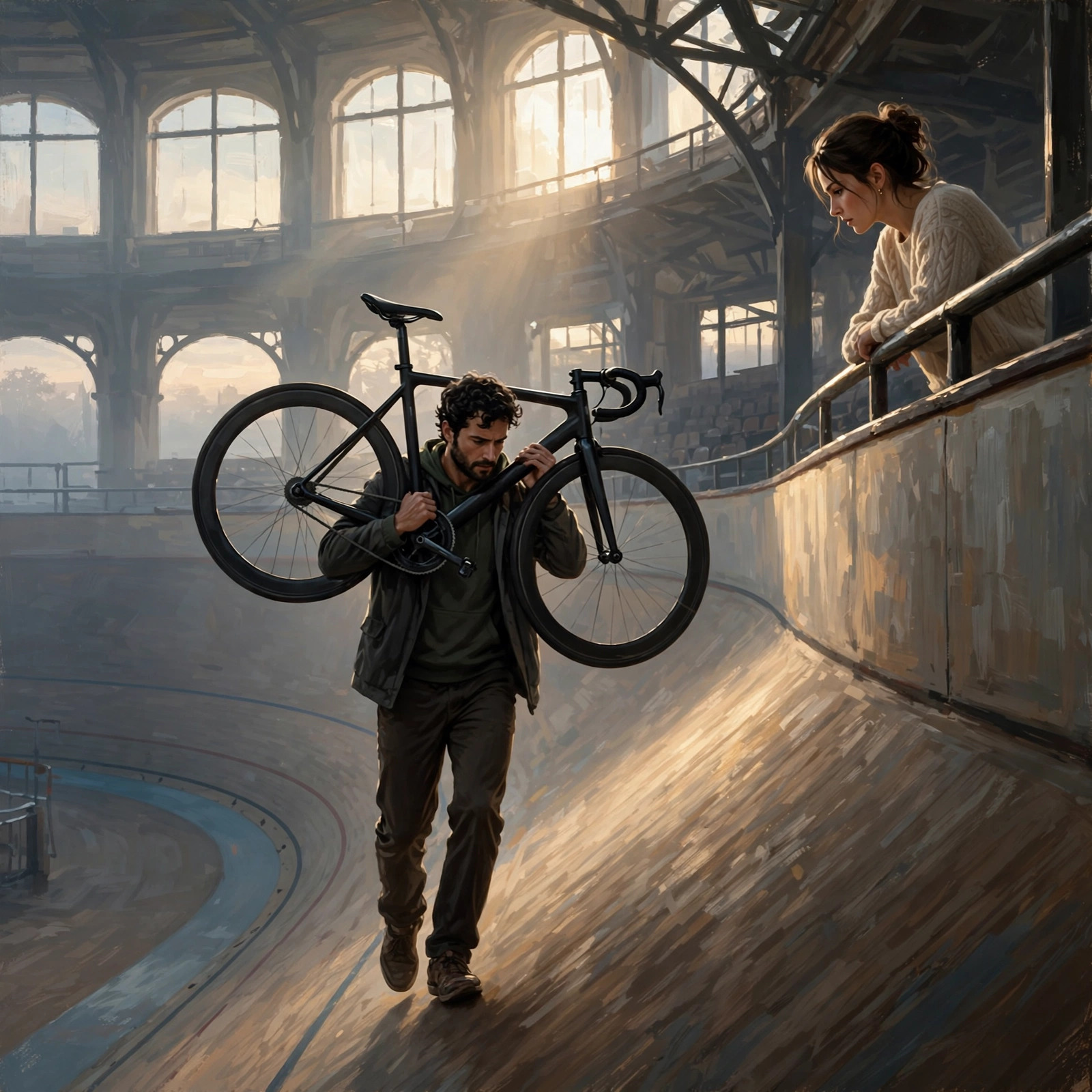
"Same gearing, same cadence window," Chen said, walking the apron with her glasses down on her nose. "Three efforts on the pursuit line. You two are within a second of each other on paper, so I want to see it on the boards instead."
"On paper," Anders said, "I'm also charming."
"On paper," Dee called from the rollers, "nobody has to talk to you."
Dee had claimed the stationary bike nearest the door, the one with the view of the whole infield, which was not an accident. Dee Okafor never sat anywhere she couldn't see everything, and she'd been watching the board since Camille walked in, with the particular stillness she saved for gossip worth sitting still for.
"Two minutes," Chen said. "Rook, you lead the first one. Lindt, you sit on her wheel and hold it. I want him on your rear axle, Camille, not on your shoulder. If he comes around you, the effort's over and you start again."
"He won't come around me."
"That wasn't an instruction to you."
Anders put both palms up, harmless, hire bike still on the track where he'd been rolling a lazy figure on the banking. He'd been there ten minutes already, riding no pace in particular, reading the boards the way some people read a room they intended to own. The 250 meters of Bellhaven were not a mystery to her, every seam and every wind-shadow of them, but he was learning them aloud, narrating his laps to himself like a man leaving a voice message for the track.
Camille led the first effort and held him off. Easy. He sat her wheel like a shadow with a pulse, close enough that on the warm-up lap she could hear his freewheel tick when she soft-pedaled, which he did not do, because he did not soft-pedal, he just sat there, patient as a debt.
Second effort, same thing. She led, he followed, Dee narrated the whole thing from the doorway in a tone reserved for nature programs.
"And here we observe the trial rider in his natural habitat," Dee said, "refusing to take a single pull."
"It's called sitting on," Anders said. "It's a tactic."
"It's called freeloading," Dee said. "It's a lifestyle."
Chen didn't look up from the stopwatch. "Third effort. Full gas from the line. Rook leads until the kilo, then it's open."
Camille rolled to the pursuit line and set herself. Her knee was quiet today, which was a gift she did not trust, and she let the gear up through the first turn, wound along the back straight, felt the boards give under her the way they gave for nobody, that small warm give that was the whole reason she'd stayed in this town nine years when other tracks had asked.
He was on her axle. Perfect. Annoying. She pushed the pace up, and he stayed there, and up through the black line they went, and then, at six hundred meters, the saddle dropped.
Not all at once. Half a centimeter, then a shudder, then the whole seatpost giving way under her with a creak like a stair in an old house. The nose dropped, her hips went back, and the bike tried to pitch her over the bars while she was doing forty an hour through a turn with a man on her wheel.
She got a foot out. She didn't get it down clean. The banking pushed her sideways, and she thought, very clearly and very calmly, this is the knee again, this is eighteen months of mornings gone at forty an hour.
Then there was a hand on her bike, not on her, on the bike, flat-palmed against the seat tube, taking her weight and her speed both, and a voice saying, "Let it run, let it run, I've got it," and Anders was beside her on the hire bike, coasting, holding her frame upright while her feet found the boards and her knee, thank God, thank nothing, held.
They rolled to a stop on the apron. Dee's commentary had gone silent, which was the loudest thing she did.
"Seatpost bolt," Anders said, already off his bike, hands out. "May I?"
She was still breathing hard, still holding the frame upright between her knees, and the correct answer was I don't need help, and the true answer was that the post was three centimeters out of the frame and she was in no position to argue with physics.
"Fine."
He had a multi-tool out of his jersey pocket before she'd finished the syllable, a little folding one, four hexes and a chain tool, the kind nobody carried at Bellhaven because there were mechanics at Bellhaven, because carrying your own tools meant you expected to be alone with your problems. He had the seat clamp bolt loose, then reset, then torqued by feel, and he did it with his ear against the frame like a doctor listening, and he didn't say anything while he did it, which was the first quiet she'd heard out of him in three days.
He wiped the post with his glove before sliding it back to her height, checking the old scratch line where the clamp had sat.
"That's the right mark," she said.
"I know. I was watching when you set it." He spun the bolt down, firm, then a half-check of a half-turn, and handed the bike back across, upright, like nothing had happened. "Cheap clamp, good bolt. You want to check it after every warm-up, this time of year. The cold gets into it."
She took the bike. The post was exactly at her height. Not close. Exact.
"You carry tools," she said, "on a track."
"I carry tools everywhere. You'd be amazed what I don't trust."
"Rook," Chen said from the rail, stopwatch still running, because of course it was still running, "you're on my clock bleeding. You've got ninety seconds."
Dee came down off her bike, unhurried, toweling her neck, radiating the specific joy of a woman with a full view. "So let me get this straight. He catches her, he fixes her bike, and he knows her saddle height by eye. In front of everybody."
"It's called preparation," Anders said.
"It's called flirting," Dee said. "With tools."
"Dee," Camille said.
"I'm not wrong, I'm just early."
Chen pointed at the pursuit line with her glasses, which was the most dangerous thing she did. "Both of you. Full gas, three laps, no catching. Go."
Camille led out, and this time she didn't think about the post or the knee or the man behind her. She thought about the line, and the boards, and the second lap when he came up level with her, not passing, just level, wheel to wheel, two lines of the same speed, and the track opened up in front of them both like it had been waiting for exactly this.
They held it. One lap. Two. Three. Same cadence, same gear, the wind-roar off the banking going from two voices to one, and neither of them said a word, and neither of them had to. It was the first time in eighteen months that someone else's wheel had been where her wheel was, exactly, and it did something to her chest she decided not to name until after the effort.
They rolled down through the banking together, and it was Camille who broke the quiet, which surprised her even as she heard herself do it.
"Track closes at nine," she said. "Empty, no coach, no clipboard. You want the boards at night, that's when they're honest."
Two Trued Wheels
The bell over the door of Rook Frame Works had a crack in it that made every arrival sound like an apology, and Camille had heard it ten thousand times in nine years, so she knew exactly which of her father's moods it would announce tonight.
Henry looked up from the vice with steel shavings caught in the gray of his forearms. He did not say her name. He looked past her shoulder at Anders instead, took in the track-scarred helmet hanging off the man's backpack strap, and went back to his filing.
"Shop's open," Henry said, to nobody in particular.
"I need the spoke key," Camille said. "The good one, not the yellow one with the stripped flats."
"Drawer's where the drawer's always been."
Anders stood in the doorway a beat too long, like a guest waiting for an invitation, which he was. Camille realized she had never actually seen him still. On the boards he was either moving or leaning, and leaning was just moving at one speed. Here he was a statue with dust on it.
"This is my father," she said. "He builds frames. He was fast once, if you believe the trophies, and the trophies do, because they're the only ones left who saw it."
"Camille," Henry said, a warning with no edge left in it.
Anders put out his hand across the counter. "Anders. I'm on trial at the velodrome."
"I heard." Henry shook the hand, quick and dry. "Heard you came in on your own money too. That's either brave or stupid, and in this sport they're usually the same animal wearing different socks."
"Dad."
"It's a compliment where I'm from."
The drawer held the spoke key, and under it, in a plastic parts tray, a handful of nipples in sorted sizes, and under that, nothing, which was the drawer's whole trick. Camille took the key and turned to go, and that was when Anders said, "Is that the one?"
He was looking at the wall rack. High rack, back wall, where the finished frames hung on wooden pegs with tags on strings. One frame sat alone on the top rung, midnight blue gone soft at the edges with twenty-six years of shop light, lugless joints filed down until the tubes looked like they'd grown into each other.
"Camille's frame," Henry said, before she could. "Brazed it in '98. Took me a winter. Took my eyesight most of the rest of that decade, but nobody's counting."
"Take it down," Anders said.
"It's not for taking down."
"Then I'll look at it from here." He was already under the rack, neck craned, and Camille watched her father watch him, and watched her father fail to hide that someone had just walked into his shop and looked at the frame the way builders look at frames, which was to say, hungrily and without manners.
Henry got the step stool. Nobody asked him to.
He lifted the frame off the pegs with both hands and set it on the bench, and the whole shop went quiet around it the way shops do when the good thing comes off the wall. Camille had seen it maybe four times since she'd grown tall enough to see the top rack.
"Tig on a jig?" Anders asked.
"Brazed, he said," Camille said.
"I heard him. I'm asking because it doesn't look possible by hand. The tolerances."
Henry made a sound that was nearly a laugh. "You'd want a plate gauge and better eyes than mine now. But it was true when it left the torch and I've kept it true. Ask her what it rides like."
"You've ridden this?" Anders turned to her, and there was something open in his face she hadn't paid for and didn't know what to do with.
"Once. Pursuit position. He wouldn't let me take it above the blue band." She rolled her sleeve where the memory lived, though there was nothing there to show. "I was maybe twenty. It fit like it had been filed for me, because of course it had, he had my measurements before I did. That's the whole man. Measurements before people."
"Camille."
"See," she said to Anders, lighter than she felt, "I told you it's an animal."
But Anders had stopped listening to the argument. He was at the end of the bench, where two wheels stood in the stand, a front and a rear, silver rims, plain gauge spokes, no tires, obviously waiting for something. He crouched and turned the front wheel with one finger, and the reflection of the ceiling lamp went around the rim without a single wobble in it.
"These aren't yours," he said to Henry.
"They're in my shop."
"They're hers." He spun it again, then plucked two spokes and listened, then looked up at the old man with an expression Camille recognized because she'd worn it at that age. "You trued these. I can see the file marks on the nipple ends. Same hand does all the work in this shop, same pressure per spoke, I'd bet my track bike on it. These are her race wheels, or they're meant to be."
Henry said nothing. The lamp buzzed over the three of them.
"Dad," Camille said. "How long."
"How long what."
"How long have you been leaving wheels for me at the velodrome desk."
He filed a burr off the bench edge that wasn't there. "Since you stopped coming here."
She had carried those wheels to the track. Twice this season she'd found a set at the desk, no note, and she'd told herself it was Chen's program, spares getting rotated through, and she had ridden them and they had ridden perfectly, and she had not once let herself do the arithmetic on whose hands had been inside those hubs, because the arithmetic led somewhere she'd nailed shut. Eighteen months ago she had needed a spare wheel and she had bought one from a stranger online rather than walk two streets.
She sat down on the shop stool, and the sitting was the mistake, because sitting meant unloading, and today she had taped the knee at four in the morning the way she always did, and the tape pulled at her calf when she folded her leg under her, and Anders, who noticed everything on a track and apparently everything off one, said, "How long has that been going on?"
She could have stood up. She put her hands flat on her knees instead, like a rider at a start gate, and peeled the legwarmer down, and the tape was there, white and neat over the kneecap, her own work, done in the dark.
"Since the crash," she said. "It's nothing. It grips when I load it at effort."
"Eighteen months of gripping."
"Eighteen months of managing," she said, and heard her father stop breathing behind her, which was its own kind of noise. "You want to know the worst part? Not the knee. The day it gave out, I called him from the medical lot. First call, before the team, before anyone. And he came, and he sat with me while they strapped it, and then on the drive home he said, well, maybe now you'll have time for a real job. That a hobby was a fine thing to have until it cost you a year of your life." She kept her eyes on the wheel in the stand. "So. That's the tape. That's what's under it."
Nobody spoke. Her father's file had gone still.
Anders didn't say sorry, which she'd have hated, and didn't say anything brave, which she'd have hated worse. He picked up the spoke key where it lay by her hand, turned the rear wheel in the stand, and found the one spoke that sang flat, because there was always one, and held the key out to her across the bench.
"You do it. I'll watch."
"You don't watch, you're the most judged man I've ever met."
"I'm not judging. I'm pacing myself. There's a thing I should probably tell you, and I keep getting to the middle of the sentence and..." He spun the key once in his fingers, caught it. "You know what, it'll keep. It's boring. Federation paperwork boring. Worse than this shop's coffee, and I've smelled that coffee."
"There is no coffee," Henry said.
"That's what I'm saying."
They trued the wheels. Both of them, front and rear, under the one good lamp, her hands and then his hands and then her hands again, quarter turns, plucking spokes, the notes climbing toward true, and Henry stayed to run the plate gauge at the end and said nothing about the frame or the phone call or the tape, and the wheels came out round. Properly round. Round the way things are when two people have been on opposite sides of the same job for two hours.
At the door, bell cracking its apology, Anders set the key back in the drawer where the drawer had always been.
"Night, Mr. Rook. Thanks for the frame."
"It didn't do anything," Henry said. "It just hung there."
"Yeah," Anders said, and his eyes went to Camille, then away, quick, like a man checking a gap that wasn't safe to take. "That's kind of what I meant."
The lock turned. The street took them both, two shadows on the same grade of hill, and the velodrome lights were still burning three streets down, and neither of them said anything about that either.
The Screenshot
The frame came to the velodrome on day seven because Anders had no reason to leave it at the shop and every reason to carry it. Midnight blue, lugless, brazed in 1998, and now wrapped in a wool sock blanket in his arms like something that had been asleep for a while and was being carried somewhere warm.
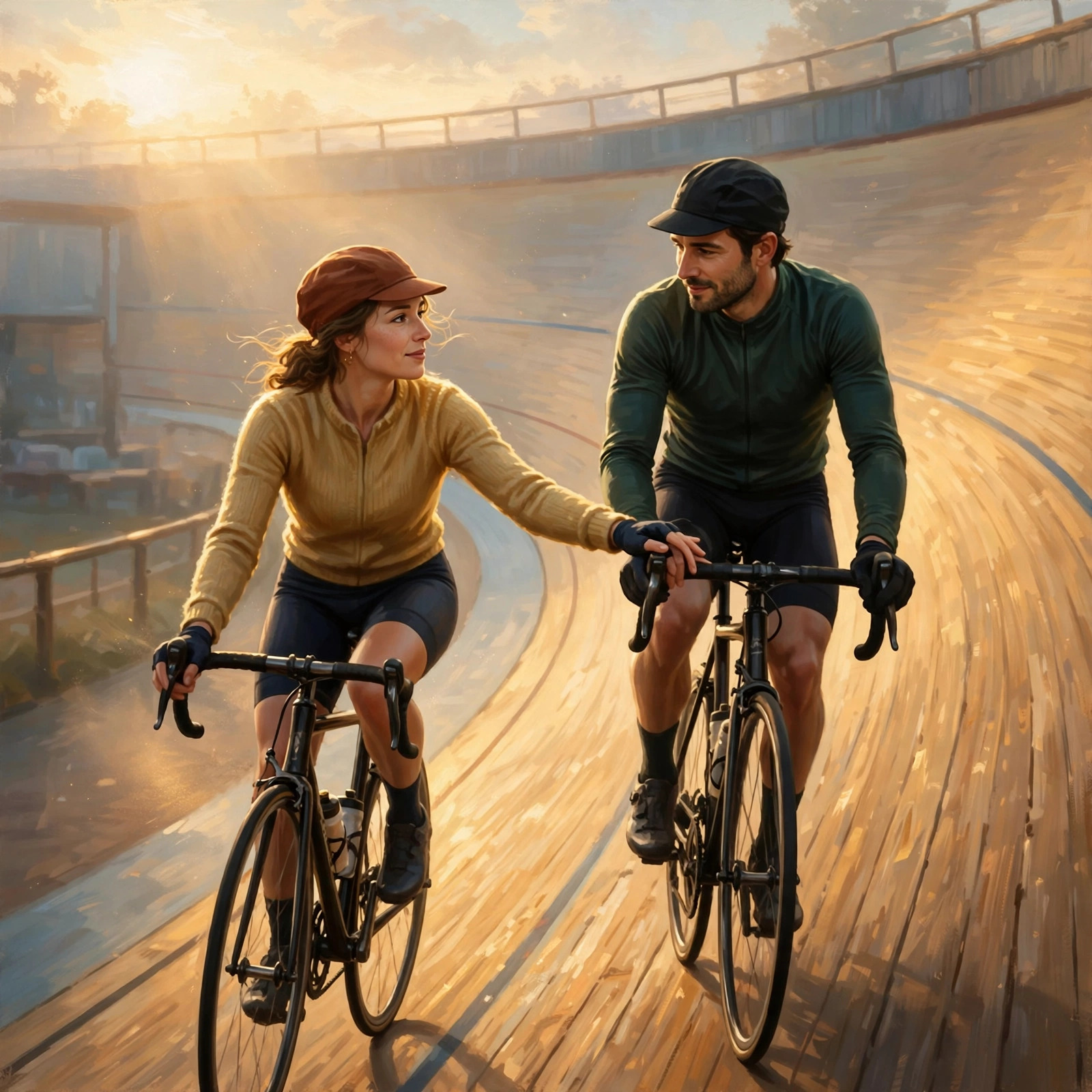
"You didn't have to bring it," Camille said, pushing the door open with her hip. Rain had followed them up the hill all morning, a fine grey suit of it, and the boards inside smelled like winter despite the calendar.
"Your father said if I left it one more night, he'd build it up himself and put his own name on the head tube." Anders set it down on the track-center stand, the one with the padded jaws, the one she usually used for her race bike. "And I don't have a name worth stamping into steel. Not yet. So." He laid the parts out on a towel like a surgeon who'd learned his trade at picnics. "It builds here or it doesn't get built."
Chen had given them the morning. Open sprint lanes until noon, she'd said, and then the juniors, so if the two of them wanted to spend their rest day wrenching instead of sleeping, that was their own poor math. Then she'd gone up to her office, and for an hour it was just the two of them on the infield with a track bike's worth of parts and the rain talking on the roof.
He built the way he rode. Quick hands, no waste, and a running commentary that had no purpose except to keep her from noticing that he was nervous. "Bottom bracket, obviously. Cranks. Pedals, because I know how you feel about loaner pedals." He held up the pair and she took them and didn't ask how he knew. He'd seen her bike. He'd seen everything about her bike.
That was the thought that was sitting in her chest when Dee came through the infield gate, and the thought didn't move when Dee did.
"Cam." Dee never used one syllable unless the second one had gone missing. She stood with her phone held against her ribs like a girl hiding a card she'd already lost with. "Can I grab you a second? It's..."
"It's fine, we're just building," Camille said. Anders was three threads into the bottom bracket, ears down, working.
"It's not about the bike."
Dee walked her ten meters off, toward the showers, past the stands where Grant Meech had installed himself at nine sharp with a coffee he hadn't drunk and a notebook he hadn't opened. Camille had clocked him from the door. A selector didn't drive three hours in the rain to watch a bottom bracket get torqued. Meech had been in the stands all week, in the corners of things, at distances that said nothing and saw everything, and she'd made herself stop counting his visits on day four.
"So." Dee turned the phone around.
The screen had been coming on and off all morning to save itself, so it took a second to wake, and the second was the worst second of the whole week. Then there it was. A message thread. Meech's name at the top. Anders's under it. Camille read it twice, because the first pass her eyes just took the shape of the words and the second pass took the words themselves.
She's finished. Eighteen months out and still guarding that knee. The slot's yours if you want it, and you should want it. I can make it quiet.
"When," Camille said. Her voice worked. That surprised her.
"Day one." Dee's thumb was shaking slightly against the phone's edge. "Somebody on the men's endscreen'd it by accident, or not by accident, I don't know. Cam, I only saw it because I was in the room when..."
"Day one." Camille looked back across the infield. Anders was on the bench now, headphones on, head tipped back, eyes shut, and he wasn't listening and he wasn't watching, and for six days she had thought that was rest.
Day one. The night he'd shown up mid-session and ridden the boards like a man who'd read the manual on her before he'd ever shaken her hand. Knowing her gears. Knowing her marks. Setting her saddle from memory, catching her bike when it slipped, riding the empty track with her at closing, plucking spokes flat in her father's shop under a lamp, six solid days of being exactly, precisely, usefully interested in her.
Studying her. That was the word for it. It had been the word for it the whole time, and she'd let the wool blanket down over it because the wheel had come out round and round things felt honest.
She crossed the infield. The rain got louder on the roof as she went, or her ears did.
"Cam." Anders pulled one headphone out. He saw her face first and the phone second, and his whole body did the thing she'd watched it do on day three when the saddle slipped: it went still before it moved. "Okay. Whatever that is, I can..."
"Day one." She held Dee's phone out flat between them. "Read it. Out loud, so I don't have to."
He read it. His lips moved through it twice, silently, and something under his face closed like a shopfront in the rain, shutters one after another, tidy, practiced, quick.
"I didn't take it," he said.
"You knew about it."
"Yes."
"For six days."
"Yes." He put the headphone down on the towel, careful, deliberate, a man setting a match somewhere dry. "Cam, it wasn't mine to..."
"Was that the joke?" Her voice came out level and that was worse, and she knew it was worse, and she couldn't fix it. "In the shop. Federation paperwork boring. The sentence you kept getting to the middle of." She heard her father in her own cadence and hated it, the same flat courtroom rhythm, the same verdict handed down before the accused had finished. She didn't stop. "You were going to tell me. Then you counted the spokes and thought, well, she's riding well, she trusts me, I'll just..."
"No. God, no, I..." He stood. He had the wheel in one hand, the front, half-laced from the morning, spokes still standing out of it like a winter hedge. "I told Meech no. Day one, before I ever met you, I told him no. I came here on my own money because I wanted it clean. The ride, day nine, whatever it says, that's what I wanted it to..."
"You kept it."
"I kept it." His jaw worked. "Because saying it meant saying Meech thinks you're finished, out loud, to your face, and you'd just told me about the knee, and..."
"And you'd rather I found out from Dee. With a date on it. Day one, Anders. You walked in knowing. Every question you asked me, every mark you set on my bike..."
"I set your saddle because I'd watched you ride for ten minutes and I have a decent eye. That was..."
"Don't." One word, and it dropped flat on the boards between them. "Don't explain yourself to me like I'm a leg you're pacing. I know what pacing looks like. I've been doing it to myself for eighteen months."
He flinched at that, the knee, the number, and she watched him decide not to reach for it and turn it into a joke, watched the joke get as far as his eyes and stop. For once he had nothing light. He just stood there holding the half-built wheel while the rain found a new rhythm on the roof and Meech sat in the stands above them both, dry, patient, watching two riders he'd already priced.
"Cam," Anders said. "I refused it. Whatever you believe about today, I need you to know I refused..."
"You refused it and kept it." She picked up her helmet from the bench. "That's not clean. That's just quiet."
The frame stayed on the stand. Mid-build, cranks on, no wheels, no bars, midnight blue with its old brazes showing silver where the rain-wet hands had smudged it. She left it there. She left the tool roll open and the front wheel half-laced and Anders standing with it, and she took the gate out past the showers, past Dee, who said nothing, past the stands where Meech lifted two fingers off his coffee in a little salute she did not return.
Her bike was on the rack by the doors. Her bike, with the wheels somebody had left at the desk for her all season, trued, round, ridden in without a word from anyone, and she didn't look at them long enough to think about who, because her chest was already full.
The rain outside was honest at least. It came down straight and cold and made no offers. She rolled out through it, spinning up the first hill, gear by gear, knee singing its flat note under the tape, and behind her in the doorway of the Bellhaven Velodrome a light burned that she didn't turn to check.
On the track-center stand, the frame sat half-built, going nowhere.
And in the infield, under the roof's long grey talk, Anders Lindt stood alone on the boards with a half-laced wheel in both hands, not moving, holding it, while Grant Meech watched him from the stands and wrote nothing down.
Open Ride
The rain had moved on by day nine, and the Bellhaven Velodrome had that scrubbed, too-bright look it got after weather, the lights buzzing over 250 meters of pine boards like the whole track had been rinsed and hung out to dry. Camille rolled through the gate at seven with her helmet under her arm and her knee taped and her mind made up about exactly one thing: she was going to ride, and she was going to ride alone.
The frame was already on the boards.
She saw it from the tunnel mouth, first as a color, midnight blue, and then as a shape she knew better than her own handwriting. Built. Finished. Wheels round and true, bars taped, cranks turning over slowly under someone's hand. Anders stood behind it on the infield with his sleeves pushed up, and when he saw her he stopped turning the cranks and took a step back from it, like a man stepping away from evidence.
"You finished it," she said.
"I finished it last night. Here." He nodded at the boards. "Didn't want to move it. It's your father's work. It deserved to be built where he built it."
"You slept here."
"The showers are warm. Don't tell Chen I said that, she bills me for the water." He said it lightly, the old reflex, and then he let the joke die on purpose this time, right in front of her, and just looked at her. "Cam. Before the ride. There's things."
"There's always things with you."
"Two things. Then I'll shut up and you can go be furious on a bike." He held up one finger. "One. I'm not riding against you today."
Chen came out of the tunnel then, clipboard under her arm, Dee a step behind her, and Meech behind Dee with his coffee, so the sentence landed in front of everyone. Camille felt the stands lean in.
"Explain that," Chen said. Flat. Not angry. Worse than angry.
Anders reached into his jersey pocket and took out a folded sheet of paper, soft at the creases from being carried, and held it out to Camille. "It's the open ride. One spot, two candidates. That's the whole format. And I'm not your candidate. I'm your pacer." He waited, hand out. "These are my notes. Every line I'd take, every lap I'd sit you on, where I'd lift you, where I'd leave you. Take it or don't."
She didn't take it yet. "You'd throw away the spot."
"I'd throw away the spot." He said it like it cost nothing, which was how she knew it cost everything, because she'd spent nine days learning to read him and he never priced anything honestly except the things that mattered.
Meech came down the stands two steps. "Lindt. A word, before you hand your career to a girl with a knee that failed eighteen months ago."
Dee moved before anyone else did. She came off the rail with her phone already out, screen up, and put it flat in front of Camille like a card dealt face down. "Timestamps," she said. "Day one, nine forty-two in the morning. His reply to Meech's offer. Read it."
Camille read it. It was short. It said no. It said it three different ways, which was two more ways than Anders usually needed for anything.
"It's real," Dee said. "I checked the headers myself. Meech offered him your spot before he ever unpacked a bag in this town, and he said no, and he never told you, and I'm sorry I gave you the worst half of it on day seven, but the good half's been sitting on my phone the whole time."
Meech's coffee had stopped halfway to his mouth. "That message was private, Ms. Okafor."
"So was mine, when you forwarded it around the federation," Dee said pleasantly, "and yet."
Chen had not moved. She looked at Anders for a long moment, then at Camille, then at the frame on the boards. "Second thing," she said. "You said two things, Lindt."
Anders's jaw worked once. He looked at the front wheel, the one Camille had ridden in on all season, the one she'd refused to think about in the rain on day seven. "The wheels," he said, to Camille. "The spares at the desk. Every one of them, all season. That wasn't the program. That wasn't me. I only found out because I got curious who kept leaving them, and I asked the desk, and the desk said a man drops them off on Sundays before you train, early, before you get here." He paused. "It's your dad, Cam. He's been truing your wheels all season. He filed the marks into the hubs himself so you'd know the set when you rode it. Little file marks, three lines. Look at the hub."
She looked at the hub. Three fine lines, bright in the dark anodizing, close together. She had seen those marks for months. She had assumed they came from a machine, or from nobody.
"I knew," she said. "Day six, in the shop. He told me. I just never let myself do the arithmetic on the hubs."
"I knew for three days, and every day I almost told you, and then I thought, that's his to tell, not mine." He rubbed the back of his neck. "And then on day seven you left, and I stood here holding half a wheel, and I thought, no. If she rides today not knowing, that's not an open ride. So now you know."
The track was very quiet. Somewhere in the stands a heater ticked. Meech set his coffee down on the rail with a small deliberate click, the sound of a man recalculating.
Chen looked at her clipboard, and Camille knew her well enough to know she was buying time. "Selection ride's in forty minutes," Chen said. "I can't stop him pacing you, it's within the rules, a pacer's allowed. But Rook, hear me. He rides your line, you ride his tempo, and the clock doesn't care about any of this. Three thousand meters. Four riders plus a reserve is what I'm naming for worlds, and this ride decides the open place. Ride it like that."
Camille took the folded notes out of Anders's hand. She unfolded them on the rail. His handwriting was small and exact, lap by lap, and across the top, underlined twice, it said: she lifts at 1800, don't be in front when she does.
"You wrote me down like data," she said.
"I know." He didn't flinch off it. "It's the only way I know how to pay attention to things I'm afraid of losing."
They rode it at ten. The boards were dry and singing and Anders sat in front of her on the midnight-blue frame like he'd been brazed onto it, lifting at 1800 exactly as the page said, dropping to the pole line through the banking where his notes said she'll want the wall here, give her the wall. She posted the time. It was the time. Dee screamed herself hoarse in the stands, Chen didn't write anything down because there was nothing left to decide on paper, and Meech left before the clock finished settling, coffee abandoned on the rail.
Camille found Anders afterward in the tunnel under the stands, where the sound of the track goes hollow and the lights are low and the chalk dust gets into everything. He was putting his helmet away in the crate, unhurried, and she came down the ramp and stopped one step above him so they were the same height for once.
"You gave up the spot," she said.
"You gave up a whole season of asking why your wheels were round."
She kissed him. It wasn't careful. He made a small startled sound against her mouth and then his hand came up and settled at the back of her neck like it had been reading those notes too, and the tunnel hummed around them with the track overhead.
When they broke apart he said, "Day six. The workshop. The frame came off the wall and you handed me a spoke and I thought, well, that's that, then."
"Day six," she said. "The night you set my saddle from memory and didn't make it a joke. I'd been choosing you since then. I just kept choosing the squad out loud instead."
"I'd been choosing you since day three, and out loud I chose Meech's silence, so we're neither of us heroes." He tipped his forehead against hers. "Cam."
Chen's voice came down the ramp before anything else could. "Rook. Lindt. Congratulations, you're both insufferable." She held the clipboard against her hip. "Squad's named from this ride and this ride only. Rook, you're on the four for worlds. Lindt, you're the reserve, and before you argue, reserve means you train with us, funded, through the program." A pause. "Your trial's over either way."
Dee whooped from somewhere up the ramp. The tunnel lights buzzed. Anders laughed, low, against Camille's hair, and she felt it through her whole chest, and overhead the empty track waited, patient, holding the time she'd made on her father's steel.
Dawn Laps
The velodrome was empty at ten past five, which was exactly why Camille had chosen it. The dawn lights ran along the top of the banking in a low gold line, and the boards below them held the night's chill like a cellar. She had the midnight blue frame down off the wall rack before Anders found her, her race wheels already seated, hubs freshened, the whole bike humming under her palm the way steel did when it was happy.
Anders came through the tunnel with two coffees and her old bike, the aluminum one she'd been riding all season, the one he'd apparently claimed as his own sometime around the kiss and she had not yet found the energy to argue about.
"You stole my bike," she said.
"I'm borrowing your bike. There's a difference. Yours is the one with your father's initials filed under the bottom bracket." He set the coffees on the infield grass and looked at the steel frame leaning against her hip. "You're riding it."
"I'm riding it."
"It's twenty-six years old."
"It's better than anything with a price tag on it." She swung a leg over. The saddle was hers, the wheels were the ones that had been arriving at the desk all season with their quiet hand-filed spoke marks, and the frame was the one her father had brazed in 1998, before she was born, before any of it. It fit her like a sentence she'd known by heart and stopped saying.
Anders clipped in beside her on her old bike, and they rolled out onto the boards together, easy, no clock, no split to hold, nobody's name on a start list. The 250 meters of Bellhaven unrolled under them turn after turn. The velodrome made its old sound, the soft roar of wood holding wheels, and the dawn lights slid along the blue band like water.
Halfway up the banking she said it, because she'd promised herself she would say it out loud where it couldn't be taken back. "I'm done riding alone."
He glanced across. "For the squad, you mean."
"For everything. The squad. The mornings. The hiding." She kept her line. "Eighteen months of training like a secret, Anders. Icy tape and a locked door so nobody could see me favor it. My father calls my career a hobby and I answered him by making it one, on my own, out of spite. No more."
"And me?"
"Especially you."
He was quiet for a lap. Then: "I've been a line on somebody's spreadsheet since I was nineteen. Meech would've kept me one. Chen's the first coach who ever wrote my name down next to a time I actually rode." He tipped his wheel in until it nearly touched hers. "So when she put me on reserve last night, I called my sister. First time in three years."
"What did she say?"
"She said, 'Is this the nice one or the fast one?' So I have some explaining to do at Christmas."
Camille laughed, and it came out easy, which surprised her, and then didn't.
Chen arrived at six with a clipboard and no announcement. She walked the apron, watched them circle twice, then called them down off the banking with two fingers.
"The squad posts at nine," Chen said. "You're on it, Rook. First man, so to speak. Lindt, reserve, and I filed the open-ride times with the federation last night, so it's done, signed, unchangeable." She looked at Camille, then at the steel frame between her knees. "Meech called me twice this morning about the selection process. I reminded him the process was the ride, and the ride was the fastest qualifier, and the fastest qualifier was you. He'll be leaving the panel by his own choice, I'm told, once the screenshots make their rounds. Dee sends her love, by the way, and a threat."
"Which threat?"
"She says if either of you says 'thank you' at the wedding she'll be unable to cope."
"Bold of her to assume there'll be a wedding," Anders said.
"Bold of her to assume there won't be," said Camille, and Anders nearly went off the boards into the infield, which was the reaction she'd been fishing for.
Chen handed Camille the posted sheet, four riders and one reserve, names typed, hers at the top of the pursuit squad. Camille folded it and put it in her pocket next to the pacing notes Anders had written her, and tried to feel the weight of it and couldn't, because the heavier thing in her chest had a different shape entirely.
"We're going to the workshop," she told Chen. "Before it opens. We're walking."
"Walking."
"It's two streets. Some things you shouldn't arrive at too fast."
Rook Frame Works had its light on already, because her father had never once in thirty years slept past five. Camille rolled the blue frame along the pavement between them, one hand on the stem, Anders walking on the far side with her old bike, and the morning was the color of the inside of a bell.
Henry was at the bench with a file in his hand when she pushed the door open, and he looked up like a man who had been rehearsing a casual sentence and lost it.
"The wheels came round," he said. "All season. I didn't want you to think you owed anybody anything."
"I know it was you." She set the frame against his workbench, upright, where he could see his own file marks catching the lamplight. "Dee showed me the nipples. Your cross-hatch. You never could file a spoke nipple without signing it." Her voice held, mostly. "You called it a hobby, Dad. The day my knee went. And I've spent eighteen months proving you right by keeping everything at arm's length, including you, including this frame, which is the best thing anyone ever built for me."
He set the file down very carefully, the way you set down something you don't trust your hands with.
"I was frightened," he said. "That's all it was. It came out wrong and I let it stay wrong because I'm stubborn, and she's where you get it from, God knows." He touched the top tube, one finger, along the midnight blue. "You rode it to the line yesterday."
"I rode it fastest. I'm on the squad. Worlds. And I want you there." She swallowed. "Not building wheels in your basement for a daughter who won't come to the door. At the track. In the stands. Where I can see you when I look up."
Henry Rook, who had brazed a thousand frames without his hands ever shaking, wiped his eyes with the back of his wrist and pretended it was sawdust, and nobody in the shop was cruel enough to say otherwise.
Anders cleared his throat. "Sir, I'm also going to worlds. Reserve. And I'd like to keep borrowing your daughter's old bike, and possibly your daughter, if that's, if the two of you have an arrangement about, I'm going to stop talking now."
"First smart thing you've said," said Henry, and shook his hand, and it was nearly a broken thing, the grip held too long, and Camille loved both of them so much she had to look at the ceiling.
They rode back to the velodrome with the sun fully up, because Henry pushed the frame toward the door and said, "Go on. It wants the boards more than it wants my wall." The two streets went by in a ribbon of gold. The boards of Bellhaven Velodrome sat warm now, dried out, humming their old note, and the track was still empty, all theirs, the last lap of the season unrolled and waiting.
They took it side by side. Not racing. Not pacing. Camille on her father's steel, Anders on her old bike, two wheels' width apart up on the banking where the world tilts and you have to trust something. Her hand came off the bars first. His followed. Their knuckles brushed through the turn, once, twice, deliberate as a signature, and she didn't look over, and neither did he, because when you've finally chosen something with your whole chest you don't need to check that it's still there.
They crossed the line together and rolled into the infield grass, and the season ended the way it had started, except nothing about it was the same.
Get notified when new stories drop
Noah Carrington
Noah covers sports romance and forced-proximity heat: rivalries, road trips, and the quiet moment after the crowd goes home.
Leave a comment
Comments