





The Hall Bridge
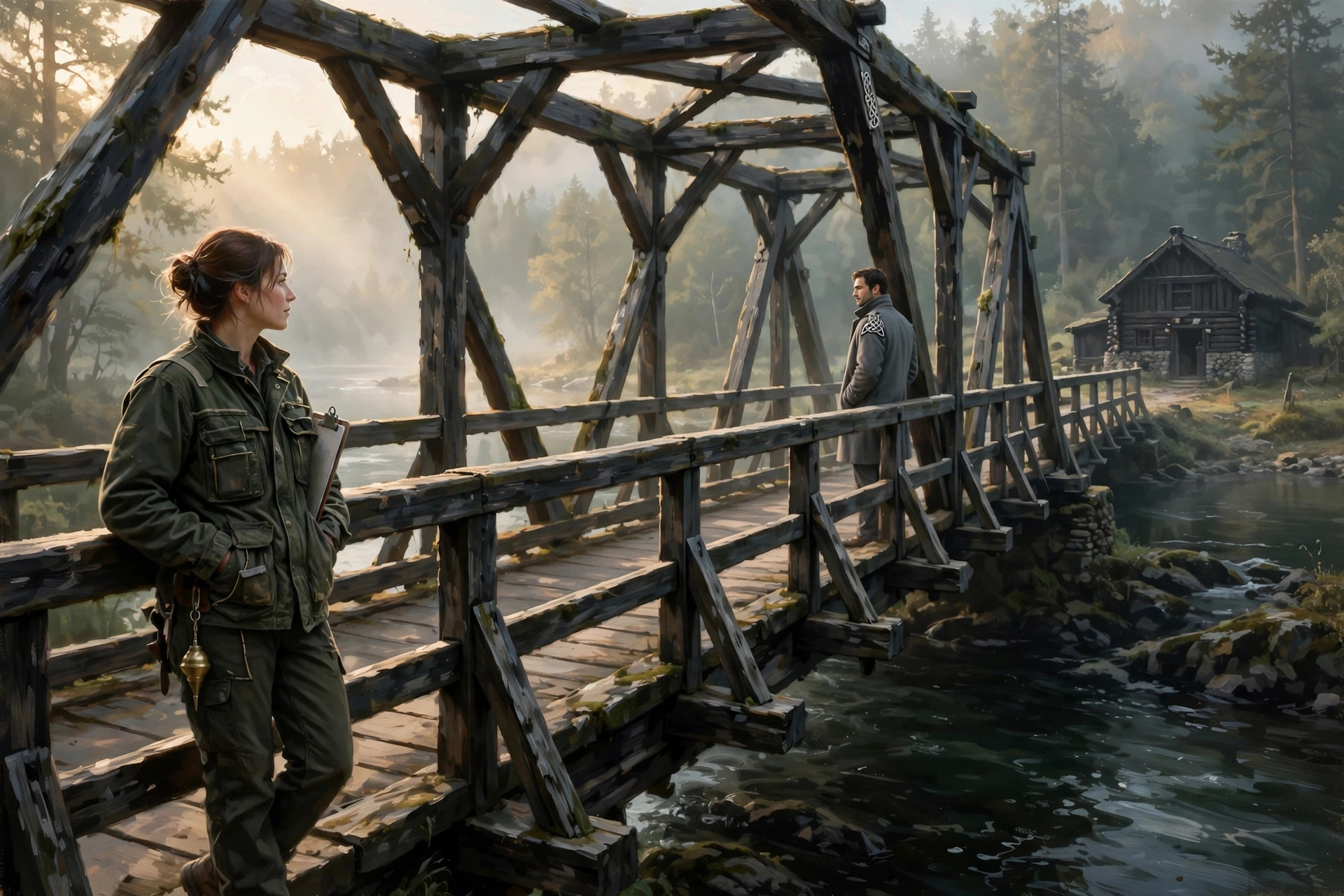
Petra Lindqvist stepped onto the hall bridge at seven in the morning with a clipboard under one arm and her father's plumb bob knocking against her hip. The brass was warm from the walk upriver, worn bright along the string line where seven years of inspections had rubbed it smooth. She gave it a pat out of habit, the way other people checked for keys.
The Vane ran low for late September, green-black under the sixty-meter span, loud enough that she had to raise her voice for the voice memo.
"Day one. Hall bridge, full structural. Deck, truss, posts, plaque." She clicked off and started counting her paces across the boards.
The Longhouse pack hall sat on the far bank like it had grown there, black timber and river stone, older than the town's paperwork and smug about it. Petra had crossed this bridge maybe two hundred times in three years, always as a neighbor, never as the city's inspector. Today the clipboard made her something else, and she could feel the difference in her own shoulders.
Tobias Lindqvist was on the water below, rowing his old boat upstream along the far pilings, taking his dusk stroke three hours early. He didn't wave. He never waved when she was working. He'd told her once that a person on the clock shouldn't be interrupted, and then he'd rowed under her first condemned structure without looking up. She kept her eyes on the deck joints and pretended she hadn't checked whether he was watching her.
"Inspector."
The man came off the bank path without any sound she could point to, which was its own kind of rude. Tall, gray coat, a steel clasp at the shoulder stamped with a knot she recognized from the hall's doors. He'd been at the harvest supper last week, at the far table, not talking to anyone. She'd noticed that too, and then noticed that she'd noticed.
"You're the pack's enforcer," she said. "Ardal."
"Kasim." He stopped a polite two meters off, hands loose at his sides. "Aurel asked me to walk with you while you work."
"Walk with me."
"The tenure's been in dispute since spring. The alpha wants the bridge watched, and the city's inspector is the one walking it." He tipped his chin at her clipboard. "I'm the watching."
"I don't need watching. I need quiet and a free hand." She held up the plumb bob. "This doesn't lie to anybody."
"Good. Neither do I." He fell into step behind her at the same polite distance, and if she was honest with herself, which she mostly avoided being before eight in the morning, the distance was the problem. He moved like the river did, all the noise somewhere else.
She worked the deck first. Post to post, joint to joint, the chalk moving, the plumb line dropped twice at every meter to check the lean of the railing posts. Sixty meters of it. Her knees ached by the twentieth post in the pleasant, familiar way, and she lost herself in the count the way she always did, the way that made the rest of Marlow Ford go quiet and small.
Under the deck, the work turned physical. She took the ladder down to the gravel bar and started along the truss from below, where the light came through the deck boards in long stripes and the river talked past her ankles. The plumb bob swung from her belt. She checked the bearing plates, the bolts, the founder's plaque bolted to the third truss panel, its raised iron letters soft with rust at the mounting.
That was when she started humming. She always hummed under a deck. Some tune her father used to row to, no name she knew, just a rise and a fall that fit a stroke rate. She'd have denied it under oath.
The answer came from behind her.
Low, under his breath, matching her rise and fall exactly, then bending it, a note below hers and one above, a little braid of sound that hadn't been in her tune at all and that she somehow knew down to the bone, like a phone number from childhood. She stopped. He stopped. The river went on.
Something settled in her chest. There was no better word for it. Like a beam finding its bearing, like the plumb line catching true, a click she felt in her teeth and her wrists and somewhere under the sternum she didn't have a form for. Her chalk hand was shaking. She looked at it with real annoyance.
"Don't," she said, without turning around. "Whatever that was."
"I didn't mean to." His voice had gone rough at the edges. "It's a work song. My grandmother's."
"It's my father's rowing song."
"It's older than both of them," Kasim said, and there was something in how he said it, something careful, that made her turn around.
He was standing in the striped light with his hand flat against the truss like he needed it to hold him up. His face had gone still the way people's faces go still when they're listening hard to something nobody else can hear.
"Are you all right?" she asked.
"Yes." He took his hand off the wood. "No. I don't know what that was."
"It was a tune. People hum. It's a bridge, not a chapel." But her heart was going faster than the climb down accounted for, and the plumb bob against her hip felt warm through her shirt, warmer than brass gets in shade. She put her palm flat over it and got nothing she could write down.
She turned back to the truss because the truss was the thing she could do. Third panel. She checked the plaque bolts with a wrench, found the rust was skin-deep, marked them for cleaning, and moved to the fourth panel, and the fifth, and made herself not look at him. He kept the two meters. He had stopped being polite about it and started being stubborn about it, like a man holding a door closed with his back.
By mid-afternoon she had the deck line chalked and forty of the sixty meters under the span measured, and the count in her notebook had a shape. Fourteen posts with rot at the waterline, all of them on the downstream edge, all of them reachable, all of them the kind of rot that cut out clean if a crew came in with the right lumber. Everything else so far read sound. She sat back on her heels at the twelfth bad post and let herself feel it: relief, thin and premature, six days early.
"You found something," Kasim said. He'd come closer without her hearing it again, close enough to read her notebook upside down, which she did not appreciate and did not stop.
"I found fourteen posts that need replacing and a lot of timber that doesn't. Which is the difference between a repair order and a wrecking ball, so don't get excited in either direction. I've got until day seven to file, and I don't file what I haven't checked twice."
"Check it three times," he said. "This bridge carries more than foot traffic."
He said it looking at the hall, not at the bridge, and she filed that away in the place she kept things that weren't numbers.
She stood, tucked the notebook, and reached up to the truss to strike her last chalk line of the day, high on the diagonal, marking the panel she'd start on tomorrow. The chalk slipped out of her fingers.
His hand came up and took it out of the air, easy as breathing, an arm's length before it would have hit the gravel.
He held it out to her. She reached for it and his fingers didn't let go right away, and hers didn't pull away right away, and for the length of three of her father's strokes they just stood there in the striped light with the chalk between them, the river talking past.
"Tomorrow," Kasim said.
"Seven sharp," she said. "And don't hum."
He smiled like a man who already knew he was going to.
Under the Deck
Seven sharp meant seven sharp, so Petra was under the deck at six fifty, and Kasim was already there, sitting on the downstream stringer with the lamp unlit in his lap, watching the water go by like it owed him money.

"You're early," she said.
"You're earlier."
"I'm on time. You're early. That's the difference between us." She unrolled her kit on the dry gravel, checked the probe against her palm, and did not look at him while she said it, because looking at him had become a thing she was budgeting. She had a system for the day: upstream posts first, then the fourteen downstream, then the truss panels she'd chalked yesterday. Numbers in, numbers out, and the man on the stringer could be scenery.
He was bad scenery. He kept moving to be useful. When she needed the lamp lit, he lit it before she finished turning. When she knelt at the first rotted post, he moved the light without being asked, low and to the left, exactly where she'd have put it, and she disliked how much she liked that, and put the dislike away with the rest of the morning's luggage.
"Yesterday," she said, working the probe into the soft wood at the waterline, "your alpha asked you to watch me. How long is that assignment meant to run?"
"Until the bridge is decided." His voice came out flat, the way a door comes shut. She filed the flatness. Her father had a flatness like that, the kind that meant the sentence behind it was longer than the one he'd said.
The probe went in eight centimeters and stopped against good heartwood. She measured the rot column twice, wrote the figure, moved left. Post two. Post three. The river kept its own count underneath them, and somewhere in it, faint, her ears caught a rhythm in the current and her blood answered before her brain did, and she stopped herself with her thumb on the notebook page.
"Don't," she said.
"I didn't."
"You were about to."
He was quiet a moment. "I was," he admitted. "It's not on purpose. It comes out of me around you, like water finding a low spot. I can stop it if you tell me to, but I wanted you to know it's not a trick."
"Nobody said trick." She moved to post four. "I said don't."
"You did." And then he did stop, and the morning got quieter in a way she noticed like a missing stair.
Post four had rot at the base and a clean core above it. Post five, the same. Post six had a split she hadn't clocked the day before, a long check running up the grain, and she spent ten minutes on it while Kasim held the lamp steady and said nothing, and the nothing was almost worse than the being useful, because it had a shape to it, like he was carrying something with his mouth shut.
Her phone buzzed at post eight. Bett. Petra put it to her ear with chalk on her fingers.
"Tell me you're not going to condemn my bridge," Bett said, no hello. Down the line a printer was grinding out somebody else's week.
"It's not your bridge, it's the city's, and I'm not going to tell you anything until day seven. That's the filing date."
"I know the filing date, I signed your schedule. I'm asking what your gut says. The Kestrel business has the whole waterfront jumpy. If you condemn, the tenure question answers itself, and I'd rather not learn at the council meeting."
Her gut said fourteen posts and clean timber. Her gut had also, once, been wrong in the direction that broke a ferry, so she didn't lead with it. "It says wait for day seven."
"Petra."
"Bett."
A sigh came down the line, nineteen years of supervisor deep. "Fine. Count twice."
"Always."
She hung up and found Kasim watching her with the lamp held low, his eyes doing something she couldn't instrument. She went back to post eight. Post nine. Post ten had rot halfway up, worse than yesterday's read, and she measured it three times before she wrote it, and then measured a fourth time because the third had felt too much like hoping.
"You check everything twice," Kasim said. It wasn't a question.
"Once is a rumor. Twice is a number."
"And the third time?"
She didn't answer that one. He didn't press. The current took a branch past them, spinning, unhurried, and she watched it go under the deck and out the other side.
At post eleven she hit her head on a crossbeam, not hard, and his hand was there at her shoulder before the sting arrived, steadying, and then it wasn't, withdrawn like it had a rule against itself. She sat back on her heels.
"Okay," she said. "The tune. Yesterday. The thing you do with the pitch. What is it? Because I've had a song stuck in my head since yesterday afternoon and I don't get songs stuck. I get numbers stuck. Songs are new equipment and I don't like new equipment I haven't been briefed on."
He set the lamp down on the gravel between them, which felt deliberate, like a man putting down something before he said a heavy thing. The light lay along his jaw. Up close, under the deck, in the striped morning, he looked like what he was, and she made herself keep looking.
"It's called the bond-song," he said. "A wolf sings it once in a life. Once. Not once a year, not once a decade. Once. You pick the person you'd bind to, and you sing, and if they answer, the knot forms. And it has to be sealed inside three moons, both people, by choice, or the wolf's shift burns out. Forever. No second song. No appeal."
The gravel was very dry under her knees. "That's a folk custom."
"That's a law of my body," he said, "the way gravity is a law of yours."
"And yesterday. Under the deck. When I was on the diagonal and the current had that rhythm, and you pitched in." She kept her voice level, the way she'd trained it for council rooms. "Did I answer something?"
"You answered it before I'd finished deciding to sing it," he said. "It was out of me before I knew. And your ear picked it up like it had been waiting for the sheet music. The knot's formed, Petra. Since yesterday. I'm sorry. I should have told you at first light."
She looked at her hands. Chalk dust, probe oil, the bright weight of the plumb bob riding her belt where it always rode, the one instrument she'd never once distrusted, because her father had cast it the week she was hired and it had never lied to her. She thought about instruments. She thought about how you calibrated a thing you couldn't check twice.
"Three moons," she said.
"Three moons."
"And if nothing is sealed, you lose your shift. Your wolf."
"Yes."
"And if I'd never found out, you'd have carried that alone until it burned." She watched him not answer, which was an answer, and something in her chest went sideways, some load-bearing thing shifting off its bearing by a degree she could measure. "That's a terrible system."
"It's the only one we have."
"No," she said. "It's the only one you have. I have a bridge to file on by day seven and a father who rows this river at dusk and a supervisor who wants my gut. I don't have room in the load calc for a, a knot." But her hand had come up, without permission, to rest on the plumb bob at her belt, and he saw it, and neither of them said anything about it.
Posts twelve, thirteen, fourteen went faster, because she was angry in a clean way now and anger made her quick. Rot columns, measured twice. Sound cores, sounded with the probe's butt. Kasim moved the lamp where she needed it and kept the two meters and didn't sing, and his silence had a different weight at the end of it than it had at the start, and she noticed the difference, and she liked him anyway, measured and tallied and liked, which was the worst number she'd taken all day because she couldn't check it against anything.
Fourteen posts. Fourteen rot columns. All downstream, all reachable, all cut-out clean with the right crew.
"Hold the light on the page," she said.
He crouched, brought the lamp over her notebook, and held it still while she wrote. Downstream deck posts: fourteen rotted at waterline, cores sound above. Truss and stringers sound to date. Repairable, pending full count. She underlined repairable and then, because she was who she was, underlined it again.
"Is that good news?" he asked.
"It's a number," she said. "Good news is what happens on day seven when I've checked it twice. Hold the lamp. I've got four more panels to sound before I trust it."
He held the lamp. She worked. The river went on counting underneath them both, patient as any instrument she'd ever trusted, and somewhere down it, she knew without checking, her father would be at the shed, tuning his oars for dusk.
Night Deck
She came back up to the deck at half past eight with a hand lamp and a thermos of her father's coffee, because the last four truss panels would not sound themselves and because the alternative was going home to a rented roomsit where the radiator ticked like a slow metronome and she would think about knots until morning.
He was already there.
Of course he was already there. Kasim Ardal stood at the upstream rail with his gray coat open to the night air, steel clasp catching her lamp, and he did not pretend he had been doing anything else. The river ran dark under the bridge, sixty meters of it between the abutments, and the planks under her boots gave their small familiar complaint, sound wood, dry wood, wood she had walked on all day until her ankles ached.
"The panels will keep until tomorrow," she said. "You don't have to stand guard over them."
"I'm not standing guard over the panels."
She set the thermos down on the rail. The coffee would go cold either way. She had learned that about him in three days: he arrived where she would be before she arrived there, and he never explained it, and tonight she was too tired to pretend she hadn't noticed.
"Then what are you guarding?"
"Nothing tonight." He turned to face her properly, and his voice dropped out of its enforcer's register into something lower, something she had only heard once, under the deck, braided into her father's rowing tune. "I owe you a straight answer, and I've been circling it since yesterday."
"I've noticed."
"You would." A breath of a laugh, gone as soon as it came. "The song. Day one. It wasn't a, a folk thing. It wasn't something the pack sings at solstice."
She waited. Waiting was the one instrument she had never needed to calibrate.
"A wolf gets one," he said. "One bond-song. One, in a whole life. You sing it once, and if the person it finds answers the tune, the knot ties. That's it. There's no second verse. There's no taking it back."
The river said its dark patient nothing. Somewhere under them a plank ticked as the temperature fell, and she catalogued it without meaning to, sound joint, no movement, and hated herself a little for cataloguing it.
"You sang yours," she said slowly. "On day one. At me. By accident."
"At the river," he said. "At the light on the water. At the fact that a woman had stepped onto this deck and started measuring it like she meant to save its life." His jaw worked. "It came out before I understood what it was. I've carried it thirty-five years without spending it. I never meant to spend it on anything."
"And I answered it." Her voice came out flat, inspector-flat, and she was grateful for that. "Because my father rowed that tune into me before I could walk. So I answered, and it tied."
"Yes."
"Without either of us deciding anything."
"Yes."
She took the plumb bob off her belt. Brass, palm-sized, cast in a sand mold in the ferry shed the week she'd been hired, the one object in her kit that had never once lied to her. She unspooled a hand of string and set the whole thing down on the rail between them, bob resting on its point, string coiled around it like a sleeping snake.
"Here's the thing about me," she said. "I don't want anything I haven't verified. Not a truss, not a post, not a finding, and not a man. My whole job is people pointing at something and telling me what it is, and my whole working life is checking whether they're right. So if you're standing there telling me there's a knot tied between us, I'm not going to take it on your word, and I'm not going to take it on mine."
"Then what will you take it on?"
"Measurement."
She picked the bob back up, paid out the string to its full arm's length, and held it up between them, dead center, so the point hung in the dark air equidistant from her breastbone and his.
"Hold still."
He held still. She'd expected him to joke; he didn't. The string steadied, the point stopped swinging, and then it didn't stop, that was the thing, that was the reading. A plumb line with no wind on it and no hand tremor in it swung three degrees toward him and hung there, leaning, taut, pointing at the man like a compass needle that had found a north nobody had ever charted. She watched it for ten full seconds. Her pulse was in her ears, and under her palm the string pulled faintly, steadily, the way water pulls at a hull.
"That's not possible," she said.
"No," he agreed, very quietly.
"Strings don't lean."
"No."
She looked up from the bob to his face, and his eyes were on the string, and then on her, and he looked, for the first time in three days, like a man standing on something he hadn't inspected, something he was afraid would not hold. She had spent her whole working life being the one who said it holds. She had said it about bridges and ferry landings and one terrible afternoon about a ramp that turned out not to matter, and she had learned the cost of saying it fast.
So she didn't say it fast. She wound the string, set the bob down on the rail between them, deliberately, both hands empty, and then she took one step, and one more, closed the distance to arm's reach, took his collar in her fist the way she'd take a line to cleat it, and kissed him.
He made one small sound, surprise or relief or both, and then his hand came up to cradle the back of her head like something breakable he had been given the job of carrying, and the deck, the river, the whole dark sixty meters of the span went quiet in the way a bridge goes quiet under load, everything in it working at once, nothing in it moving.
He tasted like woodsmoke and cold air. His mouth was careful, which she had known it would be, and then less careful, which she had not, and her free hand found the steel clasp at his shoulder and held onto it as if it were a rail, which after a moment it was, because her knees had opinions now.
When she finally pulled back a hand's width, her breath was ragged and her field book was in her bag forty meters down the deck and she did not care, which was a sentence she could not remember ever thinking before.
"Verified," she said.
"Verified," he echoed, and his voice cracked on the second syllable, and she watched him decide not to be embarrassed about it, and she liked watching that more than she had liked anything on this river in three years.
"For the record," she said, "I still don't trust it."
"For the record," he said, "I don't either."
"Good." She did not step back out of his arm's reach. "Then we're both checking."
The howl came up the river then, from upstream, long and low and rising at the end, one of the Longhouse voices on a ridge she couldn't see. Kasim's head turned toward it before the sound had finished, old habit, twelve years of answering written into his neck. They pulled apart, and the space between them went cold where his warmth had been.
And the knot answered the howl. That was the part she had no instrument for and no column for: something in her chest turned with the sound, and turned in him too, she could see it, a shudder through his shoulders like a struck string in both of them at once, one note, two bodies, ringing.
He looked at her across the small cold space with his hand still half-raised where her shoulder had been.
"You felt that," he said.
"I felt that."
Her plumb bob sat on the rail between them, brass gone amber under her hand lamp, string coiled, point resting on the wood. She looked at it. It had leaned toward him. It would lean toward him tomorrow, and the day after, and on day seven when she filed whatever she filed, and there was no fixing a reading like that. There was only living inside it.
"Day seven," she said, mostly to herself. "Four more days of panels."
"Four more days," he said. "I'll hold the lamp."
She picked up the bob, threaded it back onto her belt, and put her cold hand in her pocket, where it went on feeling, for a long time after, like it was still holding the string.
"You'd better," she said.
Survey Stakes
Petra came up the towpath early, before the mist had lifted off the Vane, because the mist made the light lie and she wanted the light straight. Three years in Marlow Ford had taught her which mornings belonged to the river and which belonged to her clipboard, and this one, day four of seven, belonged to the clipboard. Fourteen posts down, she kept telling herself. Fourteen posts, then the deck, then the trusses, then a finding she could sign with a clean hand.
She was cutting upstream along the bank to start at the far abutment when the orange caught her eye.
Six stakes, driven in a line through the mud of the pack's riverside, plastic ribbon looped from the third one, and stamped along the ribbon in block letters she could read from ten meters: VANE HYDRO, LLC. She stood over them a long moment. The mud held the print of boots around each stake, several pairs, recent, the water still seeping back into the holes. Someone had come up from the water, planted their line, and gone back down it. On pack land. On the land that lived or died by whatever she filed on day seven.
She crouched and put two fingers against the nearest stake. It was planted deep, no amateur's tap-work. A crew had done this, and a crew had done it with permission from somebody, because crews did not row up somebody else's river and survey it for fun.
"Morning," Kasim said, behind her, and she did not startle, which frightened her more than a startle would have. Four days of his footsteps had already gotten into her ears and filed themselves under known.
"Whose stakes are these?"
He came down the bank. She watched him see them, and she watched him not be surprised, and that was the whole finding right there, wasn't it. His face did the thing it did when he was deciding how much truth could survive the daylight. She had a scale for that now, four days old and already calibrated.
"Vane Hydro's," he said.
"On pack land."
"On the riverside tenure." He looked at the ribbon, not at her. "Which Aurel has already promised them."
The mist was lifting off the water in slow rags. Somewhere downstream a fish broke the surface and she counted the rings out of habit, one, two, three, because counting was what her hands did when the rest of her wanted to shout.
"Promised them. Signed or promised?"
"Signed. An option. It only converts if the tenure falls, and the tenure falls if the hall bridge is condemned, and the hall bridge is condemned if the city's inspector says so." He said it flat, like reading a plate off a machine. "So the inspector was assigned an escort."
Her hand was still on the stake. She took it off and wiped the mud down her trouser seam, twice, the way she always did, and stood.
"You told me you were watching the tenure."
"I was."
"You told me it was to protect it."
"I told you what Aurel told me to tell you." He finally looked at her. "And I told you the true part too, both times. I don't know if that counts for anything. I think it doesn't."
She walked the line of stakes, six of them, heel to toe in the mud, her boots printing over the crew's prints. The line ran straight toward the hall, past the bridge, upstream, the way a weir would run if you wanted to hold the whole river in your hand. She stopped at the third stake, where the ribbon was, and turned.
"Say the rest of it. You've been winding up to it since the bank."
"The truce with the Kestrels. It gets ratified at the muster, day after your deadline. The glue holding it is a bond-match. Juno Marek, their heir, matched to me." His jaw worked. "It's void, Petra. It's been void since the first morning on this deck, and she doesn't know it, and if I say why at the muster it tears the truce apart, and if I don't say it I'm standing there letting a pack believe in a thing that isn't real. That's the shape of it. That's the whole shape."
"Why void?" she asked, though she knew, and he knew she knew, and the question was a cruelty and she asked it anyway.
"Because my song is spent." He said it to the stakes, not to her. "On you. Without meaning to. And a wolf sings once."
The rings from the fish had reached the bank by now and flattened into the mud. She thought about her field book, forty meters down the deck in her bag, with its columns and its counts and its clean honest numbers, and how none of its columns had a place for a man who had spent the one thing he could never replace on her without meaning to.
"You knew," she said. "Day one. You knew what you were, what this was, and you knew what Aurel wanted from my report, and you stood on my deck and held my lamp and let me think the only thing aimed at me was the river."
"Yes."
"Was there ever a version where you told me straight? Day two. Day one, even."
He was quiet so long that a kingfisher crossed the whole span of the water between them, low and blue, and neither of them turned to watch it.
"There's a pair in the northern pack," he said. "There was. Twelve years I've carried the clasp, and early on I was given an order about them, and I enforced it, because that was the job and the job was straight and I trusted straight more than I trusted people." His hand came up and rested, flat, against the founder's plaque on the near truss, the iron cold under his palm, the raised letters gray with rust. "They were bonded. Like us. The order split them, county line and a custody of land and a winter of enforced distance. I made it stick. I stood in a doorway once and made it stick with these hands."
"And?" she said, though the shape of it was already standing in front of her.
"The three moons closed. The wolf half of that pair never shifted again. He's alive, if you call it that. Sits at the edge of their yard and watches the tree line." Kasim's hand stayed flat on the iron. "So no. There was no version where I told you straight, because the last time I was straight with anyone about a bond, I destroyed one, and I have kept every living soul at arm's length since, and then I spent my song on a woman who checks everything twice, and now you know all of it, and I'd rather you were angry at the true thing than sorry about the rest."
She thought about the ferry shed. She thought about a landing she had signed away as a junior inspector, straight numbers, clean columns, and a father who had never run the river again. She had trusted instruments because instruments had no doorways to stand in. And here was another one, aimed at her family's river, wearing a gray coat and holding her lamp.
"You're not a wolf to me this morning," she said. "You're a surveyor's stake. Planted where somebody told you to stand, holding a ribbon with somebody else's name on it."
He didn't flinch. He'd already priced it, she could see, somewhere in the night.
"Then pull me up," he said. "Like the stake."
She almost laughed. It came out as a breath through her nose, and it hurt on the way.
She pulled the third stake out of the mud instead, both hands, the sucking release of it loud in the quiet, and dropped it on the bank above the waterline, ribbon and all, where the whole pack would see it on their way to the hall. Let Aurel explain a Vane Hydro ribbon on land he hadn't sold yet. Then she walked to the deck, took her bag from the rail, and slung the field book under her arm, hard against her ribs.
"Petra."
"Day seven," she said, not turning. "I'll file what the bridge is. Not what it's worth to anybody."
She crossed the whole sixty meters of the deck without looking back, which was the longest walk of her three years in this town, and down the steps, and onto the towpath. At the bend she did look, once, in the end. Kasim stood where she'd left him, hand fallen from the plaque to his side, not following.
Juno Marek stood at the far abutment in a dark traveling coat, and she was not watching Petra. She was watching Kasim not follow, and her face said she'd been at that arithmetic for longer than this morning.
The Muster Stone
She spent the fifth day under the deck alone.
Fourteen posts, and she put her gauge to every one of them, twice, the second time with her eyes shut so her hands would have to tell her true. Rot read true or it didn't. A number was a number. She had stopped being able to hear his voice in her head saying the tenure was disputed, and she had liked it better when she could.
The sixth day it rained, a fine sideways rain, and she worked anyway, field book going soft at the corners, and the bridge stood over her, sixty meters of it, sound but for the posts and the plaque bolts, and she thought about her father's ferry shed downstream and did not go there.
On the seventh, Bett called twice. The first time Petra let it ring to voicemail. The second time she answered, because an inspector who wouldn't answer her own supervisor on the day her finding was due was a different instrument entirely.
"I need the word today, Lindqvist. Condemn or clear."
"Neither. I need until tomorrow noon to confirm the repair count."
A pause on the line, long enough that Petra could hear the office window open and shut behind her.
"Nobody asks for more time on a sound bridge."
"Nobody asks for less time on a repairable one," Petra said. "Fourteen posts. I'm counting them again tomorrow morning, and you'll have the finding by noon."
She hung up and sat on the downstream abutment with the plumb bob in her palm, brass gone cold in the drizzle, and it leaned, faint and stubborn, upstream, toward the hall and the Longhouse and everything she had walked away from. She put it back on her belt.
Her father came up the bank road at dusk, rowing done, collar up against the weather. He didn't ask how the bridge read. He looked at her face and said, "You've been checking it twice."
"Always."
"Muster's tomorrow. Eight o'clock, the pack hall. If the Alpha's selling the riverside, that's where he does it, and that's where somebody had better stand up and say so." He turned his collar down. "I'll row over at first light. You come when your count's done. A finding nobody hears is just paper, Petra."
She didn't answer him. She went home and slept badly and got up before the light.
She counted the fourteen posts a final time in the gray of the eighth morning, marked each one with her wax pencil, closed the field book, and then she rowed her father's second skiff upriver because she was not walking into that hall without knowing her own numbers.
The Longhouse was already full when she came in the doors. Full, and quiet in the way a hall gets when a man is talking and nobody likes what he's saying.
Aurel Danek stood on the dais with a paper in his hand. On the flat muster stone in front of him, laid square as if it had been set out for a burial, lay a steel shoulder clasp, hand-forged, stamped with the Longhouse knot. Kasim's clasp. Kasim stood beside the stone without it, in his gray coat, shoulders bare of rank, and Petra stopped ten rows from the front and did not sit down.
"...and I have told him," Kasim was saying, not loud, and the hall leaned in to get it, "that the match cannot be made. Not because of the Kestrel heir. Because of me. My song is spent."
The hall did not breathe. Somewhere back of her a woman said, "Spent where?" and someone hushed her.
"Spent on the bridge," Kasim said. "The first morning. I sang it without meaning to, and it was answered, and the knot is real. It's three moons now, and I don't have them to waste on a truce nobody needs a bond to keep."
Aurel's voice came down off the dais, level and pleasant, which Petra had learned over four days of watching that man was his most dangerous register. "The song is spent, so the song is a lie you tell yourself. Enforcer, you were given an order. You'll stand at the stone tomorrow and you'll take the Marek girl's hand, and the truce will hold because I say it holds."
"The truce can hold without me being the price of it," Kasim said. "And you know why I won't stand there. Ask me why, Aurel. Ask me in front of them."
"You've given up the rank," Aurel said. "You gave it up when you put the clasp on the stone. Rankless men don't bargain."
"Then I'll say it as a guest." Kasim turned, slow, to the hall, and Petra watched his shoulders, bare of the steel, and how he didn't once look for anything to hold on to. "There's a signed purchase option on our riverside. It's held by the power company that wants the weir, and it's signed, and our Alpha signed it, and it only comes good if this hall loses its bridge. That's why the city inspector was assigned to me. Not to watch her. To steer her. Toward a condemnation."
The hall made a sound then, all together, like something big shifting on its foundations.
"Lies," Aurel said, but he said it too fast, and the pack heard that too.
"The stakes are in the alder scrub," Kasim said. "Orange ribbon, six of them, planted a week back through our own ground. Go and count them. Go and read the ribbon. I'll wait."
Petra's father was already up off his bench. "I'll read it," he said. "I've been reading that river since before your father held this stone, Danek, and I know a survey when I trip over one."
Juno Marek stood then, from the Kestrel benches, courier's bag still on her shoulder, and her voice carried clean to the back wall. "I heard the song was spent before I came in, Alpha Danek. My family's signatures were waiting on a bond-match. There isn't one. So here's what's still standing." She set her bag down. "The truce, as written, without the match. Kestrel doesn't need a wedding to keep peace, and I won't be married to a man whose knot is already made. That's an insult to me, to him, and to the woman on the other end of it."
Petra felt her own face go hot, standing in the tenth row, unseen, hearing her own name in the shape of a sentence that didn't use it.
Aurel looked at the paper in his hand. He looked at the clasp on the stone, and at the rankless man beside it, and at the benches, and Petra watched him do the arithmetic of a hall that had stopped being his. His jaw worked once.
"You'd break a truce over a bridge," he said.
"No," Kasim said. "I'd break a sale over a pack. Tear the option, Aurel. Tear it here, where they can watch you do it, and keep your seat. Or don't, and lose the seat anyway."
A long quiet. Rain on the hall roof. Somebody's child, back near the doors, being told to sit still.
Aurel Danek tore the paper. Once, twice, and the halves fell on the muster stone beside the clasp, and the hall came up off its benches with a noise that Petra felt in her sternum, and above all of it Tobias Lindqvist's voice, cracked and glad, calling out, "There's a ferryman's word for that, and it isn't fit for company."
Kasim found her in the tenth row. Of course he did. He came through the standing benches without his rank, without the option, without a single thing she had ever seen him carry, and stopped an arm's length off, which was closer than he had stood on day two and farther than he had stood on day three.
"You heard all of it," he said.
"From the spent song on." Her field book was under her arm. Fourteen posts, confirmed. "You told him yesterday."
"Yesterday. He told me to stand at the match today anyway." He looked at the torn halves on the stone. "I stood somewhere else."
"Rankless," she said.
"It was only ever steel, Petra. Grett can forge another one for somebody who wants it more than I did." He looked at her, and then, for the first time since she'd come through the doors, at the plumb bob on her belt. "Three moons from the first morning. I can count. Can you?"
She unhooked the bob, brass warm from her hip, and held it out flat on her palm between them, in the tenth row, in front of the whole pack, and let it lean.
"I count everything twice," she said. "Noon finding's going to say the bridge is sound. It needs fourteen posts and new bolts, and it stays. And after I file it, I'm free till dark."
"It's not dark yet," he said.
"No," she said. "It's barely even morning."
Her father was watching from the front, not even pretending not to, and Juno Marek was repacking her courier's bag with the truce unsigned and whole anyway, and the rain had thinned to nothing over the Longhouse roof, and Petra put the plumb bob back on her belt, and did not let go of Kasim's sleeve.
Dusk Crossing
Noon came, and Petra filed the finding from the public works office with the river still bright through the window. Fourteen posts, ordered replaced. The plaque bolts, ordered new. The hall bridge over the Vane, sixty meters of it, standing sound on its piers, and the riverside tenure standing with it.
Bett Foss read the pages twice, which was her way, and looked up over the top of them.
"Fourteen posts."
"Fourteen. Counted twice."
"The city's going to pay for those."
"The city's going to pay for those."
Bett squared the pages against the desk and slid the whole thing into the file drawer with a sound like a door closing on something heavy. "You filed for time on day seven. Everybody downstairs thought you were stalling."
"I was confirming."
"Same thing, in your trade." Bett stood and got her coat off the hook. "Go home, Lindqvist. Whatever else you've got waiting, it isn't mine to inspect."
Petra's phone buzzed in her pocket the whole way to the river, and she let it. City crews, already scheduling. A work order with the fourteen posts on it. She read it once at the top of the bank, then twice, because it was a habit, and because some things deserved to be read twice.
Kasim was waiting at the water, rankless, carrying nothing she recognized. Her father's rowboat sat at the shale below the hall bridge, and Tobias Lindqvist stood in it with an oar in one hand, which was where he had always stood, every dusk of her life before the ferry went.
"There she is," Tobias said. "The woman who kept my bridge."
"The pack's bridge."
"Same timbers." He tipped his chin at Kasim. "He asked me for a crossing. I told him I don't carry passengers who don't pay."
"What did you pay him?"
"A truthful answer to a question," Kasim said.
Her father grunted, which from him was a whole conversation. "Get in. Both of you. The shed's warm and I've the kettle on, and if the city's going to tear up fourteen of my posts, they can do it from my bank as well as any other."
The shed sat downstream on the near bank, cedar-shingled, older than the bridge, younger than her father's hands. Inside it smelled like rope and lamp oil and the particular cold of a working river. He had cleared the long bench for her field book, and the stove was already lit, and there were three mugs out, not two, because he had counted who was coming.
"Repair base," Tobias said, tapping the bench. "Materials, tools, coffee. The city crews can launch from here. I want the crossing kept open, girl. I never once said I wanted your career safe more than that."
"I know, Papa."
"Good. Then it's settled and you don't have to argue with me, which you'd lose at." He poured the kettle. "Now drink and get out to the bridge before the light goes. He's been watching the door since you turned onto the towpath."
Kasim had the grace not to deny it.
They rowed upriver in the last of the light, her father at the oars, the current pushing back the way it always had. The hall bridge came up over them, sixty meters of truss, and the deck above was quiet with the day's crews gone home.
They climbed the bank stair to the deck together. The wind was softer up here than it had been all week. Someone from the city had been at the truss already, and she could see the work before she was close enough to touch it: the founder's plaque, wire-brushed down to clean iron, the raised letters readable for the first time since she'd come to town, and four bright new bolts holding it to the truss where the rusted ones had been.
She put her thumb on one of the new bolts. It was cold, and it held.
"You asked them to do the plaque first," she said.
"I asked for the small thing first," Kasim said. "I've learned something about small things that hold."
She unhooked the plumb bob from her belt and hung it off the truss rail between them, the way she had on the third night, and let the string settle. The brass leaned toward him. It had leaned toward him every time she'd let it, and she had stopped pretending that meant anything but what it meant.
"Day three was the kiss," she said. "I know the order of things. I'm an inspector."
"I remember the order of things." He turned to face her, and there was nothing in his hands, and nothing in his pockets, and no rank on his shoulder, and no match waiting anywhere in the world for him to stand in. "So I'm asking with nothing left to trade. No assignment. No seat. No song, even. Just me, standing where I stood down there in the tenth row."
"An arm's length off."
"Closer than day two. Farther than day three." He watched the bob swing. "The knot's already real, Petra. It formed before either of us knew the tune. The only question left is whether we seal it, and that one's not mine to answer."
She took the bob down off the rail and wrapped the string around it, twice, because it was a habit, and because some things deserved to be done twice. Then she set it on the deck between them, on the new bolt line, on the bridge that was staying.
"I checked this twice," she said. "The bridge is sound. The finding's filed. The tenure holds. And the knot leans toward you every single time I hang it, and I've hung it more times than I'll admit to."
"Petra."
"I'm not done." She put her hand flat on the warm iron of the plaque, over the founders' letters, over the years the bridge had been carrying people across the Vane while she was learning to read numbers. "I signed a paper once that broke my father. I promised myself I'd never sign another one that broke somebody. I thought that meant instruments instead of people. I thought that meant checking everything twice and trusting nothing that breathed." She looked up. "You checked nothing. You hummed a tune on day one and lost your one song before you knew I'd answer. And I trust you anyway. That's my finding. I'm filing it."
"Sealed," he said, "by both."
"By both."
He kissed her then, on the deck, in the last light, and it was not the first time and did not pretend to be, and it was better than the first time because nothing about it was an accident.
Below them on the water, her father's voice came up off the river, cheerful as a Sunday. "Dusk is on, you two. Boat leaves when I say it leaves."
Kasim laughed against her hair. It was a sound she had not heard out of him in eight days of watching him carry things. He picked up the plumb bob from the bolt line, unwound the string with more care than it needed, and put it into her palm. Then he closed her fingers over it with both of his hands.
"Yours," he said. "It was always yours. Your father cast it the week they hired you."
"I know. I checked."
"Twice?"
"Twice."
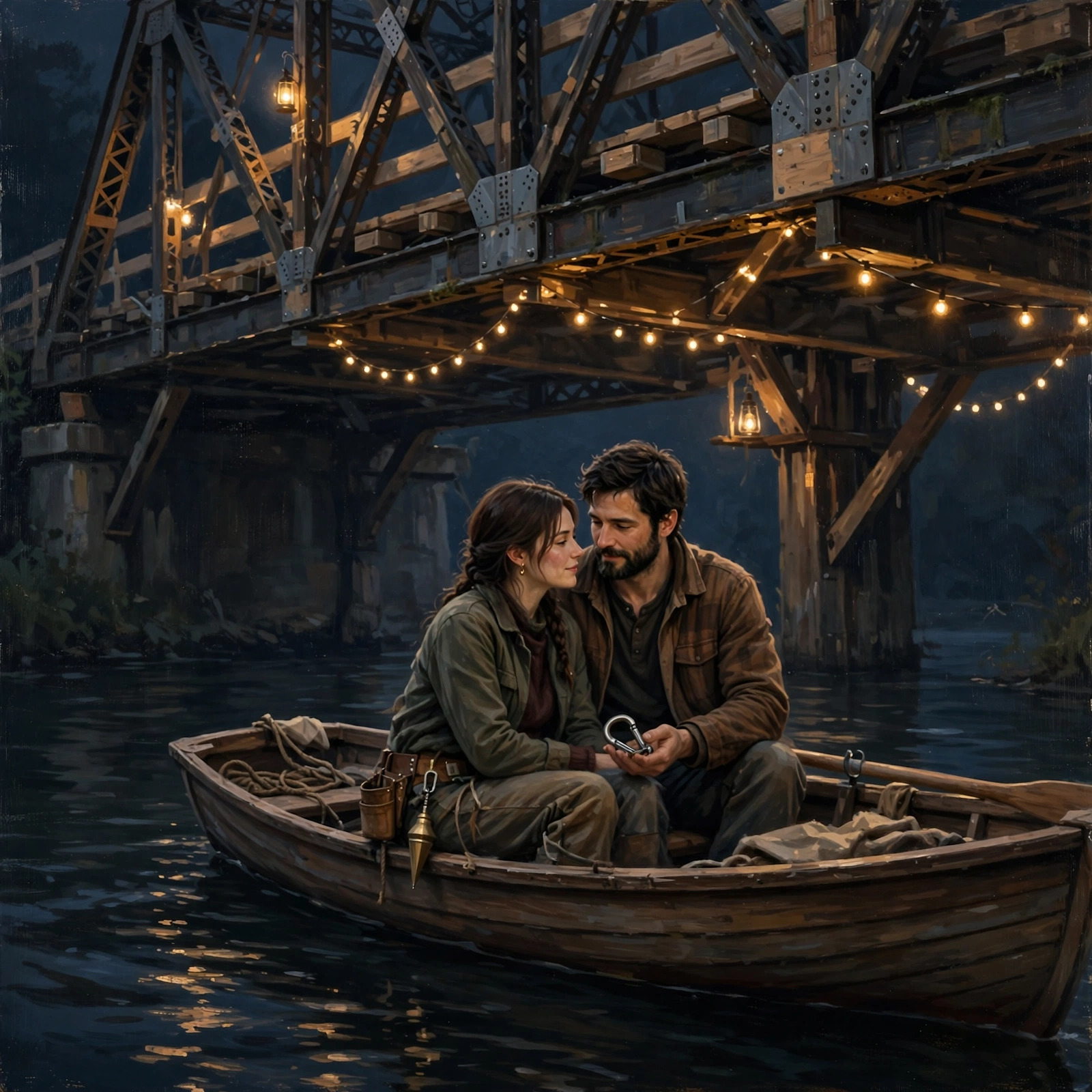
She clipped it back onto her belt, where it had hung through every day of this, and where it would hang through the fourteen posts and the new timbers and whatever the river did next. Then she went down the bank stair ahead of him and stepped into the boat beside him, and took the second oar without being asked, and her father let her, and the three of them pulled out onto the darkening Vane with the bridge standing behind them, sound, and lit along its rail by the first of the evening lamps.
Get notified when new stories drop

Cade Ellison
Cade specializes in romantasy and paranormal romance: magic systems with rules, courts with knives, and longing that rearranges destinies.
Leave a comment
Comments