





The Counting Room
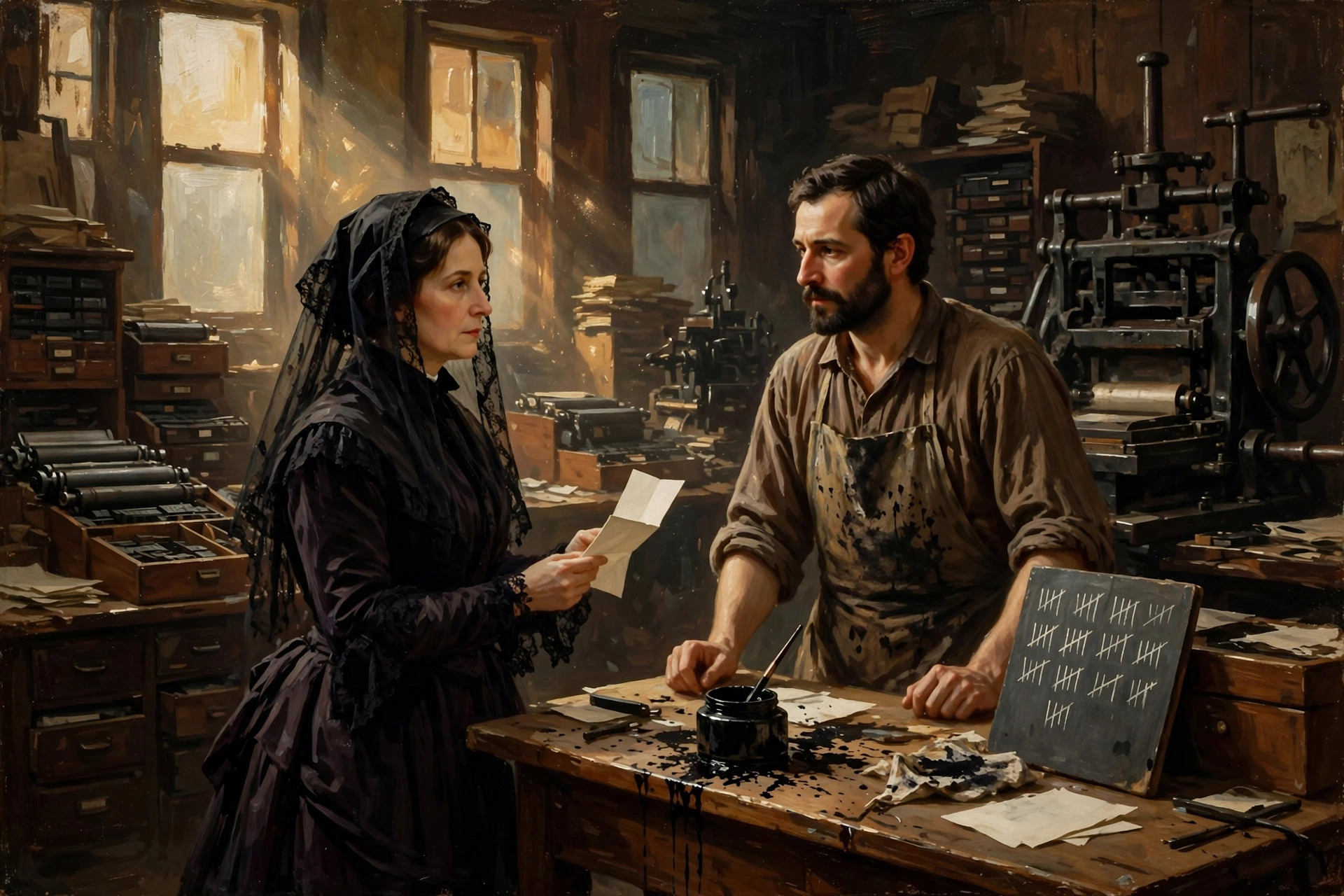
Cressida Ashcombe had rehearsed her complaint the whole way down Cordwainer Lane, and the rehearsing had not helped. The bill was wrong. She had checked it three times against her own ruled pages, in her own hand, and it was wrong, and the milliner's shop could not pay four pounds ten for paper it had not received. That was the whole of it. Simple. She had only to say so.
The Merrick press smelled of ink and hot metal, and the floor shook faintly under her boots, as though the building itself were working. A man stood at a frame with his back to her, tying a small cord of type with quick, sure fingers.
"Mr. Pratt," she said.
He turned. "Miss Ashcombe. It's been a while since you came down the floor. You used to sit on that stool by the window, doing your letters, while your father set for us on busy weeks."
"I remember the stool. And the noise. I had forgotten the smell, though. It comes back like a relative."
He laughed, a short warm sound, and wiped his hands on his apron. "What brings you past the counting room door?"
"A bill. Four pounds ten for paper I never ordered and never saw. I keep Mrs. Halloway's books, and I keep them honestly, so I've come to say so."
"Then you'll want the proprietor." He nodded toward the half-glazed door at the room's end. "He's at his desk, where he mostly is. Go in. He doesn't bite."
"I never supposed he did."
"No," Pratt said, mild. "But you've been in Wetherfield six years, and I'd wager this is your first time through that door."
It was. She did not answer it, because answering it would have required explaining why every other door in the town had shut itself to her, and she had explained it too many times to people who had already decided what they believed.
She knocked once and went in.
Silas Merrick sat behind a desk with a slate of figures beside him and a pencil behind his ear, and he looked up as though he had been expecting someone else. Perhaps he had. She had never spoken to him directly. She had seen him across the guild yard, at the market, once at a funeral, and he had always seemed to her a man who kept himself folded, like a letter he had no intention of anyone reading.
"Miss Ashcombe."
"Mr. Merrick. Your bill to Mrs. Halloway's shop, for the quarter. Four pounds ten, charged for paper stock I can find no record of ordering."
He did not reach for a ledger. He simply looked at her, and then he said, "You're right."
She had prepared for resistance. She had prepared for a man defending his clerk, his carrier, his honor. She had not prepared for agreement, and it left her standing there with her argument still folded in her mouth.
"I beg your pardon?"
"The charge is wrong. My carrier delivered to the wrong shop in March. Mrs. Pettigrew's stationer took the ream and said nothing, because Mrs. Pettigrew is who she is. I found it out a fortnight ago and I've been too busy to send corrections. That's my fault, not your arithmetic. Your arithmetic, I'd wager, is very good."
"It is," she said, before she could stop herself.
"I know. Your father taught you at that stool by the window. Pratt used to say you could cast a column in your head faster than he could set one."
She shifted the parcel she was carrying, the brown-paper bundle under her arm, her father's ledger, wrapped and tied because she did not leave it anywhere she could not feel it. "Then I'll tell Mrs. Halloway the account will be corrected."
"I'll send the correction myself, with my apologies in writing." He rose, and crossed to the small window that looked onto the lane. "You'll have seen the notice on your way in."
"The one pasted by your door? I did. The Free Library committee. Printing proposals."
"Six hundred pounds over three years." He said it evenly, but she heard the weight under it, the way a woman carrying water up stairs hears each step. "To a guild-nominated house. That's the condition. The committee won't consider a printer who isn't nominated by the guild, and the guild nominates men with families, or with standing, or with thirty years of cousins in the town."
"And you have nine," she said, and then heard herself. "I beg your pardon. That was forward."
"It was accurate. Nine years, and before that, nowhere. I came from Leeds with a press and a debt and no relations. I've built the floor, I've kept every man on it through two thin winters, and I can't be nominated, because to the guild I'm a stranger with dirty hands and no one to vouch for my dinner habits."
She looked at him. He looked back, and she realized, with a slow cold feeling, that this was not a conversation about a bill.
"Mr. Merrick."
"Miss Ashcombe. I'll say it plainly, because I've watched this town for nine years and you've had six of watching it back, and I think we're both tired of doors." He set his hands flat on the desk. "I want the library work. I want it enough to marry for it, and I think you want a name that the shops will take at the counter again, enough to marry for it too. My house respectable by yours, your name respectable by mine. No claim on either heart. A plain arrangement, on the books, like everything else in this room."
The floor shook under her boots. Somewhere in the building a press pulled a sheet, and another, patient as a pulse.
"You are asking me to marry you for a contract."
"I'm asking you to marry me for a door that opens. Both of ours. Mine's the guild, yours is every shop on the high street that has stopped taking your orders since your husband's affairs were called in. I've seen it happen. I've seen Mrs. Halloway send you on errands at odd hours so you needn't stand at counters where people talk."
"Mrs. Halloway is kind."
"Mrs. Halloway is kind, and she is one woman, and you have been living on one woman's kindness and a small quarterly sum from a trustee for a long time. I'm not offering you kindness. I'm offering you terms."
Her grip tightened on the parcel. The string bit her fingers through the paper.
"You know what they say about my husband's estate. Three hundred and forty pounds gone out of the Choral Society fund, and me, the widow who kept his books and never saw a thing."
"I know what they say."
"And you would put your name beside mine anyway."
"I'd put it there because of what they say, not in spite of it. I know what it is to be talked about by people who've never done a day's work at your bench. And because I've watched you check a bill against your own figures and walk into a printer's shop alone to say so, which is more than most of the men in this town have done for me lately."
She should have been angry. She had been angry at so much, for so long, that she knew its weather well, and this was not it. This was something warmer and more dangerous, and she turned from it toward the door.
"I don't have an answer."
"I didn't ask for one today. The committee's notice went up this morning. There are three weeks before the nomination is sealed. You can have some of them."
She stopped with her hand on the latch. "Why me and not some widow with cleaner affairs?"
"Because you'd understand the arrangement. It's a working thing. Not a romance." He picked his pencil up again, as though the matter were already filed. "And because I don't want to be lied to, and you don't strike me as a woman who'd bother."
She went out through the press room without speaking to Pratt, though he called a goodbye after her, and she was glad of the noise of the floor because it covered the sound of her own heart, which had no business behaving as it did. Outside, the notice hung by the door, paste still wet at one corner, curling in the wind. Six hundred pounds. Three years. A guild-nominated house.
She tucked the parcel tighter under her arm, where she could feel its brass corners through the paper, and walked toward Tanner's Row without an answer.
Brown Paper
Two mornings later, Cressida stood again on Cordwainer Lane with the parcel under her arm, and this time she did not stop at the notice pasted by the door. She had read it a dozen times at the lodging house, once aloud to the ceiling, once aloud to her mother, who had said nothing back, which was its own kind of speech.
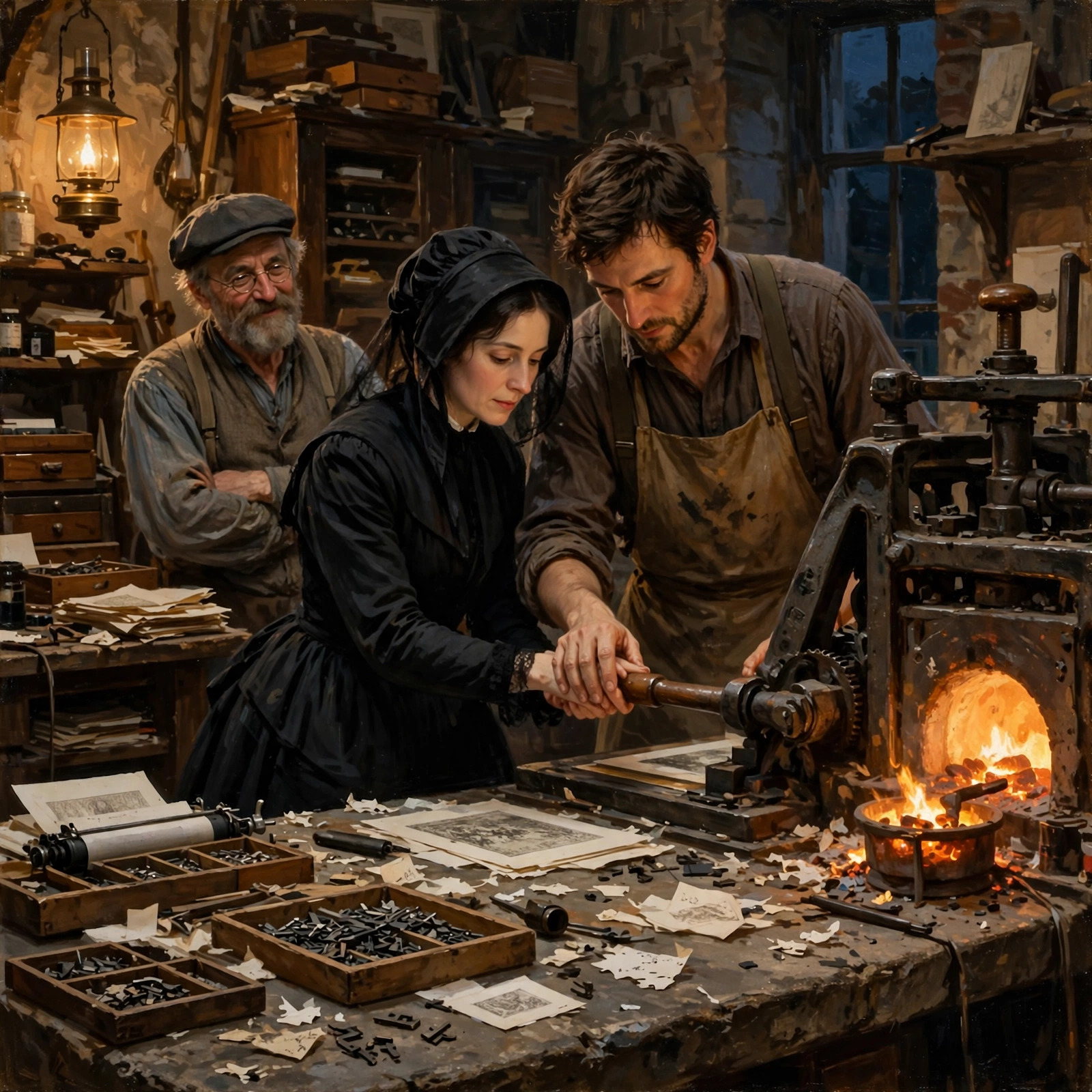
The press room smelled of ink and hot metal, and the floor shook under her boots in a way she was beginning to know. Pratt looked up from his frame and touched his forehead to her, the way a man does to a woman he has decided to like.
"He's in the counting room," Pratt said. "Been at the day book since seven. Don't tell him I told you he was nervous, for he'll say he wasn't."
"I won't tell him."
"You're a good woman for a secret, ma'am. It's all over your face."
Silas was indeed at the day book, and indeed he did not look nervous. He looked like a man who had been waiting for a train and would not admit he'd checked the clock. "Mrs. Ashcombe."
"Mr. Merrick."
"You have an answer."
"I have a condition." She set the parcel on his desk, on top of his blotter, dead center, where he could not pretend it was furniture. The brown paper had gone soft at the corners where the brass edges underneath had worried it for two days. "I'll do it. The register office, the name, all of it. But you'll never lie to me. Not to spare my feelings, not to keep the peace, not because a truth would cost you something. If I ask you a straight question, I get a straight answer, or I get 'I won't tell you,' which is honest, and I'll respect it. But never a lie. That's my price."
He put his pencil down, which she was learning to read as his version of another man's raised voice. "You've thought about it."
"For two nights."
"Done," he said. "And the same from you. I've had a partner before who thought a cheerful fiction was a kindness. It cost me a press and nine years in Leeds, and I came here with the debt and not the press. So. No lies either direction."
"You came from Leeds with a debt," she said. "That's more than you told me Tuesday."
"You didn't ask Tuesday." But he said it evenly, and he did not look away, and she found she believed him, which was a sensation she had not had toward anyone in Wetherfield for longer than she cared to count.
"Then here's my second condition, and it's practical." She unwound the string. The paper fell open, and there it was: her father's ledger, calf leather gone dark at the edges with handling, brass corners bright where thumbs had polished them, the boards sewn and bound by his own hands in 1871, when she was small enough to sit under the bench and hand him thread. "I wind up the estate for the trustee, a quarter's accounts at a time, and I do it at the milliner's back table between customers, which is why it's taken four years and why it isn't finished. Your counting room has a desk, a lamp, and quiet. I want to use them. I bring my work here, you get your respectable wife who can be seen keeping honest books under your roof, and I get it done in months instead of years."
He turned the ledger toward himself without asking, which she'd have minded from anyone else, and opened it, and read a page the way a man reads who wants to know rather than to judge. "Edmund Ashcombe's binding. I've seen his work in the Quaker house on Tanner's Row. Your father?"
"My father."
"It's good work."
"He thought so." She kept her voice level. "The estate's papers are all in this hand or mine. The town has opinions about both hands."
"The town has opinions about my floor and my ink and my Sundays," Silas said. "Bring it. There's a desk by the window. The lamp's yours after six."
So that was how the days went, and she had not expected it to be easy, and it was easy anyway, the way a thing is easy when the work is hard and the company is right. She came at ten with the ledger and the trustee's bundle of bills. She worked while he worked, and the two rooms talked to each other through the open door, his floor clattering and hissing, her pen scratching. Pratt brought tea at noon without being asked and set down two cups, and when she thanked him he said, "I set type beside your father at the Quakers' when I was a lad learning, so you're not company, you're furniture," and went back out before she could decide whether to be offended or warmed. She was warmed. She was also fairly sure he'd invented half of it, and she loved the half he'd invented.
On the second evening, past nine, Silas came in with ink on his wrist and stood over the desk where the lamp pulled their two shadows onto the wall. "You've found something."
"I've found that the trustee's bundle and this ledger don't agree, and they haven't agreed for years, and I've known that for four years, and I've never once had the quiet to lay them side by side and find out why." Her voice came out lower than she meant. "Entries crossed out. Re-entered. In my husband's hand, and then in a hand that isn't his."
Silas was quiet for a moment. "Whose?"
"I don't know yet." She closed the ledger on her finger to hold the page. "But I will. That's the third condition, and you won't like it. Whatever this marriage is, it isn't going to stop me opening this book. If it goes somewhere that embarrasses aldermen, it goes there anyway."
"Mrs. Ashcombe. Cressida." He said her name like he was trying the weight of it. "I asked you for your name, not your silence. Open the book."
She went home late along Cordwainer Lane with the ledger wrapped again, and found her mother sitting up in the lodging house kitchen with a shirt-cuff turned under her needle, though it was near ten and there was no light enough in that room to sew by, which meant Lucinda Ashcombe was not sewing. She was waiting.
"You were at the printer's."
"I was at the printer's."
"Nine o'clock, and not nine o'clock at the milliner's." Her mother's needle stopped. "I came to this town for you. I could have stayed in Leeds, I had work in Leeds. Six years I've been here, and in six years I have not once seen you walk home behind a man's door at nine at night."
"It's a counting room, Mother, with a desk and a lamp."
"It's a man I don't know, who wants your name for a contract worth six hundred pounds, and who said so to your face inside a day of the notice going up. I heard it from Mrs. Halloway, who heard it from the carrier. A man like that has a use for you, Cressida, and when a man's use is spent, the door shuts. I watched a door shut on you once already. I carried your trunk myself."
"And I carried it after you." Cressida set the parcel on the table between them, brass corners down, and put her hand flat on the brown paper. "He's offered me what nobody in this town has. Not kindness. Terms. I can keep my books under his roof and finish what my husband left unfinished, and if there's anything under these covers that clears my father's name and mine, I'll have the quiet to find it. You want a door that doesn't shut. So do I. This one opens both ways, that's all. It's a working arrangement."
"A working arrangement." Her mother looked at her a long time, and then, slowly, threaded her needle again, which in Lucinda Ashcombe was a laying down of arms. "Then work it. But you'll tell me the day it stops being one. You'll tell me the day before you know it, or I'll know anyway, because I'm your mother and I knew that man you married before you did."
The next morning, Cressida and Silas stood in the counting room with the day book open between them and the banns question settled in about four sentences, because neither of them was a person who wasted a good sentence.
"The register office," she said. "No church, no party, no breakfast. Thursday next."
"Thursday next," Silas agreed. "Pratt will want to stand up with me. He'll sulk for a month if I don't let him."
"Let him." She put out her hand across the ledger, across the whole estate of it, and Silas took it, and they shook on it, twice, like two houses closing a contract, and if her hand stayed a half-second past business, neither of them put a name to it.
"Partners," he said.
"No lies," she said.
"No lies."
The Proof Sheet
Thursday came down over Wetherfield with a sky like wet slate, and Cressida Ashcombe walked to the register office in her second-best grey, carrying her father's ledger wrapped in brown paper because she had nowhere safe to leave it and no intention of letting it out of her arm's reach on any day that mattered. This day, she had decided, did not matter. She repeated that to herself twice on the way down Cordwainer Lane, which was once more than anything she did not believe deserved.
Silas was waiting at the steps, in a coat she had not seen before, dark and brushed, with a speck of dried ink high on the left cuff that no brush had ever reached. Pratt stood beside him in a muffler wound to the chin, looking like a man attending the funeral of a very respectable idea.
"You're punctual," Silas said.
"You sound surprised."
"I'm confirming. I keep a day book too, you know."
Pratt cleared his throat with great ceremony. "If you two are going to exchange figures on the steps, I'll wait inside, where it's warm and the witnesses don't have opinions."
The registrar's clerk read the words out flat, the way one reads a bill of lading, and Cressida found that flatness steadying. Her first wedding had been candles and lace and her mother crying into a handkerchief embroidered for the purpose, and it had ended in a trustee's bundle and a town's opinion. This one took eleven minutes. Silas's hand was dry and warm when it closed over hers, and he looked at the clerk the whole time, not at her, and she understood that as a courtesy and was grateful for it, and then was faintly, unaccountably annoyed that she'd needed it.
"Married," Pratt said on the pavement outside, and shook each of them by the hand in turn, solemn as a churchwarden. "Well. I set the type for the announcement last night. Fourteen lines. I put no flourish on it, Mr. Merrick, before you ask. You said plain."
"I said plain," Silas agreed. "Come and pull the proof before the ink's cold."
So the whole of the wedding party, being three people, walked back down Cordwainer Lane to the press, and the morning's first real work of the day began.
The press floor smelled the way Cressida imagined the inside of her father's mind must have smelled, oil and lead and paper, a warm metallic sweetness that sat at the back of the throat. Four men worked the room, and every one of them nodded to her without slackening, which she noted and filed. The composing frames stood in rows like looms. At the far end, the iron handpress waited under its fringe of light from the window, and Pratt led them to it like a verger to a font.
The forme sat in the bed, locked and planed, the type face up and gleaming dully. She bent over it. Her father had bound books, not set them, but she knew good work the way any Ashcombe did, by eye and by instinct, and this was good work, every letter standing to its shoulder height, the lines even as ruled paper.
"You set this in an evening?"
"Pratt set it," Silas said. "I corrected it. Twice."
"He changed 'esteemed proprietor' to 'printer,'" Pratt said, with the face of a man describing a personal injury. "On his own wedding notice. I ask the room, is that natural?"
"It's accurate."
"It's cold."
"It's warm," Cressida said, before she had examined the sentence for safety, and both men looked at her, and she busied herself with the proof paper.
Pratt laid the damp sheet over the tympan, worked the frisket down, and then stepped back from the lever with the stiffness of a man making a formal gift. "Your hand, Mrs. Merrick. Pull it steady and pull it even, and don't snatch at the top of the stroke."
She heard the new name land and did not flinch at it, which surprised her more than the name did. She took the lever in both hands, and pulled, and the great screw came down with a sound like a slow held breath, and the press kissed the paper, and she let it rise again. When Pratt peeled the sheet away, the ink stood up black and soft and still shining.
"Merrick," it read, across the top of the fourteen lines. "Cressida Ashcombe, of this town, to Silas Merrick, printer, Cordwainer Lane."
"Tack still wet," Pratt said, laying it flat on the imposing stone with two careful fingers. "Give it a minute and it'll pin anywhere."
She stood over it with her parcel under her arm, and Silas stood over it too, a foot away, both of them looking down at their own names drying side by side on a single sheet of laid paper, and the room worked on around them, the balls of the other men thumping the stone in their rhythm like a tide.
"It's a good notice," she said. "It says what it is and nothing else."
"That was the bargain."
"I wasn't complaining. I've read notices that said a great deal more and meant a great deal less. My first one said 'esteemed' twice." She heard her own voice go dry on the word and let it. "This is better paper, anyway."
He looked at her then, properly, for the first time that morning, and she found she did not mind it, which she filed away as a thing to think about later, at home, with the lamp and the door and no witnesses.
"Pratt," Silas said, "take the men their tea, will you. I want to show her the books."
"The books," Pratt said, with immense meaning, and went.
The counting room was at the back, and the books were honest, which she had already known from the two days she'd spent in them, but there was a difference between knowing a man's figures were clean and knowing his figures were clean on the morning he had made her his wife on paper. She read the week's takings and the week's wages and the rent of the paper store, and he watched her read, arms folded, saying nothing, letting her find it herself, which no one in Wetherfield had ever thought to do before.
"You pay yourself last," she said.
"After the men."
"And after the carrier, when the carrier's wronged you, which is often, by your own account."
"He misdelivers with great regularity. It's practically a service."
She laughed. It came out of her sideways, unguarded, and she heard it fill the little room, and he looked pleased and then looked away, and she bent back over the ledger so neither of them would have to do anything about it.
They worked the rest of that day and the two after, and the press floor began to fit itself under her hands. She learned the frames and the racks, learned which boy swept under which press, learned that Pratt had set type beside her father in this very town and would tell her so only by the way he handled the ledger when he passed it, brass corners up, like something belonging to a family. She learned that Silas read proofs standing, hip against the imposing stone, and that he read everything twice, and that his second reading was slower than his first when the piece was one he despised, which was most of the political handbills that kept his floor alive.
"You don't like the work," she said, on the Thursday, over the stone, while he sorted a handful of type back into its box.
"The work's work. I like the men it keeps. There's a difference between a trade and a livelihood, and I've had one of them for nine years and wanted the other." He tipped the last letters in. "The library printing would be the other. Three years of it. Steady. Clean. Worth six hundred pounds to this house, and worth more than that in what I wouldn't have to take."
"Then we'll both of us count," she said, "and see it's counted fair."
That evening, when the floor had gone quiet and the men had gone home, she took the proof sheet from the stone where it had lain drying, and carried it to her desk, and pinned it to the shelf above, the fourteen lines squared and level, Pratt's plain warm work.
She stood back and looked at it for a long moment, her parcel of brown paper and brass corners on the desk below it.
"It's only paper," she told the empty room.
The room, which knew more about ink and pressing than most, kept its opinion to itself.
Saint Oswald's Yard
The yard of the Guild Hall had been raked that morning, and the gravel still held the lines of the rake like a fresh page holds the rule. Cressida came through the arch on Silas's arm, her satchel over her wrist, and the wind off the square went through her new cloak as though the cloak were an old one, which it was, only brushed.
The nomination was to be sealed by three o'clock. It was now barely half past one, and the yard was full of men with papers in their fists and a smell of pipe smoke that hadn't blown off yet. She had dressed for this as she dressed for everything in Wetherfield, which was to say as a woman expecting to be looked at and found wanting, and determined to give them nothing to find.
"The committee sits inside," Silas said. "The guild seals after. You needn't come in for the sealing if you'd rather wait."
"I've waited in enough yards."
He glanced at her. "I meant it kindly."
"I know what you meant." She softened it, because it was true and because he had earned some softening these nine days of her. Nine days of ink under her nails and his shoulder across the counting room and Pratt's plain good mornings, and if she was honest, which she mostly was, she had stopped marking the days against him somewhere around Thursday. "Show me the hall. I've only ever seen it from the outside, like everyone else the town holds its judgments in."
Alderman Croft found them by the steps. He had a way of arriving that made it seem he had been standing there all along and the crowd had merely been shifted around him. "Mrs. Ashcombe," he said, and then, with a small correct bow of the head, "Mrs. Merrick. My congratulations. Wetherfield does love a quiet wedding. So few witnesses to disappoint."
"Alderman." She kept her hand where it was, on Silas's arm, and did not take it back.
"Merrick." Croft turned to him, easy as a man turning a page. "Your nomination's in order. Second on the list, I believe, after my cousin's people. Of course, the guild being the guild, what's in order isn't always what's decided. But you've improved your standing lately." He looked at Cressida again, and his eyes were the eyes of a man pricing something. "A wife from a bookkeeping family. Respected name, her late father's, once. Clever with figures, I'm told. It reads well, Mr. Merrick. Almost as well as it reads kindly."
The yard noise went on somewhere behind her ears, but the space Croft stood in had gone quiet to her. "I'm not sure I follow you, Alderman."
"No? Then follow the arithmetic, Mrs. Merrick, since figures are your trade. A man bids for three years of county printing. A widow with a disgraced account book attached to her name agrees to marry him five days before the bid is read. The town draws its conclusions. Some say sentiment. Some say salvage." He straightened his cuff. "I say only what will be said at the sealing, so you're not surprised by it in public. That's friendship, surely, of an old kind."
"You named the missing money once already," she said. "In public. You were very loud, I'm told. You've been loud for years, on my husband's behalf, and on the fund's."
"On the fund's, always." Something crossed his face then, quick as type falling, a sort of flinch of a man whose footing is tested. "The Choral Society lost three hundred and forty pounds, madam, and your husband held the account. I grieved for him and I said so. If grief with a voice attached offends you, that's Wetherfield's fashion, not mine."
Silas's arm had gone hard under her hand. "Alderman," he said, "the hall is that way."
"Presently." Croft hadn't finished with her; that was plain. "I came to offer something, actually, before the sealing. The committee values quiet. Withdraw the Merrick nomination, publish some words about the disputed ream and the carrier's error, and the dispute dies on the page, so to speak. Printers understand pages better than most. And the lady's situation," he went on, and his voice dropped into a register that was meant for her alone, though the yard was gravel and echo and gave up everything, "the lady's situation would be less remarked upon. A pity marriage can be forgiven, Mrs. Merrick. A pity marriage that profits a press cannot."
She heard Silas begin, "You'll take that back," and she heard Croft wave it off before it finished landing, and she stood in the middle of the two of them with her satchel against her hip and the wind coming through the arch, and she did the thing she had done all her life, which was to reach for the figures when the words got dangerous.
"You subscribed to the fund," she said. "Your signature's in my father's ledger. Twice, I think, on the subscription pages. Renewed the year before the money went missing."
"I did, and honorably, and was repaid by drafts like every subscriber who asked for their money back before the season. Some did." He smiled with no warmth in it at all. "Check your ledger, madam. That's what you brought it for, isn't it? I hear you carry it everywhere now. Like an heirloom no one will inherit."
He went up the steps then, and the crowd went with him, the way the town always went with him, and she was left in the raked gravel with her husband and her rage and half an hour to kill before the sealing.
She sat on the low stone wall at the yard's edge and got the ledger out of the satchel. She had meant only to prove Croft's signature to herself, to make the man a set of figures again, because figures never sneered. The brass corners caught the light. She turned to the subscription pages, and there his hand was, sure enough, Josiah Croft, twice, in the year and the year before. And then she kept going, because once her hands were in that book they had never in her life been able to stop, through the subscription pages and into the disbursement pages, and she found what she had been four years too angry and too frightened to read line by line.
Crossed-out entries. Re-entered in a second hand. Her husband's hand had crossed them out. She knew his hand the way she knew his walk, asleep. But the entries beneath the crossings, the replacements, the sums that had actually moved, the second hand, that was not her husband's. She put her finger under one, and another, and a third, and the total built itself under her finger the way totals did, indifferent and exact. One hundred and eighty pounds, paid out of the Choral Society fund against private debts of Alderman Josiah Croft, dated and dated and dated, in a hand that cramped at the descenders.
The wind turned the page for her. She let it.
"Cressida." Silas had come down from the steps and stood a little way off, and there was something in his voice she hadn't a name for yet. "The hall's filling. I've the nomination paper to hand in at the desk before three."
"How long have you had the trustee's report?"
He didn't pretend. She watched him decide not to pretend, watched the decision happen in his jaw. "Since before I asked you to marry me."
"Since before." She closed the ledger on her finger to hold the page. "It says what, that report? In plain words, since we're being plain in yards now."
"It says the account books were the late Mr. Ashcombe's, kept in his hand and in a second hand, and that no entry against you was found. No crime of yours. It says so twice, because Pratt's cousin is the trustee's clerk and made certain it said it twice."
"Six years," she said. The words came out level, which frightened her more than shouting would have. "Six years I have been the woman who emptied her husband's fund, and you have sat on a paper that says different, and you let me set terms with you over it. You let me thank you for the roof. You let Pratt hand me the ledger like a relative, and all of you knew."
"I meant to show you."
"When?"
He was quiet a moment. "When it wouldn't look like I'd bought your gratitude with it."
"And instead it looks like pity that kept a paper in a drawer." She stood up. The ledger went into the satchel, and her hands were steady, which was the worst of it, that they were steady. "You've been kind to me for nine days, Silas Merrick, and I can't tell now which of it was the marriage and which of it was the report, and you've made it so I can't tell, and that's a thing I'd have forgiven a stranger for sooner than a husband."
"Cressida."
"No." She took her arm from his. "Croft is in the ledger. A hundred and eighty pounds of Croft is in that ledger, and my husband crossed it out to hide it, and I'm going to sit in that hall while they seal your nomination, because the town will look sideways if the wife walks out of her husband's bid. And then I'm going home to Cordwainer Lane, and you can be kind to the house, and I will be kind to the books, and we will be married, and I will not be grateful."
She went up the steps. The doors were open, and the hall swallowed her the way halls did, all noise and oak. At the top she looked back once. He stood in the raked gravel where she had left him, alone now in the yard, and the nomination paper was in his fist, crushed along one edge where his hand had gone tight on it without his noticing, and he was looking after her with an expression she had no arithmetic for at all.
She turned and went in. The ledger rode her hip like a second heart.
In the hall the sealing came off at three o'clock exactly. The guild named its nominee to the committee, one house, second on the list by the clerk's count, and Alderman Croft pronounced it all very civil from his chair. Silas Merrick handed his paper in without looking at the desk. Cressida Ashcombe sat in the third row with her satchel on her knees and her hands folded over the brass corners, and did not once glance up at her husband, and did not once glance anywhere else either.
Midnight on the Press
The lamp over the imposing stone still burned at midnight, which was how Cressida found the press floor when she came down Cordwainer Lane with her satchel and no intention of explaining herself. Four days she had kept to her own side of the house above the shop, and four days Silas had left the stair door unbolted and the kettle warm, and neither of them had said one word about it. She had told herself she was coming for the ledger, which was hers, and for nothing else in the building at all.
The floor was not empty. Enoch Pratt sat at the composing frame with his stick in his hand, setting nothing, a cold pipe parked in the corner of his mouth. Silas stood at the handpress with a paper spread on the iron bed, and the paper was the nomination, she knew the seal on it from across the room, the guild's wax pressed second on the list, and his coat was off and his sleeves were rolled and there was a smell of burnt wax in the air.
She stopped halfway across the floor. On the stone, where her father's ledger had sat these two weeks past, there was a scorch mark and a curl of paper that had once had a clerk's hand on it.
"What have you done?"
"Come in, missus." Pratt didn't look up from his frame. "He's been at it an hour. I've been sitting here being a witness, which is a job I can do sitting down."
Silas turned the paper over on the press bed so she could see the whole of it. The nomination, signed, sealed, second on the list. One corner of it was charred. The seal itself had been cracked off whole and lay beside the ink ball like a tooth.
"The committee sits Thursday," he said. "Open session. Any proprietor may lay a matter before it, and any matter laid goes into the record whether Croft likes it or not. But not a proprietor who is himself on the list for the work. A bidder can't bring evidence in his own cause. It looks like purchase. It looks like what Croft would call it, which you can imagine without my help."
"Silas."
"So I went round to the clerk this afternoon and drew my paper back. In his own hand, witnessed, date on it. And then I burned the copy, because a thing like that, left in a drawer, gets found, and gets used, and I have had my fill of papers in drawers." He said it evenly, without weight on it, and she found that worse than if he'd thrown it.
"The library work was six hundred pounds over three years. You said it would keep every man on this floor. You said it before you ever said one word to me."
"It would have."
"And the handbills you hate. The political work. You'd have to go on taking it."
"Yes."
"You built the marriage on that contract. You said so at the start, plainly, and I said yes to it, plainly, and it was the first honest bargain anyone had offered me since the spring my father died. And you have put it in the fire." She set the satchel down on the stone, on the scorch mark, over the ash. "Why. Not because you're sorry. I won't have sorry. I've had sorry from this town until I could paper a wall with it."
Pratt took the pipe out of his mouth. "I'll just go and check the drying racks," he said, and did not move an inch.
Silas came round the press. The iron was ticking as it cooled behind him, that small settling sound the whole floor made at the end of a day, and the lamp pulled his shadow long across the type cabinets.
"The report I kept," he said. "You called it pity. I've had four days to think about what to say to that, and I'll tell you what I found. I found nothing, because it wasn't pity, and I can't prove a thing wasn't something. But I can tell you what it was." He put his hand flat on the ledger's brass corner, not opening it, just resting there. "Your father bound books. Pratt here set type beside him when they were boys in this town, and I've sat through four years of dinners where every man on my floor had some memory of Edmund Ashcombe's hands. I never met him. I came to Wetherfield nine years ago with a debt and a bad partnership behind me and a name that meant nothing here, and the first month I was in this shop, Pratt put a ledger on my desk and said, that's the binding, that's the standard, and it was this binding. Brass at the corners so the boards don't wear. Your father sewed it so it would lie flat and stay honest."
"That's my father's craft. That isn't me."
"No. You're the woman who carried it through four years of a town calling her a thief's widow, and kept the accounts for a milliner to eat, and took a trustee's quarterly pittance to finish a dead man's books, and never once let her own mother pay for so much as a shawl. I read the report before I ever spoke to you, because Croft's committee had it circulating among the bid men like a dirty joke. And it said what it said, which was that you had done nothing, and I thought, there's a woman holding a standard alone in a town that's decided to be wrong about her. And I thought, I know what that is. I've been it. And then I met you, and you were worse than the report, you were proud and exact and you argued type sizes with my foreman, and I stopped thinking of the report at all, because I was busy thinking of you."
She stood very still. The lamp hissed.
"The marriage needed my name to stand for something and your hand to keep the books. That was true on the day I asked you, and it's true now. But I asked you because of the evenings. I'll not dress it up. The contract was six hundred pounds and I've lit it like a match, and if you want to know what I bought with it, I bought Thursday. You, in that hall, with the ledger open, and me nothing but a private man with no bid in it, so that no one in the room can say you were put up to it by the house that wanted the work. Your father's name has a chance on Thursday that it never had while I held a paper. That's what it cost. That's what I paid."
"You should have asked me."
"You'd have told me not to."
"Of course I would. It's your floor, Silas. Those men eat because of that contract."
"They'll eat. Pratt's kept worse from me before, and I've two years of chapel work quoted at the diocese if it comes to it, and it's beneath my pride to say so, but there it is. I can find work. I can't find another Thursday." He took his hand off the ledger. "I'm not asking you for gratitude. You said you wouldn't give it and I believed you. I'm not asking you for anything. I'm telling you what I did, because you had it from Croft that I'd bought your silence with a kindness, and I'd rather you had the truth from me at midnight than his version at noon."
Pratt cleared his throat. "The racks," he said, "are dry as they were an hour ago, and I'm going home to my bed, and I'll thank the pair of you to put the lamp out and the bolt down, and I'll see you Thursday in the hall, both of you, or I'll know the reason." He set his stick in its case, took his hat off the frame, and went out through the back, and the door clacked behind him, and the floor was theirs.
Cressida looked at the ash on the stone, and at the cracked seal lying by the ink ball, and at the man in front of her with his sleeves rolled and his hands empty for once in nine days of knowing him.
"You never once said it was pity," she said. "I said it was, and you stood there and let me."
"You were hurt. I'd earned the hurt, keeping the thing quiet. A man can stand being called a name he's earned."
"It wasn't pity?"
"No."
"What was it, then, in one word, because I've been carrying four days of the wrong word and it's heavy."
"Respect," he said. "Which I understand is a cold-sounding word, and I don't mean it cold."
She crossed the floor. The press ticked behind him, cooling. She put one hand on his jaw, which was rough at this hour, and he went very still, the stillness of a man who has decided not to decide anything until he's told. She kissed him. His hand came up and closed careful on her shoulder, and the kiss was unhurried, and when they broke apart neither of them stepped back.
"Thursday, then," she said.
"Thursday. Open session. Your ledger, your voice. I'll be a private man in the second row, and Pratt will be beside me, and my mother can be told after, or before, or never, whichever you like."
"After. She'll want to starch my collar first, and I'd rather she didn't know until it's done." Cressida picked up the lamp. "Come and put the bolt down with me. We'll go in together, Silas. One door, both of us."
He rolled his sleeves down, and they put the press floor dark together, and the ash of the nomination stayed on the stone until morning.
Open Session
The Guild Hall on Saint Oswald's Square smelled of wet wool and floor polish, and the benches were full by ten. Cressida came in with the ledger under her arm, wrapped in brown paper, and Silas walked at her left with his hat in his hand, and Pratt came behind them both with the air of a man who has set type beside half the room and expects every one of them to behave. Her mother was already on the second bench, sitting very straight in her gray bonnet, and she did not wave. She only looked at the parcel under Cressida's arm, then at Silas, and gave one small nod, which from Lucinda Ashcombe was a speech.
Alderman Croft sat at the long table with the papers of his cousin's firm squared in front of him, and he was talking before the clock had finished the hour.
"We have the bids before us," he said. "The committee has met, the guild list is sealed, and I see nothing on the day's paper to reopen it."
"Then you haven't read the day's paper," Cressida said, and she didn't raise her voice, and the room went quiet anyway, the way it does when a woman who has been talked about for four years finally stands up to talk back.
She walked to the table. Nobody stopped her. She laid the parcel down, cut the string with the small scissors from her reticule, and folded the paper back off the boards.
"This is the account book of the Wetherfield Choral Society," she said. "My father bound it in 1871. It was kept in my late husband's desk, and I have kept it for the trustee these four years, and I have read every line of it, some of them many times over." She set her hand flat on the brass edge. "Three hundred and forty pounds went missing from that fund. The town decided it knew whose hand took it. The town was wrong, and I can show it, because the hand is still in the book."
Croft's color came up from his collar. "Madam, this is a closed session in everything but name. A grieving widow's arithmetic is not evidence."
"I'm not grieving, Alderman, I'm bookkeeping," she said, and a man in the third row laughed before he could stop himself. "Page forty-one. A subscription entered in my father's hand. Paid in, ten pounds, the fourth of March. Then struck through, in a second hand, and carried against a private account. One hundred and eighty pounds of private debt, Alderman. Entered in a hand that is not my father's and not my late husband's, because I have sat with both of those hands since I was old enough to hold a pen, and I would know them under water and in the dark."
"You will not put that book before this body."
"I already have." She turned it toward the benches. "The strike-throughs are my husband's. He covered the entries after they were made. That's the sin the town hung on me, and it was his, and it was small, and it was done for a friend. The debts themselves are entered here in a hand I will leave this room to compare with any signature this hall holds. Pratt, you've a long memory for hands."
Pratt stood up among the benches. "Forty years I've set type in this town, and every notice that ever went up on that board came through my cases first. I've a tray of the Alderman's hand at the shop. Handbills from the last election. I'll fetch it inside the hour if the session wants it."
The session wanted it. Nobody said so out loud, but the murmur said it, and Croft stood, and the papers of his cousin's firm slid and were caught by the clerk before they reached the floor.
"This is a grudge," Croft said. "A widow's spite, dressed as a ledger."
"No," Silas said.
It was the first word he had spoken, and it carried, because he had spent nine years in Wetherfield saying very little and saying it slowly. He rose from his place by the wall and came to stand at Cressida's shoulder, not in front of her, at her shoulder, where a man stands when he means to be counted with somebody.
"I withdrew my house's name from the guild list on Saturday," he said. "It's known to the list, it'll be known to this room by now, and I'll tell you the reason plainly. The Alderman offered my nomination as a trade. His cousin's bid for the library printing, uncontested, in exchange for this book staying shut. I was told my work would stand either way. All it would cost was her name." He looked down the benches. "I've kept men on my floor through two bad winters on the promise of better work coming. Six hundred pounds over three years is worth something. But I'll tell you what I told my foreman, who set type beside her father and told me not to be a fool. There isn't a contract in Yorkshire worth a door shut in a decent woman's face."
Lucinda Ashcombe stood up then, on the second bench, and she was a seamstress of thirty years and she knew how to hold a room. "Mr. Merrick," she said, "you have called on me twice since Tuesday and I put you off both times."
"You did, ma'am."
"I'm put off no longer." She sat back down, and half the hall smiled, and Cressida had to look very hard at the brass edge of the ledger to keep her own face still.
The reading took the better part of the hour. The clerk went line by line down page forty-one and the pages after it, and the Alderman's advocate, a thin man with cold hands, argued date against date and lost each one on the arithmetic. A member of the Society, red-faced, confirmed that the March subscription had been paid in and never banked. When the clerk read out the total of the private debts carried against the fund, one hundred and eighty pounds, Croft gathered his coat about him and left by the side door, and the sound of it stayed with the room longer than he did.
Then the chair, which had passed to the vice-chairman the moment Croft's name was entered on the docket, cleared its throat.
"The Merrick house withdrew its nomination on Saturday. The list is sealed." He looked at his paper. Then at the room. "The list is sealed. Nothing in the rules binds this committee to the list, only to a guild-nominated house. The guild may be asked, in open session, whether it will stand behind a house that has just done this town's books an honest service. Will any member ask it?"
Every hand on the benches went up at once, hers and Pratt's and her mother's among them, and Silas's, who was standing next to her and had not once let go of the edge of the table since he came up.
The vote was put and carried without a count. The library printing, three years, six hundred pounds, to the Merrick press on Cordwainer Lane, nominated by the guild from the floor without the proprietor's asking, entered in the minute book while Cressida stood there with her hand still resting on her father's boards.
"The books of the Society," the vice-chairman added, "will go to a proper examiner, and the examiner's report will be posted. The town has said one thing about the widow Ashcombe for four years." He did not look at her when he said it, which was a courtesy, because she could not have borne it if he had. "This hall will say another, and it will say it in ink."
Afterward there was tea in the passage, and hands to shake, more of them than she had expected, and one woman from the milliner's who squeezed her fingers and said nothing at all, which was somehow the kindest of it. Lucinda took her aside by the door and pressed her mouth to her daughter's cheek and held on a moment past what was dignified, and then told Silas, in a voice she did not trouble to soften, that he would come to Sunday supper and he would come punctually.
It was Pratt who called them back into the hall itself.
"They've pinned the award on the board," he said. "And I'll tell you now, because I've a confession of my own. I never struck the notice off the case. Fourteen lines, set the day you were married, and I've kept the forme locked on its side shelf all this while. So when the award went up this morning, I pulled the proof fresh and pinned it in the clear space beside it, and I don't ask pardon, because I did it deliberate."
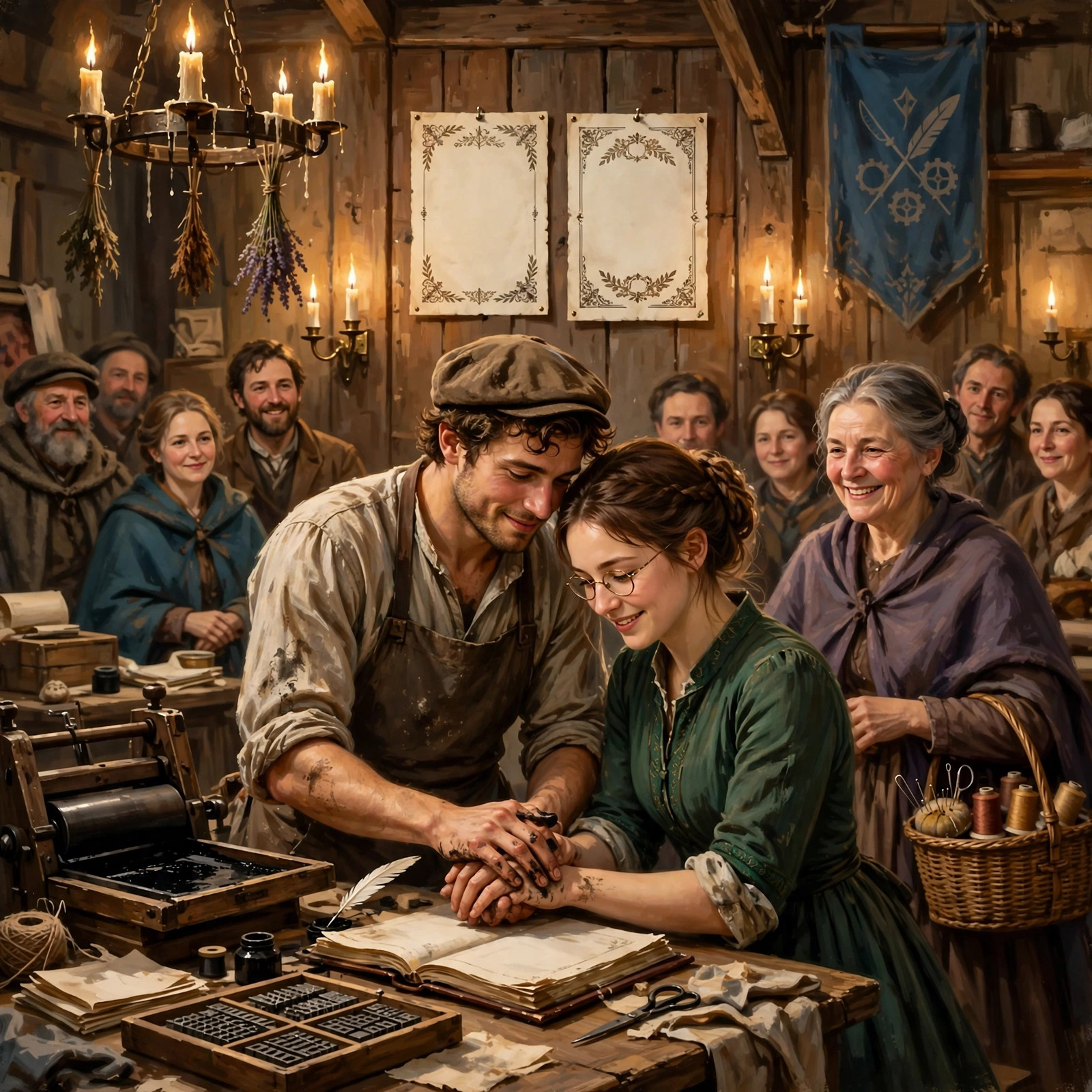
They went in together. The hall had emptied, and the light through the high windows lay along the notice board, and there it was: the notice of the award in the clerk's fair hand, and beside it, on a clean sheet of laid paper, the fourteen lines of their marriage announcement, the ink sharp and black as the day she had pulled the proof herself on the iron handpress, Mr. Silas Merrick, printer, of Cordwainer Lane, and Cressida Ashcombe, of the same town, married at the register office a fortnight since. Her hand went to it without her asking it to.
"Fourteen lines," Silas said, "and not one word of them was true when Pratt set it."
"Not one word of them was false, either. Only the front of it. The front that was for the town." She turned from the board to him. "I signed the terms for a door that wouldn't be shut in my face. A name kept respectable by yours. A house kept respectable by mine. No claim on either heart." She held his eyes, and her voice stayed level, and only her hands knew otherwise. "I'd like to strike that last clause through, in my own hand, before a witness. I find I can't carry it anymore."
Silas looked at her for a long moment, and then at the fourteen lines above them, and then he took off his hat, which he had been holding all this time, and set it on the bench beside him, which from him was a laying down of arms.
"I never wanted a wife," he said. "I wanted the contract, and I told myself the rest was the price of it. Then I sat up with that trustee's report four nights before I ever spoke to you, and I read it a fifth time on the day I asked, and I've read it twice since, and I'll tell you the truth in front of our notice, since it's pinned where the town can see. I wasn't buying a respectable name in November. I was buying a reason to keep walking down Cordwainer Lane past the shop door, because by October I was going out of my way to do it."
She laughed, and it caught in her throat, and he heard it catch and did not pretend otherwise.
"Pratt," she said, not turning. "You're a witness."
"I'm a foreman," Pratt said from the door, gruff, "and I'm going to go stack the last of the tea cups, and I'll be ten minutes about it." The door went to behind him.
They stood under the notice board, the award on the left and the announcement on the right, both pinned by the same man's hand, and the hall was empty and smelled of floor polish and ink. He took her hand, and she saw that his was not quite steady, and she did not look away from that, because she understood it, because hers had not been steady on the brass edge of her father's ledger an hour before.
"No claim on either heart," she said. "Struck."
"Struck," he said. "In her own hand, before a witness." He raised her fingers and set his mouth to her knuckles, quick and formal and then not formal at all. "Cressida Merrick."
"Cressida Ashcombe Merrick," she said, correcting him, because she had earned every syllable of both, "of the bookkeeper's desk at the Merrick press."
"Of the shop on Cordwainer Lane," he said, "where the proprietor's wife keeps the books and the proprietor does as he's told."
"That last clause is mine to write, not yours."
"Then write it," he said, and pulled her hand through his arm, and they stood together under the board while the light moved off the high windows and down the long hall, two notices side by side, one that the town had voted and one that a foreman had set and kept, both of them true now, both of them theirs, pinned where nobody passing through Saint Oswald's Square could miss them.
Get notified when new stories drop

Marcus Hale
Marcus writes slow-burn and marriage-of-convenience stories where logistics become intimacy and competence is a love language.
Leave a comment
Comments