





The Blue Pot
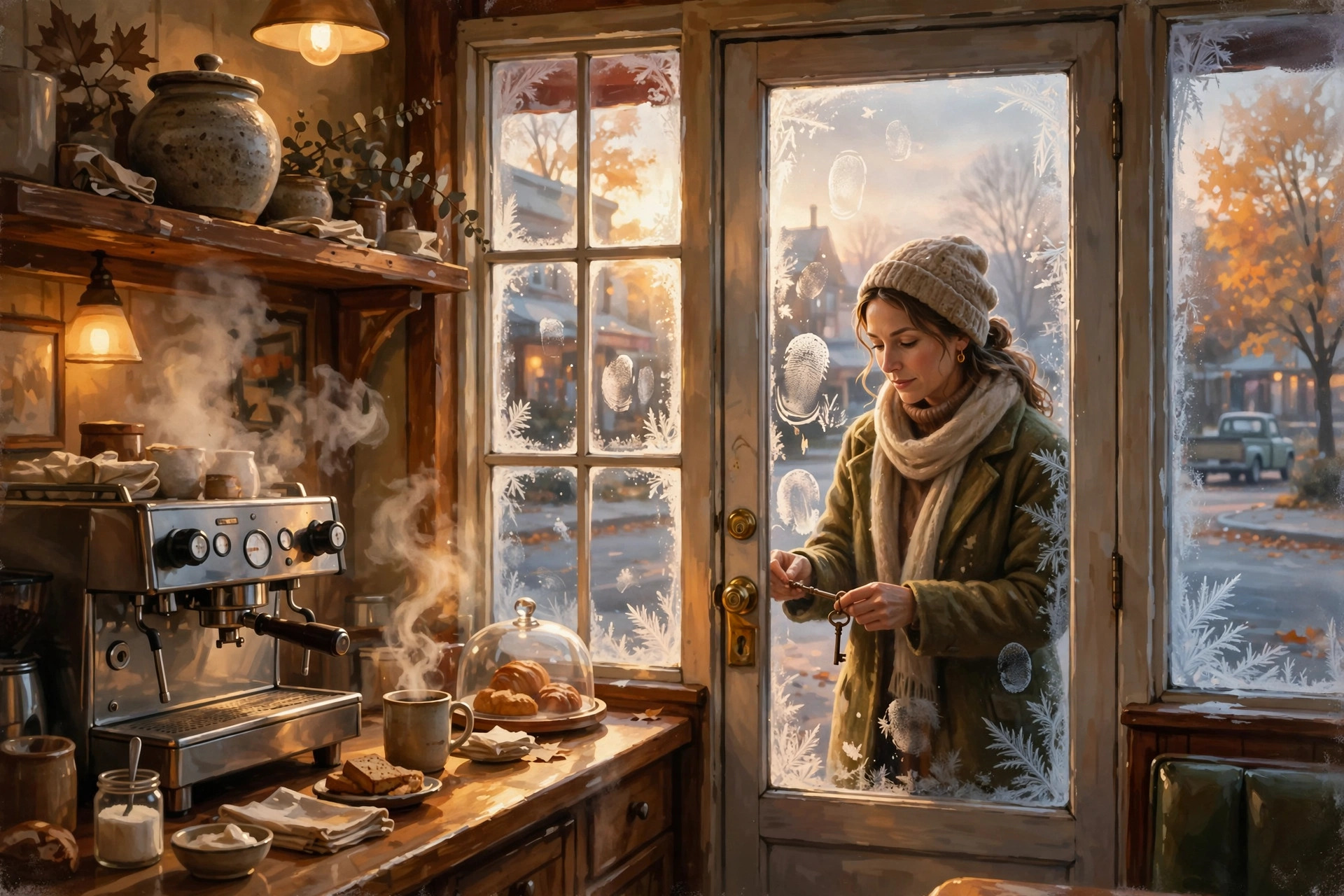
The first cold morning of October came in through the diner door before Petra did, pushing past her ankles while she wrestled the key into the lock. The glass shivered in its frame. Frost had gotten to the windows overnight and left fingerprints everywhere, and she stood a second in the doorway with the smell of it in her nose, cold and clean, like the whole building had been rinsed while she slept.
Eight months, and she still reached for the light switch with her left hand, the way Opal had. Her grandmother had been six inches shorter and had needed the reach. Petra flicked it on and the counter lit up in a long warm stripe, and the room looked exactly as it had yesterday, and last October, and every October before that: nine stools with their chrome feet worn to silver, the pie case breathing its little fog, the shelf above the counter where the plates lived in stacks of six.
And the pot.
It sat at the end of the shelf where it always sat, salt-glazed stoneware, fat-bellied, the color of a field in November. Hartwell Pottery of Marlow, said the stamp on the bottom, though nobody ever saw the bottom because nobody ever picked it up. It hadn't been off that shelf since the funeral, when June had lifted it down, dusted it with a dish towel, and put it back without a word. Petra stood on the first stool and dusted it now with the same towel, her thumb riding the curve of it. Not a chip. Not a crack. She put it back exactly where it had been, handle to the right, and told herself she'd done it because it was opening day, not because it was Opal's.
The coffee went on first. That was the rule, older than she was. The coffee goes on first and everything else catches up. She'd gotten in at five, and by six the smell had filled the room, and by six-forty the front door chimed and Delia Marsh's husband had his nose over the pass and his two dollars on the counter, and Petra thought, all right. All right. We can do this another year.
She'd baked for it, of course. Fourteen loaves of the October bread, the one with the apple boiled into it, went into the case still ticking with heat. Rhubarb from the freezer, last of the spring, in nine pies. It was opening day and the cold had come on schedule and the town wanted what it always wanted, which was to come in from that cold and find the room already warm.
The bell over the door went again at seven-fifteen, and the man who came in with it was a stranger.
That was a thing you could say in Halsey Corners and mean it. She knew every face that came through that door, knew what they took in their coffee and which stool they'd pick, and this face was none of them. Tall, dark jacket zipped to the chin, brown hair cut short like he paid somebody to keep it that way, and a paper cup from the gas station in Marlow still in his hand, which Petra took as a personal insult.
"Sit anywhere," she said. "Or don't. But you're drinking that?" She nodded at the gas station cup. "In my diner?"
He looked down at it like he'd forgotten it was there. "It was cold out."
"It's still cold out. That's no excuse." She was already reaching for a mug, the heavy blue one, because if a man was going to take up a stool on opening day he was going to do it properly. "You want the coffee, or you want to keep insulting me?"
That got a smile out of him, quick, gone as fast as it came. He took the stool at the end, the one by the window, and set the paper cup down like a surrender flag. "Coffee. Please. And whatever that is in the case that smells like my grandmother's kitchen."
"October bread." She poured. "It's my grandmother's recipe, actually."
"Then I'll take two slices and owe you an apology."
She cut him three, because that was the other rule, and slid them across, and watched him eat the first one without saying anything, which she liked more than she wanted to. Strangers usually talked. They asked how long the place had been there, and she'd have to decide how much of the answer she could carry. He just ate, and looked out the window at Main Street like he was taking its measurements.
The bell again. June Halvard came through the door with the cold wrapped around her like a shawl, postmaster's coat buttoned wrong at the bottom, and a clipboard of her own hugged to her chest. She was at the diner before the mail most mornings, and Petra had learned that June's knock and June's opinions arrived in that order and neither waited for permission.
"It's open," June announced, to the room in general. "Good. Petra, I need the counter, I need your ears, and I need them at the same time." She set her clipboard down, then saw the stranger on the end stool, and her eyebrows did a small journey. "Oh. Morning."
"Morning," he said.
June turned back to Petra and lowered her voice approximately one inch, which in Halsey Corners was a confidence. "You've seen the green yet this morning?"
"I came up the back lane. Why?"
June flipped her clipboard over, and there it was in her handwriting, the town record book she carried everywhere, a page with a little sketch on it. A stake. A flag. "There's a stake driven in at the corner of the green. Red flag on it. Pine, machine-cut, fresh this week. County truck did it, and I called the county garage and they said Route 9, and I said Route 9 what, and the man hung up on me."
The bread in Petra's hand had stopped halfway to the case. "Route 9 what?"
"Route 9 straightening." June said it flat, the way she said things she'd rather not believe. "The county's been talking about it for years, but talking and stakes are two different animals. I measured from the stake this morning. Four meters off the porch line, give or take."
"Four meters off whose porch line?"
"This porch." June tapped the counter twice, right on the blue laminate, right over the place where Opal had set down ten thousand cups. "And it doesn't stop at your porch. It goes through, Petra. It takes the front of the green. The whole front third."
The room had gotten quieter somehow, though the coffee was still on and the pies were still ticking in the case. Petra looked down the length of her own counter, down past the stools to the window, out to where the green lay flat and pale under the frost, the place where the tables went up every year, where the pot came down off the shelf and got carried out and opened. Ninety neighbors on a good year. Ninety, out there in the first cold, in the dark, in the light of it.
"They can't take the green," she said. "That's where the supper is."
"I know where the supper is." June's voice had gone gentle, which was worse than sharp. "I've set those tables for twenty-two years."
Petra turned to the man at the end of the stool, because he'd gone very still, and because stillness in her diner had a sound. "You. You're not from here. You know anything about this? You look like you'd know a survey stake from a fence post."
He put down his coffee. "I know the difference," he said, careful.
"Which are you? County? State? Gas company?"
"County. Public works." He said it like a man reading it off a card.
And then he shifted, and his own clipboard came up over the edge of the counter, the county seal on it catching the light, and Petra saw the paper clipped to the top. A plan sheet. A long straight line where no straight line had ever been. Route 9. And stamped in the corner, in blue ink, a signature block: R. Kesling, Wren County Public Works, engineer.
The coffee she'd poured him sat there going cold, and Petra stood with the bread knife in her hand and understood, slowly and all at once, that the man on the end stool wasn't a stranger with bad taste in coffee. He was the man who'd driven that stake. He was the man measuring away her porch.
"You," she said. "You're the county engineer."
"Rafe Kesling." He didn't look away from her, which she'd give him credit for later, when she was in a mood to give anybody credit. "I was going to tell you. I was getting there."
"Get there faster," June said, and sat down two stools away from him, and folded her hands like a judge.
Porch Rails
Petra was wiping down the counter two mornings later when the bell over the door rang and Rafe Kesling came back in with a tape measure clipped to his belt like it belonged there. The diner smelled of the second rise of bread and the first pot of the day. Frost was still on the window in a thin lace at the corners, and out past it the stake on the green stood with its little red flag snapping, same as it had since Monday.

"Coffee's on," she said, before he could open his mouth. "You want it, you take it black this time. I'm not wasting cream on a man with a clipboard."
"Fair." He held the clipboard up, half in surrender. "I'm here to measure the porch. Not the diner. The porch."
"The porch is the diner. You shave four meters off my line, this room gets shorter. That stool you're not sitting on ends up in the county right-of-way."
He looked at the stools. He looked at the counter. Then, because he was apparently a man who did what he said he was going to do, he took his coffee out the front door and started measuring her porch like it was already gone.
Petra followed him with the pot still in her hand. That was her mistake, or her choice, she hadn't decided. He worked quietly. Tape out along the boards from the corner of the building to the top step, a pencil tick on the rail, numbers going onto the clipboard in a small square hand. He crouched at the corner post. He put his hand on the railing to steady himself and the railing gave, a slow wooden groan, the whole run of it shifting under his palm.
"That's loose," he said.
"That's been loose since the spring."
"It's more than loose. The post has rot in the base. Somebody shimmed it." He crouched lower, thumbed at a wedge of wood jammed into the joint. "Somebody who didn't want to dig it up."
"My grandmother." Petra set the pot down on the porch rail, careful, away from the loose section. "She shimmied everything. The screen door, the back gate, one leg of the counter. She said a fix you do yourself is a fix you don't have to be grateful for."
He looked up at her then, squinting a little in the low sun. "That's a way to live."
"It was her way to live." She heard how that came out and softened it with the coffee pot, pouring him a refill he hadn't asked for, into the same cup. He wrapped one hand around it and went back to the rail with the other.
She should have gone inside. There was dough to shape, pies already ticking in the case, and June would be by before noon with opinions. Instead she stood there in the cold holding a pot, watching a county engineer put his shoulder against her railing like he meant to keep it standing.
"You could pull the shims and set a new base," he said. "Bolt it, not nail it. It'd hold another thirty years."
"You fixing to write that up for the county too? They can have the porch when it's shorter, no sense spending my money on it first."
He didn't laugh. He set the cup on the step and went to his truck, and came back with a canvas roll that turned out, unrolled, to be tools. He knelt at the corner post and started pulling shims out one at a time, working them loose with a flat bar, laying them in a neat row on the boards like little teeth.
"That's not your job," Petra said.
"No." A shim came free. He turned it over in his fingers before he set it down. "It's yours, though, come the first hard freeze. This rail goes in January, somebody's leaning on it with a plate of beans, it goes down with them."
"It's held for years."
"It's held because she asked it to." He said it without looking up. "Things hold for her a while yet. Not forever."
Petra stood very still. The frost was coming off the green in a slow haze where the sun hit it, and the stake's flag went snap, snap, snap, and he kept working, and she found she had nothing sharp to say. She went inside and came back with a sheet of coarse sandpaper, because if he was going to touch her grandmother's rail she was going to have a hand in it, and she handed it down to him without a word.
"Thanks." He sanded the raw spot where the biggest shim had been, dust running off between his fingers. "You know this porch has a dip? Third board from the step. Somebody in heels catches that."
"Ninety people walk over it every October and nobody's sued me yet."
"Ninety." He sat back on his heels and looked out at the green, and something crossed his face that she couldn't read, and she would think about that later too. "Tables out there, right? Under the maples."
"That's the supper. First hard frost of October."
"I know." He said it too fast, and then he said it again, slower, like he was setting something down careful. "I've seen it. Once. Years back I was passing through in the fall, and the whole town was out there with lanterns, and I couldn't tell what it was. Somebody waved me in off the road."
"They would. That's how it works, you get waved in, you get fed."
"A woman carried a pot out from that shelf in there." He nodded at the window, at the diner, at the shelf she knew was behind her in the mirrored wall of the pie case. "Big brown one. Salt glaze. Whole town went quiet when she set it down. I'd never seen a town go quiet like that, all at once, on purpose."
Petra's hand tightened on the coffee pot handle.
Because nobody carried that pot but Opal. Not in years. And a man passing through, waved in off the road, would have seen it from the far side of the tables, near the maples, and it was years back, and it was fall, and there had been a young man at the end of the long table once who'd come in off Route 9 with the light going and given a name that had turned out not to be the name on any of his papers, or on his clipboard, or on anything. She'd known him for one night and never asked which name was real, and then she'd quit asking anything, because asking was how you got left holding the question.
She looked at the back of his head, at his hand going slow over the sanded wood, patient as a man who had learned to fix things instead of saying things.
The pot in her hands was still hot through the glaze. She could ask. She could say, that was you, wasn't it, that year, you sat at the end by the lanterns. She could watch his face do whatever it would do.
She didn't. He was measuring her porch for a county that wanted a straighter road, and if she pulled that thread now, out here in the cold, she'd find out something and have to do something with it, and Petra Nyland had spent a whole life knowing that part came after the knowing, and it never came cheap.
"You remember a lot," is what she said. "For a man passing through."
"It was a good night." He gathered the shims into his palm, stacked them, set the stack on the rail like a little offering. "I've moved around more than you'd credit. You don't keep many nights. You keep the ones where a whole town goes quiet over a bean pot."
He stood, brushed off his knees, and picked up his tape. He measured from the corner post to the step, wrote it down, and Petra watched him write it and thought, that's my railing, on your clipboard, in your little square hand, next to a line that ends my porch.
"Board's good," he said. "The rail. If you bolt the base, it'll hold to the next supper easy."
"You do it or I do it?"
"I'll come back with a bag of bolts." He said it plain, like a fact, not a question, and she noticed he didn't say when.
He rolled his tools. He thanked her for the coffee, both cups, and he went down the steps and out to his truck, and Petra stood on the porch in the cold with the pot going cool in her hands and did not say a single word about lanterns.
Then she went in and put his cup on the shelf behind the counter, upside down over a warm spot on the pie case where the heat came up through the steel. It would keep warm there till noon, maybe later. In case he came back for the bolts the way he'd come back for the measuring, twice now, without being asked.
She set the pot back on its shelf, handle to the right, where it had always gone. She didn't look at it long.
Out on the green, the flag snapped, and Petra got out the beans to soak.
Bean Night
The diner filled with smoke on purpose for once. Molasses in the big kettle, onions in the fry pan, and the woodstove drawing hard enough that the door sighed when anyone came through it. Petra had the windows cracked at the top so the glass wouldn't weep, and every surface she owned was dusted with flour or damp with suds, and she thought, this is what the place is for. Not coffee for county men. This. Smoke and sugar and a whole town coming through the door in a week's time.
June Halvard came through it at four o'clock sharp with her postmaster's coat still buttoned wrong at the bottom and a crate in both arms.
"Don't stand there gawping. Take the other end."
Petra took the other end. The crate was heavier than it looked, and she knew before June set it down what was in it, because there was only one thing June Halvard carried with her wrists locked like that. The salt-glazed pot. Hartwell Pottery of Marlow stoneware, wheel-thrown, kiln-fired, older than Petra's mother and darker than a storm drain. Opal's bean pot. The one that opened every First-Frost Supper since before Petra could reach the shelf it lived on.
"June."
"It's not a gift, so don't make the face." June straightened her coat hem with one hand, official as a stamp. "It's a handoff. There's a difference, and your grandmother would want it said proper. The pot goes to whoever carries it out. That's the whole of the rule, and I've watched people get it wrong for twenty-two years."
"I know how the supper works."
"You know how it looks from the outside. This is the inside." June put her palm flat on the crate lid. "Ninety mouths, more or less, and this pot goes in front of all of them, and you carry it, because Opal told me before she went that it was you or nobody. She said it cranky, too, so I know she meant it."
Petra looked at the pot inside the crate, nested in yesterday's Gazette, its handle wrapped in a flour-sack towel. Eight months it had sat above the pie case with the dust on it and the handle to the right, and she had not once taken it down, because taking it down meant deciding what she was now. Owner. Keeper. Opal's granddaughter with a diner instead of a grandmother.
"I don't know the recipe," she said. "Not really. I watched her a hundred times and I never wrote it down."
"Nobody wrote it down. That's why there's bean night." June rapped the crate with her knuckles. "You scrub, you soak, you ask the pot nicely, and by Friday you'll have it. That's how everyone got it. That's how she got it."
The door sighed again. Rafe Kesling came in with a paper bag of bolts in one hand and his tape on his hip, and Petra watched June watch him, a slow weighing look, postmaster thorough.
"Rail's fixed," he said. "Bolted through the base, like I said. I'll take my coffee if it's going."
"It's going." She poured without asking how he took it, because she'd learned that on day one and hadn't needed to learn it, she'd only needed to admit it. "You're early for bolts."
"I'm late, actually. Said I'd come back and I didn't say when, so." He set the bag on the end of the serving shelf and then he saw the crate, and Petra saw him see it. Something crossed his face that had no business being that old.
"That's the pot," he said. "The Hartwell one."
"You know your stoneware," June said, in a voice that meant she was filing him somewhere.
"I know that pot. I saw it carried out once, a long time ago, by a woman with white hair, and the whole green went quiet." He was looking at it the way people look at a house they grew up in. "I'd have sworn it was bigger."
"Everything you saw at twelve years old was bigger," Petra said, and the words were out before she'd checked them, and she watched them land on him one at a time.
He didn't move. The stove popped. June's eyes went from one of them to the other like a scale finding its balance.
"Twelve," Petra said, quieter. "I said twelve. I did the math standing in my kitchen on Tuesday, and then I didn't say anything, because I wanted to be wrong."
"You're not wrong." He turned his cup a quarter turn on the steel. "I went by my middle name that night. Nobody was carding anybody at a bean supper, and I liked how it sounded. I'd been driving through and I stayed for the lanterns."
"I know what you stayed for. I was twenty-two and I thought a stranger who knew all the words to the songs was the most romantic thing Halsey Corners had ever produced." She kept her voice level, which cost her. "You left before the pot came back inside."
"I had a load time at four in the morning. My father's truck, his route, his rules." He said it flat, but his thumb was going over the rim of the cup, around and around. "I looked for you at the second supper. And the one after. Then I stopped looking and told myself you'd gone to the city, which is what people did."
"I did go to the city. Bakery apprenticeship, two years in, and then I quit it like I quit everything, because that's what I do." That was more than she'd meant to hand him with June standing right there, and June made a small sound like a ledger closing. "Ask me why I never wrote."
He didn't. He said, "Why didn't you."
"That's not the same question," Petra said, "and you know it, and I'm not answering either one tonight." She picked up the crate with both arms. "I've got forty pounds of beans to scrub and June's got a town to badger. You can take the bolts and go, or you can put that tape measure away and get your hands in my sink."
He looked at the crate, at her, at the sink where the basin of beans stood waiting in cold water. Then he rolled his sleeves to the elbow, and Petra noted, in a distant and unhelpful part of herself, that he did it in one motion, practiced, a man who'd worked with his hands in a lot of strange kitchens.
June stayed exactly long enough to be sure he wasn't leaving, then buttoned her coat. "Petra. Saturday, the green, you carry it out at six sharp. He can carry the lanterns." She pointed at Rafe without looking at him. "You. Lanterns. That's not a request either." And she went out into the blue cold, and the door sighed shut behind her.
The sink was wide enough for four hands and they used all of it. Beans by the pound, cold water up past their wrists, grit coming off into the suds, and the pot sat on the drainboard above them being scrubbed by turns, its old glaze coming up dark and shining under the window light.
"You never answered," he said, after a long stretch of nothing but water and beans. "About the city."
"You never asked me anything about yourself either." She rubbed a bean between her fingers, and his hand was there in the water next to hers, and neither of them moved away. "So. Ask me something real."
"How long are you staying?"
She nearly dropped the bean. "That's not a question you ask a person."
"It's the only one I've got. I've moved eleven times. My father's work, then the county's. Eleven towns, and I can tell you the diner in every one of them, and I couldn't tell you a single name that would be glad to see me back." His voice stayed even, working-man even, and Petra heard what it was costing him to keep it that way. "I'm thirty-six years old and I have never once been anywhere long enough for anybody to keep me. I stamp what they hand me because the county's the first thing that ever renewed me without my asking. So when I ask how long you're staying, it's not small talk. It's me doing arithmetic I don't want to do."
His hand was still there in the water. Petra looked at it, dark-haired, knuckle scarred, holding still.
She almost told him. It rose right up in her, the whole shape of it, why she'd never written, why she quit, what she was afraid the diner would turn her into, how she'd stood on the porch Tuesday and let him drive off rather than pull one thread. She opened her mouth with all of it ready, twenty-two years of it, and what came out was, "I need a second pair of hands Saturday."
He went still. "For the supper."
"For the supper. The pot's heavy and June's elbows are official but they're not young, and I will be carrying my grandmother's pot out in front of ninety people who all knew her and none of them know me, and I'd like one person on that green who isn't measuring anything." She pushed the last basin of beans toward him. "Scrub those. And come back Friday night, too. I'll be here till late and the stove's better company than the radio."
Rafe Kesling scrubbed the beans, all of them, and didn't say anything for a while, and the water in the sink went from cold to colder as the light outside went down over the green, where the red flag on the stake snapped and snapped and neither of them looked at it.
"Friday," he said finally. "I'll be here."
The Stamped Page
Petra came down the stairs on the second morning after the beans with her sleeves still rolled from scrubbing the parlor woodwork, and found June Halvard standing in the middle of Main Street with a camera raised to her face, aimed at the green.

Not the whole green. The stake. Pine, machine-cut, red plastic flag gone stiff overnight with the cold, standing at the corner of the grass where it had stood since before Petra reopened. June took one photograph, wound the film with a small mechanical groan, and took another from a foot to the left.
"June? You photographing the road or the weather?"
"The road." June lowered the camera and didn't smile, which was how Petra knew the morning had turned on its hinge somewhere before seven. "The town record book wants pictures of anything that arrives on town land uninvited. Been keeping that book since I took the post. You'd be surprised what turns up." She wound the film again, capped the lens, and then she did look up, and her eyes under the crooked-buttoned coat were steady in a way that made Petra's hands go cold ahead of anything being said. "Petra. Come stand by me a minute."
Petra crossed the street in her apron. The frost was still on the grass in the shade of the elms, and it broke under her shoes like sugar. "What is it?"
June held out a folder. Manila, county-gray, the kind with the little metal tab bent down to keep it shut. "County's preliminary right-of-way filing for the Route 9 work. Preliminary, I said. Not final. Final filing goes to the county seat at Marlow before Saturday, is my understanding, and after that it's not a proposal anymore, it's a road." She waited while Petra worked the tab up. "Page three."
The paper was folded wide, a survey sheet printed in that thin engineer's line, the kind that looked like honesty itself. Petra knew the diner's footprint the way she knew her own hands, the porch, the steps, the long south window Opal had scrubbed every Friday of her life. The new line came through it all without hesitating anywhere. Four meters off the porch line. She measured it with her thumb and forefinger against the scale bar, and it was true, it was exactly what the stake had been saying all week from the corner of the green. The line went through the porch rail where the shims had been, and through the front third of the green, straight through the middle of where the supper tables went, where the lanterns would stand Saturday night if any of it was still standing.
Then she found the corner of the sheet, where the stamp sat in its little box, blue-black and official, a seal with a wreath of laurel around the county name, and under the seal, printed in the neat engineer's lettering that she had watched twice this week write down numbers off her porch:
R. Kesling, P.E., Wren County Public Works.
She stood very still. The frost was coming off the green in long silver strips as the sun got up over the elms, and June let her stand still for exactly as long as she needed to, which was June's particular gift, learned across forty years of handing people bad envelopes in the post office line.
"He measured my porch," Petra said. "On Tuesday. He pulled Grandma's shims out and sanded the post and told me the rail was sound."
"I expect it is sound." June took the folder back with two hands, gently, the way she handled the record book. "A man can stamp a line through your porch and still like your porch. I've watched men do more contradictory things than that at town meetings. But I wanted you seeing it from me and not from a notice in the paper, and I wanted you seeing it before Saturday, because the filing stops being stoppable at Marlow after Friday close of business." She slid the folder under her arm. "Also, Petra, I'll say one more thing and then I'm going to open the post office, because that's my actual job. He's been in this town one year and he's shown up at your diner three times that I know of, and the last two weren't for coffee. Whatever's on that page, that's not nothing either. I just don't know yet how the two of those things weigh against each other, and neither will you, standing here in the road."
She crossed back to the post office, coat buttons wrong at the bottom, and left Petra standing in the frost.
He came at noon. Petra heard the truck before she saw it, and she heard herself notice that she knew the sound of it now, and that noticing was the beginning of everything she was about to be angry about. She had the pot out, the salt-glazed one, Opal's, drying on the shelf by the register where she'd set it after scrubbing it, and she took it down and set it on the service shelf, and she didn't know yet why she'd taken it down.
Rafe Kesling came in with the cold on his jacket and the clipboard under his arm, and he stopped one step inside the door, because he was a man who read rooms, and this one had changed since Friday night.
"Coffee?" Petra said.
"Sure. Please." He sat where he'd sat the first morning, second stool, where he could see the green through the window. She poured his cup and set it down, and then she didn't move away, and he looked up at her.
"You knew," she said.
"Knew what?"
"You knew from the first morning. Don't tell me you didn't. You knew what the line does to this building, and you came in and drank my coffee and pulled my grandmother's shims out of my rail, and then Wednesday you sat right there and let me talk about the porch like it was some nice little piece of carpentry, and never once did you say, by the way, I'm the man whose stamp is on the page that takes four meters off it."
"Petra."
"You knew about the green, too. The whole front third of it, gone, and the supper with it, and you let June hand me the pot Thursday like it mattered, like Saturday was going to happen on a piece of grass that's not going to be there, and you sat across my sink and told me about the eleven towns." Her voice was climbing and she didn't pull it down. "You want to know what my arithmetic is? Here it is. My mother left when I was nine. Nine. And I have quit every town and every kitchen I've ever stood in since, because I learned early that a person will take what they want off your shelf and walk out the door, and the door doesn't even stick. And you walked in here with the county's seal in your pocket the whole time."
"The filing's preliminary."
"The stamp's real. The line's real. You sanded my rail and you knew where the road goes."
"The rail is sound." He was on his feet now, and the coffee sat untouched, going cold in the cup, and his voice was low and fast, trying to get under her anger instead of over it. "I stamped the survey they handed me because that's the job, and the job is the first thing in my life that ever renewed me without asking, and I've been trying for a week to find a way to make those two things sit in the same man, and I thought I had until Saturday to figure out how. I wasn't lying to you by the sink. I swear I wasn't lying to you."
"No. You were just going to let me find out after Friday." She picked the pot up off the service shelf, both hands, Opal's heavy salt-glazed stoneware, the pot that had opened every supper since before she was born, and she set it down on the shelf hard, hard enough that the glaze rang against the wood and the whole diner seemed to rattle in its bones, and the sound of it shamed her even as she did it, which was the worst part, because it was exactly the kind of thing her mother would have done, the slap of an object put down instead of a word. "You're not different," she said, quieter, and quieter was worse. "You're just another one with one foot out the door, taking what he wants on the way through. Go on to Marlow. Go get whatever they're paying you."
He stood a moment with his jaw working, and there was something in his face she would think about for three days afterward, a man doing arithmetic he didn't want to do. Then he took his clipboard off the table.
He didn't answer. He walked out into the cold with the clipboard under his arm and his coffee untouched on the table, and the bell went over the door, and the truck turned over at the curb, and the red flag on the stake across the way snapped and snapped in the wind like it was calling after him.
Petra locked the diner at two in the afternoon, hours early, flipped the little card in the window to CLOSED, and stood behind the register with her hand flat on the pot's lid, where it had cooled from the ring of her own temper. She didn't cry. She took the tin of flour down and started a bread she didn't need, because her hands had to be doing something, and the whole time she kneaded she could see the stamped page in her mind, the thin honest line, and the seal, and the neat lettering of a name she had known once under a different name, twelve years and one long week ago, on a night in October with lanterns on this same grass.
The bread didn't rise. She left it in the bowl under a cloth anyway, and turned out the lights, and went up the stairs to bed with the diner locked tight beneath her.
The Tin Box
Petra came down before five, and the bread under its cloth was still a sad gray fist of a thing, and she turned the bowl out into her hand and stood there with it, because throwing away dough felt like a sentence she wasn't ready to say out loud.
She put it in the pan and set it near the oven's warm side anyway. Her grandmother had never once thrown out a dough that hadn't risen. Opal had fed it, coaxed it, or cut it into dumplings and called it a plan. Petra dusted flour off her palms and lit the burners, and through the front window the green sat gray and flat under a sky the color of dishwater, and the stake stood at its corner with its red flag gone limp and wet.
June came in at seven with the mail sack still on her shoulder and the town record book under her arm, which meant she wasn't here for coffee. She was here the way a person comes to a sickbed.
"He'll be in Marlow by now," June said. "Wes Draper keeps the filings in the annex office, and Wes keeps county hours, which start early and end mean."
"Good." Petra said it too fast, and both of them heard what it cost her. She wiped down a table that was already clean.
"It's Friday," June said. "Close of business today, that page goes into the book and nobody pulls it back out. Not Wes. Not you. Not the selectmen."
"Then by tonight it's done, and I'll know where I stand." Petra got the coffee down, two cups, out of habit, and hated herself for the second cup even as she filled it. "You can't run a diner on a road that's four meters closer to your front windows."
"I know what it does. I've measured that porch myself with a string." June sat, but she didn't touch her cup. She turned the record book so it faced Petra, and opened it, and there was the survey page again, photocopied into the town's own pages, the seal, the neat lettering. "I've been sitting up nights with this book, girl, and I keep circling the same line. Right-of-way, it says. Assumed. Assumed is a soft word for a county that never asked."
"Asked who?"
"Us." June said it simply. "That green isn't just grass that happens to be there. Nothing in this town is just anything."
The bell went over the door.
Petra's whole body knew who it was before she turned around, which was a humiliation she kept to herself. Rafe stood in the doorway with his coat smelling of cold and his hair flattened on one side like he'd been driving with the window cracked, and his hands were empty. No clipboard. Nothing to hide behind.
"You're back," June said.
"He's not staying," Petra said.
"I'm not staying long." He came to the table but didn't sit. He looked at the open record book, then at June, and something in his face went careful. "Mrs. Halvard. I came to say I'm sorry for yesterday, and I know how that sounds from a man with a stamp on that page."
June studied him the way she studied a stamp on an envelope, front and back, for a long moment. "You drove to Marlow this morning."
"I did."
"And you're here, at eight in the morning, standing in a diner where a woman told you yesterday you take what you want on the way out. That's twice now you've come back when coming back cost you something. Once I could call it guilt. Twice is a habit."
He didn't answer that. He looked at Petra. "Could I ask you something first?"
"No," Petra said.
"Then I'll ask anyway. When your grandmother deeded the green, did she ever tell you who she deeded it to?"
The diner went very quiet. The refrigerator hummed. Somewhere a coffeemaker sighed.
June rose. "You come with me, both of you."
She went behind the register herself, an old woman moving with the certainty of a person in her own kitchen, and she crouched and reached into the shadowed shelf beneath the service shelf, and Petra heard the scrape of metal before she understood what she was hearing. June came up with a tin box, rust freckling its hinges, the size of a loaf pan, and she set it on the table like she was setting down something breakable and alive.
"Opal told me about this box one time, and one time only," June said. "She made me promise not to mention it unless the green was ever in real danger. I figured that meant a flood or a fool with a plow." She wiped her thumb across the lid. "Go on, girl. It's your name on the diner now. It should be your hands."
Petra lifted the lid. Inside was a folded cloth, and inside the cloth was a single page, heavy paper gone the color of weak tea, ink browned at the folds. The date at the top was printed in a hand she knew, because it was the hand on every recipe card in her kitchen. 1958.
She read it once silently. Then her voice came out on its own.
"'I, Opal Nyland, do grant this parcel to the town of Halsey Corners, in trust, for the holding of the First-Frost Supper, in perpetuity, and for no other use.'" Her throat caught on the last words. "'For no other use.'" She looked up. "June. She gave it away. It was never hers to leave me. It was already the town's."
"It was never in danger of leaving," June said. "It was in danger of being taken by somebody who never knew it was given. The county assumed. Your grandmother didn't put that deed where lawyers look. She put it where the supper lives."
Petra looked at Rafe. He had gone very still, and his eyes were on the page, and she watched him do the arithmetic she'd watched him do yesterday, except this time the numbers weren't his to carry alone.
"The right-of-way overlaps it," he said quietly. "Every foot of it. I drew those lines over land held in trust, and I drew them because nobody at the county asked, and I didn't ask either. I stamped what was handed to me." He exhaled. "I've been doing that for nine years."
"Is that why you drove to Marlow?" Petra said. "To tell Wes his engineer found a problem?"
"I withdrew the survey." He said it plainly, no softening. "The whole preliminary filing, my stamp and all. I wrote on the withdrawal that the right-of-way conflicts with a recorded trust, and that the town holds the green. Wes can curse me to the county line and back. It's done. It was done before seven."
June made a small sound, almost a hum, and turned the record book to a fresh page. "Then this deed gets copied in today, while I'm still upright to do it."
Petra's heart was doing something loud and inconvenient. "The promotion," she said. "The one that came with the stamp. Wes was going to move you up."
"It came with the filing." He shrugged, and the shrug was too light, a man wearing something heavy and pretending at the weight. "It's eleven thousand dollars a year I don't get now. That's the number. I've looked at it from every side since yesterday and it's still the number."
She heard it and it landed wrong ways in her, grief and something warmer, because a man had just handed her the cost of a thing and asked for nothing.
"Why didn't you tell me yesterday?"
"Because yesterday I was still trying to figure out how to have it both ways. Keep the job, keep the town, keep you not looking at me like that." His mouth pulled sideways. "Can I show you something before the light goes? It's out on the green."
She untied her apron. June stayed behind with the tin box and the record book and both cold coffees, and her face as they went out the door was the face of a woman who intended to write something in a margin.
The green was pewter-colored in the late afternoon, the frost already breathing up out of the grass at the edges. Rafe walked her to the corner, and there it was, the hole. A neat round hole in the turf, dirt dark and fresh around the rim, and the stake nowhere in it.
He held it out to her. Both hands, pine, the red flag damp and trailing.
"I pulled it at six this morning, before Marlow, in case they told me no and I had to think again." A short laugh, no humor in it. "In case I needed to know I could still do one thing right today. It's yours. Or the town's. I don't know the difference anymore and I don't think your grandmother did either."
Petra took it. It was heavier than it looked, and colder, and holding it felt like holding the whole week.
"Twelve years ago," she said, "you told me your name was Kesling. Just the one name. I thought about writing to Kesling for a month, and I never did, and I told myself it was because I didn't know where to send it." She looked down at the flag in her hands. "That was a lie. I knew the county offices. I could've found you in an afternoon. I didn't write because I was already practicing. Practicing leaving, the way I'd practiced it my whole life. My mother left when I was nine, and I've quit every town since, and I quit a bakery apprenticeship in the city because one morning it was going well and that scared me more than anything that had gone wrong. I didn't write to you because you were the one thing that year I didn't want to leave, and I left anyway, because leaving was the only thing I trusted myself to finish."
The wind moved the wet grass. Rafe stepped closer, near enough that she could see the cold had pinched his ears.
"My father moved us eleven times," he said. "I counted. Eleven towns, and I learned that if you're useful, they keep you one more season, and if you're not, they don't. The county's the first place that ever renewed me without me begging first. I stamped what they handed me because I was afraid of what I'd be if I didn't." He touched the stake in her hands, just the tip of one finger on the pine. "I'm not asking you to trust me. I'm asking you to watch what I do next, and decide from that."
"That's a terrible thing to ask a woman who bakes for a living," she said. "We watch dough for a living. We know exactly how long to watch."
He laughed, really laughed, and the sound went through her like warm water, and she reached up with the hand not holding the stake and pulled his collar, and kissed him on the green at dusk, with the hole empty beside them and the deed back in the diner in a tin box and the whole town's supper still to come.
He kissed her back like a man coming home from a long way off, which, she thought, he had been for twelve years, and so had she.
The flag hung damp and still from her fist when they broke apart, and somewhere behind them the diner's windows had gone gold with light, and June was moving in there, a small dark shape, copying a page into a book that would hold.
First Frost
The frost came on the night it was supposed to, which Petra decided was Opal's doing, and she wasn't taking questions on it.
By four in the afternoon the green had filled with folding tables and mismatched chairs, and by five there were lanterns on every post, the ones Rafe had hung himself with wire and a borrowed ladder, checking each twice while June stood beneath him with her arms crossed like a woman grading a fence. The air smelled like woodsmoke and chowder and cold mud. Ninety people, give or take, June said, counting the casserole dishes instead of the heads, because heads moved and casseroles held still.
Petra had been up since before light, proofing rolls in the dark kitchen, and her hands still held the warmth of the oven when she carried the pot out the back door and down the porch steps into the crowd.
Opal's pot. Salt-glazed stoneware out of Hartwell Pottery in Marlow, older than most of the people in the crowd, and heavier than it looked, which Petra knew because she'd carried it the length of the green twice already and her arms were reminding her of it.
"Set it on the tripod," June said, walking beside her with the record book under one arm. "Not the table. The tripod. Your grandmother never once set it on a table, and I'm not starting a rumor that you did."
The tripod stood over the fire ring at the center of the green, iron legs black with fifty years of use. Petra bent her knees, kept her back straight, the way Opal had drilled into her at eleven, and set the pot down with a knock that went up through her wrists. Steam pushed out around the rim of the lid, carrying up with it the smell of beans and molasses and a whole day of low fire, and half the line turned its head at once.
"That's the smell of my whole childhood," someone said behind her, a woman Petra didn't know, which meant she wasn't from town, which meant the supper had already grown past June's count.
"Speech," called a man near the chowder. "June, make her give a speech."
"I don't make anybody do anything," June said, and then she put two fingers in her mouth and whistled so hard the lanterns swayed. "Petra Nyland's got something to say."
That was news to Petra. She looked at June, and June looked back with the serene face of a woman who had planned this since Tuesday, and there was nothing to do but turn around and find the whole supper waiting.
Ninety faces. Lantern light. Her own breath showing. She put one hand on the lid of the pot, and the warmth of it came up through her palm, and she thought about how many times Opal had stood exactly here with her hand exactly there, and how easy it would be to just be the echo of that, the granddaughter-shaped hole in the same old ritual.
"My grandmother started this supper with one pot and a borrowed table," she said, and her voice came out steadier than she'd expected. "And for a while this fall, I thought I was just holding her place. Warming her chair. Keeping her recipes from getting thrown out with her linens."
A few people glanced at each other. Everyone in town knew about the stake, and everyone knew about Marlow, and nobody had said a word about either to her face, which was the town's version of kindness.
"I'm not holding her place," Petra said. "This is my diner. That was my porch they measured. This is my pot tonight, and I'm claiming it, and if you want to argue, you'll have to argue with June, because she's got the book."
Laughter, and June held the book up over her head like a verdict. Petra got both hands under the rim of the lid, and the crowd went quiet in that way crowds do when a thing is about to happen that they'll describe to their grandchildren, and she lifted it.
The steam came up in a column, thick and white against the blue dusk, and the smell rolled out over the green, and ninety people made the sound that ninety people make when a long year finally gets its supper. She set the lid on the table beside the tripod, careful of it, because it was older than she was and had outlasted worse hands.
"First bowl goes to the chair," June announced. "Oldest at the table."
But before the first bowl could be ladled, a county truck rolled up the lane and parked crooked, half on the grass, and a big man in a county coat got out and stood there with his hands in his pockets like he was waiting to be told to leave.
Wes Draper. Petra knew him from the one public meeting she'd attended, where he'd sat beside Rafe and said nothing, which she now understood had been a kind of courtesy, because Wes Draper looked like a man who filled a room just by standing in the doorway of it.
"Come to see whether it was true," Wes said to nobody, and then to June, and then, finally, to Petra. "Kesling resigned the Marlow posting. Turned down the grade. I drove out here because I figured a man who turns down that kind of money ought to be observed in his natural habitat, in case it's catching."
"It's catching," Rafe said, from the fire.
Petra hadn't seen him come up. He'd been hauling wood since four, and he was wearing a canvas coat she hadn't seen before, and over the pocket of it there was a badge, small and tin, the kind the town gave out, not the county kind.
"Wes Draper, this is Petra Nyland," June said, with the faint air of a woman who had been waiting to make an introduction for twelve years. "Petra, Wes has driven all this way for chowder, whether he's admitted it yet or not."
"I've had worse reasons to drive," Wes said, and came the rest of the way onto the green, and it stopped being a county visit and started being a supper, somewhere in those few steps.
Later, with a bowl in both hands and his tie gone, Wes said to Rafe, quietly, in the undertone men use when they mean it, "The grade's gone, the road's dead, I'm not here about that. There's a county inspection posting coming open for this end of the valley. Part-time. Town pays half, county matches it. It's a step down and I know it. I also know you, so I'm mentioning it once, and then I'm going to eat."
Rafe looked at Petra across the fire. She was ladling, her arm going steady, steam on her face, and she could feel him looking and let him do it.
"I'll take it," he said. "I don't need to think about it."
"That's what worries me about you," Wes said, into his chowder, and that was the end of the county's business with Halsey Corners for the night, and of most nights after.
The line moved. Bowls went out. The Hartwell stoneware kept bubbling low on its tripod, and Petra ladled and handed and ladled, and at some point Rafe took up the second ladle without asking, at the other side of the pot, the way he'd taken up scrubbing beans a week ago, the way he apparently intended to take up everything now, one pot at a time.
"You're staying," June said to her, somewhere in the middle of it. Not a question. "I'm asking so I can write it down."
"I'm staying," Petra said.
The record book came out. June wrote in it standing up, with the lantern swinging light across the page, and Petra caught the words First-Frost Supper, pot carried by Petra Nyland, and behind that, smaller, inspector, R. Kesling, and the whole thing fit on the green with room to spare.
The crowd thinned slowly, the way crowds do when nobody wants to be the first to admit the night is over. Wes Draper was on his third bowl. Somebody's children were chasing the dark edges of the field with a lantern, and June had decided not to see them. The frost was coming down now, for real, silvering the tables, and the fire cracked against it.
Petra set down her ladle. Rafe set down his. The pot bubbled between them, steam rising straight up in the still air, and the ninety had gone down to stragglers and family, and the lanterns burned low on their wires.
"Twelve years," she said, "and you spent this one hanging lanterns and hauling wood."
"Somebody had to hang the lanterns."
"That's not why you did it."
"No," he said. "It's not."
She reached across the steam and took his hand, and his fingers closed around hers, warm where they'd been resting near the fire, and the whole town was there to see it, June with her book closed, Wes with his bowl, the lanterns, the tables, the field with no stake in it anywhere, and none of it was a monument to anybody. It was just a supper, on the green, in the town she was keeping.
"First frost," Rafe said.
"First frost," she said, and did not let go.
Get notified when new stories drop

Ivy Chen
Ivy writes historical and second-chance romance with period texture and modern emotional clarity. Courtship stakes, letters, and choices that cost.
Leave a comment
Comments