

The Cartographer of Quiet Storms
What happens when the one thing standing between two people and everything they want is the truth neither of them can afford to say? That is the question the island of Bellermoore asked every stranger it ever swallowed, and it is the question that waited for Callum Reyes on the morning his ferry finally came.
I. The Stranger on the Last Ferry
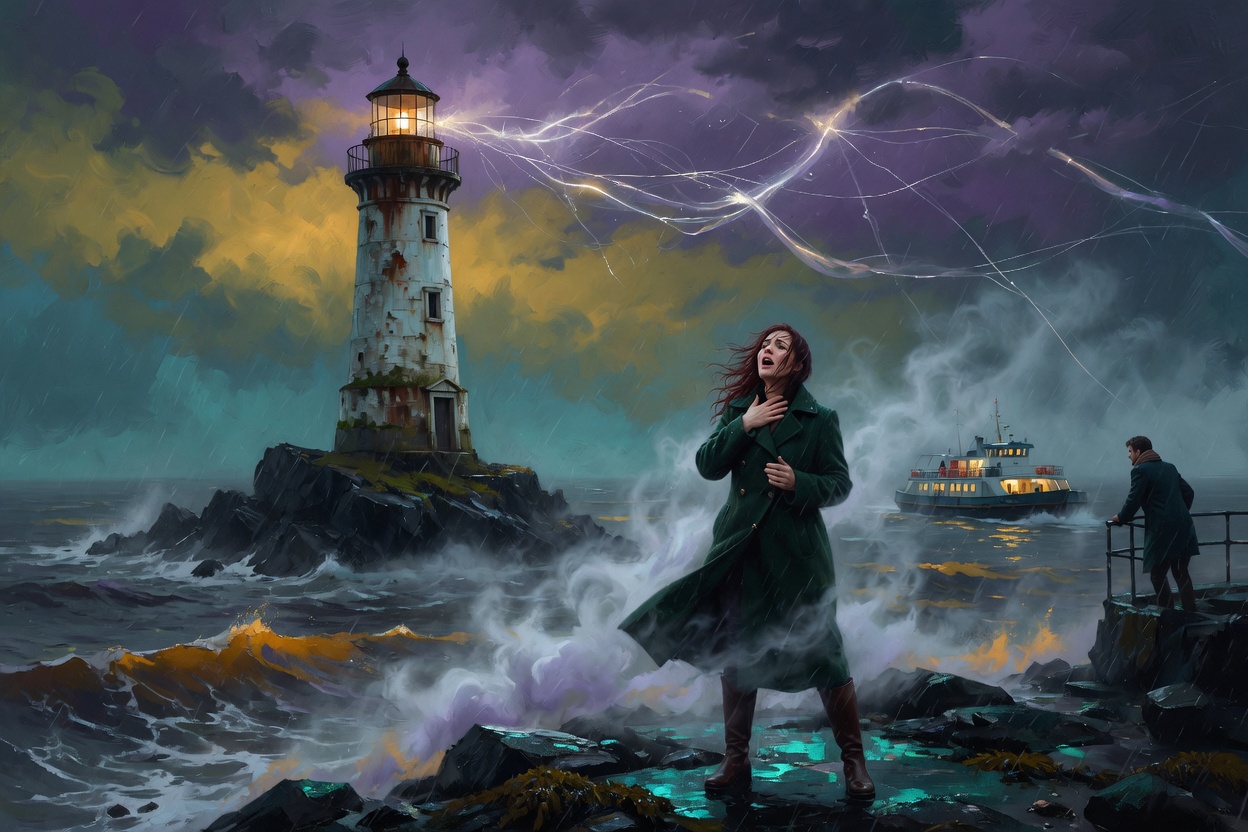
From above, the passenger would have looked like a dropped stitch, one dark figure alone on a boat built for forty. Mira Thane did not look from above. She looked from the rocks, boots planted on wet black stone, and she counted the ways this was going to be a problem.
Strangers came to Bellermoore perhaps once every three years. They came for the fishing, sometimes, or because their grandmothers had been born here, or because they were running from something and the mainland was not far enough. Those visitors stayed a night, said the word beautiful the way people said it about churches and war memorials, and left. But this man stood at the ferry rail for the whole crossing, and he was not looking at the water. He was looking at the lighthouse. Not the tower itself, she noted, with the irritation of a woman who had spent a decade learning to notice the wrong things, but the air around it. The way the sea mist bent above the rocks in a slow, rising spiral that no honest eye should have been able to see.
He could see it, then. That was worse.
She pulled her collar up and sang three low notes into her own chest, below the threshold of hearing, the private lullaby that told the wind to be gentle and the mist to behave. The spiral above the tower obediently flattened. The stranger's head turned sharply, like a man who had heard a door close in an empty house, and his gaze swept the rocks and found her. Even at that distance, across a half mile of grey water, the look landed on her skin like a struck match.
Mira did not wave. She did not turn away either, which she was proud of. She had learned to be proud of strange, small things. When you are the only person on an island who can sing a storm from the sky, and the cost of the singing is a memory you never get to choose, pride is one of the few belongings that does not wear out.
The ferry groaned into the harbour. The stranger came down the gangway with a canvas case slung across his back and a hard-paper tube under his arm, and the first thing out of his mouth was not hello.
'The mist bends here,' he said. 'Above the tower. It bends like it is being told to.'
'Welcome to Bellermoore,' Mira said. 'I'm afraid I don't make conversation with men who lead with observations they should not be able to make.'
'Callum Reyes.' He offered a hand, rain-wet and ink-stained at the nails. 'Cartographer. My client asked me to chart this coastline properly, and this coastline has been dodging maps for two hundred years.'
She did not take the hand. She looked at it, and at the tube under his arm, and at the way he tracked the mist with his eyes even while speaking to her, and every one of her quiet alarm bells rang at once.
'Dodging maps,' she repeated. 'That is a lovely way to put it. Some of us call that survival.'
His mouth curved, one side only. 'Survival. That is a lovely way to put pretending to be nowhere.'
'Supper is at seven in the harbour house,' she said, already turning away. 'There is one guest room. Do not sing, whistle, or hum after dark, and do not ask the fisherman Whitby anything about the tower. He will lie to you badly and then be embarrassed for a week.'
'And if I already know how to be quiet?' he called after her.
She stopped on the rocks. The wind caught her answer and nearly carried it off.
'Then you will be the first.'
II. A Map That Refuses to Be Finished
Callum Reyes had built his whole life out of unfinished lines.
There was the father who had left when Callum was nine and left behind, improbably, a love of pens. There was the Guild scholarship he had clawed out of a slum in Marrowfield by drawing city rooftops so precisely the Guild master had blinked and said, that is a lovely way to waste a boy's youth, and enrolled him anyway. There was the commission, folded in the tube under his arm, that paid a year's rent in advance and asked for exactly one thing: a complete survey of the Bellermoore littoral, including, in the Conservancy's careful phrase, any residual thaumaturgic features suitable for registration.
Suitable for registration. Callum had learned to read Guild language the way other men read weather. It meant: find the magic, fix it on paper, and paper is the first half of ownership.
He had told himself all the ordinary things on the way here. That the Conservancy was a charitable trust. That registering wild magic mostly protected it from worse hands. That a chart was only a chart, and he was only a man who was very good at making them. He had repeated these things across the harbour, over the fish smells and the screaming gulls, and they had sounded almost true until he saw the mist bend.
Now, standing in the harbour house with bread and smoked mackerel in front of him and the woman called Mira Thane pouring tea like a guard pouring poison, he listened to the second thing the Guild had told him about Bellermoore and wished he could unhear it.
There should be more than one of them, the old archivist had said. The songs need at least two voices or the singer bleeds her own memories out through the notes. Whoever is left there is singing alone. Find out if anyone is left.
'You are staring at my hands,' Mira said.
'I am,' Callum admitted, because lying to a woman like that felt like lying to weather. 'Your fingertips. They are scarred. Ritual scars run in the pattern of a laceration chord, third inversion. It is an old sea-magic notation. My grandmother sang dockside work songs, the small kind. She had the same scars.'
Something crossed her face, fast, like a bird over water. She put the teapot down with exaggerated care.
'Your grandmother,' she said, 'would know that the third inversion is not a work song. It is the last chord a singer uses when she wants the storm to forget her. It is what you sing so the sea does not come looking for what you took from it. And you would know that too, if she taught you anything at all, which means you came to my island knowing more than you are admitting, Mr. Reyes, and I would like to know why before I let you sleep under my roof another minute.'
The fire ticked. Outside, the first gust of the night's weather leaned on the windows.
Callum put his hands flat on the table. He had decided, somewhere between the ferry and the fish, not to show her the commission. He had not decided anything else, and this seemed as good a place as any to start being honest, in the smallest increments a man could manage.
'I know how to be quiet,' he said, 'because I grew up in a house where quiet was the only weather. I chart things, that is true. I came here to chart this coast, that is also true. The rest, you will have to trust me to tell you in pieces, because if I tell you all of it tonight, you will put me back on the ferry, and I do not think either of us wants to find out what I am lying about when I say that would be easy.'
It was a risk. He watched it land. Mira Thane was not a woman who blushed or gasped; her reactions happened in the hands, and he was learning, uncomfortably fast, to read her hands. Her fingers had gone still around the cup. Then she laughed, one dry, disbelieving note.
'In pieces,' she said. 'Fine. Pieces. One piece per day, Mr. Reyes, and on the day you run out of pieces, you had better have brought a truth worth the wait.'
III. Rules for Singing Weather
On the third morning she took him up the cliff path, which he understood to be a test, and on the fourth morning she took him into the tower, which he understood to be a much worse one.
'Rules first,' she said, in the round room at the tower's heart, where the walls were hung not with lamps but with dozens of small bells, each one silent, each one aimed at the sea. 'Rule one. Never sing in Bellermoore unless you are paying something. Rule two. Never sing alone unless the alternative is worse than the price. Rule three.' She hesitated, and her eyes went to the largest bell, which was green-black with salt and shaped like a clenched throat. 'Rule three is that you always finish the song. An unfinished storm-song is a debt with interest, and the sea keeps excellent accounts.'
'Who taught you the rules?' Callum asked.
'My brother.' She said it the way people say the names of places that no longer exist. 'There used to be two of us. Our mother made sure there were two, the way your Guild should have made sure there were two of me. Song needs company or the singer bleeds memory into the notes. You knew that already, though, did you not? You knew it on the ferry. I watched you hear the mist.' Her voice thinned. 'I watched you hear it and I could not decide, for three days, whether that made you the most dangerous thing to land here in thirty years or the most hopeful one.'
Callum stood very still in the belling room. He had been called many things in his life. Precise. Ambitious. A man to watch. Nobody had ever said hopeful, and nobody had ever said it in a voice like hers, low and furious and full of something she was clearly not willing to name.
'Which did you decide?' he asked.
'I have not,' she said. 'That is the trouble with you, Mr. Reyes. You keep arriving everywhere before I can finish deciding about you.'
She showed him the work then, because she needed the excuse to stop looking at him. Bellermoore's weather was not natural and never had been. A century and a half ago a shipping magnate had mined the island's reef for whatever dark purpose magnates had, and broken something, and ever since the sea threw storms at the coast like a dog throwing itself at a fence. The women of the Thane line, and the women before the Thane line, sang the fence back up. Not every storm. Only the ones that would otherwise reach the town.
'How often?' Callum asked. The ledger in his head, the part of him that the Guild had built and paid for, was already taking notes it would later charge him for.
'More every year,' she said. 'The reef degrades. The storms get worse. I sing a big one, I lose a day, sometimes a week. Memory, you understand. I sang the squall on the first of March and lost the name of my mother's favourite hymn. I have sung four this season.' She looked at him, at last, straight on, and it was like being charted himself. 'So yes. I noticed the mist bending for you. A man who can see magic with no training, standing in the one place in the world that is one bad winter away from having nobody left to sing for it. You see my problem with hope, Mr. Reyes. It has a shape, and its shape is a debt, and I have been paying debts alone for eleven years.'
Callum thought, with a clarity that felt like falling: tell her now. About the commission. About registration, about what a complete chart would mean, about the exact four words suitable for registration sitting in a tube in the harbour house.
He said: 'Show me the shape of a storm-song,' which was not a lie, only a cowardice with good posture.
IV. The Grammar of Longing
What no one warned Callum about slow ruin was that it comes with a schedule.
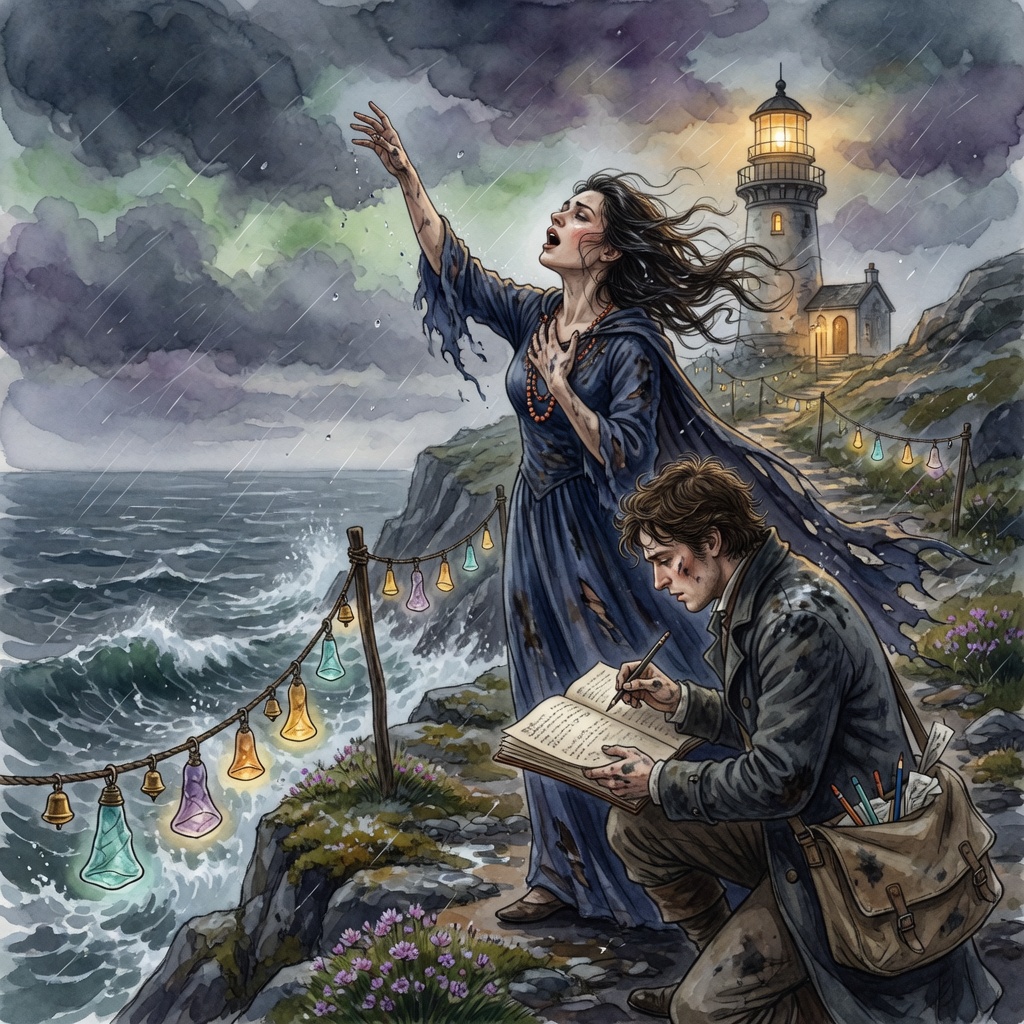
Mornings, they worked. She sang the small airs, the tidying songs that kept mist and gulls orderly, and he drew the result: pressure lines, current deflections, the astonishing geometry of weather deliberately bent. He had charted glaciers and volcano craters and one cursed river in the north that took two of his assistants and gave back one, and he had never in his life drawn anything as beautiful as a storm mid-conversation with Mira Thane.
That was the phrase his own mind used, mid-conversation, and he disliked his own mind very much for it.
Because it was true. She spoke to weather, and weather spoke back, and he stood at her shoulder with a pencil and caught the outlines of their words on paper. On the sixth day, a squall came up the shipping lane, minor, nothing the town needed to know about, and she turned to face it with her arms loose and her chin up, and the storm gathered itself in front of her like a horse resisting a bridle, and for eight seconds he forgot his own name.
Not the scars, this time. Her voice, even, unhurried, slightly tired, threading five notes through the rain like a hand through wet hair. Not power, exactly. Persuasion. An argument she had won so many times it had almost become a friendship, and the storm curving around her, and the sea going from slate to pewter to a soft defeated grey, and the exact sound she made at the end, one breath, quiet, the sound of a woman putting down something heavy and not daring to be glad about it.
He had the presence of mind to close his ledger before his hand drew her face from memory, which it wanted to do with frightening accuracy, and which would have been, he reasoned later, the first true confession of his entire visit.
Afternoons, they argued. She argued the way she sang, in chords. She would say one thing and mean three, and he would answer the one and miss the three, and she would get a particular flinty look that he was starting to catalogue the way other men catalogued gems.
'You flinch,' she said, on the ninth afternoon, over ink and biscuits, 'every time I mention the Guild. Your left hand goes to that tube. You hold it like a man carrying a confession in a paper wrap. So either you hate them or you owe them, and I have been trying for nine days to decide which lie I mind less.'
'Maybe it is neither,' Callum said.
'Maybe it is not,' she agreed, gracious as a knife, and passed him the ink, and their fingers overlapped on the bottle's neck for one second too long, and the harbour bells rang three o'clock in the most enormous interruption in the history of interruptions, and they both let go of the ink bottle like it had caught fire.
It was a grammar, that was the thing. He had studied six languages and invented notations for four of them, and he could say with professional authority that he and Mira Thane were developing one. Unfinished sentences as a tense. Prolonged glances as a mood. That evening on the gallery of the tower, watching a front come in from the west, she said, 'When my brother sang, storms used to go quiet for him before he even opened his mouth. I always thought the sea was showing off for him.' Pause. 'I do not mind that it shows off for you. When the mist bends. When I am not asking it to.' And then she went inside without waiting for a reply, because a reply would have been a fact, and facts about what they were becoming could still, at that point, be survived without.
He did not follow her. He wanted to. He wanted to follow her and take her face in his ink-stained hands and say every true thing at once, all of them, the whole inventory, the grandmother and the Guild and the tube of paper and the four words suitable for registration, and he stayed on the gallery in the wind like a man standing in front of a closed door with his hand raised and no knock in him.
Midnight, he told himself. He would tell her everything at midnight.
At midnight, the sea sent the worst storm of the season.
V. The Almost
It started with the bells.
All of them, every bell in the round room, shivered once, though nothing had touched them, and Mira was up the stairs before Callum had finished sitting up, and her voice came down the dark stairwell with a command in it he had never heard from her in daylight: 'The east gallery. Stay where I can see you and do not come past the line of bells. Do you hear me? Do not come past the bells, whatever you see, whoever you see me become out there.'
He did not ask what she meant by become. He was too busy being afraid, and being afraid of a new thing, which was the anger, the cold yellow anger, at the sea itself, at this weather, at the whole cursed coast that required her to stand on a cliff and bleed memories into the sky every time the water was in a mood.
From the gallery he watched her take the storm apart. That was the only honest verb. It was a full spring gale, forty-foot seas, the kind of blow that had wrecked the Aldering Queen and ninety souls in 1874, and she stood on the south point with her hair tearing loose and she unpicked it. He could see the song now, actually see it, a braid of pale lines in the dark air, and he could see the cost too, because at intervals like a cough she would stagger a half step and press her palm to her temple, and each time she did, Callum understood, a memory went out of her. Out of her, into the ledger of the sea, gone.
He charted. It was the only thing his hands knew how to do in an emergency. He drew the braid's geometry as fast as his pencil could travel, a notation no Guild archivist had ever published because no Guild archivist had ever been allowed to see it, and he drew her position, and then, in the margin, because he was weak and it was two in the morning and he had stopped pretending to himself for exactly one line, he drew her stance, the arm raised like a conductor, and under it, small enough that only a cartographer would ever find it, he wrote her name.
Then the storm did the thing storms did to singers, the thing she had called rule three with a face like a closed door.
It broke the song.
The braid of light split at its third chord. Callum saw the break happen and saw her reach for it and saw her reach fail, saw the storm rear back up from its own ruins like something with a spine, and then he was running, past the bells, past the line she had forbidden, down the stair and out the sea door with no lantern and no plan, because whatever rule she had made about who he was allowed to watch her be, there was a better rule, and the better rule was that she did not die alone on that point with a debt to the sea going unpaid on her side of it.
The rain was horizontal and the wind tried to take his ribs apart. He got to her. She was on one knee, both hands pressed to the rock, singing at a volume no human voice should own, the chord that she had once told him was not a work song, and he dropped beside her, and there was no time for permission in words so he gave it the only way the gale would carry: he put his mouth beside her ear and he sang, off key, toneless, tuneless, terrible, the third inversion exactly as her mouth shaped it, a harmony so bad it could barely be called sound, and the storm checked. Just for one beat, one bar. A pause like a held breath.
Long enough. She finished it. The sky, insulted, emptied itself and moved on out to sea like a debtor crossing the street.
Then it was quiet, and they were both on their knees on black rock, and her hand found his wrist, grip ferocious, anchoring, and her forehead came down against his shoulder, and the only sounds left in the world were the retreating sea and her breathing.
'You sang with me,' she said into his coat. 'You can see, and you can carry, and you can be called, and no one is called.' She pulled back and looked at him and there was lightning afterlight in her face. 'Who are you? What are you? Do not give me a piece, Callum. Give me the whole truth, now, or I will spend the rest of my life deciding about you and never deciding.'
And he opened his mouth. The whole truth, the grandmother, the Guild, the tube, the four words, all of it was right there at his teeth, and her hand was still on his wrist and her eyes were asking, and he got as far as 'Mira, I came here to' before the sea answered.
Not with weather. With a sound. A vast, subterranean groan from the reef, the old broken thing beneath the bay grumbling in its sleep, a sound she flinched from the way other people flinched from their own names called suddenly. Her face shut like a drawer. Whatever name the reef had just reminded her she had paid, she went to collect her composure, and by the time she had it back, the window of the whole truth had closed.
'Tomorrow,' she said. 'Tell me tomorrow. Weather is done for tonight. I have paid enough for tonight.'
Tomorrow, he promised himself on the walk back, was a promise the universe had never once honoured, and he heard the words of that promise in his own voice even now, walking alone in the wet dark. He had almost said it. She had almost heard it. The tide was going out and the reefs were grumbling and somewhere behind him, in the tower, the woman he was catastrophically in love with was probably losing, right now, this very minute, a memory to the ledger, and his tube of paper lay in the harbour house like a loaded gun on a clean table.
Tomorrow, he told the sea. And the sea, being the sea, said nothing.
VI. What the Commission Said
From above, at noon, the passenger would have looked like a man reading his own death warrant. Mira Thane did not look from above. She looked from the boat shed, where she had gone to find him and to say her own piece, the one she had finally finished deciding about, and instead she stood in the lee of the doorway and watched him unroll the paper from the tube she had been trying not to think about for eleven days.
She had trained herself out of eavesdropping on humans. Weather was more articulate. But the wind was kind that noon, or cruel, and it carried his voice off the paper to her in fragments.
'...complete survey of the Bellermoore littoral... including any residual thaumaturgic features suitable for registration... registration confers custodianship of the recorded phenomenon upon the Conservancy, subject to evacuation and resettlement of current inhabitants where custodianship requires...' and then, in his own handwriting, in his own voice, reading what he had added himself: 'Note. The singer is one woman. Population one. Recommend the feature be registered as extinct to protect...' and the wind, perversely, took the rest.
Extinct. Evacuation. Suitable for registration. The Conservancy, which she had never heard of, and paper, which she had always known was the first half of ownership. Mira Thane stood in the boat shed doorway with her heart doing something enormous and slow in her chest, and understood three things at once, in the way she understood weather.
First: he had lied to her since the ferry. Second: he had also, reading it now aloud to himself, editing it, added a word of protection for her, the word extinct, a lie inserted into an official document to make her vanish from the ledgers. Third, and this one arrived like a tide, inescapable, warm: he was standing on a rock in broad daylight reading a betrayal out loud and revising it in her favour, which meant that somewhere in the last eleven days the betrayal had stopped being possible for him, and he had not known it until he heard the words in his own voice.
It would have been wise to wait. She had a gift for waiting; it was half her profession. Instead she walked out onto the rocks, and he looked up, and the paper sat between them like a gull on a corpse, and every unfinished sentence they had ever accumulated hung in the bright cold air with nothing left to do but finish.
'Say it to me,' she said. 'Not to the wind. To me. What did they send you to do?'
'Chart the magic,' he said. His voice did not waver, which she respected, and did not step back, which she did not expect. 'And registration means custody. Custody of you, Mira, recorded, classified, owned. I did not know what registration meant until the fourth day, and by the fourth day...' He stopped. Her hands were waiting. She watched them. 'By the fourth day I was keeping the ledger of you instead,' he said. 'And I have been trying to find the version of this where I keep the commission and keep you, and there is no such version, and last night on that rock, with you bleeding memory into a gale, I understood that the commission and I are the same thing. We both arrived here to turn you into paper. So I am going to do the only thing a cartographer can do about a map he will not finish.' He turned the document over. He took the little knife he used for trimming quills. 'I am going to render it unsuitable.'
'No,' Mira said.
He paused, knife at the paper. 'No?'
'Not like that.' She came closer, boots wet, hands open. 'Burning it is one afternoon's bravery, Callum Reyes. They will send another. There is always another man with a tube under his arm. Listen to me.' She stood in front of him close enough that he had to tilt his chin up, and it occurred to her with a fierce, inconvenient joy that she had never in her life been this close to anyone she was not about to sing for. 'The sea does not accept burned paper. It accepts payment. So here is what I want instead. I want you to chart the true map. The one with the mist, and the braid, and the singer. All of it. Give the Conservancy exactly what they asked for, gorgeous and complete and entirely legible, and let them read what it says when they finally do. Let them see the cost. Let them see the memory ledger. Let the first thing they meet in their own paperwork be the arithmetic of what their custody would have cost them, a woman paying a decade of herself into the water. Paper cuts both ways, cartographer. Write them the truth and let it be a weapon. And you will stand with me when they come, because you sang a bar of the third inversion on the point at two in the morning, badly, wonderfully badly, and the sea heard you, and Bellermoore heard you, and I heard you, and all three of us are no longer taking applications for anyone who can carry.'
The knife hung in his hand. The paper flapped. Somewhere out on the water the ferry gulls wheeled and screamed about nothing, as gulls did.
'You are asking me,' Callum said slowly, 'to become the map.'
'I am asking you to stay,' Mira said, and heard, too late, everything she had just said out loud, every unfenced word of it, and did not take one syllable back.
He put the knife down on the rock. Deliberately, with ceremony, the way her mother had laid tools on the altar before a big singing. Then he reached past her, for the tube, and pulled out the commission, and tore it, once, clean across, not in fury but in the manner of a man cutting a mooring line he no longer needed, and he said, 'There is the easy half. The true map will take years. I will need to be paid. I accept room, board, and' and here his voice, which had held so well, finally gave at one edge, 'and the grammar. We have a grammar, Mira. I would like to be fluent in it before I die. I would like to be fluent in it for a long time before I die.'
'That,' said Mira Thane, who had sung down a spring gale alone the night before, 'is the worst confession I have ever heard in my life.'
'I know.'
'It will have to do,' she said, 'for now,' and the for now was a door opening, and they both stood in its draft and let it.
VII. The First Lesson
That was not the kiss. He thought, later, that it was; that the rocks at noon had been the moment, and everything after was denouement. He was wrong, because Mira Thane did nothing without rules, and rule four, unwritten until that evening, was this: a first kiss, like a first storm, is not weather you take. It is weather you are given.
Two nights later she came up the tower stair with two cups of tea and a look he had begun to keep an atlas of.
'My brother,' she said, without sitting, 'used to sing duets with the gulls for fun. Whole evenings. Mother said he had the gift of carrying, same as you. When the reef broke and the storms came, we were meant to sing together, and I could always hear him under me, this second voice, this floor under my feet, and then one night he went out to a squall alone because I had a fever, and he finished the song, and the song took him.' Her voice was level. Her hands were not; she folded them around the tea like a prisoner folding a door. 'He finished it. That is rule three. He finished it and it took him out on the water and they never found a boat, only his coat. I have been singing alone for eleven years because the sea heard two voices here once and it liked it too much. It hunts choruses. You sang with me anyway, at two in the morning, when I was on my knees. It could have taken you. Do you understand what you did? Do you understand what I have been not saying to you since?'
'I think so,' Callum said. It was the honest total of his understanding, and she did not correct it.
'Teach me your notation,' she said. 'The one you write in margins. Your grandmother's dockside songs. Not to fight weather. To carry it. Two voices, Mr. Reyes, properly trained, is the thing this island has been starving for. One more singer and I stop bleeding memory every gale. Two singers and the storms get bored of us and take their business elsewhere. It is arithmetic. You like arithmetic.' She set her tea down. 'But first, before the arithmetic. Because you will be one more voice on this cliff, and the sea will hear you, and begin, slowly, to learn you, and I will not teach you into that without saying the thing that makes it worth the danger. So. The thing is this.' A breath. The gulls, mercifully, were elsewhere. 'I have watched you for fourteen days the way I watch the shipping lanes. Every morning.First thought. I did not decide about you, Callum. I decided for you. Weeks ago. And I have been singing it to myself very quietly, like rule three, because saying it out loud made it a fact, and facts about you were the only facts I was not ready to lose to the sea.'
There was a silence in the round room such as the island had not heard in eleven years. All the bells hung still.
'I am twenty-nine years old,' Callum said at last, 'and I have charted four continents and I cannot read the room I am standing in. Are you. Mira. Are you saying that you...'
'Yes,' she said.
'Because if I have misread the grammar I will take myself to the mainland and never' 'You have not misread the grammar,' she said, one degree of exasperation in it, the degree that meant she was smiling without permission, and then he closed the distance, and the last foot of it he took slowly, visibly, a hand rising to ask the question his voice had been too stupid to finish, and her hand came up to answer, fingers closing over his wrist where he had held her in the storm, and that was the permission, asked and granted, written in the body's own clean language, and he kissed her.
It was not a storm. He would want to say it was a storm, because he was a romantic and had earned a little romance. But the truth was better and stranger: it was a lull. The specific, sacred lull in the eye of weather, the held breath between two halves of a gale, the island's own signature move, and he understood with something close to vertigo that she had chosen this on purpose, that she had, all her life, been saving this one quiet for a person and a moment and a tide, and had spent it now, here, on a man who made maps and smelled of ink and sang like a dropped hammer.
When they broke apart, the tea was cold and neither of them had noticed, and the mist above the tower was bending, gently, warmly, entirely without instruction, and Mira looked at it and laughed, an unguarded sound, twice, which she later claimed under oath had never happened before in her adult life.
'It shows off for you,' she said. 'I told you I did not mind. I lied. I mind beautifully. I have minded for fourteen days.'
'Compose yourself, Miss Thane,' said Callum Reyes, and his voice cracked like a boy's, and he did not care. 'We have work. The sea does not respect declarations.'

VIII. The Second Voice
They trained all that year, which is to say they fought.
Not each other, mostly. The coast. His grandmother's dockside songs turned out to be a dead dialect of the reef chord, and resurrecting them took winters of wrong notes. She was exact and he was associative and there was a memorable March evening involving a minor squall, a miscounted bar, and both of them absolutely soaked on the south point, laughing like lunatics while the rain bounced off the rock around them, which was the night the sea, veteran of ten thousand patience tests, finally decided these two were more trouble than the hunting of them was worth.
The arithmetic held. Her memory losses shortened from weeks to days, and then to a single grey hour after a big blow, the way a fever shortens when the body is no longer fighting alone. Things came back. She had, she told him one April dawn, remembered her mother's hymn.
'Which one?' Callum asked, pencil already moving.
'You are not charting my mother's hymn,' she said, and was smiling, and she sang it anyway, and he did not write down one note of it, and she knew, and it mattered.
The Conservancy came in the autumn, two grey men and a greyer woman with a portable drafting case and the bland invulnerability of people who have never been rained on meaningfully. Callum met them at the harbour with the true map. It was, by his own professional admission, the finest work of his career: the braid notation, the memory ledger, the reef wound mapped vein by vein, and a survey line reading, in his cleanest copperplate hand, Remnant population: two. Custodianship arithmetic: replacement cost per registered custodian, one lifetime, payable in advance. The grey woman read it twice and wrote a great deal in her own notebook and thanked him in a voice like a receipt.
'They will be back,' Mira said, on the cliff, watching the ferry go.
'Of course they will,' Callum said. 'There is always another man with a tube under his arm. But this is the beautiful thing about the truth, Mira. It reads as arrogance and it funds as scandal and it breeds as folklore, and by next spring, thanks to the folklore, half the sailing world will believe Bellermoore is sung by a witch and a thief who stole a storm's heart, which will be, let the record show, approximately correct, and nobody in the whole credulous maritime world will want to register a place with our reputation for exact prices.'
'Stole a storm's heart,' Mira repeated. 'I am putting that in the tower ledger. Under this date. Witnessed.'
'By whom?'
'The sea,' she said. 'It keeps excellent accounts.'
IX. The Ledger
Two years on, the harbour house had a second desk. Visitors rare enough to count on the chart itself reported that the island now bent its mist for exactly two strangers in all the world, that storms approaching Bellermoore were observed to slow and circle like dogs presented with a fence they had decided, on reflection, to respect, and that on fine evenings a duet could be heard from the point, one voice bright and exacting, one low and off-key and getting, they said, unmistakably, infuriatingly, better.
In the tower ledger, in two hands now, in the grammar they had built out of unfinished sentences and finished ones, entries accumulated. Storm sung. Cost: two hours, shared. Memory spent: none. Debt carried: none. And at the bottom of the year's page, small enough that only a cartographer would ever find it, the entry Mira Thane wrote in March and let him find on purpose, because rule five, the last one, unwritten, was that a love like theirs was to be recorded like everything else on the coast. Paid in full. Witnessed by the sea. Renewed, God and the reef willing, annually.
Beneath it, in ink the colour of a charted braid, a second line in a worse hand: She said yes first. Map continues.
From above, the two of them on the point would have looked like a single inked stroke, one line drawn true across the last blank place on the chart. They did not look from above. They looked at each other, which was, by then, the only cartography either of them practiced professionally, and the storm overhead, an old customer, old friend, bent its mist, unasked, and settled in to listen.
Cade Ellison
Cade specializes in romantasy and paranormal romance: magic systems with rules, courts with knives, and longing that rearranges destinies.
Leave a comment
Comments